OpenAI Frontier vs Microsoft Agent 365 vs Agentforce
Turn this article into takeaways for your work.


Each assistant summarizes the article only for you and suggests best practices for your work.
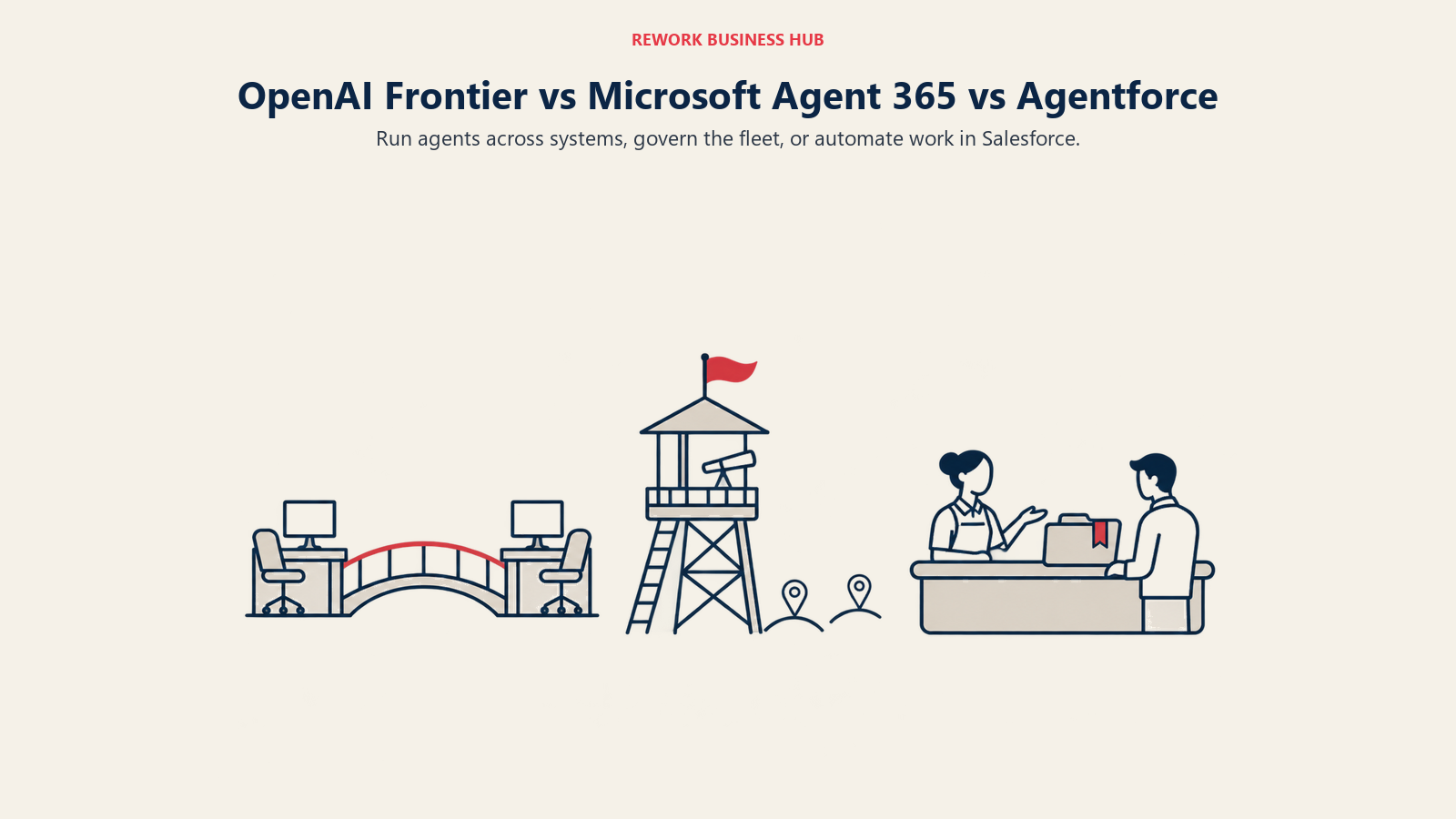
If you're searching for "OpenAI Frontier vs Agent 365 vs Agentforce", you probably have a shortlist that looks like a three-way race. It isn't quite one. The three products get lumped together in analyst notes and vendor keynotes because all three promise to help a large company run AI agents safely, but they sit at different layers of the stack. One is built to create and run agents that work across your systems. One is built to see and control agents, no matter who made them. One is built to put agents to work on top of a CRM.
That distinction matters more than any feature grid, because it changes what you're actually buying. Choose the wrong layer and you can end up paying for governance when you needed a builder, or building agents with nothing to keep them in check.
This guide is written for the CIO, CTO, COO or head of AI who has to sponsor one of these and explain the choice to a board or a security committee. It covers what each product is, how it's priced, how it handles identity and control, how well it plays with the other two, and when each is plainly the right call. It's deliberately different from our Agentforce vs Copilot Studio comparison, which pits two builders against each other on grounding and credit math. This one asks a broader question: which layer do you need, and who should own it?
TL;DR
| OpenAI Frontier | Microsoft Agent 365 | Salesforce Agentforce | |
|---|---|---|---|
| Layer | Build, run and improve agents across enterprise systems | Observe, govern and secure agents | Build and run agents on Salesforce and connected data |
| Vendor's own pitch | A platform to build, deploy and manage agents that "can do real work" | A control plane to observe, secure and govern agents | An AI agent platform for autonomous support and CRM-native work |
| Launched | February 5, 2026 | Generally available May 1, 2026 | Agentforce 3 announced in 2025 |
| Published price | Pricing on request | $15.00 per user per month, billed yearly | Flex Credits from $500 per 100,000; per-user options from $5 |
| Availability | Limited set of customers per OpenAI, broader access planned | Generally available for the Commercial segment | Salesforce Foundations is $0 to start |
| Best for | Cross-system agents with hands-on vendor help | Microsoft shops that need one governance view | Salesforce shops automating records-based work |
| Main caution | No public price or self-serve path | It governs agents, it doesn't build them | Value depends on how much of your data lives in Salesforce |
Key Facts
- OpenAI launched Frontier on February 5, 2026 as a platform for enterprises to build, deploy and manage AI agents. The page says it's available to a limited set of customers, with broader availability planned over the following months, and it doesn't mention pricing.
- Microsoft says Agent 365 reached general availability on May 1, 2026 for the Commercial segment, licensed per user.
- Microsoft lists Agent 365 at $15.00 per user per month and Microsoft 365 E7 at $99.00 per user per month, both billed yearly with an annual commitment. E7 includes Agent 365.
- Salesforce's Agentforce pricing page lists Flex Credits at $500 per 100,000 credits, a standard action at 20 credits (about $0.10), and Conversations at $2 per conversation.
- Salesforce says over 18,000 companies run on Agentforce. That's the vendor's figure.
- Microsoft's licensing FAQ states that agents don't require their own Agent 365 licenses, because one per-user license covers the agents tied to that user.
The Three Are Not Interchangeable
Most comparison pages treat these as three answers to the same question. They're better read as answers to three different questions.
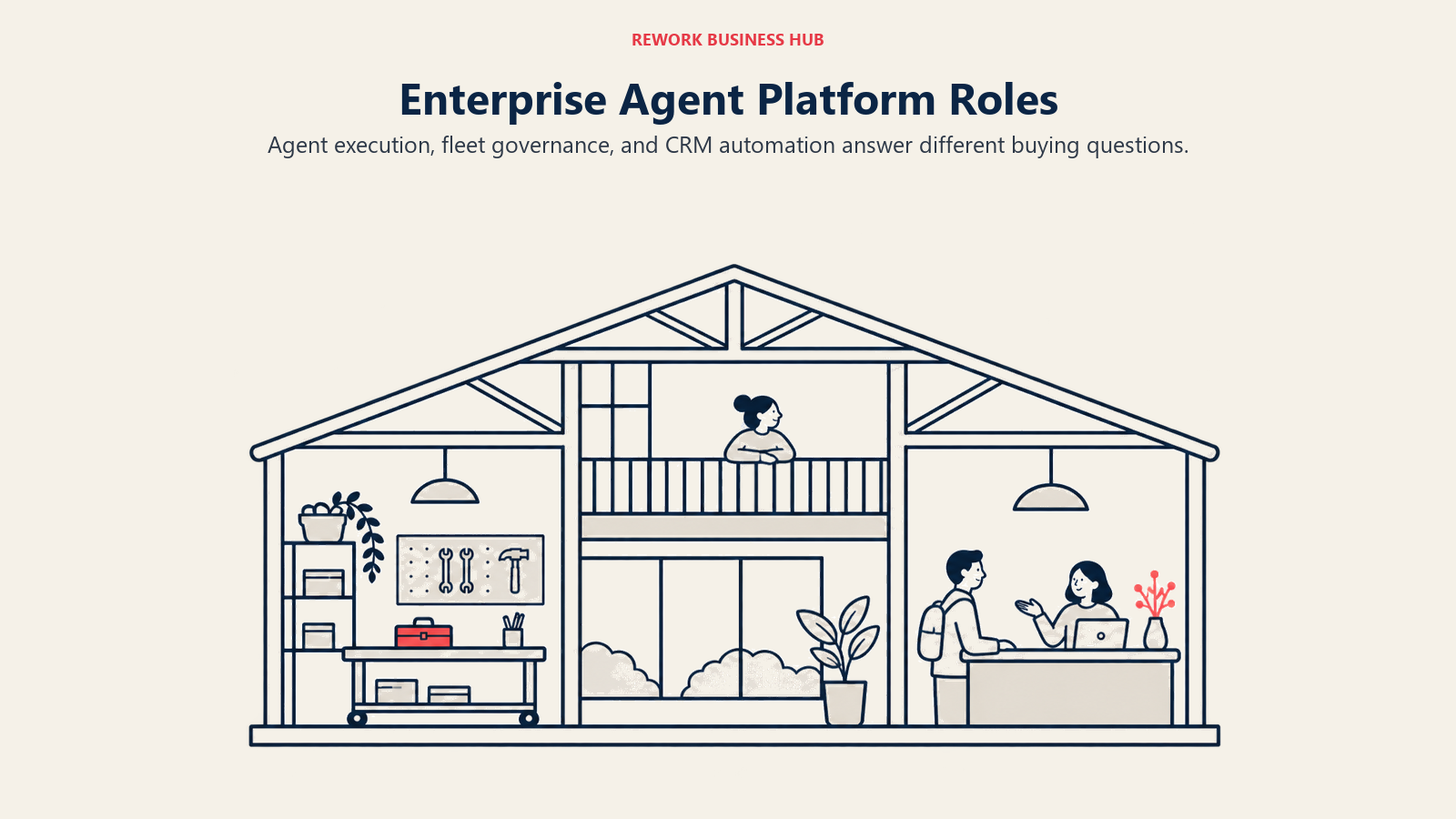
Frontier answers: how do we get agents to do real work across our CRM, data warehouse, ticketing tools and internal apps, with shared context and an engineer from the vendor beside us? OpenAI's launch page describes a shared business-context layer, an agent execution environment, evaluation tools, and per-agent identity and permissions, plus forward deployed engineers who work alongside customer teams.
Agent 365 answers: now that agents are multiplying inside the company, who's keeping a registry, who has access to what, and how do we catch a risky one? Microsoft's overview frames it around three verbs: observe, govern and secure. It extends Entra, Purview and Defender controls to agents.
Agentforce answers: how do we put an agent on a case, lead or opportunity inside the system where reps and service staff already work? Salesforce positions it as an AI agent platform that reasons over CRM data and Data 360, with a low-code builder, voice, observability and multi-agent orchestration.
| Question you're asking | Closest fit |
|---|---|
| "Build agents that span many systems with an engineering partner" | Frontier |
| "Inventory, secure and audit every agent in the company" | Agent 365 |
| "Automate support, sales or service work on Salesforce records" | Agentforce |
| "Govern agents built on someone else's platform" | Agent 365 |
| "Get started free and test a builder this week" | Agentforce (Foundations) |
| "Understand price before a sales call" | Agent 365 or Agentforce |
That table already tells you why many large companies will end up owning more than one. A company could run Agentforce for customer service, build cross-system agents on Frontier, and govern all of it through Agent 365. Whether that stack is practical is a question this article returns to, because Microsoft and Salesforce both claim openness, but neither page promises the others are governed automatically.
What Each Product Actually Is
OpenAI Frontier
OpenAI describes Frontier as a platform that gives agents what people get at work: onboarding, shared context, feedback and permissions. Its page lists these components:
| Component | What OpenAI says it does |
|---|---|
| Business context | Connects data warehouses, CRM systems, ticketing tools and internal apps into a shared semantic layer |
| Agent execution | An environment where agents reason over data, work with files, run code and use tools; agents also build memories from past interactions |
| Model access | Low-latency access to OpenAI's models for time-sensitive work |
| Evaluation and optimization | Tools that show managers and agents what works so behavior improves |
| Identity, permissions and boundaries | Each agent has its own identity, explicit permissions and guardrails |
| Open standards | Works with existing systems and clouds, with no replatforming |
| Forward deployed engineers | OpenAI staff who work alongside customer teams |
The go-to-market is as notable as the product. OpenAI says Frontier is open to agents built by OpenAI, by the enterprise itself, and by third parties, and it names launch partners Abridge, Clay, Ambience, Decagon, Harvey and Sierra. Later in February, The Register reported that Accenture, Boston Consulting Group, Capgemini and McKinsey were the first four members of a Frontier Alliance, each building a dedicated team to sell and install it. The same report listed HP, Intuit, Oracle, State Farm and Uber among early users, with Cisco and T-Mobile piloting.
So Frontier today is a sold-and-deployed program, not a product you trial on a Friday afternoon. That's neither a flaw nor a virtue. It matches a buyer who expects a transformation project, and it mismatches one who wants a pilot by next week.
If you want to see how the partner names fit into the broader agent market, our Fin vs Sierra, Decagon vs Parloa and Abridge vs Ambience comparisons cover three of the vendors OpenAI lists.
Microsoft Agent 365
Agent 365 is not an agent builder. Microsoft describes it as a control plane. Its capabilities, per the product page and Microsoft Learn:
| Pillar | What it includes |
|---|---|
| Observe | A registry of agents from Microsoft platforms, ecosystem partners and manual registration; an agent map; analytics on performance, quality and business impact |
| Govern | IT-controlled onboarding workflows, security policy templates, lifecycle rules such as expiring inactive agents or flagging ownerless ones, audit and logging |
| Secure | Conditional access and traffic filtering extended to agents, data security against oversharing, threat protection through Defender |
| Administration | Defender, Entra, Purview and Microsoft 365 admins each own a slice (security posture, agent identity, data governance, inventory) |
It also works with agents from outside Microsoft. Microsoft Learn says Agent 365 can make agents built on Google Vertex AI or Amazon Bedrock visible in the Microsoft 365 admin center, and lists partner agents and "agent factories" such as Kore, n8n and Kasisto that get a governed Entra Agent ID when they integrate. Microsoft's page says agents published through Microsoft 365 channels with an Entra Agent ID appear in the inventory automatically, while agents built elsewhere need additional steps.
That "additional steps" caveat is the one to test in a proof of concept. A registry is only as good as the agents that actually show up in it.
Salesforce Agentforce
Salesforce's page lists Atlas Reasoning Engine, Data 360, Agent Builder, Agent Development Lifecycle, Agent Script, Agentforce Voice, Agentforce Observability, MCP support and multi-agent orchestration. Agentforce 3, announced in 2025, added a native MCP client, a Command Center for observability, and an AgentExchange marketplace with services from over 30 partners.
There was also an ownership change in September. Salesforce completed its acquisition of Fin on September 10, 2026. Salesforce describes Fin as formerly Intercom. Salesforce says Fin will sit alongside Agentforce and operate within Salesforce AI Labs, which matters because it widens what "Salesforce agents" means for customer service. For a direct comparison of Fin with another vendor, see Fin vs Sierra.
Pricing: Three Different Meters
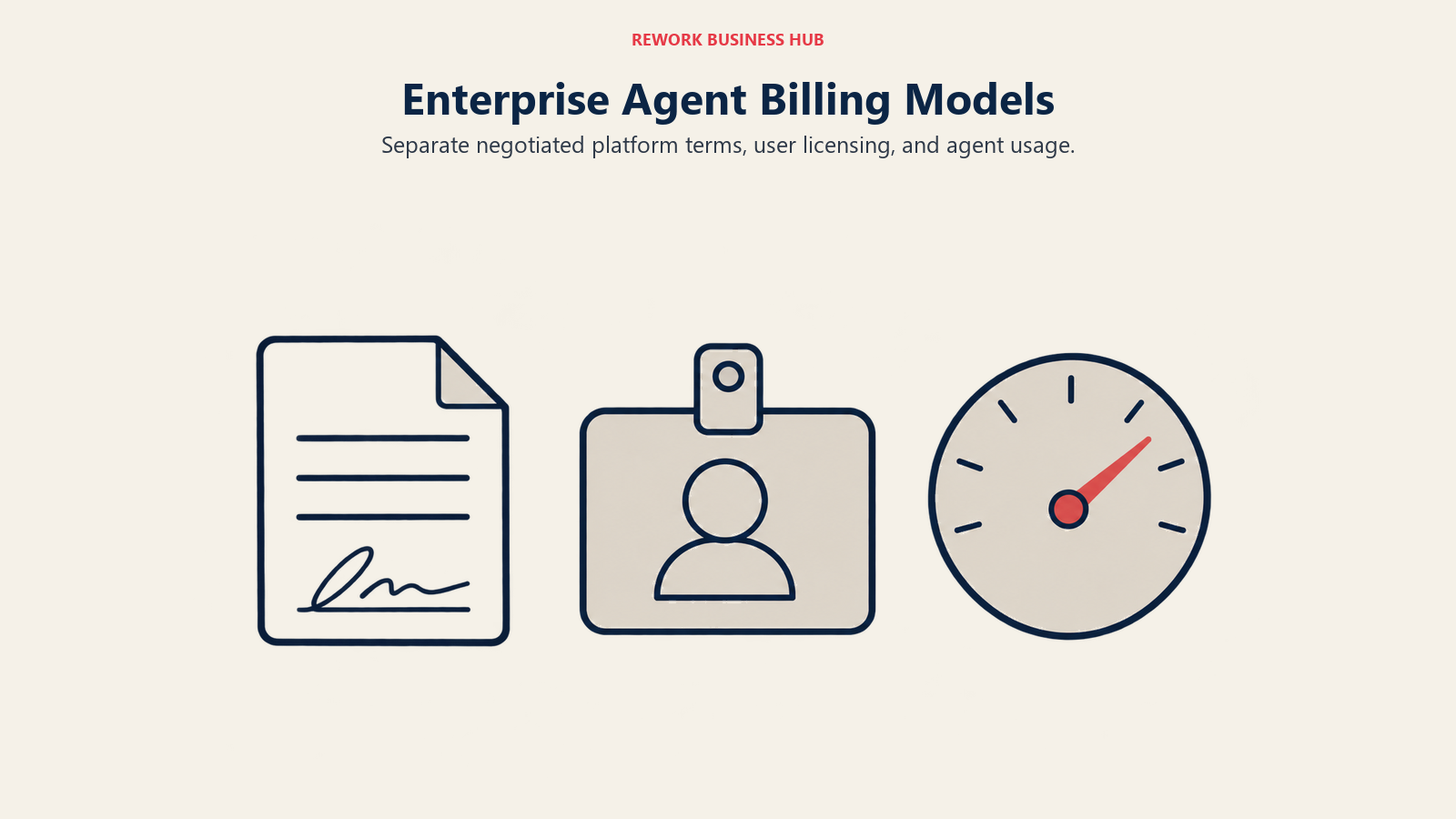
Pricing is where the layer difference becomes concrete. One vendor charges per user for governance, one charges per credit or per conversation for usage, and one publishes nothing.
| OpenAI Frontier | Microsoft Agent 365 | Salesforce Agentforce | |
|---|---|---|---|
| Billing unit | Not published | Per user | Credits, conversations or per user |
| Headline price | Pricing on request | $15.00 per user per month, billed yearly | Flex Credits $500 per 100,000 credits |
| Bundle | Not published | Microsoft 365 E7, $99.00 per user per month billed yearly ($90.45 without Teams) | Max Edition from $550 per user per month |
| Free entry | None listed | None listed | Salesforce Foundations, $0 |
| Commitment | Not published | Annual | Pre-Purchase, Pre-Commit or PayGo |
Agent 365 licensing
Agent 365 is $15.00 per user per month on Microsoft's page, with an annual commitment. The licensing FAQ says users who delegate their access to agents must be licensed, as must the owner, sponsor or manager of an agent with its own access. Agents themselves don't need licenses, and the FAQ says there are no consumption-based costs for Agent 365 at this time. Agent 365 isn't part of Microsoft 365 E3 or E5.
Eligibility is the detail to check early. Microsoft Learn says Agent 365 works best with Microsoft E5 as a prerequisite, and the licensing FAQ ties enterprise eligibility to E5 or to the Defender and Purview suites. Confirm which of your users qualify before building a budget.
Microsoft's March announcement also introduced Microsoft 365 E7, the "Frontier Suite", priced at $99 per user per month at retail. It bundles Microsoft 365 Copilot, Agent 365, Microsoft Entra Suite and Microsoft 365 E5. Note the naming: Microsoft's "Frontier" program and suite have nothing to do with OpenAI Frontier, a coincidence that causes real confusion in vendor meetings.
Agentforce pricing
Salesforce's page lays out the most options:
| Option | Price listed | Notes |
|---|---|---|
| Salesforce Foundations | $0 | Includes Agentforce Builder, Prompt Builder, Agent Script, Agentforce Coworker and Agentforce Vibes |
| Flex Credits | $500 per 100,000 credits | Standard action is 20 credits (about $0.10); Agentforce Voice action is 30 credits (about $0.15) |
| Conversations | $2 per conversation | Cannot be used in the same org as Flex Credits |
| Help Agent Resolutions | $2 | Listed in USD only |
| Agentforce add-ons (Sales, Service, Field Service and Operations) | $125 per user per month | Unmetered employee usage |
| Agentforce Industries add-ons | $150 per user per month | Unmetered employee usage |
| Max Edition | From $550 per user per month | Includes the Agentforce add-on and 2.75 million Flex Credits per org per year |
| Agentforce User License | $5 per user per month | Requires Flex Credits |
| Agentforce Coworker User License | $50 per user per month | Includes Coworker searches and 30 MB of indexing per user per month |
The buying models matter as much as the rates. Pre-Purchase means paying upfront for usage over the contract term. Pre-Commit commits to a baseline with no upfront payment, billed monthly in arrears with a true-up at term end, and Salesforce says it will be widely available later this year. PayGo has no upfront commitment. Salesforce states there's no overage penalty, that unused Flex Credits don't roll over, and that Conversation pricing, add-ons and Editions aren't available under every buying model. The page also says it's provided for information and is subject to change, so ask for the Agentforce Rate Card.
If you're pricing Agentforce against its alternatives, best Agentforce alternatives covers cheaper and lighter routes.
Frontier pricing
OpenAI doesn't publish Frontier pricing. Treat it as Pricing on request, and expect it to be negotiated alongside services, because forward deployed engineers and consulting partners are part of how the product is delivered. When you ask for a quote, ask what's platform, what's model usage, and what's services.
| Budget question | Frontier | Agent 365 | Agentforce |
|---|---|---|---|
| Can I put a unit price in a memo today? | No | Yes | Yes |
| Does cost grow with agents deployed? | Ask OpenAI | No, it grows with licensed users | Yes, with usage on credit and conversation models |
| Does cost grow with users? | Ask OpenAI | Yes | Yes on per-user options |
| Are services part of the price? | Ask OpenAI | No | Depends on your Salesforce partner |
Governance, Identity and Security
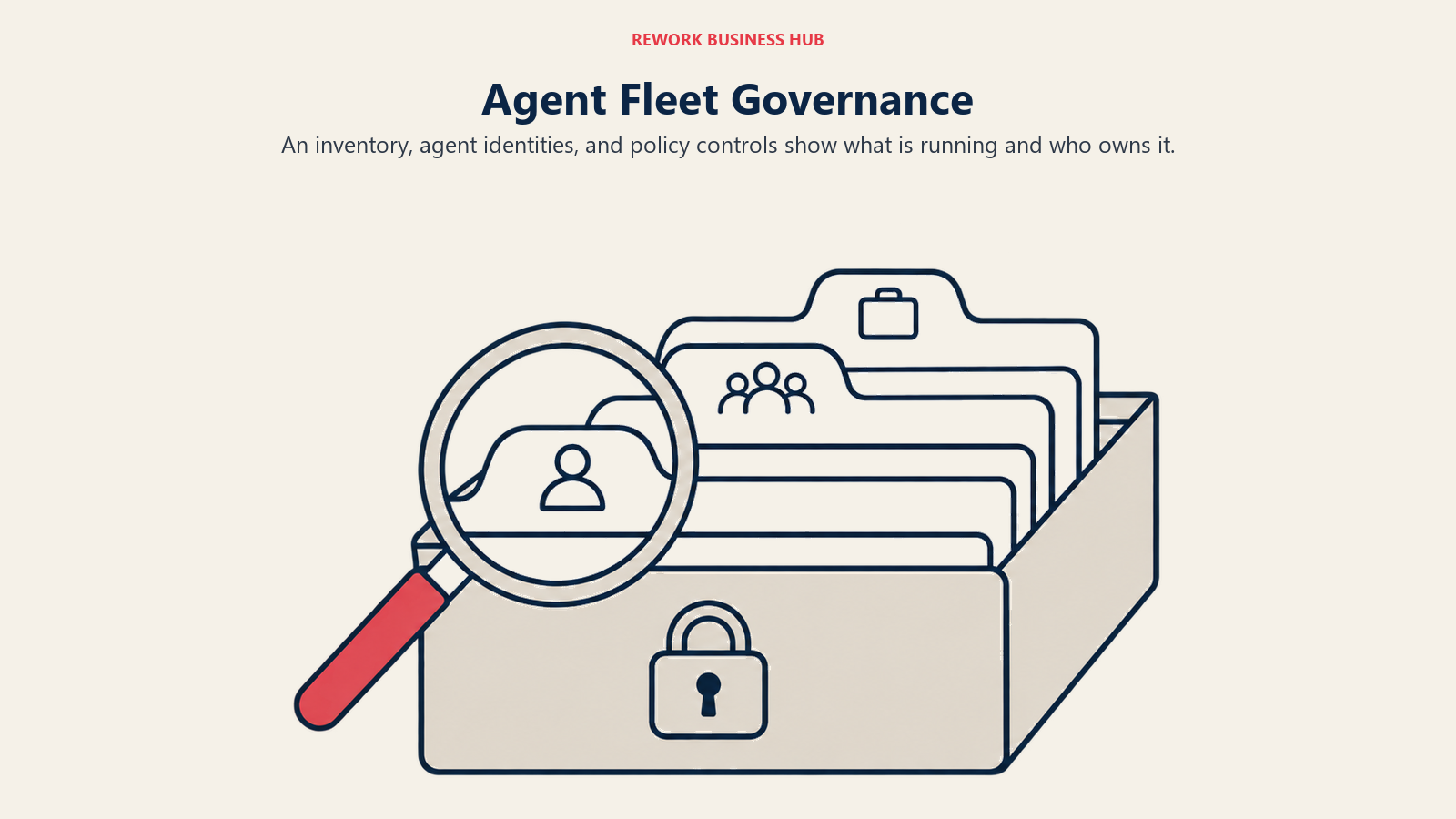
This is where the three differ most in depth. Agent 365 is purpose-built for it. The other two include it as a feature of a larger product.
| OpenAI Frontier | Microsoft Agent 365 | Salesforce Agentforce | |
|---|---|---|---|
| Agent identity | Each agent has its own identity with explicit permissions | Entra Agent ID for agents in the inventory | Salesforce permission model; Agentforce Observability and Command Center for monitoring |
| Cross-vendor registry | Not described | Yes: Microsoft platforms, partner agents, manual registration, Vertex AI and Bedrock agents | Agentforce 3 added MCP support and agent connections; not a company-wide registry for non-Salesforce agents |
| Policy and lifecycle | Guardrails and boundaries | Onboarding workflows, policy templates, expiry and ownerless-agent rules | Agent Builder controls and Agentforce observability |
| Data protection | Enterprise security and governance described as built in | Purview protection, DLP and oversharing controls | Confirm controls with Salesforce for your edition |
| Threat protection | Not described | Defender integration | Not described as a separate layer |
| Audit | Evaluation and optimization tools | Audit and logging, Purview | Session tracing built on OpenTelemetry, per the Agentforce 3 release |
Two readings of that table are both fair. If your main worry is "we have agents appearing everywhere and no one knows what they can touch," Agent 365 addresses the problem most directly, and its registry can reach beyond Microsoft's own platforms. If your main worry is "we need an agent that is safe enough to act on our customer records," governance inside Agentforce may be enough, because the agent is operating within one system's permission model.
The weak point for all three is the same: governance of an agent works best when you control where the agent runs. A Frontier agent that calls tools in five systems, an Agentforce agent that talks to an MCP server, and a Copilot agent that reads a SharePoint site each generate their own trail. Whether those trails join up in one place is something to test with your own SOC, not something to assume from a product page.
For a broader look at the tooling that sits around these platforms, see best AI agent security tools and best AI agent observability tools.
Building and Running Agents
Only two of the three are builders. That's the sharpest practical difference.
| OpenAI Frontier | Microsoft Agent 365 | Salesforce Agentforce | |
|---|---|---|---|
| Is it a builder? | Yes | No | Yes |
| Builder surface | Agent execution environment with business context | Not applicable; registers agents built elsewhere | Agent Builder (low-code), Agent Script, Prompt Builder |
| Where agents get their facts | Shared semantic layer over warehouses, CRM, ticketing and internal apps | Not applicable | CRM records and Data 360 |
| Models | OpenAI models, with low-latency access | Not applicable | Atlas Reasoning Engine; Agentforce 3 supports natively hosted models such as Anthropic's Claude |
| Who does the work | Your team plus OpenAI forward deployed engineers and partners | Your IT, security and Microsoft 365 admins | Salesforce admins and developers |
| Multi-agent | Agents from OpenAI, the enterprise or third parties | Registers and observes agents from many sources | Multi-agent orchestration listed on its page |
That table is worth printing for your steering committee. Agent 365 can't replace a builder, so a Microsoft shop that wants a builder still needs Copilot Studio or another platform, which is exactly the decision covered in Agentforce vs Copilot Studio and best Copilot Studio alternatives. And a Frontier or Agentforce deployment doesn't come with an enterprise-wide registry. You'd need a control plane, whether Microsoft's or another.
Where the Agents Meet People
Surfaces matter because they decide where employees and customers actually meet the agent.
| OpenAI Frontier | Microsoft Agent 365 | Salesforce Agentforce | |
|---|---|---|---|
| Primary surfaces | Inside the enterprise's own systems and workflows | Agents appear in Teams and the Microsoft 365 admin center; partner agents deploy from the admin center | Web, phone and apps per Salesforce's page; Slack and email appear in its examples |
| Voice | Not described | Not applicable | Agentforce Voice, 30 Flex Credits per action |
| Customer-facing agents | Possible via partners such as Decagon and Sierra | Not its role | A core use case; Fin now sits alongside |
| Employee-facing agents | Core use case ("AI coworkers") | Governed in Teams and Microsoft 365 | Agentforce Coworker and per-user add-ons |
If customer-facing support is the primary job, the broader category is covered in best AI agents for customer service.
Ecosystem Fit: Which Stack Are You Already In?
Large-company AI decisions usually follow the existing stack, and these three have different gravity.
| If your core systems are... | Natural gravity | Why |
|---|---|---|
| Salesforce for sales and service | Agentforce | Agents read the records your teams already work in |
| Microsoft 365, Entra, Defender and Purview | Agent 365 | Governance controls reuse identity and compliance tooling you already run |
| Mixed estate: warehouse, several SaaS apps, internal tools | Frontier, or a control plane plus a builder | The shared context layer is designed to span systems |
| Google Cloud or AWS with agents already built | Agent 365 can register Vertex AI and Bedrock agents; Frontier or Agentforce can sit alongside | Check that the registry sees what you actually run |
| No dominant platform | Start with the best enterprise AI agent platforms | You need the wider field before choosing a layer |
Combining Them
Many buyers will ask whether they can run all three. The honest answer is that it's technically plausible and operationally heavy.
| Combination | What you get | What to test |
|---|---|---|
| Agentforce plus Agent 365 | CRM-native agents with a company-wide registry | Whether Agentforce agents are actually registered and observable in Agent 365, and what telemetry reaches Purview |
| Frontier plus Agent 365 | Cross-system agents with a Microsoft control plane | Whether Frontier agents get Entra identities and show up in the inventory |
| Frontier plus Agentforce | Cross-system agents alongside Salesforce-native ones | Where shared context overlaps and who owns each data path |
| All three | Maximum coverage | Cost, ownership and three audit trails to reconcile |
Agent 365's documentation names the partners and platforms it supports, and neither OpenAI nor Salesforce appears among the ecosystem agents listed on Microsoft's partner page. That doesn't prove it can't be done, since Microsoft says agents built outside its environments can be registered with additional steps, but it does mean you should ask each vendor for a reference customer that runs the exact combination you're planning.
Implementation Effort and Time to Value
| OpenAI Frontier | Microsoft Agent 365 | Salesforce Agentforce | |
|---|---|---|---|
| Fastest start | Contact OpenAI; access is by engagement | Buy licenses and enable in the admin center | Start on Salesforce Foundations at $0 |
| Typical lead | Executive sponsor plus consulting or OpenAI engineers | IT and security administrators | Salesforce admin or architect |
| Biggest dependency | Quality of connected data and scoping | Whether agents are registered and licensed users are identified | CRM data quality and Data 360 setup |
| Change management | High: cross-functional "AI coworkers" | Moderate: policy and ownership rules | Moderate to high where agents change rep or service workflows |
| Risk of overbuilding | High without a scoped first use case | Low | Medium |
Two pieces of advice apply across all three. First, pick one narrow workflow for the first deployment, such as a service-case triage agent or an internal IT helpdesk agent, and define its success metric before you start. Second, decide who owns an agent after launch. Agent 365's lifecycle rules flag ownerless agents for a reason: it's the most common governance gap.
Team and Role Fit
| Role | What they'll care about | Closest answer |
|---|---|---|
| CIO | One view of every agent, ownership and cost | Agent 365 for visibility; Frontier or Agentforce for delivery |
| CISO | Identity, least privilege, threat detection, audit | Agent 365 |
| COO or head of operations | A working agent on a real process within a quarter | Agentforce if on Salesforce; Frontier with a partner otherwise |
| CRO or VP of Sales and Service | Agents on pipeline, cases and customer conversations | Agentforce |
| CFO | Predictable spend | Agent 365 (per-user) or Agentforce with Pre-Purchase; Frontier needs a negotiated cap |
| Head of AI or CTO | Flexibility, models and extensibility | Frontier, or Agentforce with MCP |
Honest Caveats on the Evidence
Be careful with vendor-supplied outcomes. OpenAI's launch page cites examples from an unnamed manufacturer, an unnamed global investment company and an unnamed energy producer, with claims such as production optimization falling from six weeks to one day. Those are OpenAI's own descriptions, with no customer named and no method attached. Salesforce's "over 18K companies" is a count of companies running Agentforce, not a measure of results.
A Forrester analyst quoted by The Register said AI coworkers have been discussed conceptually but few have delivered for large businesses, and that enterprise adoption takes process context, skills, security, governance and performance measurement. That's a useful corrective to any of the three pitches.
| What to ask any of the three | Why it matters |
|---|---|
| Name a customer running the same use case in production | Launch examples can be unnamed or narrow |
| What's measured, by whom, and over what period? | Outcome claims without a method aren't comparable |
| Which of our systems are native, which need custom work? | Integration cost decides the real budget |
| What happens to pricing at renewal or at scale? | Per-user, credit and negotiated models grow differently |
| Who can see an agent's actions, and where are logs kept? | Audit needs differ by regulator |
When Each One Is the Right Call
When OpenAI Frontier is the right call
- You're a large enterprise with work that crosses many systems, and you want a shared context layer instead of one agent per app.
- You want a vendor partner, including forward deployed engineers or a consulting firm, to help scope and deploy.
- You're comfortable with a sales-led, negotiated engagement and no public price.
- You already use OpenAI models and want agents built around them.
- Your first use cases are internal "AI coworker" tasks, not just CRM automation.
When Microsoft Agent 365 is the right call
- Your company runs on Microsoft 365, Entra, Defender and Purview, and security wants agents under the same controls.
- You already have agents spread across Copilot, partner tools and other clouds, and need one inventory.
- You prefer a published per-user price and don't want cost to grow with every agent deployed.
- You'd rather buy governance separately from the builders, so you stay free to change them.
- You're considering Microsoft 365 E7 and want to know what's in it.
When Salesforce Agentforce is the right call
- Your customer, case and pipeline data already lives in Salesforce.
- You want to start at $0 with Foundations and pay by credit, conversation or user as you scale.
- You need customer-facing agents with voice and chat, and a Salesforce partner ecosystem to help.
- You want your service stack to include Fin alongside Agentforce under one parent.
- Your admins and developers already know the platform.
If None of Them Fits
If your company is smaller, not on Salesforce or Microsoft, or just not ready for a platform commitment, the wider field is easier to navigate through best AI agent platforms and best AI agents for enterprise. For a different head-to-head on how builders at two other vendors compare, see Claude Managed Agents vs OpenAI Agents API.
Decision Framework
| If you are... | Pick |
|---|---|
| Needing one registry, identity and security view over all agents | Microsoft Agent 365 |
| A Salesforce shop automating cases, leads or opportunities | Salesforce Agentforce |
| Building agents that span a mixed estate with vendor engineers | OpenAI Frontier |
| Wanting a public price to take to finance this week | Agent 365 or Agentforce |
| Wanting to test a builder for free | Agentforce on Foundations |
| Governing agents that run on Vertex AI, Bedrock or partner platforms | Agent 365 (confirm coverage) |
| Wanting model and platform from the same vendor, with services | Frontier |
| Running Microsoft 365 and Salesforce both | Agentforce for CRM work and Agent 365 for governance; test the integration first |
| Unsure which layer you need | Start with the governance gap: if agents already exist, begin with a control plane |
What to Do Next
- Inventory the agents you already have. Count the ones in Copilot, in Salesforce, in custom code and in vendor tools. If the answer is "we don't know," your first purchase is visibility, not another builder.
- Choose one pilot workflow and write the success metric before any demo. A service-case triage agent or an internal IT helpdesk agent are both good, bounded starters.
- Ask each vendor for the same things in writing: a price model for your volume, a named reference customer on a comparable use case, and the exact data and identity path for an agent in your environment.
- Confirm Microsoft eligibility if Agent 365 is on the list, including the E5 or Defender and Purview prerequisites, before you build a budget.
- Run a short, scoped pilot on the layer you've chosen and set a review date. Keep the contract term short enough that you can add or change a layer as the category keeps moving.
Related Resources:

Co-Founder, Rework.com
On this page
- TL;DR
- Key Facts
- The Three Are Not Interchangeable
- What Each Product Actually Is
- OpenAI Frontier
- Microsoft Agent 365
- Salesforce Agentforce
- Pricing: Three Different Meters
- Agent 365 licensing
- Agentforce pricing
- Frontier pricing
- Governance, Identity and Security
- Building and Running Agents
- Where the Agents Meet People
- Ecosystem Fit: Which Stack Are You Already In?
- Combining Them
- Implementation Effort and Time to Value
- Team and Role Fit
- Honest Caveats on the Evidence
- When Each One Is the Right Call
- When OpenAI Frontier is the right call
- When Microsoft Agent 365 is the right call
- When Salesforce Agentforce is the right call
- If None of Them Fits
- Decision Framework
- What to Do Next