Abridge vs Ambience: Which AI Medical Scribe Fits Your Health System in 2026?
Turn this article into takeaways for your work.


Each assistant summarizes the article only for you and suggests best practices for your work.
If you're a CMIO, COO, CFO or revenue cycle leader weighing these two, you're probably past the question of whether ambient AI scribes work at all. Your clinicians are asking for one, a vendor has already pitched you, and now you need to pick a partner you can live with for several years. The decision is less about which model writes a better note and more about what job you're hiring the product to do.
Abridge and Ambience Healthcare both listen to the clinician-patient conversation and draft the note. They diverge on what surrounds that note. Abridge presents itself as a broad layer across clinical documentation, revenue cycle, nursing and inpatient work. Ambience presents itself as a platform that reconciles the chart, surfaces documentation gaps and codes the encounter, with the clinician attesting. This guide walks through where they differ on integration, coding, security, commercial model and rollout, using what each vendor publishes. Where a vendor doesn't publish something, we say so and tell you what to ask.
TL;DR
| Abridge | Ambience Healthcare | |
|---|---|---|
| Core pitch | One intelligence layer across clinicians, revenue cycle, nursing and inpatient work | A context and action layer: reconciled chart, CDI at the point of care, coding with clinician attestation |
| EHR named on the vendor site | Epic (capture in Haiku, review in Hyperspace) | Not named on its main site; Epic Toolbox membership is announced elsewhere |
| Coding and revenue cycle | "Billable documentation," coding specificity, a Revenue Cycle product line | ICD-10, HCC/MCC/CC and E&M levels, with the clinician attesting |
| Prior authorization | Announced real-time prior authorization with Highmark Health and AHN | Not listed on its site |
| Specialties | Multi-specialty; 40+ specialties cited in one customer story | "200+ specialties supported" |
| Care settings | Outpatient, emergency medicine and inpatient | Ambulatory, inpatient and emergency department |
| Compliance listed | HIPAA, SOC 2 Type 1 and 2, CCPA, TX-RAMP on its trust center | No certifications itemized on its main site |
| Pricing | Not published; contact sales | Not published; "Our fees tied to your outcomes" |
| Best for | Large health systems on Epic standardizing documentation across many service lines | Systems whose bigger problem is coding accuracy and CDI, not just note time |
Key Facts
- Abridge says 300+ health systems use its platform and lists "Best in KLAS" recognition for 2025 and 2026 on its homepage.
- Ambience states 200+ specialties are supported and describes coding across ICD-10, HCC/MCC/CC and E&M levels with clinician attestation.
- Abridge's trust center lists CCPA, HIPAA, SOC 2 Type 1, SOC 2 Type 2 and TX-RAMP, and says its products are covered by a SOC 2 Type 2 report.
- Neither vendor publishes a price. Ambience's site says only that its fees are tied to your outcomes, and Microsoft's Dragon Copilot page offers a "Contact us" option instead of a rate card.
- Epic released a built-in ambient charting tool around its February 2026 customer event, per Fierce Healthcare's coverage, which changes the buy-versus-bundle math for every Epic customer.
What Each Product Is Actually Built For
Think of the two as different answers to the question "where does the money or the pain sit?"
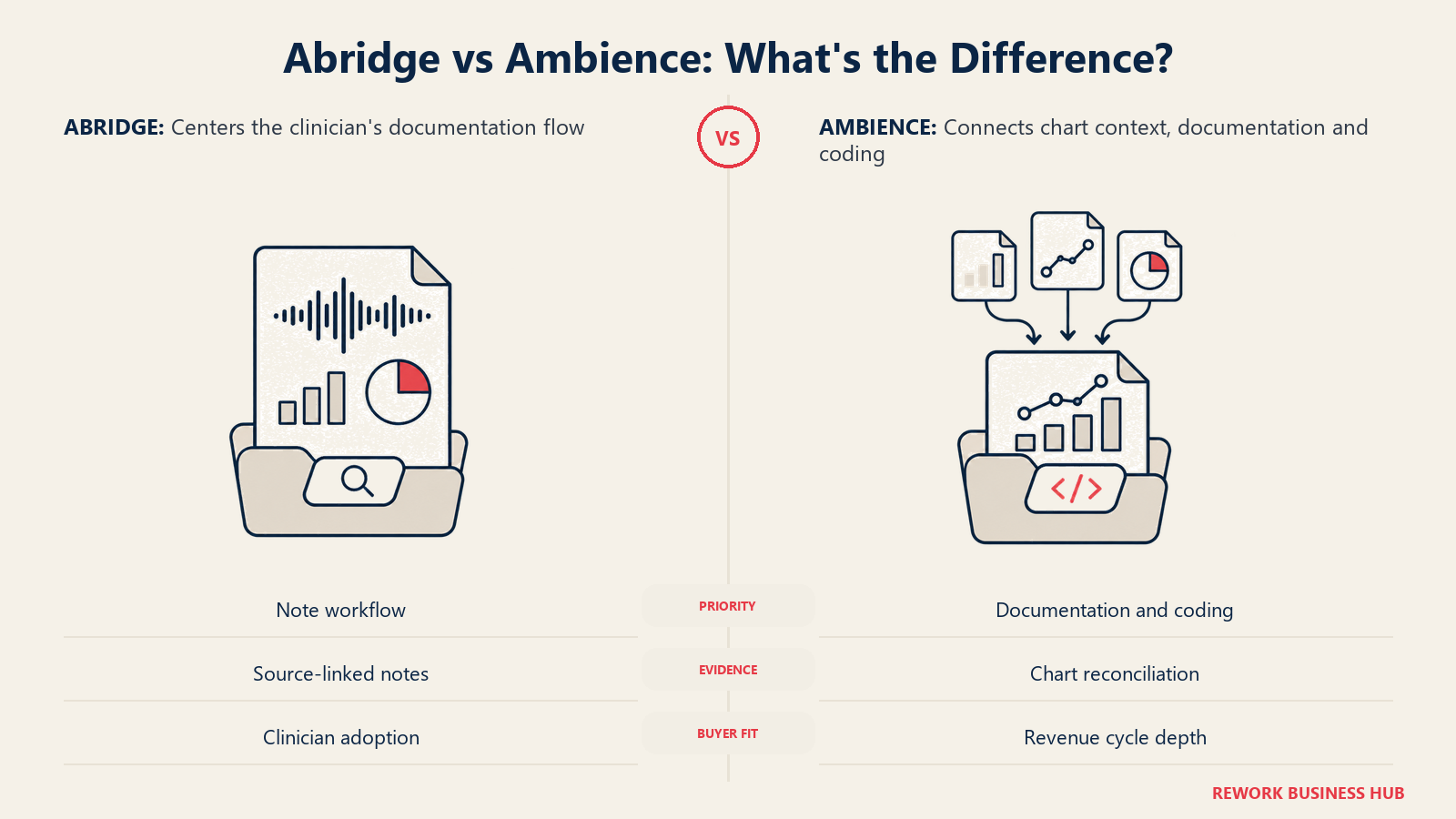
Abridge's product page frames the offer around the clinician's workflow: capture the conversation in Epic's Haiku mobile app, then review AI note drafts in Hyperspace using what it calls Linked Evidence. It extends that same capture into revenue cycle ("billable documentation, automated from the start"), nursing and inpatient work. If your priority is getting one scribe in front of thousands of clinicians across many specialties with a vendor that already operates at that scale, that's the story it tells.
Ambience's site leans the other way. It describes a context layer that extracts and reconciles chart data (conflicting medication lists, stale problem lists, scanned faxes), plus an action layer that writes decisions back to systems of record. The note is one output. Documentation gaps surfacing during the visit, and coding with clinician attestation, are others. If your finance team has been losing sleep over under-coding or denials tied to thin documentation, that's the story it tells.
| Dimension | Abridge | Ambience |
|---|---|---|
| Primary buyer concern | Clinician time and satisfaction at scale, with revenue cycle added | Documentation quality and coding accuracy alongside the note |
| Product lines on site | Clinicians, Revenue Cycle, Nursing, Inpatient, Assistant, Care Signals | Ambulatory, inpatient and ED documentation, CDI, coding, chart questions with cited sources |
| How it describes itself | "One intelligence layer connecting health systems, payers, and life sciences organizations" | A platform with a context layer and an action layer |
| Who it is for | Large enterprise systems | Health systems that want a forward-deployed team and outcome-linked fees |
| Biggest unknown to chase | EHR coverage beyond Epic; HITRUST status | EHR coverage; itemized security certifications |
If you're building a shortlist beyond these two, the broader best AI agents for healthcare guide covers ambient documentation alongside prior authorization, patient access and revenue cycle agents, and it's the right place to see the other scribe vendors side by side.
Decision by Business Goal
Executives rarely buy a scribe for the scribe. Match the goal to the vendor's strength before you look at a demo.
| Your goal | Lean toward | Why |
|---|---|---|
| Reduce documentation burden across a large Epic footprint | Abridge | Documented Haiku and Hyperspace workflow, broad specialty and care-setting coverage, enterprise reference base |
| Improve coding accuracy and CDI at the point of care | Ambience | Lists ICD-10, HCC/MCC/CC and E&M coding with attestation, and CDI gap surfacing in the visit |
| Tie vendor fees to measurable results | Ambience | States "Our fees tied to your outcomes" (confirm what the outcome metrics are) |
| Move prior authorization to the point of conversation | Abridge | Announced real-time prior authorization with Highmark Health and AHN |
| Cover nursing and inpatient workflows with the same vendor | Abridge | Nursing and Inpatient are named product lines |
| Scale to a hundred or more specialties without re-platforming | Ambience (verify), Abridge (verify) | Ambience says 200+ specialties; Abridge says multi-specialty. Ask each for your specialty list |
| Keep the number of vendors in the Epic ecosystem low | Neither by default | Epic's own ambient charting is now an option to price first |
CEO, CFO and CMIO Lenses
Different executives will read this decision differently, so run the comparison through each lens before the committee meets.
CFO: which one has the clearest cost-of-ownership math? Neither publishes a rate card, so you can't build a model from a website. Ambience's outcome-linked fee language is potentially attractive if the outcome metric is something you already measure, such as coding accuracy or documentation completeness. It's only attractive if the contract defines the metric, the baseline and the measurement method in writing. Abridge's enterprise contracts are negotiated; ask for a term sheet that separates the clinician documentation license from the revenue cycle modules so you can see what each layer costs.
CMIO: which one has the fewest workflow landmines? Abridge describes a specific Epic flow, which makes it easy to ask a reference site whether that flow matches reality. Ambience describes a reconciling platform that does more (chart questions, to-do tracking, order drafting), which also means more behaviors to govern and train. More capability is not automatically better for a clinician who wants a draft note and nothing else.
COO: which one rolls out without a disaster? Ambience says it deploys a forward-deployed team from day one with pilots, change management and 24/7 support. Abridge's page speaks of helping systems manage security, compliance and deployments, without detailing a services model. Ask both what the staffing ratio looks like during your go-live month.
CIO: which one has the fewest governance and integration landmines? Both depend on Epic for the integration surface, so your Epic team's roadmap and release cycle matter more than either vendor's slides. See the security section below for the questions to put in writing.
Documentation, Coding and CDI
This is where the two products diverge most, and it's where most of the money is.
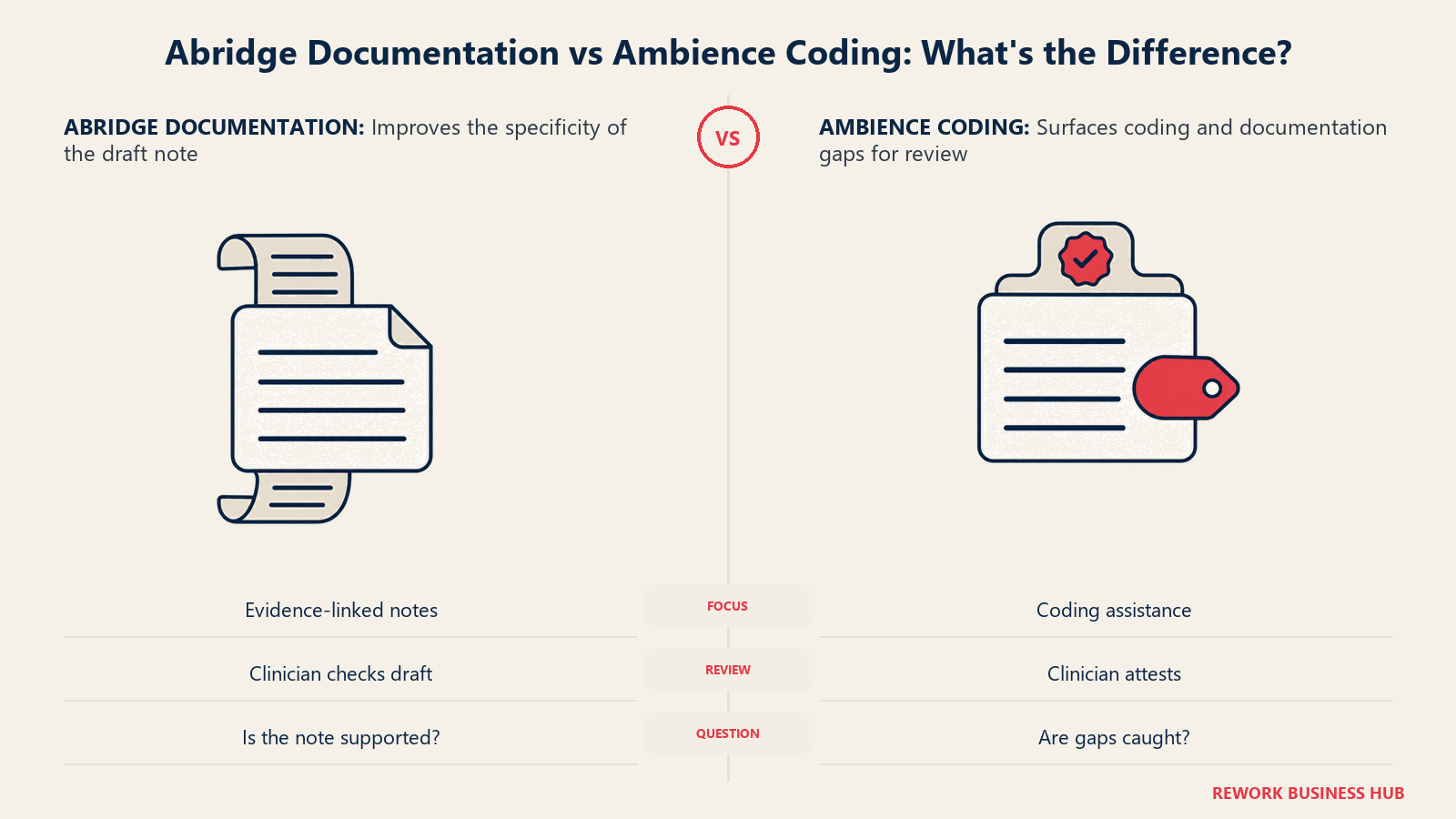
Abridge's published language on coding is mostly about the quality of the draft: "finalized notes, coding specificity, orders, and patient summaries" after the visit, and problems captured in language that aligns with appropriate billing codes. It has a Revenue Cycle product line and a customer story about pre-bill review for CDI and coding teams. That suggests a documentation-first approach with revenue cycle tooling layered on.
Ambience lists its coding scope explicitly: ICD-10, HCC/MCC/CC and E&M levels, with the clinician attesting, plus CDI gaps surfaced at the point of care. It also cites vendor-reported coding figures on its own page: 95% coding accuracy, and 95% coding compliance verified by AAPC. Those are the vendor's numbers, not independent results, so ask for the methodology and the specialties tested before you put them in a business case.
| Capability | Abridge (per its site) | Ambience (per its site) |
|---|---|---|
| Ambient note drafting | Yes, reviewed in Hyperspace with Linked Evidence | Yes, specialty-specific notes, orders and instructions |
| Coding support | Coding specificity and billable documentation language | ICD-10, HCC/MCC/CC and E&M levels, clinician attests |
| CDI | CDI and coding team pre-bill review referenced in a blog title | Documentation gaps surfaced at the point of care |
| Prior authorization | Real-time prior authorization announced with Highmark Health and AHN | Not listed |
| Chart reconciliation and chart Q&A | Assistant product line named | Medication list, problem list and fax reconciliation; chart questions with cited sources |
| Nursing and inpatient | Named product lines | Inpatient and ED named as care settings; nursing not listed |
Two cautions apply to both. First, coding assistance is only as useful as your coders' trust in it, so plan a side-by-side audit on a sample of real encounters rather than accepting a demo. Second, a note that supports higher-level billing creates compliance exposure if clinicians click accept without reading. Whichever vendor you choose, write the attestation workflow into your policy before launch.
EHR Integration and Interoperability
For most buyers this section decides the shortlist before anything else does.
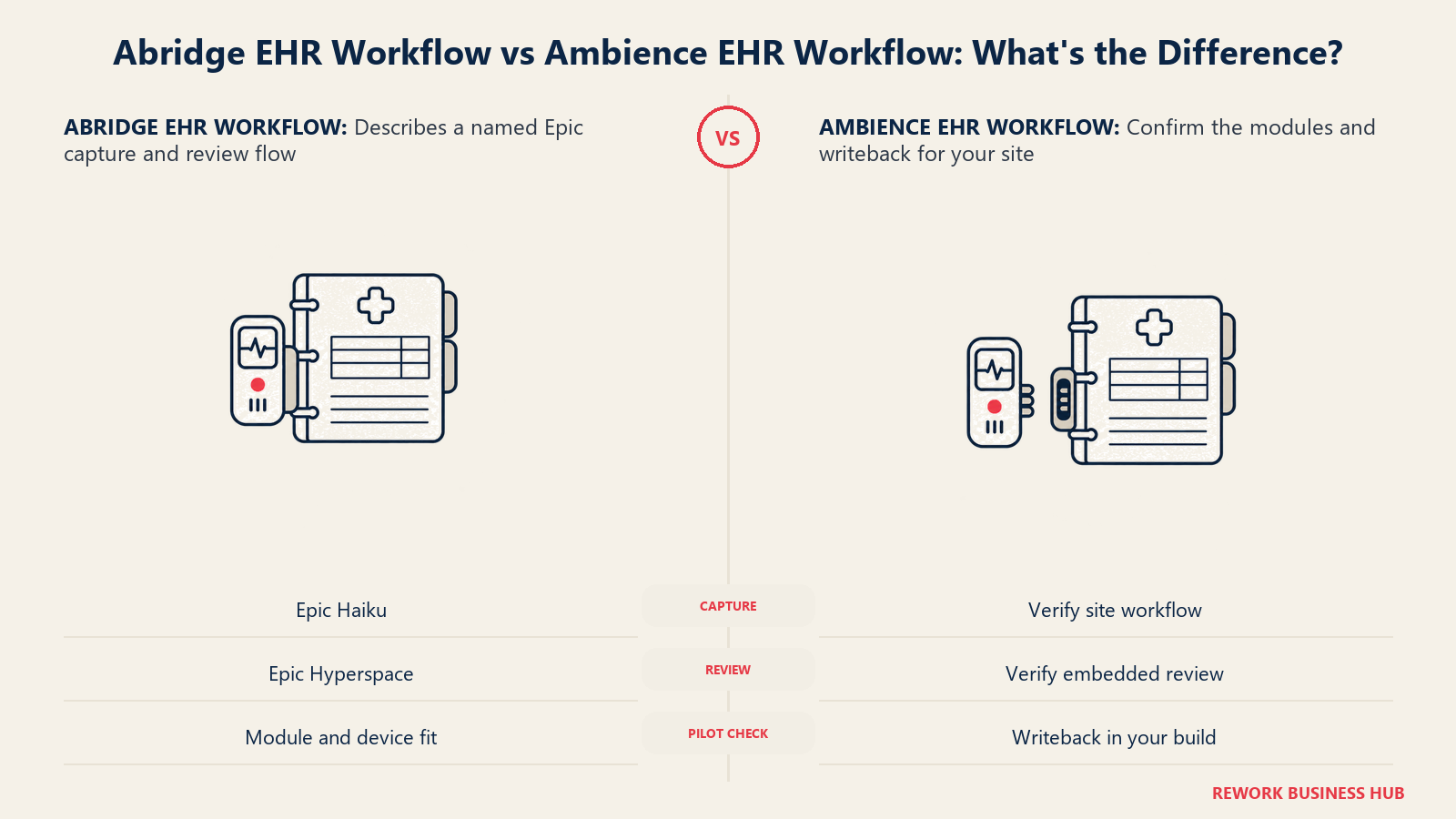
Abridge's site names Epic only, with capture in Haiku and review in Hyperspace. Ambience's own site doesn't name an EHR, though a press release distributed through Bio-IT World reports that it joined Epic Toolbox with functionality inside Haiku. If you run Epic, both are reasonable candidates. If you run something else, you need written confirmation before you take another meeting.
| Question | Abridge | Ambience |
|---|---|---|
| Epic | Named; Haiku capture, Hyperspace review | Epic Toolbox announced; confirm the live build for your Epic version |
| Other EHRs | None named on its site; confirm with the vendor | None named on its site; confirm with the vendor |
| Enterprise sign-on and governance | Single sign-on, custom governance controls, analytics and reporting listed | Governance and telemetry layer mentioned; details to confirm |
| Writes back to the record | Notes integrated into EHR workflows | Action layer writes decisions to systems of record |
| What to demand | A reference site on your Epic release and module mix | A reference site on your Epic release and module mix |
The sentence to watch for in any proposal is "integrates with Epic." It can mean a mobile capture app, a deep embedded workflow, or a file that gets pasted in. Ask which Epic modules, which releases, which devices, and who maintains the integration when Epic upgrades.
It's also worth checking what your own Epic contract already includes. Epic released a built-in ambient charting tool around February 2026, per Fierce Healthcare's report. Some sources say it draws on Microsoft's Dragon technology, but the news coverage we reviewed doesn't confirm that, so confirm any such dependency with Epic. Microsoft's own Dragon Copilot is also an option: its product page lists Epic, athenahealth and MEDITECH among EHR partnerships and describes multilingual ambient capture. For a systems team, the honest framing is that you aren't choosing between two vendors. You're choosing between these two, the Epic-native option, and Microsoft, and the two vendors here must justify the price premium over whatever your EHR contract can bundle.
Security, Privacy and Governance
Clinical audio and notes are about as sensitive as data gets. Here's what each vendor publishes.
| Control | Abridge | Ambience |
|---|---|---|
| HIPAA | Listed on the trust center; product page states HIPAA compliance | Not itemized on the main site |
| SOC 2 | Type 1 and Type 2 listed; products covered by a SOC 2 Type 2 report, validated by an independent auditor | Not itemized |
| HITRUST | Not listed on the trust center; ask directly | Not itemized |
| Other frameworks | CCPA and TX-RAMP listed | Not itemized |
| Data location and encryption | Product page says U.S.-based data centers and 256-bit encryption in transit and at rest | Not stated on the main site |
| Clinician review and audit | Review in Hyperspace with Linked Evidence | States every action is clinician-reviewed and audited |
| BAA | Confirm in contract | Confirm in contract |
Read that table carefully. The difference is largely one of disclosure, not of proven security quality. Abridge publishes a trust center with named frameworks. Ambience's public site says little about certifications, which could mean the documentation exists but sits behind a security questionnaire. Ask for it. Whichever vendor you pick, put these in front of your security team before the pilot, not after:
- The current SOC 2 Type 2 report and any bridge letter covering the gap since the audit period ended.
- The signed business associate agreement terms, including subcontractors and any foundation model providers.
- Whether audio is retained, for how long, and whether it's used to train models.
- The patient consent and disclosure workflow, which varies by state and by your own policies.
- How hallucination or omission errors are reported, tracked and fed back.
For the wider security picture on agentic tools, see best AI agent security tools.
Pricing and Commercial Model
Neither vendor will give you a number from its website, and we won't invent one. Third-party blogs and healthcare procurement trackers float per-clinician monthly ranges, but none is confirmed by Abridge or Ambience, so don't put them in a board deck. Treat the commercial conversation as a negotiation with structure rather than a price lookup.
| Commercial factor | Abridge | Ambience |
|---|---|---|
| Published price | No; contact sales | No; "Our fees tied to your outcomes" |
| Likely contract shape | Enterprise agreement, negotiated | Enterprise agreement, with outcome-linked fee language |
| What to unbundle | Documentation license vs revenue cycle, nursing, inpatient modules | Documentation vs CDI vs coding modules |
| Pilot terms to request | Fixed-term pilot with an exit and no auto-renewal | Fixed-term pilot with defined outcome metrics and baseline |
| Hidden cost to model | Epic build hours, training time, clinician hours in pilot | Epic build hours, training time, coder audit time |
| Comparison price to get | Your Epic contract's native ambient option | Your Epic contract's native ambient option |
Three tactics help. First, ask both vendors for the same price table across the same three clinician counts (a department pilot, a campus, the whole system) so that tiering is visible. Second, if you pursue outcome-linked fees, define the metric, baseline period, data source and dispute process in the contract. Third, get Epic's quote and Microsoft's quote in the same week, so each vendor knows it's in a real competition.
Implementation and Change Management
The scribe is a software purchase and a behavior change at once. Clinicians will either love the time back or quietly abandon it within a month.
| Phase | What to plan | Abridge | Ambience |
|---|---|---|---|
| Weeks 0-4: Epic build and security review | Build, access, privacy sign-off | Epic workflow via Haiku and Hyperspace; confirm build effort | Epic Toolbox path; confirm build effort |
| Weeks 4-8: Pilot group | 20 to 50 clinicians across 3 to 4 specialties | Ask for vendor-led training and super-user support | States a forward-deployed team, pilots and 24/7 support |
| Weeks 8-12: Measure | Time in notes, edit rate, coding review, clinician survey | Agree metrics in advance | Agree metrics in advance, including coding audit |
| Month 4+: Expand | Specialty by specialty, not all at once | Confirm adoption dashboards | Confirm telemetry and governance reporting |
The most common failure isn't the technology. It's choosing pilot clinicians who are already enthusiasts, then rolling out to skeptics with no support. Include at least a few skeptical high-volume clinicians in the pilot, and include a few specialties with unusual workflows, such as behavioral health or procedural clinics.
Pay attention to who owns the outcome. If your CMIO owns documentation and your revenue cycle VP owns coding, a product that touches both needs a named joint owner. Without one, the vendor will get conflicting requirements and the pilot will drift.
Team and Role Fit
| Team | Where Abridge helps most | Where Ambience helps most |
|---|---|---|
| Primary care and ambulatory | Documentation time and note quality | Documentation plus E&M level support |
| Specialty clinics | Multi-specialty coverage | 200+ specialties claimed; verify your list |
| Emergency medicine | Named care setting | Named care setting |
| Inpatient | Named product line | Named care setting; chart reconciliation across rounds |
| Nursing | Named product line | Not listed on its site |
| Revenue cycle and coding | Revenue Cycle product line, pre-bill CDI review | Coding with attestation, CDI gaps at point of care |
| Utilization management | Real-time prior authorization announced | Not listed |
When Abridge Is the Right Call
Choose Abridge when you recognize these situations:
- You run Epic across a big, multi-specialty footprint and want one documentation vendor. Its Haiku and Hyperspace workflow is the most specific Epic description on either site, and it names nursing and inpatient lines you may want later.
- Clinician burnout and retention is the board-level problem. Its homepage leans heavily on clinician experience and adoption, which fits a CMIO-led buying process.
- You want prior authorization at the point of conversation on your roadmap. It has announced work with Highmark Health and AHN, so ask for a reference.
- Your security team wants named frameworks up front. A published trust center listing HIPAA, SOC 2 Type 2 and TX-RAMP shortens the questionnaire cycle, though you should still ask about HITRUST and the BAA.
When Ambience Is the Right Call
Choose Ambience when:
- Under-coding or documentation gaps cost you more than note time does. Its listed scope of ICD-10, HCC/MCC/CC and E&M levels, with clinician attestation, speaks directly to that.
- You want fees linked to outcomes. Get the metric and baseline in writing, but the posture suits a CFO who dislikes paying per seat for unproven value.
- Your specialty mix is unusual. A claim of 200+ specialties is worth testing against your actual list.
- You want a hands-on deployment team. It states a forward-deployed team from day one, with change management and round-the-clock support, which helps if your informatics team is thin.
When Neither Is the Right Call
- You're not on Epic and neither vendor will confirm your EHR in writing.
- Your Epic contract already includes ambient charting that clears your quality bar in a head-to-head pilot.
- You need a fully published, per-seat price today for a small practice. These products are sold to health systems, and a smaller practice is likely better served by a self-serve scribe.
- You can't staff the pilot. A scribe with no champion, no coder audit and no measurement plan will disappoint no matter which logo is on it.
Decision Framework
| If your situation is... | Pick |
|---|---|
| Large Epic health system, documentation burden is the top pain | Abridge |
| Coding accuracy and CDI are the top pain | Ambience |
| You want nursing and inpatient on one vendor | Abridge |
| You want outcome-linked fees | Ambience (define the metric) |
| You want prior authorization at the point of conversation | Abridge (ask for references) |
| Your security team needs a published trust center | Abridge |
| You can get the Epic-native option bundled at low cost | Pilot Epic's tool first, then use the vendors as the benchmark |
| You can't decide | Run both in a head-to-head pilot with the same clinicians |
What to Do Next
Run a six-to-eight-week head-to-head pilot. Pick 20 to 30 clinicians across four specialties, including some skeptics and at least one coding-heavy specialty. Split them so the same specialty is covered by each vendor, and add Epic's built-in option as a third arm if your contract allows it. Before you start, write down the metrics: minutes in notes per visit, edit rate on the draft, coder-reviewed accuracy on a sampled set of encounters, and a clinician survey at weeks two and six. Ask each vendor for the SOC 2 report, the BAA terms and a reference site on your Epic release before the pilot begins, not at contract time.
If you're still scoping the wider category, best AI voice agents covers the patient-facing voice side that sits next to scribes, and best enterprise AI agent platforms helps if your organization is setting up an agent governance model that will cover these tools as well.
Frequently Asked Questions about Abridge vs Ambience
Is Abridge or Ambience better for a health system on Epic?
Both name an Epic path, and the better fit depends on your goal. Abridge describes capture in Haiku and review in Hyperspace and suits documentation at scale, while Ambience adds coding and CDI to the note. Ask each for a reference site on your Epic release.
Does Ambience do medical coding and Abridge doesn't?
Ambience lists ICD-10, HCC/MCC/CC and E&M coding with the clinician attesting. Abridge describes coding specificity and billable documentation, and has a Revenue Cycle product line, but its site doesn't list the same coding scope. Compare both on a sample of your own encounters.
How much do Abridge and Ambience cost?
Neither publishes pricing. Abridge is sold through enterprise contracts, and Ambience says only that its fees are tied to your outcomes. Confirm any number in a written quote, and don't budget from third-party estimates.
Are Abridge and Ambience HIPAA compliant?
Abridge's trust center lists HIPAA and SOC 2 Type 2, along with CCPA and TX-RAMP. Ambience doesn't itemize certifications on its main site, so ask for its SOC 2 report and BAA terms directly. Either way, your security team should review the documents before a pilot.
Do they work with EHRs other than Epic?
Abridge's site names only Epic. Ambience's main site names no EHR, though it has announced Epic Toolbox membership. If you aren't on Epic, get a written statement of supported EHRs and a live reference before you proceed.
How do they compare with Epic's built-in scribe and Microsoft Dragon Copilot?
Epic released a built-in ambient charting tool around February 2026, and Microsoft's Dragon Copilot lists Epic among its EHR partnerships. Price both before you commit, so you know what the premium for Abridge or Ambience buys you.
Should we run a pilot with one vendor or both?
Run both against the same specialties with the same metrics if you can staff it. A head-to-head shows differences in edit rate, coding review and clinician preference that a demo can't.

Co-Founder, Rework.com
On this page
- TL;DR
- Key Facts
- What Each Product Is Actually Built For
- Decision by Business Goal
- CEO, CFO and CMIO Lenses
- Documentation, Coding and CDI
- EHR Integration and Interoperability
- Security, Privacy and Governance
- Pricing and Commercial Model
- Implementation and Change Management
- Team and Role Fit
- When Abridge Is the Right Call
- When Ambience Is the Right Call
- When Neither Is the Right Call
- Decision Framework
- What to Do Next