Best Multi-Agent Frameworks in 2026: 11 Frameworks for Orchestrating Agents That Hand Off Work
Turn this article into takeaways for your work.


Each assistant summarizes the article only for you and suggests best practices for your work.
The best multi-agent framework in 2026 depends on which coordination pattern your workflow actually needs, not which framework has the most stars: LangGraph is the only one that ships both a supervisor and a swarm as separate, maintained libraries so you pick deliberately, CrewAI is still the fastest way to get a role-based crew running today, and Microsoft Agent Framework now bundles the widest set of built-in patterns (sequential, concurrent, handoff, group chat, and Magentic) since it absorbed AutoGen and Semantic Kernel. This guide ranks 11 frameworks built specifically to coordinate several agents that hand work to each other, evaluated on their actual orchestration mechanics against vendor docs, GitHub activity, and pricing pages in August 2026.
A single agent calling tools in a loop is not what this list covers. These frameworks exist for the harder problem: a supervisor routing tasks to specialists, a swarm of peers passing control directly, or a fixed pipeline where one agent's output becomes the next agent's input. For the vendor-neutral blueprint on how that coordination works under the hood, see multi-agent systems; for the broader buy-side view across no-code, managed, and framework classes, start with best AI agent platforms. If licence terms and self-hosting rights matter more to you than orchestration pattern, our best open-source AI agent frameworks roundup ranks several of the same frameworks by that lens instead. One honest number before you pick a favorite here: Anthropic's own engineering team measured its multi-agent research system burning roughly 15 times the tokens of a single chat turn, so the harder question usually isn't which framework, it's whether your task is valuable enough to justify running more than one agent at all.
Key Facts
- UC Berkeley's MAST study examined 1,642 real execution traces across 7 popular multi-agent frameworks and found failure rates between 41% and 86.7%, with specification and system-design issues (unclear roles, ambiguous handoffs, missing verification) causing roughly 41.8% of all failures on their own, the single largest category (arXiv:2503.13657).
- Anthropic's multi-agent research system, a lead agent coordinating parallel subagents, used about 15 times the tokens of a single chat interaction, yet outperformed a single Claude Opus 4 agent by 90.2% on internal research evaluations, with token usage alone explaining roughly 80% of that performance variance (Anthropic).
- Anthropic's own guidance names "most coding tasks" as a poor fit for multi-agent coordination specifically because they require dense shared context between agents, the opposite of the parallel, independent research work multi-agent systems are built for (Anthropic).
- Gartner predicts more than 40% of agentic AI projects will be canceled by the end of 2027 over unclear ROI and inadequate risk controls, a risk that compounds specifically in multi-agent systems where a failure can originate several hops upstream of where it surfaces (Gartner).
- Microsoft's unified
agent-frameworkrepository, merging AutoGen and Semantic Kernel into one multi-agent SDK, has already drawn more than 12,800 GitHub stars in its first 16 months since its April 2025 launch, a fast climb for a framework built specifically around orchestration patterns rather than a single-agent loop (GitHub).
What Changed in Multi-Agent Orchestration This Year
- Microsoft merged AutoGen and Semantic Kernel into Microsoft Agent Framework, generally available since April 3, 2026, and its five orchestration patterns (Sequential, Concurrent, Handoff, Group Chat, Magentic) reached stable 1.0 status this year, all supporting streaming, checkpointing, and human-in-the-loop approval.
- LangGraph's supervisor and swarm patterns matured into their own maintained libraries,
langgraph-supervisorandlanggraph-swarm, turning "who's in charge" into a pluggable choice instead of something every team hand-rolled from primitives. - MetaGPT's commercial product MGX rebranded to Atoms on January 13, 2026. The open-source MetaGPT repository itself has gone quiet since, with no push since late January, while DeepWisdom's attention shifted to the hosted product.
- AG2 kept building independently under Apache-2.0 after its 2024 governance split from AutoGen, and remains the one framework on this list with genuinely open, non-corporate governance for the classic shared-conversation pattern.
- Anthropic's published engineering post on its own multi-agent research system has become the reference case study the rest of the industry cites for both the performance upside and the token cost, more than a year after it first shipped.
- A naming collision worth knowing before you search: OpenAI's original experimental "Swarm" project is retired in favor of the Agents SDK's Handoffs primitive, LangGraph's
langgraph-swarmlibrary is a different, unrelated thing, and Swarms (from Kye Gomez and swarms.ai) is a third, much larger framework. None of the three share code.
Quick Comparison Table
| Framework | Primary Topology | Handoff Mechanism | Best For | Starting Cost |
|---|---|---|---|---|
| LangGraph | Supervisor or peer-to-peer swarm (pluggable) | Command object via a handoff tool, full state object |
Explicit, replayable control over which agent acts next | Free (OSS); LangSmith Plus $39/seat/mo |
| CrewAI | Sequential or hierarchical crew | Task output passed into the next role's context | Fastest role-based crew to a working demo | Free (Basic, 50 runs/mo); custom Enterprise |
| Microsoft Agent Framework | Sequential, Concurrent, Handoff, Group Chat, or Magentic | Manager-mediated or rule-based transfer, pattern-dependent | Every built-in orchestration pattern in one SDK | Free (OSS); pay for model/Azure usage |
| AutoGen and AG2 | Group chat (shared topic) | No handoff; all agents publish to one shared thread | The original conversational multi-agent pattern | Free; AutoGen in maintenance, AG2 active OSS |
| OpenAI Agents SDK | Peer-to-peer handoff (triage pattern) | Full conversation history via handoff(), optional metadata |
Native handoffs for teams standardized on OpenAI models | Free SDK; pay per token |
| Google ADK | Hierarchical sub-agents plus Sequential/Parallel/Loop | Parent-child delegation through the agent tree, shared session state | Multi-agent systems deploying to Vertex AI Agent Engine | Free (OSS); consumption-based hosting |
| Claude Agent SDK | Orchestrator-worker (lead plus subagents) | Isolated context per subagent, summary-only return | Coding and research agents that need clean context isolation | Free SDK; pay per Claude API token |
| LlamaIndex Workflows | Peer-to-peer handoff (AgentWorkflow) | canHandoffTo tool call transfers control |
Handoffs inside a retrieval-heavy pipeline | Free (OSS); LlamaCloud usage-based |
| Swarms | 12 prebuilt structures (sequential, concurrent, hierarchical, group chat, more) | Structure-specific, configurable per workflow | Every topology available without switching frameworks | Free (OSS); Cloud from $19.99/mo |
| CAMEL | Role-playing agent society, scalable to a workforce | Structured turn-taking dialogue between roles | Research into agent-to-agent behavior at scale | Free (OSS, Apache-2.0) |
| MetaGPT | Fixed SOP pipeline (sequential role hierarchy) | Structured documents pass role to role | Simulating a software team's fixed handoff sequence | Free (OSS); commercial Atoms product separate |
Multi-Agent Orchestration Topologies, Explained
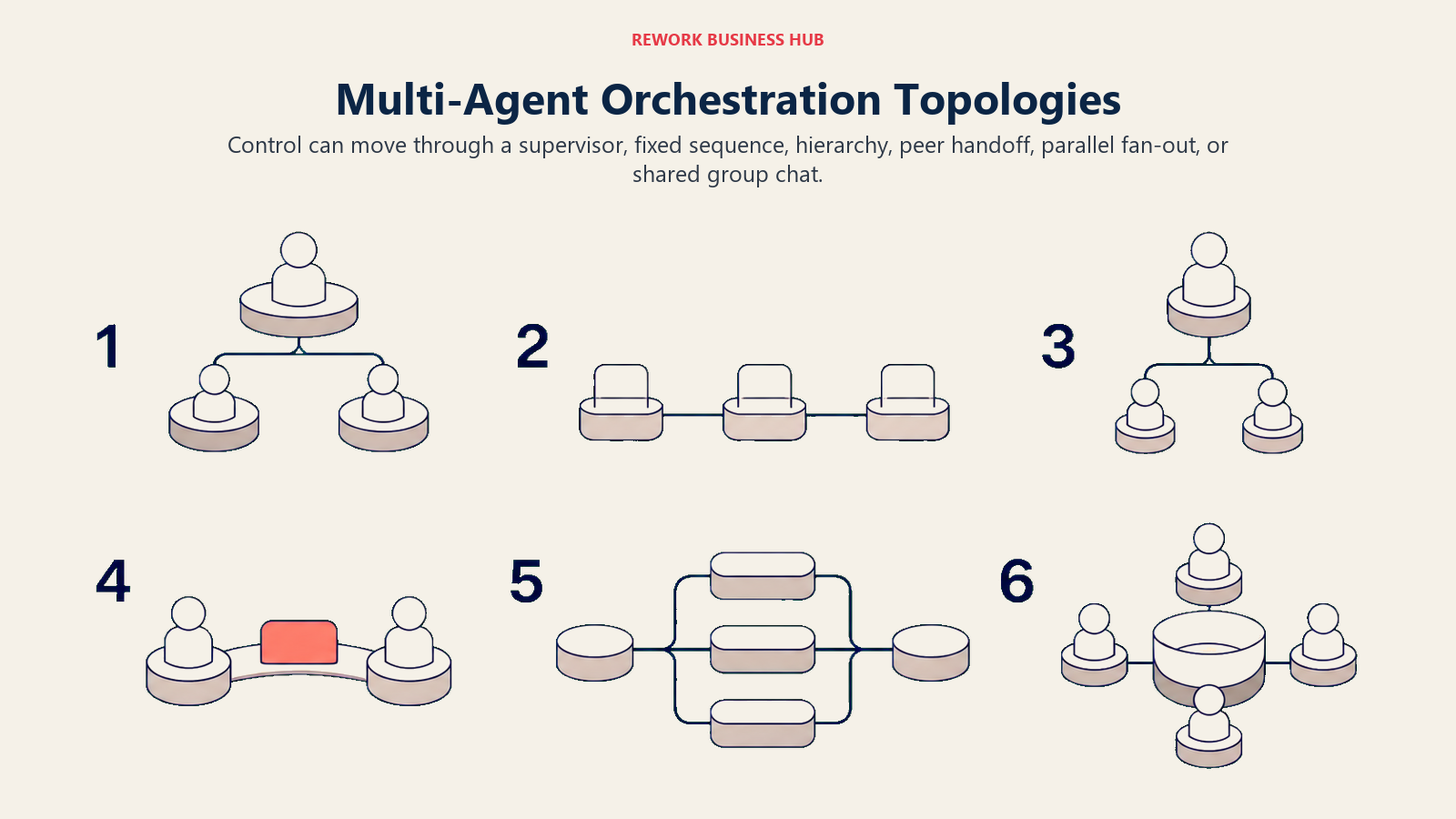
Most roundups list features. The choice that actually determines whether your multi-agent system works is the topology: the shape control takes as it moves between agents. Every framework below implements at least one of these, and several implement three or four, which is the real differentiator once you look past the marketing.
| Topology | What It Means | How Control Moves | Frameworks That Use It |
|---|---|---|---|
| Supervisor / Orchestrator-Worker | One central agent decides who acts next and reads every result | Supervisor calls a worker, worker returns, supervisor decides the next step | LangGraph (langgraph-supervisor), Claude Agent SDK (lead plus subagents), Microsoft Agent Framework (Magentic manager) |
| Sequential / Pipeline | Agents run in a fixed order; one agent's output becomes the next agent's input | Deterministic, no agent decides who goes next | CrewAI (Process.sequential), Google ADK (SequentialAgent), MetaGPT (SOP pipeline), Microsoft Agent Framework (Sequential) |
| Hierarchical | A manager agent decomposes a goal and assigns pieces to subordinate agents, sometimes nested | Manager delegates down a tree, subordinates report back up | CrewAI (Process.hierarchical), Google ADK (sub_agents tree), Swarms (HierarchicalSwarm) |
| Swarm / Peer-to-Peer Handoff | No central manager; whichever agent is active decides which peer takes over next | Agent A calls a handoff tool naming Agent B directly | LangGraph (langgraph-swarm), OpenAI Agents SDK (Handoffs), LlamaIndex Workflows (canHandoffTo) |
| Concurrent / Parallel | Multiple agents run the same or related task at once, then results merge | Fan out, then fan back in | Google ADK (ParallelAgent), Microsoft Agent Framework (Concurrent), Claude Agent SDK (parallel subagent dispatch), Swarms (Concurrent Workflow) |
| Group Chat / Shared Topic | All agents publish to and read from one shared message thread | Broadcast, not point-to-point; a manager or the group picks the next speaker | AutoGen and AG2 (GroupChat), Microsoft Agent Framework (Group Chat), CAMEL (role-playing dialogue) |
Swarms is the outlier worth flagging here: it ships nearly all six patterns in one package (12 named structures in total), which is either exactly what you want or more surface area than a small team needs to learn. Most teams are better served picking the one or two topologies their actual workflow needs and choosing the framework built around those, not the framework with the longest list.
How Handoffs Actually Pass Context
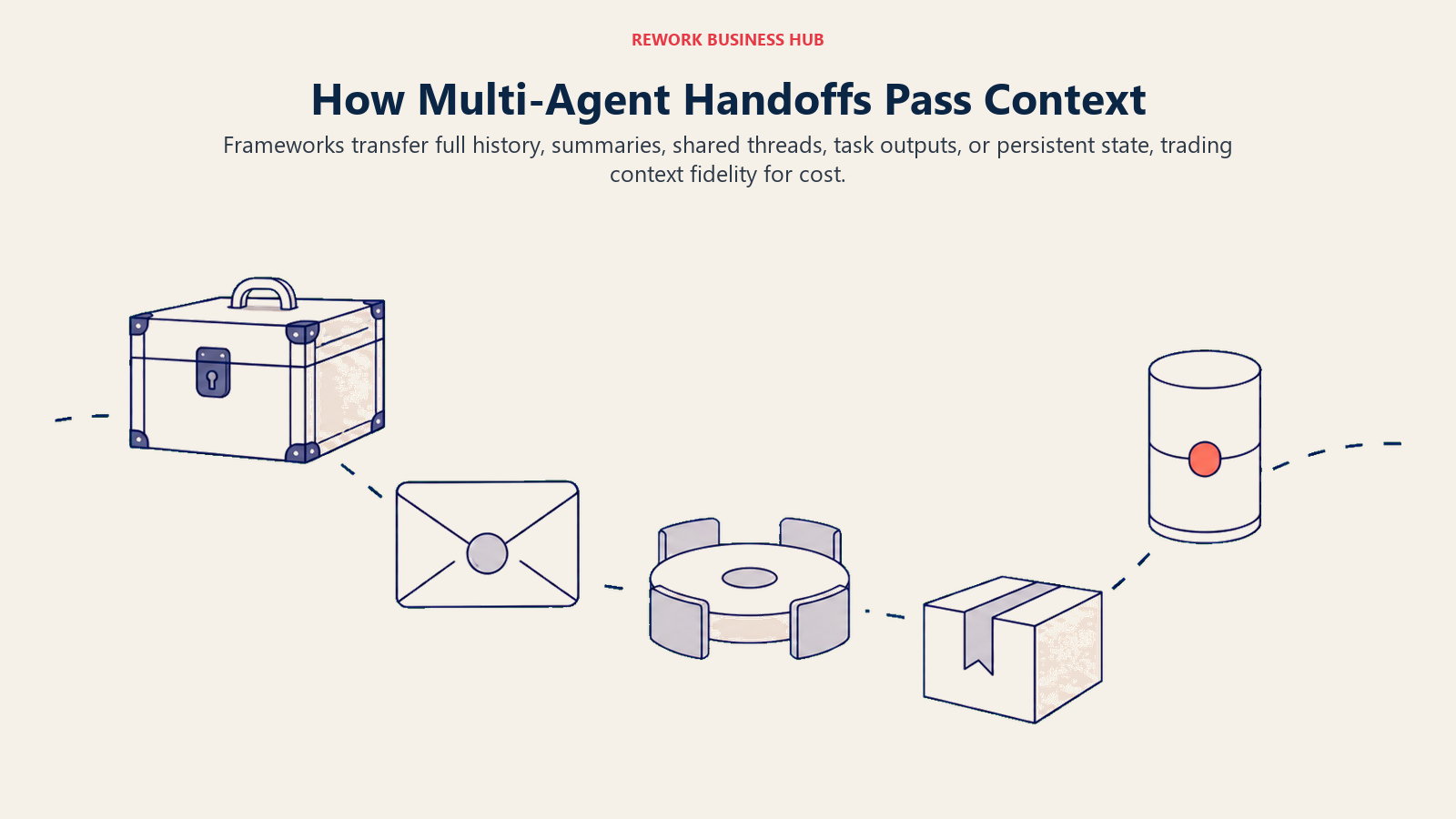
The topology tells you who talks to whom. It doesn't tell you what actually travels when they do, and that detail decides whether your multi-agent system stays coherent or quietly loses information three hops in.
| Framework | What Transfers at Handoff | What Gets Left Behind |
|---|---|---|
| LangGraph (swarm) | Full message history plus a structured Command object |
Nothing by default; a custom handoff tool can trim it |
| OpenAI Agents SDK | Full conversation history, plus optional structured metadata via on_handoff |
Nothing by default; input filters can prune it |
| AutoGen / AG2 (group chat) | Nothing is "handed off": every agent already reads the same shared topic | Each agent's private reasoning or scratch state, if any |
| Claude Agent SDK (subagents) | Only the subagent's final summary returns to the lead agent | The subagent's full transcript, tool calls, and intermediate reasoning stay isolated |
| LlamaIndex Workflows | The full workflow Context object, plus the triggering event |
Nothing by default |
| CrewAI (sequential process) | The previous task's output, injected as context into the next task | Earlier agents' full reasoning traces, unless stored explicitly in Flow state |
| Google ADK (sub-agents) | Shared session state (a key-value store) plus the delegated instruction | Nothing structurally; visibility depends on what each agent writes to state |
| Microsoft Agent Framework (Handoff) | Conversation history up to the handoff point, per the active pattern's contract | Depends on pattern; Magentic keeps a running shared context the manager maintains |
The practical trade-off repeats across every framework here. Full-history handoffs (LangGraph's swarm, the OpenAI Agents SDK) are simple to reason about but bloat context, and cost, the longer a chain of handoffs runs, since every downstream agent re-reads everything upstream agents said. Summary-only handoffs (Claude Agent SDK subagents) protect the lead agent's context window, but the lead never sees the detail the subagent worked through, only its conclusion. Shared-topic models (AutoGen and AG2's group chat) skip the handoff question entirely by making every agent pay to read everything, relevant or not, which is simple until the group grows past a handful of participants.
Shared State and Memory Between Agents
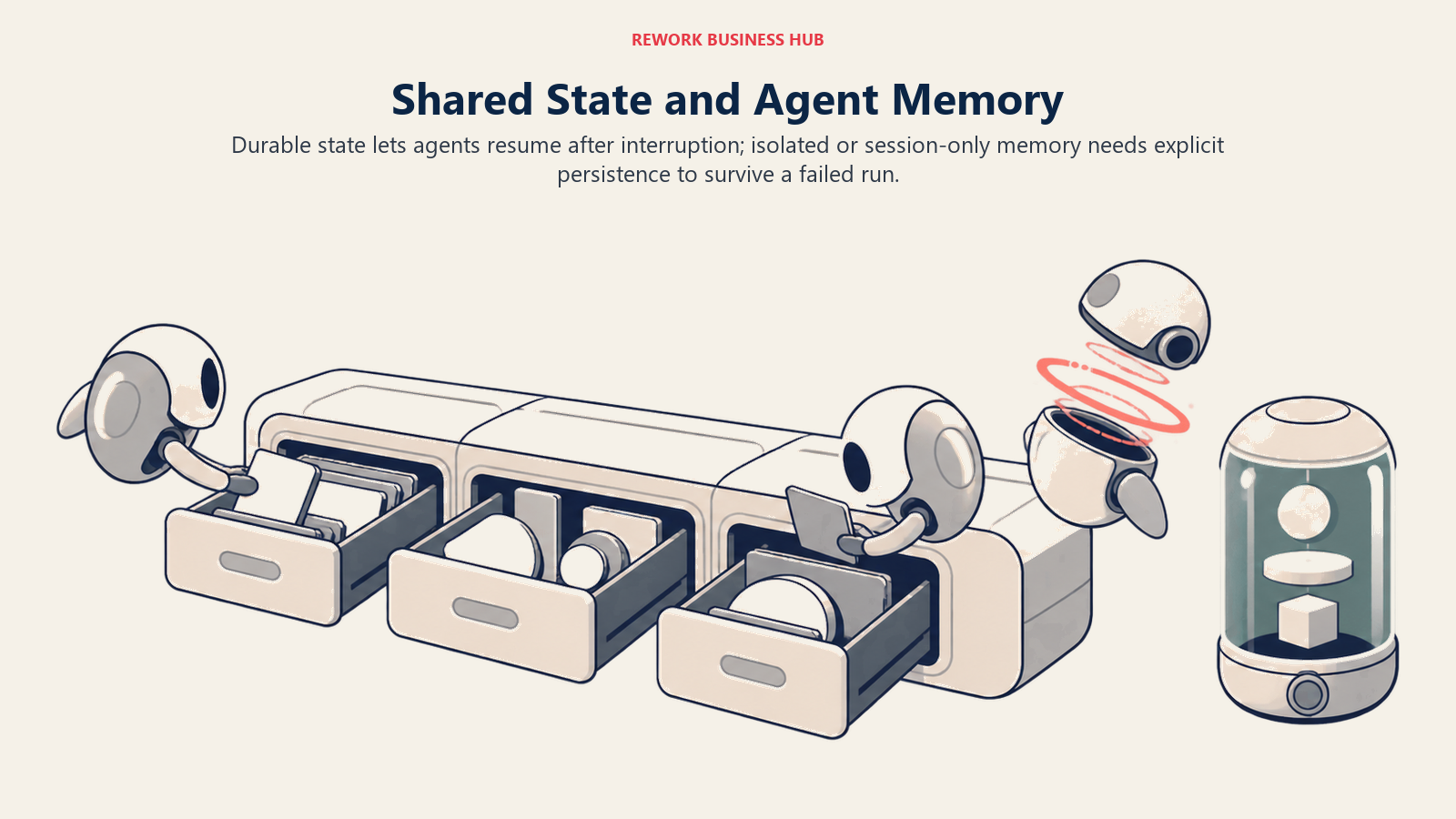
A handoff is a single moment of transfer. Shared state is the ongoing store multiple agents read and write across a whole run, and it's what determines whether a crashed multi-agent job can resume or has to restart from zero.
| Framework | Shared State Model | Durable / Resumable? |
|---|---|---|
| LangGraph | Typed State object every node reads and writes, checkpointed at each step |
Yes, native checkpointing with pause, resume, and time-travel |
| Microsoft Agent Framework | Shared context maintained by the active pattern (Magentic's manager keeps a running context) | Yes, checkpointing and pause/resume across all five patterns |
| Google ADK | Session state (key-value), shared across sub-agents in the same session | Yes, the session service persists it |
| Claude Agent SDK | Deliberately not shared; each subagent gets a fresh, isolated context window | Forks resume with full history; standard subagents are one-shot unless resumed via SendMessage |
| LlamaIndex Workflows | Workflow Context object, serializable between steps |
Can serialize and resume between steps |
| CrewAI | Flow state (structured) for Flows; task outputs otherwise | Local persistence for Flow state; deeper durability lives in the AMP cloud product |
| OpenAI Agents SDK | Session object carries conversation state across turns |
Sessions API covers basic history; durable state beyond that is on you |
| AutoGen / AG2 | The shared group-chat message thread is itself the memory | In-memory by default; you add persistence |
| Swarms | Conversation history object scoped to the active structure (for example, GroupChat) | Varies by structure; no single unified durability layer |
| CAMEL | Structured dialogue history within a role-playing session | Session-scoped; no built-in long-term memory layer |
| MetaGPT | A shared "environment" object roles publish messages to | Project-scoped; state persists within one SOP run, not across runs |
If your agents need to survive a server restart mid-task, that durability column is the one to read closely, not the topology diagram. LangGraph, Microsoft Agent Framework, and Google ADK all treat state as a first-class, checkpointed object. Several others treat it as something you're expected to wire yourself once you outgrow a single session.
The Real Cost of Multi-Agent: Token Multiplication
Every product page in this category shows a demo where a crew of agents solves something a single prompt couldn't. What most skip is the bill. Anthropic's own engineering team, describing the system behind Claude's research feature, measured multi-agent orchestration at roughly 15 times the token volume of a single chat turn, and about 4 times a single agent working alone. That number isn't a worst case; it's what a well-built orchestrator-worker system costs by design, because a lead agent's context accumulates on top of what every subagent already spent reaching its own answer.
The table below is an illustrative estimate, not a benchmark or a vendor-published figure: it applies Claude Sonnet 5's real, current API pricing ($2 per million input tokens, $10 per million output tokens, as of August 2026) to a plausible token range for each pattern, so you can see the shape of the cost curve rather than treat "multi-agent" as a single line item.
| Task Pattern | Agents Involved | Illustrative Token Volume | Rough Cost at Sonnet 5 Rates |
|---|---|---|---|
| Single agent, direct tool-assisted answer | 1 | ~5,000 tokens | ~$0.03-$0.05 |
| Supervisor plus 3 parallel subagents (research fan-out) | 4 | ~70,000-80,000 tokens | ~$0.60-$0.90 |
| Sequential 5-agent pipeline, full history carried at each hop | 5 | ~130,000-150,000 tokens | ~$1.20-$1.60 |
The gap is real, and it compounds with every hop a full-history handoff design adds. Anthropic's own guidance is specific about when that's worth paying: multi-agent systems earn their cost on tasks with heavy parallelization, information that exceeds a single context window, and many independent tool calls, the kind of work where a human team would also divide labor. The same guidance calls out "most coding tasks" as a poor fit for multi-agent coordination specifically, because edits to a shared codebase create dense dependencies between agents rather than clean, parallel, independent work, which is part of why the strongest entries in our best AI coding agents roundup default to one capable agent instead of a crew.
Debugging and Tracing a Multi-Agent Run
Single-agent debugging means reading one transcript top to bottom. Multi-agent debugging means reconstructing which agent said what, in what order, across parallel branches and handoffs that can interleave unpredictably, and MAST's own failure taxonomy exists precisely because that reconstruction is hard enough that most teams get it wrong. A failure surfacing in agent four's output can originate in a bad handoff from agent one, and without step-level tracing, you're debugging the symptom instead of the cause.
| Tool | Best Fit | What It Shows |
|---|---|---|
| LangSmith | LangGraph supervisor and swarm graphs | Step-level trace of every node, tool call, and state mutation, replayable |
| CrewAI AMP | CrewAI crews and flows | Visual execution trace and AI copilot, gated behind the hosted platform |
| AgentOps | Framework-agnostic (LangGraph, CrewAI, AutoGen, and others) | Session replay across agent boundaries, with local-first, privacy-scrubbed logging |
| Claude Code / Agent SDK | Claude subagent runs | A resumable session ID per subagent; the main thread sees only the summary until you resume it |
| Microsoft Agent Framework | All five built-in orchestration patterns | Native OpenTelemetry-based tracing plus checkpointing for pause and resume |
Pick the tracing tool before you scale usage, not after a failed run makes you wish you had one. A framework with a free licence and no visibility into which agent did what is more expensive in debugging hours than a framework with a modest paid tracing tier and a team that actually uses it.
1. LangGraph: Supervisor and Swarm as Pluggable Libraries, Not a Hand-Rolled Pattern
LangGraph earns the top spot for one specific reason: it's the only framework here that ships both major topologies as separate, maintained libraries instead of forcing a team to commit to one pattern and hand-code the rest. langgraph-supervisor gives you a central router that calls each worker, reads the result, and decides what happens next. langgraph-swarm removes the router entirely: agents hand off directly to each other through a create_handoff_tool that passes the full message history, and the graph remembers which agent was last active so the next turn resumes with it. Both sit on LangGraph's native checkpointing, so a run can pause, resume, and time-travel back to an earlier state without losing progress.
The trade-off is the one that shows up across LangGraph generally: more control means more to learn. For a hands-on build, see build an AI agent with LangGraph.
| What you get | What you don't |
|---|---|
| Both supervisor and swarm as separate, maintained libraries, not a DIY pattern | Two libraries to learn instead of one opinionated default |
| Native checkpointing means a multi-agent run can pause, resume, and time-travel | Full-history handoffs in the swarm library can bloat context over many hops |
| LangSmith gives step-level tracing across every agent and tool call | LangSmith beyond one seat is a separate paid product |
Licence: MIT. Pricing: Framework free, including langgraph-swarm and langgraph-supervisor. LangSmith Plus $39/seat/month (10,000 free traces/month), Enterprise custom. Best for: Teams that want to choose supervisor or swarm deliberately, and replay exactly which agent held which state at each step.
2. CrewAI: Role-Based Crews, Sequential or Hierarchical
CrewAI defines agents by role, goal, and backstory, then runs them through a Process: sequential, where each task's output feeds the next, or hierarchical, where a manager agent (one CrewAI generates for you, or one you supply) assigns work across the crew. That structure, plus the largest tutorial and course base in this category, is why CrewAI is usually the fastest path from zero to a working multi-agent demo, even for a team that has never built one before. Flows add a more deterministic, code-first layer on top for teams that outgrow pure autonomous crews.
For a hands-on setup, see build an AI agent with CrewAI.
| What you get | What you don't |
|---|---|
| Fastest path to a working multi-agent crew of any framework here | Hosted AMP platform's free tier caps at 50 executions/month |
| Both sequential and hierarchical processes in one framework | Less granular state control than LangGraph for complex branching |
| Large community, courses, and ready-made crew templates | No public self-serve paid tier, only free or custom Enterprise |
Licence: MIT. Pricing: Basic free (50 workflow executions/month, visual editor, AI copilot); Enterprise custom (adds SSO, RBAC, workload identity, PII redaction). Best for: Teams that want a role-based crew running in an afternoon, sequential or hierarchical.
3. Microsoft Agent Framework: Every Built-In Pattern in One SDK
Microsoft placed AutoGen in maintenance mode and merged it with Semantic Kernel into Microsoft Agent Framework, generally available since April 3, 2026. What makes it distinct for this specific list is breadth: it ships five stable orchestration patterns rather than one. Sequential and Concurrent cover the predictable cases. Handoff dynamically transfers control based on context, built for escalation and expert routing. Group Chat gives you the shared-topic pattern AutoGen popularized. Magentic, modeled on the Magentic-One research system, is the most flexible: a dedicated manager agent selects who acts next based on evolving context and progress, rather than a fixed script.
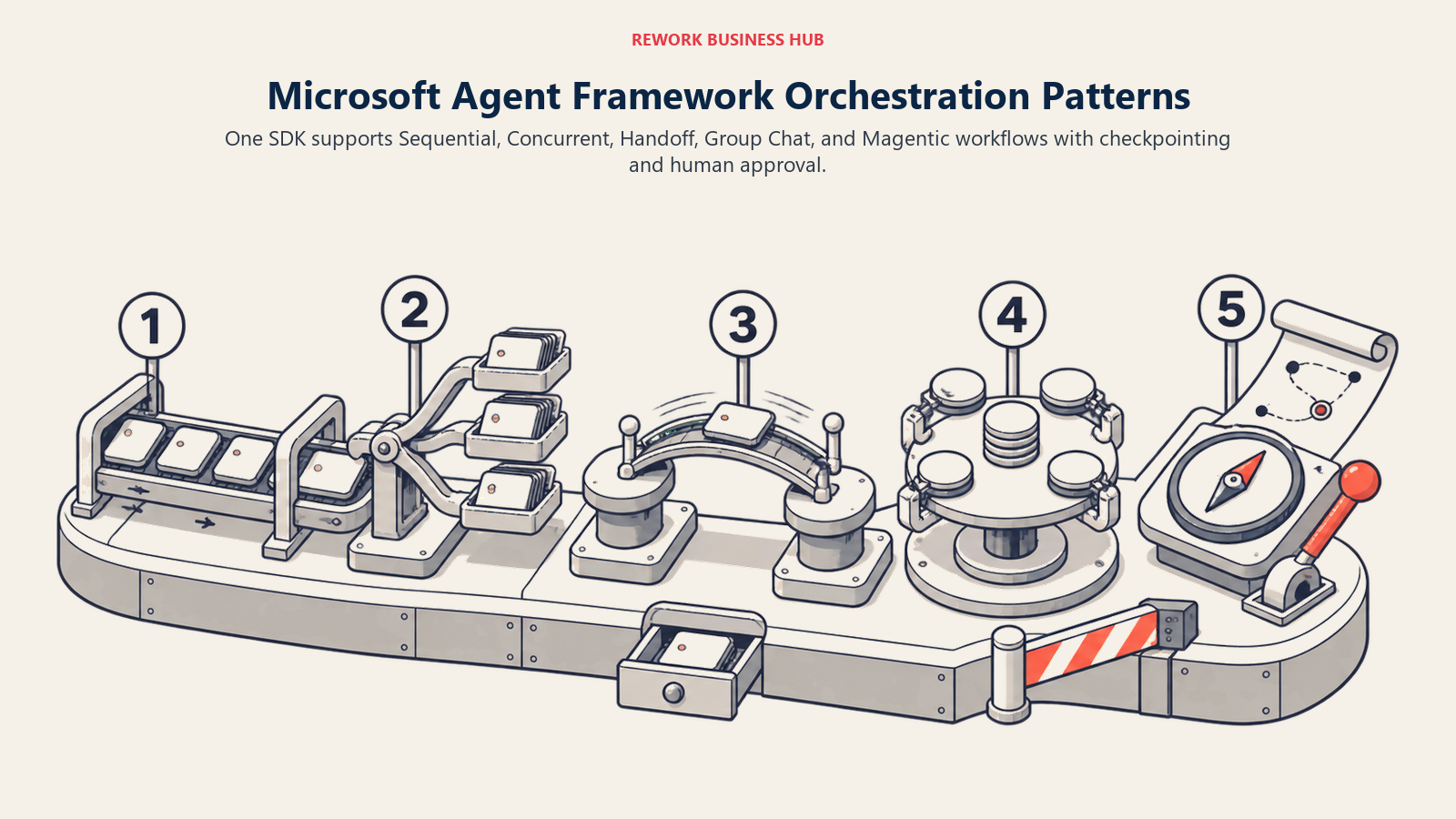
That flexibility has a cost signature worth knowing upfront: sequential and handoff patterns invoke agents individually, which limits concurrent resource use but accumulates cost across steps, while Magentic's iterate-until-viable-plan design makes total cost the hardest of the five to predict in advance.
| What you get | What you don't |
|---|---|
| Five stable orchestration patterns in one SDK, not one opinionated default | Magentic's iterative planning makes total run cost hard to predict upfront |
| Native streaming, checkpointing, and human-in-the-loop approval across all five | Younger unified product; ecosystem and tutorials still catching up to legacy AutoGen |
| Deep Azure AI Foundry integration for teams already on Microsoft's stack | Best fit narrows outside the Microsoft ecosystem |
Licence: MIT. Pricing: Free and open source, no licence fee. Cost is the model API usage you connect it to, typically Azure OpenAI Service token pricing. Best for: Teams that want to pick a different orchestration pattern per workflow without adopting a second framework.
4. AutoGen and AG2: The Original Shared-Conversation Pattern, Two Paths Now
AutoGen popularized multi-agent orchestration as a group conversation: agents publish to and read from one shared topic, and a GroupChatManager uses an LLM-based selector to pick the next speaker, tracking the previous speaker so the same agent doesn't dominate the thread. That shared-topic model is genuinely different from a handoff: nothing is "transferred," because every participant already sees everything.
As of 2026, Microsoft's AutoGen is officially in maintenance mode, its development redirected into Microsoft Agent Framework. AG2, the community fork created after a 2024 governance split, kept building independently under Apache-2.0, with an active roadmap and the only genuinely open, non-corporate governance model in this list. For the underlying pattern either way, see multi-agent systems.
| What you get | What you don't |
|---|---|
| AutoGen: the original, most battle-tested group-chat pattern, huge example base | AutoGen: no new features; Microsoft's roadmap points to Agent Framework instead |
| AG2: same pattern, Apache-2.0, actively maintained, open governance | AG2: far smaller community and star count than AutoGen or LangGraph |
| Both: proven "conversation as control flow" model for dynamic, open-ended tasks | Both: less native durability tooling than LangGraph's checkpointing |
Licence: AutoGen: MIT (code). AG2: Apache-2.0. Pricing: Both free and open source; no official hosted tier for either. Best for: Teams that want the classic shared-conversation multi-agent pattern, with AG2 as the actively developed choice.
5. OpenAI Agents SDK: Native Handoffs From the Model Vendor Itself
The OpenAI Agents SDK's signature multi-agent pattern is the Handoffs primitive: a cheap triage agent classifies an incoming request and transfers it to the right specialist using the handoff() function, with the full conversation history moving to the new agent by default and optional structured metadata (a reason, a priority) attached along the way. It's the production successor to OpenAI's experimental "Swarm" project, a different thing entirely from LangGraph's langgraph-swarm library or the separate Swarms framework covered below.
Despite the name, it isn't locked to OpenAI models; an official LiteLLM extension reaches more than 100 providers.
| What you get | What you don't |
|---|---|
| Handoffs is a first-class, minimal primitive, not something bolted on | Full-history handoffs by default can bloat context over multiple transfers |
| Structured metadata support lets a receiving agent act on why it was called | Thinner built-in persistence story than LangGraph's checkpointing |
| Multi-provider support via an official LiteLLM extension | LiteLLM provider support is officially best-effort, still in beta |
Licence: MIT. Pricing: Free SDK; cost is model token usage, with flagship pricing around $5.00 per million input tokens and $30.00 per million output tokens per OpenAI's published API rates. Best for: Teams building a triage-and-specialist pattern natively on OpenAI's models.
6. Google ADK: Hierarchical Sub-Agents Built for Vertex AI Deployment
Google's Agent Development Kit models multi-agent systems as a hierarchy: a parent agent owns a list of sub_agents it can delegate to, and three workflow agent types handle the mechanical patterns without custom orchestration code. SequentialAgent runs children in a fixed order. ParallelAgent fans work out to run concurrently. LoopAgent repeats a sub-agent until a condition is met. All three compose, so a real ADK system is usually a tree of these wired together.
ADK is Apache-2.0 and free to self-host. Where it earns its keep is deployment: it's built to ship straight to Vertex AI Agent Engine, Google's managed runtime, which bills on consumption (compute, memory, and session storage) rather than a flat subscription, the same model AWS Bedrock AgentCore uses for its own agent runtime.
| What you get | What you don't |
|---|---|
| Three composable workflow agent types cover sequential, parallel, and loop patterns natively | Consumption-based Agent Engine pricing has no flat, predictable number to quote upfront |
| Native path to Vertex AI Agent Engine, Google Search grounding, and BigQuery | Best fit narrows outside Google Cloud-standardized teams |
| Apache-2.0, genuinely self-hostable outside Google Cloud entirely | Younger multi-agent-specific tutorial base than LangGraph or CrewAI |
Licence: Apache-2.0. Pricing: Framework free. Vertex AI Agent Engine hosting bills on consumption, no flat subscription; foundation model tokens billed separately. Best for: Teams deploying a hierarchical multi-agent system on Google Cloud infrastructure.
7. Claude Agent SDK: Orchestrator-Worker With Isolated Subagent Context
The Claude Agent SDK exposes the same lead-agent-plus-subagents architecture that powers Claude Code. A lead agent delegates a task to a subagent, which runs in its own isolated context window, a clean slate containing only its system prompt, the delegation message, and whatever it reads or calls, with no visibility into the main conversation's history. When the subagent finishes, only its final summary returns to the lead; the verbose intermediate work (searches, file reads, tool output) never reaches the parent context. Subagents can spawn their own subagents up to a configurable depth (3 levels by default), and up to 20 can run concurrently before hitting the default limit.
That isolation is a deliberate design choice, not a limitation: it's what keeps a lead agent's context window from filling up with exploration detail it doesn't need, at the cost of the lead never seeing what it didn't ask a subagent to summarize.
| What you get | What you don't |
|---|---|
| Genuine context isolation: verbose subagent work never pollutes the lead's context | Summary-only returns mean the lead can miss detail it never asked to see |
| Nested subagent spawning (3 levels by default) for real hierarchical delegation | No shared-state object across subagents; coordination happens through the lead |
| Model selection per subagent (route cheap tasks to a cheaper model) for cost control | Concurrent subagent limit (20 by default) needs raising for very large fan-outs |
Licence: MIT (SDK). Pricing: Free, open source SDK; cost is standard Claude API token usage, currently $2/$10 per million input/output tokens for Sonnet 5, $5/$25 for Opus 5, $1/$5 for Haiku 4.5. Best for: Coding and research agents that need clean context isolation between a lead agent and its specialists.
8. LlamaIndex Workflows: Handoffs Inside a Retrieval-Heavy Pipeline
LlamaIndex Workflows' AgentWorkflow orchestrates multiple agents through a canHandoffTo parameter: each agent declares which other agents it's allowed to delegate to, and when it calls the built-in handoff tool, control and the full workflow Context object transfer to the named agent. That grew directly out of LlamaIndex's retrieval and data-connector heritage, which shows in how naturally it handles a multi-agent system whose core job is pulling from documents and structured sources rather than pure conversation.
| What you get | What you don't |
|---|---|
canHandoffTo makes the handoff graph explicit and declared upfront, not implicit |
Smaller multi-agent-specific community than LangGraph or CrewAI |
| Best-in-class retrieval and data-connector primitives among this list | Most tutorials still assume a RAG use case even for general multi-agent work |
| Works standalone or layered under the full LlamaIndex stack | Workflow context serialization is newer than LangGraph's checkpointing |
Licence: MIT. Pricing: Framework free. LlamaCloud (hosted parsing and indexing) is usage-based and separate. Best for: Multi-agent systems where handing off between retrieval and reasoning specialists is the core job.
9. Swarms: Every Topology in One Enterprise-Grade Framework
Swarms, built by Kye Gomez and the Swarm Corporation, takes a different bet than the rest of this list: instead of picking one or two topologies, it ships 12 named multi-agent structures in one package, including sequential and concurrent workflows, a director-worker hierarchical pattern, an asynchronous group chat, a mixture-of-agents pattern that runs parallel experts and aggregates their answers, and a graph-based DAG orchestrator. It also advertises backward compatibility with LangChain, AutoGen, and CrewAI agents, positioning itself as an orchestration layer over other frameworks rather than a replacement for them.
That breadth is the whole pitch, and also the learning curve: a small team building one workflow will use a fraction of what's here.
| What you get | What you don't |
|---|---|
| 12 prebuilt multi-agent structures, more topology coverage than any framework here | Broad surface area means picking the right structure takes real evaluation time |
| Interoperability claims with LangChain, AutoGen, and CrewAI agents | Smaller mindshare and tutorial base than the Python-first incumbents |
| Cloud tier with usage-based token pricing for teams that don't want to self-host | On-premise Enterprise licence is priced separately from the Cloud tiers |
Licence: Apache-2.0. Pricing: Framework free. Swarms Cloud: Free ($0, 100 requests/minute); Pro $19.99/month; Premium $100/month ($1,020/year); Enterprise custom, with a separate $9,999/year on-premise licence. Best for: Teams that want every major topology available in one framework without switching tools per pattern.
10. CAMEL: The Role-Playing Framework Behind Multi-Agent Research
CAMEL started from a research question, "what happens when you let two AI agents talk to each other with only a starting role and goal," and its role_playing module still shows that origin: two agents, an "AI user" and an "AI assistant," carry out a structured, turn-taking dialogue toward a task, with no external orchestrator directing the conversation. CAMEL has since scaled that idea into "societies" and "workforces" of many agents, positioning itself as a framework for studying how agent populations behave and coordinate at scale, not just a tool for shipping one workflow.
The commercial product built on top, Eigent, is a separate desktop multi-agent product with its own subscription pricing, distinct from the open-source CAMEL framework itself.
| What you get | What you don't |
|---|---|
| Purpose-built for studying multi-agent behavior and coordination, not just running one workflow | Less oriented toward "ship a production workflow fast" than CrewAI or LangGraph |
| Scales from a two-agent role-play to large agent societies | Smaller production-deployment track record than the incumbents on this list |
| Apache-2.0, fully permissive, active development (pushed within the past week) | Commercial layer (Eigent) is a separate product and price, not the framework itself |
Licence: Apache-2.0. Pricing: Framework free. Eigent, the team's separate commercial desktop product, is priced independently; see eigent.ai/pricing for current tiers. Best for: Teams and researchers studying how agent populations coordinate, not just teams that need one workflow shipped.
11. MetaGPT: A Fixed Pipeline That Simulates a Software Team
MetaGPT takes a one-line requirement and runs it through a fixed sequence of specialized role agents, product manager, architect, project manager, engineer, each producing a structured document (user stories, a design, tasks, code) that becomes the next role's input, following SOPs meant to mirror how a real software team hands off work. That fixed, sequential, role-based pipeline is a genuinely different topology from the other frameworks here, closer to an assembly line than a conversation.
Worth stating plainly: the open-source MetaGPT repository has gone quiet, with no push since late January 2026, while its creator, DeepWisdom, moved commercial focus to Atoms (rebranded from MGX in January 2026), a separate hosted product with its own pricing. That's not disqualifying, the framework still works and remains MIT-licensed, but it's a real signal to weigh against a framework where the team's attention has visibly shifted.
| What you get | What you don't |
|---|---|
| A genuinely distinct fixed-pipeline topology, useful for reproducing a software team's document handoffs | Open-source repo has gone quiet since January 2026; verify current activity before betting on it |
| MIT licence, no carve-outs | Company focus has visibly shifted to the commercial Atoms product |
| Clear, structured document handoffs between roles (PRD to design to code) | Less flexible than a general-purpose framework for workflows outside the software-team shape |
Licence: MIT. Pricing: Framework free. Atoms (the commercial, rebranded product): Free ($0/month, 15 credits/day); Pro from $20/month (100 credits); Max from $100/month (500 credits). Best for: Reproducing a fixed, sequential software-team handoff pipeline, with eyes open about the framework's current maintenance pace.
When Multi-Agent Is the Wrong Choice
Every framework above works. The harder discipline is knowing when none of them should be used yet. Anthropic's own guidance, from the team that published the clearest data on multi-agent performance and cost, is to find the simplest solution that works, and to treat a single LLM call or a single tool-using agent as sufficient for most tasks.
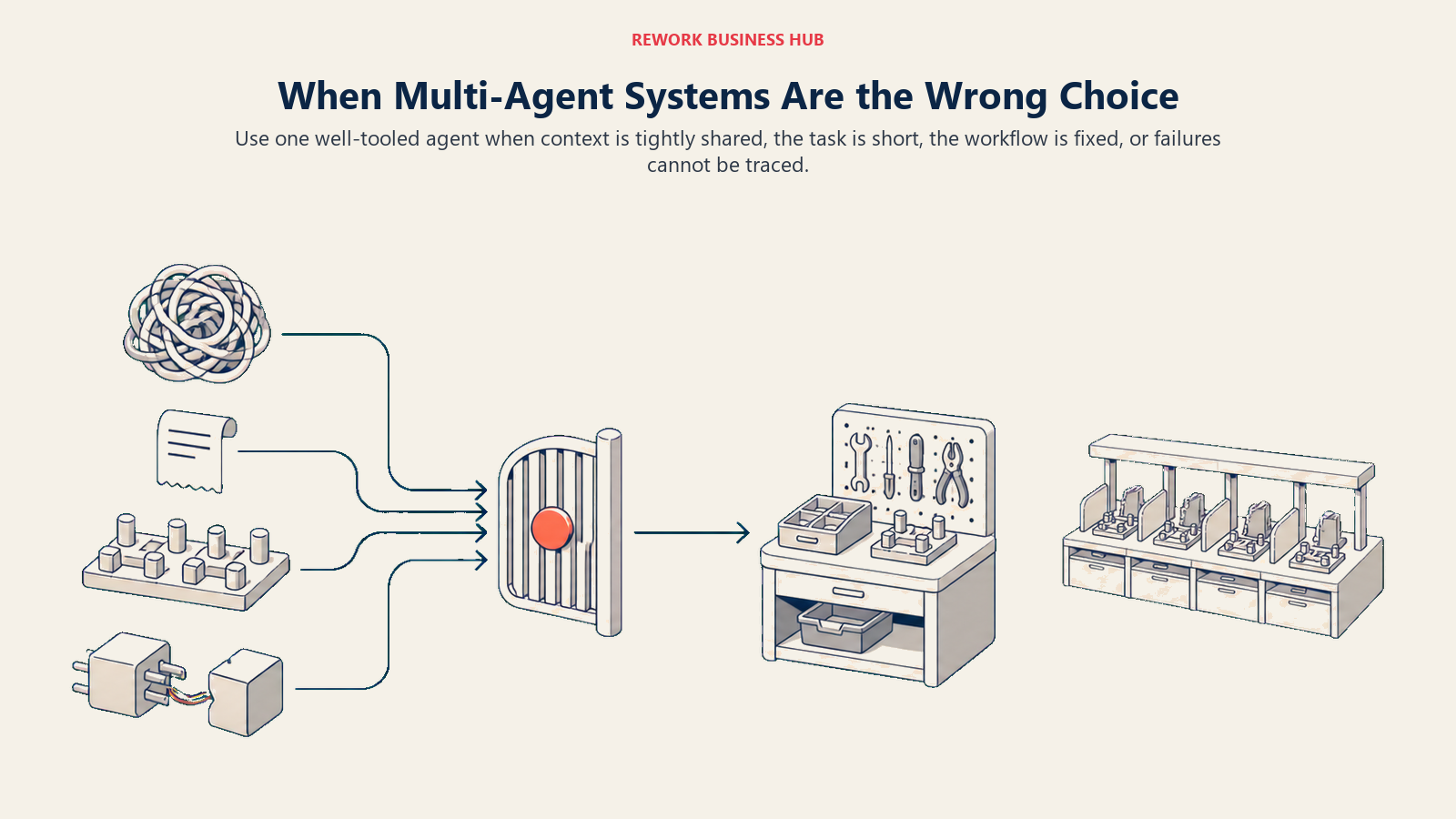
| Signal | Why It Predicts Trouble | What to Do Instead |
|---|---|---|
| The task needs every agent to share dense, overlapping context | Anthropic's own findings flag exactly this as a poor fit, since agents duplicate work or step on each other, most coding tasks included | One agent with a bigger context window and better tools, not more agents |
| You can't say who's "in charge" when two agents disagree | MAST's largest failure category (~41.8%) is specification and system-design issues: unclear roles, ambiguous handoff conditions, missing verification | Write the handoff contract down before you write the code: who owns the final call |
| The task is a short, single-turn request | A 15x token multiplier only pays for itself on tasks with real value at stake | A single well-tooled agent, or a plain LLM call with good examples |
| Your pipeline chains many sequential steps, each individually reliable | 10 steps at 99% reliability each compound to roughly 90% overall; 20 steps at 95% each drop under 36% | Shorten the chain, add verification checkpoints, or collapse steps into fewer, larger turns |
| Nobody on the team can explain why the last run failed | Most real multi-agent failures need full-session trace review to diagnose, not a single log line | Pick a framework with real tracing (LangSmith, AgentOps, built-in observability) before scaling usage |
| The job is templated and repeats the same way every time | Multi-agent's advantage is judgment on non-routine work; a fixed job doesn't need it | A no-code AI agent builder or standard automation, both cheaper to run and debug |
If your team is choosing a platform for procurement, compliance, or security-review reasons rather than orchestration pattern, that's a different decision entirely; see best enterprise AI agent platforms for that lens.
How to Choose: Decision Framework
Choose the control topology first, then use the matrix to pick the framework that implements it with the durability and deployment model you need.
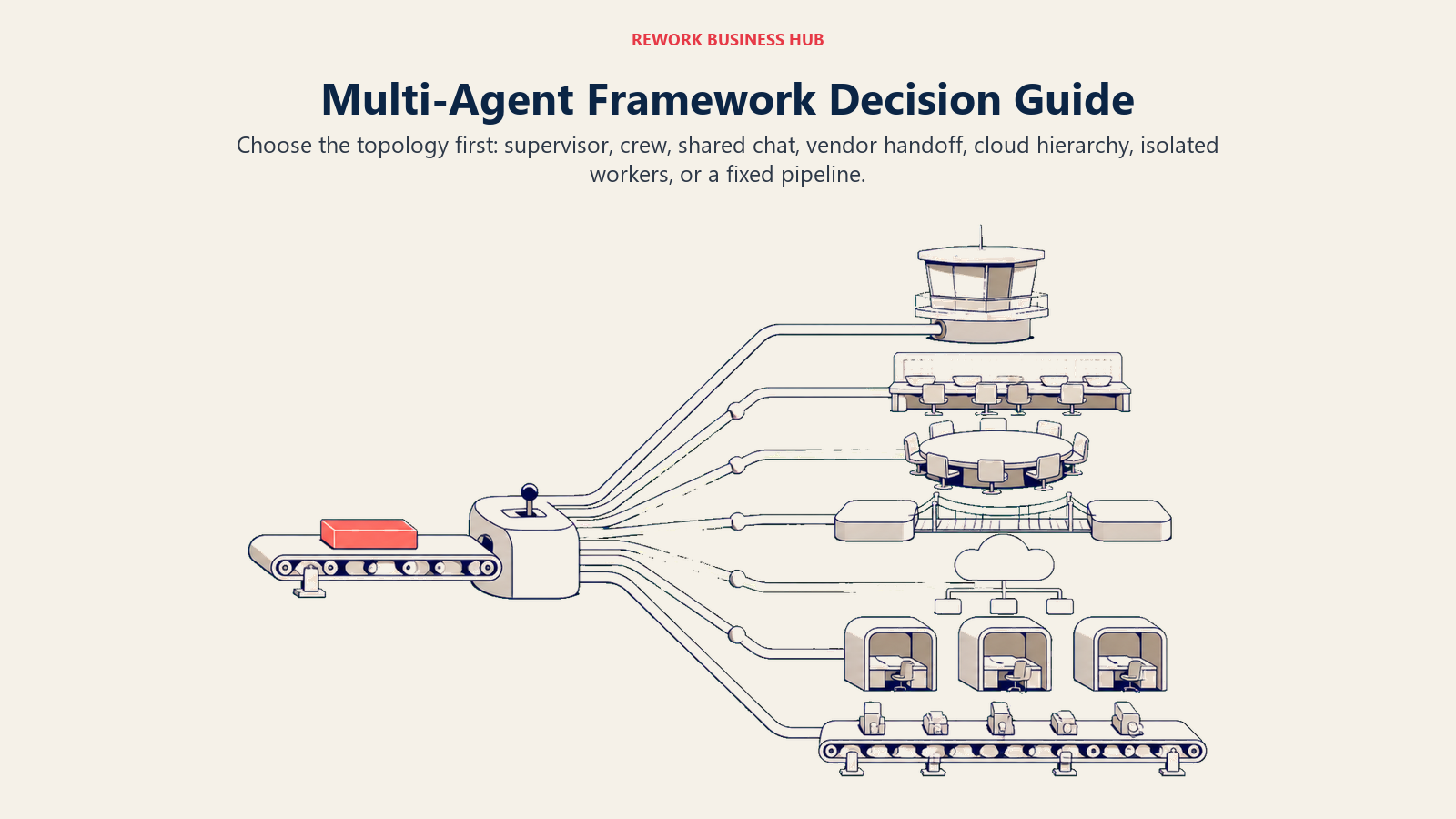
| If you need... | Pick... | Why |
|---|---|---|
| Explicit control over supervisor vs. swarm, with full replay | LangGraph | Both patterns ship as maintained libraries on native checkpointing |
| The fastest role-based crew running today | CrewAI | Sequential or hierarchical process, the largest tutorial base here |
| Every built-in orchestration pattern in one enterprise SDK | Microsoft Agent Framework | Sequential, Concurrent, Handoff, Group Chat, and Magentic, all stable |
| The original shared-conversation pattern, still openly governed | AG2 | Apache-2.0, community-governed fork of AutoGen, actively maintained |
| Native handoffs tied to your model vendor | OpenAI Agents SDK | Handoffs primitive built by the same lab that trains the models |
| Multi-agent that deploys straight to your cloud's agent runtime | Google ADK | Sub-agent hierarchy plus Sequential/Parallel/Loop, built for Vertex AI |
| Context-isolated subagents for coding or research work | Claude Agent SDK | Each subagent gets a clean context window; only a summary returns |
| Handoffs inside a retrieval-heavy pipeline | LlamaIndex Workflows | canHandoffTo hands control between specialists mid-workflow |
| Every topology available without switching frameworks | Swarms | 12 prebuilt structures, from sequential to hierarchical to group chat |
| A framework for studying agent-to-agent behavior itself | CAMEL | Role-playing origin, scales to large agent societies |
| A fixed, sequential simulation of a software team's handoffs | MetaGPT | SOP pipeline moves a spec through PM, architect, and engineer roles |
What to Do Next
Before you commit to a framework, write down the handoff contract for your actual workflow: which agent owns the final decision, what exactly transfers at each handoff, and what happens when two agents disagree. Then build the smallest version that tests it, one supervisor and two workers, or a single sequential handoff, in whichever framework matches your language and ecosystem. Time-box it to a week and measure token cost against a single well-tooled agent doing the same job. If the single agent gets you most of the way there, you likely don't need the others yet.
If you do need them, choosing an AI agent platform covers the broader buy-versus-build decision, and how to build an AI agent walks through the fundamentals regardless of which framework you land on.

Principal Product Marketing Strategist
On this page
- Key Facts
- What Changed in Multi-Agent Orchestration This Year
- Quick Comparison Table
- Multi-Agent Orchestration Topologies, Explained
- How Handoffs Actually Pass Context
- Shared State and Memory Between Agents
- The Real Cost of Multi-Agent: Token Multiplication
- Debugging and Tracing a Multi-Agent Run
- 1. LangGraph: Supervisor and Swarm as Pluggable Libraries, Not a Hand-Rolled Pattern
- 2. CrewAI: Role-Based Crews, Sequential or Hierarchical
- 3. Microsoft Agent Framework: Every Built-In Pattern in One SDK
- 4. AutoGen and AG2: The Original Shared-Conversation Pattern, Two Paths Now
- 5. OpenAI Agents SDK: Native Handoffs From the Model Vendor Itself
- 6. Google ADK: Hierarchical Sub-Agents Built for Vertex AI Deployment
- 7. Claude Agent SDK: Orchestrator-Worker With Isolated Subagent Context
- 8. LlamaIndex Workflows: Handoffs Inside a Retrieval-Heavy Pipeline
- 9. Swarms: Every Topology in One Enterprise-Grade Framework
- 10. CAMEL: The Role-Playing Framework Behind Multi-Agent Research
- 11. MetaGPT: A Fixed Pipeline That Simulates a Software Team
- When Multi-Agent Is the Wrong Choice
- How to Choose: Decision Framework
- What to Do Next