Best AI Agents for Project Management in 2026: 11 Agents for Status, Risk, and Task Automation
Turn this article into takeaways for your work.


Each assistant summarizes the article only for you and suggests best practices for your work.
Asana's AI Studio and AI Teammates and monday.com's native agent workforce lead this list for teams that want an agent to actually act (reassign a task, reschedule a deadline, draft the status update) rather than just flag a problem, Atlassian's Rovo Agents and Wrike's Work Intelligence are the strongest picks if the real need is catching delivery risk early inside an engineering-heavy org, and Notion Agents is the one genuinely autonomous enough to run a whole project end to end with light supervision. Selection method: every agent below had to demonstrably plan, act, or predict against real project data, not just summarize it in a chat window, and every price is.
This guide covers agents that live inside a work-management platform and touch actual project execution: status roll-ups, risk and slippage detection, task creation and assignment, dependency and capacity checks, meeting-to-task capture, and resource planning. That's a narrower question than best AI tools for project managers, which covers AI that drafts and summarizes while a human does every step, or best AI tools for agile teams, which covers the sprint ceremonies specifically. An AI tool assists a human who stays in the loop for every action. An agent plans a sequence, takes the action inside your board or backlog, and checks back in at the boundaries rather than at every click, a loop the what is an AI agent explainer covers in more depth. If you'd rather build a narrow one than buy a platform's version, the AI project status agent and AI risk monitoring agent blueprints are the vendor-neutral starting point.
Updated August 2026: What Changed
- monday.com repositioned as an "AI work platform." It shipped native infrastructure for agents to authenticate and operate inside a workspace, then launched Agentalent.ai in March 2026, a managed marketplace for discovering and effectively hiring agents into defined roles.
- Notion's Custom Agents reached general availability on May 4, 2026. They now run on a schedule or trigger without anyone opening the app, on top of the autonomous Agents Notion introduced with Notion 3.0 in September 2025.
- Height shut down on September 24, 2025. The tool several 2025 roundups pointed to for "autonomous project management" no longer exists. It's not on this list because there's nothing left to verify.
- Atlassian's Rovo credit pools (25/70/150 per seat by tier) are still unmetered for overage as of mid-2026, though Atlassian has flagged usage-based billing is coming with 90 days' notice.
- Smartsheet announced a "Smart Agent Platform" for continuous, autonomous monitoring, but it isn't shipped yet. What's live today is Smart Assist plus an MCP server that lets an external agent (Claude, Copilot, ChatGPT, Gemini) read and act on Smartsheet data instead.
- Airtable folded AI credits into plan pricing on June 24, 2025. Its Omni agent builder is free to use either way; only running the agents you build against it draws down the credit pool.
- Bending Spoons agreed to acquire Airtable for $1.285 billion on August 4, 2026, a deal expected to close later this year. Airtable also shipped Superagent in January 2026 and Hyperagent shortly after, both more autonomous successors to Omni, though Hyperagent was carved out into a separate corporation just ahead of the sale.
Key Facts
- Gartner predicts 40% of enterprise applications will feature task-specific AI agents by the end of 2026, up from less than 5% in 2025, per Gartner.
- Only 16% of what companies call an "AI agent" in production actually plans, observes, and adapts on its own; the rest are fixed-sequence workflows wearing agent branding, per Menlo Ventures' State of Generative AI in the Enterprise report.
- Gartner predicts organizations will abandon 60% of AI projects through 2026 for lack of AI-ready data, per Gartner; a project board full of stale statuses is that exact problem wearing a different name.
- 72% of organizations spend half a day or more every month manually collating a project status report, and 42% spend a full day or more, per Wellingtone's State of Project Management Report.
- Only 36% of organizations say they always or mostly complete projects on time, per the same Wellingtone research.
- Project professionals who use GenAI on more than half their projects are 16 times more likely to achieve advanced productivity gains than those still experimenting with it, per PMI's GenAI Journey report.
Quick Comparison Table
| Agent | Best For | Starting Price | Detects or Acts | Key Limitation |
|---|---|---|---|---|
| Asana AI Studio + AI Teammates | Prebuilt, named agents for specific PM jobs | $10.99/user/mo (Starter, AI Studio included) | Acts | AI Teammates priced separately, contact sales |
| monday.com AI Agents | Native risk detection plus a hiring marketplace | $9/seat/mo (full agent workforce at $12/seat) | Detects and acts | AI credits are now a required paid add-on |
| Atlassian Rovo Agents (Jira) | Delivery risk inside an engineering-led org | Free (10 users); $7.91/user/mo | Detects and acts | Weak fit if engineering isn't already on Jira |
| ClickUp Autopilot Agents | Trigger-based automation across one workspace | $7/user/mo + Brain $9/user/mo | Acts | Brain billed per workspace member, not per AI user |
| Wrike Work Intelligence | Predicting risk on large, complex programs | $10/user/mo (Team; AI Elite actions from $25 Business) | Mostly detects | Deeper AI Elite actions are metered, add-on required |
| Notion Agents | Handing an agent a whole project end to end | $20/user/mo (Business, full AI required) | Acts | Full AI gated to the $20/user/mo tier |
| Linear Agents | Assigning delivery work to a coding agent | $16/user/mo (Business, full agent API) | Acts | Scope is engineering delivery, not general status/risk PM |
| Motion AI Project Manager | Scheduling that re-plans around real conflicts | $19/mo (Pro AI) | Acts | No free tier, only a 7-day trial |
| Airtable Omni | Building a custom agent on structured project data | Free to build; $20/user/mo (Team) for real usage | Configurable | You design what it detects or acts on yourself |
| Taskade AI Agents | Multi-agent automation on a small team's budget | $10/mo (Pro, ~10 users) | Acts | Thinner governance than enterprise PM platforms |
| Smartsheet AI | Acting on project data through an AI you already use | $9/user/mo (Pro) | Detects natively | Native autonomous Smart Agents not yet shipped |
What Actually Counts as an Agent Here: Detect vs Act
Every vendor on this list has an AI button somewhere on its pricing page. Fewer of them clear the bar this guide uses: does the agent take a multi-step action inside your actual project data (reassign a task, reschedule a deadline, escalate a blocked dependency, draft and post the status update), or does it only detect and describe a problem for a person to act on. Both are legitimate purchases. They are not the same purchase, and a vendor's homepage rarely makes clear which one you're buying until you're already using it.
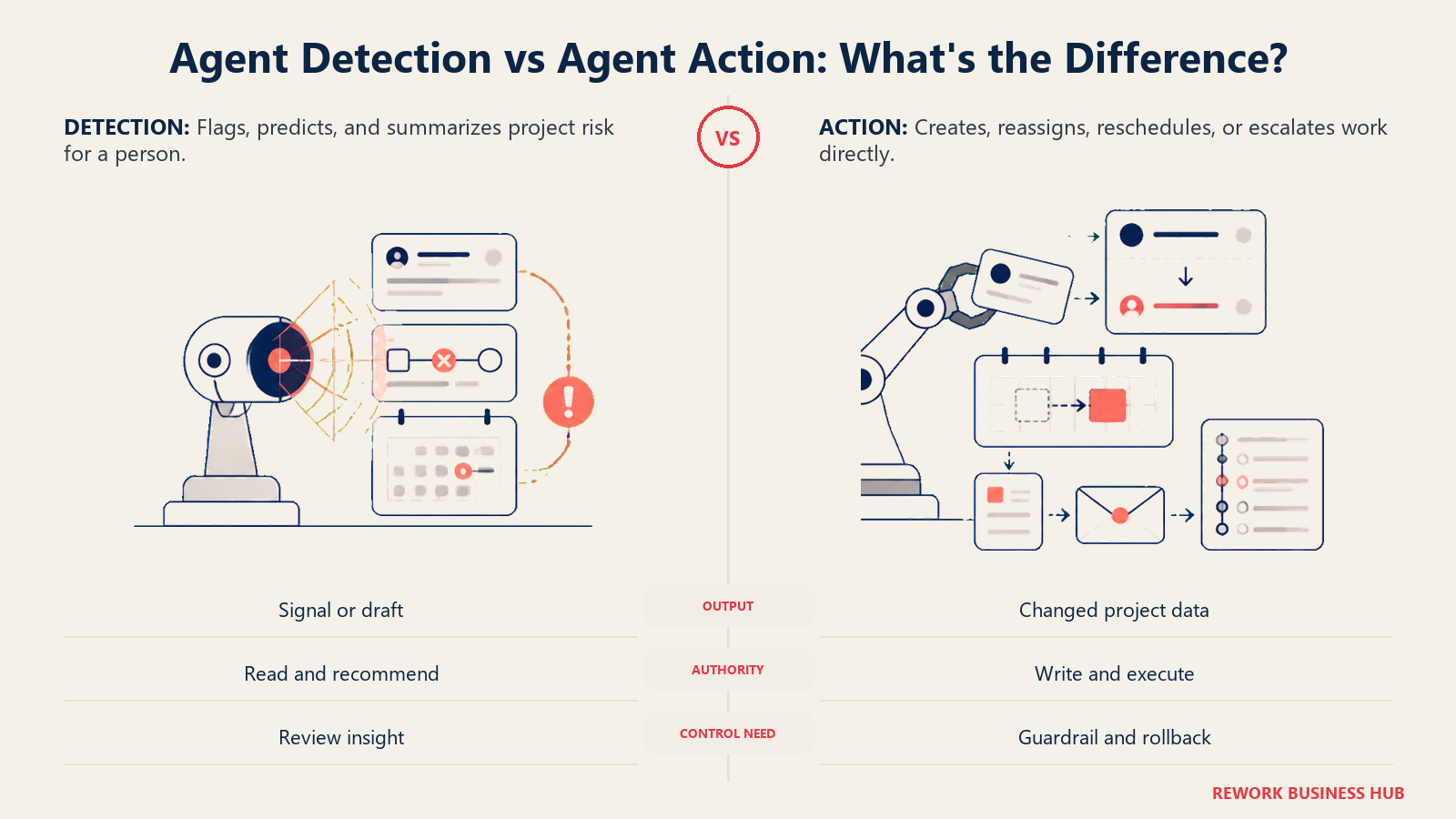
| Agent | Detects (flags, predicts, summarizes) | Acts (creates, reassigns, reschedules, escalates) |
|---|---|---|
| Asana AI Studio + AI Teammates | Data Quality Manager and Status Reporter flag gaps and draft updates | Workflow Optimizer and AI Studio automations route and create work, including across connected systems |
| monday.com AI Agents | Project Analyzer flags bottlenecks and predicts delays in real time | Agent workforce updates workflows, triggers automations, generates reports |
| Atlassian Rovo Agents (Jira) | Jira Delivery Agent monitors progress and flags delivery risk | Service Triage and On-call Helper act directly inside Jira Service Management workflows |
| ClickUp Autopilot Agents | Super Agents reason across steps before acting | Autopilot Agents auto-execute triggered actions on tasks, subtasks, and chats |
| Wrike Work Intelligence | Predicts project risk from historical delivery patterns | AI Priority Inbox triages intake; deeper Elite actions extend further, metered |
| Notion Agents | Summarizes and audits a stale project brief on request | Builds a launch plan, breaks it into tasks, assigns them, and drafts docs, largely unattended |
| Linear Agents | Triage Intelligence auto-routes and flags incoming issues | Assigns issues to external coding agents that ship the fix as a pull request |
| Motion AI Project Manager | Flags scheduling conflicts as they appear | Automatically re-plans the calendar and task order around them, no confirmation step |
| Airtable Omni | Whatever you configure it to watch for | Whatever you configure it to create or update; no native default |
| Taskade AI Agents | Multi-agent teams can review and report on task state | Multi-agent teams can execute and update tasks directly |
| Smartsheet AI | Smart Assist and Smart Columns summarize and analyze on request | Native Smart Agents still in development; action today runs through an external MCP-connected agent |
The Precondition Nobody Wants to Hear: Your Tickets Have to Be Honest First
None of the eleven agents below fix a project board where half the tasks say "In Progress" because nobody has touched the status field in three weeks. Gartner predicts organizations will abandon 60% of AI projects through 2026 for lack of AI-ready data, and a project board is exactly that kind of data: it's only as trustworthy as the last person who bothered to update it. A status-roll-up agent reading a stale board doesn't produce a wrong answer that looks wrong. It produces a confident answer that happens to be wrong, which is worse than the manual status meeting it was supposed to replace.
That gap is probably why 72% of organizations still spend half a day or more every month manually collating a status report by hand, per Wellingtone's research, and why only 36% of organizations say they complete projects on time. Manual collation is a workaround for a board nobody fully trusts. An agent doesn't remove that trust gap on its own. It automates whatever is actually sitting in the field, gap included, faster than a human would have.
Before shortlisting anything below, check three things: whether your team updates task status as a habit or only when a manager asks, whether "done" means the same thing on every team's board (a common failure mode when marketing and engineering share one workspace with different conventions), and whether dependencies are actually linked inside the tool or only tracked in someone's head. If the honest answer is "not really" on any of those, a status or risk agent will either surface that gap loudly in its first week, the best outcome, or quietly launder it into a confident-looking report nobody double-checks, the outcome that costs you a blown deadline later.
Sizing and Persona Table
| Agent | Ideal Team Size | Primary Buyer Persona |
|---|---|---|
| Asana AI Studio + AI Teammates | 20-2,000+ employees | PMO Director, Ops Lead, Marketing Ops Manager |
| monday.com AI Agents | 10-1,000 employees | Operations Manager, PMO, Team Lead |
| Atlassian Rovo Agents (Jira) | 20-5,000+ employees | Delivery Lead, Engineering Manager, Release Manager |
| ClickUp Autopilot Agents | 5-500 employees | Ops Manager, Team Lead, Small PMO |
| Wrike Work Intelligence | 50-5,000+ employees | Program Manager, Portfolio Manager, PMO Director |
| Notion Agents | 10-1,000 employees | PM running docs-first teams, Chief of Staff |
| Linear Agents | 5-500 employees (engineering-led) | Engineering Manager, Delivery Lead |
| Motion AI Project Manager | 1-200 employees | PM, Consultant, Solo operator managing several projects |
| Airtable Omni | 10-1,000 employees | Ops Lead, RevOps or BizOps building custom trackers |
| Taskade AI Agents | 1-100 employees | Small team lead, Founder, Agency PM |
| Smartsheet AI | 50-5,000+ employees | PMO Director, Enterprise Program Manager |
1. Asana AI Studio + AI Teammates: The Widest Bench of Purpose-Built PM Agents
Asana's bet for 2026 is that a project manager shouldn't have to choose between an AI assistant and a real teammate. AI Studio is a no-code builder for wiring multi-step automations (route a request, validate a form, escalate a blocked task) directly into the same projects and portfolios already in use, while AI Teammates are 30 prebuilt agents, including Status Reporter, Data Quality Manager, Workflow Optimizer, Decision Tracker, and Sprint Coach, that sit inside a project like a named team member rather than a chat window bolted to the side. Asana positions the combination as capable of orchestrating multi-step work across CRMs, ERPs, and other connected systems, not only inside Asana's own boards.
The honest limit is cost clarity. AI Studio's usable capacity ships as a shared credit pool tied to the plan (50,000 monthly credits on Starter, 75,000 on Advanced, 200,000 on Enterprise), and AI Teammates themselves are a separate line item priced only after a sales call, which makes it hard to budget the full agent build before talking to Asana.
| What you get | What you don't |
|---|---|
| 30 prebuilt AI Teammates for PM-adjacent roles, not just chat | AI Teammates are priced separately, contact sales required |
| No-code AI Studio for custom, multi-step, cross-system workflows | Credit pool is shared account-wide, not per user |
| AI Studio is included starting at the Starter tier | Deeper orchestration assumes fluency in Asana's own structure |
Pricing: Personal is free for up to 2 users. Starter is $10.99/user/month annually ($13.49 monthly), with AI Studio Basic and 50,000 monthly credits included. Advanced is $24.99/user/month annually ($30.49 monthly), 75,000 credits. Enterprise is custom, 200,000 credits. AI Teammates are priced separately. Source: asana.com/pricing.
Best for: PMOs and ops teams that want prebuilt, named agents for specific PM jobs (status, data quality, workflow routing) instead of one general-purpose chat assistant.
2. monday.com AI Agents: A Native Agent Workforce, Now With a Hiring Marketplace
monday.com spent 2026 repositioning around agents rather than boards. The platform now ships dedicated infrastructure for AI agents to authenticate and operate inside a workspace, and in March 2026 it launched Agentalent.ai, a managed marketplace where a company discovers, evaluates, and effectively hires an agent into a defined role. The most directly relevant agent for this list is the Project Analyzer, which monitors every active project in real time, flags bottlenecks, identifies at-risk items, and predicts delays from progress and timeline data instead of waiting for someone to raise a hand.
The catch is pricing structure, not capability. As of May 2026, AI credits became a required paid add-on for new signups rather than a bundled freebie, and the useful agent workforce is gated above the entry tier: Basic only gets a limited agent workforce, Standard is where it opens up fully.
| What you get | What you don't |
|---|---|
| Native agent infrastructure, not a bolted-on chat panel | AI credits are now a required paid add-on for new signups |
| Project Analyzer predicts delays before they're a surprise | Full agent workforce requires Standard tier or above |
| Agentalent.ai marketplace to add specialized agents by role | Marketplace is new in 2026; maturity still varies by agent |
Pricing: Free for up to 2 seats. Basic is $9/seat/month annually, 1,000 AI credits/month, limited agent workforce. Standard is $12/seat/month annually, 2,000 credits, full agent workforce plus a meeting notetaker. Pro is $19/seat/month annually, 3,000 credits, adds an AI workflow builder. Enterprise is custom. Source: monday.com/pricing.
Best for: Ops-forward teams already running projects visually on monday.com that want native risk detection with room to add specialized agents as the marketplace matures.
3. Atlassian Rovo Agents (Jira): Delivery Risk Detection Native to the Engineering Stack
Rovo is Atlassian's answer for teams whose project management question is really a software-delivery question. The Jira Delivery Agent monitors progress against a plan and flags delivery risk directly inside the same sprint and backlog data engineering already updates, with no separate tracking tool for the PM to maintain. Beyond delivery risk, Atlassian ships several narrower, prebuilt agents, including Service Triage, On-call Helper, and Service Request Helper for Jira Service Management, plus a Figma Agent that pulls mockups into a ticket, that a PM can assign work to, mention in a comment, or wire into a workflow the same way they'd loop in a person.
The limitation is scope. This is a strong pick specifically for delivery risk inside an engineering-led org already standardized on Jira. It's a weak fit if projects don't run through sprints and backlogs at all.
| What you get | What you don't |
|---|---|
| Delivery-risk detection built on data engineering already updates | Weak fit for PM work that isn't sprint- or backlog-based |
| Rovo credits included, not a separate paid SKU, from Standard up | Standard tier's 25 monthly credits per seat can feel thin |
| Prebuilt agents can be assigned work like a team member | Usage-based billing above the allowance is expected, just not active yet |
Pricing: Free supports up to 10 users. Standard is $7.91/user/month annually, 25 Rovo credits per seat/month. Premium is $14.54/user/month annually, 70 credits per seat/month. Enterprise is custom, 150 credits per seat/month. Source: atlassian.com/software/jira/pricing.
Best for: PMs and delivery leads running sprint-based work inside an engineering org already standardized on Jira.
4. ClickUp Autopilot Agents: Trigger-Based Action Across One Workspace
ClickUp's pitch is that an agent should act on whatever changes in the workspace, not just answer questions about it. Autopilot Agents are no-code, trigger-based agents configured to fire on a task or subtask event across Spaces, Folders, Lists, and Chats, built for well-defined, repeatable jobs like reassigning a task when a status flips or nudging an owner when a due date slips. For work that needs more reasoning across multiple steps, ClickUp separates that into Super Agents, a deliberate split between simple trigger-response automation and something closer to genuine multi-step planning.
The real cost lives in the add-on structure. Brain, the base AI layer that Autopilot Agents run on top of, bills every workspace member whether or not they touch AI, and the deeper Everything AI tier stacks another $28 per user on top, which can push the effective seat cost close to a dedicated enterprise PM tool.
| What you get | What you don't |
|---|---|
| No-code Autopilot Agents for well-defined, repeatable triggers | Brain is billed per workspace member, not per active AI user |
| Super Agents split out for genuinely multi-step reasoning | Everything AI's $28/user/month pushes cost near enterprise tools |
| One workspace for docs, tasks, chat, and the agents that touch them | More setup time than a narrower, purpose-built scheduling tool |
Pricing: Free Forever available. Unlimited is $7/user/month annually ($10 monthly). Business is $12/user/month annually ($19 monthly). Enterprise is custom. Brain AI adds $9/user/month on any paid plan; Everything AI is $28/user/month. Source: clickup.com/pricing.
Best for: Teams that want planning, tasks, docs, and trigger-based agents in a single workspace instead of stitching several specialized tools together.
5. Wrike Work Intelligence: The Strongest Pure Risk-Prediction Layer
Wrike built Work Intelligence around a specific job: catch a project before it slips, not after. It predicts project risk from historical delivery patterns, auto-writes task descriptions from a short prompt, and runs an AI Priority Inbox that triages incoming requests so a program manager isn't hand-sorting every new ask. That prediction-first design makes it one of the stronger detect-side options here, especially for the kind of large, multi-workstream program where a slip in one place cascades into three others.
The honest gap is how much of that stays detection versus action. AI Essentials (drafting, summaries, board AI) is unlimited and free on every paid plan as of an April 2026 pricing update, but the deeper AI Elite actions that actually move work, not just flag it, are metered by tier, with a paid Actions Pack required for heavy use.
| What you get | What you don't |
|---|---|
| Predicts project risk from historical delivery patterns | Deeper AI Elite actions are metered, add-on pack for heavy use |
| AI Essentials unlimited and free on every paid plan | Steeper learning curve than lighter PM tools |
| AI Priority Inbox cuts daily intake triage time | Strongest at detection; acting on the risk still often needs a human |
Pricing: Free plan available. Team is $10/user/month (2-15 users), AI Essentials included. Business is $25/user/month (5-200 users), starter AI Elite actions pack included. Pinnacle and Apex are custom, with 3x and 10x more AI Elite actions respectively. Source: wrike.com/price.
Best for: Program and portfolio managers running larger, multi-workstream initiatives who need risk prediction before a deadline is missed.
6. Notion Agents: The Most Autonomous Agent on This List
Notion rebuilt its AI from the ground up as Agents in Notion 3.0, and the capability gap versus everything else here is real. A Notion Agent can run continuously for up to 20 minutes across hundreds of connected pages, taking on what Notion describes as an entire project end to end: building a launch plan, breaking it into tasks, assigning them, and drafting the supporting docs, largely unattended. Custom Agents reached general availability on May 4, 2026, and can run on a schedule or trigger, so a status pass or a project audit can happen overnight instead of waiting for someone to ask.
The tradeoff is that this lives inside a docs-and-wiki-first workspace, not a purpose-built PM tool. Task dependencies, Gantt-style views, and formal resource planning are thinner here than in Wrike or Smartsheet, and full agent capability is locked to a specific tier.
| What you get | What you don't |
|---|---|
| Genuinely autonomous multi-step runs, up to 20 minutes unattended | Full AI access requires the $20/user/month Business plan |
| Can take on a whole project and draft the supporting docs itself | Dependency tracking and Gantt views are thinner than dedicated PM tools |
| Custom Agents run on a schedule, no one has to open the app | Custom Agents billed separately, on top of the seat cost |
Pricing: Free and Plus ($10/user/month annually, $12 monthly) include no AI. Business is $20/user/month annually ($24 monthly) and includes full AI and Agents. Enterprise is custom. Custom Agents cost an additional $10 per 1,000 monthly credits. Source: notion.com/pricing.
Best for: Teams that already run project docs and planning in Notion and want an agent that can execute a multi-step project, not just summarize one.
7. Linear Agents: Built for Turning Issues Into Shipped Work, Not Status Reports
Linear's agent model is narrower than everything else on this list by design, and worth including specifically because of that. Rather than a general PM assistant, Linear treats agents as peers: Claude Code, Devin, Cursor, and GitHub Copilot show up as workspace members with their own profile and assignment queue, and a PM or engineering lead can assign an issue to one directly, the same way they'd assign it to a person, with the agent posting updates and turning the issue into a pull request through OAuth-scoped read and write access.
That focus is also the limit. This is a strong pick for the specific job of engineering delivery agents that ship code, not for status roll-ups, resource planning, or cross-functional risk tracking, which is what most of the rest of this list is built for.
| What you get | What you don't |
|---|---|
| Agents assigned to issues like a real team member, not a side panel | Scope is engineering delivery, not general PM status or risk |
| Native integration with Claude Code, Devin, Cursor, Copilot | Full agent access gated to the $16/user/month Business tier |
| Triage Intelligence auto-routes and flags incoming issues | Not a fit for teams whose work isn't tracked as engineering issues |
Pricing: Free tier includes the core agent platform (250 issues, 2 teams). Basic is $10/user/month annually. Business is $16/user/month annually and includes Triage Intelligence, Code Intelligence (beta), and full third-party Agent API access. Enterprise is custom. Source: linear.app/pricing.
Best for: Engineering managers and delivery leads who want issues assigned directly to a coding agent instead of routed through a human first.
8. Motion AI Project Manager: The Only Agent Here Built Around Rescheduling Itself
Motion's angle is scheduling specifically, and its AI Calendar is one of the few agents on this list that visibly acts rather than waiting for approval: it auto-plans a day or a project timeline around meetings, deadlines, and task priority, then automatically re-shuffles the plan the moment something changes, with no confirmation step in between. The AI Project Manager and AI Gantt Chart apply that same logic at the project level, and the Business tier extends it to team-wide capacity planning.
The tradeoff is exactly that automatic behavior. There's no free tier to test the risk tolerance before committing, and because rescheduling happens without a review step by default, a team that wants a human to sign off on every date change should budget time to configure that guardrail rather than assume it exists out of the box.
| What you get | What you don't |
|---|---|
| AI Calendar that actually re-plans the day, not just tracks it | No free tier, only a 7-day trial before billing starts |
| Auto-scheduling logic extends to Gantt charts and team capacity | Reschedules happen automatically, with no default approval step |
| Business tier adds team-wide capacity planning | Built for scheduling specifically, not a full project workspace |
Pricing: Pro AI is $19/month monthly ($12.73/month billed annually), 7,500 AI credits. Business AI is $29/seat/month monthly ($19.43/seat/month billed annually), 15,000 credits, plus team capacity planning. Source: usemotion.com/pricing.
Best for: PMs and consultants whose biggest daily pain is manually re-arranging a calendar every time a meeting moves or a task slips.
9. Airtable Omni: Build Your Own PM Agent on Structured Project Data
Airtable's answer isn't a single named PM agent, it's Omni, a natural-language builder for constructing custom apps and agents directly on top of whatever project data is already structured in a base. Omni itself is free to build with and doesn't draw down the credit pool; only running the agents built against live data consumes credits, which makes prototyping a resource-tracking or status-rollup agent cheap even before committing to running it in production.
The tradeoff is exactly what you'd expect from a build-it-yourself layer: nothing detects or acts out of the box, and a team decides what "at risk" means and what the agent does about it. Airtable's agent roadmap has also moved fast since Omni shipped: Superagent (January 2026) and Hyperagent (soon after) push further into autonomous territory, though Hyperagent was carved out into a separate corporation just ahead of Bending Spoons' $1.285 billion agreement to acquire Airtable's core business. What's priced below is Omni, the capability actually bundled into an Airtable seat today.
| What you get | What you don't |
|---|---|
| Free to build agents with Omni; only running them costs credits | No default PM agent; the team configures what it watches and does |
| Runs directly on structured project data already maintained | Requires a clean base design before an agent is worth building |
| Credit pool bundled into seat pricing, no separate per-seat AI fee | Extra credit packs needed fast if agents run frequently |
Pricing: Free includes 500 AI credits per editor/month. Team is $20/user/month annually, 15,000 credits per collaborator/month. Business is $45/user/month annually, 20,000 credits per user/month. Enterprise is custom. Extra credits run $20/month for 10,000 up to $800/month for 400,000. Source: airtable.com/pricing.
Best for: Ops and RevOps teams with a well-structured Airtable base who want to build a narrow, purpose-specific PM agent rather than adopt someone else's.
10. Taskade AI Agents: Multi-Agent Automation Sized for a Small Team's Budget
Taskade's bet is that a small team shouldn't need enterprise PM pricing to run real multi-agent automation. Every paid plan includes unlimited AI agents rather than metering them as a premium add-on, and the Business tier adds "AI teams," multiple agents collaborating on the same workspace instead of one assistant working alone. For a founder or small agency PM juggling several client projects, that combination covers genuine task execution, not just chat, without the per-seat AI fees larger platforms charge on top of a base plan.
The honest ceiling is maturity. Reporting depth, governance controls, and formal resource planning are lighter here than on Wrike, Smartsheet, or Atlassian, and heavier automation use can still outpace the credit allowance on lower tiers.
| What you get | What you don't |
|---|---|
| Unlimited AI agents on every paid tier, not a metered add-on | Less mature reporting and governance than enterprise PM tools |
| "AI teams" let multiple agents collaborate on one workspace | Credits still cap usage on lower tiers under heavy automation |
| Workspace pricing covers several users, not per-seat AI billing | Not built for large, formal programs with resource leveling |
Pricing: Free includes 1 agent and 6,000 one-time credits. Pro is $10/month billed annually, up to 10 users, 50,000 credits/month, unlimited agents. Business is $25/month billed annually, unlimited users, 150,000 credits/month. Max is $100/month billed annually, 400,000 credits/month. Enterprise is $250/month billed annually. Source: taskade.com/pricing.
Best for: Small teams and solo PMs juggling multiple projects who want real multi-agent automation without enterprise per-seat AI pricing.
11. Smartsheet AI: Honest About What's Shipped Versus What's Coming
Smartsheet is worth including specifically for the honest caveat. What's live today is Smart Assist, Smart Columns, and Smart Flows, natural-language tools that build a dashboard, summarize a sheet, or automate a workflow when asked, not an autonomous agent that watches a program unprompted. Smartsheet has described a Smart Agent Platform of AI agents that continuously monitor programs and recommend or take next steps on their own, but that capability is still described as in development, not generally available.
What Smartsheet ships instead is a bridge: an MCP server that connects live Smartsheet data to Claude, Microsoft Copilot, ChatGPT, or Gemini, so one of those external agents can read a sheet and take action through a conversation. For a PMO already standardized on one of those assistants, that's a genuine capability. For a PM expecting a native Smartsheet agent watching the portfolio overnight, it isn't there yet.
| What you get | What you don't |
|---|---|
| MCP server lets Claude, Copilot, ChatGPT, or Gemini act on live data | Native autonomous Smart Agents are still in development, not shipped |
| Smart Assist and Smart Columns build dashboards from a prompt today | Today's AI mostly assists on request; it doesn't watch unprompted |
| Enterprise-grade sheet, form, and workflow foundation underneath | Action requires pairing with an external AI assistant for now |
Pricing: Pro is $9/user/month annually ($12 monthly), up to 10 members. Business is $19/user/month annually ($24 monthly), 3+ members. Enterprise and Advanced Work Management are custom. Source: smartsheet.com/pricing.
Best for: PMOs already standardized on Claude, Copilot, or ChatGPT that want those assistants acting directly on Smartsheet data rather than waiting for a native agent.
Native Platform Agents vs Cross-Tool Orchestrators
Every agent above assumes project data lives mostly in one place. That's true for plenty of teams and false for plenty of others: marketing runs its calendar in Asana, engineering runs sprints in Jira or Linear, and finance tracks budget in a spreadsheet nobody else can see. A native platform agent, Rovo inside Jira or AI Studio inside Asana, is excellent at the slice of the project it can see and blind to everything outside its own platform. Ask a Jira Delivery Agent about a marketing dependency sitting in Asana and it has nothing to say.
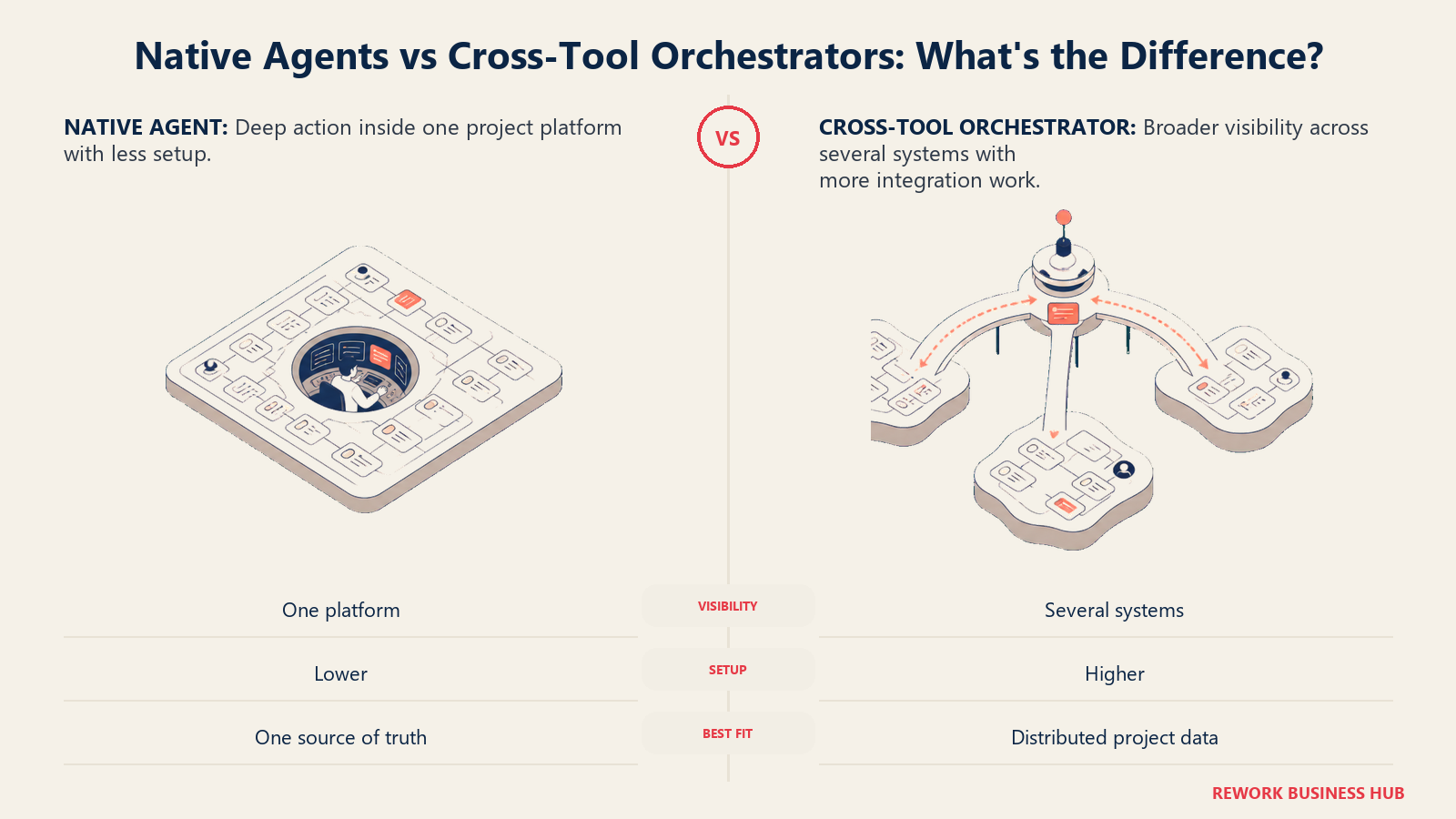
Two different fixes exist for that gap, and they aren't the same purchase. The first is per-platform: run each tool's native agent on its own slice and accept that a person still stitches the pieces together at the portfolio level, which is honestly what most PMOs do today. The second is a cross-tool orchestrator that sits above all three systems and calls each one as a tool, whether that's a no-code builder covered in best no-code AI agent builders or a broader platform from best AI agent platforms, wired to each tool's API. Smartsheet's approach above, an MCP bridge that lets an external assistant read and act on its data, is effectively a lighter version of the same idea: instead of building its own actor, it made itself a good tool for someone else's agent to call.
Neither path is wrong. The question worth asking before shopping is whether a project actually lives in one system with occasional exceptions (native agent, cheaper, less setup) or genuinely spans three systems with equal weight (orchestrator, more setup, the only view that's actually complete).
How Each Agent Handles a Project Manager's Judgment Call
Every capability above that impresses in a demo comes with the same follow-up question: what happens when the agent is wrong about a call only a person should make. Deciding a deadline should move, that a task is genuinely blocked and not just quiet, or that an underperforming contributor needs work reassigned are calls with team and political consequences a model doesn't feel. Only 21% of organizations have a mature governance model for autonomous agents, per Deloitte's State of AI in the Enterprise research, which means most teams buying anything on this list are building that discipline themselves rather than inheriting it from the vendor.
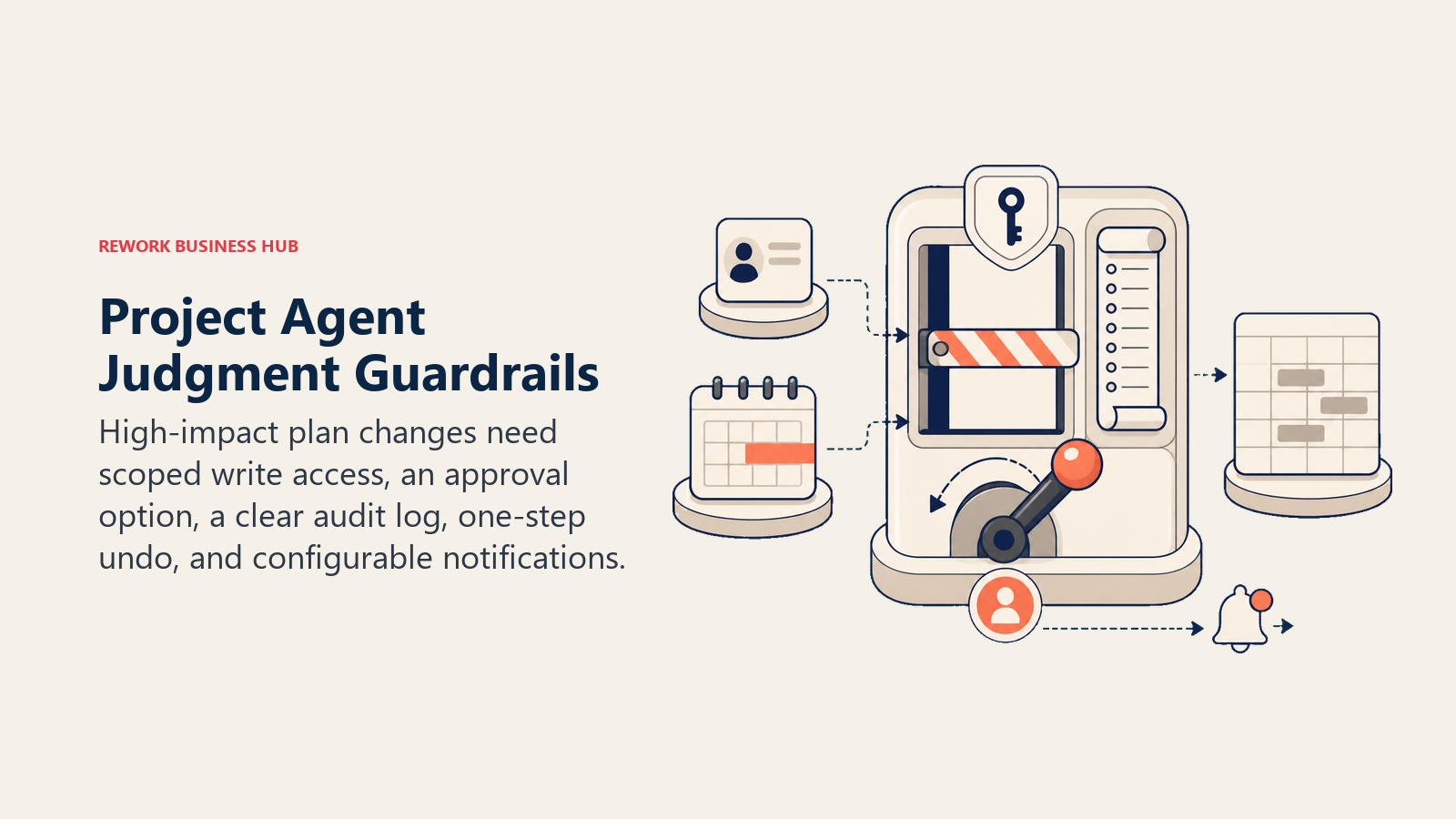
Motion's calendar reschedules automatically with no approval step by default, fine for a personal task list and worth reconfiguring before trusting it with a shared team calendar. Notion's Custom Agents run unattended on a schedule, which is the point, but means nobody's watching the moment one makes a call a person would have made differently. Rovo and Asana's AI Teammates lean the other way: an agent is assigned or mentioned the way a person would be, which keeps someone in the loop for the specific action but also means nothing happens until someone remembers to ask.
Ask each vendor these questions before an agent gets write access to a live project plan, not after:
| Question to ask | Good answer | Red flag |
|---|---|---|
| Does it act automatically, or stage changes for approval? | Configurable per workflow, with an approval gate available | "It just updates the board," no review step offered |
| Can write access be scoped to specific fields or projects? | Yes, field- and project-level permissioning | All-or-nothing access to the whole workspace |
| Is there a log of what the agent changed and why? | A queryable audit trail tied to the specific trigger | "Check the item's activity history" only |
| Can a change be undone in one step? | A documented rollback or undo path | No rollback, or "you'd fix it manually" |
| Who gets notified when it acts? | Configurable alerts to the task owner or manager | Silent changes, no notification by default |
For a formal audit trail across every agent's actions rather than one vendor's own activity log, best AI agent observability tools covers the monitoring layer that sits above individual platforms, and best enterprise AI agent platforms covers the certification and governance questions a formal security review will raise.
How to Choose: Decision Framework
The best project agent depends on the job, the honesty of the underlying task data, the systems it must see, and the write controls your team can govern.
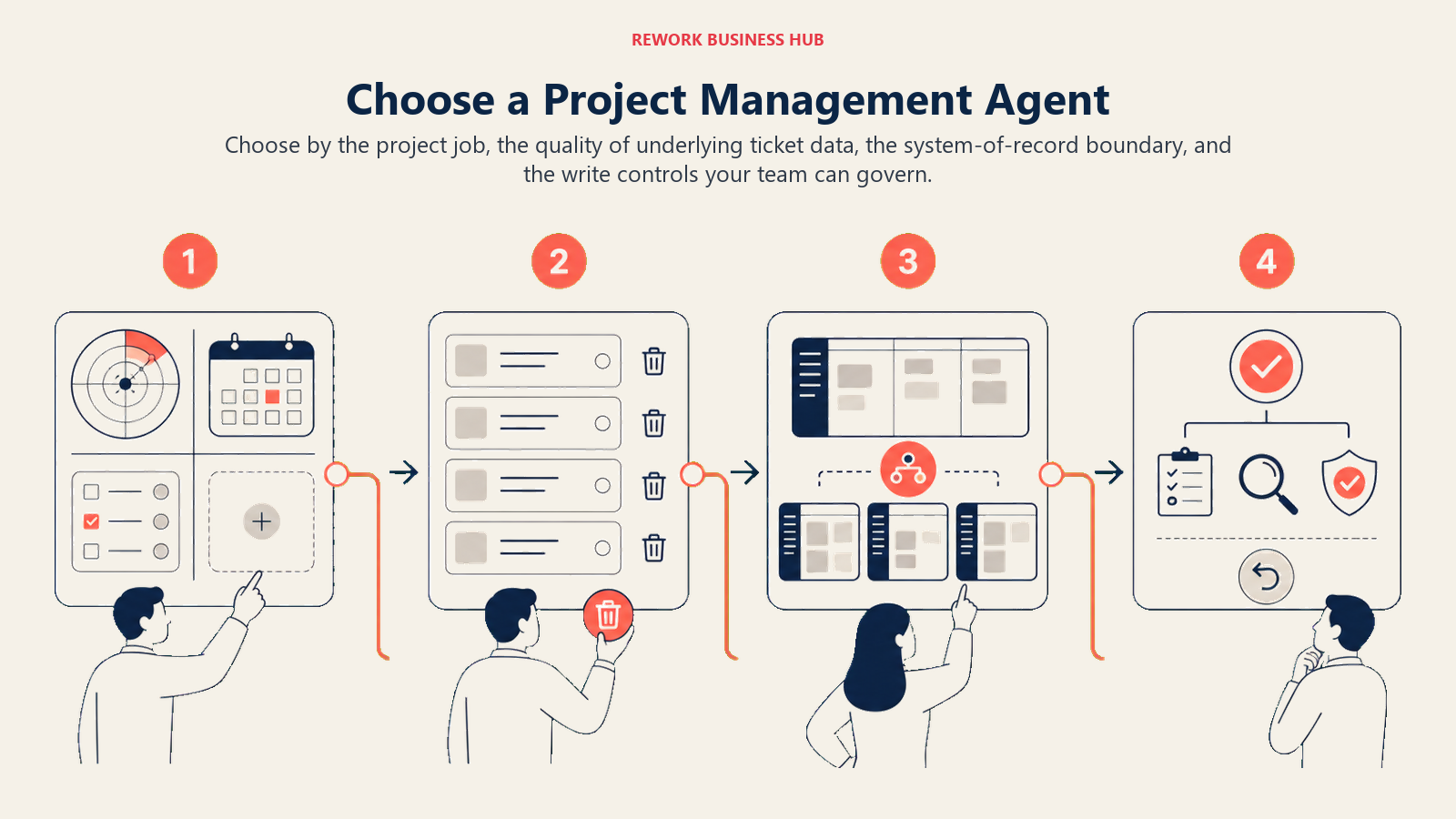
| If you need... | Pick... | Why |
|---|---|---|
| The widest bench of prebuilt PM-specific agents | Asana AI Studio + AI Teammates | 30 named agents plus a no-code builder for the rest |
| Native risk detection with room to add more agents later | monday.com AI Agents | Project Analyzer plus a growing hiring marketplace |
| Delivery-risk detection inside an engineering-led org | Atlassian Rovo Agents (Jira) | Built on the sprint and backlog data engineering already updates |
| Trigger-based automation across one unified workspace | ClickUp Autopilot Agents | No-code triggers plus a Super Agent tier for harder reasoning |
| The strongest pure risk prediction on large programs | Wrike Work Intelligence | Predicts slippage from historical delivery patterns |
| An agent that can run a whole project largely unattended | Notion Agents | Up to 20 minutes of continuous, multi-step autonomous action |
| Assigning delivery work directly to a coding agent | Linear Agents | Peer-agent model built for turning issues into shipped PRs |
| Scheduling that actually re-plans itself around conflicts | Motion AI Project Manager | AI Calendar reschedules automatically, no manual rebuild |
| A custom agent built on your own structured project data | Airtable Omni | Free to build; you define what it watches and does |
| Multi-agent automation on a small team's budget | Taskade AI Agents | Unlimited agents on every paid tier, not a metered add-on |
| Acting on project data through an AI assistant already in use | Smartsheet AI | MCP bridge to Claude, Copilot, ChatGPT, or Gemini |
What to Do Next
Pick the one job that's actually costing time today, status roll-ups, risk detection, or task reassignment, and pilot a single agent against it for 30 days before committing to a platform-wide rollout. Point it at the messiest active project, not the cleanest one; that's the only way to find out whether it exposes a data-quality problem worth seeing anyway or quietly launders it into a confident report nobody double-checks. If the honest answer to the ticket-hygiene question above is "not yet," fix that first. An agent bolted onto a board nobody trusts just automates the mistrust faster.
If the real job is meeting notes turning into tasks rather than status or risk, the AI meeting notes agent blueprint covers that capture step specifically. And if the real gap is picking the underlying platform before adding any agent to it, best AI agent platforms is the wider starting point.

Principal Product Marketing Strategist
On this page
- Updated August 2026: What Changed
- Key Facts
- Quick Comparison Table
- What Actually Counts as an Agent Here: Detect vs Act
- The Precondition Nobody Wants to Hear: Your Tickets Have to Be Honest First
- Sizing and Persona Table
- 1. Asana AI Studio + AI Teammates: The Widest Bench of Purpose-Built PM Agents
- 2. monday.com AI Agents: A Native Agent Workforce, Now With a Hiring Marketplace
- 3. Atlassian Rovo Agents (Jira): Delivery Risk Detection Native to the Engineering Stack
- 4. ClickUp Autopilot Agents: Trigger-Based Action Across One Workspace
- 5. Wrike Work Intelligence: The Strongest Pure Risk-Prediction Layer
- 6. Notion Agents: The Most Autonomous Agent on This List
- 7. Linear Agents: Built for Turning Issues Into Shipped Work, Not Status Reports
- 8. Motion AI Project Manager: The Only Agent Here Built Around Rescheduling Itself
- 9. Airtable Omni: Build Your Own PM Agent on Structured Project Data
- 10. Taskade AI Agents: Multi-Agent Automation Sized for a Small Team's Budget
- 11. Smartsheet AI: Honest About What's Shipped Versus What's Coming
- Native Platform Agents vs Cross-Tool Orchestrators
- How Each Agent Handles a Project Manager's Judgment Call
- How to Choose: Decision Framework
- What to Do Next