Best AI Agents for Healthcare in 2026: 13 Agents for Documentation, Patient Access, and Revenue Cycle
Turn this article into takeaways for your work.


Each assistant summarizes the article only for you and suggests best practices for your work.
Need ambient documentation that holds up at enterprise scale? Abridge is the two-time Best in KLAS ambient AI vendor and the default answer for large health systems on Epic. Want the one scribe with a result from someone else's randomized trial, not just its own marketing? Nabla cut documentation time by a statistically significant margin in a 238-physician NEJM AI study. Chasing prior authorization or patient access instead? Notable and Cohere Health own those jobs specifically, and Infinitus automates the payor phone call underneath both. This guide ranks 13 real agents across six administrative jobs, ambient documentation, patient access and scheduling, prior authorization, revenue cycle and coding, patient intake and follow-up, and care-gap outreach, each held to the same plan-act-observe bar covered in best AI agent platforms: genuine multi-step agentic capability, not a copilot wearing agent branding.
One boundary before anything else: this is an administrative and operational buying guide, not a clinical one. Nothing ranked here diagnoses a condition, recommends a treatment, or makes a clinical judgment call. That's a regulated medical-device question this article doesn't cover, and none of what follows is medical advice. What's ranked below drafts the note a clinician still signs, routes the prior auth a utilization reviewer still owns, and books the visit a front-desk team still confirms. If you're shopping for a clinician-facing tool instead, our AI tools for doctors guide covers that ground directly, and it overlaps on a few of the same scribe vendors from the individual physician's buying decision rather than the health system's. A tool and an agent aren't the same thing either: see AI agents vs. chatbots, RPA, and automation for that distinction.
Updated August 2026: What Changed
- The Peterson Health Technology Institute published an administrative AI report on August 17, 2026 that found AI can lower an individual organization's cost to run prior authorization but "has not reduced overall system-level costs," and warned that AI-assisted billing is increasing billing intensity, a serious reality check on ROI claims right as 2027 budgets get set.
- Oracle Health expanded its Clinical AI Agent beyond documentation into drafting orders. As of February 2026, it can propose prescriptions, lab and imaging orders, referrals, and follow-up appointments directly from the ambient conversation, moving it further into genuinely agentic territory than a scribe that stops at the note.
- Microsoft retired its discounted "Physician Practice" Dragon Copilot offer effective May 1, 2026, moving every customer onto one standard per-user license. Microsoft calls it an overall list-price cut, but several third-party licensing trackers now report higher effective monthly costs than the discontinued program.
- Athelas and Commure, sometimes still referenced as separate vendors, are one company. They merged in 2024, and Commure has since folded in Augmedix and Memora Health too, spanning patient access, documentation, and revenue cycle under one platform.
- Qventus launched a Care Gap and Coding Automation Suite in February 2026, extending a hospital-operations vendor into coding and care-gap territory that used to belong to Notable and Innovaccer alone, a sign this category is consolidating around broader platforms rather than staying siloed by job.
Key Facts
- Prior authorization remains the least automated major transaction type in U.S. healthcare: only an estimated 40% runs electronically versus 78%+ for claim status and payment, per the CAQH 2025 Index, part of why an estimated $21 billion in administrative savings is still on the table industry-wide.
- Physicians complete an average of 40 prior authorizations a week, consuming roughly 13 hours of physician and staff time, and 94% say prior auth contributes to burnout, per the AMA's December 2025 Prior Authorization Physician Survey of 1,000 practicing physicians.
- 90% of medical group practice leaders said prior authorization requirements increased over the past year, per MGMA's 2026 Regulatory Burden Report.
- In a 3-arm randomized trial of 238 outpatient physicians across 14 specialties, Nabla reduced time-in-note by 9.5% against a usual-care control (statistically significant, p=0.02), while Microsoft's DAX Copilot did not reach significance in the same trial, per the NEJM AI-published study.
- Only 15% of healthcare organizations already using AI in the revenue cycle report a positive ROI so far, out of the 63% that have adopted some form of it, per an HFMA poll of 101 healthcare finance organizations.
- Waste accounts for an estimated 25% of U.S. healthcare spending ($760 billion to $935 billion a year), with administrative complexity named as one of six waste domains, per Shrank et al., JAMA, 2019.
Quick Comparison Table
| Agent | Best For | Starting Price | Key Strength | Key Limitation |
|---|---|---|---|---|
| Abridge | Large Epic health systems standardizing on one documentation vendor | Custom, enterprise only (reported ~$200-$1,200+/provider/mo) | Two-time Best in KLAS Ambient AI winner | No self-serve tier or public pricing at all |
| Nabla | Organizations wanting independently verified time savings | Not published, contact sales | Only scribe with a positive result in a published RCT | Broadest EHR list but no transparent pricing |
| Ambience Healthcare | Epic health systems wanting real-time coding during the visit | Not published, contact sales | AutoCDI surfaces HCC and E/M coding live | Only Epic is named; other EHRs unconfirmed |
| Microsoft Dragon Copilot | Health systems standardized on Microsoft and Nuance Dragon Medical | Reported ~$369-$1,000+/provider/mo | Deepest Microsoft/Nuance ecosystem tie-in | Discounted physician-practice tier ended May 2026 |
| Suki | Practices wanting a voice-first assistant plus RCM help | Reported ~$299-$399/provider/mo | Broadest confirmed EHR list of any scribe here | Revenue cycle help is a separate module |
| Oracle Health Clinical AI Agent | Health systems already running Oracle Health as their EHR | Not published, bundled into EHR contract | Only agent that also drafts orders, not just notes | Native to Oracle Health only |
| Notable | Patient access and revenue cycle teams wanting one platform | Not published, contact sales | Widest job coverage of any vendor here | HIPAA/BAA not itemized on its public site |
| Hippocratic AI | High-volume patient outreach, priced per agent-hour | Reported ~$9/agent-hour | Explicit "we do not diagnose or prescribe" boundary | Usage-based pricing is hard to forecast |
| Infinitus | Revenue cycle teams drowning in payor hold-time calls | Not published, contact sales | Automates the payor call itself: benefits, PA status | Confirm HIPAA/BAA with the vendor |
| Cohere Health | Providers whose payer already routes auth through Cohere | Free to providers; custom to health plans | Real-time approval on most requests it reviews | Providers don't control the contract |
| Qventus | Hospital operations teams tackling capacity and coding together | Not published, enterprise only | Now spans capacity planning through coding automation | Long enterprise implementation |
| Innovaccer | Health systems wanting revenue cycle tied to a data platform | Not published, enterprise only | Black Book's #1-ranked AI revenue cycle vendor, 2026 | Full value needs the broader data platform |
| Commure (incl. Athelas) | Practices wanting one vendor from first call to final claim | Not published, contact sales | Only platform spanning call center, notes, and RCM | Depth on any one job varies by module |
Which Healthcare Operations Job Each Agent Actually Owns
| Job | Agents That Cover It Today |
|---|---|
| Ambient clinical documentation | Abridge, Nabla, Ambience Healthcare, Microsoft Dragon Copilot, Suki, Oracle Health Clinical AI Agent, Commure |
| Patient access and scheduling | Notable, Hippocratic AI, Qventus, Commure |
| Prior authorization | Cohere Health, Infinitus, Notable, Innovaccer |
| Revenue cycle and coding | Suki, Innovaccer, Commure, Notable, Qventus, Ambience Healthcare (via AutoCDI) |
| Patient intake and follow-up | Notable, Hippocratic AI, Commure |
| Care-gap outreach | Notable, Hippocratic AI, Qventus, Innovaccer |
Two of these six jobs already have a vendor-neutral build blueprint if buying isn't the right call yet: the AI Document Processing Agent covers the documentation-to-coding pattern, and the AI Follow-Up Agent covers the outreach cadence behind intake and care-gap work. Infinitus and Hippocratic AI are both, at their core, purpose-built voice agents for healthcare's phone-heavy workflows; that guide covers the general-purpose market if a healthcare-specific vendor doesn't fit.
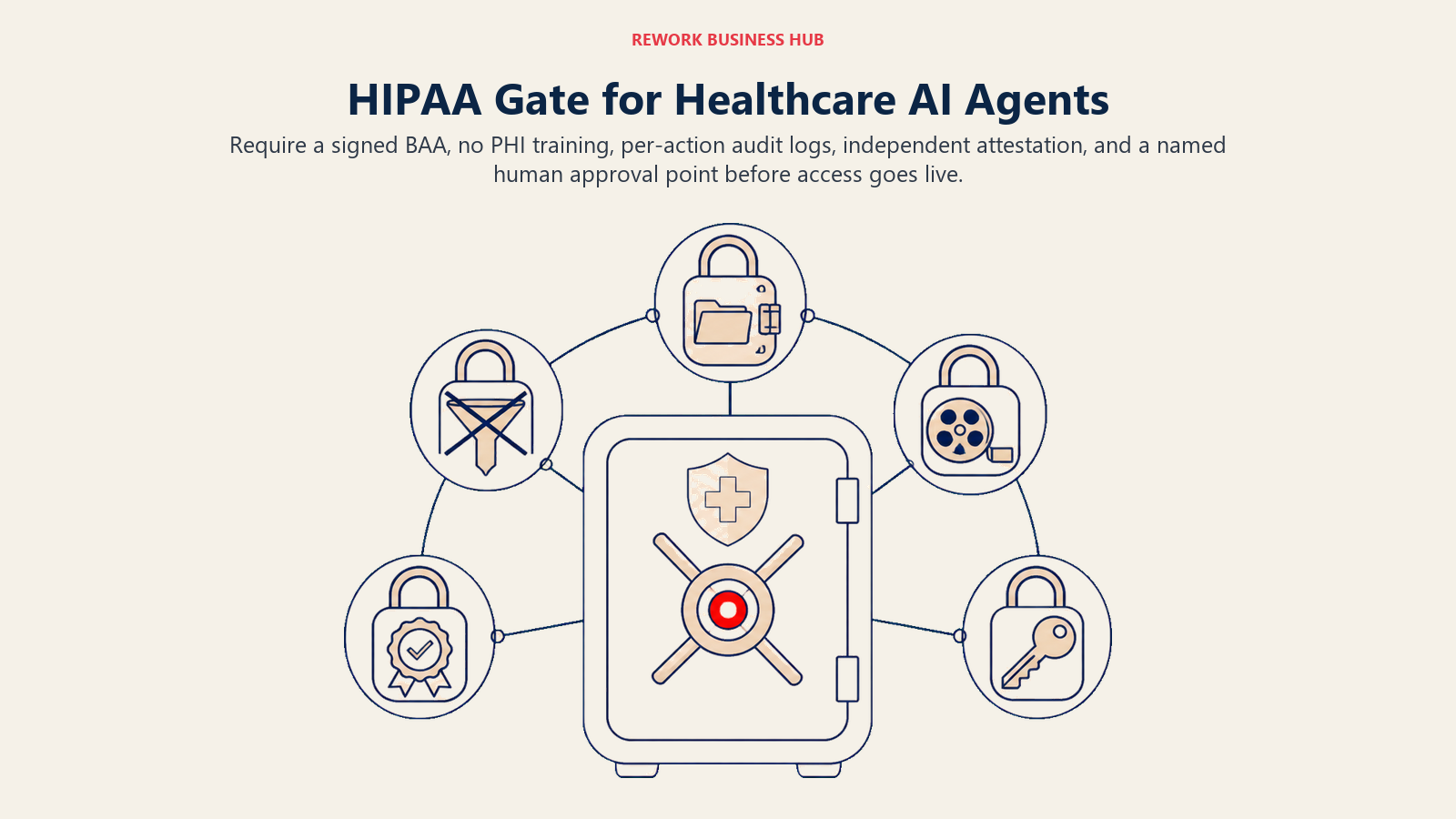
The HIPAA Gate: What to Require Before an Agent Touches PHI
Every agent on this list processes protected health information as a normal part of doing its job, which makes the trust page as important as the feature list. The AI agent data privacy blueprint covers the underlying controls; here's what each vendor in this guide actually states on its own site, not what a sales deck implies.
What Each Vendor Actually Has on Its Own Trust Page
| Agent | What Its Own Trust/Compliance Page Lists |
|---|---|
| Abridge | HIPAA compliant; signs a standard BAA with enterprise customers; current SOC 2 Type 2 report and penetration-test results available |
| Nabla | HIPAA compliant, SOC 2 Type 2, ISO 27001, and GDPR, all stated directly on its site |
| Ambience Healthcare | States it is "trusted and fully certified" but doesn't itemize HIPAA, SOC 2, or a BAA on its public site; ask directly |
| Microsoft Dragon Copilot | Inherits Microsoft's enterprise HIPAA BAA program; confirm current Dragon Copilot-specific terms with your account team |
| Suki | SOC 2 Type 2 certified and HIPAA compliant, with a dedicated Trust Portal |
| Oracle Health Clinical AI Agent | As a native Oracle Health module it inherits Oracle Health's compliance program; confirm the specific attestation with your Oracle Health team |
| Notable | SOC 2, ISO 27001:2022, and AICPA badges shown; HIPAA/BAA not itemized on its public site |
| Hippocratic AI | HIPAA and SOC 2 badges shown; states "zero incidents of harm since inception" as its own safety claim |
| Infinitus | Confirm HIPAA and SOC 2 status directly, given it processes PHI over live phone calls to payors |
| Cohere Health | Confirm HIPAA and SOC 2 status directly with Cohere Health |
| Qventus | Confirm HIPAA and SOC 2 status directly with Qventus |
| Innovaccer | Trust Center names compliance, security, and privacy as pillars; specific HIPAA/HITRUST attestation not itemized publicly |
| Commure (incl. Athelas) | A Trust Center link exists; specific HIPAA/SOC 2 attestation not itemized in what's public |
What to Ask For Before You Grant Access
| What to require | Good sign from a vendor | Red flag |
|---|---|---|
| A signed BAA before any PHI flows | A standard BAA is a named part of the contract | "We're HIPAA compliant" with no BAA offered |
| Clarity on model training | PHI is contractually excluded from model training and fine-tuning | Vague language, or silence on whether conversations train the model |
| A queryable audit log | Every agent action (a note generated, a code suggested, a call placed) is timestamped and tied to the source encounter | Only a generic "activity history" with no per-action detail |
| Independent, current attestation | A SOC 2 Type 2 report or a HITRUST certificate, available on request | A trust page written in prose with no named report or auditor |
| A defined human sign-off point | The product names exactly which output a clinician or biller must approve before it's final | Marketing language implies full autonomy with no stated checkpoint |
If this purchase has to clear a formal security review before your compliance team signs anything, best enterprise AI agent platforms covers the certifications and governance questions that review typically raises. And once more than one of these agents is running against live PHI, best AI agent observability tools covers the monitoring layer that watches what every agent actually did, not just the one you're paying closest attention to.
Accuracy and Liability: Who Signs What an Agent Drafts
An agent that mishears a sentence in a marketing brief is a minor edit. An agent that mishears a medication dose, misses a code, or misroutes a denial is a patient-safety and revenue problem, and potentially a liability one. None of the agents in this guide are built to run those steps fully unsupervised, and the honest ones say so plainly.
| Task | An agent can typically do this on its own | This should stay a human decision |
|---|---|---|
| Drafting a structured note from the visit | Capturing and organizing the conversation into a note | Signing the note that becomes the legal medical record |
| Suggesting a billing code | Surfacing likely E/M, ICD-10, or CPT codes from the documentation | Submitting the claim with that code attached |
| Prior authorization submission | Pre-filling the request from clinical documentation on file | Deciding to appeal a denial or escalate to a peer-to-peer review |
| Patient outreach for a care gap | Placing the reminder call or message on a defined schedule | Handling anything the patient discloses that needs clinical triage |
| Appointment scheduling | Finding and booking an open slot against defined rules | Prioritizing which patient gets an urgent same-day slot |
| Claims and denial follow-up calls | Calling a payor to check status or collect standard information | Deciding whether to write off a balance or dispute a denial |
EHR and System Integration Depth
| Agent | EHR/System It Connects To | Integration Depth |
|---|---|---|
| Abridge | Epic named; ask Abridge about other EHRs | Deep, native Epic Ambient Module partner; enterprise-only rollout |
| Nabla | Epic, athenahealth, Oracle Health, NextGen, Aryaehr, Greenway Health | Broadest named EHR list of any agent in this guide |
| Ambience Healthcare | Epic only, lives inside Epic Toolbox via native FHIR APIs | Deep on Epic; other EHRs unconfirmed |
| Microsoft Dragon Copilot | Marketed as EHR-agnostic; long-standing Dragon Medical ties into Epic and Oracle Health | Broad, but confirm your specific EHR version is certified |
| Suki | Epic, Oracle Health, athenahealth, MEDITECH | Confirmed across four major EHRs, plus telehealth partners |
| Oracle Health Clinical AI Agent | Oracle Health (Cerner) only | Deepest possible, but only if Oracle Health is already your EHR |
| Notable | Epic, Oracle Health/Cerner, athenahealth (athenaOne, athenaIDX), MEDITECH Expanse | Bi-directional sync via APIs, RPA, and HL7 |
| Hippocratic AI | 50+ EMR systems, including Epic | Broad, though depth per EMR isn't itemized |
| Infinitus | Not EHR-focused; connects to payor systems and clearinghouses instead | N/A for EHR; ask about your specific payor mix |
| Cohere Health | Epic, athenahealth, plus a payer-side API suite | Providers submit and track authorizations from inside the EHR |
| Qventus | Full bidirectional EHR integration described generally; specific vendors not named publicly | Ask which EHR versions are certified for your health system |
| Innovaccer | 50+ EHR systems via FHIR/HL7 | Ingestion-focused; unifies data before agents act on it |
| Commure (incl. Athelas) | Not named specifically; Athelas also offers its own EHR (Air) | Ask whether you're evaluating an EHR overlay or a full EHR replacement |
Sizing and Persona
| Agent | Best Fit | Primary Buyer |
|---|---|---|
| Abridge | Large health systems and academic medical centers on Epic | CMIO, VP Clinical Informatics |
| Nabla | Mid-size to large health organizations wanting proven results | CMIO, Ambulatory Medical Director |
| Ambience Healthcare | Epic health systems with a coding-accuracy problem, not just a documentation one | CMIO, VP Revenue Cycle |
| Microsoft Dragon Copilot | Health systems already standardized on Microsoft/Nuance | CIO, CMIO |
| Suki | Practices and health systems wanting voice-first plus RCM help | Practice Administrator, CMIO |
| Oracle Health Clinical AI Agent | Health systems on Oracle Health (Cerner) as their EHR of record | CMIO, CIO |
| Notable | Health systems and large medical groups running patient access centrally | VP Patient Access, VP Revenue Cycle |
| Hippocratic AI | Health systems wanting high-volume outbound patient contact | VP Patient Engagement, Chief Nursing Officer |
| Infinitus | Revenue cycle and patient access teams buried in payor phone calls | VP Revenue Cycle, Director of Patient Access |
| Cohere Health | Providers whose payer contracts already route through Cohere | Director of Utilization Management |
| Qventus | Hospitals and health systems, not single clinics | COO, VP Operations |
| Innovaccer | Health systems wanting revenue cycle tied to population health data | CFO, VP Revenue Cycle |
| Commure (incl. Athelas) | Practices and health systems wanting one vendor front-to-back | Practice Owner, COO |
1. Abridge: The Two-Time Best in KLAS Ambient Documentation Leader
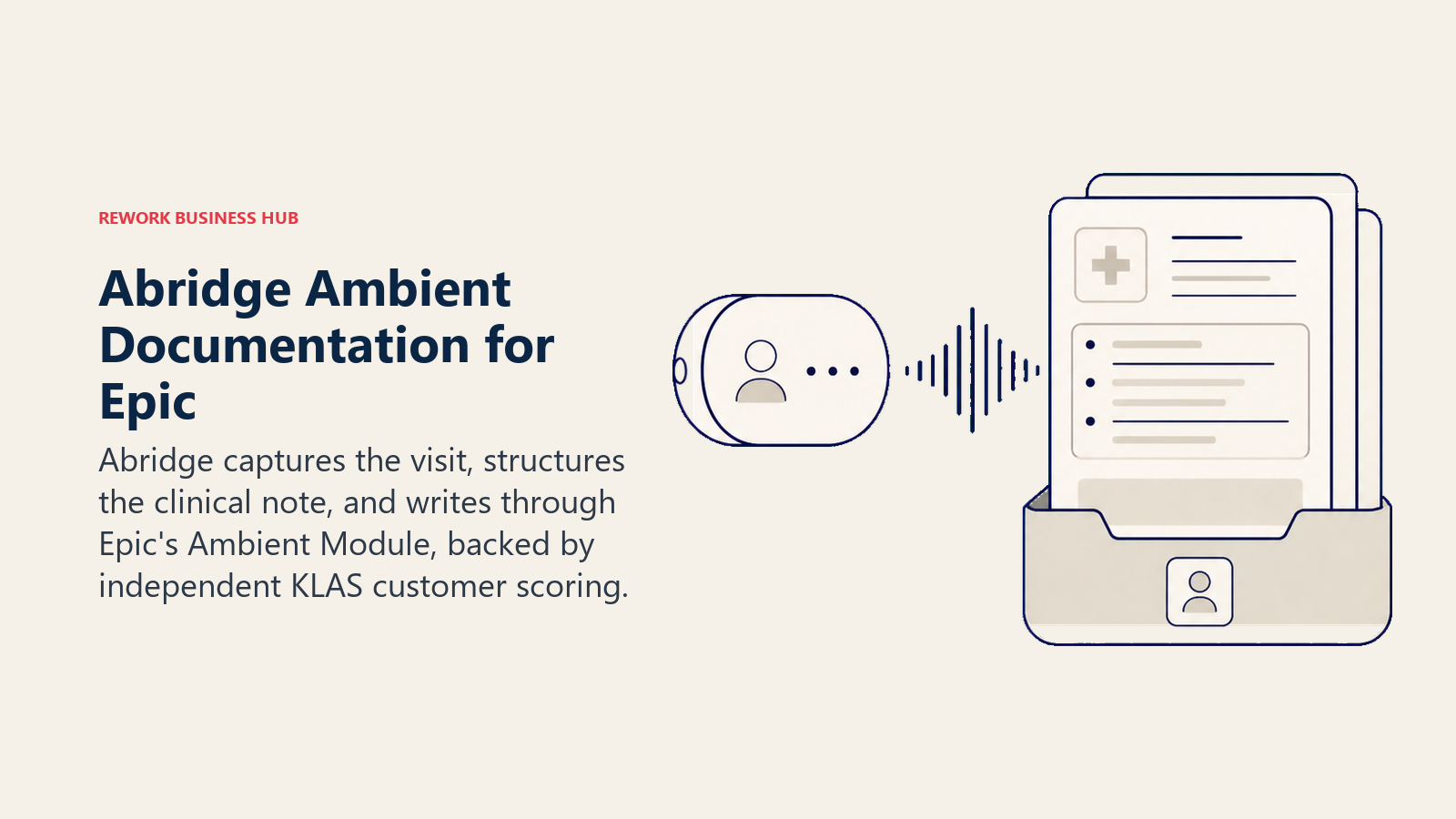
Abridge is the name most large health systems land on first, and the KLAS numbers back that instinct: it won Best in KLAS for Ambient AI in both 2025 and 2026, scoring 95.3 based on independent interviews with the country's largest and most complex health systems, with A+ ratings on culture, loyalty, relationship, and value. The product captures the visit conversation, structures it into a note, and integrates natively inside Epic's Ambient Module, the deployment path most of its enterprise customers actually use.
What Abridge doesn't offer is a way in for anyone smaller than an enterprise: there's no self-serve signup, and every deployment runs through a negotiated contract. Abridge states it's HIPAA compliant and signs a standard BAA as part of those contracts, backed by a current SOC 2 Type 2 report and independent penetration testing. It doesn't publish pricing; third-party procurement research and healthcare cost-driver trackers put real contracts anywhere from roughly $200 to $1,200 or more per provider per month, converging around a commonly cited $2,500-per-clinician annual figure, though none of that is vendor-confirmed.
| What you get | What you don't |
|---|---|
| Two-time Best in KLAS Ambient AI winner, independently scored | No self-serve tier; every deal is a negotiated enterprise contract |
| Native Epic Ambient Module integration | No public pricing; reported ranges span $200 to $1,200+/provider/mo |
| HIPAA compliant with a standard BAA and current SOC 2 Type 2 report | Other EHR integrations beyond Epic aren't confirmed on its own site |
Pricing: Not published; enterprise contracts only. Third-party procurement research reports roughly $200 to $1,200+ per provider per month (reported, not vendor-confirmed). See abridge.com.
Best for: Large health systems and academic medical centers on Epic that want the top KLAS-rated ambient documentation vendor and can clear an enterprise procurement process.
2. Nabla: The Scribe With an Independently Verified Result
Most ambient scribes cite their own internal studies. Nabla is the rare one with a result from someone else's randomized trial: in a 3-arm NEJM AI study of 238 outpatient physicians across 14 specialties (November 2024 to January 2025, roughly 72,000 encounters), Nabla cut time-in-note by 9.5% against a usual-care control, a statistically significant result (p=0.02). Microsoft's DAX Copilot ran in the same trial and didn't reach significance (-1.7%). That's one trial at specific sites, not a guarantee of your own results, but it's a genuinely different kind of evidence than a vendor's own case study.
Nabla also carries the broadest confirmed EHR list in this guide, Epic, athenahealth, Oracle Health, NextGen, Aryaehr, and Greenway Health, plus coding support (E/M and ICD-10) layered on top of documentation. It processes roughly 20 million encounters a year across 130-plus health organizations and 85,000-plus active clinicians. Compliance is stated plainly on its site: HIPAA, SOC 2 Type 2, ISO 27001, and GDPR. Nabla doesn't publish pricing.
| What you get | What you don't |
|---|---|
| The only scribe here with a positive, independently published RCT result | No published pricing; every deal starts with a sales conversation |
| Broadest confirmed EHR list: Epic, athenahealth, Oracle Health, NextGen, and more | Scale (20M encounters/year) means it's built for volume, not a solo practice |
| HIPAA, SOC 2 Type 2, ISO 27001, and GDPR all stated directly on its site | Coding support is E/M and ICD-10 only, not a full RCM suite |
Pricing: Not published; contact sales for a quote. See nabla.com.
Best for: Health organizations that want documentation-time evidence from an independent trial before they commit, not just a vendor's own numbers.
3. Ambience Healthcare: Real-Time Coding Alongside the Note
Ambience's pitch is that documentation and coding shouldn't be two separate steps: its AutoCDI capability surfaces HCC opportunities and guides E/M level selection while the visit is still happening, alongside ICD-10 and CPT suggestions, across more than 200 medical specialties including oncology, psychiatry, and emergency medicine. For a health system whose real pain point is under-coding and missed HCC capture as much as documentation time, that's a meaningfully different pitch than a scribe that stops at the note.
The tradeoff is a narrower confirmed footprint: Ambience names only Epic on its public site, describing itself as living directly inside Epic Toolbox through the native Epic Ambient Module and FHIR APIs. It states it's "trusted and fully certified" without itemizing HIPAA, SOC 2, or BAA terms on the page, so ask directly before you sign. Pricing isn't published.
| What you get | What you don't |
|---|---|
| Real-time HCC and E/M coding guidance during the visit, not after | Only Epic is named; other EHR integrations aren't confirmed |
| Deep support across 200+ specialties, including oncology and psychiatry | Compliance claims aren't itemized on its public site; ask directly |
| Lives natively inside Epic Toolbox via FHIR APIs | No published pricing; enterprise consultation required |
Pricing: Not published; enterprise consultation required. See ambiencehealthcare.com.
Best for: Epic health systems whose documentation problem is really a coding-accuracy and HCC-capture problem in disguise.
4. Microsoft Dragon Copilot: The Microsoft and Nuance Ecosystem Play
Dragon Copilot is Microsoft's answer, built on Nuance's decades of clinical dictation experience, combining ambient documentation with voice-driven dictation and EHR navigation in one license. The 2026 licensing story is worth understanding before you budget: Microsoft discontinued its discounted "Physician Practice" offer effective May 1, 2026, moving every customer onto one standard per-user license and calling it an overall price cut. Third-party licensing specialists nonetheless report the resulting Physician Flex tier running around $604.80 a month, with total reported ranges of roughly $369 to $1,000-plus per provider per month depending on capability tier, higher than the discontinued program's rates.
In the same NEJM AI trial that validated Nabla's result, DAX Copilot didn't show a statistically significant reduction in time-in-note (-1.7%, not significant), worth knowing before you treat either vendor's internal case studies as the last word. As part of Microsoft's enterprise cloud, Dragon Copilot inherits Microsoft's standard HIPAA BAA program, though you should confirm current product-specific terms with your account team.
| What you get | What you don't |
|---|---|
| Deepest tie-in for health systems standardized on Microsoft and Nuance Dragon Medical | Discounted Physician Practice tier is gone as of May 1, 2026 |
| Combines ambient documentation, dictation, and EHR navigation in one license | Didn't reach statistical significance for time-in-note in the NEJM AI RCT |
| Inherits Microsoft's enterprise HIPAA BAA program | Microsoft doesn't publish pricing; reported figures vary by source |
Pricing: Not published by Microsoft; licensing specialists report roughly $369 to $1,000+/provider/month, with the Physician Flex tier around $604.80/month (reported). See microsoft.com.
Best for: Health systems already standardized on Microsoft and Nuance Dragon Medical who want documentation folded into that existing relationship.
5. Suki: Voice-First, With Revenue Cycle Help Built In
Suki started as a voice assistant, not just a scribe, and that shows in what it still does beyond note generation: voice-enabled editing, ordering, chart navigation, and an Assisted Revenue Cycle module aimed at coding and billing optimization. KLAS-validated reporting found real revenue gains at three health systems (Rush, McLeod Health, and FMOL Health) using Suki, tied to more complete visit documentation supporting the coding levels those visits actually justified, a genuine link between documentation quality and what gets billed.
Suki also carries the broadest confirmed EHR list of any documentation vendor in this guide: Epic, Oracle Health, athenahealth, and MEDITECH, plus telehealth and care-management partnerships, across 100-plus specialties on iOS and Android. It states directly that it's SOC 2 Type 2 certified and HIPAA compliant, with a dedicated Trust Portal for further detail. Pricing isn't published.
| What you get | What you don't |
|---|---|
| Confirmed integration across four major EHRs: Epic, Oracle Health, athenahealth, MEDITECH | No published pricing; reported figures cluster around $299-$399/provider/mo |
| Assisted Revenue Cycle module ties documentation to coding and billing outcomes | Revenue cycle help is a separate module, not automatic on every plan |
| SOC 2 Type 2 certified and HIPAA compliant, with a public Trust Portal | KLAS-cited revenue gains are health-system-reported, not a controlled trial |
Pricing: Not published; third-party sources report roughly $299 to $399 per provider monthly (reported). See suki.ai.
Best for: Practices and health systems that want a voice-first assistant, not just a scribe, plus a documented link to revenue cycle outcomes.
6. Oracle Health Clinical AI Agent: The Only One That Also Writes Orders
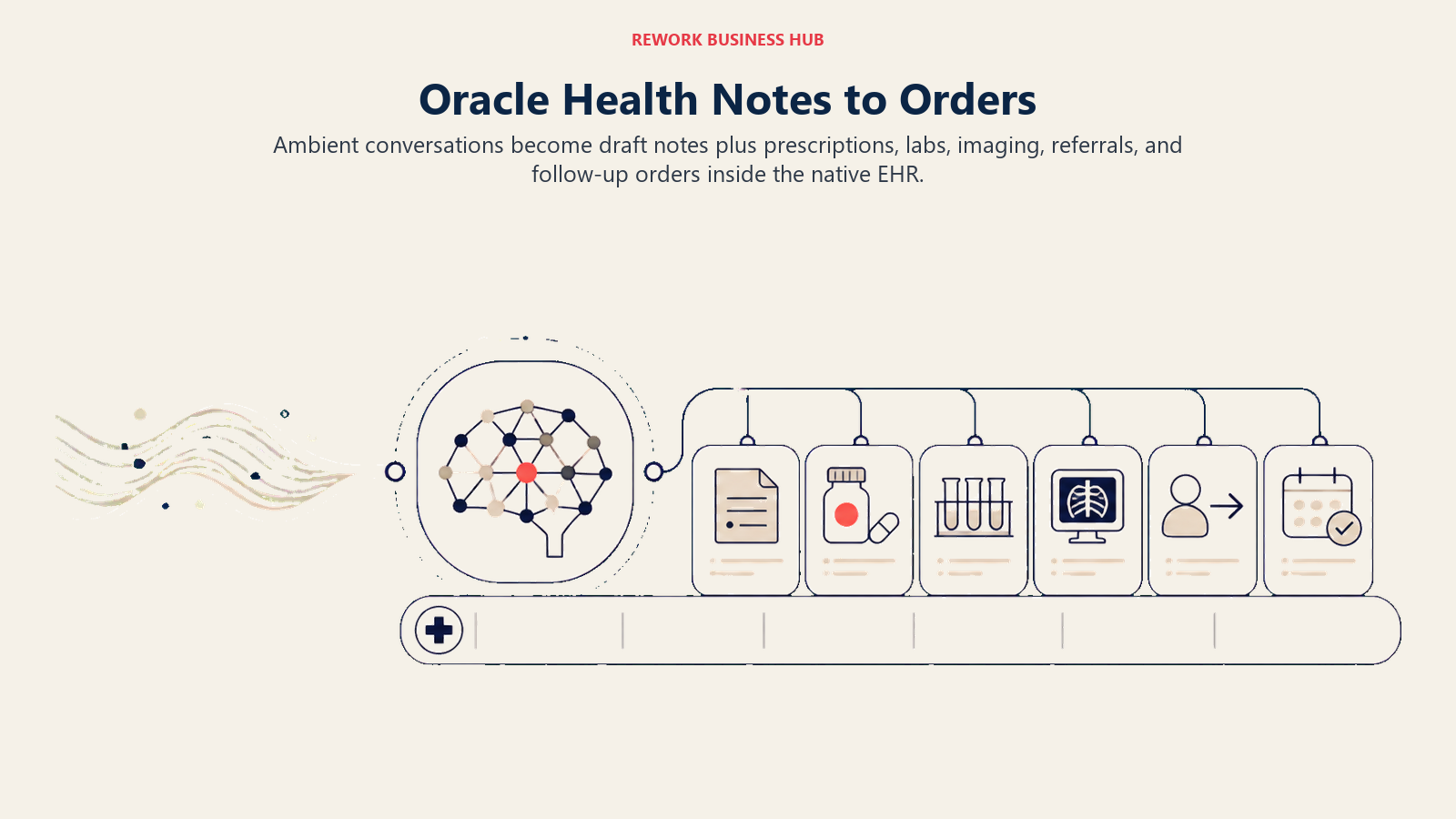
Every other documentation agent in this guide stops at the note. Oracle Health's Clinical AI Agent, built natively into the Oracle Health (formerly Cerner) EHR, expanded in February 2026 to draft prescriptions, lab orders, imaging orders, referrals, and follow-up appointments directly from the ambient conversation, using what Oracle describes as semantic reasoning over patient history, prior orders, and physician-specific preferences rather than plain speech-to-text. Oracle reports the tool has saved U.S. doctors more than 200,000 hours since launch (a vendor-reported figure, not independently audited), and it went generally available in the UK in February 2026 after a multisite NHS pilot.
The catch is exclusivity: this is a native Oracle Health capability, not a cross-EHR overlay like Abridge or Nabla, so it only applies if Oracle Health is already your EHR of record. As part of Oracle Health's EHR, it inherits Oracle Health's broader compliance program, though you should confirm any specific standalone HIPAA or HITRUST attestation for this module with your Oracle Health team directly. Pricing isn't published separately from your EHR contract.
| What you get | What you don't |
|---|---|
| Only agent here that drafts orders (prescriptions, labs, imaging, referrals), not just notes | Native to Oracle Health only; not usable if you run a different EHR |
| Deepest possible integration since it's built into the EHR itself | Module-specific compliance attestation not independently confirmed this session |
| NHS-validated at multisite scale, generally available in the UK since February 2026 | Pricing isn't published separately from your Oracle Health contract |
Pricing: Not published; quoted as part of your Oracle Health EHR contract. See oracle.com/health.
Best for: Health systems that already run Oracle Health as their EHR and want documentation and order-writing native to the record, not bolted on.
7. Notable: The Widest Job Coverage in One Platform
Notable is the one vendor in this guide that genuinely spans the whole administrative arc: patient access and intake (registration, referral capture, contact-center deflection), revenue cycle (prior authorization, copay estimation and collection, appeal-letter generation), and care operations (care-gap outreach, chart reviews, risk-adjustment optimization), combining AI, RPA, and NLP to read and write across whichever system holds the data. That breadth is the whole pitch: instead of stitching together a scheduling vendor, a prior-auth vendor, and an outreach vendor, one platform owns all three jobs against the same patient record.
Notable's public integration page confirms Epic, Oracle Health/Cerner, athenahealth (both athenaOne and athenaIDX), and MEDITECH Expanse, syncing bi-directionally through APIs, RPA, and HL7. It displays SOC 2, ISO 27001:2022, and AICPA compliance badges, though HIPAA and BAA terms specifically aren't itemized on its public pages, worth confirming directly. Pricing isn't published.
| What you get | What you don't |
|---|---|
| Covers patient access, prior auth, revenue cycle, and care gaps in one platform | No published pricing; scoped per organization and module |
| Confirmed integration across Epic, Oracle Health, athenahealth, and MEDITECH | HIPAA/BAA terms aren't itemized on its public site; ask directly |
| SOC 2, ISO 27001:2022, and AICPA compliance badges shown | Breadth this wide means a longer implementation than a single-job vendor |
Pricing: Not published; scoped per organization and module selected. See notablehealth.com.
Best for: Health systems and large medical groups that want patient access, prior auth, and care-gap outreach running against one unified platform instead of three vendors.
8. Hippocratic AI: Patient-Facing Outreach, Priced Per Agent-Hour
Hippocratic AI takes a genuinely different commercial shape: more than 1,000 pre-built voice agents for tasks like post-discharge recovery check-ins, preventive-screening reminders (colorectal, flu, mammogram), pre-visit paperwork and appointment scheduling, and chronic-condition follow-up, priced per agent-hour rather than per seat. Publicly discussed rates put that around $9 an hour, well under a typical U.S. registered nurse's hourly wage, though Hippocratic AI doesn't publish a formal rate card and final terms are volume- and agent-specific.
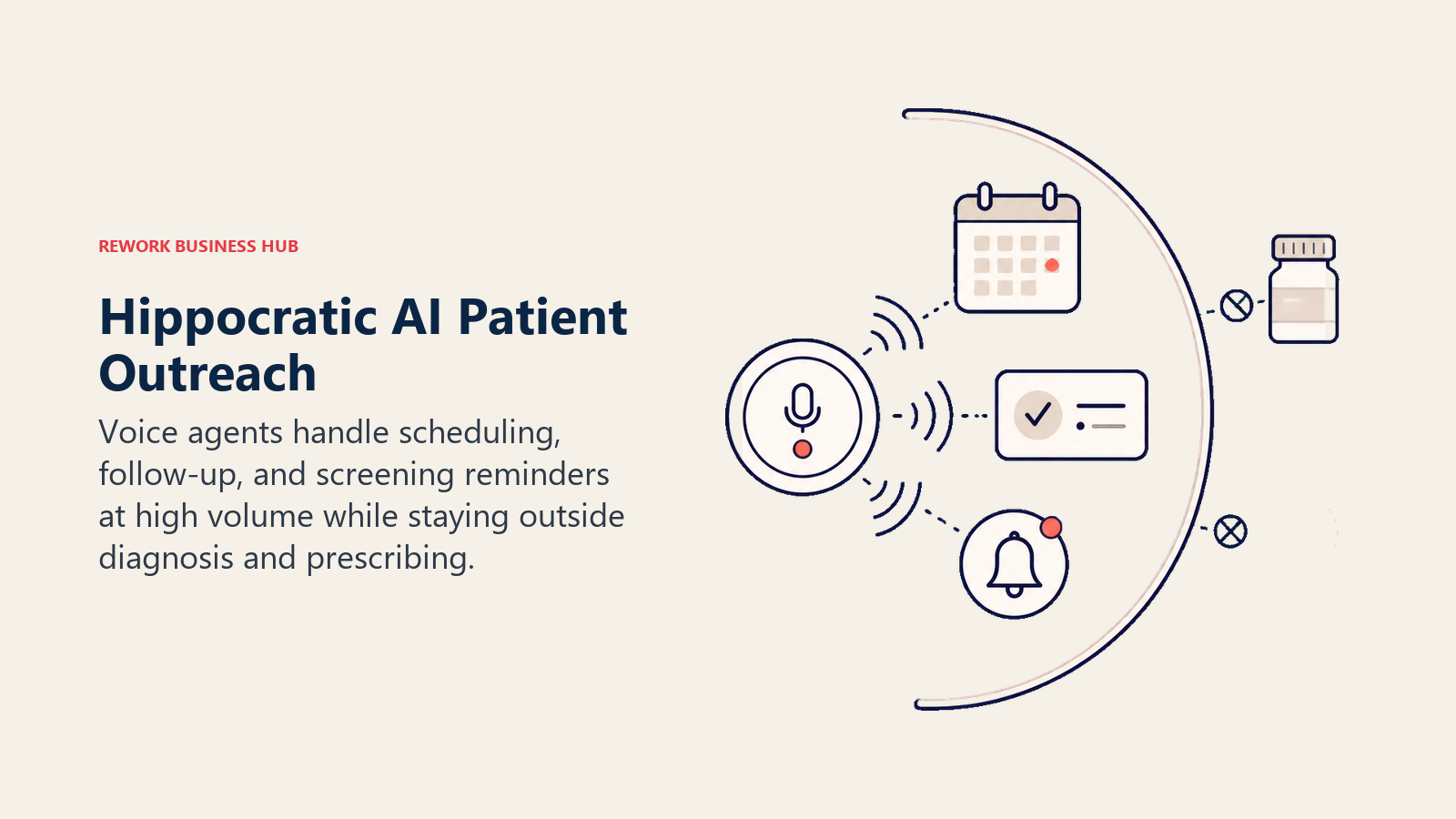
The company is explicit about the boundary that matters most for this guide: its own site states plainly that its agents "do not diagnose or prescribe," and it excludes hospice, mental health, and children under 2 from its scope entirely, drawing exactly the administrative-versus-clinical line this article is built around. It displays HIPAA and SOC 2 badges and reports clinical validation from 7,700 licensed U.S. clinicians across 775,000-plus test calls, with a stated safety record of zero incidents of harm since inception (a vendor claim). It integrates with more than 50 EMR systems, including Epic.
| What you get | What you don't |
|---|---|
| 1,000+ pre-built agents for outreach, intake, scheduling, and follow-up | Usage-based per-agent-hour pricing makes monthly cost hard to forecast |
| Explicit "we do not diagnose or prescribe" boundary, stated on its own site | No formal published rate card; reported ~$9/hour figure isn't vendor-confirmed |
| HIPAA and SOC 2 badges shown; integrates with 50+ EMR systems including Epic | "Zero incidents of harm" is the vendor's own safety claim, not third-party audited |
Pricing: Not published as a rate card; publicly discussed figures cite roughly $9 per agent-hour (reported). See hippocraticai.com.
Best for: Health systems wanting high-volume, patient-facing outreach (post-discharge, preventive reminders, intake) without hiring proportionally more staff.
9. Infinitus: Automating the Payor Phone Call Itself
A huge share of revenue cycle and patient access work in U.S. healthcare still happens on hold with a payor, and Infinitus is built specifically to automate that call: its Eva agent and FastTrack copilot verify benefits (coverage, deductibles, plan type, cost-share), check prior authorization status, and handle appeals and bridge-eligibility confirmations by calling payors and PBMs directly, with human escalation available when a call needs it. Infinitus reports a 98% call success rate and data that's roughly 10% more accurate than manual calls, with a typical 50% ROI (vendor-reported figures, not independently audited).
This is a narrower, deeper play than a general patient-access platform: Infinitus doesn't integrate with EHRs so much as with clearinghouses, payor APIs, and provider directories, the systems on the other end of the phone call rather than the chart. Confirm HIPAA and SOC 2 status directly with Infinitus, given the platform is processing PHI over live phone calls. Pricing isn't published.
| What you get | What you don't |
|---|---|
| Automates the payor phone call directly: benefits, PA status, appeals | Not an EHR integration play; connects to payors and clearinghouses instead |
| Reports 98% call success and roughly 10% better data accuracy than manual calls | Reported ROI and accuracy figures are vendor-claimed, not independently audited |
| Human escalation available when a call needs a person | Confirm HIPAA/SOC 2 status with the vendor |
Pricing: Not published; contact sales. See infinitus.ai.
Best for: Revenue cycle and patient access teams whose real bottleneck is hold time and manual data entry on payor calls, not documentation.
10. Cohere Health: Prior Auth Intelligence, Bought by Your Payer
Cohere Health is a genuine outlier on this list because providers rarely buy it directly: it sells its clinical-intelligence platform to health plans, which then extend real-time authorization decisions and provider-facing tools to the practices submitting requests. That matters for how you'd actually encounter it, but not for whether it's worth knowing. Cohere reports up to 90% of requests approved automatically overall, with real-time, in-the-moment approval running closer to 85% depending on specialty, plus provider-facing adoption of its digital intake solution at 94% with an NPS of 67 among the practices using it (vendor-reported figures).
On the provider side, Cohere integrates with Epic and athenahealth so authorizations can be submitted and tracked from inside the EHR rather than a separate portal, with clinical data extracted automatically from attachments to cut manual entry. Confirm HIPAA and SOC 2 status directly with Cohere Health. Pricing follows an enterprise, custom model on the health-plan side; providers typically get access at no direct cost through their payer contract.
| What you get | What you don't |
|---|---|
| Up to 90% of requests reported approved automatically overall | Providers don't control the contract; health plans buy and configure it |
| Submits and tracks authorizations from inside Epic or athenahealth | Confirm HIPAA/SOC 2 status with the vendor |
| 94% reported adoption and an NPS of 67 among practices using its intake tool | Provider experience depends on how your specific payer configured it |
Pricing: Enterprise, custom, sold to health plans; providers typically access it at no direct cost through their payer. See coherehealth.com.
Best for: Providers whose payer mix already routes prior authorization through Cohere and want the fastest possible path to a real-time decision.
11. Qventus: Hospital Operations, Now Including Coding
Qventus built its name on hospital operations: predicting capacity constraints and automating perioperative, inpatient-flow, and emergency-department workflows, with reported results including up to a 40% cut in surgery cancellations and a 15-30% reduction in excess inpatient days (vendor-reported). Its inpatient capacity solution focuses on early, accurate discharge planning without adding work to care teams, and in February 2026 the company extended into new territory with a Care Gap and Coding Automation Suite that identifies missed diagnoses and completes documentation in real time, embedded directly in EHR workflows.
That expansion is exactly why Qventus belongs in this guide rather than a pure hospital-operations roundup: it now touches patient access (capacity and scheduling), care-gap outreach, and coding in one platform. The company describes full bidirectional, real-time EHR integration without naming specific EHR vendors publicly, so confirm your system is certified before you buy. HIPAA and security attestations weren't confirmed on its public homepage. Pricing isn't published; this is an enterprise, health-system-scale commitment with a long implementation.
| What you get | What you don't |
|---|---|
| Spans capacity, perioperative scheduling, and (new in 2026) coding automation | Not built for a single clinic; this is health-system-scale software |
| Reports up to 40% fewer surgery cancellations, 15-30% fewer excess inpatient days | Reported outcome figures are vendor-claimed, not independently audited |
| Full bidirectional, real-time EHR integration | Specific EHR vendors and HIPAA attestations aren't named on its public site |
Pricing: Not published; enterprise, health-system-scale contracts with long implementations. See qventus.com.
Best for: Hospitals and health systems tackling capacity, OR scheduling, and coding accuracy as one connected operations problem, not separate purchases.
12. Innovaccer: Revenue Cycle Agents Tied to a Data Platform
Innovaccer's agents, coding automation that suggests ICD-10, CPT, and HCC codes in real time, denial-prevention rules with ML-driven risk flags, and payer connectivity for eligibility and claim-status tracking, sit on top of its broader Flow data platform, which ingests clinical and claims data from more than 50 EHR systems via FHIR and HL7. That data-first foundation is the actual differentiator: Black Book Research ranked Innovaccer the #1 vendor for AI-Powered Revenue Cycle Autonomy in 2026, based on an 18-KPI evaluation drawing on feedback from 2,193 verified respondents, a genuinely independent, buyer-led research result rather than a vendor's own claim. The company is committing $250 million to expand this agent platform further across prior authorization, revenue cycle, and population health.
Because the agents are built on top of Innovaccer's data platform rather than sold as a narrow point tool, the real value shows up when you're also using Innovaccer to unify clinical and claims data more broadly, not just buying one isolated agent. Its Trust Center names compliance, security, and privacy as pillars, though a specific HIPAA/HITRUST attestation wasn't itemized in what's public. Pricing isn't published.
| What you get | What you don't |
|---|---|
| Black Book's #1-ranked AI-powered revenue cycle vendor for 2026 (independent survey) | No published pricing; enterprise platform contracts only |
| Real-time ICD-10, CPT, and HCC coding suggestions plus denial-prevention flags | Full value depends on adopting the broader Flow data platform, not just one agent |
| Ingests data from 50+ EHR systems via FHIR/HL7 | Specific HIPAA/HITRUST attestation not itemized on its public Trust Center pages |
Pricing: Not published; enterprise platform contracts. See innovaccer.com.
Best for: Health systems that want revenue cycle agents grounded in a unified clinical-and-claims data layer, not a standalone point tool.
13. Commure (Including Athelas): One Vendor From Intake to Claim
Athelas and Commure merged in 2024 to form a combined healthcare AI company now serving more than 130 health systems across roughly 2,000 sites of care, and the company has kept acquiring since: Augmedix in 2024 and Memora Health in December 2024. The result is a genuinely front-to-back platform: Call Center Agents and an Orchestrator handle patient access and referral routing, Ambient AI and Commure Pro handle clinical documentation, and an RCM layer handles billing automation, reconciliation, denial management, and appeal automation, connecting, in the company's own words, the patient's first call and the doctor's note directly to the ledger.
If you're evaluating Athelas specifically rather than Commure's broader suite, know that Athelas also sells its own AI-powered EHR (Air) alongside its revenue cycle tools, so confirm whether you're buying an overlay for your existing EHR or a genuine EHR replacement before you scope a deal. A Trust Center link exists on Commure's site, but specific HIPAA or SOC 2 attestation details weren't itemized in what's public this session. Pricing isn't published.
| What you get | What you don't |
|---|---|
| One platform spanning patient access, documentation, and revenue cycle | Breadth means depth on any single job varies module to module |
| Serves 130+ health systems across roughly 2,000 sites of care | Specific EHR integrations and HIPAA attestation not itemized publicly |
| Athelas also offers its own EHR (Air), an option most competitors here don't have | Evaluating Athelas vs. Commure's broader suite takes an extra clarifying conversation |
Pricing: Not published; contact sales. See commure.com.
Best for: Practices and health systems that want one vendor covering intake, documentation, and revenue cycle instead of stitching together three.
Vendor Claims vs. What's Actually Verified
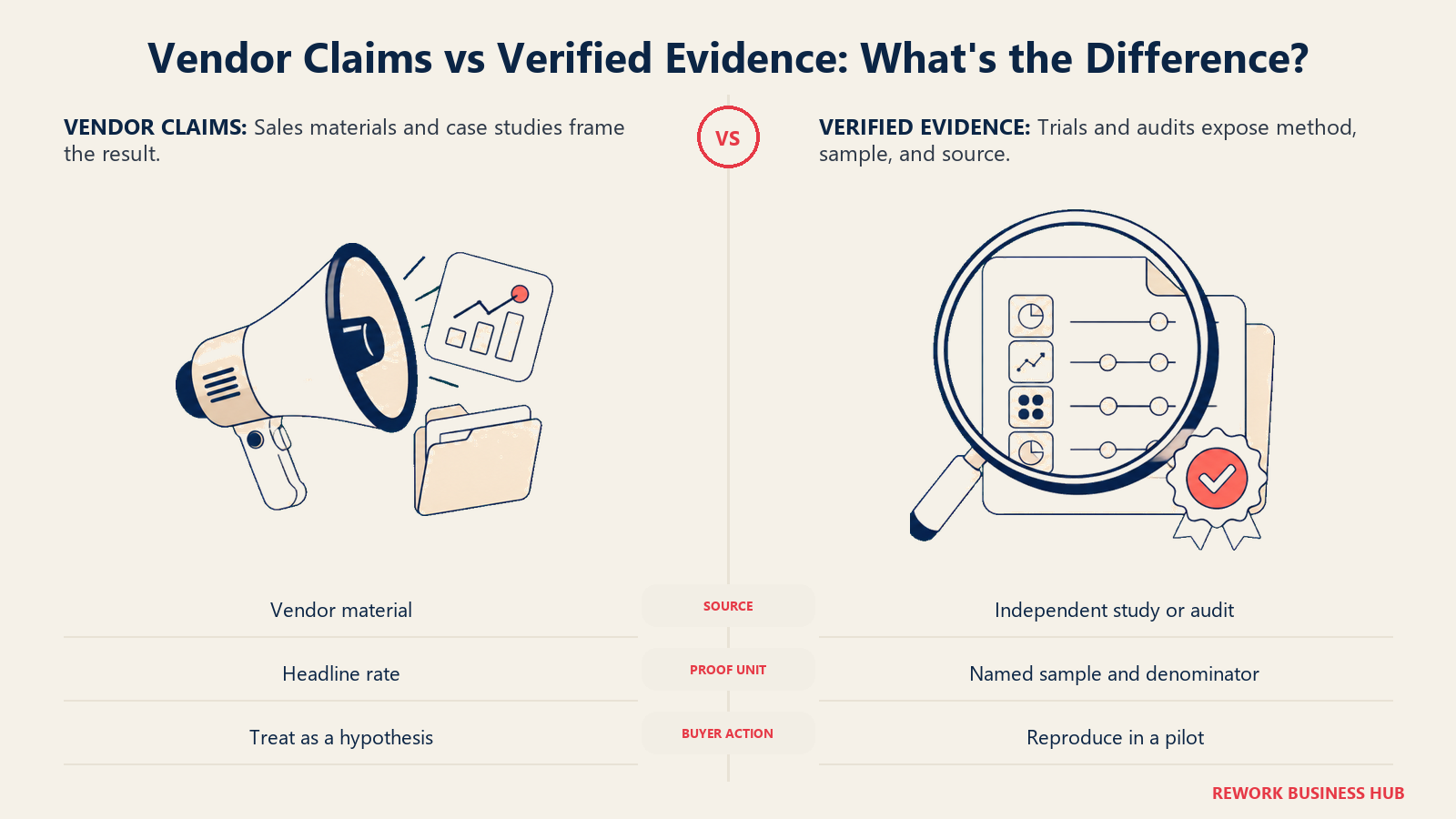
Treat every ROI or automation-rate figure below the way the AI agent ROI blueprint recommends: as a hypothesis to test against your own baseline, not a number for a board deck before you've piloted it yourself.
| Claim | What's Actually Verified | How to Test It Yourself |
|---|---|---|
| Ambient scribes cut documentation time and burnout | Independently verified: a NEJM AI-published RCT of 238 physicians across 14 specialties found Nabla cut time-in-note 9.5% (p=0.02); Microsoft's DAX Copilot didn't reach significance in the same trial | Ask any vendor whether their time-savings figure comes from an internal study or an independent trial, and on what sample size |
| AI agents pay for themselves in the revenue cycle | Not proven at the system level: PHTI's August 2026 report on administrative AI found prior-auth AI can lower an individual organization's cost but "has not reduced overall system-level costs," and that AI-assisted billing may be increasing billing intensity | Ask for your own pilot's before-and-after cost data, not a vendor ROI slide, and watch your payer mix's response over the following two quarters |
| "Best in KLAS" and similar rankings | Genuinely independent for KLAS specifically: Abridge's Best in KLAS Ambient AI win (2025 and 2026) is based on direct customer interviews conducted by KLAS Research, not a vendor self-report | Read the underlying KLAS report yourself if your organization has access, rather than a press release's summary of it |
| Call and task automation rates (Infinitus's 98% call success, Cohere's up-to-90% auto-approval, Qventus's 40% fewer cancellations) | Vendor-reported in every case; none independently audited in what's public | Ask for the denominator, all requests or only the ones routed to automation, and pilot on your own volume first |
| "HIPAA compliant" as a homepage claim | Meaningfully different from a signed BAA and a named SOC 2 or HITRUST report; several vendors in this guide show a badge without itemizing the underlying attestation | Ask for the BAA and the actual audit report by name, not just the compliance page's badge |
How to Choose: Decision Framework
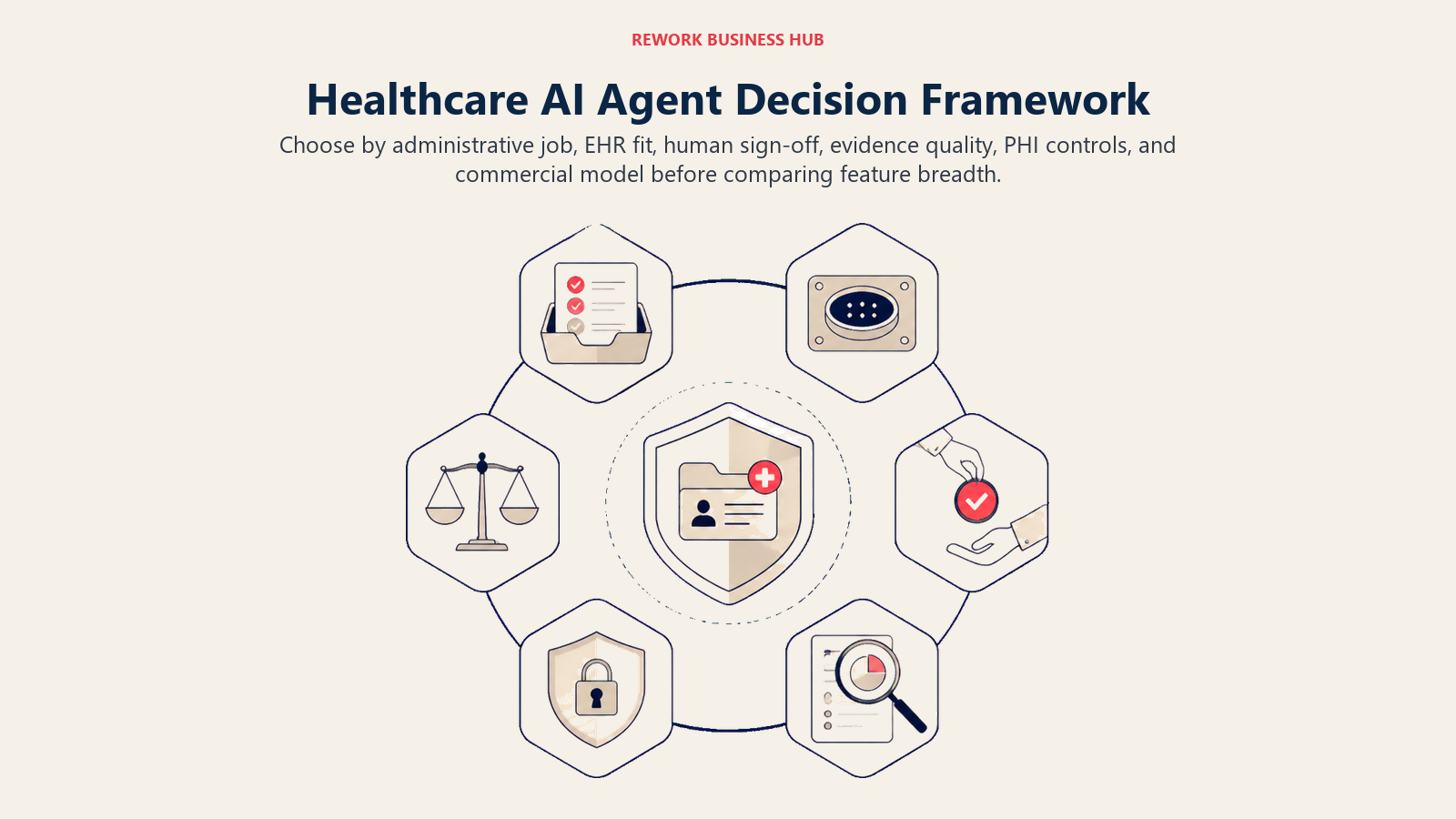
Use this framework to choose by administrative job, evidence, EHR fit, and PHI controls before comparing feature breadth.
| If you need... | Pick... | Why |
|---|---|---|
| The most independently validated documentation time savings | Nabla | Statistically significant result in a 3-arm NEJM AI randomized trial |
| The highest-satisfaction enterprise scribe on Epic | Abridge | Two-time Best in KLAS Ambient AI winner, independently scored |
| Documentation plus real-time coding accuracy | Ambience Healthcare | AutoCDI surfaces HCC and E/M coding during the visit, not after |
| You're already standardized on Microsoft or Oracle Health | Microsoft Dragon Copilot or Oracle Health Clinical AI Agent | Deepest tie-in to an EHR/ecosystem you already run; Oracle's agent even drafts orders |
| Documentation tied to a revenue cycle module | Suki | Assisted Revenue Cycle plus KLAS-cited revenue gains at three health systems |
| One platform across patient access, prior auth, and care gaps | Notable | Widest confirmed job coverage of any vendor here |
| High-volume patient outreach without adding headcount | Hippocratic AI | 1,000+ pre-built agents, priced per agent-hour, explicit non-diagnostic scope |
| Fewer payor hold-time calls | Infinitus | Automates the benefit-verification and prior-auth-status call itself |
| Faster payer decisions on the authorizations your patients already face | Cohere Health | Real-time approval on most requests it reviews |
| Hospital-wide capacity, OR scheduling, and coding together | Qventus | Now spans capacity planning through a dedicated coding automation suite |
| Revenue cycle agents grounded in unified clinical and claims data | Innovaccer | Black Book's #1-ranked AI-powered revenue cycle vendor for 2026 |
| One vendor from the first patient call to the final claim | Commure (incl. Athelas) | Only platform here spanning call center, documentation, and RCM natively |
What to Do Next
Don't start with a demo. Write down, in one sentence, which single job is costing your team the most time or money right now, documentation, prior auth, patient access, or revenue cycle coding, and let that sentence narrow this list to two or three real candidates instead of all thirteen. Then run the HIPAA and accuracy checklists above against each one, a signed BAA, a named SOC 2 or HITRUST report, a defined human sign-off point, before anyone in procurement signs anything, since retrofitting those questions onto an agent that already has PHI access is a much harder conversation than asking up front.

Principal Product Marketing Strategist
On this page
- Updated August 2026: What Changed
- Key Facts
- Quick Comparison Table
- Which Healthcare Operations Job Each Agent Actually Owns
- The HIPAA Gate: What to Require Before an Agent Touches PHI
- What Each Vendor Actually Has on Its Own Trust Page
- What to Ask For Before You Grant Access
- Accuracy and Liability: Who Signs What an Agent Drafts
- EHR and System Integration Depth
- Sizing and Persona
- 1. Abridge: The Two-Time Best in KLAS Ambient Documentation Leader
- 2. Nabla: The Scribe With an Independently Verified Result
- 3. Ambience Healthcare: Real-Time Coding Alongside the Note
- 4. Microsoft Dragon Copilot: The Microsoft and Nuance Ecosystem Play
- 5. Suki: Voice-First, With Revenue Cycle Help Built In
- 6. Oracle Health Clinical AI Agent: The Only One That Also Writes Orders
- 7. Notable: The Widest Job Coverage in One Platform
- 8. Hippocratic AI: Patient-Facing Outreach, Priced Per Agent-Hour
- 9. Infinitus: Automating the Payor Phone Call Itself
- 10. Cohere Health: Prior Auth Intelligence, Bought by Your Payer
- 11. Qventus: Hospital Operations, Now Including Coding
- 12. Innovaccer: Revenue Cycle Agents Tied to a Data Platform
- 13. Commure (Including Athelas): One Vendor From Intake to Claim
- Vendor Claims vs. What's Actually Verified
- How to Choose: Decision Framework
- What to Do Next