Best AI Agents for Digital Marketing in 2026: 11 Agents for Paid, Organic, and Social Acquisition
Turn this article into takeaways for your work.


Each assistant summarizes the article only for you and suggests best practices for your work.
If you run acquisition (paid, organic search, social, or email) and you're deciding whether to hand execution to an AI agent instead of a person or a platform's own automation, eleven products currently do real agentic work in this space. Jasper and HubSpot Breeze cover the most ground across content and channels, Smartly and Madgicx run paid social close to unattended, Optmyzr does the same for paid search, AirOps and SEO.ai handle organic content and SEO end to end, and Ocoya, Gumloop, Lindy, and Pencil fill in social, custom orchestration, and creative production. Every product below had to clear one bar to make the list: it plans and executes more than one step on its own, not just draft-and-hand-back.
An AI agent differs from an AI tool in a way that matters for your budget: a tool drafts one thing when you ask it to, an agent runs the ongoing job (research, draft, publish, adjust) with some standing permission to act without you in the loop. That line got blurry fast in 2026 as every vendor started calling its features "agents." One product that launched with the same pitch, Icon, shut down entirely in February 2026. Another, AdCreative.ai, describes its own core product as generative creative output rather than autonomous execution, so it's covered properly in our AI ad creative tools roundup instead. This guide covers acquisition agents specifically, not the wider set of marketing-operations agents (brand governance, asset management, campaign planning) a broader function roundup would include, and not the AI-assisted software in our best AI tools for digital marketing guide. If you'd rather build a narrow agent yourself than buy one of these, what an AI agent actually is and the AI agents for marketing blueprint map are the place to start.
Updated August 2026: What Changed
- Icon, a heavily funded all-in-one AI ad platform, shut down entirely in February 2026, a reminder to check a vendor's current operating status before standardizing a workflow on it, not just its funding announcement.
- HubSpot moved its Prospecting and Customer Breeze Agents to outcome-based pricing in April 2026: $1 per qualified lead and $0.50 per resolved conversation, down from flat monthly and per-conversation fees.
- Jasper launched an end-to-end GEO Agent in June 2026, extending its agent lineup from content production into ongoing AI-search visibility management.
- Paid-media autonomy got more standard, not less: Smartly, Madgicx, and Optmyzr all now push budget or bid changes to live ad accounts on a schedule, not just a recommendation a person has to action manually.
Key Facts
- 87% of marketers now use generative AI in at least one workflow, up from 51% in 2024, and those who do save roughly five hours of work a week, per Salesforce's State of Marketing 2026 report.
- High-performing marketing teams are nearly twice as likely as underperformers to use AI agents specifically, reclaiming up to eight hours a week in the process, according to Salesforce's research on marketing trends in the AI era.
- CMOs allocate 15.3% of marketing budgets to AI in 2026, but only 30% say their teams are actually ready to scale it, per Gartner's 2026 CMO Spend Survey.
- Mature AI deployments in marketing and sales can lift lead volume by more than 50% and cut prospecting costs by up to 60%, per McKinsey.
- Only 16% of what companies call an "AI agent" in production actually plans, observes, and adapts on its own; most are fixed-sequence automation wearing agent branding, per Menlo Ventures' State of Generative AI in the Enterprise report, worth remembering before you take any vendor's "agent" claim at face value.
Quick Comparison Table
| Agent | Best For | Orchestration Model | Starting Price | Key Limitation |
|---|---|---|---|---|
| Jasper | Cross-channel content and GEO under one brand layer | Cross-channel orchestrator | $69/mo/seat ($59/mo annual) | Doesn't touch ad platforms or send email itself |
| HubSpot Breeze | Teams already running marketing from HubSpot's CRM | CRM-embedded orchestrator | Outcome-based, from $0.50 per resolved conversation | Requires an active Hub subscription on top |
| Smartly | Enterprise paid social and creative at scale | Paid-media orchestrator (cross-platform) | Custom, roughly $4-5K/mo minimum (reported) | Priced out of reach below about $50K/mo ad spend |
| Madgicx | Autonomous Meta ads budget and creative optimization | Paid social specialist | From $99/mo (spend-tiered, shown in-app) | Real price hidden until you connect an ad account |
| Optmyzr | Autonomous PPC rule execution across search engines | Paid search specialist | Custom (spend-tiered, not published) | No self-serve number anywhere on the site |
| Pencil | Fast multi-platform ad creative production | Paid creative specialist | $14/mo ($11/mo annual) | Generates creative, doesn't launch or manage the campaign |
| AirOps | SEO and content operations at scale | Organic/SEO specialist | Free (1,000 tasks/mo); ~$200/mo Solo (reported) | Self-serve tiers jump from ~$200 to ~$2,000/mo with nothing between |
| SEO.ai | Hands-off SEO from keyword to published page | Organic/SEO specialist (plus paid search) | $149/mo | Single Site plan covers exactly one domain |
| Ocoya | Agencies posting and messaging across client social accounts | Social specialist | $15/mo ($12/mo annual) | No paid, SEO, or email coverage at all |
| Lindy | Custom no-code agents for any marketing workflow | Configurable orchestrator | $29.99/mo/user | Not marketing-native; you build the workflow yourself |
| Gumloop | Technical teams building multi-tool agent pipelines | Configurable orchestrator | $37/mo (unlimited seats) | Usage-based credits plus an 8% orchestration fee add up fast |
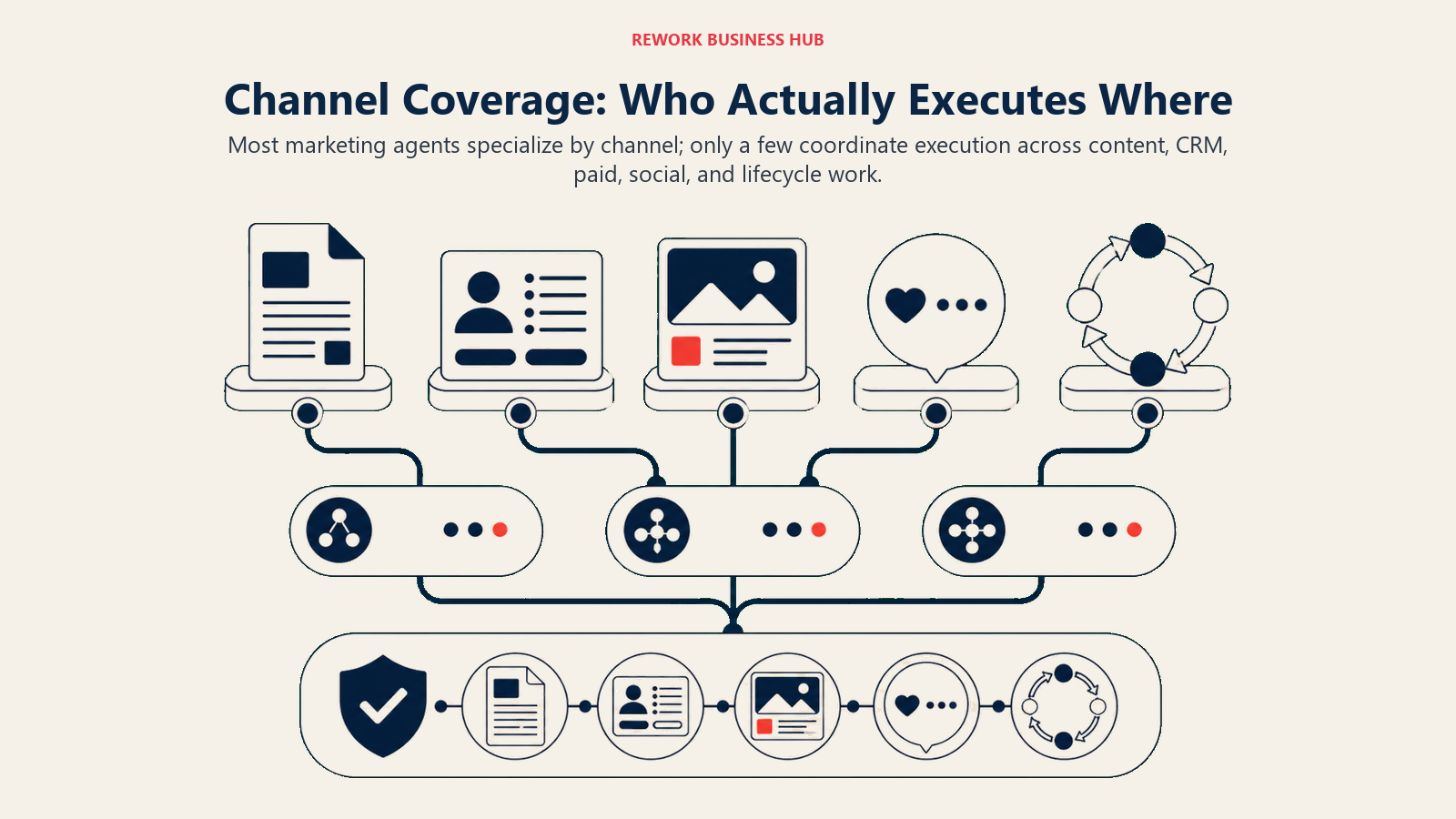
Channel Coverage Matrix: Who Actually Executes Where
This is the table most roundups skip: which of these agents touches a channel end to end, versus which one drafts something a human still has to publish or launch. ● means the agent executes and publishes or pushes changes on its own. ◐ means it drafts, recommends, or optimizes but a human (or a different tool) completes the loop. Dash means the channel isn't covered.
| Agent | Paid Search | Paid Social | Organic/SEO | Organic Social | |
|---|---|---|---|---|---|
| Jasper | ◐ | ◐ | ● | ◐ | ◐ |
| HubSpot Breeze | - | - | ◐ | ● | ◐ |
| Smartly | ● | ● | - | - | - |
| Madgicx | ◐ | ● | - | - | - |
| Optmyzr | ● | ◐ | - | - | - |
| Pencil | - | ◐ | - | ◐ | - |
| AirOps | - | - | ● | ◐ | - |
| SEO.ai | ◐ | - | ● | - | - |
| Ocoya | - | - | - | ● | - |
| Lindy* | ◐ | ◐ | ◐ | ◐ | ◐ |
| Gumloop* | ◐ | ◐ | ◐ | ◐ | ◐ |
*Lindy and Gumloop are general-purpose agent builders. Every column depends entirely on which integration and workflow you configure, not on channel-native product design.
Two things jump out. First, nobody in this list runs email as an autonomous acquisition channel the way Smartly runs paid social or SEO.ai runs organic. The closest any of them get is drafting email copy inside a broader content agent (Jasper, HubSpot Breeze), which still leaves send logic, list segmentation, and deliverability to your ESP. If email is the specific channel you want an agent for today, building a narrow one from the AI email marketing agent blueprint currently beats waiting on a vendor to ship it.
Second, the agents that go furthest left to right on this table (Jasper, HubSpot Breeze) are also the ones that never touch a platform's ad account or bidding engine directly. The ones that do (Smartly, Madgicx, Optmyzr) stay inside one paid lane and go deep instead of wide. That's not a flaw in either approach. It's the real tradeoff this category runs on: breadth versus depth, and almost nothing on the market has cracked both at once yet.
The Agency Question: Multi-Client Workspaces and White-Label
Buying an agent for one brand and buying one to run twenty client accounts are different purchases. Most vendors on this list don't say a word about agencies on their pricing page. These are the ones that do. (If security and procurement review matter more to your buying process than channel fit, our enterprise AI agent platforms guide covers that angle specifically.)
| Agent | Multi-Client Workspaces | White-Label / Client Reporting | Where Agency Pricing Starts |
|---|---|---|---|
| Ocoya | Yes, Gold tier: 20 workspaces, 20 users | Branded reporting at the Diamond tier | Gold $79/mo ($63.20/mo annual) |
| Smartly | Yes, multi-brand enterprise accounts | Agency-grade reporting via its Intelligence Suite | Custom, effectively $50K+/mo ad spend to justify |
| Jasper | Yes at Business tier: unlimited Brand Voices, Knowledge, and Audiences | Governed via Groups, not white-labeled | Business, custom, 12-month minimum |
| Pencil | Yes from Growth tier: unlimited workspaces | Enterprise tier adds IP assignment and data ringfencing per client | Growth $55/mo ($44/mo annual) |
| HubSpot Breeze | Yes via Business Units | Reports carry the HubSpot brand, not the agency's | Requires Marketing Hub Enterprise |
| Gumloop / Lindy | Unlimited teams and seats, not client-workspace-specific | No | Gumloop Pro $37/mo; Lindy $29.99/mo/user |
Ocoya and Pencil are the two genuinely built for a small-to-mid agency budget. Smartly is built for agencies too, just not small ones: its pricing only makes sense once a client's monthly spend clears roughly $50,000. Madgicx, Optmyzr, AirOps, and SEO.ai don't publish agency-specific packaging at all, which doesn't rule them out for an agency, it just means negotiating a custom deal per seat or per account instead of picking a listed tier.
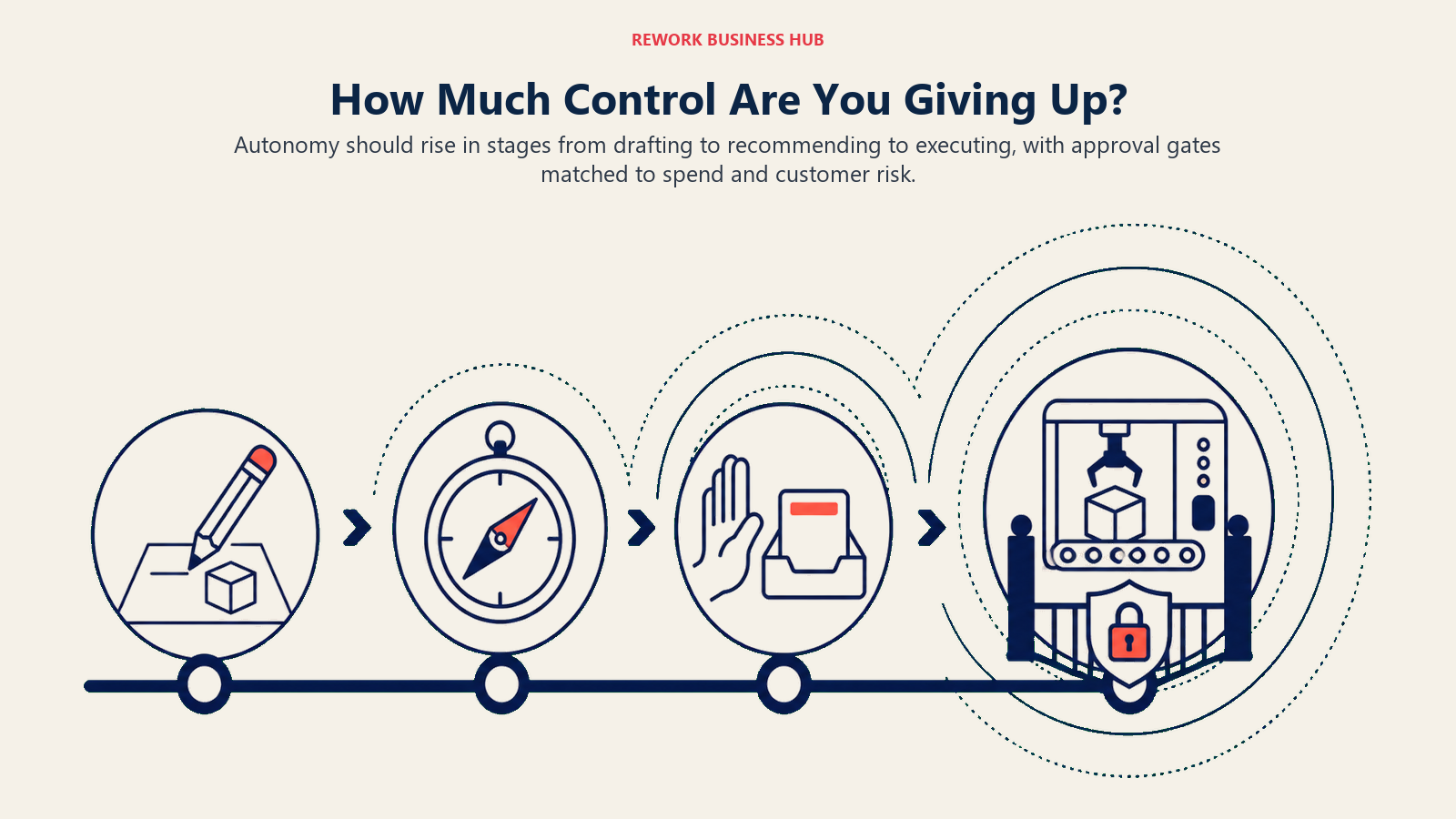
How Much Control You're Actually Giving Up
Platform-native automation (Meta's Advantage+, Google's Performance Max) already runs plenty of your budget without asking. The real question with a third-party agent is whether it adds a genuinely useful layer on top, or just a second black box between you and your spend. Autonomy varies a lot across this list, and the pricing model is usually a tell: outcome-based and standing-permission agents bill for what they did, draft-only agents bill for your seat regardless of output.
| Agent | Autonomy Level | What You're Actually Trusting It With |
|---|---|---|
| Optmyzr | Standing autonomy | Pushes bid and budget rule changes straight to Google, Microsoft, and Amazon Ads, on a schedule as tight as hourly |
| Smartly | Standing autonomy | Reallocates creative and budget across nine or more paid channels through its Media Suite |
| Madgicx | Standing autonomy, opt-in | AI Marketer adjusts Meta targeting and spend inside guardrails you set upfront |
| HubSpot Breeze (Prospecting, Customer) | Outcome-triggered autonomy | Runs the full outreach or resolution loop; you pay once it completes one ($1/lead, $0.50/resolved conversation) |
| Jasper | Guardrailed autonomy | Executes inside brand rules you define; a human still approves most outputs before publish |
| Ocoya, AirOps, SEO.ai | Configurable, approval-gated | You choose per workflow: draft for review, or auto-publish once you trust it |
| Pencil | Draft-only | Generates and scores creative; a human still launches the campaign |
| Gumloop, Lindy | Whatever you build | Autonomy is entirely a function of the workflow and guardrails you configure yourself |
Gartner expects more than 40% of agentic AI projects to be canceled by the end of 2027, citing unclear business value and weak risk controls as the leading causes, and only 21% of companies say they have a mature governance model for autonomous agents at all, per Deloitte's State of AI in the Enterprise. Before you hand any of the standing-autonomy tools above a live budget, write down what "good" looks like and who gets paged when it's wrong. That's a lot cheaper to do on day one than after the fact.
1. Jasper: The Closest Thing to a Cross-Channel Marketing Agent
Jasper spent 2026 rebuilding itself around agents instead of a single writing box. Jasper Agents are described by the company as self-learning operators that autonomously execute workflows like optimization, personalization, and research, using your brand's own knowledge base rather than a generic prompt. The June 2026 addition was a GEO Agent built specifically to track and improve how a brand shows up inside ChatGPT, Perplexity, and AI Overviews on an ongoing basis, not a one-time audit. For tracking-focused platforms to compare it against, Best GEO Tools in 2026 sorts twelve of them by whether they only watch, also diagnose, or act.
The honest limit: Jasper's agents work on content and brand signals. They don't place a bid, don't send an email, and don't touch a Meta or Google Ads account directly. What you get instead is one governed layer (Brand Voices, Knowledge, Audiences) that every piece of output across channels has to pass through, which matters more as your team and prompt volume grow.
| What you get | What you don't |
|---|---|
| Agents for optimization, personalization, research, and AI-search visibility (GEO) | No direct execution on ad platforms, email sends, or social publishing |
| Brand governance (Voices, Knowledge, Audiences) every agent output passes through | Business tier pricing is custom with a 12-month minimum |
| No-code custom agent builder at the Business tier | Pro tier ships with only 1 seat; more seats require Business |
| LLM-agnostic routing across multiple underlying models | Credits meter GEO Hub and Agent usage separately from Chat/Canvas |
Pricing: Pro is $69/mo per seat, or $59/mo per seat billed annually, and includes core marketing agents, Canvas, 2 Brand Voices, 5 Knowledge assets, and 3 Audiences. Business is custom-quoted with a 12-month minimum and adds the no-code agent builder, unlimited Brand Voices/Knowledge/Audiences, API access, and admin governance (jasper.ai/pricing).
Best for: Marketing teams that want one governed agent layer across content, SEO, and AI-search visibility, and are fine handling paid media and email execution somewhere else.
2. HubSpot Breeze: Agents That Already Live Inside Your CRM Data
HubSpot's advantage isn't a smarter model, it's that its agents start from the same contact record your sales and service teams already use. The Content Agent drafts landing pages, blog posts, and social content in your brand voice using that CRM context, and the Prospecting Agent identifies and engages leads worth a rep's time.
The more interesting story is the pricing shift. As of April 14, 2026, HubSpot moved the Prospecting Agent and Customer Agent to outcome-based pricing: Prospecting Agent now costs $1 per lead once a prospect is qualified and handed to your team (down from a flat monthly charge per contact enrolled), and Customer Agent dropped from $1.00 per conversation to $0.50 per resolved conversation. Both run on HubSpot Credits, which cost $0.01 each and are sold from 1,000 credits for $10, with Customer Agent consuming 50 credits per resolution and Prospecting Agent 100 credits per qualified lead. All of this sits on top of an active Marketing, Sales, or Service Hub subscription: HubSpot's own pricing page lists Marketing Hub Starter at $20 per seat monthly as the standard rate, though a new-customer promotional rate as low as $7 per seat was showing, so confirm the live offer before you budget.
| What you get | What you don't |
|---|---|
| Agents that share one contact record across marketing, sales, and service | Requires an active Hub subscription before any agent works |
| Pay-per-outcome pricing on Prospecting and Customer Agents, not flat seat fees | Content Agent's own standalone price isn't broken out from Hub credits |
| Content Agent generates landing pages, blog posts, and social content in-brand | New-customer promo pricing makes the sticker price hard to pin down |
| Business Units support multi-client setups at the Enterprise tier | Full agent lineup only ships on the pricier Hub tiers |
Pricing: Prospecting Agent: $1 per qualified lead. Customer Agent: $0.50 per resolved conversation (down from $1.00, effective April 2026). HubSpot Credits: $0.01 each, from 1,000 credits for $10. Requires a Marketing, Sales, or Service Hub subscription, Starter listed from $20/mo per seat (hubspot.com/pricing).
Best for: Teams already running marketing, sales, and service from HubSpot who want agents reading and writing to the same record instead of stitching a separate agent platform on top.
3. Smartly: Enterprise Paid Social and Creative Automation Across Nine Channels
Smartly pairs an AI creative studio with automated media buying across Meta, Google, TikTok, Pinterest, Snapchat, Amazon, Reddit, Spotify, YouTube, and connected TV, the widest paid-channel spread of anything on this list. Its AI Studio generates and adapts creative variants by audience and product automatically, and its Media Suite handles the buying side, reallocating budget based on performance instead of waiting for a person to notice a losing ad set. Smartly reports its AI Studio produced 1.9 million creative assets across more than 260 customers since its 2025 launch, with an average 27% performance lift over static creatives, a vendor figure worth treating as directional rather than audited.
None of this is cheap or self-serve. Smartly doesn't publish pricing, and third-party reporting puts the minimum software fee around $4,000 to $5,000 a month, which only pencils out once an account is spending $50,000 to $100,000 or more monthly.
| What you get | What you don't |
|---|---|
| Paid-channel breadth across nine-plus platforms plus connected TV, one login | No public pricing; a sales conversation is mandatory |
| Autonomous budget reallocation and creative production, not just recommendations | Minimum spend requirement prices out anything under roughly $50K/mo |
| Unified analytics across every connected paid channel | Zero coverage of organic, SEO, or email |
| Proven at agency and enterprise scale (260+ customers on AI Studio alone) | Implementation and onboarding add real ramp time |
Pricing: Custom, quote-based; no public tiers. Third-party reporting puts the minimum monthly software fee around $4,000 to $5,000 (reported, ITQlick), realistic only once managed ad spend clears roughly $50,000 to $100,000 a month.
Best for: Agencies and enterprise brands running paid social (and connected TV) across many platforms at a scale where a percent or two of efficiency gain covers the software cost many times over.
4. Madgicx: Autonomous Meta Ads Budget and Creative Optimization
Madgicx's AI Marketer is built specifically for Meta advertisers who want targeting and budget decisions made continuously instead of checked in on once a day. It's an opt-in autopilot: you set the guardrails (target CPA, budget ceilings, which campaigns are in scope) and it adjusts spend and audience allocation inside them, plus generates a One-Click Report for client-facing summaries.
The catch is pricing transparency. Madgicx Pro Complete with AI is priced on a sliding scale tied to your monthly Meta ad spend, from roughly $99/mo at the lowest bracket (under $1K spend) up to $329/mo around the $20K to $30K bracket, but the actual number only appears inside the app once you connect an ad account, not on the public pricing page. Quarterly and annual billing reduce the effective monthly rate, though Madgicx doesn't publish the discount percentage. A separate Tracking Pro add-on for server-side conversion tracking runs $49/mo per connected account and is listed publicly.
| What you get | What you don't |
|---|---|
| Autonomous budget and targeting adjustments inside guardrails you set | Real Pro Complete price is hidden until you connect an ad account |
| Spend-tiered pricing scales down for smaller advertisers | Meta-centric; Google and other channels are a secondary feature at best |
| One-Click Report for client and stakeholder reporting | Tracking Pro is a separate $49/mo add-on per account |
| 7-day free trial with full access | No published agency or multi-brand packaging |
Pricing: Pro Complete with AI is spend-tiered, roughly $99/mo to $329/mo depending on monthly Meta ad spend, shown only after connecting an account inside the app. Tracking Pro add-on: $49/mo per account (madgicx.com/pricing).
Best for: Meta-first advertisers who want continuous, autonomous budget and creative optimization without building the rules themselves from scratch.
5. Optmyzr: Autonomous PPC Rule Execution Across Search Engines
Optmyzr has been a PPC management tool for over a decade, and its Rule Engine is the part that actually qualifies it as an agent rather than a dashboard: automation rules run on a schedule down to hourly and push bid, budget, and structure changes straight to Google Ads, Microsoft Ads, and Amazon Ads without a person clicking publish each time. An AI Sidekick layer adds natural-language PPC assistance on top, and an MCP connection lets Claude, ChatGPT, or other AI tools query account data directly.
Optmyzr is one of the harder products on this list to price. Essentials, Premium, and Enterprise tiers are all sized against the ad spend under management, and none of the three shows a self-serve number on the public pricing page. Enterprise is explicitly "get a custom plan," and Essentials and Premium don't show one either, so budget for a sales conversation.
| What you get | What you don't |
|---|---|
| Rule Engine pushes changes to live ad accounts automatically, not just recommendations | No self-serve pricing published anywhere on the site |
| Coverage across Google, Microsoft, and Amazon Ads in one dashboard | Social advertising tools are a Premium-tier add, not a core strength |
| MCP connection for querying account data from Claude or ChatGPT | Portfolio-level features (PMax, Shopping) reserved for Premium and above |
| 30% discount for annual prepayment | Essentials tier trims most of the automation depth the tool is known for |
Pricing: Essentials, Premium, and Enterprise, all priced against managed ad spend with no public self-serve number; a 30% discount applies to annual prepayment. Enterprise is custom-quoted (optmyzr.com/pricing).
Best for: PPC teams and agencies managing multiple Google, Microsoft, or Amazon Ads accounts who want rule-based changes to actually execute, not just show up in a report.
6. Pencil: Fast, Multi-Format Ad Creative Production
Pencil, acquired by Brandtech Group in 2023 and still operating and expanding into enterprise accounts in 2026 (including a Gen AI content system built with Coty), positions itself as an AI agent for the creative side of paid acquisition specifically. Its agents take an audience brief, generate copy, images, and video, and score the output, with a full ad typically ready in two to three minutes using models from Anthropic, OpenAI, and Google under the hood.
What Pencil doesn't do is launch or manage the campaign itself. It's a creative production agent, not a media-buying one, which makes it a natural pairing with something like Madgicx or Smartly on the buying side rather than a replacement for either.
| What you get | What you don't |
|---|---|
| Multi-format creative (text, image, video) generated and scored in minutes | Doesn't launch, bid, or manage the campaign after creative is produced |
| Unlimited workspaces from the Growth tier, useful for agencies | Core tier caps at 50 generations a month |
| Enterprise tier adds IP assignment and data ringfencing per client | Enterprise pricing is fully custom, no published ceiling |
| Multi-model routing (Anthropic, OpenAI, Google) under one interface | Positioning has shifted toward larger accounts since the 2023 acquisition |
Pricing: Core is $14/mo ($11/mo billed annually) for 50 generations. Growth is $55/mo ($44/mo annually) for 250 generations and unlimited workspaces. Pro is custom, unlimited generations (trypencil.com/pricing).
Best for: Teams and agencies that need a high volume of tested ad creative fast, and already have a separate tool or team handling media buying.
7. AirOps: SEO and Content Operations at Scale
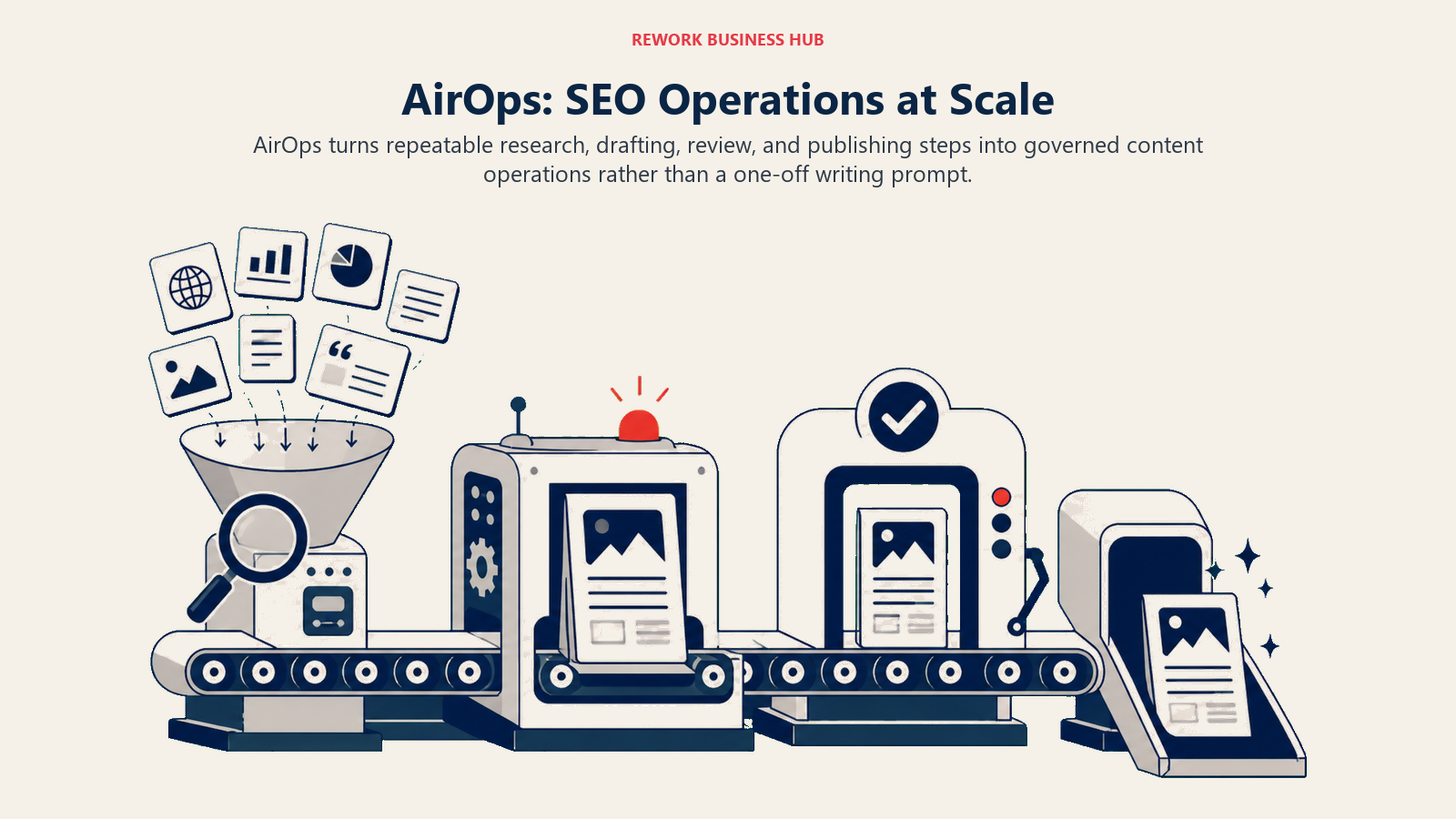
AirOps pairs two layers: an Insights side that tracks AI search visibility, citations, and share of voice, and an Action side built around its Quill agent and no-code workflows that chain AI calls, data lookups, human review steps, and CMS publishing into one repeatable pipeline. That's a genuinely multi-step agent, not a content generator with a publish button. A workflow can research a keyword, draft against your brand voice, route for review, and push live to WordPress, Webflow, or another CMS without you touching each step.
Where it gets expensive fast is the jump between self-serve tiers. The free Insights plan covers 1,000 tasks a month at no cost, but the next step up (Solo, reported around $200/mo for 20,000 tasks) jumps roughly tenfold to Pro (reported around $2,000/mo for 75,000 tasks), with nothing published in between. If you'd rather build a narrower version of this yourself, the AI SEO content brief agent blueprint covers the research-to-brief half of what AirOps automates end to end.
| What you get | What you don't |
|---|---|
| Genuine multi-step workflows: research, draft, review, publish, chained together | Solo-to-Pro pricing jumps roughly 10x with no tier in between |
| Free Insights tier for AI search visibility tracking at no cost | Task-based credits mean cost scales unpredictably with content volume |
| CMS, SEO, AEO, and social integrations at the Pro tier | Exact Solo/Pro prices aren't shown on the public pricing page itself |
| Built for teams publishing 20+ articles a month | Overage runs $0.025 per task past your plan's allotment |
Pricing: Insights (free): $0/mo, 1,000 tasks. Solo: reported around $200/mo, roughly 20,000 tasks, $0.025 per extra task (reported, coldiq.com; AirOps' own pricing page requires an interactive calculator). Pro: reported around $2,000/mo, roughly 75,000 tasks. Pages and Enterprise: custom.
Best for: Content and SEO teams publishing at real volume who want one workflow instead of stitching together a research tool, a writing tool, and a publishing script.
8. SEO.ai: A Hands-Off Agent From Keyword to Published Page
SEO.ai's pitch is the most literal "agent" claim on this list: it describes itself as an AI colleague that works around the clock, running keyword research, writing algorithm-aligned articles, building internal links, generating backlinks, and even building and optimizing Google Ads, then monitoring performance after publish. You choose whether it publishes automatically or hands you a draft first, and human SEO specialists reportedly run spot checks on the output.
The scope is narrower than AirOps in one sense (it's built around your own site rather than a multi-brand workflow builder) and broader in another: the Google Ads piece makes it the only organic-first agent on this list that also touches paid search.
| What you get | What you don't |
|---|---|
| Full keyword-to-publish pipeline, including optional auto-publish | Single Site plan covers exactly one domain or language |
| Google Ads building and optimization bundled in, not just SEO | No paid social, organic social, or email coverage |
| No developer setup; connects to WordPress, Webflow, Wix, Shopify in minutes | No public credit or generation caps stated per plan |
| Human spot checks alongside the automated output | No annual price shown, only "save 25%" without the dollar figure |
Pricing: Single Site: $149/mo. Multi Site (up to 3 sites or languages): $299/mo, with roughly 25% off on annual billing (seo.ai/pricing). Prices exclude VAT.
Best for: A single site or small portfolio that wants one agent handling SEO content and Google Ads together, with the option to auto-publish once you trust it.
9. Ocoya: Built for Agencies Running Client Social Accounts
Ocoya's agents are scoped narrowly and honestly: a Social Poster agent that writes and publishes across more than 30 channels, a DM Chatbot for automated replies, and a Comment-to-DM agent that turns a keyword in a comment into a private offer or link. An RSS-triggered workflow can turn a new blog post into social content, caption and image included, without a person starting the job. Multi-level approvals (internal, then client) are built in for anyone who wants a human gate before anything goes live. If Ocoya's fixed workflow doesn't fit and you'd rather build your own version, the AI social media agent blueprint walks through the same job.
It's also the most affordable agent on this list by a wide margin, and the tier structure (workspaces, users, and social profiles that scale together) is clearly built with agencies managing several client brands in mind, not a single in-house team.
| What you get | What you don't |
|---|---|
| Purpose-built agent types for posting, DMs, and comment-to-DM conversion | Zero coverage outside organic social, no paid, SEO, or email |
| Multi-level approval workflow for agency and client sign-off | AI credits (captions, images) are capped by tier, not unlimited |
| Pricing scales cleanly with workspaces and client accounts | Diamond tier still caps at 150 social profiles before custom pricing |
| Lowest entry price of any agent in this guide | Positioned for social specifically, not a broader marketing agent |
Pricing: Bronze: $15/mo ($12/mo annual), 5 social profiles. Silver: $39/mo ($31.20/mo annual), 20 profiles. Gold: $79/mo ($63.20/mo annual), 50 profiles across 20 client workspaces. Diamond: $159/mo ($127.20/mo annual), 150 profiles, branded reporting (ocoya.com/pricing).
Best for: Agencies and freelancers managing organic social for multiple client brands who want one agent handling posting, DMs, and engagement across all of them.
10. Lindy: No-Code Agents for Whatever Marketing Workflow You Define
Lindy isn't a marketing product. It's a general-purpose no-code agent builder with more than 40 prebuilt skills, thousands of integrations, and MCP support, which is why it also shows up in our no-code AI agent builders roundup. For marketing specifically, that means you can wire up an agent that monitors brand mentions, drafts and routes social replies, or triages inbound form leads, but you're building and maintaining that workflow yourself rather than buying a marketing-native product with the channel logic already built in.
Credits, not seats, determine your bill: a simple ask runs 2 to 250 credits, deeper work runs 250 to 1,000, and a full build can run 1,000 to 2,500, so the advertised tier price and your real monthly cost can diverge fast once you add voice or high-frequency workflows.
| What you get | What you don't |
|---|---|
| 40+ prebuilt skills plus a custom builder, thousands of integrations | Not marketing-native; every channel workflow is DIY |
| MCP support connects it to nearly any tool with an API | Credit-metered usage means the sticker price isn't the real price |
| Slack-native interface, useful for teams that live in Slack already | No annual discount shown on the public pricing page |
| Enterprise tier adds HIPAA/BAA for regulated industries | Per-user pricing gets expensive fast for a full marketing team |
Pricing: Plus: $29.99/mo per user, 3,000 credits. Pro: $99.99/mo per user, 15,000 credits. Max: $199.99/mo per user, 35,000 credits. Enterprise: custom (lindy.ai/pricing).
Best for: Teams that already know exactly which marketing workflow they want automated and would rather configure it themselves than adapt to a vendor's fixed agent.
11. Gumloop: Multi-Tool Agent Pipelines for Technical Marketing Teams
Gumloop is Lindy's closest direct comparison: another no-code builder, positioned more toward technical and ops-minded users stitching together multi-step pipelines across 35+ models and whatever tools you connect. For marketing, that typically looks like a pipeline pulling competitor ad data, running it through analysis, and dropping a brief into a shared doc, built once and left running rather than a single-prompt tool.
Pricing is credit-based with an 8% orchestration fee layered on top of usage, worth modeling before you commit if your workflows run high-volume or high-frequency. Unlimited seats and teams mean the real constraint is usage, not headcount.
| What you get | What you don't |
|---|---|
| Unlimited seats and teams on the Pro plan, 35+ connected models | 8% orchestration fee adds on top of metered credit usage |
| Custom MCP server hosting for teams with existing tool stacks | Not marketing-native; workflow design is entirely on you |
| 14-day free trial before committing | Concurrency caps (5 workflow runs, 25 agent chats) at the Pro tier |
| Org-wide connector policies at Enterprise | No marketing-specific templates out of the box |
Pricing: Pro: $37/mo, 20,000 credits, unlimited seats and teams, plus an 8% orchestration fee on usage. Enterprise: custom (gumloop.com/pricing).
Best for: Technical marketing or RevOps teams that want to build custom multi-tool agent pipelines rather than adopt a vendor's fixed workflow.
The Measurement Problem: When Several Agents Touch One Funnel
Run Jasper for content, Smartly for the paid media, Ocoya for organic social, and HubSpot Breeze for prospecting on the same campaign, and you've got four systems independently touching one funnel, each with its own idea of what counts as a result. Smartly reports a media-driven conversion. Ocoya reports engagement on an organic post that may have influenced the same buyer three days earlier. HubSpot Breeze reports a qualified lead it charged you $1 for reaching out to. None of those numbers reconcile automatically, and the more agents you add, the worse the double-counting gets.
Three things help before you're three agents deep and can't explain a single number to your CFO. First, pick one system of record for the contact and conversion, not four dashboards you compare by eye. HubSpot Breeze has a real advantage here simply because its agents already write to the same CRM record. Second, decide up front which agent gets credit when a touch is ambiguous, before the ambiguous case happens, not after two teams have already claimed it. Third, revisit that rule monthly for the first quarter. Nobody gets multi-agent attribution right on the first configuration. And if you're not sure a given channel needs its own agent yet versus staying manual a while longer, the when to use an AI agent framework is a faster gut check than buying a fifth tool to find out.
How to Choose: Decision Framework
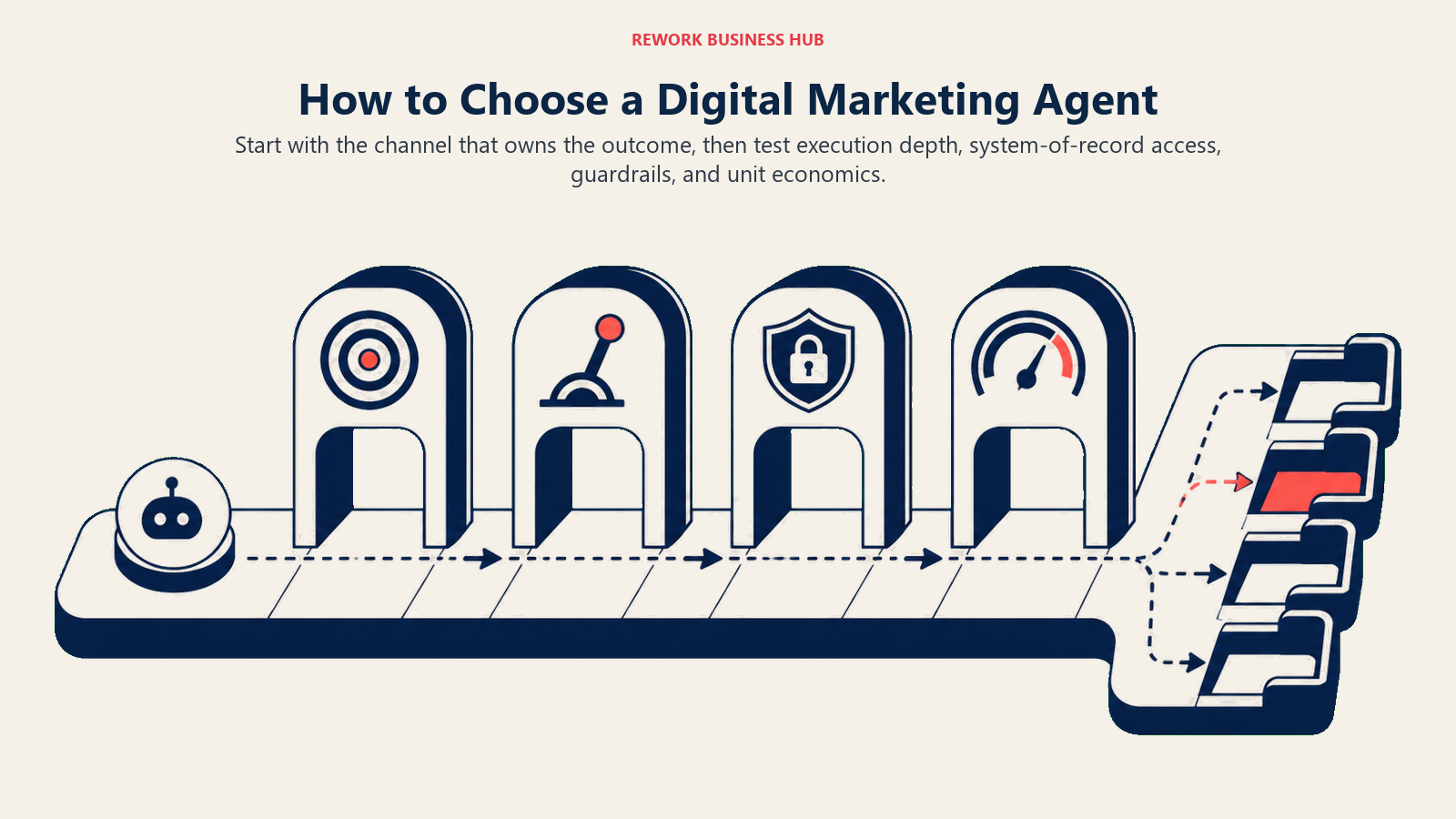
Choose the agent by the channel that owns the outcome, then verify execution depth, system-of-record access, guardrails, and unit economics.
| If you need... | Pick... | Why |
|---|---|---|
| One agent to draft and govern content across every channel | Jasper | Brand-governed multi-agent workspace spanning SEO, GEO, social, and email copy |
| Agents embedded in the CRM you already run marketing from | HubSpot Breeze | Prospecting, content, and customer agents share the same contact record |
| Autonomous Meta ads budget and creative optimization | Madgicx | AI Marketer adjusts targeting and spend inside guardrails you set |
| Enterprise-scale paid social and creative automation across many platforms | Smartly | Broadest paid-channel coverage, built for $50K+/month spend |
| Autonomous PPC rule execution across Google, Microsoft, and Amazon Ads | Optmyzr | Rule Engine pushes bid and budget changes without manual sign-off |
| A hands-off SEO agent that writes, publishes, and monitors | SEO.ai | Full keyword-to-publish pipeline with optional auto-publish |
| Multi-account social posting and DM handling for client brands | Ocoya | Purpose-built workspace tiers for agencies |
| High-volume ad creative production, media buying handled elsewhere | Pencil | Multi-format creative generated and scored in minutes |
| To build a custom agent instead of buying a packaged one | Gumloop or Lindy | No-code, cross-tool orchestration you configure yourself |
Digital Marketing Agent Buying Mistakes to Avoid
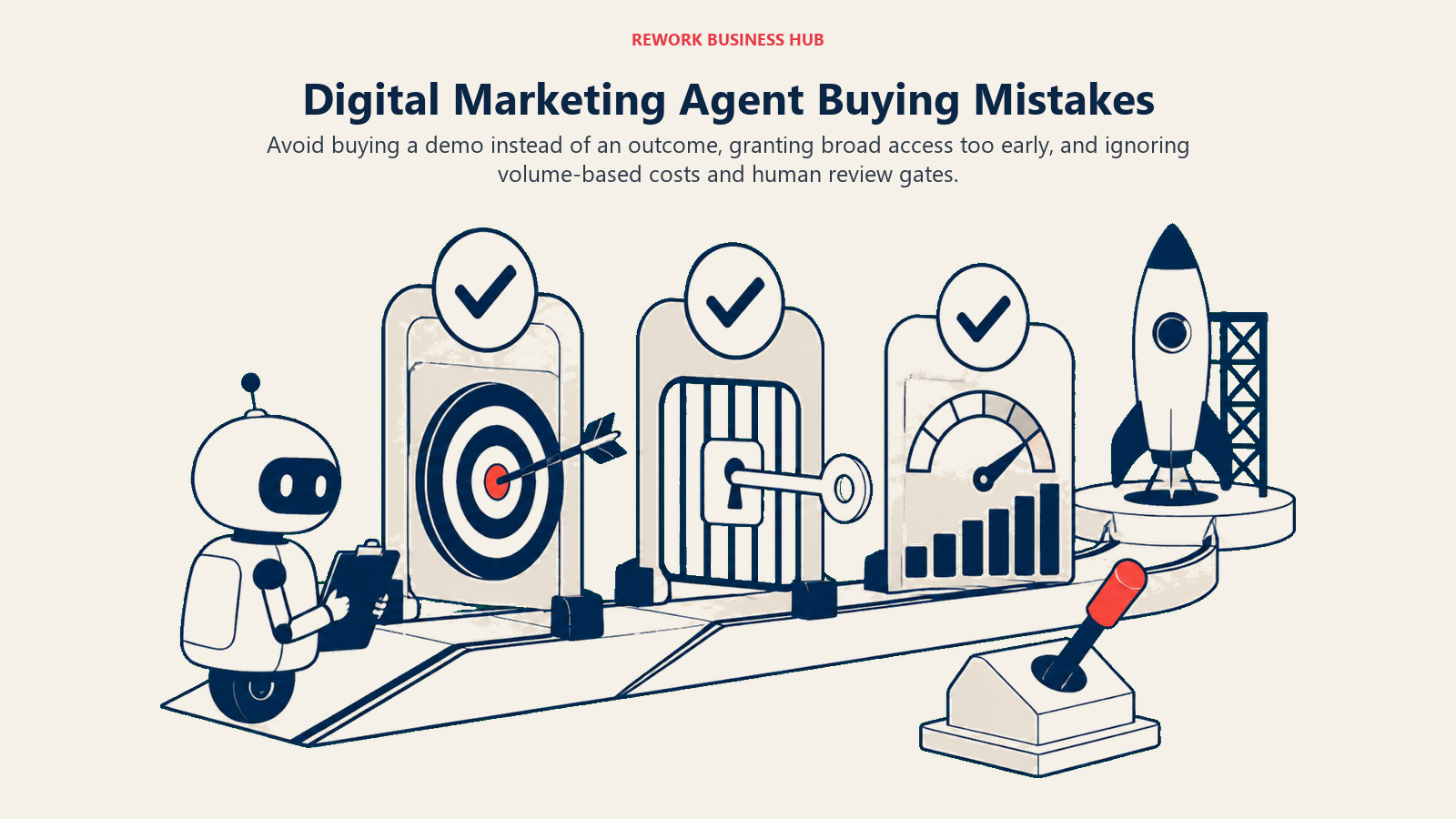
The costly mistakes start when teams buy a polished demo without defining the outcome, permissions, integrations, review gates, or volume-based cost.
| Mistake | What It Looks Like | What to Do Instead |
|---|---|---|
| Buying a channel agent before you have channel-level KPIs defined | Optmyzr optimizing against a "get more clicks" goal nobody wrote down | Define the metric each agent optimizes for before it goes live, not after |
| Treating "AI agent" as a synonym for "safe to automate fully" | Turning on Madgicx's autopilot on a new account with no guardrails set | Start approval-gated (Ocoya, AirOps, and SEO.ai all support this), tighten over time |
| Stacking agents on the same channel without a shared system of record | Breeze prospecting and a separate outbound tool both emailing the same lead | Pick one CRM or contact record every agent writes to first |
| Buying a cross-channel orchestrator to solve a single-channel problem | Paying for Jasper Business when the actual gap is paid-social budget management | Match the agent to the specific job, not the biggest feature list |
| Ignoring the free or cheap tier's real ceiling | Building a real workflow on AirOps Insights, then hitting the 1,000-task wall mid-month | Model your actual monthly volume against the plan before committing |
| Assuming agency pricing exists because the vendor is popular | Expecting Madgicx or Optmyzr to have a published multi-client tier | Ask directly; several vendors here only negotiate agency terms by request |
Frequently Asked Questions about AI Agents for Digital Marketing
What's the difference between an AI agent and an AI tool for digital marketing?
An AI tool drafts or assists with one task when a person asks it to, like generating an ad headline or optimizing a paragraph for SEO. An AI agent runs the ongoing job with some standing permission to act on its own: researching, drafting, publishing, and adjusting across multiple steps without a person driving every one of them. Smartly reallocating paid social budget automatically is agent behavior; a tool generating an ad variant on request is not, even though both get called "AI" in their marketing.
Which AI agents actually manage ad budgets and bidding on their own?
Optmyzr, Smartly, and Madgicx all push bid, budget, or targeting changes to live ad accounts without a human clicking publish each time, inside guardrails you set. Most of the other agents in this guide (Jasper, HubSpot Breeze, Pencil) stop at generating or optimizing creative and content, and leave the actual media buying to you or one of those three.
Are there AI agents that handle email marketing execution the way Smartly handles paid social?
Not yet, at least not among verified, generally available products as of August 2026. Several agents here (Jasper, HubSpot Breeze) can draft email copy inside a broader content workflow, but none run email as a fully autonomous acquisition channel end to end. If email is the specific gap you need filled, building a narrow agent from a blueprint currently beats waiting on a vendor to ship one.
Which of these agents work best for agencies managing multiple client accounts?
Ocoya and Pencil publish agency-friendly pricing at a genuinely small-agency budget. Smartly and Jasper support multi-client and multi-brand setups too, just at enterprise pricing. Madgicx, Optmyzr, AirOps, and SEO.ai don't publish agency-specific tiers, which means negotiating custom terms rather than picking a listed plan.
How much does an AI marketing agent cost in 2026?
Entry pricing runs from about $15/mo (Ocoya) to $69/mo per seat (Jasper Pro) for the self-serve products. Spend-tiered paid-media agents like Madgicx start around $99/mo and scale with ad spend, and enterprise paid-media platforms like Smartly typically require $4,000 to $5,000 or more a month, realistic only once managed spend clears roughly $50,000 monthly.
Can one AI agent cover paid, organic, and social all at once?
Not fully, and treating any vendor's claim that it does as literal is the most common buying mistake in this category. Jasper and HubSpot Breeze come closest by orchestrating content and brand signals across channels, but neither places a bid or manages an ad account directly. The channel coverage table above shows exactly where each agent's execution stops and a human, or a different tool, has to pick up the work.
What happened to Icon, the AI ad platform that used to show up in these roundups?
Icon launched in February 2025 with a broad, 14-product pitch and Founders Fund backing, then shut down in February 2026 after roughly a year, with users reporting billing complaints and a difficult cancellation process before the shutdown. It's a useful reminder to check a vendor's current operating status, not just its funding announcement, before standardizing a workflow on it.
How do you measure results when multiple agents touch the same marketing funnel?
Pick one system of record for the contact and conversion before you deploy a second agent, not after. HubSpot Breeze has a structural advantage here since its agents already write to the same CRM record; a stack of independent point agents (Smartly for paid, Ocoya for social, a separate email tool) requires you to build that reconciliation yourself.
Should a marketing team build a custom agent instead of buying one of these?
It depends on how standard the job is. A well-defined, common job, like posting to social on a schedule or running PPC bid rules, is usually cheaper to buy, since Ocoya or Optmyzr have already built and hardened that workflow. A job specific to your stack or brand rules is often better built on a general orchestrator like Gumloop or Lindy, or from one of the marketing agent blueprints, since no packaged vendor will match your exact workflow out of the box.
What to Do Next
Pick the one or two channels where you're most confident you could describe "good" in a sentence (paid social budget efficiency, SEO content velocity, whatever it is) and pilot a single agent there for 30 days before you add a second. Run it approval-gated first even if the vendor supports full autonomy, and only loosen the leash once you've seen a few weeks of its actual decisions. If none of these 11 fit what you need and you want the wider view of agent platforms generally (no-code builders, enterprise suites, developer frameworks), start with our best AI agent platforms guide instead, and if you're not sure a job is even ready to hand to an agent yet, our AI tools for digital marketing roundup covers the assistive software worth trying first.

Principal Product Marketing Strategist
On this page
- Updated August 2026: What Changed
- Key Facts
- Quick Comparison Table
- Channel Coverage Matrix: Who Actually Executes Where
- The Agency Question: Multi-Client Workspaces and White-Label
- How Much Control You're Actually Giving Up
- 1. Jasper: The Closest Thing to a Cross-Channel Marketing Agent
- 2. HubSpot Breeze: Agents That Already Live Inside Your CRM Data
- 3. Smartly: Enterprise Paid Social and Creative Automation Across Nine Channels
- 4. Madgicx: Autonomous Meta Ads Budget and Creative Optimization
- 5. Optmyzr: Autonomous PPC Rule Execution Across Search Engines
- 6. Pencil: Fast, Multi-Format Ad Creative Production
- 7. AirOps: SEO and Content Operations at Scale
- 8. SEO.ai: A Hands-Off Agent From Keyword to Published Page
- 9. Ocoya: Built for Agencies Running Client Social Accounts
- 10. Lindy: No-Code Agents for Whatever Marketing Workflow You Define
- 11. Gumloop: Multi-Tool Agent Pipelines for Technical Marketing Teams
- The Measurement Problem: When Several Agents Touch One Funnel
- How to Choose: Decision Framework
- Digital Marketing Agent Buying Mistakes to Avoid
- What to Do Next