Smartly.io vs Madgicx: Enterprise Creative Scale or Self-Serve Meta Automation in 2026
Turn this article into takeaways for your work.


Each assistant summarizes the article only for you and suggests best practices for your work.
Updated August 2026
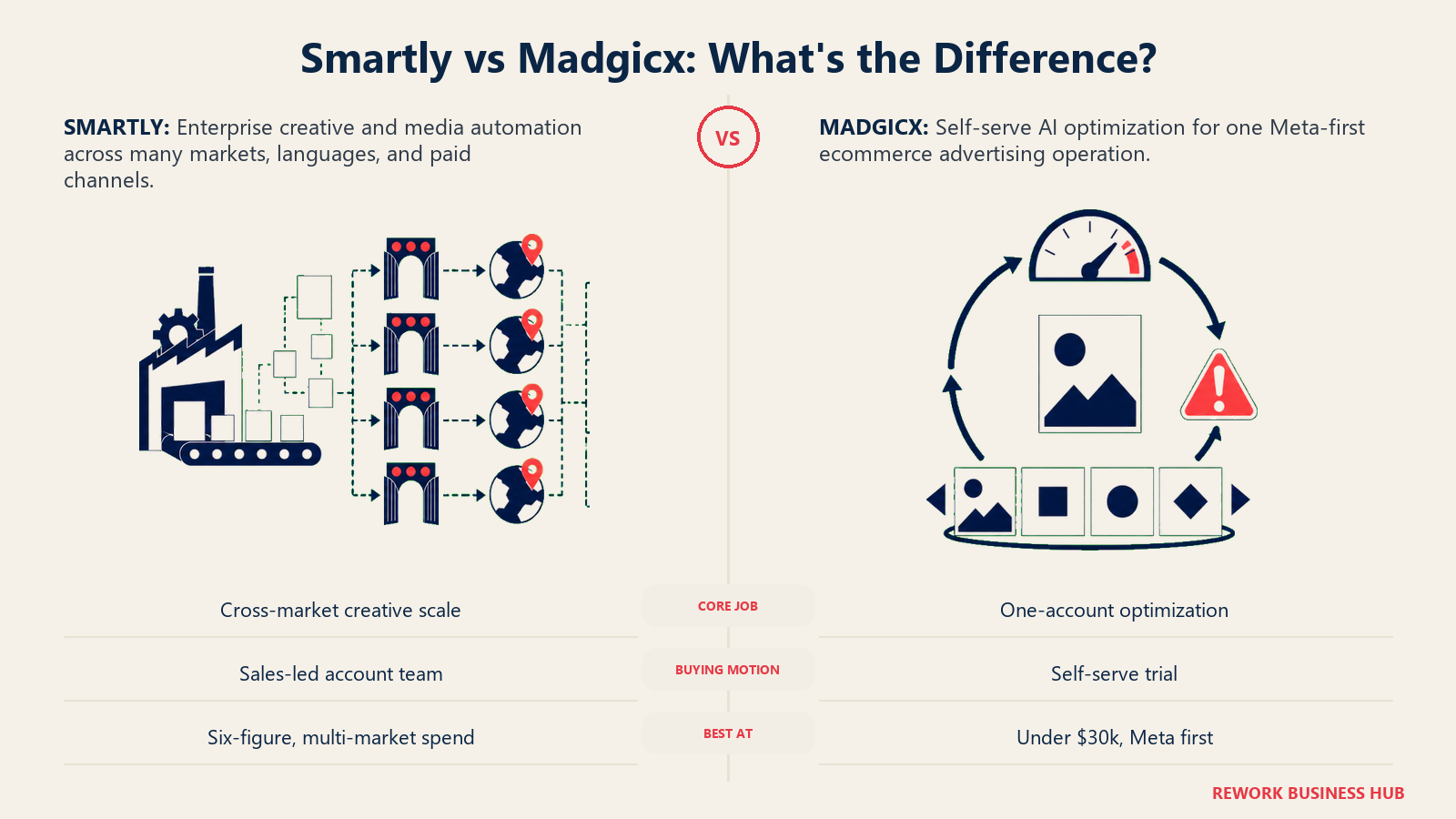
If you run ads for an ecommerce or DTC brand and you've been using Madgicx to automate Meta campaigns, you've probably wondered whether Smartly is the "grown up" version once you outgrow it. It isn't, not in the way that question assumes. Smartly doesn't sell a bigger tier of what Madgicx does. It sells a different job: creative and media automation for brands running hundreds of ad variants across dozens of markets and languages, with a dedicated account team attached. Madgicx is one self-serve plan built to run a single Meta ad account well.
If you're the other kind of reader, an enterprise marketer already paying a Smartly retainer or getting quoted one, wondering whether Madgicx's advertised low price could do the same job cheaper, the honest answer is also no, but for a specific and checkable reason: Madgicx's published pricing bands stop at $30,000 a month in ad spend. Past that, the page stops offering a number at all and points you into the app instead. Neither tool is a smaller or bigger version of the other. They're built for different budgets and different bottlenecks, and the rest of this comparison exists to help you place yourself correctly before you spend a sales cycle finding that out the hard way.
TL;DR
| Dimension | Smartly | Madgicx |
|---|---|---|
| What it actually is | Enterprise creative and media automation for paid social, connected TV, and conversational commerce | AI optimization and creative layer built specifically for Meta ads |
| Built for | Brands and agencies running paid social at real scale across many markets | Small to mid-size ecommerce and DTC brands, Meta-first |
| Pricing model | Percentage of managed ad spend, sales-led, no self-serve | Flat fee tied to a spend band, self-serve signup |
| Starting price | No published price; industry reports cite a monthly minimum around $4,000 to $5,000 (reported) | Madgicx Pro Complete plans start from $99/month, per Madgicx's own academy page |
| Where the published ladder stops | No ceiling; scales with spend | Published bands stop at the $20,000 to $30,000 tier; nothing published above $30,000/month spend |
| Trial / self-serve | No free trial, demo only | 7-day free trial, fully self-serve |
| Best for | Enterprise paid-social creative volume across markets and languages | Cheap, bundled AI automation on a Meta-first ecommerce budget |
Who Each Tool Is Actually Built For
Smartly and Madgicx aren't two points on the same scale. One is creative and media infrastructure built to run through a dedicated account team; the other is a single login built for one marketer to operate alone. The company profiles make that obvious before a single feature gets compared.
| Smartly | Madgicx | |
|---|---|---|
| Founded | 2013, Helsinki, Finland, as Smartly.io | 2018, Herzliya, Israel |
| Company today | Rebranded from Smartly.io to Smartly; the domain is still smartly.io | Operates under its original name |
| Product lineup | Smartly Creative, Smartly Media, Smartly Intelligence, and Smartly Synapse for planning and optimization | One plan: Madgicx Pro Complete with AI |
| Core job | Creative and media automation for paid social, connected TV, and conversational commerce | AI-driven optimization and creative testing for Meta, with thinner Google Ads support |
| Primary customer | Enterprise brands and agencies running paid social at scale | Small to mid-size ecommerce and DTC brands, Meta-first |
| Buying motion | Demo only, sales-led, negotiated contract | Self-serve signup, 7-day free trial |
Smartly's own site describes an interface spanning social creative, connected TV across more than 200 streaming services, and conversational commerce (WhatsApp-style messaging), all run through a dedicated account team. There's no "Get Started" button anywhere on it. Every path routes to "Get a Demo," which tells you who the product is built for before you read a single feature list: a brand or agency with a media team large enough to justify an account relationship, not a founder logging in solo.
Madgicx sits at the opposite end. It's Meta and Instagram ads automation for a team that wants AI-driven creative testing, audience targeting, and budget rules in one login instead of stitching three tools together. Sign up, connect an ad account, and the 7-day trial starts immediately. That accessibility is also the boundary: Madgicx's own pricing page shows a spend-band selector running from under $1,000 a month to $30,000-plus, and above $30,000 it stops offering a dollar figure and tells you to check inside the app.
Core Capability Comparison
The two products don't compete feature-for-feature so much as answer different questions: Smartly asks "how do we produce and localize enough creative to keep dozens of markets running," and Madgicx asks "how do we make one Meta account perform better without hiring a media buyer."
| Capability | Smartly | Madgicx |
|---|---|---|
| Creative variant generation at scale | Core product, built to output hundreds of variants across languages and markets | AI suggests creative changes and flags fatigue, but isn't built to generate market-scale variant volume |
| Dynamic creative optimization | Yes, performance-driven templates that update automatically | Yes, scoped to a single Meta ad account |
| AI budget and audience automation | Available through Smartly Synapse, the planning and optimization layer | The core pitch of the product, the main reason customers sign up |
| Multi-market localization | Purpose-built, the reason enterprise brands buy Smartly at all | Not a feature; the product assumes one market at a time |
| Self-serve dashboard | No, access runs through the account team | Yes, the entire product is self-serve |
| Dedicated account team | Included in every contract | Not offered; documentation and in-app guidance instead |
That last row is worth sitting with. Smartly's minimum fee, reported by industry trackers in the $4,000 to $5,000 a month range, isn't just paying for software. It's paying for a team that builds and maintains creative templates across every market you run in. Madgicx charges a fraction of that because there's no team on the other end, just AI recommendations and documentation.
Creative Automation, the Real Differentiator
This is where the two products stop looking like competitors at all. Smartly's entire reason for existing is creative production at a volume no single marketer can keep up with by hand: hundreds of ad variants, localized copy, on-brand templates that refresh automatically as performance data comes in, all coordinated across markets that don't share a language or a media calendar. That's a problem that only shows up once a brand is running paid social in ten or more countries and creative output, not media buying, becomes the bottleneck.
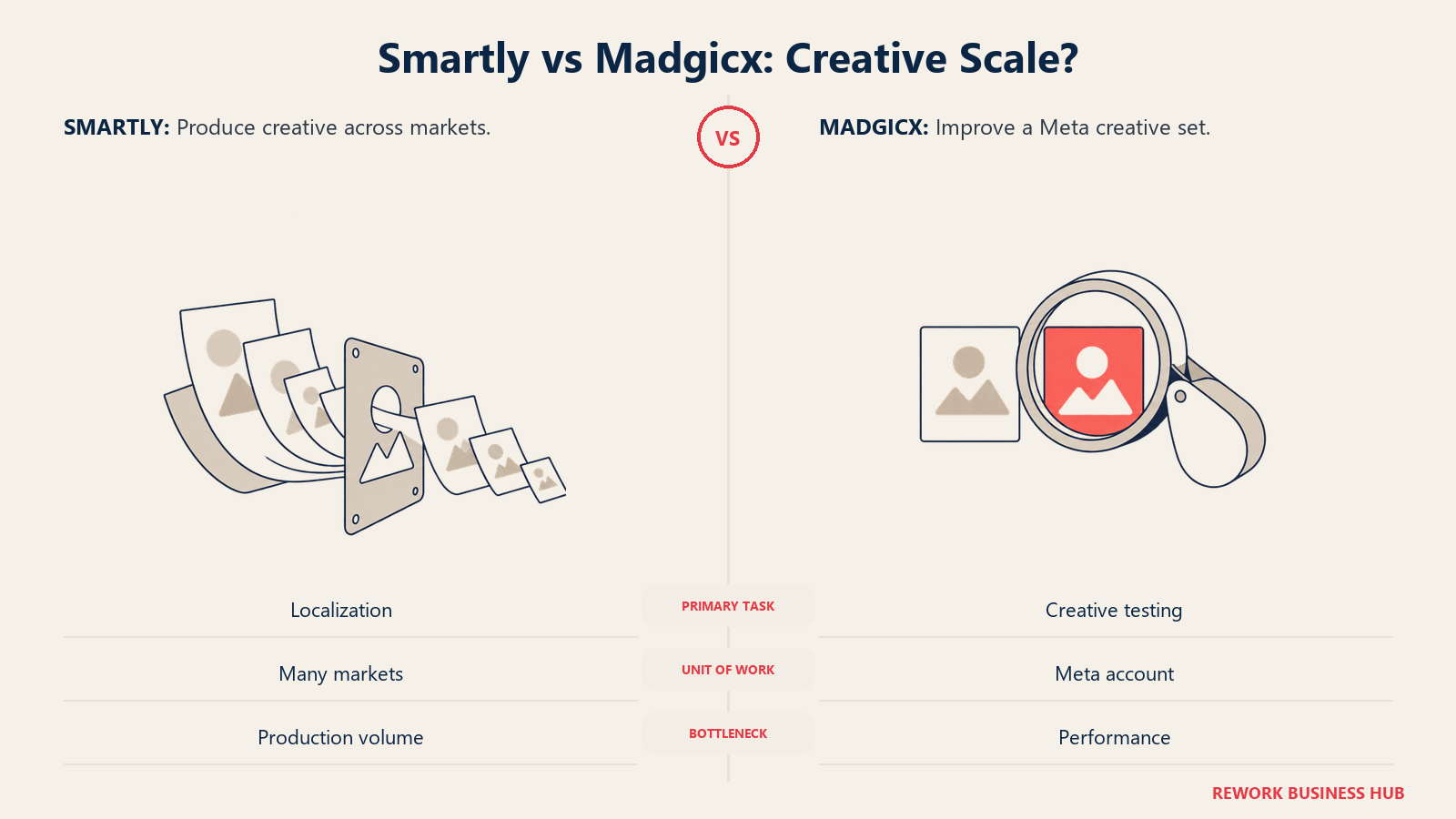
Madgicx's version of "creative automation" solves a narrower problem well: an ecommerce brand running Meta ads has a handful of creative variants, and Madgicx's AI flags which ones are fatiguing, suggests audience and budget shifts, and automates the rules a solo marketer would otherwise babysit manually. It's genuinely useful at that scale, and it's also not the same job as producing localized creative across dozens of markets. Comparing the two on "which has better creative automation" without naming the scale each is built for is how a reader ends up disappointed either way, buying Smartly's enterprise machine for a single Meta account, or expecting Madgicx to somehow scale into Smartly's job once the ad account grows past what a spend-band pricing page can quote.
Channel Coverage
Coverage is the other place the gap shows up plainly. Smartly is a multi-channel creative and media platform; Madgicx is a Meta-first tool with thinner support for one adjacent channel.
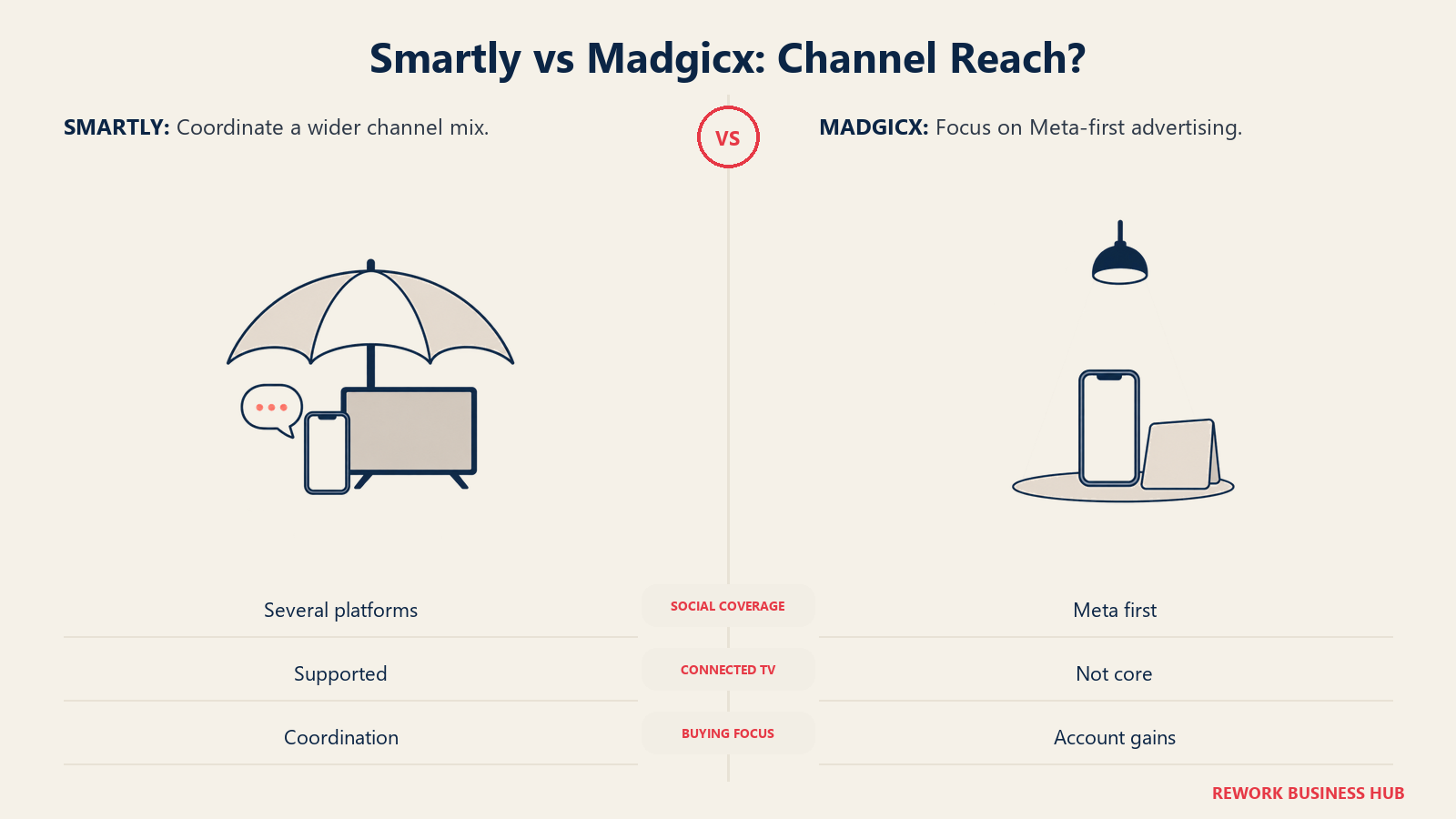
| Channel | Smartly | Madgicx |
|---|---|---|
| Meta (Facebook/Instagram) | Yes | Yes, the core product |
| Google Ads | Not a core focus | Thinner than Meta |
| TikTok, Snapchat, Pinterest | Yes | No |
| Connected TV | Yes, 200+ streaming services | No |
| Conversational commerce (WhatsApp, etc.) | Yes | No |
| Open-web programmatic | Via third-party DSP integration | No |
Meta's own generative AI ad tools passed 8 million advertisers by the first quarter of 2026, roughly doubling in about four months, per PPC Land's coverage of Meta's Q1 2026 earnings. That's the free baseline layer every Madgicx customer, and every Smartly customer running Meta campaigns, already sits on top of. Madgicx's whole value proposition is doing more with that baseline on a single channel; Smartly's is coordinating it alongside channels Meta doesn't touch at all, connected TV chief among them. US connected TV ad spending is projected to climb 14.5% in 2026 to $37.95 billion, per eMarketer, exactly the inventory Smartly automates and Madgicx doesn't touch at all.
Automation and Rules
Both products automate campaign decisions, but at different scopes. Smartly's automation runs across the creative and media layer simultaneously: a template updates, performance data flags which variant is winning in which market, and the system reallocates budget and swaps creative without a person touching every market individually. It's built to manage complexity, not remove the need for a media team, since someone still has to set the strategy Smartly's rules execute against.
Madgicx's automation is tighter in scope and, for a solo operator, arguably more hands-off: connect a Meta account and the platform starts surfacing budget and audience recommendations within the first session, then applies rules automatically once you approve them. There's no equivalent to Smartly's multi-market template engine, because there's no multi-market job to automate. For a single account, that's a feature, not a gap. For a brand running the same campaign in fifteen languages, it's the reason Madgicx isn't a substitute for Smartly no matter how good the automation is on one account.
Reporting and Attribution
Reporting is another place the pricing structure quietly shapes the product. Smartly bundles its analytics layer, Smartly Intelligence, into the same contract that includes the account team, so custom reporting gets built with you rather than configured by you. Madgicx ships a self-serve dashboard as part of the base plan, which covers most of what a single-account marketer needs, but its pixel-level tracking and attribution layer, Tracking Pro, is a separate $49-a-month add-on, not part of the base plan.
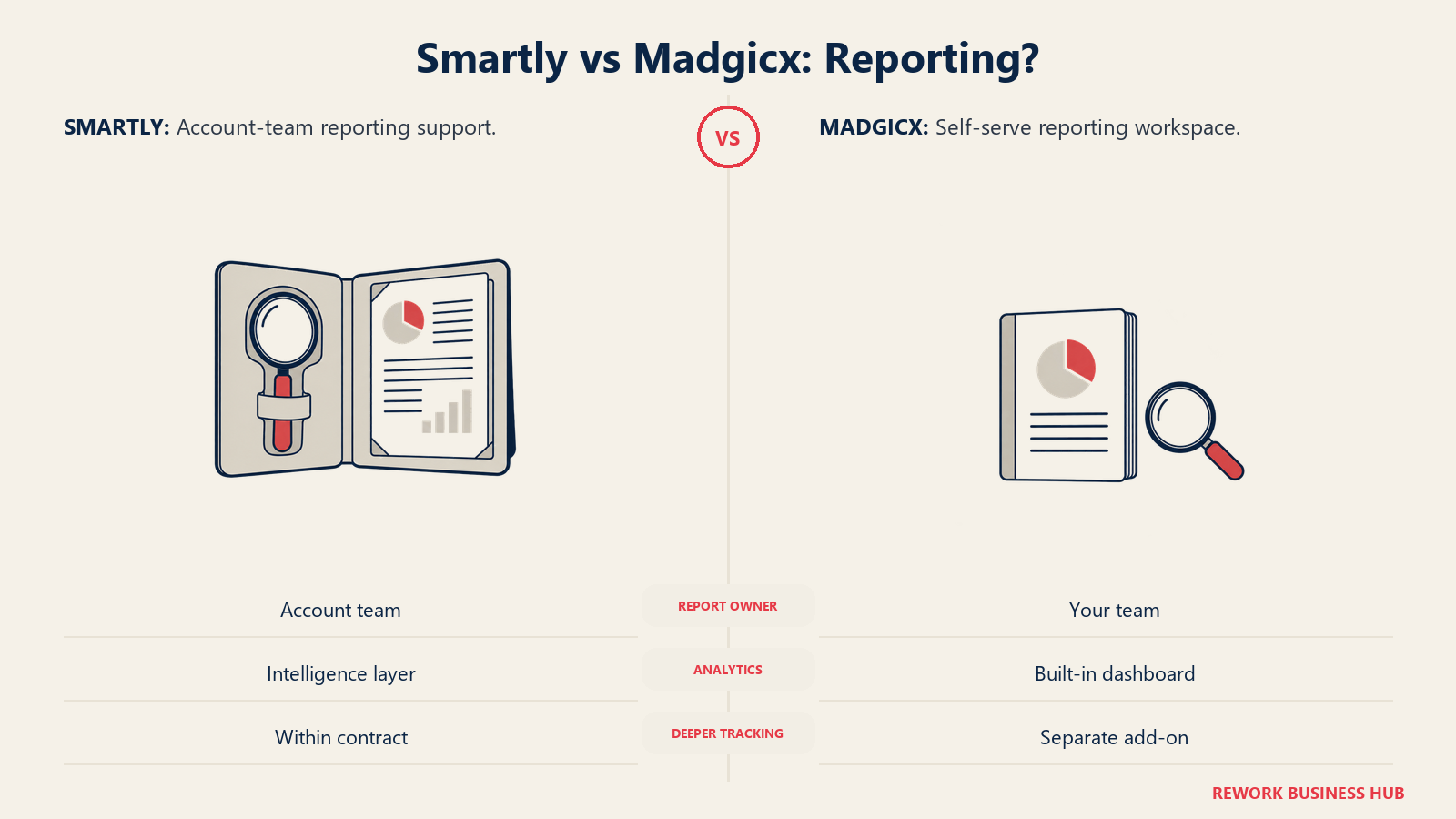
| Smartly | Madgicx | |
|---|---|---|
| Reporting layer | Smartly Intelligence, bundled into the contract | Built-in dashboard on every plan |
| Attribution add-on | Included, built by the account team | Tracking Pro: $49/month, separate from the base plan |
| Who builds custom reports | Smartly's account team, working with you | You, using the self-serve dashboard |
That $49-a-month figure is the only other fixed dollar amount that appears on Madgicx's own pricing page besides the plan price itself, confirmed directly on Madgicx's pricing page. It's easy to read a Madgicx quote, see the base plan number, and assume attribution is included. It isn't. Budget for it separately if closed-loop tracking matters to how you evaluate the platform.
Pricing at Real Ad Spend Levels
Neither vendor publishes a simple rate card, but they hide the number in opposite ways. Smartly negotiates every contract and won't quote anything until a sales call happens. Madgicx publishes a spend-band selector but hides the dollar figure behind a login for every band except the entry tier and, per its own academy page, the top of the published ladder.
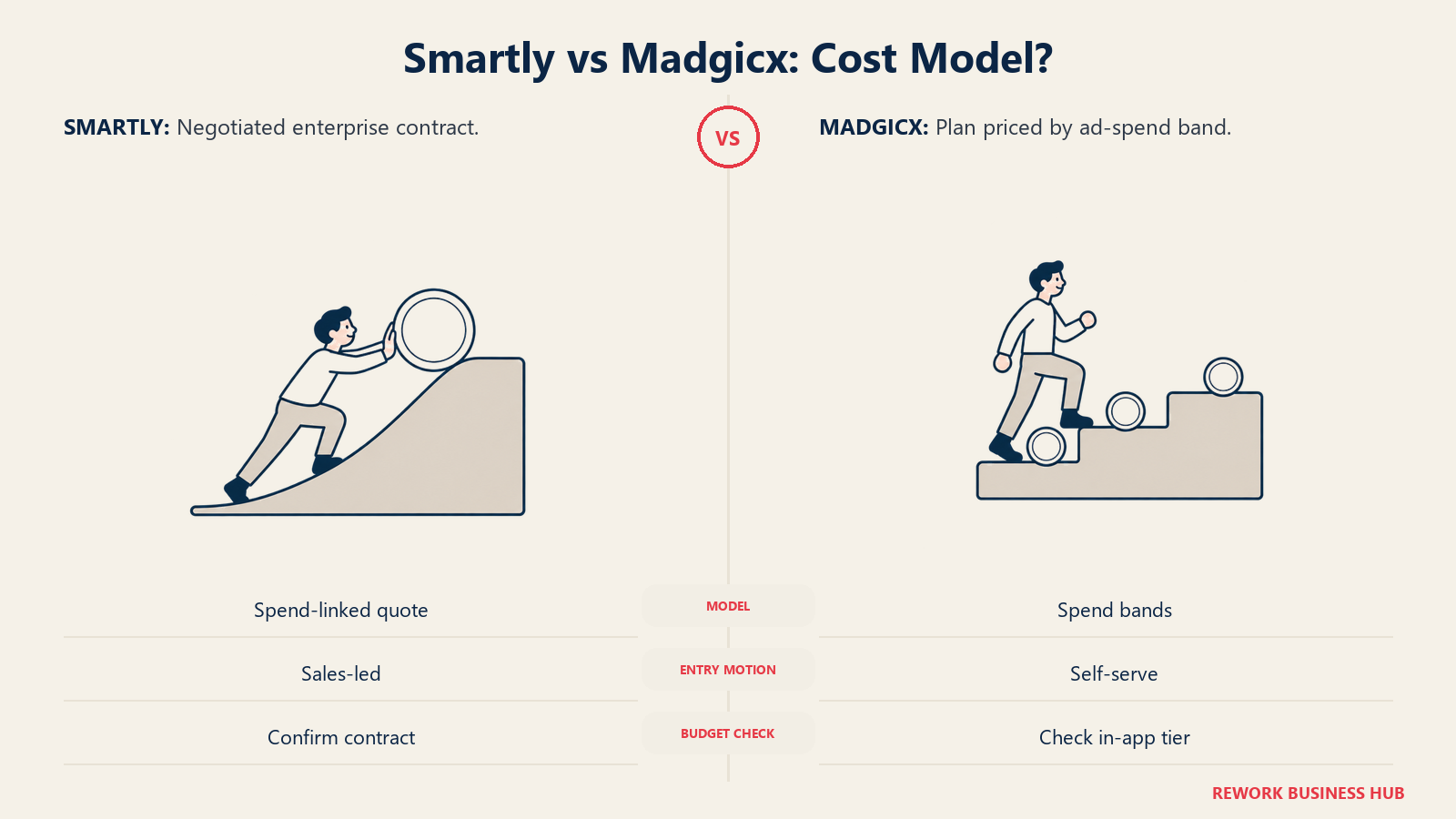
Madgicx's own academy page states that Madgicx Pro Complete plans start from $99 a month, with extra ad accounts priced at $9 per account per month and discounts available on quarterly and annual billing, though no percentage discount is published. The top of the ladder is widely reported at $329 a month for the $20,000 to $30,000 spend band, though Madgicx does not print that figure on any page it controls either. Everything in between, and everything above $30,000 a month, only shows a number after you've signed up and logged into the app. Treat any other figure you see floating around for Madgicx's mid-tier bands as unconfirmed; it isn't printed on any page Madgicx controls.
Smartly discloses nothing publicly. smartly.io/pricing doesn't exist; the homepage routes every call to action to "Get a Demo." What third-party data exists points to a percentage-of-spend model: industry trackers commonly cite a reported 2 to 4 percent of managed spend with a reported monthly minimum in the $4,000 to $5,000 range, and Vendr's marketplace pricing data puts the median annual Smartly contract at $90,000 a year, with reported deals ranging from $25,500 to $171,240 a year. None of that is vendor-confirmed. It's the best available signal for what a real contract tends to look like.
| Monthly ad spend | Smartly (reported) | Madgicx (published where available) |
|---|---|---|
| $2,000/month | The reported $4,000 to $5,000/month minimum alone runs two to two and a half times the media spend itself | Inside Madgicx's lowest published band; plans start from $99/month per the academy page |
| $10,000/month | Reported minimum fee still applies, roughly 40 to 50% on top of media spend | Inside the mid-range published bands; the exact figure only shows inside the app after signup |
| $30,000/month | Reported minimum fee is a smaller share of spend, but still a real cost on top of media | At the top edge of the published ladder; the $20,000 to $30,000 band is confirmed at $329/month |
| $100,000/month | A reported 2 to 4% rate works out to $2,000 to $4,000/month, likely still below the reported minimum, so the minimum probably still applies | Off the published ladder entirely; the pricing page stops offering any number above $30,000/month spend |
| $250,000/month | Reported percentage clears the minimum on its own, consistent with Vendr's roughly $7,500/month equivalent of its $90,000/year median contract | Not applicable; Madgicx isn't priced or built to run an account this size |
Read that table for where each model stops making sense, not for the exact dollars. Under roughly $30,000 a month, Madgicx is the only one of the two actually priced for your budget: Smartly's reported minimum fee can run several times your media spend at that scale. Past $100,000 a month, the comparison stops being close. Madgicx's own pricing page has already told you it isn't built for an account that size by refusing to publish a number, and Smartly's percentage fee finally starts working out closer to its quoted rate instead of being dominated by the minimum.
Implementation and Time to Value
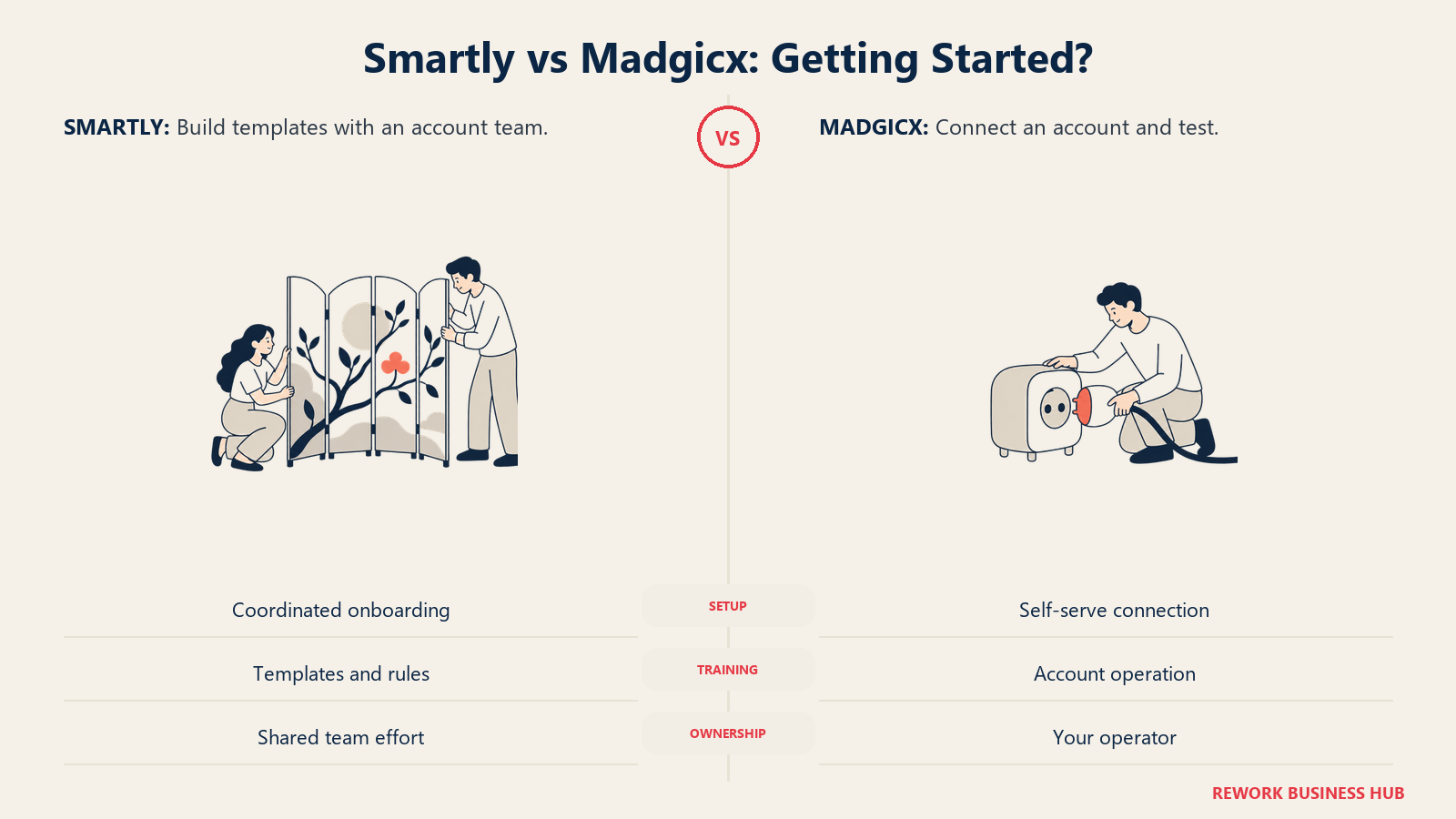
Enterprise template setup takes coordination; a Meta account connection offers a faster first test.
| Smartly | Madgicx | |
|---|---|---|
| Time to first live campaign | Weeks; onboarding runs through a dedicated account team | Hours to days; connect a Meta ad account and go |
| Who sets it up | Smartly's onboarding team plus your creative and media staff | You, largely without outside help |
| Training load | Real; creative templates and rules across markets take genuine ramp time | Low; built for one marketer to run alone |
| Ongoing management | Dedicated account team included in the contract | You, unless you hire or contract a specialist |
Smartly's onboarding is the heaviest of the two by design. Building creative templates across every market you run in, integrating existing ad accounts, and training your team on the workflow commonly takes weeks before the platform is doing real work, a direct tradeoff for the automation depth once it's live. Madgicx is close to the opposite: connect a Meta ad account and the platform starts surfacing recommendations in the first session, and the 7-day trial is genuinely enough time to judge whether its calls are worth trusting with real budget.
When Smartly Is the Right Call
- You're running paid social across ten or more markets or languages, and creative production, not media buying, is the actual bottleneck
- Your monthly ad spend is comfortably into six figures, where a reported minimum fee stops being a meaningful tax on the account
- You want connected TV and conversational commerce automated alongside social creative, not bought as separate tools
- You have the internal team, or an agency budget, to work with a dedicated account team rather than run the platform yourself
- You're prepared for a sales-led process and a negotiated, likely annual, contract rather than a self-serve trial
When Madgicx Is the Right Call
- Your ad spend runs under roughly $30,000 a month and Meta is genuinely most of your budget
- You want AI-driven creative testing, audience targeting, and budget automation bundled into one login instead of three separate tools
- You need to see a real starting number, $99 a month per Madgicx's own academy page, before committing to anything
- A 7-day trial is enough runway for you to judge whether the automation is worth trusting with real budget
- You don't need Google Ads, TikTok, or Snapchat covered natively; Meta is the whole job
If Madgicx's $30,000-a-month ceiling is already the wall you've hit, best Madgicx alternatives covers what to look at next before assuming Smartly is the only step up. And if Smartly's minimum fee or sales-led process is the actual barrier rather than a fit issue, best Smartly.io alternatives covers tools built for enterprise creative automation without the same negotiated, demo-only entry point.
Decision Framework
| If you are... | Pick |
|---|---|
| Running paid social at real scale across many markets, creative volume is the bottleneck | Smartly |
| Running mostly Meta ads under $30,000/month, want bundled AI automation, self-serve | Madgicx |
| An ecommerce operator wondering if Smartly is "grown-up Madgicx" | Not really. Wait until spend is well past six figures a month and creative volume, not media buying, is the constraint |
| An enterprise buyer wondering if Madgicx could save you money | Only if you're willing to shrink your channel mix down to Meta and stay under Madgicx's $30,000/month ceiling, which most enterprise accounts won't |
| Wanting a transparent, self-serve signup with no sales call | Madgicx |
| Needing reach beyond social into CTV, native, audio, or DOOH inventory | Neither. See the three-way spend-ladder comparison below for where StackAdapt fits |
The verdict: these two rarely compete for the same budget line. Madgicx wins on cost, speed, and simplicity under roughly $30,000 a month if Meta is your whole job. Smartly wins once spend and market count are large enough that creative production across languages becomes the real constraint, and a dedicated account team is worth paying for. Neither is a bigger or smaller version of the other, so the question isn't which one wins. It's which job you actually have.
What to Do Next
- Total your actual monthly ad spend and check it against the pricing table above. Under $30,000/month with Meta as your primary channel, start Madgicx's 7-day trial before booking any demo.
- If you're above six figures a month or running paid social across multiple markets and languages, get Smartly's minimum fee and percentage rate in writing before assuming a single quoted number applies to your account.
- If you're comparing this against the full three-way picture, including where StackAdapt fits into the spend ladder, see Smartly vs Madgicx vs StackAdapt.
- If your actual gap is reach into inventory neither of these tools sells, connected TV, native, audio, or digital out-of-home, StackAdapt vs The Trade Desk and best StackAdapt alternatives cover that different, adjacent decision.
- Still narrowing down the wider category? Best Ad Management Software in 2026 and best Optmyzr alternatives cover the PPC and bid-management corners this article skips. If your comparison is really about self-serve versus sales-led retargeting rather than social creative automation, AdRoll vs Criteo is the closer analog in that corner of the category.
Frequently Asked Questions about Smartly.io and Madgicx
Is Smartly.io the same company as Smartly?
Yes. Smartly.io rebranded to Smartly, though the domain is still smartly.io. The current product lineup, Smartly Creative, Smartly Media, Smartly Intelligence, and Smartly Synapse, carries the new name.
Is Smartly or Madgicx cheaper?
Madgicx is cheaper at low spend. Its own academy page states plans start from $99 a month, and it's priced for accounts under roughly $30,000 a month. Smartly publishes no price at all; industry reports cite a reported monthly minimum around $4,000 to $5,000, which can run several times a small account's actual media spend.
Does Madgicx really start at $99 a month?
That figure comes directly from Madgicx's own academy page, which states "Madgicx Pro Complete plans start from $99/month." Madgicx's pricing page itself shows a spend-band selector without dollar figures for most bands, so the $99 starting price and the confirmed $329 figure for the top published band ($20,000 to $30,000) are the two numbers you can trust; everything in between only appears after you log into the app.
Can Madgicx replace Smartly once my ad spend grows?
Not really. Madgicx's published pricing stops at $30,000 a month in spend, and the product itself is Meta-first with no built-in multi-market creative localization. A brand outgrowing Madgicx on spend or channel mix is looking at a different category of tool, not a higher Madgicx tier.
Is Madgicx's Tracking Pro included in the base plan?
No. Tracking Pro is a separate $49-a-month add-on, confirmed on Madgicx's own pricing page. The base plan includes a self-serve reporting dashboard, but pixel-level attribution tracking is billed on top of it.
Does Smartly offer a free trial or self-serve signup?
No. Every relationship with Smartly starts with a sales demo, and pricing is negotiated per contract rather than published or self-served. That's standard for enterprise software at this tier, but worth knowing before you spend a sales cycle expecting a trial.

Principal Product Marketing Strategist
On this page
- TL;DR
- Who Each Tool Is Actually Built For
- Core Capability Comparison
- Creative Automation, the Real Differentiator
- Channel Coverage
- Automation and Rules
- Reporting and Attribution
- Pricing at Real Ad Spend Levels
- Implementation and Time to Value
- When Smartly Is the Right Call
- When Madgicx Is the Right Call
- Decision Framework
- What to Do Next