AI Sales Ops vs. Sales Operations Tradicional: O Que Muda e O Que Não Muda

Turn this article into takeaways for your work.


Each assistant summarizes the article only for you and suggests best practices for your work.
O sales ops tradicional cumpriu seu papel. Por uma década e meia, o modelo padrão, uma pequena equipe de analistas dentro do CRM (Customer Relationship Management), realizando revisões semanais de pipeline, construindo regras de roteamento e escrevendo o relatório trimestral para o conselho, foi a infraestrutura que manteve as equipes de receita longe de voar completamente às cegas.
Esse modelo não está quebrado. Mas tem um teto, e a maioria das equipes de vendas em fase de crescimento está batendo nele.
O AI sales ops não substitui a função. Ele muda em que a função gasta seu tempo, a quem ela atende e com que velocidade pode responder. Entender essa distinção, em vez de tratar a AI como uma bala de prata ou uma ameaça, é o que separa os líderes de sales ops que constroem sistemas eficazes daqueles que correm atrás de ferramentas reluzentes.
Como o sales ops tradicional realmente parece
Entre numa empresa B2B SaaS de 80 pessoas típica e a equipe de sales ops está fazendo aproximadamente cinco coisas:
Relatório de pipeline. Alguém constrói um relatório semanal no Salesforce, limpa os dados, concilia nomes de estágios que os reps usam inconsistentemente e o formata para a ligação de previsão de segunda-feira. Isso leva de 4 a 8 horas por semana. O output é preciso na manhã de segunda-feira e começa a envelhecer imediatamente.
Regras de roteamento de leads. Alguém mantém a lógica de atribuição no HubSpot ou Salesforce. Território = Oeste, tamanho da empresa > 200 = fila enterprise. É uma árvore de regras que provavelmente não foi auditada em 18 meses, e ninguém tem certeza se ainda corresponde à forma como a empresa realmente segmenta.
Higiene do CRM. Uma passagem regular pelas oportunidades abertas, atrás dos reps para atualizar datas de fechamento, adicionar campos de concorrentes e preencher colunas em branco de "por que estamos ganhando". Isso é manual, frequentemente feito via exportação de planilha, e os dados são sempre incompletos.
Amostragem de revisão de ligações. Um manager ouve duas ou três ligações gravadas por rep por mês. Isso revela oportunidades de coaching, mas 2-3 ligações é uma amostra de 5-10% no máximo. Os outros 90% das conversas são invisíveis.
Previsão. A equipe de ops faz um rollup do CRM, ajusta para o sandbagging dos reps, aplica uma substituição do manager e apresenta um número. Esse processo é parte dados, parte reconhecimento de padrões e parte intuição acumulada ao observar a mesma equipe errar a cota das mesmas formas.
Nada disso está errado. É a abordagem certa dado o que estava disponível: analistas humanos operando em velocidade humana, com os dados que existem em campos estruturados de CRM.
O problema é escala. Quando seu pipeline cresce mais rápido do que o headcount de ops, algo é despriorizando. Geralmente é a higiene do CRM. Então a qualidade dos dados degrada. Depois a precisão da previsão degrada. Depois as revisões de pipeline se tornam adivinhação com slides. A HBR observou em 2023 que os reps de vendas gastam apenas cerca de um terço do tempo vendendo de fato, com o restante perdido em admin, pesquisa e entrada de dados.
Key Facts: Sales Operations Tradicional vs. com AI
- Os reps de vendas gastam apenas cerca de um terço do tempo vendendo de fato; o restante é perdido em admin, pesquisa e entrada de dados (Harvard Business Review, 2023)
- A revisão manual de ligações cobre 5-10% das conversas; a Meeting Intelligence com AI cobre 100% das ligações gravadas sem headcount adicional
- Equipes de vendas habilitadas por AI relatam aumentos de receita a uma taxa 14 pontos percentuais maior do que equipes sem AI (80% vs. 66%), de acordo com o Cirrus Insight 2025
O que o AI sales ops muda
O AI sales ops não se trata de eliminar o que foi descrito acima. Trata-se de mover tarefas específicas da fila humana e executá-las continuamente, com cobertura total de dados, em velocidade de máquina.
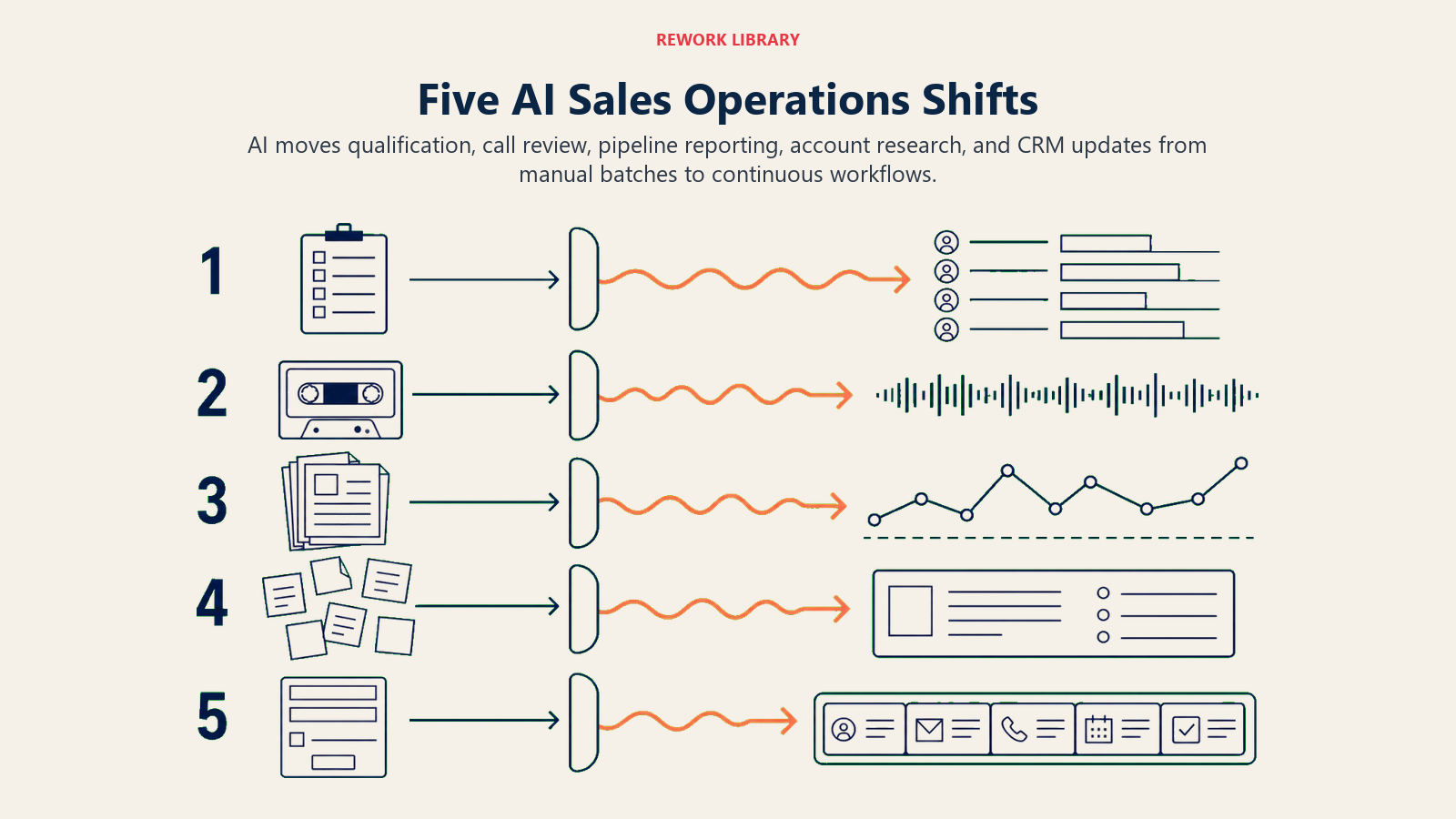
Veja o mapeamento das tarefas tradicionais para suas contrapartes gerenciadas por AI:
Qualificação manual de leads → Scoring+Routing
Em vez de um analista revisar leads inbound contra um conjunto de critérios e atribuí-los manualmente, um Padrão de Scoring e Routing ingere cada sinal (cargo, tamanho da empresa, comportamento, fonte, conversão histórica de contas similares) e atribui um score de probabilidade em tempo real. O lead é encaminhado automaticamente ao rep certo. A cobertura passa de "quem a equipe de ops consegue chegar" para 100% dos leads, sempre.
Anotações manuais de ligações e amostragem de coaching → Meeting Intelligence
Em vez de reps escrevendo notas de ligações de forma inconsistente e managers amostrando 5-10% das ligações, o Padrão de Meeting Intelligence ingere cada ligação. Gera resumos, extrai momentos-chave, sinaliza riscos de deals e sinais de compra, e rastreia benchmarks de coaching (taxa de fala, perguntas feitas, menções a concorrentes) em toda a equipe. A cobertura passa de 5-10% para 100%.
Relatórios de pipeline semanais estáticos → Inteligência de pipeline contínua
Em vez de um relatório preciso na segunda-feira e desatualizado na quinta, um modelo de AI pontua cada deal no pipeline continuamente, sinaliza deals em risco no momento em que os sinais mudam (sem atividade por 10 dias, data de fechamento se aproximando sem reunião agendada) e os apresenta antes da ligação de previsão.
Pesquisa de conta manual → Generative Research
Em vez de um rep gastar 20-30 minutos pesquisando uma conta antes de uma ligação, o Generative Research ingere notícias recentes, arquivos da empresa, atividade no LinkedIn e vagas de emprego, e produz um briefing em menos de dois minutos. A pesquisa ainda acontece; um humano simplesmente não a faz.
Atualizações manuais de CRM → Workflow Copilot
Em vez de um rep atualizar estágios de deals, registrar resultados de ligações e enviar e-mails de follow-up manualmente, um Workflow Copilot rascunha o follow-up, propõe a mudança de estágio, cria a próxima tarefa e aguarda uma aprovação com um clique. O CRM fica atualizado porque o atrito de atualizá-lo cai a quase zero.
A Mudança de Sales Operations Nativa em AI
A Mudança de Sales Operations Nativa em AI descreve a mudança estrutural que acontece quando uma equipe de sales ops passa de fluxos de trabalho de relatórios em lote, no ritmo humano, para processamento de sinais contínuo, orientado por AI. A mudança tem três dimensões: cobertura (de parcial para 100% de leads, ligações e deals), latência (de dias para segundos) e capacidade (de gargalo de analistas para governança de arquitetura). As equipes que completam a mudança não contratam menos pessoas de ops; elas redirecionam essas pessoas da extração de dados para a calibração de sistemas e tratamento de exceções.
A comparação lado a lado
Use esta tabela de referência para se orientar na seção antes de aplicar os detalhes abaixo.
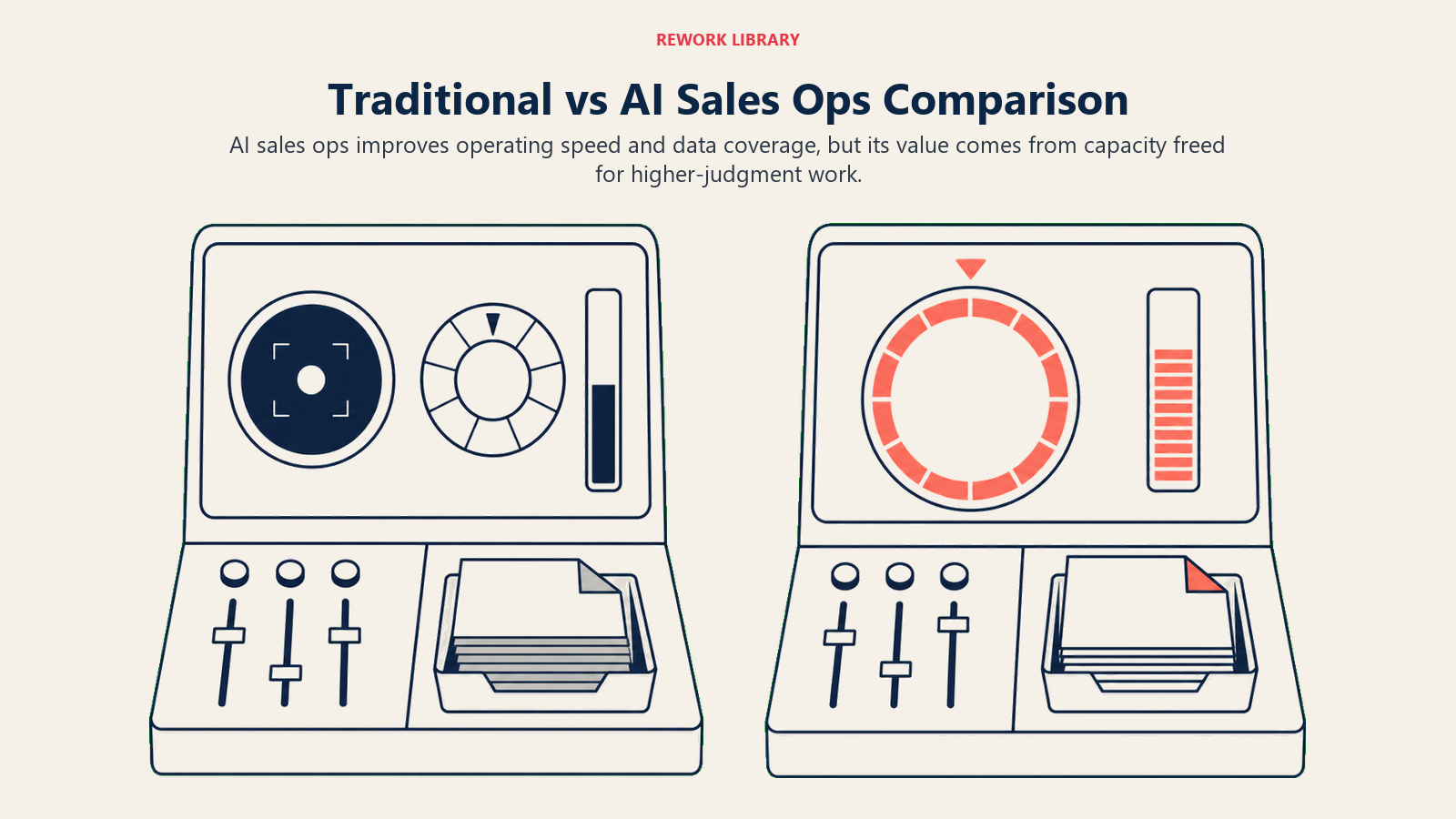
| Dimensão | Sales Ops Tradicional | AI Sales Ops |
|---|---|---|
| Velocidade de qualificação de leads | 2-48 horas (ciclo de revisão humana) | Tempo real (segundos após o envio do formulário) |
| Cobertura de leads | Parcial (quem o analista consegue atender) | 100% de todos os leads, cada submissão |
| Inputs de previsão | Extração semanal do CRM, ajustes manuais | Contínuo, todos os sinais de deals, atualizado automaticamente |
| Cobertura de revisão de ligações | 5-10% (amostragem do manager) | 100% das ligações gravadas |
| Atualidade dos dados do CRM | Desatualizado de 3 a 5 dias entre atualizações | Quase tempo real (auto-preenchimento pós-ligação) |
| Pesquisa de conta por rep | 20-30 min de preparação manual | Briefing de AI de 2-3 min |
| Tempo admin do rep | 30-40% do dia de trabalho | 15-20% do dia de trabalho (com AI Copilot) |
| Capacidade do analista de ops | 3-5 projetos principais por trimestre | 2x+ (liberado da manipulação de dados) |
| Precisão das regras de roteamento | Degrada com o tempo (regras estáticas) | Recalibra continuamente a partir dos resultados |
| Lag de detecção de erros | Dias a semanas (próximo relatório) | Horas (sinalização de anomalias em tempo real) |
Vale a pena parar nos números de tempo admin dos reps. Se um rep ganha $120K de salário base e gasta 35% do dia em tarefas administrativas, você está pagando aproximadamente $42K por rep por ano por trabalho que a AI pode realizar. Para uma equipe de 20 reps, são $840K em salários alocados para tarefas que não são vendas. Mesmo uma redução modesta de 50% nessa carga admin libera capacidade significativa sem uma única contratação. A pesquisa da McKinsey sobre AI em marketing e vendas descobriu que os casos de uso de AI generativa de maior valor em vendas se agrupam exatamente em torno desse tipo de cognição repetitiva: identificação de leads, alcance personalizado e gestão de pipeline.
Rework Analysis: A matemática do tempo admin é o argumento mais subutilizado no business case de AI sales ops. Uma equipe de 20 reps onde cada rep ganha $120K e passa 35% do dia em tarefas não relacionadas a vendas tem aproximadamente $840K em salário anual alocado para trabalho que a AI pode realizar. Uma redução de 50% nessa carga, que é uma meta conservadora, libera capacidade equivalente a adicionar 3-4 reps em tempo integral sem o custo de headcount. Na prática, as equipes que vemos obter o ROI mais rápido são aquelas que enquadram o AI sales ops como um problema de capacidade, não como uma atualização tecnológica.
O que permanece humano
O AI sales ops lida com cognição repetitiva. Não lida com julgamento.
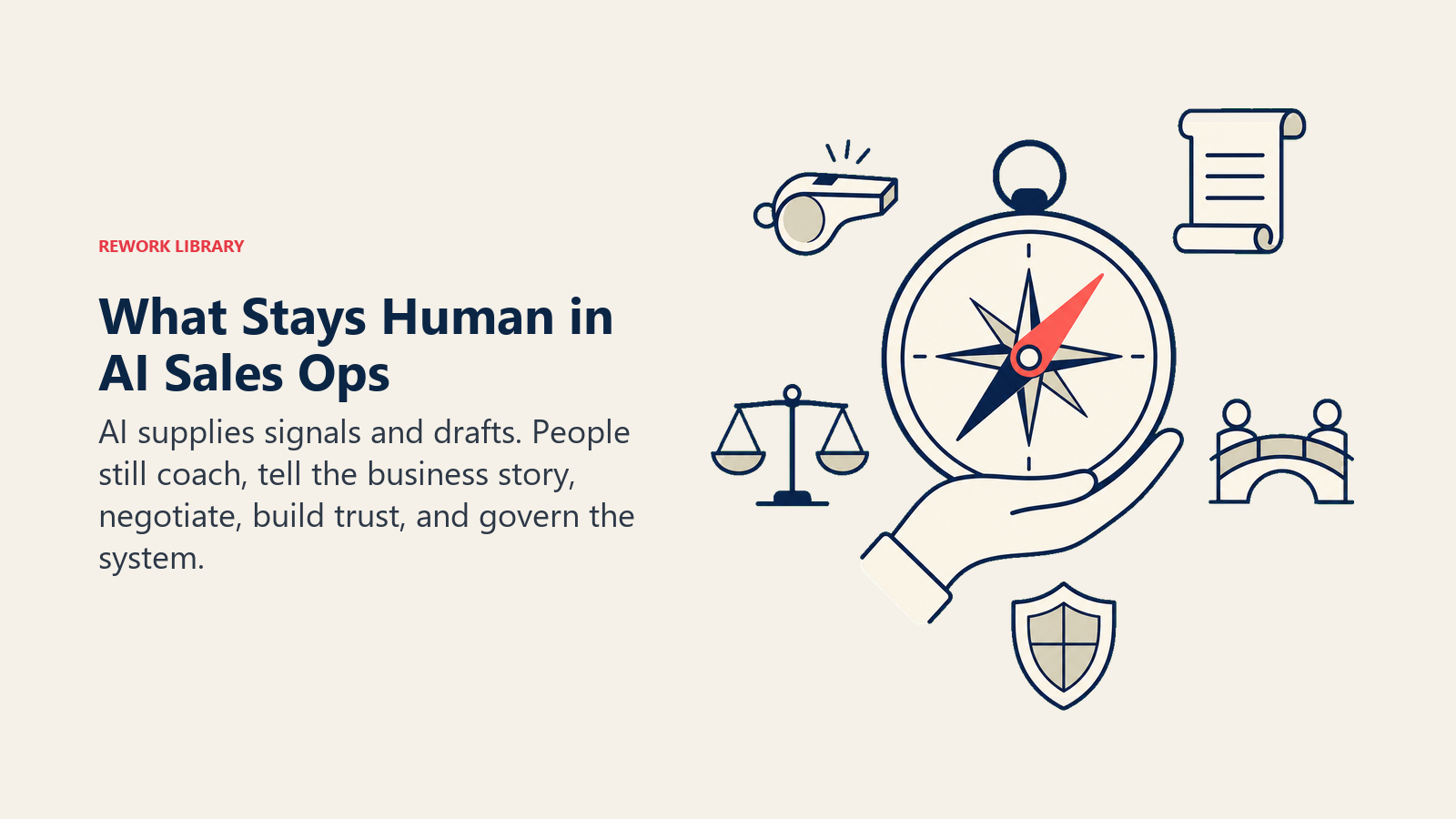
O que permanece humano:
Conversas de coaching. O Meeting Intelligence revela que a taxa de fala de um rep em ligações de discovery é de 65% (muito alta) e ele não está fazendo perguntas de multi-threading. Mas a conversa sobre o porquê e como mudar isso acontece entre um manager e um rep. A AI fornece os dados; os humanos fazem o coaching.
Storytelling executivo. O conselho quer entender o negócio, não ler uma distribuição de probabilidades. Traduzir sinais de pipeline em uma narrativa que construa confiança (ou admita um problema claramente) requer um humano que entenda o público.
Julgamento em negociações complexas. Quando uma conta-chave pede 30% de desconto para fechar o deal neste trimestre, nenhum Workflow Copilot diz se você deve aceitar. Essa é uma decisão de julgamento de negócios envolvendo margem, valor estratégico, precedente e timing.
Construção de relacionamento. Clientes compram de pessoas em quem confiam. O AI Sales Operator não constrói essa confiança. O rep constrói, ao longo do tempo, por meio de conversas honestas e promessas cumpridas.
Governança do modelo. O modelo de Scoring+Routing se recalibra a partir de dados. Mas quem decide que uma queda repentina no volume de leads significa que o modelo precisa de um novo sinal, e não apenas menos leads? Essa é uma decisão humana. E esse humano precisa entender como os requisitos de governança de cada padrão diferem.
A mudança de habilidades para profissionais de sales ops
Esse é o ângulo que a maioria dos pitches de fornecedores de AI perde completamente, e importa para qualquer pessoa em uma função de sales ops.
O sales ops tradicional recompensava a manipulação de dados (extração, limpeza, estruturação de dados de CRM), relatórios (construção de dashboards no Salesforce, tabelas dinâmicas no Excel) e construção de regras (projeto de lógica de território e fluxos de roteamento).
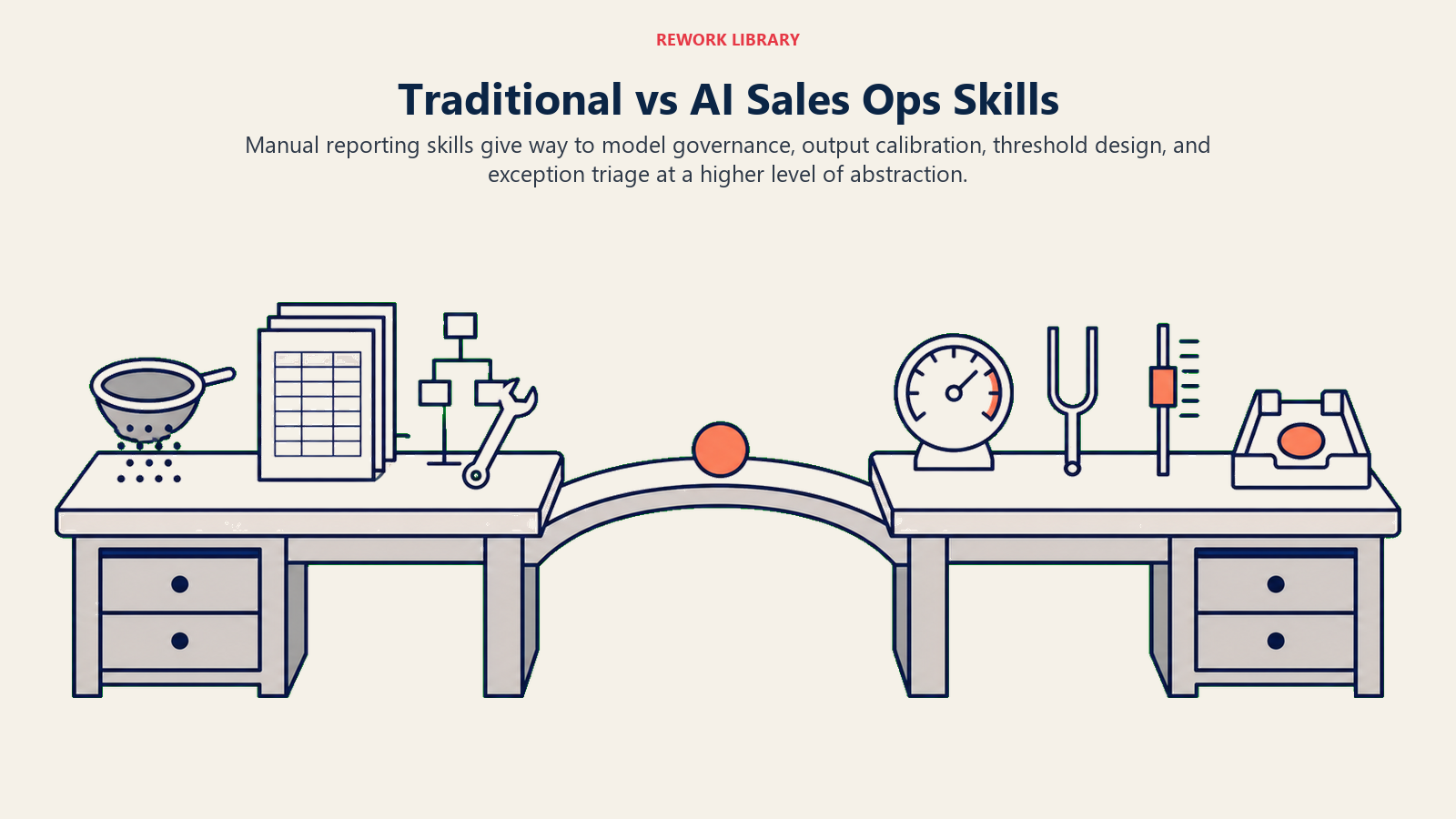
O AI sales ops recompensa um conjunto de habilidades diferente:
Governança de modelos. Você consegue configurar um ciclo de feedback onde o modelo de pontuação é recalibrado contra resultados reais trimestralmente? Você consegue ler uma matriz de confusão e saber se seu modelo está subtrigando ou disparando excessivamente em scores altos?
Engenharia de prompts e calibração de outputs. Quando os rascunhos de follow-up do Workflow Copilot estão consistentemente fora do tom, você consegue ajustar o prompt para que soem como sua empresa? Você consegue escrever um template de Meeting Intelligence que extrai os campos específicos que seus managers se importam?
Design de thresholds. A que score de lead um rep é notificado? A que score de deal um manager é alertado? Esses thresholds determinam com que frequência o sistema dispara alarmes falsos e se os reps confiam nele. Defini-los bem requer conhecer a tolerância da sua equipe ao ruído.
Triagem de exceções. A AI erra. O líder de ops é a camada de controle de qualidade. Ele vê os casos extremos, entende por que o modelo falhou e decide se deve ajustar a configuração ou escalar para o fornecedor.
Esse não é um trabalho mais difícil. É um trabalho diferente. Os analistas que se adaptam mais rapidamente são os que já faziam correspondência de padrões a partir de dados e queriam trabalhar em um nível mais alto de abstração. Os que lutam são aqueles cuja expertise está nos mecanismos de extração de dados, que é exatamente o que a AI lida primeiro.
Objeções comuns, respondidas honestamente
"Nossos reps não vão confiar nos scores de AI."
Eles não vão confiar imediatamente. A confiança se constrói quando os scores provam ser mais acertos do que o instinto. O caminho mais rápido para a confiança: mostrar aos reps três deals onde a AI sinalizou risco que eles perderam, e dois deals onde o alto score de AI correlacionou com um fechamento. Dados vencem persuasão.
"Nossos dados de CRM estão sujos demais para o scoring de AI funcionar."
Parcialmente verdade. Se suas taxas de fechamento não estão rotuladas (ganho/perdido) ou seus estágios de deal são muito inconsistentes, o AI lead scoring produzirá output barulhento. Mas "sujo demais para começar" raramente é preciso. A maioria dos CRMs tem dados históricos suficientes para um modelo funcional se alguém gastar uma semana padronizando os campos-chave. A AI também ajuda a limpar dados daqui para frente, porque o Workflow Copilot torna a atualização de campos sem esforço.
"Tentamos AI e não funcionou."
Geralmente isso significa uma de três coisas: a ferramenta errada para o problema real, a ferramenta foi configurada mas não calibrada, ou não havia um responsável de ops governando o output. O AI sales ops requer ajuste contínuo. É infraestrutura, não uma instalação única. A próxima seção sobre armadilhas comuns cobre exatamente onde esses rollouts dão errado.
O líder de ops como arquiteto
O sales ops tradicional tinha o analista como o criador de valor primário. Eram eles que extraíam insights dos dados e os traduziam em ação.
O AI sales ops move a criação de valor primário para arquitetura e governança. A AI extrai insights dos dados continuamente. O líder de ops decide o que a AI examina, quais thresholds acionam ações, quais outputs são apresentados a quem e se o sistema está funcionando conforme o esperado.
Esse é um papel mais estratégico. Também é mais duradouro. Analistas que conseguem trabalhar nesse nível, que pensam sobre sistemas em vez de relatórios individuais, são mais difíceis de substituir e mais valiosos para o negócio. A pesquisa da HBR sobre AI agêntica em vendas confirma o mesmo padrão: as equipes de vendas que veem os melhores resultados de AI são aquelas onde um responsável humano define a estratégia e a AI lida com a execução, não equipes que simplesmente compraram software e esperaram. O conceito de AI Sales Operator apresenta a arquitetura de quatro padrões que torna essa mudança concreta.
Perguntas Frequentes
Qual é a principal diferença entre sales ops tradicional e AI sales ops?
O sales ops tradicional opera em velocidade humana e cobre uma fatia parcial dos dados: uma amostra de ligações, uma extração semanal do pipeline, leads revisados quando os analistas têm tempo. O AI sales ops opera continuamente com cobertura total, pontuando cada lead em tempo real, analisando cada ligação gravada e atualizando sinais de pipeline conforme eles mudam. A função não desaparece; ela passa da extração de dados para a governança do sistema.
O AI sales ops elimina a necessidade de analistas de sales ops?
Não. O AI sales ops muda em que os analistas passam o tempo, não se são necessários. Tarefas como regras de roteamento, higiene manual do CRM e construção de relatórios são automatizadas. Os analistas se voltam para calibração de modelos, design de thresholds, triagem de exceções e engenharia de prompts. As equipes que veem os melhores resultados são as que aprimoram suas pessoas de ops existentes em vez de substituí-las.
Quanto o AI sales ops pode reduzir o tempo admin dos reps?
Benchmarks da Forrester e Cirrus Insight colocam o tempo administrativo dos reps em 30-40% do dia de trabalho no ops tradicional. O AI sales ops com uma implementação completa de quatro padrões normalmente reduz isso para 15-20%. Para um rep ganhando $120K, isso é aproximadamente $18.000-$24.000 em capacidade anual liberada para atividade de vendas sem nenhuma mudança no headcount.
Como a AI muda o roteamento de leads em comparação às regras de território estáticas?
Regras de território estáticas atribuem leads com base em critérios fixos (região, tamanho da empresa) que não se adaptam com o tempo. O roteamento por AI adiciona uma camada preditiva: pontua cada lead contra padrões históricos de conversão e roteia com base em probabilidade e capacidade do rep, não apenas na geografia. A lógica de roteamento se recalibra automaticamente conforme novos deals ganhos e perdidos atualizam os dados de treinamento.
O que acontece com a qualidade dos dados do CRM quando o AI sales ops é implementado?
Normalmente melhora. O Workflow Copilot reduz o atrito de atualizar o CRM após as ligações, então as taxas de preenchimento de campos aumentam. O Meeting Intelligence preenche automaticamente resumos de ligações e próximos passos, preenchendo lacunas que o registro manual deixou. Equipes que iniciaram o AI sales ops especificamente para resolver problemas de qualidade de dados frequentemente veem melhoria de 40-60% nas taxas de preenchimento de campos em 90 dias.
Uma empresa com dados de CRM sujos ainda pode se beneficiar do AI sales ops?
Sim, com algum investimento inicial. Se os labels de ganho/perdido e os estágios de deal são razoavelmente consistentes, um modelo de pontuação de AI funcional é alcançável mesmo com dados imperfeitos. A AI também ajuda a limpar dados daqui para frente porque o registro automatizado remove a principal fonte de lacunas. Um sprint de padronização de dados de uma semana nos campos-chave (estágio, data de fechamento, papel do contato) geralmente é suficiente para começar.
Que governança o AI sales ops requer que o ops tradicional não precisava?
Três coisas que o ops tradicional raramente precisava: gerenciamento de thresholds (decidir qual score aciona um alerta para o rep), agendamento de recalibração do modelo (auditorias trimestrais contra resultados reais de conversão) e auditoria de outputs (revisar se os rascunhos do Workflow Copilot correspondem à voz da marca e ao tom da empresa). O líder de ops se torna a camada de controle de qualidade entre os outputs da AI e o que os reps realmente agem.
Saiba Mais
- O Que É um AI Sales Operator?
- Por Que Sales Ops é o Caso de Uso de AI com Maior ROI
- Armadilhas Comuns de AI Lead Scoring
- Roadmap de Implementação de AI Sales Ops
- Modos de Falha: Quando AI Sales Ops Sai pela Culatra
- O Padrão de Scoring e Routing
- Prontidão de Dados para AI
- Requisitos de Governança por Padrão de AI

Co-Founder, Rework.com