Needs-Based Selling: The Insurance Professional's Path to Ethical and Effective Sales
Turn this article into takeaways for your work.


Each assistant summarizes the article only for you and suggests best practices for your work.
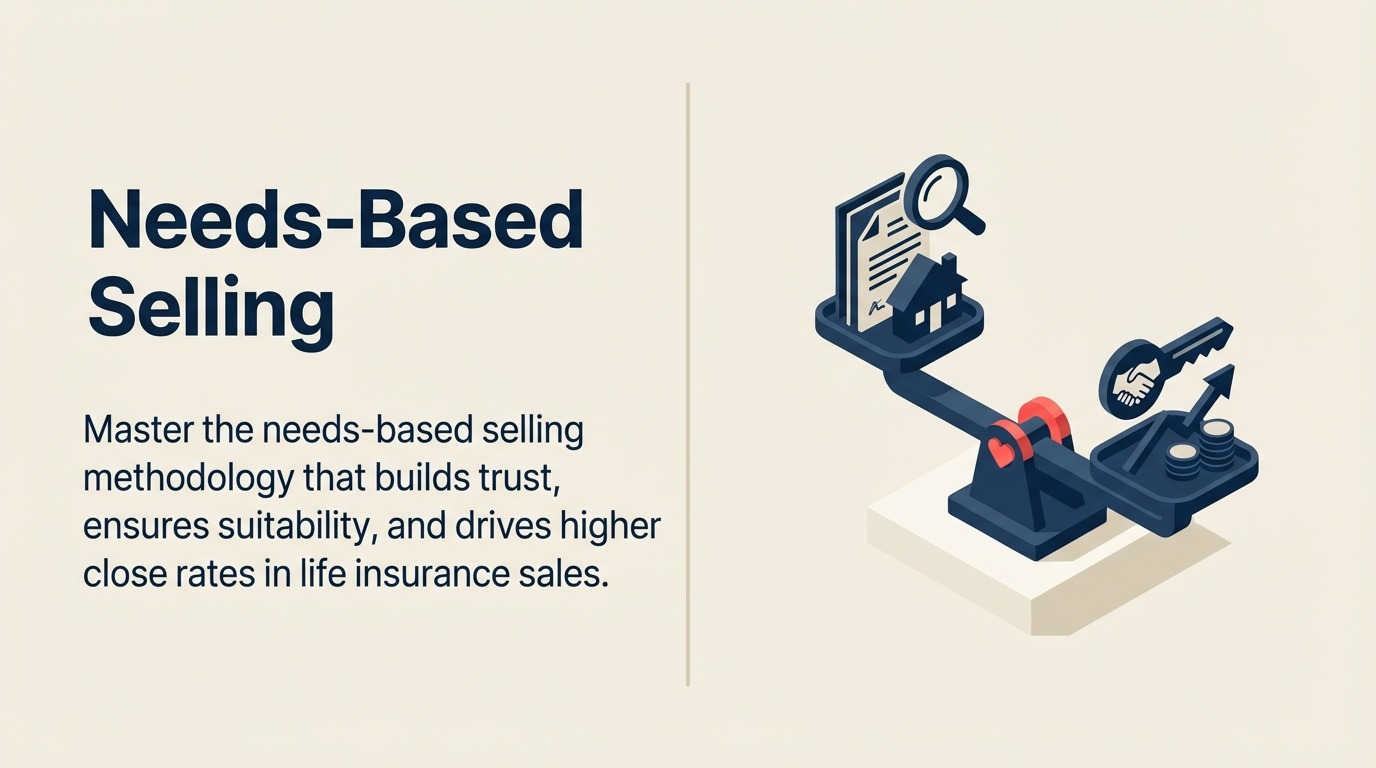
Product-first selling fails. Needs-based approaches close 60%+ of qualified prospects.
Here's the difference: product-first agents lead with "I have this great whole life policy" or "You need permanent insurance." Needs-based agents lead with "What would happen to your family if you died tomorrow?" One is selling. The other is solving.
And prospects can feel the difference immediately. When you start by understanding their situation, identifying risks, and quantifying needs before recommending products, you're not a salesperson. You're a consultant helping solve a real problem. That's why needs-based selling closes at dramatically higher rates while generating more referrals and fewer complaints.
Needs-Based Selling Philosophy
This isn't just a tactic. It's a fundamentally different approach to insurance sales.
Consultative vs transactional approach is the core distinction. Transactional agents pitch products looking for buyers. Consultative agents diagnose situations and prescribe solutions. Doctors don't sell treatments before diagnosing illnesses. Neither should insurance professionals.
Client needs before product solutions means you genuinely don't know what to recommend until you understand the situation. You might think term life is appropriate, but after thorough discovery and financial goals analysis you realize whole life makes more sense for their estate planning. Let the need dictate the solution.
Suitability and ethical standards require matching recommendations to situations. Selling $1 million whole life to someone making $40,000 annually isn't suitable, even if you could get it issued. FINRA's suitability rule establishes standards for investment recommendations. Needs-based selling creates defensible recommendations that serve client interests.
Education before recommendation builds trust and understanding. Clients who understand why they need insurance and how much coverage is appropriate are better buyers. They understand the value, they're committed to premium payments, and they refer friends because they genuinely believe in the protection.
Long-term relationship building happens naturally with needs-based approaches. You're not selling one policy. You're becoming their insurance advisor for life. As situations change (marriage, kids, promotions, business start), they come back because you've established yourself as their trusted resource.
The Needs Analysis Process
This is where sales are won or lost. Thorough needs analysis creates urgency and justifies recommendations.
Current coverage inventory establishes the starting point. What coverage do they have? Employer group life? Old whole life policy from 20 years ago? Term insurance? Review existing policies, understand coverage amounts, and identify what's in place before recommending additions.
Many prospects overestimate existing coverage. They think they have $500,000 when they actually have $150,000 of declining group term. Clarifying current coverage creates gaps.
Life stage and family situation fundamentally determines needs. Single person, no dependents? Minimal coverage needed. Married with three kids, non-working spouse, and $400,000 mortgage? Massive income replacement need. Life stage dictates protection requirements.
Ask about kids (ages, education goals), spouse (working or not, income level), dependents (parents, special needs family members), and future plans (more kids, career changes).
Income protection needs calculation quantifies the need. How much income does the family need to maintain lifestyle if primary earner dies? Most families need 60-80% of current income. Calculate the asset base required to generate that income sustainably. The NAIC's life insurance needs calculator provides a framework for determining appropriate coverage amounts.
Simple rule is 10x income. Someone making $100,000 needs $1 million to generate $100,000 annually at a sustainable 10% withdrawal rate. More sophisticated approaches adjust for actual income needs, existing assets, and spouse income.
Debt and obligation coverage creates additional needs. Mortgage balance, car loans, student loans, credit cards, business debts all need to be paid off or serviced if primary earner dies. Add these to income replacement needs.
A family with $300,000 mortgage, $50,000 student loans, and $20,000 car loan has $370,000 of debt obligations before even considering income replacement. That's substantial coverage need.
Final expense considerations ensure families can afford burial and immediate costs. Even if there are no dependents, $10,000-25,000 of coverage prevents families from scrambling for funeral money. This is minimum coverage everyone needs.
Estate liquidity requirements apply to wealthier clients. If someone has $10 million estate with illiquid business interests and $3 million potential estate tax, they need liquidity to pay taxes without forcing business sale. Life insurance creates that liquidity for estate planning coordination.
Business protection needs for business owners include key person insurance (protecting business from death of critical people), buy-sell agreement funding (enabling partner buyouts), and business debt coverage. Business owners often need more coverage than employees.
Legacy and charitable goals can be funded with life insurance. Clients wanting to leave inheritance for grandchildren or major charitable bequest can use permanent insurance to create those legacies tax-efficiently.
Essential Discovery Questions
These questions uncover needs and create emotional connection to protection.
"What would happen to your family if you died tomorrow?" This is the foundational question for your discovery meeting process. It forces prospects to visualize the scenario and feel the need. Don't rush past this. Let them think and answer honestly.
"How much debt would need to be paid off?" Quantifies one component of need. Mortgage, car loans, credit cards, student loans, business debts add up quickly. Writing these down makes the need tangible.
"What income would your family need?" Transitions from debt payoff to income replacement. Would spouse continue working? Can family maintain current lifestyle? What income is required? This question quantifies ongoing needs beyond immediate obligations.
"What are your goals for your children's education?" Uncovers education funding needs. Private school? College? Graduate school? Parents want to ensure education is funded even if they die. This can add $100,000-500,000 to coverage needs for families with multiple children.
"Do you have business partners or key employees?" Identifies business insurance needs. Business owners need coverage to protect the business value, buy out deceased partner's interest, or attract replacement key employees.
"What legacy do you want to leave?" Opens charitable giving and inheritance conversations. Some clients want to endow charities or provide substantial inheritances beyond basic needs. Permanent insurance can create tax-efficient legacies.
Coverage Need Calculation Methods
Multiple approaches exist. Use the one that makes sense for each situation.
Income replacement multiplier is simplest: 10x salary. Someone making $80,000 needs $800,000. This is rough but easy for prospects to understand. Works fine for straightforward situations.
Human life value calculation projects future earning capacity. A 35-year-old making $100,000 has 30 years of earning capacity: $3 million lifetime earnings. Discounting to present value and accounting for personal consumption gives coverage need. More accurate but complex.
Capital needs analysis is the most comprehensive. List all financial needs: debt payoff, funeral costs, emergency fund, income replacement, education funding. Calculate asset base required to meet these needs with reasonable investment returns. Subtract existing assets and insurance. The gap is the coverage need.
Example: Family needs $60,000 annual income, assumes 5% returns, needs $1.2M for income. Add $350,000 debt, $100,000 education funding, $25,000 final expenses: $1.675M total need. Subtract $200,000 existing assets and $150,000 existing insurance: $1.325M new coverage needed.
DIME method (Debt, Income, Mortgage, Education) is simplified capital needs. Add debt (excluding mortgage), income need (10-15x annual income), mortgage balance, and education costs. Simple and comprehensive enough for most situations.
Business valuation-based coverage applies to business owners. Buy-sell agreements typically require coverage equal to business valuation. Key person coverage often equals 5-10x key employee's salary or a percentage of business value they contribute.
Matching Products to Needs
Once you've identified needs, match appropriate products. The need drives the product choice.
Term life for temporary needs like mortgage payoff, income replacement until kids are grown, or business debt coverage makes sense. 10, 15, 20, or 30-year term provides affordable coverage for defined periods. Perfect for young families with limited budgets and temporary protection needs.
Whole life for permanent protection and cash value works when needs are permanent: estate liquidity, charitable legacies, buy-sell funding, or lifetime income replacement. Higher premiums but guaranteed cash value growth and permanent death benefit.
Universal life for flexibility provides adjustable premiums and death benefits. Good for people with variable income or changing needs. Indexed universal life adds market-linked growth potential with downside protection.
Variable life for investment growth puts cash value in investment sub-accounts. More growth potential but more risk. Appropriate for wealthy clients comfortable with investment risk and wanting insurance wrapper for tax-deferred growth.
Guaranteed issue for uninsurable clients requires no medical underwriting. Expensive and limited coverage but available when health issues prevent traditional coverage. Better than nothing for people who can't qualify otherwise.
Indexed products for growth with protection offer market-linked returns (capped) with protection against losses. Increasingly popular for clients wanting growth potential without full market risk. Good for permanent coverage with cash accumulation goals.
Avoiding Common Mistakes
Needs-based selling fails when you deviate from the methodology. Avoid these pitfalls.
Over-insurance and premium affordability harm clients. Selling $2 million of coverage to someone who can only sustain $500,000 premiums long-term creates lapse risk. Better to sell appropriate coverage they'll keep than maximum coverage they'll drop.
Product-first recommendation betrays the needs-based approach. Don't decide "this client needs indexed universal life" before completing needs analysis. Let the analysis determine the product.
Inadequate needs analysis undermines everything. Spending five minutes on needs discovery and jumping to product recommendation isn't needs-based selling. Spend 30-45 minutes on thorough needs analysis. This is where sales are made.
Failing to review existing policies means you don't understand current situation. Review all existing coverage, understand beneficiaries, check for outdated policies, and identify gaps. This is baseline for needs analysis.
Ignoring budget constraints creates unsustainable sales. If clients can afford $150/month but you sell them $400/month premium, the policy will lapse. Understand budget and work within it.
Underestimating future needs occurs when you only calculate today's needs. Kids will need college eventually. Income will likely grow. Businesses will expand. Help clients think about future needs, not just current needs.
Handling Cost Objections
"It's too expensive" is common objection. Needs-based selling provides the ammunition to overcome it.
Cost of not having insurance reframes the conversation. "You're right, $200/month is significant. But if something happens and your family needs to replace your $100,000 income, the cost of not having insurance is devastating. Which cost is worse?"
Premium vs coverage value shows the exchange. "$2,500 annually gives your family $1 million of protection. That's $1 million they get for $2,500. Can you find a better return on any investment?"
Payment plan flexibility makes coverage affordable. Monthly payments via bank draft reduce perceived cost compared to annual premiums. Most people can find $150/month easier than $1,800 lump sum.
Riders and customization let clients adjust coverage to fit budget. Reduce death benefit, lengthen term period, or remove optional riders to hit budget constraints while maintaining essential protection.
Starting with affordable coverage and upgrading beats having no coverage. If budget only allows $500,000 now but need is $1 million, better to start with $500,000 and upgrade later than to have no coverage while saving for ideal amount.
Documenting the Need
Documentation protects both you and the client.
Needs analysis worksheet captures all information: family situation, income, debts, existing coverage, goals. This becomes the foundation for recommendations and suitability documentation.
Coverage gap identification shows the delta between current protection and identified needs. Visual representation of the gap creates urgency and justifies recommendations.
Recommendation rationale documents why you recommended specific coverage amounts and products. "Based on $80,000 income, $300,000 mortgage, and two children approaching college, I recommended $1 million 20-year term because..."
Suitability documentation demonstrates appropriateness. Premium as percentage of income, affordability assessment, and confirmation that coverage matches identified needs all protect you against suitability complaints.
Client acknowledgment of need via signed needs analysis or email confirmation ensures client understands and agrees with need assessment. "You identified a need for $1.5 million of coverage to protect your family. Based on budget, we're starting with $1 million term life."
Ongoing Need Review
Life changes. Coverage needs change. Ongoing review creates additional sales opportunities and better client service.
Life event triggers for coverage updates include marriage, divorce, birth, home purchase, promotion, business start, or inheritance. When major life events occur, insurance needs change. Check in and review coverage.
Annual policy review process keeps coverage current. Review beneficiaries, confirm coverage still meets needs, discuss changes in situation, and identify new needs. This systematic review prevents coverage gaps.
Coverage adequacy monitoring checks if inflation and life changes have created gaps. Someone who bought $500,000 coverage 10 years ago when making $50,000 now makes $120,000 with additional debt. Original coverage may be inadequate. This requires ongoing service and regular review.
Conversion opportunities arise when term policies approach expiration or clients' needs shift from temporary to permanent. Proactive conversion discussions before term expiration preserve coverage and generate new premiums. Professional policy delivery and service builds the foundation for these conversations.
Why Needs-Based Selling Works
This methodology wins because it's genuinely client-centered.
When you identify real needs, quantify them precisely, and recommend appropriate solutions, clients see the value. You're not selling insurance. You're solving the problem of what happens to their family if they die.
That emotional connection to protection drives decisions. Logic makes people think. Emotion makes people act. Needs-based selling creates emotional connection to the need (family protection) while providing logical justification (coverage calculations).
This approach also creates defensible, suitable recommendations. If a complaint ever arises, your documented needs analysis demonstrates suitability. You recommended coverage matching identified needs within client budget. NAIFA's code of ethics emphasizes putting client interests first through needs-based recommendations. That's ethical, professional sales.
And satisfied clients refer. When people feel served (not sold), they tell friends. Needs-based selling generates referrals naturally because clients genuinely believe you helped them solve important problems. This integrates naturally with life insurance lead funnels that prioritize quality over quantity.
Stop pitching products. Start identifying needs, quantifying protection requirements, and prescribing appropriate solutions. That's how you build an insurance practice with high close rates, satisfied clients, and steady referrals.