Family Office Services: Delivering Ultra-High-Net-Worth Solutions in Advisory Practices
Turn this article into takeaways for your work.


Each assistant summarizes the article only for you and suggests best practices for your work.
Clients with $10 million+ need more than traditional wealth management. They need family office-level service.
Here's the gap: traditional wealth management focuses on investment portfolios. But clients with significant wealth don't just need portfolio management. They need tax coordination across multiple entities, estate administration, philanthropic strategy, business succession planning, and sometimes even bill payment and concierge services.
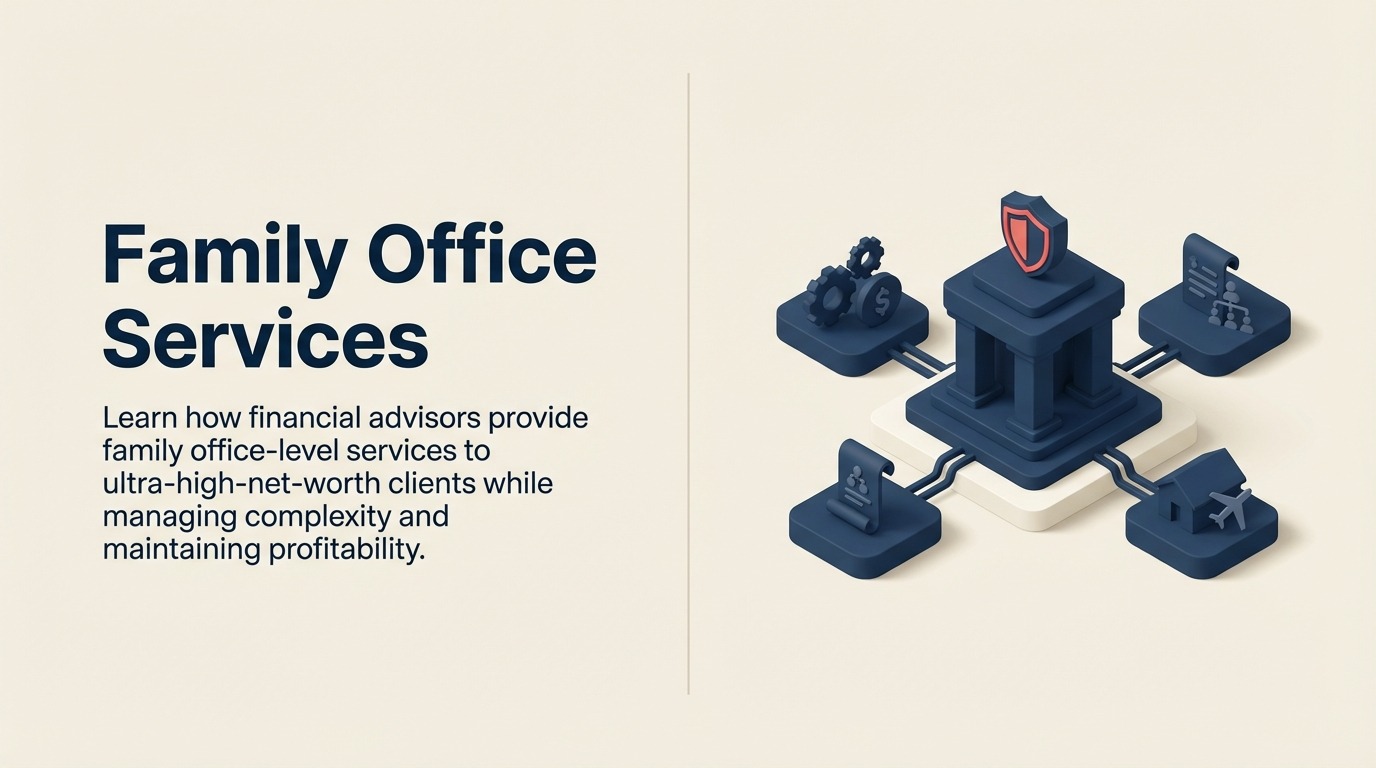
This is where family offices come in. Single-family offices serve one ultra-wealthy family with dedicated staff. Multi-family offices serve multiple families with shared resources. And wealth management firms are offering virtual family office services to capture this underserved market.
The opportunity is huge. There are about 240,000 households in the US with $10 million+ in investable assets, according to Federal Reserve wealth data. Most aren't wealthy enough to justify single-family offices (which typically require $100 million+). But they need services beyond basic wealth management. That's your opportunity.
What Family Office Service Actually Means
Let's define terms because "family office" gets thrown around loosely.
Single-family offices serve one family exclusively. They employ dedicated CPAs, attorneys, investment staff, administrative personnel, and sometimes property managers and personal assistants. SFOs make sense for families with $100 million+ (some say $250 million+) because the costs of dedicated staff run $1-3 million annually.
Multi-family offices serve multiple families with shared resources. They provide comprehensive services similar to SFOs but spread costs across clients. MFOs typically require $5-25 million minimums and charge 1-2% of assets plus additional fees for specific services.
Virtual family office models are what wealth advisors can deliver. You're coordinating comprehensive services without employing full-time dedicated staff. You're the quarterback working with external specialists (CPAs, attorneys, insurance advisors) to deliver family office-level service at sustainable costs.
Service scope beyond investments is what sets family office service apart from wealth management. You're not just managing portfolios. You're coordinating tax planning, estate administration, philanthropic giving, insurance programs, and potentially lifestyle services. The client has one relationship (with you) that coordinates everything.
Complexity and customization requirements are significant. Every family office client has unique situations: multiple business entities, complex estate plans, multi-generational considerations, or concentrated stock positions. Cookie-cutter solutions don't work. You're creating custom strategies for each family.
Minimum asset levels matter for profitability. You can't deliver family office-level service to $1 million clients profitably. Most advisors set minimums at $5 million (entry-level family office service), $10 million (comprehensive service), or $25 million+ (full-service family office). Know your costs and set minimums accordingly.
Core Family Office Services
What are you actually delivering? Here's the comprehensive menu.
Comprehensive wealth management is the foundation. Portfolio management, asset allocation, performance reporting, and rebalancing. This is table stakes. The difference is the sophistication: alternative investments, direct investment opportunities, and customized strategies beyond mutual fund portfolios.
Tax planning and compliance coordination goes deeper than basic tax advice. You're coordinating with CPAs on multi-state and international tax issues, complex entity structures, trust tax returns, and proactive multi-year tax planning. You're not preparing returns, but you're driving the tax strategy.
Estate and trust administration means you're working with attorneys on estate planning but also coordinating trust funding, ensuring proper asset titling, monitoring trust distributions, and handling estate settlement when family members pass away. Many families have multiple trusts requiring ongoing coordination.
Philanthropic advising helps families create charitable legacies. You're advising on private foundation establishment and management, donor-advised fund strategies, charitable trusts, and impact investing. Families with significant wealth want their giving to be strategic, not just emotional.
Risk management and insurance requires coordination across life insurance (often large policies in irrevocable trusts), disability coverage, long-term care planning, umbrella liability, and specialized coverage for art, jewelry, or collectibles. You're ensuring the insurance program protects family wealth comprehensively.
Family governance structures decision-making for family wealth. Family mission statements, regular family meetings, wealth education for heirs, and conflict resolution processes all fall under family governance. You're often facilitating these discussions.
Concierge and lifestyle services vary by firm but can include bill payment, property management coordination, travel planning, or household staff management. Some firms provide these, others refer them out. The decision depends on your service model and profitability requirements.
Advanced Investment Services
Family office clients expect beyond-basic investment capabilities.
Alternative investment access is often expected. Private equity, hedge funds, private credit, and direct investments typically require accredited or qualified purchaser status, which most family office clients meet. The SEC's guidance on accredited investors defines qualification requirements. You need access to quality alternative investments and ability to evaluate them.
Direct investment opportunities like private placements, angel investing, or direct private equity deals appeal to entrepreneurial family office clients. You're not always recommending these, but you should be able to evaluate opportunities when clients bring them to you.
Concentrated stock management applies to founders, executives, or families who've inherited concentrated positions. Strategies like options collars, exchange funds, or systematic diversification plans require expertise beyond basic portfolio management.
Private foundation investment management follows different rules than personal portfolios. Foundations have 5% annual distribution requirements, can't have excess business holdings, and must avoid jeopardizing investments. You need to understand these constraints.
Real estate portfolio coordination means tracking and integrating real estate holdings into the overall wealth plan. You're not managing properties directly but ensuring real estate strategy aligns with liquidity needs, estate planning, and tax strategy.
Art and collectibles advising isn't about authenticating artwork, but you should be able to coordinate with specialists for insurance, estate planning, and charitable donation strategies involving valuable collections.
Tax and Legal Coordination
Family office clients have complex tax and legal situations requiring active coordination.
Multi-state and international tax issues arise when clients own properties in multiple states, have international assets, or have business interests spanning jurisdictions. You're coordinating with CPAs who specialize in these areas and ensuring investment strategies account for various tax regimes.
Complex entity structures like partnerships, S-corps, LLCs, and trusts all require coordination. Asset location decisions, distributions, and investment strategies must account for entity structures. You're working with attorneys and CPAs to optimize structures.
Trust administration oversight means ensuring trusts are properly funded, distributions are made according to trust documents, trust tax returns are filed, and beneficiaries understand trust provisions. Many families have multiple trusts requiring active management.
Coordinating CPA and attorney relationships is core to the family office model. You're often the primary relationship, coordinating specialist involvement. You're identifying when legal or tax expertise is needed, facilitating engagement, and ensuring follow-through.
Family limited partnership management requires ongoing coordination. FLPs are often used for estate planning and asset protection, but they require proper administration, annual valuations, and compliance with partnership formalities. You're ensuring these structures are maintained properly.
Business Owner Integration
Many family office clients are business owners requiring specialized services.
Business succession planning integrates personal and business financial planning. Exit timelines, valuation monitoring, key person retention, and post-exit wealth management all require coordination. You're working with business consultants and M&A advisors on comprehensive succession strategies.
Liquidity event preparation is critical before business sales. Pre-sale tax planning, estimating after-tax proceeds, investment strategy for sale proceeds, and estate plan updates all need to happen before the sale closes. Advisors who handle liquidity events well earn clients for life.
Business valuation monitoring helps owners understand wealth and plan accordingly. Regular valuations (even informal) enable estate planning, succession planning, and insurance decisions. You're coordinating periodic valuations and integrating them into wealth planning.
Key person insurance protects business value if critical employees or owners die. You're evaluating insurance needs, coordinating coverage placement, and ensuring policies remain appropriate as business value grows.
Buy-sell agreement funding requires life insurance or other funding mechanisms to enable partner buyouts. You're reviewing buy-sell agreements, ensuring funding is adequate, and updating coverage as business values change.
Post-exit wealth management is where you capture enormous value. When a business owner sells for $20 million, they need completely different wealth management than when they had $3 million and a business. You're managing liquidity, tax planning, estate planning updates, and investment strategy shifts.
Philanthropic Strategy
High-net-worth families increasingly want strategic charitable giving.
Private foundation establishment and management creates lasting charitable legacies. Foundations require legal setup, ongoing administration, grant-making processes, and investment management. The IRS private foundation resources outline compliance requirements and tax considerations. You're coordinating foundation establishment and potentially serving as investment advisor.
Donor-advised fund strategies offer simpler alternatives to private foundations. DAFs provide immediate tax deductions, allow invested growth, and enable grant-making without foundation administration burden. For most families, DAFs are more practical than foundations.
Charitable trust implementation includes charitable remainder trusts (income to family, remainder to charity) and charitable lead trusts (income to charity, remainder to family). These advanced strategies require coordination with attorneys and tax advisors.
Impact investing integration appeals to families wanting investments aligned with charitable missions. You're evaluating impact investment opportunities and integrating them into overall portfolios without sacrificing returns for impact.
Family legacy and mission development articulates family values and charitable priorities. You're facilitating family discussions about why they give, what causes matter, and what legacy they want to create. This work is as much facilitation as financial advising.
Bill Payment and Administrative Services
Some family offices provide these services, others don't. Know your model.
Consolidated reporting across all accounts aggregates everything: managed accounts, outside accounts, real estate, business interests, liabilities. Clients see complete net worth and cash flow in one report. This requires robust technology and data aggregation capabilities.
Bill payment services mean you're literally paying clients' bills: utilities, property taxes, insurance premiums, credit cards. Some wealthy families want this service, particularly if they have multiple properties and complex situations. Others prefer handling it themselves.
Property management coordination doesn't mean you're managing properties but you're coordinating with property managers, tracking expenses, ensuring insurance coverage, and integrating property finances into overall wealth picture.
Insurance policy tracking consolidates all insurance policies (life, disability, property, liability, umbrella) in one place with renewal tracking and coverage gap analysis. Many families have insurance policies scattered across multiple agents without comprehensive oversight.
Document organization and vault services provide secure storage for important documents: estate plans, deeds, insurance policies, tax returns. Digital vaults enable client access anywhere while providing security and organization.
Service Model and Pricing
How do you structure and price family office services profitably?
Tiered service offerings let you serve different asset levels appropriately. Entry-level family office service ($5-10M) might include quarterly planning meetings and basic tax coordination. Mid-tier ($10-25M) adds philanthropy advising and more frequent touchpoints. Top-tier ($25M+) includes full service with unlimited access.
This approach aligns with a comprehensive service tier strategy that matches value to client segments.
Retainer vs AUM-based fees is an ongoing debate. Pure AUM fees (1-1.5%) can under-compensate for service complexity on smaller accounts or over-charge on very large accounts. Flat retainers ($25,000-$100,000+ annually) compensate for service complexity regardless of asset level. Many advisors use hybrid models: AUM fees on invested assets plus retainers for planning and coordination.
Minimum relationship sizes must support service costs. If you're spending 40 hours annually serving a family office client, at $500/hour opportunity cost, you need $20,000+ in fees to break even. Set minimums that ensure profitability.
Team structure and staffing requires depth. Family office clients need responsive service. You can't serve these clients alone. Build a team with specialists in tax planning, estate planning, and client service who can support complex client needs.
Technology platform requirements are significant. You need portfolio management systems, financial planning software, CRM systems for comprehensive client notes, document vaults, and ideally aggregation tools for outside account monitoring. Budget $15,000-50,000+ annually for technology.
Building vs Partnering
You can't build every capability in-house. Strategic decisions are required.
When to build internal capabilities depends on client concentration and volume. If you have 20 family office clients all needing tax planning, hiring a CFP/CPA internally might make sense. If you have three clients, partnering with external CPAs is more efficient.
Outsourced family office platforms like Fidelity Family Office Services, Schwab Advisor Services, or independent providers offer technology, back-office support, and specialist access. These platforms let you deliver family office service without building everything yourself.
Strategic partnerships with CPAs, estate attorneys, and insurance advisors extend your capabilities. Build a network of specialists who understand family office-level work and can collaborate effectively. Compensate them fairly and maintain relationships.
Custodian family office programs provide resources, training, and technology for advisors serving family office clients. These programs can accelerate your capability development without starting from scratch.
Practice capacity and profitability analysis is essential. How many family office clients can you realistically serve? If each requires 40-60 hours annually, and you have 1,000 available client service hours, you can serve 15-25 family office relationships. Know your capacity and price accordingly.
Why Family Office Services Matter
This is where significant practice value gets created.
Ultra-high-net-worth clients pay premium fees for comprehensive service. A $10 million client paying 1.25% generates $125,000 annually. A $25 million client generates $312,500 annually. These relationships are worth substantial practice value.
Retention rates are high when you deliver true family office-level service. Clients with comprehensive relationships across investment, tax, estate, and philanthropic planning don't leave easily. You're embedded in their financial lives in ways that create tremendous switching costs.
Referrals from family office clients are high-quality. They refer other wealthy families who need similar comprehensive service. One satisfied $15 million client can refer two or three similar families over time.
And personally, this work is interesting and impactful. You're solving complex problems, coordinating sophisticated strategies, and helping families preserve wealth across generations. That's more fulfilling than just managing portfolios.
If you're serious about serving high-net-worth clients, family office services are how you differentiate and capture premium value. Build the capabilities, set appropriate minimums, and deliver service that justifies premium pricing. This is where exceptional wealth management practices are built.
Learn More
Family office services require specialized knowledge and systems. Explore these complementary topics:
- High Net Worth Lead Generation - Attract family office-level clients
- Team Structure Delegation - Build teams to deliver complex services
- Technology Stack for Advisors - Implement systems for sophisticated service delivery

On this page
- What Family Office Service Actually Means
- Core Family Office Services
- Advanced Investment Services
- Tax and Legal Coordination
- Business Owner Integration
- Philanthropic Strategy
- Bill Payment and Administrative Services
- Service Model and Pricing
- Building vs Partnering
- Why Family Office Services Matter
- Learn More