Franchise Business Models: What Mid-Market Leaders Need to Know Before Franchising or Buying In
Turn this article into takeaways for your work.


Each assistant summarizes the article only for you and suggests best practices for your work.
Franchising is one of the most misunderstood business models in mid-market strategy conversations. Leaders see brands like McDonald's or Hilton and assume franchising is a way to grow fast with other people's money. That's partially true. But franchising is also a way to take on significant operational, legal, and reputational obligations that most companies aren't ready for.
This guide explains how franchise business models actually work, what the economics look like on both sides, and how to think about whether franchising makes strategic sense for your situation.
Key Facts
- There are approximately 800,000 franchise establishments in the United States, supporting roughly 8.4 million jobs, according to the International Franchise Association 2024 Economic Outlook. Franchising is a material part of the US economy, not a niche business model.
- The FTC's Franchise Rule requires franchisors to provide a Franchise Disclosure Document (FDD) at least 14 days before any agreement is signed. Buyers who skip detailed FDD review are significantly more likely to face unexpected obligations.
- Multi-unit operators now account for more than half of all franchise units across major systems. The "one location, one owner" franchise model is increasingly the exception rather than the rule in established systems.
How Franchise Business Models Work
At its core, a franchise is a license agreement. A franchisor (the brand owner) grants a franchisee the right to operate under the brand's system, processes, and trademarks in exchange for fees and ongoing royalties.
The franchisee gets access to a proven model, brand recognition, operational playbooks, training systems, and in many cases supply chain relationships. The franchisor gets capital deployment at scale without owning every location, plus recurring revenue from royalties.
But there's a third party in this relationship that's often overlooked: the customer. The customer experiences the franchise as if it were the brand itself. They don't know or care whether the location they're visiting is company-owned or franchised. Which means every franchisee is also a brand steward, carrying the franchisor's reputation with every customer interaction.
That dynamic shapes everything about how franchising must be structured to work.
The Two Perspectives: Franchisor and Franchisee
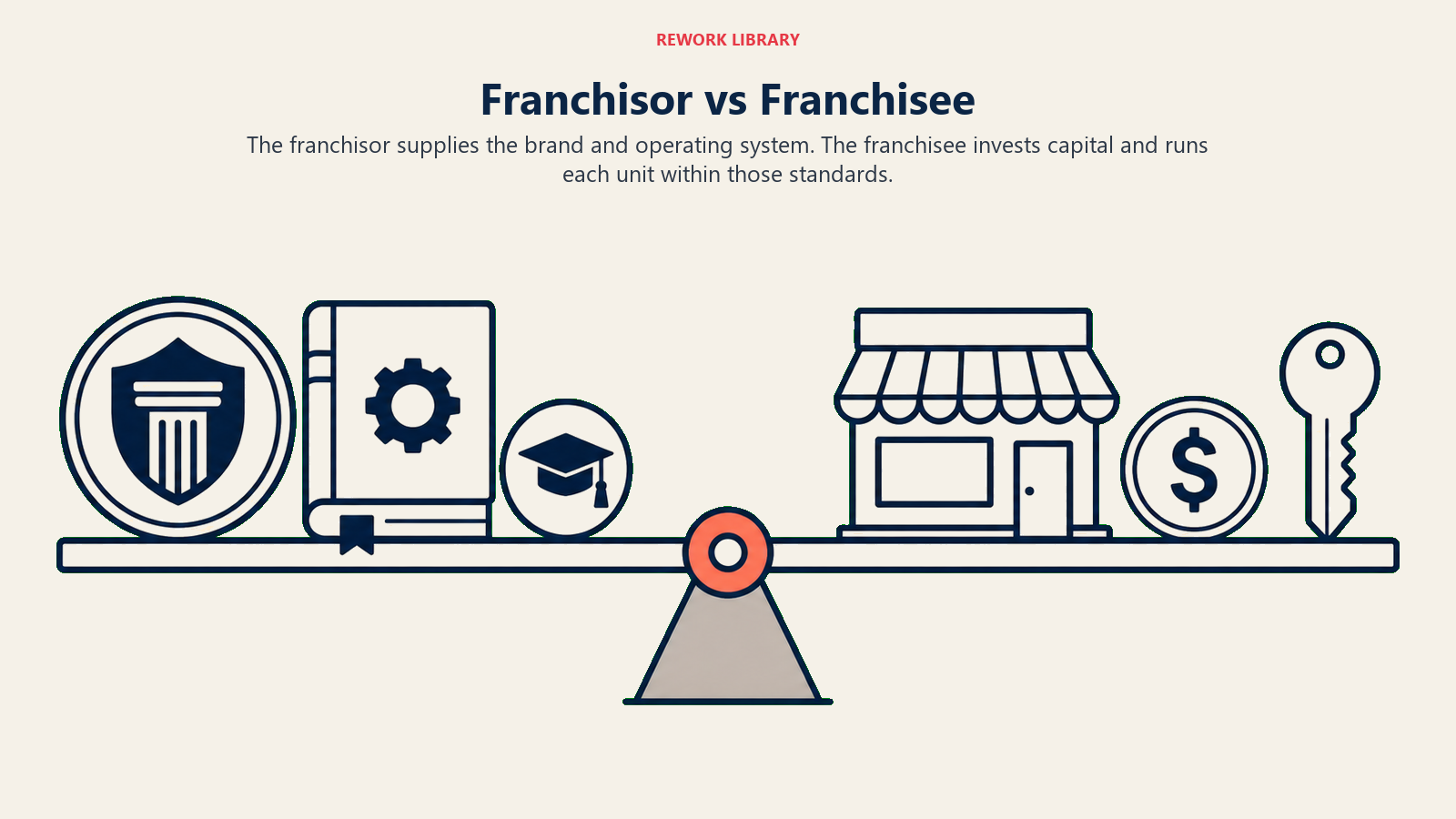
The model only works when the franchisor's system obligations and the franchisee's operating responsibilities stay in balance.
The Franchisor's Position
For a company considering franchising as a growth strategy, the value proposition is capital-efficient expansion. A franchisor typically receives an upfront franchise fee (often $30,000 to $50,000 per location for established brands) plus ongoing royalties of 4-8% of gross revenue. In exchange, the franchisor provides the brand, the system, the training, and ongoing support.
The economics sound appealing, but the obligations are substantial. Franchisors must:
- Document their system in enough detail that franchisees can replicate it consistently
- Build and staff a franchise support organization (training teams, field consultants, operations reviewers)
- Enforce brand and quality standards across locations they don't own or control directly
- Manage franchisee relationships that are contractually constrained but not employee relationships
- Handle legal compliance across a Franchise Disclosure Document (FDD) process that varies by jurisdiction
The companies that have built successful franchise systems didn't start franchising until they had 10 to 20 company-owned locations that demonstrated the model was repeatable and profitable. Franchising a business that isn't fully systematized doesn't scale the model: it scales the problems.
The Franchisee's Position
A franchisee is buying access to a system, not just a brand. The upside is real: lower failure rates than independent startups (though the data here is often overstated in franchise sales materials), proven operational playbooks, and collective marketing scale.
The constraints are equally real. Franchisees operate under terms set by the franchisor. Product offerings, pricing, supplier relationships, store layouts, and brand standards are typically dictated or heavily constrained by the franchise agreement. The franchisee has skin in the game but not full entrepreneurial freedom.
The financials vary widely by system and sector. Food service franchises typically target a unit-level EBITDA margin of 15-25% before debt service on the franchise fee. Service franchises (cleaning, staffing, professional services) often show higher margins but lower absolute revenue per unit. Multi-unit operators (franchisees who own 10, 20, or 50 locations) operate very differently from single-unit owner-operators and typically have more leverage in negotiations with franchisors.
Types of Franchise Models
Not all franchise structures are the same. The main variants are:
Single-unit franchise: One franchisee operates one location. Simple structure, lower barrier to entry for the franchisee, but limits the franchisee's growth upside and creates a fragmented franchisee base for the franchisor.
Multi-unit franchise: A franchisee is granted rights (and typically obligations) to open a specific number of units in a defined area over a defined timeline. Most of the largest franchise systems are now heavily multi-unit. It creates more sophisticated franchisee partners but requires more capital.
Area development agreement: A variation on multi-unit where the franchisee has rights to develop a geographic area. The development schedule is contractually specified, with franchise rights revoked if development milestones aren't met.
Master franchise: A franchisee is granted the right to sub-franchise in a market, essentially becoming a mini-franchisor in their territory. Common in international expansion where the master franchisee provides local market knowledge and manages regulatory complexity. The economics split three ways: franchisor, master franchisee, and sub-franchisee.
Conversion franchise: An existing independent business converts to a franchise brand. Common in hospitality and home services. The conversion franchisee gets brand affiliation and system support; the franchisor gets established operators without greenfield build costs.
The Economics: What the Numbers Look Like
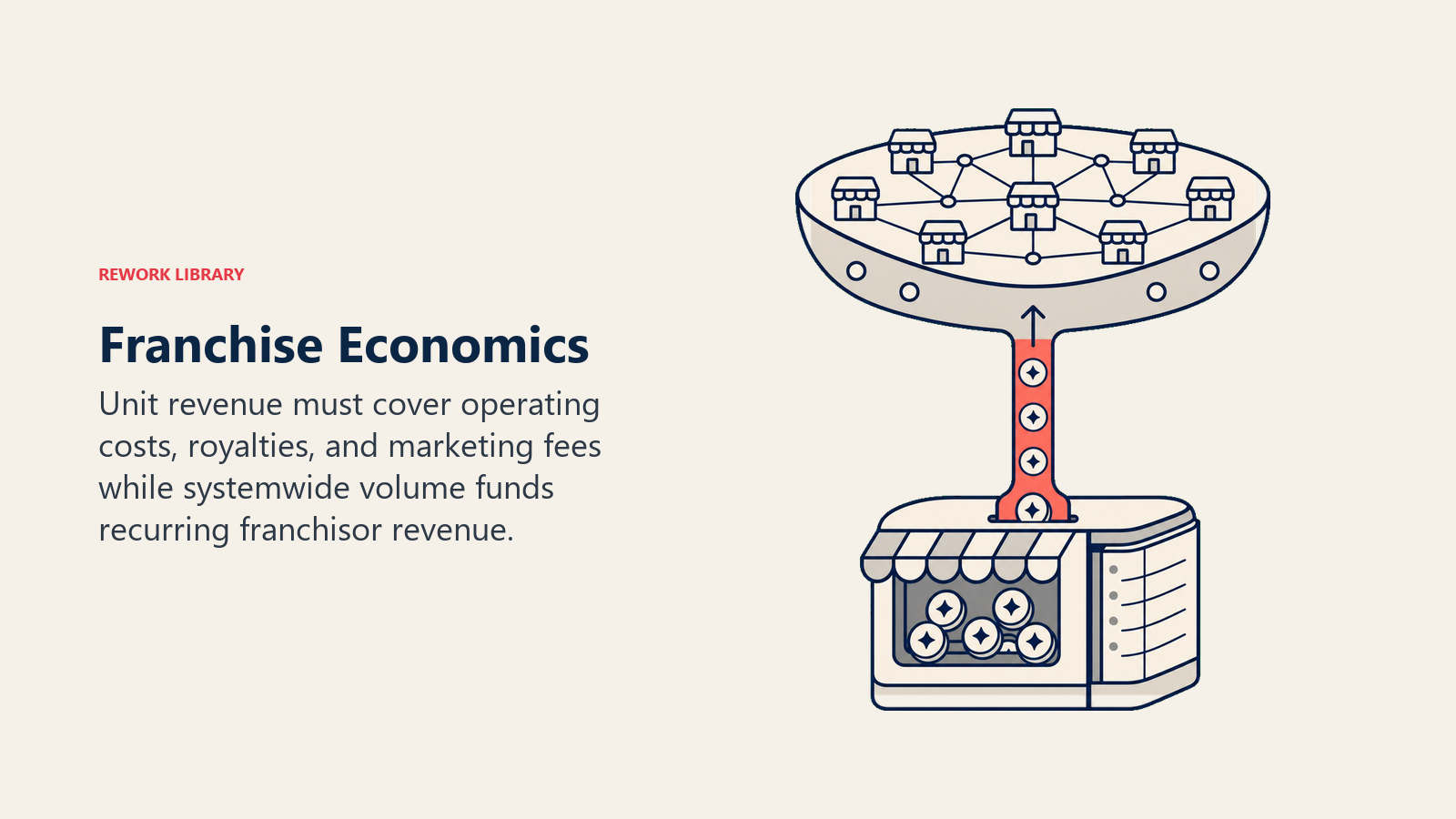
Understanding franchise economics requires separating the unit-level economics (what happens at each location) from the system-level economics (what the franchisor earns across the network).
Unit-Level Economics
A franchise unit's profitability is driven by three variables: revenue per unit, royalty and fee obligations, and operating cost structure. The royalty is typically the largest difference between franchised and company-owned unit economics.
For a food service location doing $1.5M in annual revenue with a 6% royalty, $80,000 leaves the unit before the franchisee pays labor, food, rent, or utilities. The national marketing fund contribution (typically 2-4% of revenue, separate from royalty) adds more. The franchisee's breakeven analysis has to account for both.
For buyers evaluating a franchise opportunity, Item 19 of the Franchise Disclosure Document is the most important section. It's the financial performance representation. Not all franchisors provide Item 19 data, and those that do vary in what they disclose. A franchisor that shows only average unit volumes without showing the distribution (including the bottom quartile) is hiding something. The FTC's buyer's guide to franchising covers disclosure requirements and what questions to ask before signing.
System-Level Economics
For franchisors, system revenue (the total revenue generated across all franchise units) is the top-line number that matters for brand investment decisions and marketing fund scale. Franchisor revenue is royalty revenue (typically 4-8% of system revenue) plus franchise fees plus, in many cases, revenue from required purchases through franchisor-controlled supply chains.
A franchisor with 500 units generating an average of $800K in annual unit revenue has $400M in system revenue. At a 6% royalty, that's $24M in royalty revenue annually. Add supply chain markup and franchise fees for new unit openings and you begin to see why mature franchise systems generate high-margin, recurring revenue.
Operational Requirements Most Leaders Underestimate
The operational demands of running a franchise system are almost always heavier than leaders expect before they start.
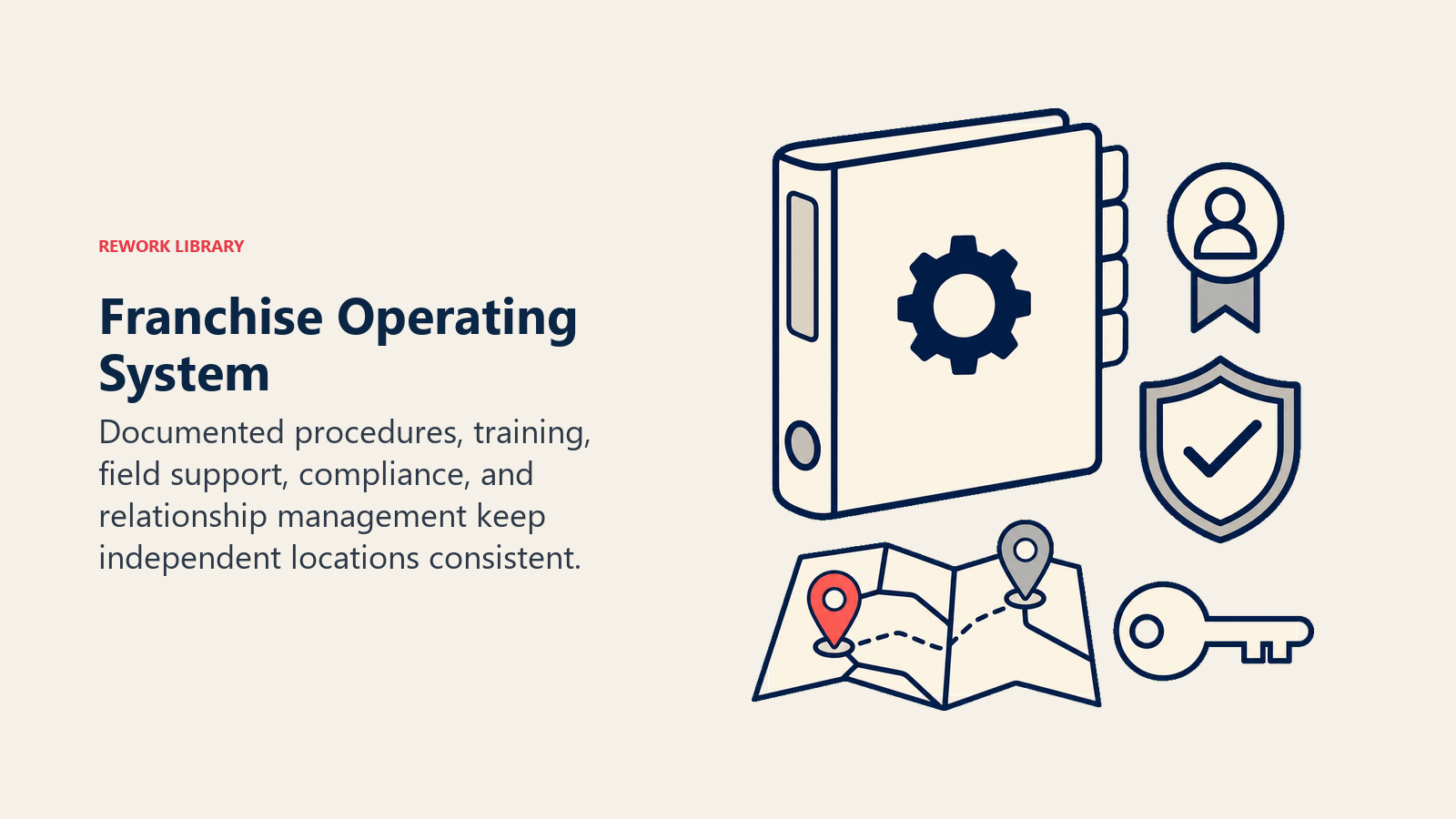
System documentation: The franchise operations manual is the system. It has to be detailed enough that an operator with no prior industry experience can replicate your model. Most companies have tribal knowledge in their heads, not documented systems. Converting that knowledge into a replicable operations manual is a major project before the first franchise is sold.
Training infrastructure: Franchisees and their teams need structured onboarding training before opening, and ongoing training as the system evolves. Most franchise systems operate a training center or a structured field training program. This infrastructure costs real money before it generates royalty revenue.
Field support: Franchisors typically deploy field consultants who visit locations, conduct operational reviews, and provide coaching to franchisee operators. The ratio varies by system complexity, but 1 field consultant per 25-40 locations is common. At 100 locations, you need 3-4 dedicated people in this role.
Legal and compliance: Franchise disclosure requirements in the US are regulated at the federal level (the FDD) and in many states separately. International expansion introduces country-specific franchise law. Legal cost is a real line item for any franchisor.
Franchisee relationship management: Franchisees are not employees. You can't direct them the way you direct your own teams. Managing a franchisee network means influencing behavior through system design, support quality, and peer pressure from high performers, rather than direct authority. It's a different leadership skill than most company-building executives have developed.
When Franchising Makes Strategic Sense
Franchising is not a fit for every business or every growth situation. It tends to work well when:
- The business model is genuinely replicable and the success factors are transferable to operators who didn't build the original business
- The unit economics are strong enough to support a royalty layer without making the franchisee's position unviable
- The company has the organizational capacity to build and sustain a franchise support system
- The brand has enough recognition or differentiation to be worth the franchise fee from a franchisee's perspective
It tends not to work when:
- The business depends on the personal reputation or skills of a specific individual
- The unit economics are marginal at best, leaving no room for royalties
- The company wants growth capital but hasn't invested in systematizing the model
- The leadership team isn't prepared for the legal, operational, and relationship complexity of running a franchise network
For companies considering franchising as a growth strategy, the honest starting question is whether you have a system or a business. A business you can run. A system someone else can run the same way. Franchising only scales the latter.
Buying into an Existing Franchise
For executives evaluating a franchise investment rather than franchising their own business, the due diligence checklist is different:
- Review the full FDD, especially Item 19 (financial performance representations), Item 20 (number of franchised and company-owned units, including terminations and non-renewals), and Item 21 (audited financials for the franchisor)
- Speak directly with current franchisees and with franchisees who have left the system
- Understand the renewal and exit terms: a 10-year initial term with a 5-year renewal option but no right of resale without franchisor consent is a very different investment than one with transferable rights
- Model the unit economics under pessimistic revenue assumptions, not the optimistic scenarios in the sales presentation
- Evaluate the support organization independently: what does the field consultant program look like, what does technology support include, how does the franchisor handle underperforming franchisees
Franchising is a real business model with a real track record. But the marketing materials from franchise sales teams are exactly that: marketing materials. Independent due diligence, financial modeling, and conversations with people who've been in the system longer than the sales rep has worked there are how informed decisions get made.
Related reading:
- Business Model Canvas: Mapping How Your Business Creates Value
- Growth Strategy Frameworks for Mid-Market Companies
- Corporate Strategy: Choosing Where to Compete
- Unit Economics for Mid-Market Leaders
- Scalability: Building a Business That Grows Without Breaking
- Business Metrics Overview - The operational and financial metrics that matter most when running a franchise network
- Technology Investment Strategy - How franchise systems evaluate and deploy technology across dispersed locations

Co-Founder, Rework.com
On this page
- How Franchise Business Models Work
- The Two Perspectives: Franchisor and Franchisee
- The Franchisor's Position
- The Franchisee's Position
- Types of Franchise Models
- The Economics: What the Numbers Look Like
- Unit-Level Economics
- System-Level Economics
- Operational Requirements Most Leaders Underestimate
- When Franchising Makes Strategic Sense
- Buying into an Existing Franchise