Keputusan Build vs. Buy vs. Integrate: Kerangka Operator untuk Tooling AI

Turn this article into takeaways for your work.


Each assistant summarizes the article only for you and suggests best practices for your work.
Lead engineering Anda ingin membangun model AI kustom. Ia bilang Anda memiliki data proprietary yang akan memberikan keunggulan nyata, dan alat off-the-shelf tidak sesuai dengan workflow Anda.
CFO (chief financial officer) Anda ingin membeli produk AI SaaS (software-as-a-service). Ia bilang Anda akan produktif dalam 30 hari bukan berbulan-bulan, dan harganya dapat diprediksi.
CTO (chief technology officer) Anda bilang integrasikan OpenAI API ke sistem yang sudah ada. Ia bilang Anda mendapatkan kemampuan AI tanpa overhead pemeliharaan model kustom, dan Anda tetap mengontrol workflow.
Ketiganya benar, untuk masalah yang berbeda pada tahap AI maturity yang berbeda. Kesalahannya bukan memilih opsi yang salah. Kesalahannya adalah menerapkan satu opsi untuk setiap keputusan, terlepas dari konteks.
Sebagian besar organisasi pada Stage 1 atau 2 AI maturity (penggunaan ad-hoc atau pilot awal) terlalu banyak membangun. Mereka berinvestasi dalam model kustom dan infrastruktur AI sebelum memvalidasi use case, sebelum data mereka cukup bersih untuk dilatih, dan sebelum mereka memiliki proses operasional untuk menggunakan AI yang canggih secara andal. Riset Gartner menemukan bahwa organisasi dengan inisiatif AI yang berhasil berinvestasi hingga empat kali lebih banyak dalam fondasi data dan analitik dibandingkan yang hasilnya buruk, menunjukkan kesiapan data sebagai prasyarat nyata sebelum keputusan build masuk akal.
ACE Framework (Ingest, Analyze, Predict, Generate, Execute) adalah alat terbaik untuk mendiagnosis kesalahan ini: organisasi yang mencoba membangun kemampuan Predict atau Execute sebelum mereka memiliki infrastruktur Ingest yang bersih hampir selalu membangun terlalu awal. Hasilnya adalah proyek AI mahal yang tidak digunakan.
Sebagian besar organisasi pada Stage 4 atau 5 (AI terintegrasi atau transformasional) terlalu banyak membeli untuk fungsi operasional. Mereka membayar harga enterprise untuk AI penjualan atau dukungan yang generik ketika workflow spesifik mereka memiliki cukup diferensiasi untuk membenarkan pembangunan atau integrasi.
Artikel ini memberikan Anda kerangka keputusan untuk pertanyaan build-buy-integrate: tiga opsi yang didefinisikan dengan jelas, delapan kriteria yang mengatur keputusan, panduan tahap maturity, dan perbandingan total cost of ownership (TCO) yang realistis di ketiga jalur.
Tiga Opsi yang Didefinisikan
Key Facts: Build vs Buy vs Integrate
- Membeli alat AI dari vendor spesialis dan membangun melalui kemitraan strategis berhasil sekitar 67% dari waktu, sementara pembangunan internal penuh berhasil sekitar setengah dari tingkat tersebut. (MIT GenAI Divide, 2025)
- Hanya 5% dari investasi AI enterprise senilai $30-40 miliar yang menghasilkan akselerasi pendapatan terukur; 95% sisanya terhenti antara pilot yang menjanjikan dan proof-of-concept yang terlupakan. (MIT)
- Organisasi dengan inisiatif AI yang berhasil berinvestasi hingga 4x lebih banyak dalam fondasi data dan analitik dibandingkan yang hasilnya buruk, menunjukkan kesiapan data sebagai prasyarat nyata sebelum keputusan build masuk akal. (Gartner)
Mendapatkan keputusan yang tepat dimulai dengan definisi yang tepat tentang apa yang sebenarnya dimaksud setiap opsi. Kosakata ini sering disalahgunakan.
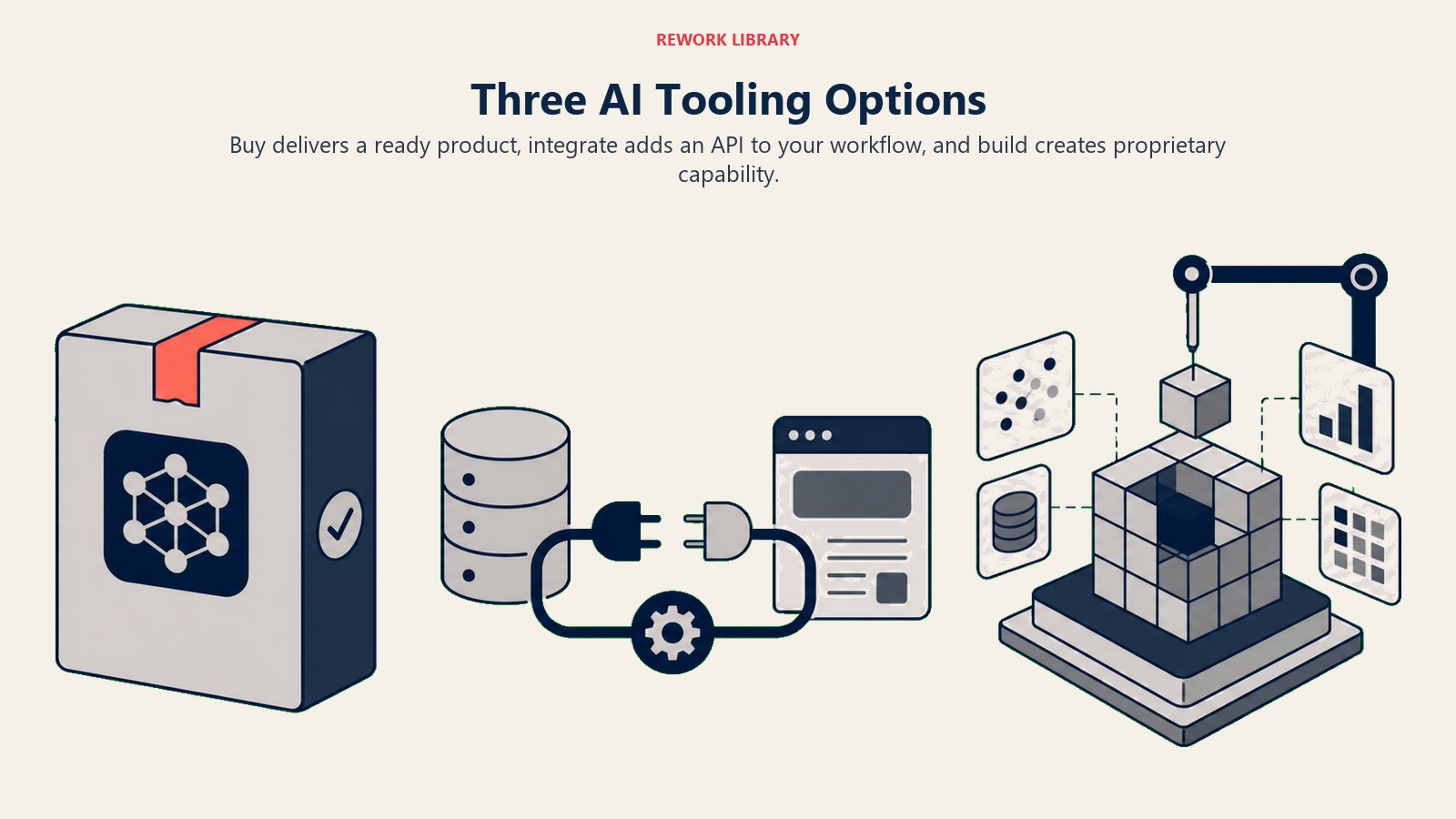
Buy: Beli Produk AI SaaS yang Dibuat untuk Tujuan Tertentu
Buy berarti memilih vendor yang produknya dirancang untuk use case Anda, membayar akses dengan model harga mereka (per-seat, per-outcome, atau platform fee), dan melakukan deploy tanpa membangun atau memodifikasi logika AI yang mendasarinya.
Contoh: membeli Gong untuk analisis panggilan penjualan, membeli Intercom Fin untuk otomasi dukungan pelanggan, membeli Rework Sales Ops untuk CRM dan manajemen sales pipeline, membeli Jasper untuk pembuatan konten pemasaran.
Yang Anda dapatkan: Waktu tercepat menuju nilai (hari hingga minggu), tidak ada investasi engineering untuk kemampuan inti, pembaruan model dan infrastruktur yang dikelola vendor, biaya berkelanjutan yang diketahui.
Yang Anda lepaskan: Produk dibangun untuk pasar yang luas, bukan workflow spesifik Anda. Anda tidak mengontrol model yang mendasari atau roadmap fitur. Jika vendor mengubah harga atau menghentikan produk, Anda bergantung pada keputusan mereka. Dan keunggulan kompetitif Anda dari AI dibatasi pada apa yang vendor tawarkan kepada semua orang.
Kapan ini pilihan yang tepat: Ketika use case bersifat operasional (bukan pembeda produk), ketika pasar SaaS sudah matang untuk fungsi ini, dan ketika AI maturity Anda berada di Stage 1 hingga 3. AI operasional (CRM penjualan, alat dukungan pelanggan, alat HR, alat produktivitas) hampir selalu lebih baik dibeli daripada dibangun.
Integrate: Tambahkan Panggilan AI API ke Sistem yang Ada
Integrasi berarti menggunakan penyedia AI API (application programming interface) (OpenAI, Anthropic, Google, Cohere, atau model open-weight melalui penyedia seperti Together AI atau Replicate) untuk menambahkan kemampuan AI ke sistem yang sudah Anda miliki atau bangun. Engineer Anda menulis kode yang memanggil AI API; Anda memiliki logika aplikasi di sekitarnya.
Contoh: menambahkan fitur ringkasan AI ke portal pelanggan Anda menggunakan Anthropic Claude API, membangun model lead scoring yang memanggil API OpenAI untuk analisis teks, menambahkan fitur penyusunan dokumen ke alat internal Anda menggunakan OpenAI GPT API.
Yang Anda dapatkan: Anda memiliki workflow dan pengalaman pengguna. Kemampuan AI masuk ke proses spesifik Anda daripada mengharuskan proses Anda menyesuaikan diri dengan desain vendor. Anda dapat mengiterasi perilaku AI (prompt, konteks, penanganan output) secara independen dari vendor. Anda tidak membayar untuk fitur yang tidak Anda gunakan.
Yang Anda lepaskan: Investasi engineering di awal dan berkelanjutan. Prompt engineering, integrasi API, validasi output, penanganan error, dan pemantauan semuanya memerlukan waktu engineering. Anda bertanggung jawab atas kualitas produk fitur AI, bukan hanya deployment.
Kapan ini pilihan yang tepat: Ketika use case memerlukan kustomisasi workflow yang tidak dapat disediakan produk SaaS, ketika Anda memiliki kapasitas engineering untuk membangun dan memelihara integrasi, dan ketika AI maturity berada di Stage 2 hingga 4. Integrasi adalah jalur tengah yang tepat ketika "buy" tidak sesuai workflow Anda dan "build" tidak dibenarkan oleh kepentingan strategis.
Build: Latih atau Fine-Tune Model AI Kustom
Build berarti melatih model Anda sendiri, fine-tuning model fondasi pada data proprietary Anda, atau mengembangkan infrastruktur AI kustom (vector databases, retrieval systems, orkestrasi agen) yang spesifik untuk use case Anda.
Contoh: melatih model prediksi churn proprietary pada data perilaku pelanggan Anda, fine-tuning LLM (large language model) pada knowledge base internal dan gaya penulisan perusahaan Anda, membangun model computer vision kustom untuk memeriksa jenis produk spesifik Anda, mengembangkan model klasifikasi dokumen proprietary untuk korpus dokumen spesifik Anda.
Yang Anda dapatkan: Langit-langit maksimum. Model yang dilatih pada data proprietary Anda dapat mengungguli model generik pada tugas spesifik Anda. Kemampuan AI terdiferensiasi dan dapat dipertahankan. Anda mengontrol seluruh stack.
Yang Anda lepaskan: Ini adalah opsi berbiaya tertinggi dan jalur terpanjang. Pelatihan model fondasi memerlukan komputasi signifikan, keahlian data science, dan investasi infrastruktur. Fine-tuning lebih mudah diakses namun tetap memerlukan data pelatihan yang bersih, kapasitas ML engineering, dan pelatihan ulang berkelanjutan seiring pergeseran distribusi. Anda juga memiliki semua pemeliharaan: model drift, keandalan infrastruktur, dan keamanan.
Kapan ini pilihan yang tepat: Ketika AI adalah pembeda produk inti (kemampuan AI adalah yang dibeli pelanggan), ketika Anda memiliki data proprietary yang memberikan model kustom keunggulan kinerja yang bermakna, dan ketika Anda berada di Stage 4 atau 5 AI maturity dengan use case yang divalidasi dan kesiapan operasional untuk mendukung AI kustom.
Kerangka Keputusan 8 Pertanyaan
Kerangka keputusan ini memaksa tim memeriksa kapabilitas, data, risiko, dan kepemilikan operasional sebelum langsung memilih build, buy, atau integrate.
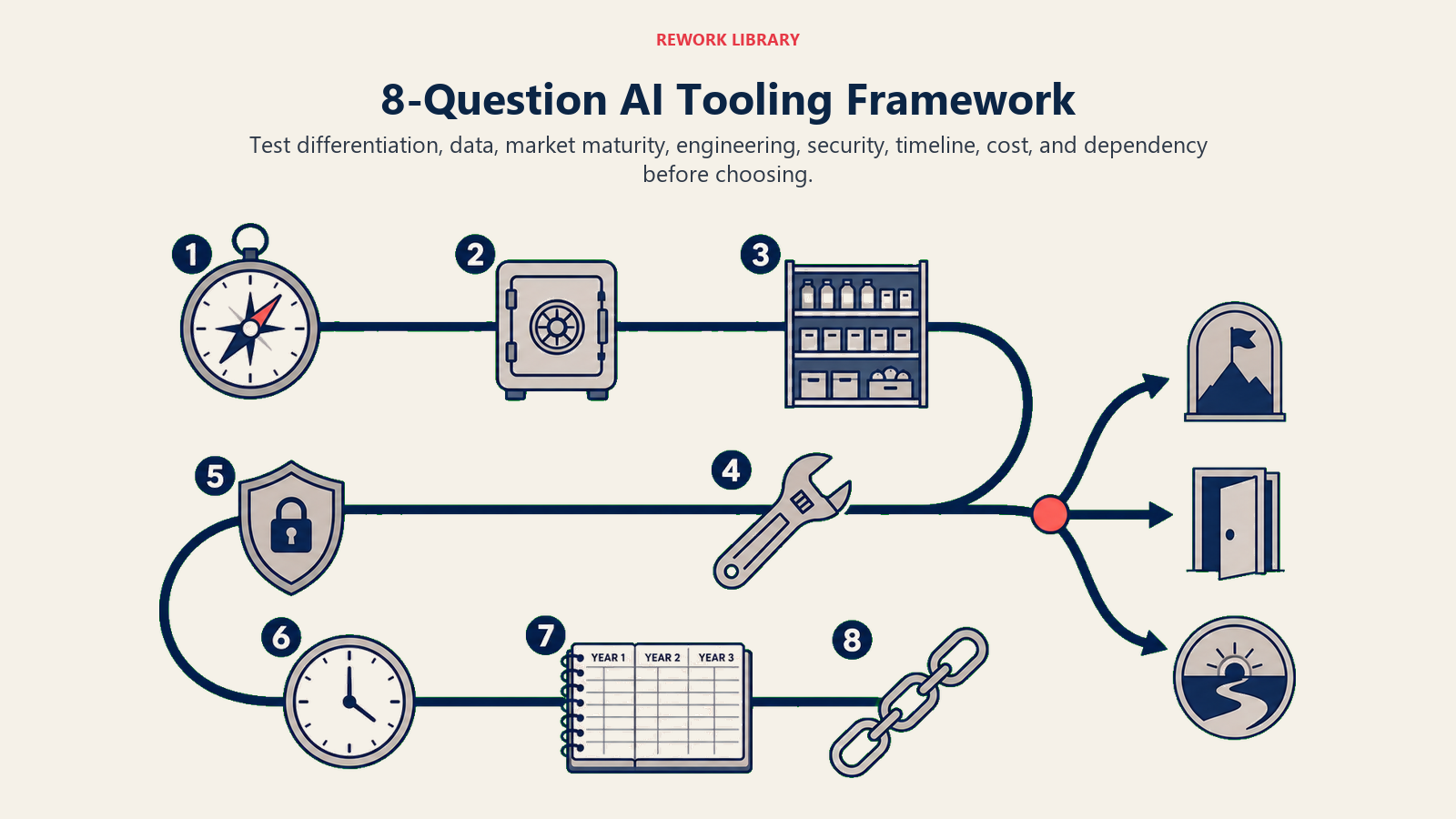
Sebelum memilih antara ketiga opsi untuk use case tertentu, jawab delapan pertanyaan ini. Jawabannya akan mengarah ke opsi yang tepat.
Pertanyaan 1: Apakah AI inti untuk diferensiasi produk Anda, atau ini AI operasional?
Jika kemampuan AI adalah alasan pelanggan memilih Anda dibandingkan pesaing, build memberikan parit yang dapat dipertahankan. Jika kemampuan AI adalah efisiensi internal (CRM tim penjualan Anda, penyusunan dokumen tim HR Anda), itu bukan pembeda produk, dan biaya build tidak dibenarkan. AI operasional hampir selalu harus dibeli atau diintegrasikan.
Pertanyaan 2: Apakah Anda memiliki data proprietary yang akan memberikan model kustom keunggulan kinerja yang bermakna?
LLM generik bekerja dengan baik pada tugas umum. Model kustom yang dilatih pada data Anda bekerja lebih baik hanya jika data Anda mengandung pola yang tidak ditangkap data pelatihan umum. Jika Anda memiliki 10 tahun riwayat interaksi pelanggan spesifik, telemetri penggunaan produk, atau dokumen spesifik domain yang tidak terwakili dengan baik dalam data pelatihan umum, model kustom mungkin mengungguli model generik pada tugas Anda. Jika data Anda mirip dengan apa yang sudah dilatih model umum, pelatihan kustom tidak akan memberikan keunggulan yang sepadan biayanya.
Pertanyaan 3: Apakah pasar SaaS sudah matang untuk use case ini?
Beberapa use case AI memiliki banyak alat yang dibuat khusus yang bersaing. CRM penjualan dengan AI, otomasi dukungan pelanggan, bantuan kode, dan pembuatan konten pemasaran semuanya adalah pasar SaaS yang ramai di mana buy didukung dengan baik. Use case lain masih dalam tahap awal atau cukup niche sehingga tidak ada solusi SaaS yang dibuat khusus yang sesuai. Di pasar SaaS yang matang, Anda harus sangat skeptis terhadap keputusan build. Di pasar yang masih berkembang di mana alat SaaS tidak sesuai workflow Anda, integrate atau build sering kali adalah jalur yang tepat.
Pertanyaan 4: Berapa kapasitas AI engineering tim Anda?
Integrasi memerlukan engineer yang dapat membangun dan memelihara integrasi API dan prompt engineering. Build memerlukan data scientist atau ML (machine learning) engineer yang dapat melatih dan memelihara model. Jika Anda tidak memiliki kapasitas ini, buy adalah satu-satunya opsi yang layak dalam waktu dekat terlepas dari apa yang dikatakan analisis strategis. Merekrut untuk build adalah rencana yang sah, namun itu adalah jalur 6 hingga 12 bulan sebelum kemampuan AI benar-benar dalam produksi.
Pertanyaan 5: Apa klasifikasi keamanan data Anda untuk use case ini?
Beberapa data tidak dapat mengalir ke penyedia AI eksternal. Data kesehatan di bawah HIPAA (Health Insurance Portability and Accountability Act), data keuangan dengan pembatasan regulasi tertentu, dan beberapa konteks pemerintah atau pertahanan memerlukan AI on-premise atau private cloud. Kerangka Klasifikasi Data untuk Akses AI memetakan kategori data Anda ke model deployment AI mana yang diizinkan, dan harus diselesaikan sebelum menjawab pertanyaan ini. Jika use case Anda melibatkan data yang tidak dapat meninggalkan infrastruktur Anda, alat SaaS vendor yang memproses data secara eksternal bukan pilihan yang patuh.
Pertanyaan 6: Berapa timeline Anda?
Jika Anda perlu menunjukkan hasil dalam 30 hingga 90 hari, build bukan timeline yang layak. Fine-tuning dan pengembangan model kustom pada jadwal realistis berjalan 3 hingga 9 bulan untuk kesiapan produksi. Integrasi memerlukan 1 hingga 3 bulan tergantung kompleksitas. Buy bisa dalam produksi dalam hari hingga minggu. Jika timeline mendorong keputusan, buy atau integrate hampir selalu diperlukan.
Pertanyaan 7: Berapa total cost of ownership selama 3 tahun?
Perbandingan biaya awal (buy paling murah, build paling mahal) sering salah ketika diperpanjang ke cakrawala 3 tahun. Biaya engineering, biaya pemeliharaan, dan skalabilitas harga vendor semuanya mengubah gambaran secara signifikan. Kami membahas ini secara rinci di bagian perbandingan TCO di bawah.
Pertanyaan 8: Berapa toleransi Anda terhadap ketergantungan vendor?
Buy dan integrate keduanya menciptakan ketergantungan vendor (vendor SaaS dan penyedia API, masing-masing). Jika organisasi Anda memiliki toleransi rendah terhadap ketergantungan vendor karena persyaratan keamanan, kendala regulasi, atau sensitivitas strategis, ketergantungan ini perlu dievaluasi dengan hati-hati. Build adalah opsi yang meminimalkan ketergantungan vendor eksternal dengan biaya komitmen sumber daya internal.
Panduan Tahap Maturity
Kaitkan keputusan dengan di mana Anda berada dalam Model Maturity AI (lihat 5 Tahap AI Maturity untuk model lengkapnya). Tampilan pendamping di SaaS AI Maturity Stages menunjukkan bagaimana jawaban build-buy-integrate bergeser khusus untuk perusahaan SaaS, di mana "buy untuk ops, integrate untuk produk" memiliki nuansa yang tidak berlaku untuk semua industri.
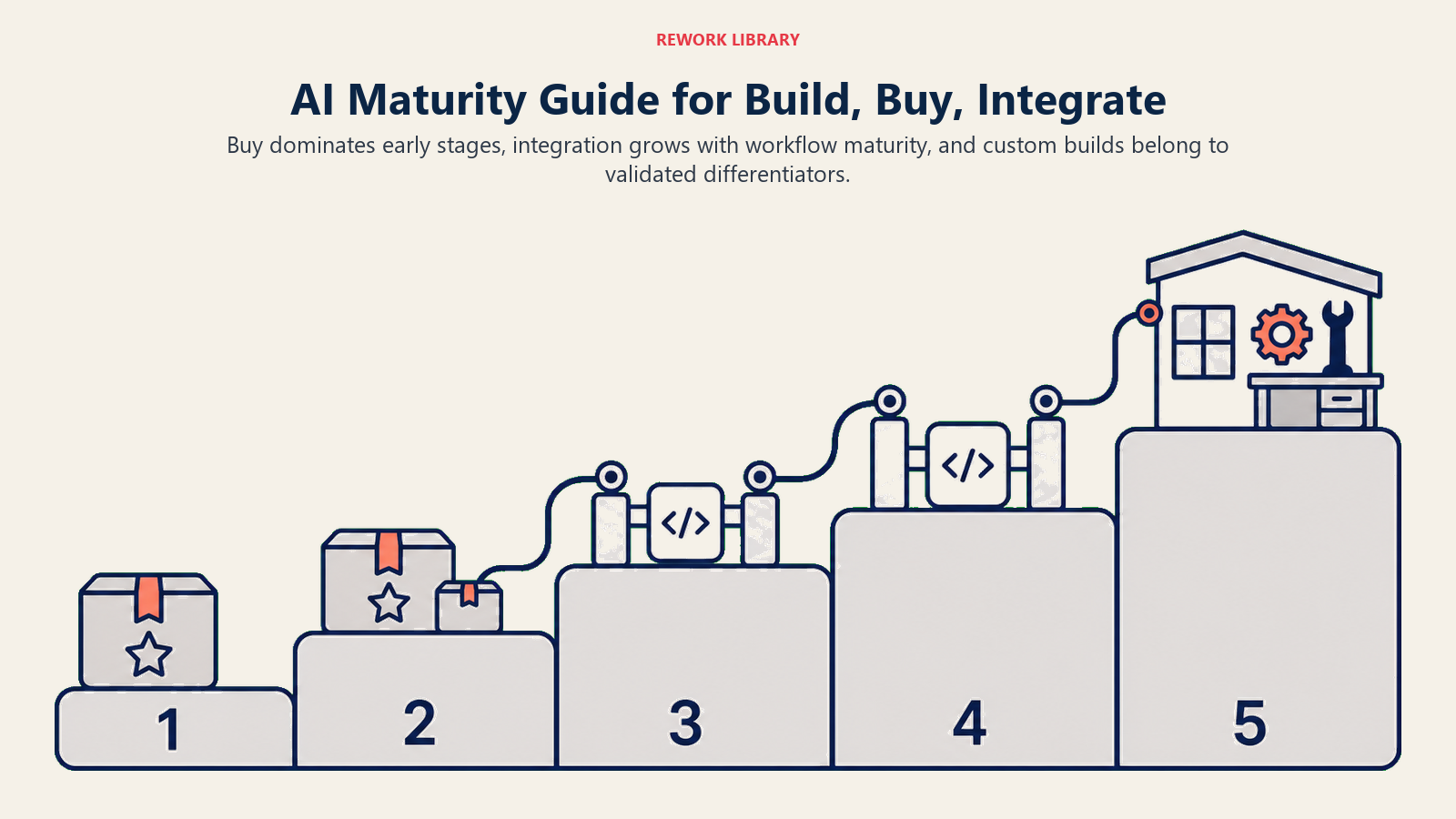
| Tahap Maturity | Deskripsi | Opsi yang Disarankan |
|---|---|---|
| Stage 1: Ad-hoc | Individu menggunakan alat AI tanpa koordinasi | Buy. Gunakan alat off-the-shelf. Jangan build apapun dulu. |
| Stage 2: Pilot | 1-2 proyek AI terbatas, mengukur ROI | Buy untuk fungsi operasional. Integrate untuk use case pilot di mana SaaS tidak sesuai. |
| Stage 3: Scaled | Beberapa use case, beberapa infrastruktur AI | Buy untuk AI operasional komoditas. Integrate di mana kustomisasi workflow penting. Build hanya jika Anda telah memvalidasi use case spesifik yang tidak ditangani buy maupun integrate. |
| Stage 4: Integrated | AI tertanam dalam workflow inti | Buy untuk AI operasional (penjualan, dukungan, HR). Integrate untuk fitur produk. Build hanya untuk pembeda inti dengan keunggulan data proprietary. |
| Stage 5: Transformational | AI membentuk ulang produk/layanan yang Anda tawarkan | Build untuk kemampuan AI yang mendefinisikan produk Anda. Integrate untuk segalanya di lapisan stack di bawah pembeda Anda. Buy untuk fungsi operasional yang tidak menyentuh produk inti Anda. |
Kesalahan paling umum dalam investasi AI adalah organisasi Stage 2 memutuskan untuk build. Mereka telah menjalankan satu atau dua pilot, mereka bersemangat dengan hasilnya, dan langkah selanjutnya yang alami terasa seperti "mari kita bangun sesuatu yang kustom." Namun organisasi Stage 2 biasanya tidak memiliki data yang cukup bersih untuk pelatihan kustom, use case yang cukup tervalidasi untuk membenarkan investasi model, atau kesiapan operasional yang cukup untuk menyerap beban pemeliharaan AI kustom. Mereka membangun, hasilnya tidak bekerja dengan baik, dan mereka menyimpulkan bahwa AI tidak bekerja untuk organisasi mereka. Namun masalahnya adalah timing, bukan kemampuan.
Prinsip "Buy for Ops"
Bahkan perusahaan pada Stage 4 hingga 5 AI maturity harus membeli AI untuk fungsi operasional. Alasannya sederhana: AI operasional (CRM, alat dukungan, alat HR, alat produktivitas) bukan produk Anda. Pelanggan tidak memilih Anda karena cara tim penjualan Anda mengelola CRM-nya. Bakat engineering Anda bukan keunggulan kompetitif jika dihabiskan membangun CRM penjualan kustom daripada membangun produk Anda.
Prinsipnya: build AI di mana ia membuat produk Anda lebih baik. Buy AI di mana ia membuat operasi Anda lebih baik. Riset McKinsey tentang di mana AI akan menciptakan nilai dan di mana tidak membuat poin yang sama: keunggulan kompetitif diperoleh organisasi yang memusatkan investasi AI pada data proprietary dan kemampuan terdiferensiasi, bukan dalam menciptakan kembali fungsi komoditas yang sudah disediakan vendor dengan baik.
Perusahaan Stage 5 seperti Stripe, Shopify, dan Salesforce, yang membangun AI proprietary yang canggih, masih menggunakan alat yang dibeli untuk sebagian besar operasi internal mereka. Mereka tidak membangun ulang setiap fungsi operasional dari prinsip pertama karena mereka tahu cara melatih model.
Khusus untuk operasi penjualan, pasar untuk alat AI penjualan yang dibuat khusus sudah matang, kompetitif, dan mencakup berbagai ukuran tim dan use case. Keputusannya adalah alat mana yang dibeli, bukan apakah harus membeli. Untuk tim penjualan 5 orang, Sales Engine dari Rework seharga $69/bulan ditagih tahunan ($828/tahun) untuk CRM dan pipeline, dan Revenue Engine seharga $159/bulan ditagih tahunan ($1,908/tahun, 5 seat pemasaran dan 5 seat penjualan) menambahkan lead capture, sequences, dan multi-channel inbox. Seat penjualan tambahan tersedia dalam blok 5 seat seharga $21/bulan per blok ditagih tahunan. Sebagai referensi, tim Sales Engine 10 seat membayar $1,080/tahun dan tim 50 seat $3,096/tahun, keduanya ditagih tahunan. Halaman harga Rework memiliki detail terkini.
Keputusan build-vs-buy untuk CRM dan AI penjualan tim penjualan 10 orang bukan keputusan nyata. Biaya engineering untuk membangun dan memelihara kemampuan yang sebanding akan menghabiskan 2 hingga 4 tahun engineering penuh waktu selama periode 3 tahun. Biaya peluang dari waktu engineering tersebut adalah apa yang tidak Anda bangun untuk pelanggan.
Perbandingan Total Cost of Ownership 3 Tahun
Perbandingan TCO adalah tempat biaya tersembunyi muncul: pekerjaan integrasi, tata kelola, pemeliharaan, perubahan vendor, dan dukungan adopsi semuanya mengubah jawabannya.
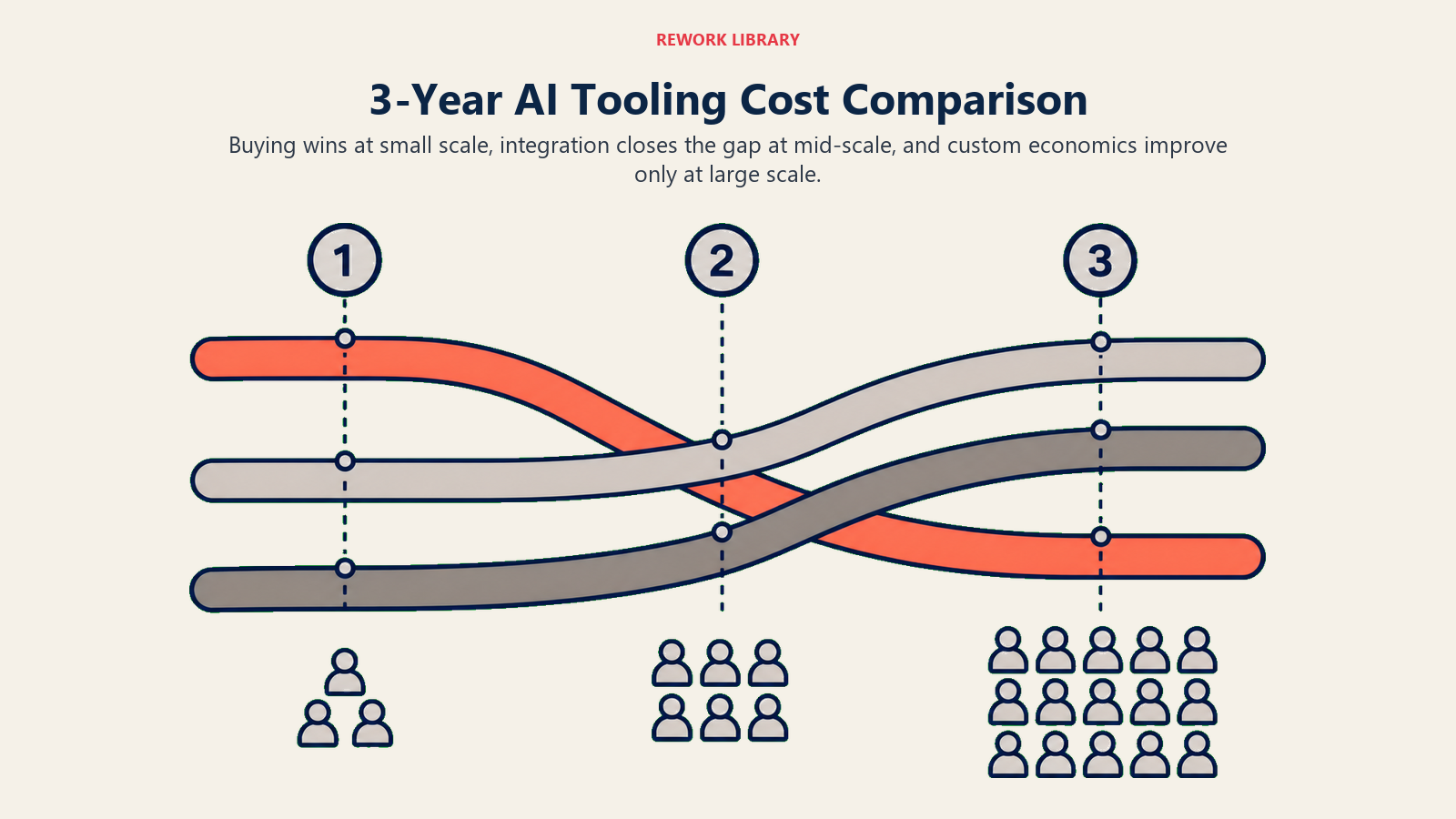
Di sinilah "buy adalah yang termurah" sering dibalik, dan "build terlalu mahal" kadang tidak berlaku. Perbandingan TCO 3 tahun perlu mencakup semua biaya yang biasanya dikecualikan dari perbandingan awal.
Kami akan menggunakan use case representatif: AI untuk workflow operasional tertentu (triage dukungan pelanggan dan penyusunan respons) pada tiga ukuran tim.
Tim 50 pengguna
| Buy (AI dukungan SaaS) | Integrate (API AI + workflow kustom) | Build (model klasifikasi + drafting kustom) | |
|---|---|---|---|
| Biaya vendor/API Tahun 1 | $24.000 | $8.400 | $18.000 |
| Engineering Tahun 1 (setup) | $8.000 | $60.000 | $180.000 |
| Engineering Tahun 1 (pemeliharaan) | $0 | $20.000 | $40.000 |
| Total Tahun 1 | $32.000 | $88.400 | $238.000 |
| Tahun 2-3 berkelanjutan (per tahun) | $24.000 | $36.000 | $70.000 |
| Total 3 tahun | $80.000 | $161.000 | $378.000 |
Pada 50 pengguna, buy mendominasi kecuali ada alasan workflow spesifik yang menjadikan integrasi lebih sesuai.
Tim 500 pengguna
| Buy (AI dukungan SaaS) | Integrate (API AI + workflow kustom) | Build (model klasifikasi + drafting kustom) | |
|---|---|---|---|
| Biaya vendor/API Tahun 1 | $180.000 | $60.000 | $18.000 |
| Engineering Tahun 1 (setup) | $15.000 | $90.000 | $300.000 |
| Engineering Tahun 1 (pemeliharaan) | $0 | $40.000 | $80.000 |
| Total Tahun 1 | $195.000 | $190.000 | $398.000 |
| Tahun 2-3 berkelanjutan (per tahun) | $180.000 | $100.000 | $100.000 |
| Total 3 tahun | $555.000 | $390.000 | $598.000 |
Pada 500 pengguna, integrate dan buy bersaing. Buy memiliki overhead engineering yang lebih rendah namun biaya vendor yang lebih tinggi pada skala. Integrasi memiliki biaya setup yang lebih tinggi namun ekonomi per-pengguna yang lebih baik pada skala. Build masih memiliki TCO tertinggi kecuali Anda memiliki kemampuan spesifik yang membenarkan investasi model kustom.
Tim 5.000 pengguna
| Buy (AI dukungan SaaS) | Integrate (API AI + workflow kustom) | Build (model klasifikasi + drafting kustom) | |
|---|---|---|---|
| Biaya vendor/API Tahun 1 | $1.200.000 | $360.000 | $18.000 |
| Engineering Tahun 1 (setup) | $30.000 | $120.000 | $600.000 |
| Engineering Tahun 1 (pemeliharaan) | $0 | $80.000 | $200.000 |
| Total Tahun 1 | $1.230.000 | $560.000 | $818.000 |
| Tahun 2-3 berkelanjutan (per tahun) | $1.200.000 | $440.000 | $300.000 |
| Total 3 tahun | $3.630.000 | $1.440.000 | $1.418.000 |
Pada 5.000 pengguna untuk fungsi operasional bervolume tinggi, integrate dan build memiliki TCO 3 tahun yang sebanding, dan keduanya secara substansial lebih murah dari SaaS per-seat. Pada skala ini, harga SaaS per-seat menjadi alasan kuat untuk integrate atau build.
Ini adalah estimasi ilustratif yang akan sangat bervariasi berdasarkan use case, harga vendor, dan biaya tenaga kerja engineering. Poin dari perbandingan ini bukan angka spesifiknya. Ini adalah bentuk kurva:
- Tim kecil: buy hampir selalu menang pada TCO 3 tahun
- Skala menengah: buy dan integrate bersaing; pilih berdasarkan kesesuaian workflow
- Skala besar: integrate dan build menutup celah dengan buy; buat keputusan berdasarkan kriteria strategis, bukan hanya biaya
Seperti Apa Keputusan Ini dalam Praktik
Perusahaan B2B SaaS pada Stage 2 (pilot AI awal) dengan tim penjualan 12 orang dan tim dukungan pelanggan 25 orang:
Penjualan: Buy. Use case penjualan bersifat operasional (CRM, pelacakan pipeline, sequencing outreach). Pasarnya sudah matang. Waktu engineering lebih baik dihabiskan pada produk. Beli platform AI penjualan yang dibuat khusus.
Dukungan: Integrate. Tim dukungan memiliki persyaratan workflow spesifik yang tidak ditangani alat AI dukungan generik. Namun use case divalidasi dari pilot. Bangun integrasi triage dukungan menggunakan Anthropic API yang terhubung ke instance Zendesk yang sudah ada dan knowledge base produk mereka. Investasi engineering adalah 2 bulan untuk build awal, 0,5 bulan per tahun untuk pemeliharaan.
Fitur AI produk: Integrate dengan jalur ke build. Untuk fitur AI dalam produk (saran cerdas, deteksi anomali), mulai dengan integrasi API untuk memvalidasi nilai pengguna sebelum berinvestasi dalam pengembangan model kustom. Jika fitur terbukti inti untuk retensi dan kinerja model generik menjadi faktor pembatas, barulah evaluasi fine-tuning kustom.
Perusahaan ini tidak harus membangun LLM kustom, tidak membangun CRM penjualan kustom, dan tidak deploy enterprise SaaS dengan harga per-seat yang melebihi biaya integrasi.
Kerangka Buy-Integrate-Build Decision Matrix
Kerangka Buy-Integrate-Build Decision Matrix adalah kerangka perutean empat variabel untuk keputusan tooling AI: (1) Apakah AI ini inti untuk diferensiasi produk Anda atau fungsi operasional? (2) Apakah data proprietary Anda memberikan model kustom keunggulan kinerja yang bermakna? (3) Apakah pasar SaaS memiliki alat yang dibuat khusus yang matang untuk use case ini? (4) Berapa TCO 3 tahun pada skala yang diharapkan? AI operasional tanpa keunggulan data proprietary di pasar SaaS yang matang mengarah ke Buy pada setiap tahap maturity. AI yang membedakan produk dengan keunggulan data proprietary pada Stage 4+ mengarah ke Build. Segalanya lainnya adalah pertimbangan yang diselesaikan oleh kesesuaian workflow dan kapasitas engineering.

Quotable: "Membeli AI dari vendor spesialis berhasil sekitar 67% dari waktu; build internal penuh berhasil sekitar setengah dari tingkat tersebut. Asimetri ini terbesar pada Stage 2-3, di mana organisasi membangun sebelum data mereka cukup bersih untuk dilatih." (MIT GenAI Divide 2025)
Quotable: "Keputusan build-vs-buy untuk CRM dan AI penjualan tim penjualan 10 orang bukan keputusan nyata. Biaya engineering untuk membangun dan memelihara kemampuan yang sebanding akan menghabiskan 2-4 tahun engineering penuh waktu selama periode 3 tahun. Itulah biaya peluang dari apa yang tidak Anda bangun untuk pelanggan."
Quotable: "Pada 50 pengguna, buy hampir selalu menang pada TCO 3 tahun. Pada 500 pengguna, buy dan integrate bersaing. Pada 5.000 pengguna, integrate dan build menutup celah dengan buy secara signifikan. Jendela perbandingan yang tepat adalah 3 tahun, bukan biaya Tahun 1 saja."
Quotable: "Organisasi dengan inisiatif AI yang berhasil berinvestasi hingga 4x lebih banyak dalam fondasi data dan analitik dibandingkan yang hasilnya buruk. Keputusan build bukan tentang ambisi engineering. Ini tentang apakah fondasi data siap untuk membuat build sepadan dengan investasinya." (Gartner)
Quotable: "Pengeluaran AI di seluruh dunia akan mencapai total $2,5 triliun pada 2026, dengan sebagian besar pertumbuhan tersebut didorong oleh enterprise yang meremehkan biaya multi-tahun ketika mengunci diri dalam kontrak vendor. Jalankan model TCO 3 tahun sebelum keputusan, bukan setelahnya." (Gartner)
| Variabel Keputusan | Mengarah ke Buy | Mengarah ke Integrate | Mengarah ke Build |
|---|---|---|---|
| AI produk vs. operasional | Operasional | Operasional dengan kebutuhan workflow | Pembeda produk inti |
| Keunggulan data proprietary | Tidak | Tidak | Ya, kesenjangan kinerja material |
| Kematangan pasar SaaS | Matang, banyak alat bersaing | Masih berkembang atau kesesuaian workflow buruk | Tidak ada vendor yang menangani use case |
| Tahap AI maturity | Stage 1-3 | Stage 2-4 | Stage 4-5 saja |
| TCO 3 tahun pada skala | Tim kecil: selalu | Skala menengah: kompetitif | Skala besar: menutup celah dengan buy |
| Kapasitas engineering | Tidak tersedia | Tersedia dan dapat dipertahankan | ML engineering + data science |
Rework Analysis: Berdasarkan pola investasi AI enterprise, kesalahan paling mahal bukan memilih opsi yang salah. Ini adalah menerapkan keputusan build pada Stage 2-3 sebelum kesiapan data dan validasi use case selesai. Organisasi yang memvalidasi use case dengan buy atau integrate terlebih dahulu, kemudian build ketika mereka memiliki data yang bersih, validasi produksi, dan langit-langit kinerja spesifik yang tidak dapat dilampaui model generik, mencapai ROI yang jauh lebih tinggi pada investasi build dibandingkan yang membangun dari prinsip pertama berdasarkan hipotesis yang belum divalidasi.
Kesalahan Umum
Build pada Stage 2 hingga 3. Kesalahan paling mahal. AI kustom sebelum use case yang divalidasi dan kesiapan data menciptakan infrastruktur mahal yang tidak digunakan.
Buy pada Stage 4 hingga 5 untuk fitur yang membedakan produk. Terlalu bergantung pada AI pihak ketiga untuk kemampuan inti yang dibayar pelanggan. Dapat dikelola dalam jangka pendek, namun menciptakan kerentanan strategis dan membatasi langit-langit kemampuan Anda pada apa yang ditawarkan vendor kepada semua orang.
Integrate tanpa perencanaan pemeliharaan. Integrasi API bukan set-and-forget. Model diperbarui, API berubah, prompt perlu dioptimalkan ulang seiring evolusi use case. Jika Anda integrate tanpa rencana pemeliharaan, fitur AI menurun kualitasnya seiring waktu. Vendor Lock-In AI: Strategi Mitigasi mendokumentasikan pola deprecasi model dari vendor AI utama dan cara membangun kapasitas re-validasi ke dalam roadmap tim tahunan.
Mengabaikan TCO 3 tahun. Memilih berdasarkan biaya Tahun 1 dan menemukan bahwa harga SaaS per-seat bertambah secara tidak nyaman pada skala. Gartner memproyeksikan pengeluaran AI di seluruh dunia akan mencapai total $2,5 triliun pada 2026, dengan sebagian besar pertumbuhan tersebut didorong oleh enterprise yang meremehkan biaya multi-tahun ketika mengunci diri dalam kontrak vendor. Jalankan model 3 tahun sebelum keputusan, bukan setelahnya.
Menerapkan satu kerangka untuk semua keputusan. Membangun AI produk inti Anda dan membeli AI operasional Anda bukan keputusan yang sama dan tidak boleh menggunakan kriteria yang sama. Laporan pergeseran teknologi enterprise McKinsey mengidentifikasi migrasi dari alat AI generik ke AI yang terdiferensiasi oleh konteks proprietary sebagai salah satu dari empat pergeseran struktural yang membentuk ulang teknologi enterprise, yang berarti pertanyaan build-vs-buy perlu ditinjau kembali pada setiap tahap maturity. Panduan tahap maturity dan 8 pertanyaan berlaku untuk setiap keputusan secara independen.
Menavigasi Keputusan Ini
Keputusan ini bukan pilihan satu kali. Ini adalah pertanyaan berulang yang akan Anda jawab secara berbeda seiring pertumbuhan AI maturity organisasi Anda, seiring evolusi lanskap vendor, dan seiring Anda belajar apa yang sebenarnya membedakan dalam konteks spesifik Anda.
Untuk evaluasi vendor sebelum keputusan buy, Kerangka Evaluasi Vendor untuk Alat AI mencakup proses penilaian 7 dimensi. Untuk mengelola risiko ketergantungan vendor setelah keputusan buy atau integrate, Vendor Lock-In AI: Strategi Mitigasi mencakup perlindungan arsitektur dan kontrak yang spesifik. Dan untuk konteks model maturity, kerangka lengkap ada di 5 Tahap AI Maturity.
Keputusan ini konsekuensial namun tidak permanen. Keputusan buy dapat dibalik, meski dengan biaya peralihan. Keputusan integrate dapat dibalik, dengan biaya re-engineering. Keputusan build paling sulit untuk dibalik karena infrastruktur kustom menjadi ketergantungan organisasi. Asimetri tersebut adalah satu alasan lagi untuk default ke buy atau integrate pada tahap maturity awal dan mendapatkan hak untuk build dengan menunjukkan bahwa AI benar-benar inti untuk diferensiasi produk Anda.
Sebagian besar bisnis harus buy atau integrate. Build hanya dibenarkan ketika AI adalah produknya, Anda berada di Stage 4 atau 5, dan Anda memiliki keunggulan data proprietary yang membenarkan investasinya. Jika Anda tidak yakin apakah kondisi tersebut berlaku, kemungkinan besar belum.

Co-Founder, Rework.com
On this page
- Tiga Opsi yang Didefinisikan
- Buy: Beli Produk AI SaaS yang Dibuat untuk Tujuan Tertentu
- Integrate: Tambahkan Panggilan AI API ke Sistem yang Ada
- Build: Latih atau Fine-Tune Model AI Kustom
- Kerangka Keputusan 8 Pertanyaan
- Panduan Tahap Maturity
- Prinsip "Buy for Ops"
- Perbandingan Total Cost of Ownership 3 Tahun
- Tim 50 pengguna
- Tim 500 pengguna
- Tim 5.000 pengguna
- Seperti Apa Keputusan Ini dalam Praktik
- Kerangka Buy-Integrate-Build Decision Matrix
- Kesalahan Umum
- Menavigasi Keputusan Ini