AI Transformation vs. Digital Transformation: Apa yang Benar-Benar Berbeda

Turn this article into takeaways for your work.


Each assistant summarizes the article only for you and suggests best practices for your work.
Anda pernah menjalankan digital transformation. Itu menyakitkan dan mahal serta memakan waktu lebih lama dari yang dikatakan konsultan. Tetapi Anda sampai di sana: perusahaan berjalan di Salesforce, semuanya ada di cloud, ERP lama diganti, keuangan ada di NetSuite, dan sebagian besar proses manual berbasis kertas telah hilang. Anda memiliki tumpukan SaaS modern.
Sekarang dewan bertanya tentang AI transformation. Dan di sudut pikiran Anda, Anda bertanya-tanya: apakah ini proyek yang sama dengan merek baru? Apakah mereka meminta kita untuk melakukan lagi apa yang baru saja kita selesaikan?
Jawabannya tidak. Tetapi kebingungannya dapat dimengerti. Dan bagaimana Anda menangani kebingungan tersebut menentukan apakah inisiatif AI Anda membangun dengan benar di atas apa yang dicapai digital transformation atau tersandung karena Anda membawa model mental yang salah ke dalam masalah yang berbeda.
Apa yang sebenarnya digital transformation itu
Key Facts: AI vs. Digital Transformation
- Untuk setiap $1 yang diinvestasikan dalam generative AI, organisasi merealisasikan rata-rata return on investment 3,7x, dengan top performer mencapai 10,3x, dibandingkan dengan timeline transformasi ROI penuh 2-3 tahun (TEKsystems, 2026)
- 94% inisiatif AI transformation gagal menangkap ROI nyata di tingkat enterprise, sementara 24% organisasi melaporkan adopsi AI penuh pada tahun 2026, naik dari 12% pada tahun 2025 (survei enterprise, 2025-2026)
- Organisasi AI transformation berkinerja tinggi menginvestasikan 70% anggaran program mereka untuk manusia dan proses daripada algoritma atau tools, kebalikan dari bagaimana sebagian besar program digital transformation didanai (McKinsey, 2025)
Digital transformation, sebagaimana terjadi dalam gelombang 2015-2022, pada dasarnya adalah tentang digitalisasi proses. McKinsey's Rewired, panduan lapangan definitif yang dibangun atas ratusan keterlibatan transformasi enterprise, menggambarkan digital transformation sebagai memindahkan perusahaan dari sistem analog dan terfragmentasi ke sistem digital yang terhubung, dengan manusia masih mengarahkan setiap keputusan.
Pekerjaannya adalah mengganti proses analog atau digital warisan dengan perangkat lunak modern. Purchase order berbasis kertas menjadi workflow pengadaan dalam sistem. Perkiraan berbasis spreadsheet berpindah ke platform business intelligence. Server on-premise berpindah ke infrastruktur cloud. Rantai email digantikan oleh perangkat lunak manajemen proyek. Database yang tersebar dikonsolidasikan ke dalam sistem CRM dan ERP.
Manusia yang melakukan pekerjaan masih melakukan pekerjaan yang sama. Pekerjaan hanya berjalan melalui tools yang lebih baik. Analis keuangan yang sebelumnya memperbarui spreadsheet kini memperbarui field di NetSuite. Datanya lebih bersih, jejak auditnya lebih baik, perangkat lunaknya lebih terhubung. Tetapi penilaian analis masih diperlukan untuk semua hal yang penting.
Itulah karakteristik yang mendefinisikan digital transformation: membuat pekerjaan manusia lebih efisien. Ini tidak mengubah apa yang diputuskan manusia atau bagaimana keputusan tersebut dibuat. Sistem menyimpan dan menampilkan informasi. Manusia memikirkannya dan bertindak berdasarkannya.
"Digital transformation membangun pipa. AI transformation mengubah apa yang mengalir melaluinya. Perusahaan dengan tumpukan SaaS modern yang lengkap memiliki infrastruktur prasyarat untuk AI. Tetapi prasyarat bukan transformation. Transformation adalah apa yang terjadi ketika AI mulai membuat keputusan yang dirancang oleh infrastruktur tersebut untuk diinformasikan." (Rework)
Apa yang sebenarnya AI transformation itu
AI transformation bergerak melampaui penyimpanan dan tampilan. Perangkat lunak tidak hanya menyimpan informasi. Ini memikirkannya, menghasilkan output darinya, dan bertindak berdasarkannya tanpa memerlukan keputusan manusia di setiap langkah.
Sistem AI yang menerima email pelanggan masuk, mengklasifikasikannya sebagai sengketa penagihan, mengambil riwayat akun yang relevan, membuat respons berdasarkan kebijakan perusahaan, dan mengirimkannya: sistem itu tidak mendigitalisasi proses. Ini menggantikan penilaian. Spesialis penagihan yang sebelumnya menangani interaksi tersebut melakukan empat langkah kognitif: membaca, mengklasifikasikan, mengambil, memutuskan-dan-menulis. AI melakukan keempatnya tanpa intervensi.
Itu berbeda secara mendasar, bukan derajat. Dan perbedaannya berjenjang ke luar ke tata kelola, desain organisasi, dan apa yang sebenarnya menjadi tanggung jawab tim eksekutif.
ACE Framework (Ingest, Analyze, Predict, Generate, Execute) memberikan kosakata yang tepat untuk ini. Ingest: menerima email. Analyze: mengklasifikasikannya dan mengekstrak detail yang relevan. Generate: membuat respons. Execute: mengirimkannya. Digital transformation memberikan tools yang lebih baik bagi manusia untuk melakukan langkah-langkah ini. AI transformation berarti sistem dapat melakukan keempatnya secara berurutan, dengan manusia hanya dalam loop untuk kasus-kasus tepi.
Kerangka Digital-AI Continuity Map
Kerangka bagi tim eksekutif untuk memposisikan organisasi mereka di seluruh kontinum dari digitisasi hingga AI transformation. Peta memiliki empat zona: Zona 1 (Digitized) mewakili proses yang berpindah dari analog ke digital dengan manusia masih mengarahkan setiap keputusan. Zona 2 (Automated) mewakili logika deterministik yang diterapkan pada proses digital, menghilangkan langkah manual dari workflow yang dapat diprediksi. Zona 3 (AI-Augmented) mewakili AI yang memberikan rekomendasi, skor, dan draf yang ditindaklanjuti manusia. Zona 4 (AI-Transformed) mewakili AI yang membuat dan melaksanakan keputusan secara otonom dalam batasan yang diatur, mengubah output bisnis. Sebagian besar organisasi yang menjalankan tumpukan SaaS modern berada di Zona 2, dengan beberapa use case Zona 3 yang tersebar di berbagai fungsi. AI transformation adalah pergeseran yang disengaja dan sistematis dari Zona 2/3 ke Zona 4 di seluruh rantai nilai inti.
Empat perbedaan nyata
AI transformation berbeda dari digital transformation pada bagian model operasi yang menjadi probabilistik, adaptif, dan sarat penilaian.
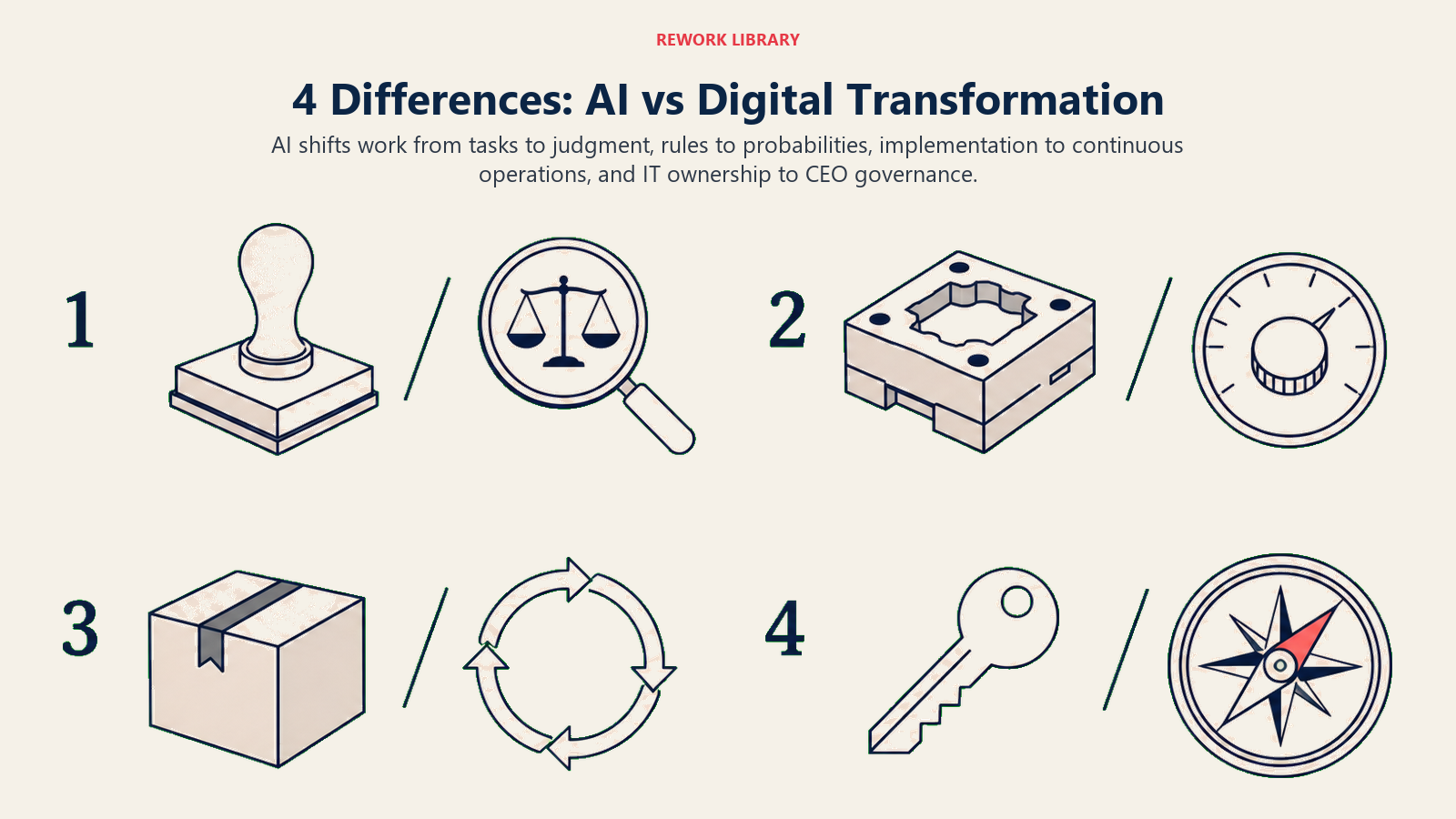
Memahami di mana digital dan AI transformation berbeda mengklarifikasi pekerjaan baru apa yang diperlukan dan apa yang bisa ditransfer.
1. Digital mengotomasi tugas. AI menambah dan menggantikan penilaian.
Digital transformation menghilangkan langkah manual dari proses deterministik. Jika pelanggan mengisi formulir A, sistem mengirim pengakuan B. Logikanya ditulis oleh manusia dan eksplisit. Kasus tepi yang tidak cocok dengan logika jatuh dari sistem dan mendarat di antrian manusia.
AI transformation mengambil alih penilaian: hal-hal yang tidak dapat diotomasi karena memerlukan membaca konteks, menimbang ambiguitas, atau membuat penilaian probabilistik. Keputusan kredit. Risiko churn pelanggan. Pembuatan konten. Tinjauan dokumen hukum. Tinjauan kode. Nilai ekonomi AI tepat pada kemampuannya beroperasi dalam domain penilaian, yang merupakan tempat tenaga kerja manusia paling mahal.
Ini berarti AI transformation menciptakan akuntabilitas yang tidak dimiliki digital transformation. Ketika sistem deterministik menghasilkan output yang salah, bug ada dalam aturan. Perbaiki aturan, perbaiki output. Ketika sistem AI menghasilkan output yang salah, kegagalannya bersifat probabilistik. Model 87% yakin dan itu salah. Siapa yang bertanggung jawab? Apa proses tinjauan? Apa yang terjadi selanjutnya? Tim kepemimpinan digital transformation tidak perlu menjawab pertanyaan-pertanyaan itu. Tim kepemimpinan AI transformation harus.
2. Digital menghasilkan output deterministik. AI menghasilkan output probabilistik yang memerlukan tata kelola.
Workflow Salesforce yang memindahkan deal ke Closed Won ketika kontrak ditandatangani menghasilkan output yang sama setiap kali, dengan input yang sama. Itu deterministik. Model tata kelola sederhana: uji aturan, terapkan, periksa bug.
Sistem AI yang menilai lead sebagai "79% kemungkinan untuk berkonversi dalam 30 hari ke depan" bersifat probabilistik. Skornya lebih sering benar daripada manusia. Ini juga salah dengan cara yang mungkin tidak dilakukan manusia. Dan mungkin salah dengan cara sistematis: bias terhadap ukuran perusahaan tertentu, dilatih pada data yang terlalu mewakili vertikal tertentu, gagal pada kasus tepi yang tidak terwakili dengan baik dalam set pelatihan.
Sistem probabilistik memerlukan struktur tata kelola yang tidak diperlukan sistem deterministik: pemantauan drift output, pelacakan akurasi terhadap hasil aktual, ambang batas tinjauan manusia untuk keputusan berisiko tinggi, dan dokumentasi tentang bagaimana model dilatih dan untuk apa seharusnya dan tidak seharusnya digunakan. Jejak audit untuk tindakan AI execute adalah satu persyaratan tata kelola yang tidak memiliki padanan dalam digital transformation. Leader's Guide to Transforming with AI dari BCG mencatat bahwa kapabilitas tata kelola dan transformation yang khusus, dibangun di sekitar metrik keberhasilan yang jelas, adalah yang membedakan perusahaan yang menangkap nilai AI dari yang tidak.
Sebagian besar tim eksekutif yang menjalankan digital transformation tidak memiliki pengalaman membangun tata kelola di sekitar sistem probabilistik. Ini adalah pekerjaan baru.
"AI transformation mengharuskan organisasi mengatur sistem yang benar sebagian besar waktu tetapi salah dengan cara yang tidak dapat diprediksi aturan. Itu menggeser akuntabilitas dengan cara yang tidak pernah dilakukan digital transformation. Pertanyaannya bukan lagi 'siapa yang menulis aturan?' Ini 'siapa yang menyetujui model, siapa yang memantau akurasinya, dan siapa yang bertanggung jawab ketika itu salah dalam skala besar?'" (Rework)
3. Digital transformation adalah implementasi satu kali. AI memerlukan pemeliharaan berkelanjutan.
Setelah ERP diimplementasikan dan data dimigrasikan, sistem berjalan. Tim implementasi pindah. Pekerjaan berkelanjutan adalah pemeliharaan dan peningkatan, bukan pemikiran ulang fundamental.
Sistem AI berubah seiring waktu. Model yang mendasarinya diperbarui oleh vendor. Distribusi data tempat model dikalibrasi bergeser seiring bisnis berkembang. Model penilaian lead yang dilatih pada data dari 2023 mungkin berkinerja kurang baik pada data 2026 karena kondisi pasar dan ideal customer profile telah berubah. Riset State of AI dari McKinsey mengonfirmasi kesenjangan ini nyata: 88% organisasi menggunakan AI secara rutin, tetapi hanya 6% yang melaporkan dampak finansial enterprise-wide yang berarti, sering kali karena sistem AI diterapkan tetapi tidak dipelihara secara aktif. Prediktor churn pelanggan memerlukan kalibrasi ulang secara berkala seiring berkembangnya bauran produk dan pelanggan bisnis.
4. Digital transformation dipimpin IT. AI transformation harus dimiliki CEO dan dewan.
Gelombang digital transformation 2015-2022, di sebagian besar perusahaan, adalah proyek IT dan operasi. CIO yang memimpinnya. COO mungkin turut memilikinya. Tetapi keterlibatan CEO biasanya adalah persetujuan anggaran dan check-in berkala.
Model itu tidak bekerja untuk AI transformation. AI transformation menyentuh model bisnis inti, posisi kompetitif, pengalaman pelanggan, dan desain organisasi. CEO yang mendelegasikan AI transformation kepada CIO dan check-in setiap kuartal akan menemukan, delapan belas bulan kemudian, bahwa teknologinya ada tetapi bisnis tidak berubah.
CEO harus memiliki business case dan mandat. Dewan harus memahami dan mendukung tesis transformation. COO harus turut memiliki desain ulang workflow. Untuk penalaran di baliknya, Apa Arti AI Transformation di Tingkat C-Level membahas model kepemilikan secara lengkap.
Di mana digital transformation menciptakan kesiapan AI
Inilah yang ditransfer: infrastruktur yang Anda bangun selama digital transformation adalah fondasi yang diperlukan AI.
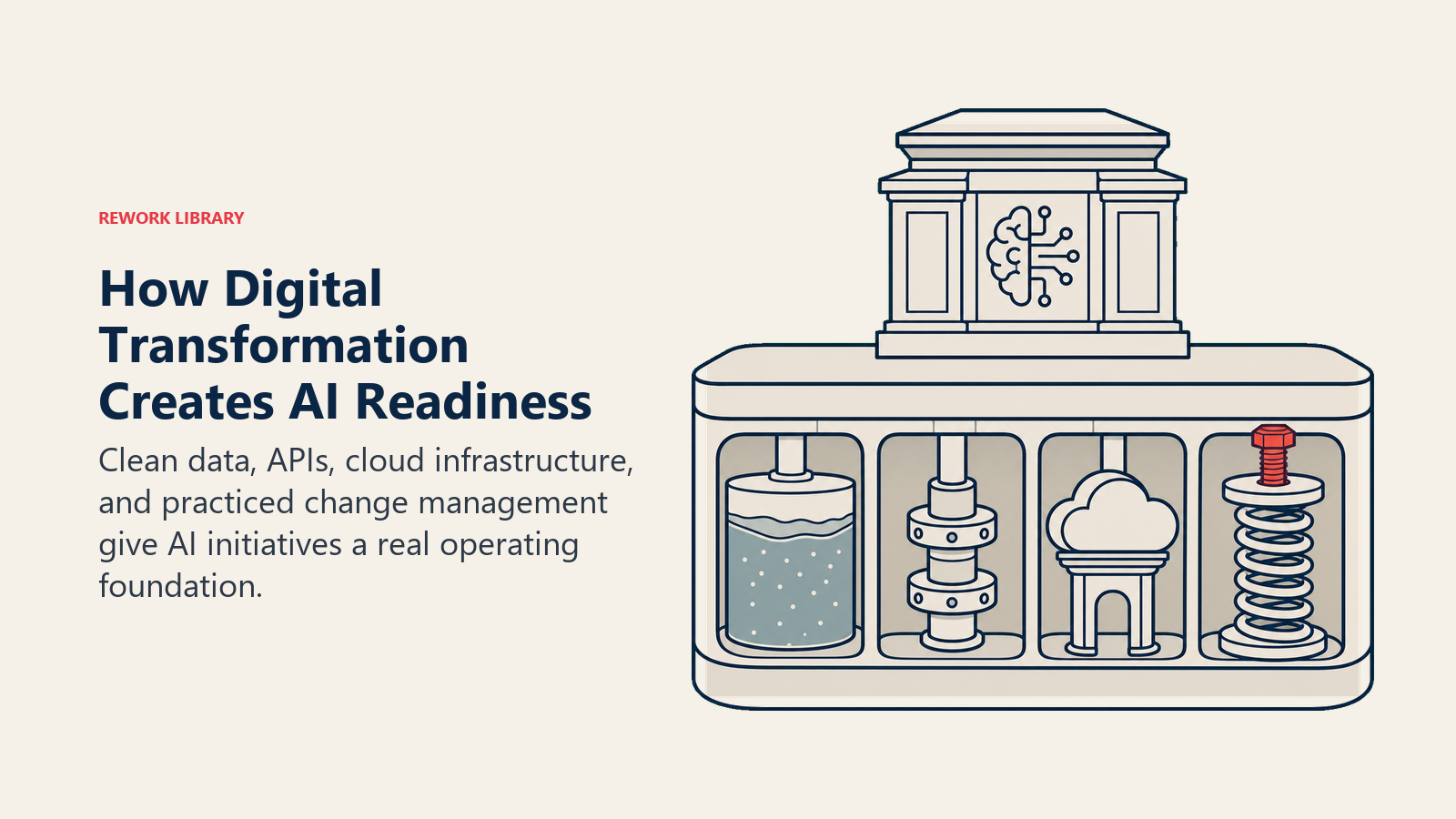
Data bersih dalam sistem yang dapat diakses. Pekerjaan pembersihan data yang dipaksakan oleh implementasi ERP dan CRM adalah prasyarat agar AI Ingest dan Analyze bekerja dengan benar. Perusahaan yang masih memiliki data pelanggan di tiga sistem tanpa pengenal terpadu harus melakukan pembersihan tersebut sekarang. Perusahaan yang menyelesaikannya selama digital transformation memiliki keunggulan awal yang sesungguhnya.
Konektivitas API. Tumpukan SaaS modern yang dibangun di atas API adalah apa yang bergantung pada integrasi AI. Menghubungkan asisten AI ke CRM, platform email, sistem dukungan, dan data penagihan Anda layak dilakukan ketika sistem-sistem tersebut memiliki API dan tim IT Anda tahu cara menggunakannya.
Infrastruktur cloud. Komputasi AI berjalan di cloud. Perusahaan yang menyelesaikan migrasi cloud dapat menerapkan infrastruktur AI tanpa beban kerja paralel modernisasi infrastruktur.
Otot manajemen perubahan organisasional. Digital transformation itu sulit. Ini memerlukan perubahan cara orang bekerja, sering kali menghadapi resistensi. Tim eksekutif yang melewatinya telah melatih keterampilan perubahan organisasional dalam skala besar. Pengalaman tersebut berlaku langsung pada tantangan manajemen perubahan AI transformation.
Di mana digital transformation menciptakan kepercayaan diri yang salah
Risikonya adalah apa yang dibawa banyak eksekutif dari pengalaman digital transformation: keyakinan bahwa pekerjaan keras sudah selesai.
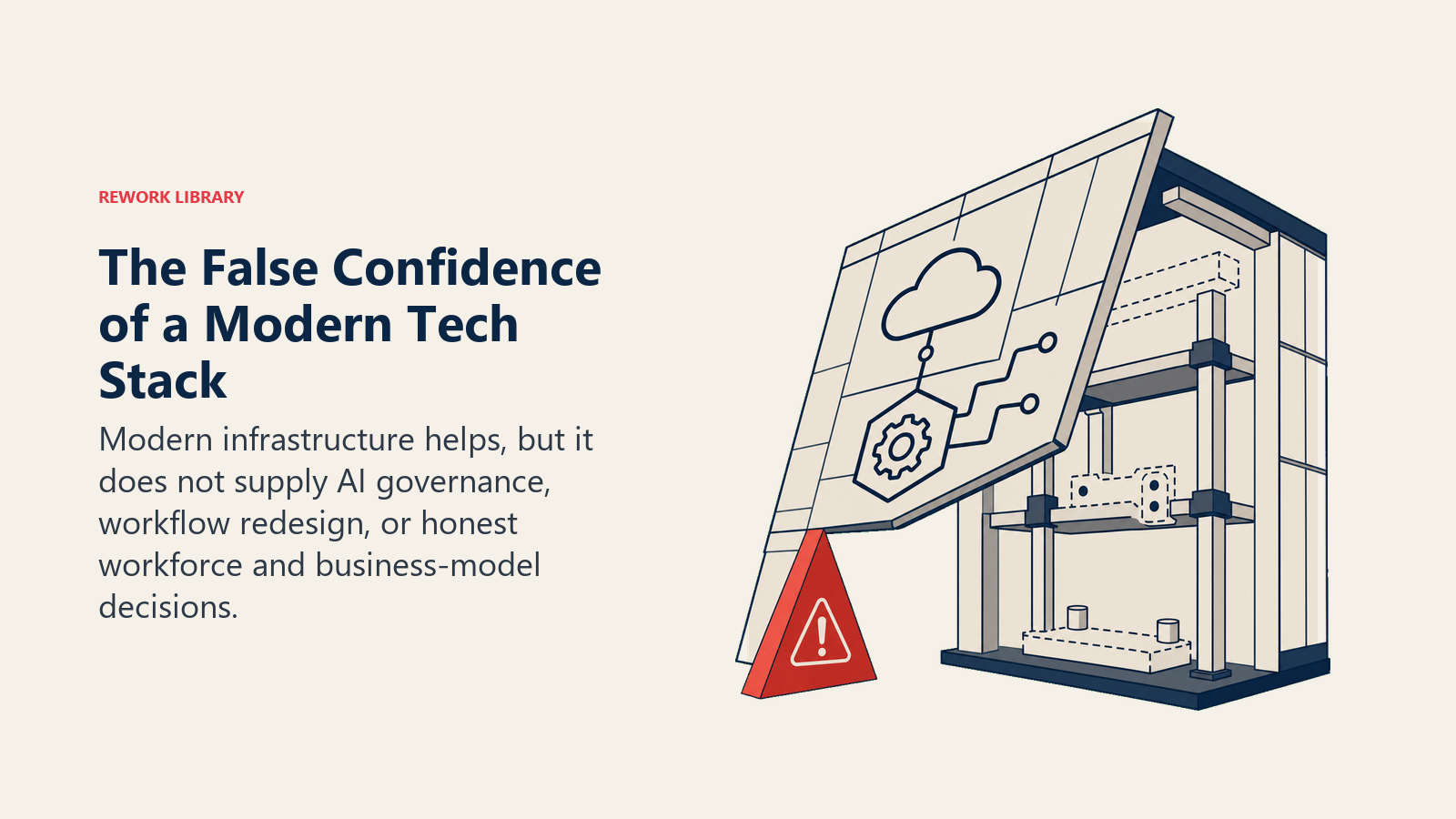
"Kami sudah bertransformasi. Kami memiliki tumpukan modern." Pemikiran itu mengarah pada memperlakukan AI transformation sebagai proyek yang lebih ringan dari yang sebenarnya. Beberapa penerapan tools di atas infrastruktur yang sudah modern. Lapisan kapabilitas, bukan pemikiran ulang fundamental.
Pembingkaian itu akan menghasilkan adopsi AI tools, bukan AI transformation. Kapabilitas Level 5 dari ACE Framework memerlukan tidak hanya infrastruktur tetapi juga model tata kelola, desain ulang workflow, dan pertanyaan model bisnis yang tidak pernah harus dijawab oleh digital transformation.
Cara membangun di atas fondasi digital tanpa memulai dari awal
Untuk perusahaan yang sedang dalam perjalanan keduanya, urutannya penting.
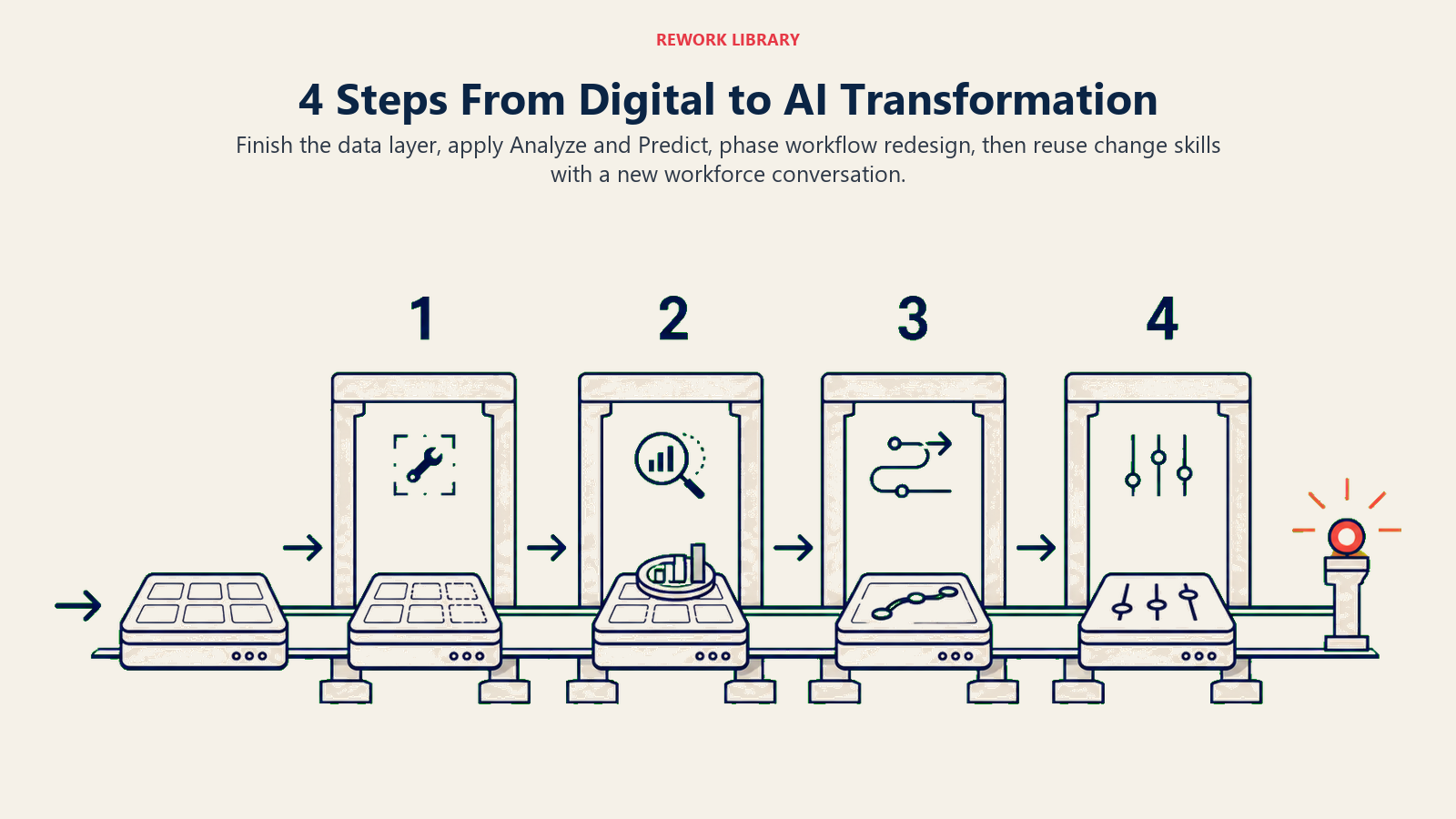
Selesaikan lapisan data terlebih dahulu. Jika digital transformation meninggalkan data Anda terfragmentasi di seluruh sistem, itulah prasyarat agar AI dapat bekerja sama sekali. Pilot AI yang dibangun di atas data yang berantakan akan gagal. Enam bulan paling berharga yang bisa Anda habiskan sebelum meluncurkan inisiatif AI adalah membersihkan infrastruktur data yang sudah Anda miliki. Lihat Data Readiness: Prasyarat yang Dilewatkan Sebagian Besar Proyek AI untuk daftar periksa audit yang praktis.
Mulai dengan Analyze dan Predict pada data yang ada. Aplikasi AI nilai tinggi yang segera untuk perusahaan dengan tumpukan digital yang lengkap adalah yang menggunakan data yang sudah ditangkap dengan lebih cerdas. Data CRM yang dinilai untuk kualitas lead. Data tiket dukungan yang dianalisis untuk sinyal umpan balik produk. Data keuangan yang dimodelkan untuk prediksi arus kas. Ini tidak memerlukan perubahan workflow yang dramatis. Ini menghasilkan nilai segera dari infrastruktur yang sudah ada.
Tahapkan desain ulang workflow. Digital transformation memindahkan workflow ke dalam perangkat lunak. AI transformation mendesain ulang apa workflow itu. Tetapi Anda tidak harus mendesain ulang semuanya sekaligus. Mulai dengan workflow yang paling mendapat manfaat dari AI (respons yang menghadap pelanggan, penilaian risiko, pembuatan konten dalam skala besar) dan berkembang dari sana. The 18-Month CEO AI Agenda memberikan urutan kuartal demi kuartal.
Gunakan kembali playbook manajemen perubahan, bukan skripnya. Keterampilan perubahan organisasional dari digital transformation berlaku. Tetapi konten percakapan perubahan berbeda. "Tools ini membuat pekerjaan Anda lebih mudah" tidak cukup untuk AI. Percakapan tentang evolusi peran, tentang apa yang akan menjadi fokus manusia ketika AI menangani penilaian rutin, adalah percakapan yang lebih sulit dan lebih penting.
Perbandingan sekilas
| Dimensi | Digital Transformation | AI Transformation |
|---|---|---|
| Tujuan inti | Mendigitalisasi dan mengotomasi proses yang ada | Mengubah proses apa yang mungkin |
| Jenis output | Deterministik (input sama = output sama) | Probabilistik (kontekstual, dinilai kepercayaan) |
| Siapa yang memimpin | CIO / COO | CEO + CIO + COO yang selaras |
| Perubahan peran manusia | Manusia bekerja dengan tools yang lebih baik | Penilaian manusia diterapkan secara berbeda, tidak digantikan secara keseluruhan |
| Model tata kelola | Uji + terapkan aturan | Pantau + kalibrasi ulang model secara berkelanjutan |
| Infrastruktur yang dibutuhkan | Cloud, SaaS, konektivitas API | Lapisan data, vector DB, tooling tata kelola |
| Keadaan akhir | Workflow yang dimodernisasi | Output bisnis baru dan positioning kompetitif |
| Durasi | Implementasi satu kali | Investasi operasional berkelanjutan |
Pembingkaian untuk percakapan dengan dewan
Jika dewan Anda bertanya "apakah kita sedang melakukan AI transformation atau sudah melakukannya dengan inisiatif digital transformation," inilah jawaban jujurnya:
Digital transformation membangun infrastruktur. AI transformation adalah apa yang Anda lakukan dengannya. Tanpa pekerjaan digital transformation, AI transformation akan jauh lebih sulit. Tetapi pekerjaan digital transformation tidak secara otomatis menghasilkan AI transformation. Model bisnis, desain organisasi, dan pertanyaan tata kelola tidak pernah menjadi bagian dari inisiatif sebelumnya.
Kami memulai inisiatif baru yang membangun di atas fondasi yang telah kami bangun. Ini memiliki risiko yang berbeda, persyaratan kepemilikan yang berbeda, dan timeline yang lebih panjang untuk ROI yang bermakna daripada program digital transformation. Ini juga memiliki langit-langit potensial yang lebih tinggi.
Jawaban itu jujur. Menghormati apa yang dicapai organisasi. Dan menetapkan ekspektasi yang akurat untuk apa yang akan datang.
Analisis Rework: Berdasarkan penelitian TEKsystems 2026, organisasi yang mencapai ROI 10,3x dari AI transformation (dibandingkan rata-rata 3,7x) berbagi perbedaan struktural yang konsisten dari 94% yang gagal mencapai dampak tingkat enterprise: mereka menyelesaikan latihan Digital-AI Continuity Map sebelum mengkomitmen modal, mengidentifikasi zona rantai nilai mana yang berada di Zona 2/3 dan secara eksplisit menargetkan penerapan Zona 4 untuk dua atau tiga fungsi inti. Perusahaan yang melewati fase pemetaan ini cenderung memperlakukan penerapan AI sebagai aditif (adopsi Zona 3) dan tidak pernah mencapai desain ulang workflow yang diperlukan Zona 4.
Untuk diagnostik kematangan untuk memahami posisi organisasi saat ini, baca The 5 Stages of AI Maturity. Untuk agenda konkret tentang apa yang harus dilakukan dalam 18 bulan ke depan, CEO AI Agenda memberikan struktur kuartal demi kuartal.
Pertanyaan yang Sering Diajukan
Apa perbedaan antara AI transformation dan digital transformation?
Digital transformation memindahkan proses dari sistem analog atau warisan ke perangkat lunak digital modern, dengan manusia masih mengarahkan setiap keputusan. AI transformation melangkah lebih jauh: menggunakan AI untuk memikirkan data, menghasilkan output, dan melaksanakan tindakan tanpa memerlukan keputusan manusia di setiap langkah. Digital transformation mengotomasi tugas deterministik. AI transformation menggantikan dan menambah penilaian, mengubah output bisnis apa yang mungkin.
Apakah menyelesaikan digital transformation berarti siap untuk AI transformation?
Menyelesaikan digital transformation memberikan keunggulan awal yang sesungguhnya. Data bersih dalam sistem yang dapat diakses, konektivitas API, infrastruktur cloud, dan pengalaman manajemen perubahan organisasional semuanya ditransfer secara langsung. Tetapi penyelesaian digital transformation tidak secara otomatis menghasilkan kesiapan AI transformation. Model tata kelola untuk sistem probabilistik, desain ulang workflow yang diperlukan, dan kepemilikan tingkat CEO semuanya mewakili pekerjaan baru yang tidak pernah ditangani oleh digital transformation.
Apa itu Digital-AI Continuity Map?
Digital-AI Continuity Map adalah kerangka untuk memposisikan organisasi Anda di empat zona: Zona 1 (Digitized), Zona 2 (Automated), Zona 3 (AI-Augmented), dan Zona 4 (AI-Transformed). Sebagian besar organisasi dengan tumpukan SaaS modern berada di Zona 2, dengan use case Zona 3 yang tersebar. AI transformation adalah pergeseran sistematis menuju Zona 4 dalam fungsi rantai nilai inti, di mana AI membuat dan melaksanakan keputusan dalam batasan yang diatur daripada sekadar memberikan rekomendasi.
Mengapa AI transformation memerlukan kepemilikan CEO ketika digital transformation dipimpin IT?
Digital transformation pada dasarnya adalah proyek modernisasi infrastruktur dan proses yang dapat dipimpin CIO dan COO. AI transformation menyentuh model bisnis inti, posisi kompetitif, pengalaman pelanggan, dan desain organisasi dengan cara yang memerlukan mandat CEO dan pemahaman dewan. CEO harus memiliki business case. Tanpa itu, teknologi mungkin diterapkan, tetapi pertanyaan desain ulang workflow dan model bisnis yang sebenarnya menciptakan nilai transformation tidak terjawab.
Berapa lama waktu untuk melihat ROI dari AI transformation vs. digital transformation?
ROI digital transformation biasanya mengikuti timeline implementasi: setelah sistem aktif, keuntungan efisiensi dapat diukur. Timeline ROI AI transformation lebih panjang untuk dampak penuh: penelitian TEKsystems 2026 memperkirakan 2-3 tahun untuk ROI tingkat transformation, meskipun use case AI yang berfokus pada otomasi dapat menunjukkan imbal hasil dalam 3-6 bulan. Organisasi berkinerja tinggi mencapai ROI 10,3x versus rata-rata 3,7x, dengan perbedaan didorong oleh kedalaman desain ulang workflow dan investasi pada manusia.
Apa yang membuat tata kelola AI berbeda dari tata kelola digital transformation?
Sistem digital transformation menghasilkan output deterministik: input yang sama selalu menghasilkan output yang sama. Tata kelola berbasis aturan: uji aturan, terapkan, perbaiki bug. Sistem AI menghasilkan output probabilistik yang dapat melayang seiring distribusi data berubah dan mungkin bias secara sistematis dengan cara yang tidak segera terlihat. Tata kelola AI memerlukan pemantauan output, pelacakan akurasi terhadap hasil aktual, siklus kalibrasi ulang, ambang batas tinjauan manusia untuk keputusan berisiko tinggi, dan dokumentasi data pelatihan dan keterbatasan model. Ini adalah pekerjaan yang secara kategoris baru bagi sebagian besar tim eksekutif.
Lihat juga:
- Why Most AI Transformations Fail: mode kegagalan yang menjebak perusahaan bahkan dengan fondasi digital yang tersedia
- The Honest Cost of AI Transformation: seperti apa investasi sebenarnya di luar lisensi
- Why AI Frameworks Fail to Help Operators: mengapa kerangka dari digital transformation tidak dapat ditransfer

Co-Founder, Rework.com
On this page
- Apa yang sebenarnya digital transformation itu
- Apa yang sebenarnya AI transformation itu
- Kerangka Digital-AI Continuity Map
- Empat perbedaan nyata
- 1. Digital mengotomasi tugas. AI menambah dan menggantikan penilaian.
- 2. Digital menghasilkan output deterministik. AI menghasilkan output probabilistik yang memerlukan tata kelola.
- 3. Digital transformation adalah implementasi satu kali. AI memerlukan pemeliharaan berkelanjutan.
- 4. Digital transformation dipimpin IT. AI transformation harus dimiliki CEO dan dewan.
- Di mana digital transformation menciptakan kesiapan AI
- Di mana digital transformation menciptakan kepercayaan diri yang salah
- Cara membangun di atas fondasi digital tanpa memulai dari awal
- Perbandingan sekilas
- Pembingkaian untuk percakapan dengan dewan