Predictive AI vs. Generative AI: Perpecahan Industri Dijelaskan
Turn this article into takeaways for your work.


Each assistant summarizes the article only for you and suggests best practices for your work.
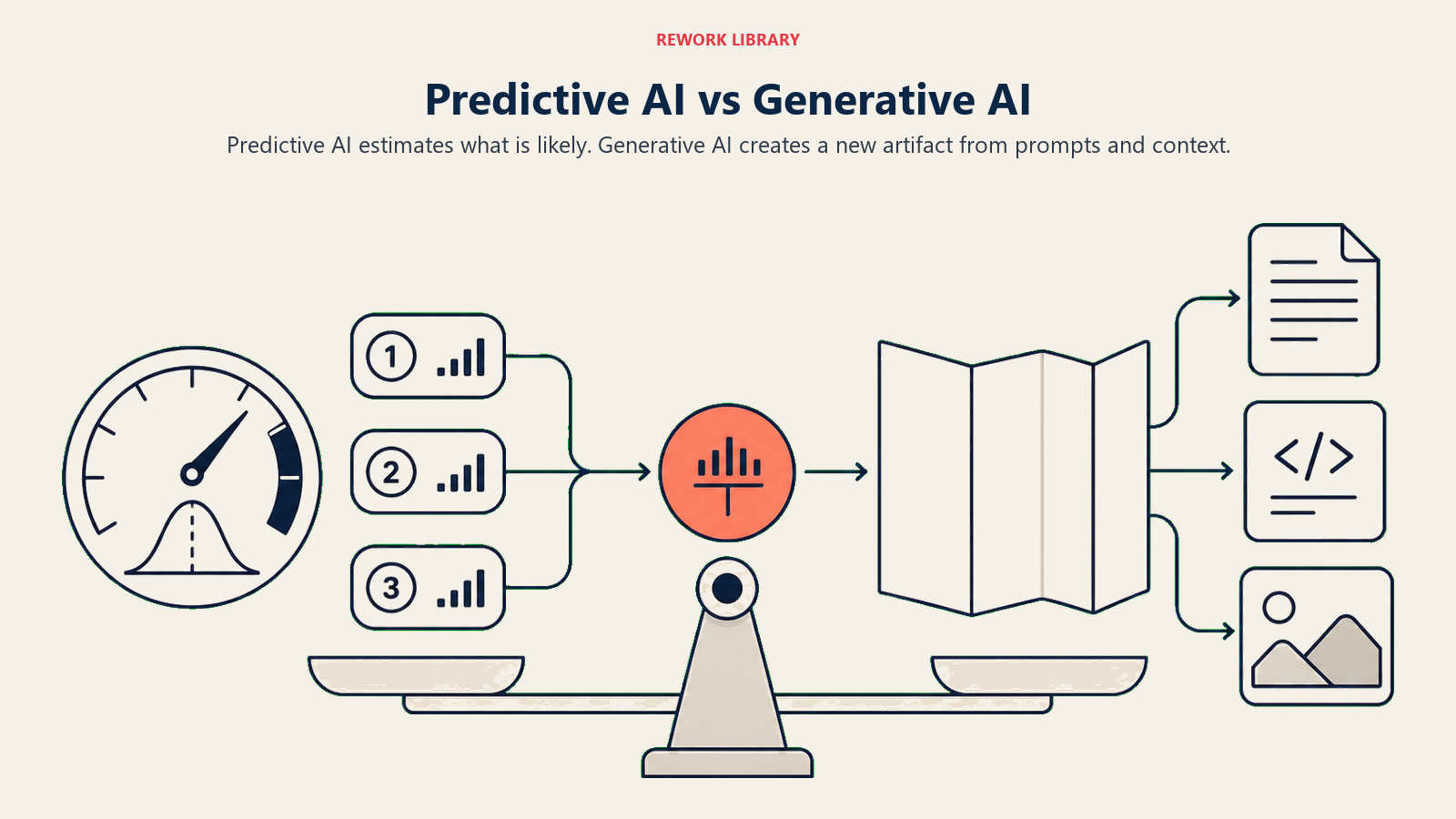
Dua kubu mendominasi setiap percakapan tentang AI: Predictive dan Generative. Singkatan ini berguna. Namun juga tidak lengkap.
Sebagian besar vendor software memilih salah satu sisi. Pitch penjualan bersandar pada salah satu istilah. Diskusi di board menyebutnya seolah-olah sudah jelas dengan sendirinya. Tetapi ketika seseorang di posisi pembeli mencoba menerapkan pembedaan itu pada kontrak nyata di mejanya, dikotomi tersebut cenderung runtuh. Apakah tool yang memberi skor lead lalu menyusun draf outreach itu Predictive atau Generative? Ketika platform customer support memprediksi urgensi tiket dan menulis balasannya di antarmuka yang sama, termasuk kubu yang mana?
Model dua kubu ini populer setelah 2022, ketika ChatGPT membuat sisi Generative terlihat jelas oleh para pembeli bisnis. Sebelum momen itu, sebagian besar liputan "AI bisnis" secara implisit membahas sisi Predictive: deteksi penipuan, lead scoring, recommendation engine. Kini kedua kubu terlihat, keduanya dijual secara agresif, dan tidak satu pun vendor kubu tersebut sangat antusias untuk menjelaskan di mana produk mereka berhenti.
Karena itu, kosakata ini perlu dibangun dengan cermat. Bukan karena istilahnya salah, melainkan karena memahami apa yang sebenarnya digambarkan istilah tersebut, dan di mana model ini runtuh, akan mengubah cara Anda mengevaluasi apa yang Anda beli.
"AI" adalah satu kata yang mencakup dua mesin berbeda
Ketika vendor software mengatakan "berbasis AI," mereka hampir selalu merujuk pada salah satu dari dua pendekatan teknis yang sangat berbeda. Pendekatan-pendekatan ini berasal dari era berbeda, melayani fungsi berbeda, dan menghasilkan nilai yang berbeda. Mencampuradukkannya mengarah pada keputusan pembelian yang buruk dan ekspektasi yang kacau.
Industri biasanya menyebut kubu-kubu ini sebagai Predictive AI dan Generative AI. Perpecahan menjadi sangat terlihat setelah ChatGPT diluncurkan akhir 2022 dan membuat sisi generatif baru dipahami oleh dunia bisnis. Sebelum momen itu, sebagian besar liputan "AI bisnis" secara implisit tentang sisi prediktif: deteksi penipuan, lead scoring, recommendation engine.
Kini kedua kubu terlihat, keduanya dijual secara agresif, dan tidak satu pun vendor kubu tersebut sangat antusias untuk memberi tahu Anda di mana produk mereka berhenti.
Jadi mari kita bangun kosakatanya sendiri.
Predictive AI: bagian yang lebih tua
Predictive AI adalah cabang yang matang. Sudah diam-diam berjalan di dalam software bisnis selama satu dekade atau lebih, melakukan satu pekerjaan: menjawab pertanyaan "apa yang kemungkinan akan terjadi?"
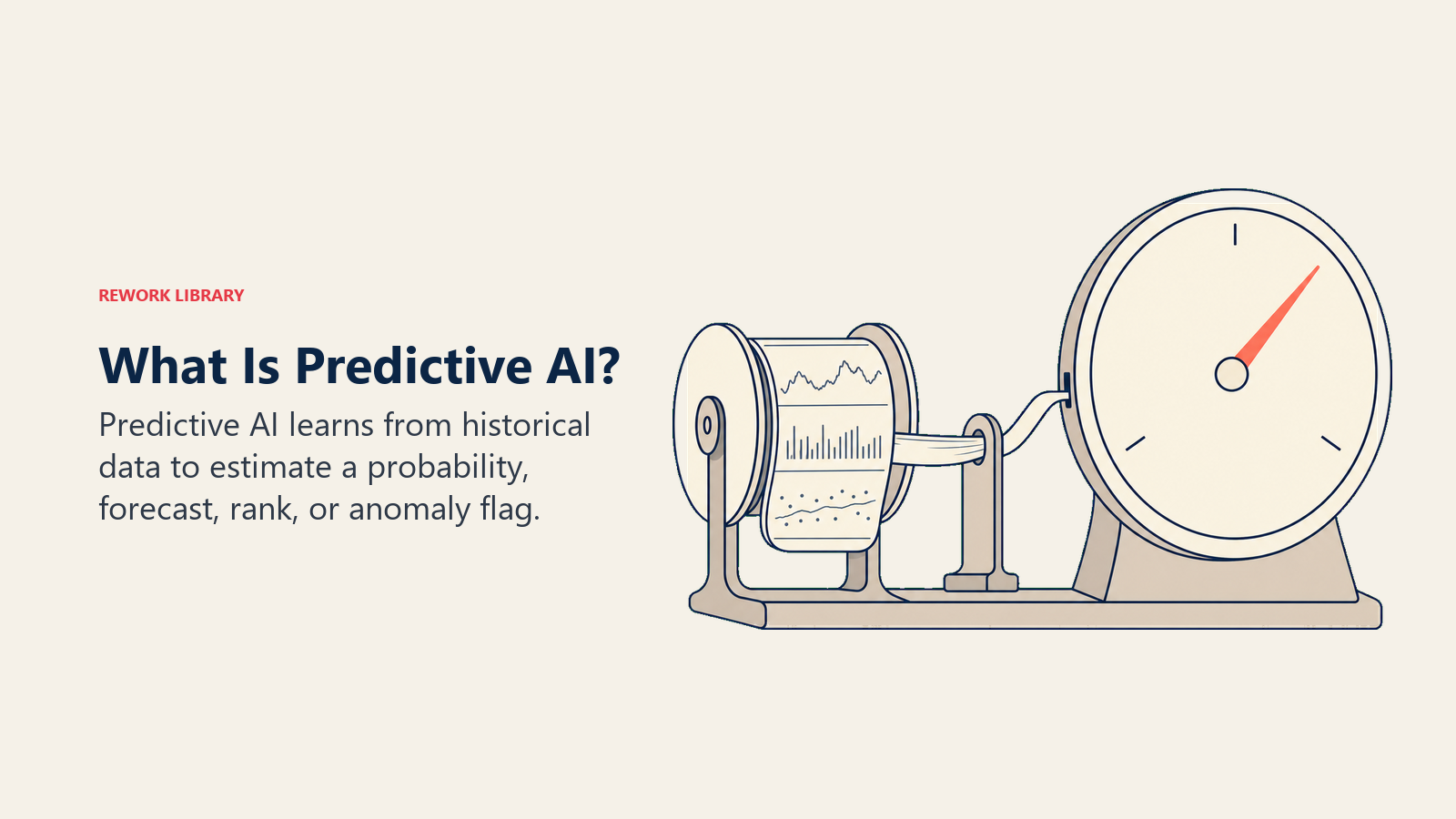
Ia memberi skor. Memperkirakan. Meranking. Mendeteksi ketika sesuatu secara statistik tidak mungkin.
Akar teknisnya adalah classical machine learning: logistic regression, decision tree, model gradient-boosted, dan neural network pra-2020 yang dilatih pada data historis berlabel. Model-model ini belajar dari apa yang terjadi sebelumnya dan menerapkan pengetahuan itu pada input baru. Mereka tidak menciptakan hal baru. Mereka memperkirakan.
Produk nyata yang pernah Anda lihat:
- Salesforce Einstein memberi skor lead, memperkirakan pipeline, dan menampilkan rekomendasi next-best-action di dalam CRM yang sudah digunakan rep penjualan setiap hari.
- HubSpot Predictive Lead Scoring meranking kontak masuk berdasarkan kemungkinan untuk menutup, menarik dari sinyal perilaku di seluruh email, website, dan riwayat deal.
- Stripe Radar mengevaluasi setiap transaksi dalam milidetik dan menghasilkan skor probabilitas penipuan, menandai anomali terhadap baseline dari apa yang "normal" untuk merchant tersebut.
- Rekomendasi Netflix tidak glamor, tetapi merupakan contoh yang jelas: Predict diterapkan pada perilaku pengguna dalam skala besar, menghasilkan daftar terperingkat dari apa yang paling mungkin ingin Anda tonton berikutnya.
Dalam ACE Framework, Predictive AI dipetakan dengan jelas ke kapabilitas Predict, biasanya didukung oleh Analyze (mengekstrak fitur dari data mentah) di hulu.
Yang tidak dilakukan Predictive AI: ia tidak menulis apa pun. Tidak membuat gambar. Tidak menghasilkan proposal. Ia menghasilkan angka, peringkat, probabilitas, atau tanda. Outputnya adalah skor, bukan kalimat.
Generative AI: bagian yang lebih baru
Generative AI adalah cabang yang dipikirkan kebanyakan orang ketika mereka memikirkan "AI" saat ini. Muncul ke pandangan mainstream dengan munculnya large language model (LLM) dan model difusi sekitar 2022 hingga 2023. Pekerjaannya berbeda: ia menghasilkan sesuatu yang baru.
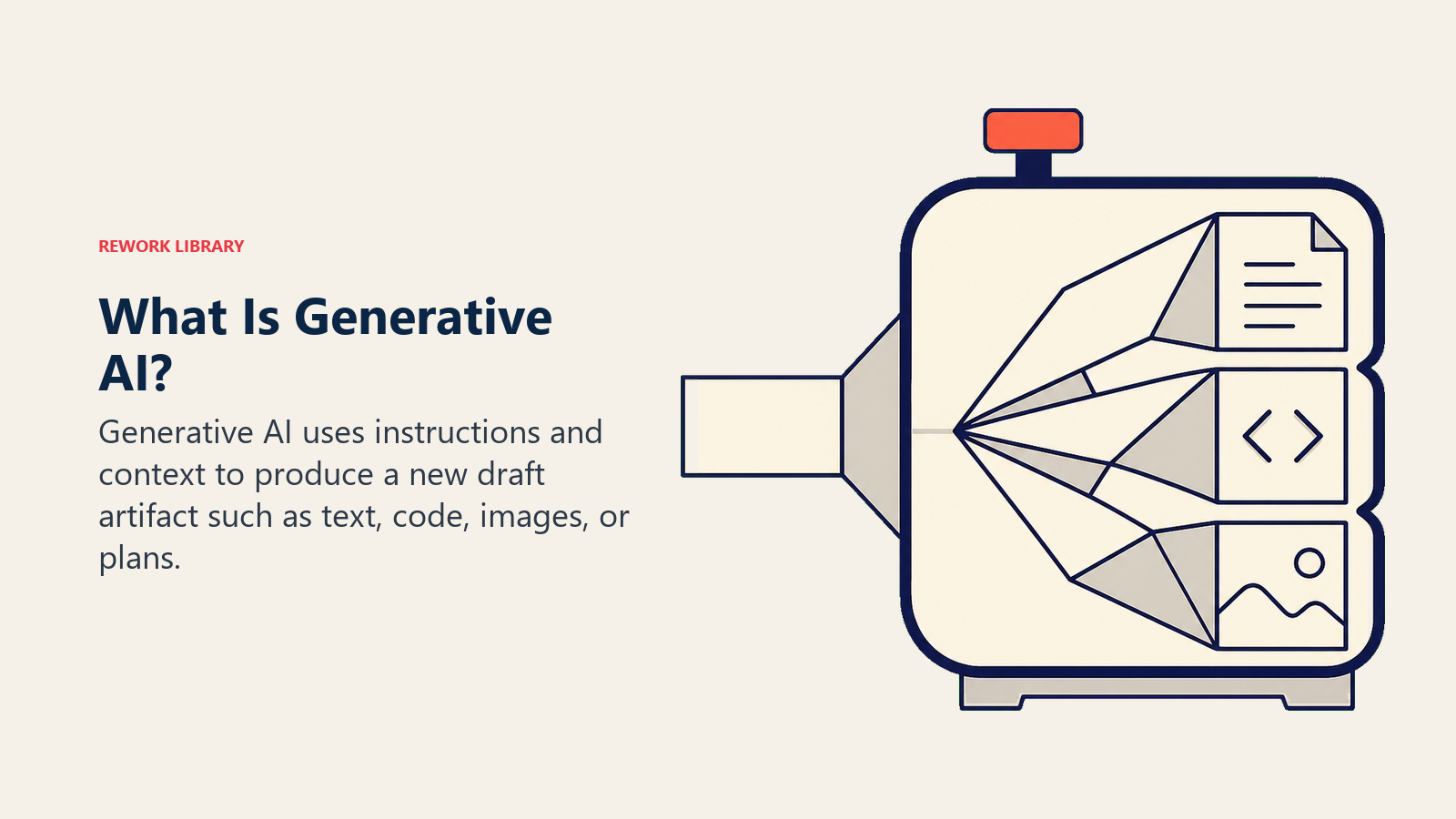
Beri prompt, konteks, serangkaian instruksi, dan ia menghasilkan artefak: draf email, blok kode, gambar, rencana proyek. Outputnya adalah sesuatu yang belum ada sebelumnya.
Fondasi teknisnya adalah model bahasa berbasis transformer (GPT-4, Claude, Gemini) dan model difusi (untuk gambar). Tidak seperti model prediktif yang menghasilkan probabilitas, model generatif menghasilkan token yang menyusun artefak yang dapat dibaca manusia atau dapat digunakan mesin.
Produk nyata yang pernah Anda lihat:
- ChatGPT menerima prompt dan menghasilkan teks (jawaban, ringkasan, draf, analisis). Ini adalah tool generatif yang paling dikenal luas, digunakan oleh individu dan tertanam dalam stack enterprise.
- GitHub Copilot menghasilkan kode saat developer mengetik, memprediksi penyelesaian yang mungkin dan menyusun fungsi lengkap dari komentar.
- Jasper dan Writer adalah tool generatif yang dibangun khusus untuk tim marketing dan konten, menambahkan kontrol suara merek dan integrasi workflow di atas kapabilitas LLM inti.
- Midjourney adalah generatif yang diterapkan pada gambar: prompt teks menghasilkan gambar baru. Tidak ada database gambar yang sudah jadi yang diambil. Artefaknya disintesis dari awal.
Dalam ACE Framework, Generative AI dipetakan ke kapabilitas Generate. Outputnya adalah artefak yang duduk dalam bentuk draf hingga manusia atau sistem lain mendorongnya keluar. Generate menghasilkan hal-hal; ia tidak mengirimnya, mempostingnya, atau melakukan commit-nya. Itu adalah pekerjaan Execute.
Perbandingan berdampingan: bagaimana keduanya berbeda
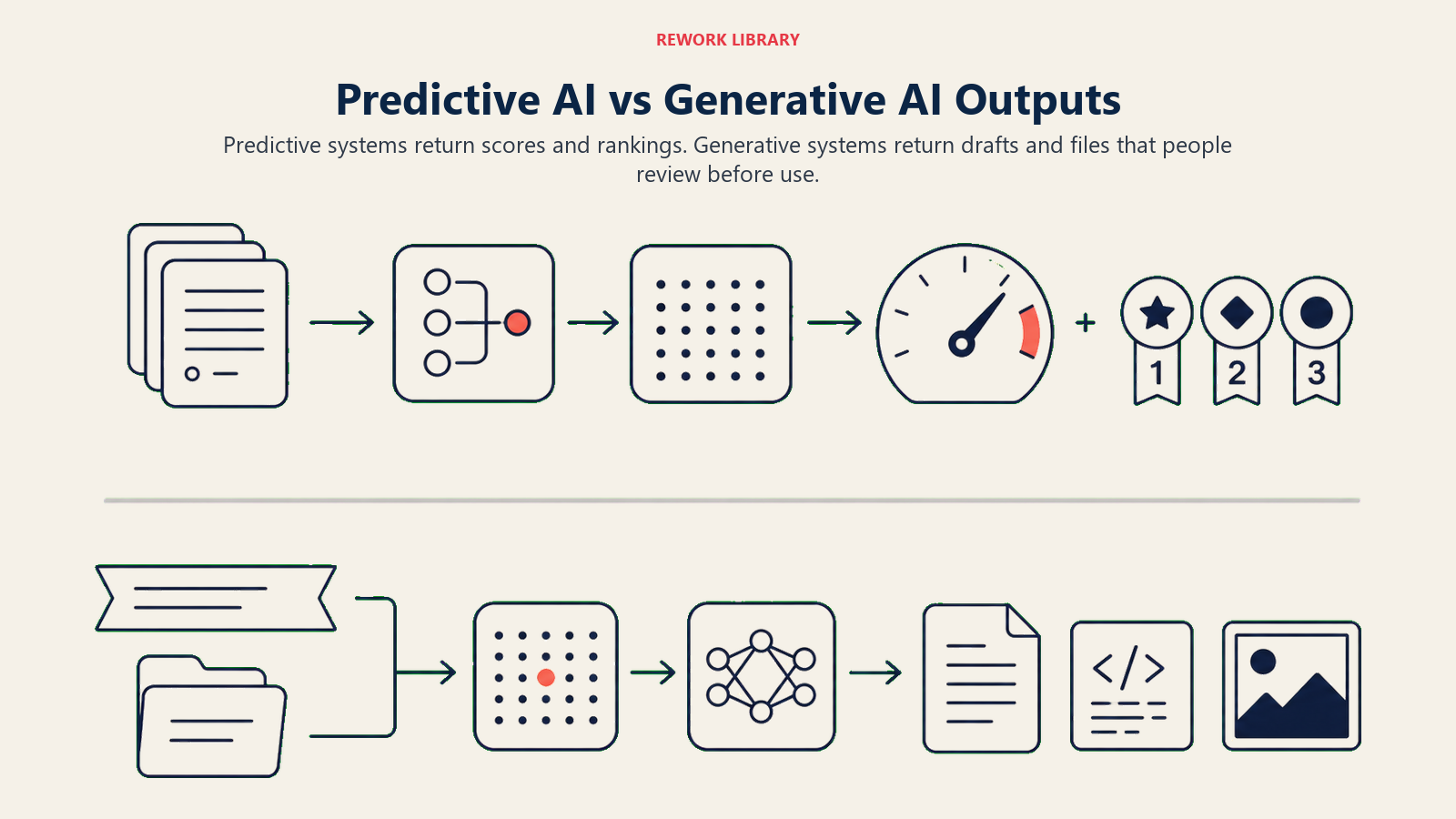
Perbandingan yang paling jelas dimulai dari apa yang dikembalikan masing-masing sistem dan apa yang bisa dilakukan seseorang dengan output tersebut.
| Dimensi | Predictive AI | Generative AI |
|---|---|---|
| Pertanyaan inti yang dijawab | Apa yang kemungkinan? | Apa yang seharusnya ada? |
| Tipe output | Skor, probabilitas, peringkat, tanda | Teks, gambar, kode, audio, rencana |
| Bentuk output | Angka atau klasifikasi | Artefak (draf, file, data terstruktur) |
| Akar teknis | Classical ML, model statistik (pra-2020) | LLM, model difusi (2022+) |
| Lokasi UX | Latar belakang / tertanam di CRM, ERP | Front-end / terlihat oleh pengguna |
| Pola ROI | Keuntungan kecil per keputusan x volume sangat tinggi | Keuntungan besar per tugas x volume awal lebih rendah |
| Persyaratan data | Data terstruktur berlabel, historis, bersih | Prompt + konteks (sering jauh lebih ringan) |
| Di mana manusia ikut campur | Biasanya melihat skor, memutuskan apa yang harus dilakukan | Biasanya meninjau artefak sebelum digunakan |
| Reversibilitas output | N/A (hanya angka) | Draf bisa dibalik; mengeksekusinya mungkin tidak |
| Mode kegagalan | Prediksi yang diam-diam salah, tidak ada error yang terlihat | Teks yang salah namun percaya diri (halusinasi) |
Kedua tipe mode kegagalan layak mendapat perhatian. Predictive AI bisa menghasilkan skor lead yang buruk atau perkiraan churn yang salah, dan tidak ada yang memperhatikan hingga kuartal berakhir. Generative AI bisa menghasilkan jawaban yang percaya diri, lancar, dan sepenuhnya tidak akurat yang terlihat meyakinkan. Tidak ada mode kegagalan yang lebih buruk secara abstrak. Keduanya memerlukan mekanisme pengawasan yang berbeda.
Cara mengetahui apa yang sebenarnya Anda beli
Pitch vendor sering mengaburkan garis. Berikut panduan terjemahan praktis.
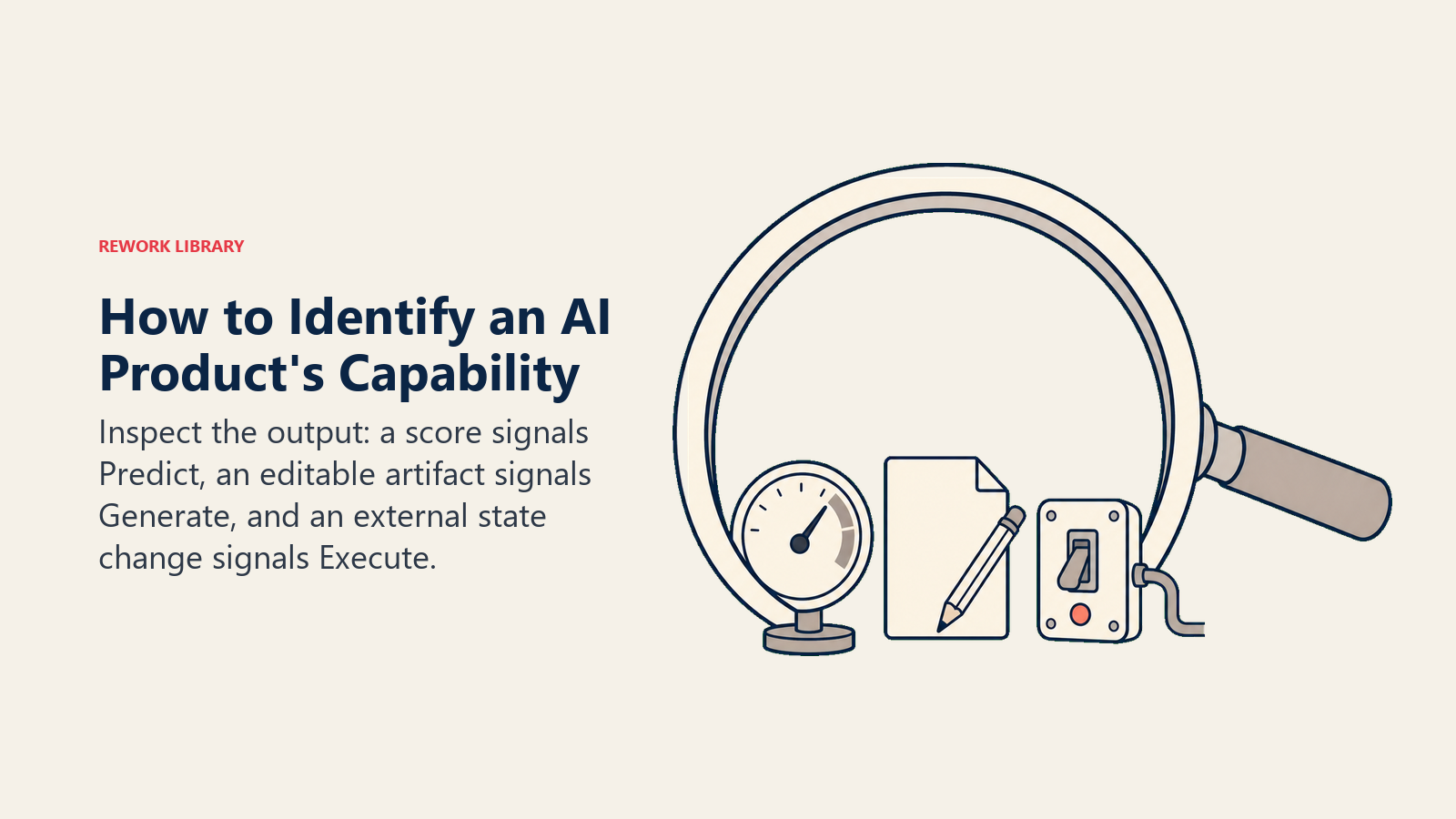
Jika pitch berpusat pada perkiraan yang lebih baik, prioritisasi yang lebih cerdas, atau menangkap hal-hal sebelum terjadi, Anda melihat produk Predictive AI. Kata kunci yang perlu diperhatikan: "lead scoring," "prediksi churn," "perkiraan pipeline," "deteksi anomali," "risk scoring," "rekomendasi."
Jika pitch berpusat pada penyusunan, pembuatan, atau penulisan untuk Anda, Anda melihat produk Generative AI. Kata kunci: "auto-draft," "konten yang dihasilkan AI," "copilot," "tulis untuk Anda," "buat secara instan."
Jika pitch menggunakan kata-kata seperti "otonom," "agen," "workflow end-to-end," Anda mungkin melihat produk yang menggabungkan beberapa kapabilitas, bukan hanya dua. Kita akan membahas itu.
Satu sinyal lagi: di mana dalam antarmuka output AI muncul? Jika muncul sebagai angka di sebelah rekaman di CRM Anda, kemungkinan besar Predictive. Jika muncul sebagai teks yang dapat diedit dalam antarmuka penyusunan, kemungkinan besar Generative. Jika menghilang ke latar belakang dan mengambil tindakan, sesuatu yang lebih kompleks sedang terjadi.
Peta kategori produk
Kategori tool yang berbeda cenderung sangat condong ke satu kubu atau yang lain. Ini adalah panduan kasar, bukan aturan kaku.
| Kategori | Kubu AI tipikal | Contoh bernama |
|---|---|---|
| Lead scoring | Predictive | HubSpot Predictive Lead Scoring, Salesforce Einstein |
| Perkiraan penjualan | Predictive | Clari, Salesforce Einstein, Gong Forecast |
| Deteksi penipuan | Predictive | Stripe Radar, Kount, Featurespace |
| Pembuatan konten | Generative | Jasper, Writer, Copy.ai |
| Bantuan kode | Generative | GitHub Copilot, Cursor, Amazon CodeWhisperer |
| Pembuatan gambar | Generative | Midjourney, DALL-E, Adobe Firefly |
| Pengayaan CRM | Campuran (keduanya) | Clay, Apollo, Salesforce Einstein |
| Customer support | Campuran (keduanya) | Intercom Fin, Zendesk AI |
| Meeting intelligence | Campuran (keduanya) | Gong, Fireflies, Chorus |
Perhatikan bahwa tiga kategori bawah menggabungkan kedua kubu. AI customer support memprediksi tiket mana yang mendesak (Predictive) dan menyusun respons (Generative). Tool meeting intelligence memberi skor kesehatan deal (Predictive) dan menulis ringkasan panggilan (Generative). Biner sudah rusak dalam kategori produk yang paling matang.
Di mana perpecahan rusak: gambaran ACE
Inilah masalah jujur dengan kerangka Predictive vs. Generative: ini mencakup dua kapabilitas dari lima.
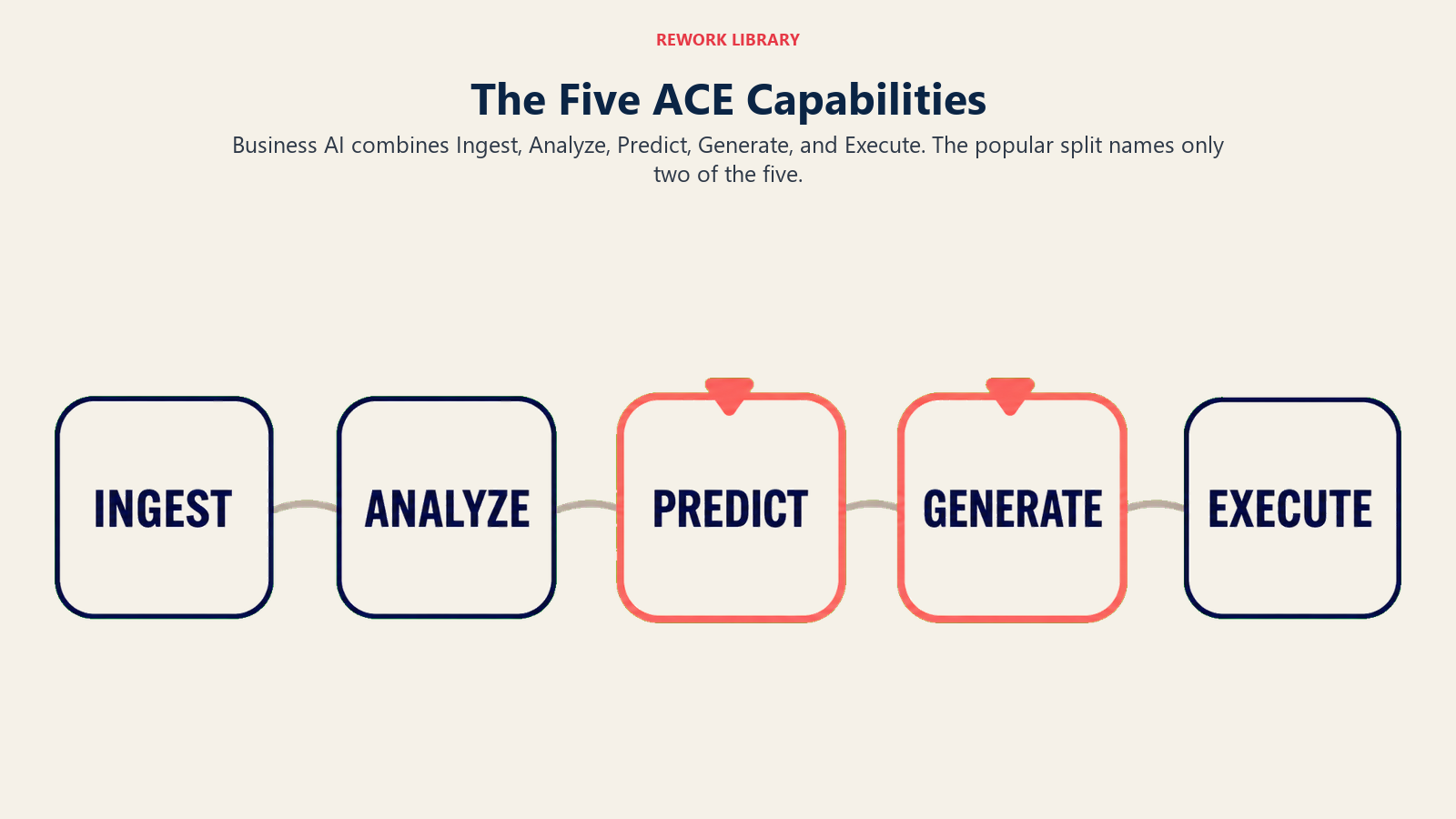
ACE Framework menyebut lima kapabilitas AI bisnis: Ingest, Analyze, Predict, Generate, Execute. Biner populer industri dipetakan ke Predict dan Generate. Itu meninggalkan tiga kapabilitas yang sama sekali tidak disebutkan dalam kosakata umum.
Ingest menerima sinyal mentah (file audio, dokumen yang dipindai, foto struk) dan mengubahnya menjadi sesuatu yang bisa digunakan AI. Stripe Radar mengingesti data transaksi. Gong mengingesti audio. Keduanya melakukan Ingest sebelum melakukan hal lain. Ingest sama sekali tidak muncul dalam kerangka Predictive vs. Generative.
Analyze memahami apa yang diingesti: mengklasifikasikan, mengekstrak, merangkum. HubSpot lead scoring menganalisis sinyal perilaku sebelum memberikan skornya. Gong menganalisis transkrip panggilan sebelum menghasilkan ringkasan. Analyze sering tidak terlihat karena merupakan langkah, bukan kategori produk. Tetapi ia melakukan pekerjaan nyata.
Execute mengubah status di sistem eksternal: mengirim email, memperbarui rekaman CRM, memicu workflow. Di sinilah risiko nyata berada. AI support yang menghasilkan respons dan AI support yang menghasilkan respons DAN mengirimnya tanpa tinjauan sangat berbeda dalam persyaratan tata kelola. ACE Framework memperlakukan batas Generate vs. Execute sebagai perbedaan kritis dalam evaluasi tool AI apa pun.
Ketika Anda membingkai segalanya sebagai Predictive atau Generative, Anda tidak bisa bertanya "apakah tool ini Execute?" Anda tidak bisa melihat di mana Ingest terjadi. Anda tidak bisa mengaudit langkah Analyze mana yang dikendalikan vendor Anda. Biner memberi Anda kerangka dua variabel untuk masalah lima variabel.
Mengapa ini penting untuk keputusan pembelian Anda
Dua implikasi praktis.
Pertama, profil ROI yang berbeda memerlukan justifikasi yang berbeda.
Predictive AI cenderung menghasilkan keuntungan lebih kecil per keputusan individual, dikalikan dengan volume yang sangat besar. Stripe Radar tidak secara dramatis mengubah transaksi tunggal mana pun. Ia menangkap persentase kecil upaya penipuan, tetapi selama jutaan transaksi, persentase itu sangat berharga. Jika Anda mengevaluasi tool prediktif, Anda memerlukan volume transaksi yang tinggi agar ROI masuk akal. Perusahaan 50 orang dengan 200 deal per kuartal mungkin tidak memiliki cukup data agar lead scoring mengungguli manusia yang terlatih.
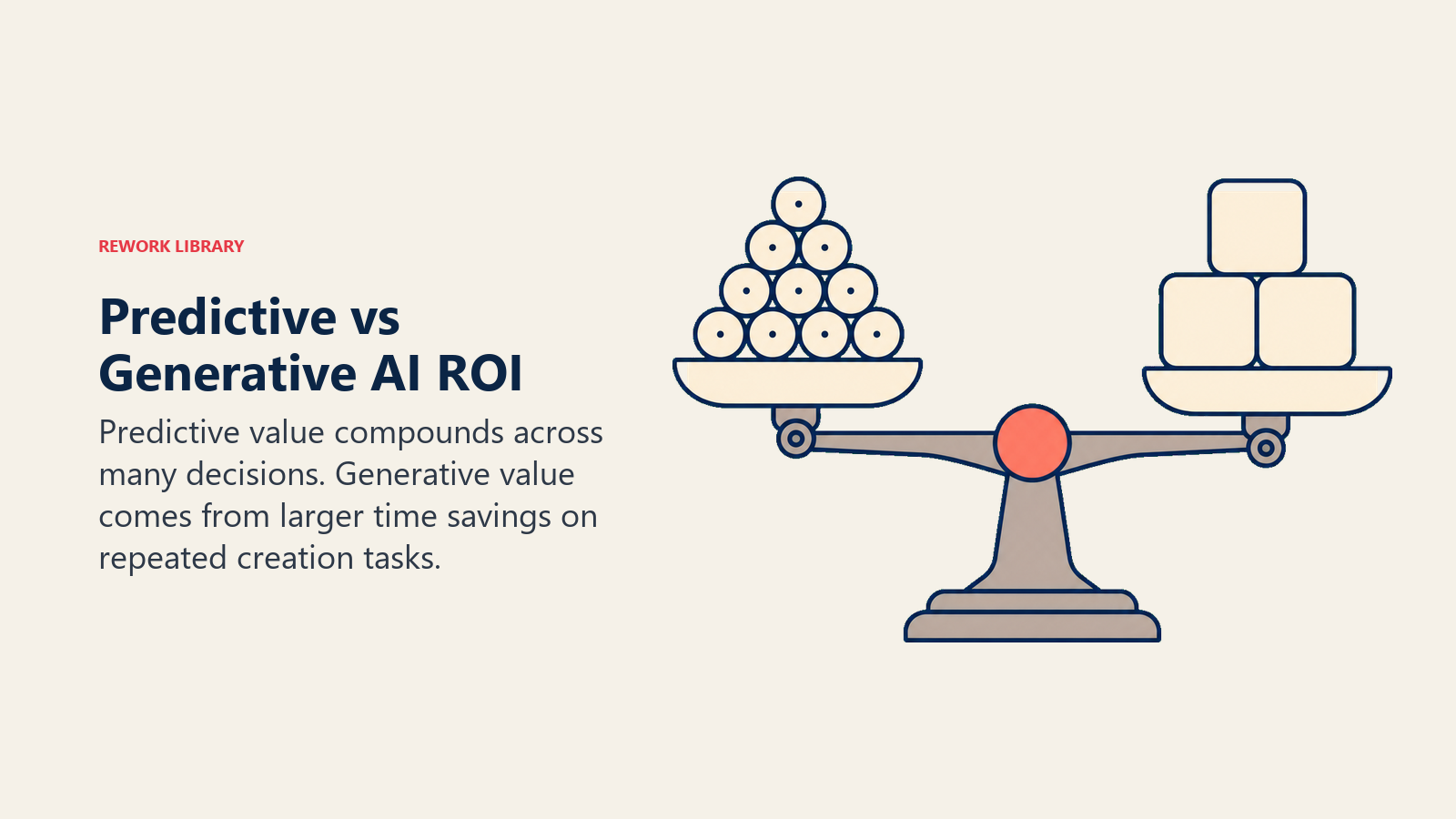
Generative AI cenderung menghasilkan keuntungan lebih besar per tugas. Rep yang menyusun 30 email sehari dan mengalihkan sebagian besar penyusunan tersebut menghemat waktu yang signifikan. Tetapi volume tugas awal harus cukup tinggi untuk membenarkan langganan. Jika tim Anda menulis lima email seminggu, ekonomi tool penulisan generatif seharga $400/bulan tidak masuk akal.
Kedua, tools tersebut berada di tempat berbeda dalam stack Anda.
Tools Predictive sering terintegrasi dalam CRM, ERP, atau data warehouse Anda. Mereka berjalan di latar belakang. Tim Anda hampir tidak melihatnya; mereka melihat skor atau tanda dalam antarmuka yang sudah mereka gunakan. Peluncuran melibatkan integrasi data dan kalibrasi model, bukan kampanye adopsi pengguna.
Tools Generative duduk lebih dekat ke pengguna. Mereka mengubah cara antarmuka terasa dan cara pekerjaan dilakukan pada tingkat individual. Peluncuran melibatkan pelatihan, pembentukan kebiasaan, dan kontrol kualitas output. Tantangan manajemen perubahan berbeda.
Memahami kubu mana yang Anda beli mengubah cara Anda merencanakan implementasi.
Kegagalan jujur yang perlu disebutkan
Berikut pola kegagalan yang umum dan secara diam-diam mahal: vendor yang mempitch kapabilitas generatif tetapi sebagian besar menyampaikan yang prediktif.
Produk berdemo dengan indah. AI menulis email, memberi skor lead, dan menyarankan tindakan berikutnya. Anda menandatangani. Enam bulan kemudian, Anda menemukan saran email yang "dihasilkan AI" adalah pengisian template berdasarkan pola kemenangan historis: predictive scoring yang didandani sebagai teks generatif. Tidak ada yang salah secara teknis dengan itu. Tetapi jika Anda membelinya dengan mengharapkan output model bahasa yang asli dan Anda mendapatkan mail-merge dengan UI yang bagus, ekspektasi Anda tidak dikelola.
Sebelum menandatangani apa pun, tanyakan langsung: "Output mana dari ini yang dihasilkan oleh language model, dan mana yang diprediksi atau dikerjakan berdasarkan data historis?" Vendor yang baik bisa menjawabnya. Jawaban yang menghindar adalah informasi.
Pendekatan use case ACE dibangun untuk tepat ini. Tandai kapabilitasnya, tanyakan mana yang aktif, dan Anda akan mempelajari lebih banyak tentang produk dalam lima menit daripada yang diungkapkan demo 30 slide.
Menyatukannya: gunakan kedua kubu, ketahui di mana masing-masing berada
Predictive dan Generative AI bukan saingan. Mereka saling melengkapi. Stack AI yang paling kuat menggunakan keduanya, pada titik berbeda dalam workflow, untuk tujuan berbeda.
Workflow penjualan yang dibangun dengan baik mungkin memberi skor lead dengan tool Predictive (Salesforce Einstein atau HubSpot), menampilkan skor tersebut di CRM rep, lalu mendorong tool Generative (ChatGPT atau Jasper) untuk menyusun outreach menggunakan konteks lead. Predict memberi tahu rep siapa yang harus dihubungi. Generate membantu caranya.
Yang tidak diberikan kerangka Predictive vs. Generative adalah gambaran lengkap tentang bagaimana dua kapabilitas tersebut terhubung, melalui langkah Ingest, Analyze, dan Execute yang terjadi sebelum, di antara, dan setelah keduanya. Di situlah ACE Framework menjadi model yang lebih berguna.
Biner adalah titik awal. Ini memberi Anda dua titik acuan dan membantu Anda mengorientasikan diri dalam percakapan vendor atau dengan cepat mengkategorikan tool baru. Tetapi untuk mengaudit stack Anda, mengevaluasi apa yang sebenarnya Anda beli, atau merancang workflow yang menggunakan AI secara disengaja, Anda membutuhkan semua lima kapabilitas dalam pandangan.
Mulai dengan Predictive vs. Generative. Kemudian gunakan peta ACE penuh untuk mengisi semua yang ada di antaranya.
Selanjutnya
Jika Anda ingin lebih mendalami salah satu kapabilitas, artikel khusus membahas masing-masing secara penuh:
- Deep dive kapabilitas Predict mencakup mekanisme, contoh nyata, dan mode kegagalan umum predictive AI dalam pengaturan bisnis
- Deep dive kapabilitas Generate mencakup apa yang dihasilkan generative AI, bagaimana artefak berbeda dari output, dan kapan Generate melewati batas ke Execute
- Cara membaca use case AI adalah kerangka lima pertanyaan untuk menandai produk AI apa pun berdasarkan kapabilitas sebenarnya
- Apa itu AI bisnis? mundur satu langkah dan menetapkan definisi yang lebih luas sebelum menyelami kategori tool

Principal Solution Architect
On this page
- "AI" adalah satu kata yang mencakup dua mesin berbeda
- Predictive AI: bagian yang lebih tua
- Generative AI: bagian yang lebih baru
- Perbandingan berdampingan: bagaimana keduanya berbeda
- Cara mengetahui apa yang sebenarnya Anda beli
- Peta kategori produk
- Di mana perpecahan rusak: gambaran ACE
- Mengapa ini penting untuk keputusan pembelian Anda
- Kegagalan jujur yang perlu disebutkan
- Menyatukannya: gunakan kedua kubu, ketahui di mana masing-masing berada
- Selanjutnya