Common PMM Pitfalls: 7 Walls You'll Hit (and How to Get Past Them)
Turn this article into takeaways for your work.


Each assistant summarizes the article only for you and suggests best practices for your work.
You're 12 months into the PMM job. You shipped three launches last quarter. Sales hasn't opened your latest one-pager. The positioning doc you spent six weeks on died somewhere between a Slack thread and a Notion page nobody bookmarked. The CMO asked what your "win rate influence" looks like and you said something vague about "lifting consideration."
You're not bad at this job. You're hitting the standard walls.
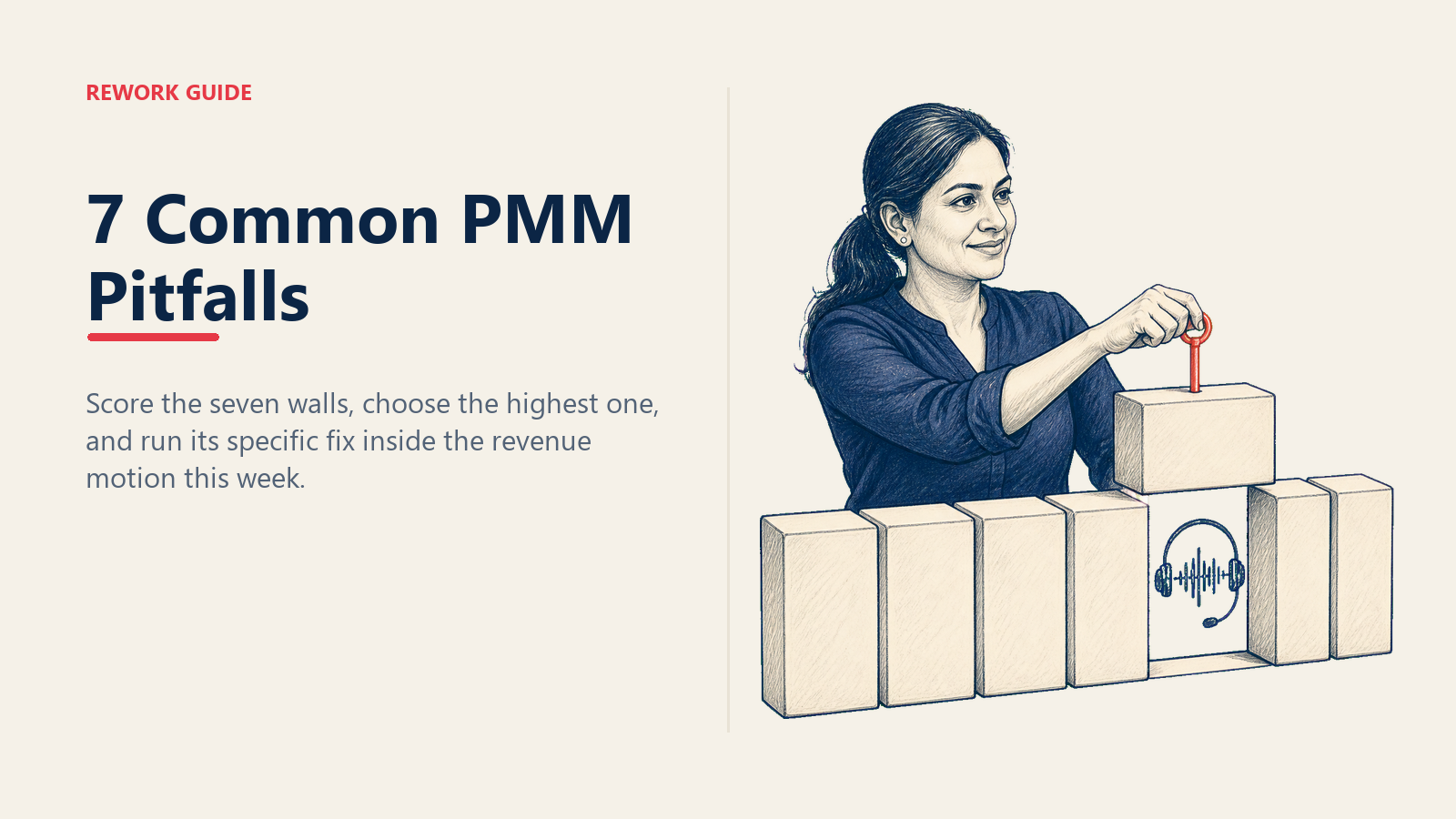
I've coached PMMs at Series B startups and 5,000-person SaaS companies, and the same seven walls show up almost every time. They're not signs you picked the wrong career. They're the predictable consequences of a role that sits between product, sales, and marketing without owning any of the three. The fix isn't working harder. It's recognizing the pattern, naming it, and running a specific play to break out.
Below, the seven walls. Each one gets a name you can use in your next 1:1, a real number that tells you whether you're hitting it, and a fix you can start this week.
Pitfall 1: Positioning by Committee
The symptom: Your positioning doc has a comments column wider than the actual copy. Eight people have edited it. The PM lead wants to lead with the AI angle. The CMO wants "platform" in the first line. Sales wants three competitor knockouts on the front page. After four weeks, you've averaged everyone's opinion into mush nobody fights for.
The number: If your positioning has more than 3 reviewers and isn't shipped within 10 business days of v1 draft, you're in the committee trap. I've seen positioning docs sit in review for 90+ days. None of them ever launched.
The fix: Name a single decider on day one. Usually you, the PM lead, or the CMO. Cap reviewers at 3. Ship a v1 in 10 business days, even if it's rough. Then iterate from sales call evidence, not from internal opinions. The best positioning I've seen in the last five years was shipped in two weeks by a PMM who said "I'm the decider, you have until Friday to push back, after that we run with it." Three months later, that doc was the foundation of a $40M ARR product line.
The truth nobody says out loud: positioning is not a consensus document. It's a bet. Committees don't make bets.
Pitfall 2: Treating Every Release as Tier 1
The symptom: Every feature gets the press release, the webinar, the sales kickoff slot, the CEO LinkedIn post, and the customer email. You're running 11 launches a quarter. Sales has stopped reading launch emails because there are too many. Customers can't tell what's actually new versus what's just an update.
The number: If 80%+ of your launches get the full T1 treatment, none of them land. Most PMMs at healthy companies ship 2 to 3 true T1s per year. Maybe 4. If you're past that, you're diluting every single one.
The fix: Use a 3-tier launch matrix and force every release through it before kickoff.
- Tier 1: Bet-the-quarter launches. Net-new product line, major repositioning, or a feature that unlocks a new buyer. Press, webinar, full sales enablement, paid amplification.
- Tier 2: Important but incremental. Email to existing customers, sales enablement update, blog post, in-app announcement. No press cycle.
- Tier 3: Release notes only. Goes in the changelog, gets one Slack post in #product-updates, lives in the help center.
Most launches are T2 or T3. The discipline is saying so out loud, even when the PM is convinced their feature is T1. If everyone fights you on the tier, that's a sign your matrix is working. It's forcing a conversation about scarce attention.
Pitfall 3: Building Enablement Reps Don't Use
The symptom: You spent six weeks building a 40-slide pitch deck. Sales opened it 12 times in the first month. By month three, attachment rate is below 5%. When you ask a rep why, they say "it's great, I just use my own deck." That's the polite version of "yours doesn't work in a real call."
The number: Asset usage rates below 20% mean you built for the marketing org's idea of what sales needs, not for what sales actually pulls into deals. The benchmark for assets that get real traction is 30 to 50% attachment in the relevant deal stage.
The fix: Shadow 5 sales calls before you write the next asset. Listen for the moments reps stumble: the objection they hand-wave through, the discovery question they skip, the proof point they wish they had. Then build the one artifact reps actually asked for. In 8 out of 10 cases, it's a discovery cheat sheet (10 questions, mapped to pain) or a single-page objection handler. Not a 40-slide pitch deck.
A good test: before you build anything, write down which call moment the asset will rescue. If you can't name the moment, you're building for marketing.
Pitfall 4: Skipping Win-Loss Research
The symptom: Your CRM says you lose 60% of deals to "no budget" or "timing." Your CEO believes it. You repeat it in the QBR. Then you talk to one churned prospect and they say "honestly, we just didn't trust you'd be around in 18 months." That wasn't in any dropdown.
The number: If 60%+ of your CRM loss reasons say "budget" or "timing," your CRM data is useless for positioning decisions. Real loss reasons are in the messy middle: trust, deployment risk, internal politics, the champion got fired. Those don't fit dropdowns.
The fix: Run 8 to 12 win-loss interviews per quarter. Mix of won deals, lost deals, and no-decisions. Thirty minutes each. Outsource them if you have to (firms like Klue or DoubleCheck do this for around $1,500 per interview), but do them. The returns are absurd: I've seen a single quarter of win-loss interviews kill an entire competitive narrative the company had been pushing for two years. Turned out customers didn't care about the thing the CEO thought was the killer differentiator.
Run them yourself if budget is tight. Twelve interviews a quarter is one interview a week. You can do this.
Pitfall 5: Optimizing for Launch Instead of Adoption
The symptom: You ran a beautiful launch. Press picked it up. The internal Slack channel was on fire on day 1. Sixty days later, only 8% of eligible accounts have used the feature. The PM is asking why activation is flat. You're asking why it's your problem now.
The number: If feature adoption sits below 15% at the 60-day mark for a launch you ran, the launch was theater. Champagne on day 1, crickets on day 30. The activation curve is the only metric the CFO actually cares about.
The fix: Define a 90-day adoption target before launch day. Instrument the activation event with the data team. Make sure you know exactly which user action counts as "adopted." Own the in-product nudges (empty states, tooltips, onboarding moments) and the lifecycle email sequence, not just the press release. Treat the press cycle as the start of a 90-day campaign, not the end of a 6-week project.
The PMMs who get promoted are the ones who own the curve from day 0 to day 90, not the ones who own the launch event.
Pitfall 6: Not Measuring Sales Asset Usage
The symptom: You have 47 sales assets in your content library. The newest one is from six weeks ago. The oldest is from three years ago and still references a competitor that got acquired. Nobody can tell you which 3 assets reps actually attached to deals last quarter, because nobody's measuring it.
The number: If you can't name your top 3 assets by usage, you're flying blind. Healthy PMM teams track asset attachment monthly and kill anything below 5 uses per quarter. The 80/20 hits hard here: usually 20% of your library drives 80% of usage. The other 80% is decay.
The fix: Tag every customer-facing asset with a unique link (a tracked URL, a unique Highspot/Seismic ID, a Gong-trackable doc). Pull usage monthly. Build a one-page report: top 10 by usage, bottom 10, candidates to kill. Run it past the sales leader for veto power, then archive the dead assets. Repeat every quarter.
The first time you do this, you'll find a third of your library hasn't been touched in 90 days. Kill it. Library health is a signal, not a vanity metric.
Pitfall 7: Writing for Marketing Instead of for the Rep
The symptom: Your slides have 60+ words per page. The headlines are clever wordplay. The hero shot is gorgeous. A rep tries to pitch from it and stumbles, because there's no talk track and the words on screen aren't what a human says out loud.
The number: If your pitch deck slides have more than 25 words on the page and no rep talk track at the top, you wrote a brochure. Brochures are for self-serve websites. Pitches are for humans talking to humans.
The fix: Every customer-facing asset gets a 2-line rep talk track at the top. Two sentences a rep can actually say. Test it by reading it out loud. If you can't say it in one breath, rewrite it. Then run it past three reps before you ship it. If two of them can't repeat the talk track from memory after one read, the asset isn't ready.
The rule I use: marketing writes to be read silently, sales writes to be said out loud. They're different crafts. If you're a PMM, you're closer to the second one than the first.
The Pattern Underneath
Look at the seven walls again. Six of the seven share one root cause: they happen when you build inside the marketing org instead of inside the revenue motion.
Positioning by committee happens because you ran the doc through marketing reviewers, not sales reviewers. Tier 1 inflation happens because marketing kickoffs reward visibility, not adoption. Asset libraries rot because nobody from sales sat in the planning meeting. Win-loss gets skipped because marketing OKRs measure pipeline-influenced, not deals-won.
The fix isn't a new framework. It's a calendar change.
Spend 30% of your week with sales. Not in marketing standups, not in product reviews, not in cross-functional syncs about cross-functional syncs. Real time: ride-along on calls, Gong reviews, weekly office hours with reps, monthly 1:1s with the top 3 AEs and the bottom 3. The PMMs who break through to senior IC and PMM lead almost always have one thing in common: sales trusts them, and sales trusts them because they showed up.
Self-Diagnostic: Score Yourself
Five-minute quiz. Score 1 to 5 on each, where 5 means "this is me, often."
- My last positioning doc had more than 3 reviewers and took longer than 4 weeks to ship.
- More than half my launches in the last quarter got "full launch" treatment.
- I haven't shadowed a real sales call (live or on Gong) in the last 30 days.
- My CRM's top 2 loss reasons are "budget" and "timing," and I haven't run win-loss interviews this quarter.
- I don't know feature adoption at day 60 for my last major launch.
- I can't name my top 3 most-used sales assets last quarter.
- My latest pitch deck has slides with 30+ words and no rep talk track.
Add up your score. 7 to 14: you're early in the role, watch for these as you scale. 15 to 24: you're in the standard PMM mid-tour wall. 25+: you're in the danger zone, pick one and start this week.
Whatever you scored, identify your top 2 highest-rated pitfalls. Those are your starting points.
What to Do This Week
Don't try to solve all seven. That's pitfall #1 in a different costume.
Pick the highest-scoring wall. Run the specific fix. Block 90 minutes on Friday to ship something concrete: a v1 talk track, three win-loss interviews scheduled, a pruned asset library, whatever the fix calls for. Tell your manager what you did and why. The next 1:1 you have, name the wall by its name. "I was hitting positioning by committee. I shipped v1 in 10 days. Here's what changed."
That sentence (naming the wall, owning the fix, showing the change) is the move that turns PMM IC into PMM lead.
Learn More

Principal Product Marketing Strategist
On this page
- Pitfall 1: Positioning by Committee
- Pitfall 2: Treating Every Release as Tier 1
- Pitfall 3: Building Enablement Reps Don't Use
- Pitfall 4: Skipping Win-Loss Research
- Pitfall 5: Optimizing for Launch Instead of Adoption
- Pitfall 6: Not Measuring Sales Asset Usage
- Pitfall 7: Writing for Marketing Instead of for the Rep
- The Pattern Underneath
- Self-Diagnostic: Score Yourself
- What to Do This Week
- Learn More