PMM Tools and Tech Stack: The Honest 2026 Buyer's Guide for B2B SaaS PMMs
Turn this article into takeaways for your work.


Each assistant summarizes the article only for you and suggests best practices for your work.
It's Monday morning. You log into Highspot, two tabs of Gong, Crayon, the Salesforce instance that RevOps controls, the HubSpot instance that demand gen controls, Maze, dscout, a Notion graveyard with 14 half-finished launch pages, and a Drive folder called _FINAL_v3_USE_THIS_ONE. A rep pings you on Slack: "what's our latest deck for the FinServ vertical?" You can't answer in under 90 seconds. Neither can the rep. The deck exists in three of those tools and none of them agree on which version is current.
I've audited 30+ PMM stacks in the last two years, and the same pattern shows up every single time. The PMM inherited 11 logins from the last person, uses 4 of them, and has no authority to kill the other 7 because someone in another department is paying for them. The pain isn't a lack of tools. It's tool sprawl that nobody owns.
This guide is the conversation I have with every PMM IC who DMs me asking "what should I buy?" The answer is almost always "buy less, organize more, and prove deal influence so finance keeps you funded." Here's how.
Why this matters more in 2026
Two things changed this year that turned PMM tooling from a nice-to-have line item into a CFO conversation.
First, the average B2B SaaS company cut software spend roughly 18% off the 2023 peak, and the cuts went deepest into seats nobody could attribute to revenue. If you can't show that your $30K/year competitive intel tool moved win rate against a named competitor by a measurable amount, that contract is in the kill list at the next QBR.
Second, sales leaders started asking PMMs the question that used to land on RevOps: which assets, battlecards, and launches actually touched closed-won pipeline? PMMs who can answer that with a number get budget. PMMs who say "it's hard to measure" get cut first. The tooling decision flows directly from this. Every tool needs a story for what it produces and how that ties to revenue.
So the frame for this guide isn't "what's the best sales enablement platform?" It's "what does my stack need to do, and what's the cheapest credible way to do it at my company's stage?"
The core 6 categories (with real prices)
Every B2B SaaS PMM stack covers six jobs. You don't need a tool for each one. You need coverage for each one, and coverage can be free, cheap, or expensive depending on stage.
1. Sales enablement (content management, version control, rep findability)
The category leaders:
- Highspot: ~$45/user/mo on a 50-seat minimum, so figure $27K/year as a floor. Real list comes in at $40-55/user depending on add-ons (analytics, training, AI search).
- Seismic: Quote-only, but the deals I've seen land around $60+/user/mo for mid-market. Six-figure ACV is normal.
- Showpad: ~$35-50/user/mo, somewhere between Highspot and the cheap tier.
The honest take: Under 50 reps, a well-organized Notion workspace plus a single Drive folder with strict naming conventions beats every one of these. I've seen $30K/year Highspot rollouts where reps still asked PMMs "what's the latest deck?" because the analytics dashboard didn't fix the underlying problem (nobody owns content velocity). You don't have a tool problem. You have a process problem.
Switch when content velocity breaks Drive. The trigger isn't seat count. It's the moment you can't answer "what's current?" within 90 seconds because there are too many versions in flight. That usually happens around 50-80 reps with active product launches every month, but I've seen it happen at 25 reps in companies launching constantly.
2. Competitive intelligence
The category leaders:
- Crayon: starts around $1,250/mo for the basic tier, climbs into $30K+/yr territory with battlecards and integrations.
- Klue: typically $30K+/yr, often higher; built around battlecards in the rep's flow (Slack, Salesforce sidebar).
The honest take: A free Google Alerts setup, a #competitive-intel Slack channel, and a Notion page per top 5 competitor will get a solo PMM 80% of the way there. Crayon and Klue earn their seat when (a) reps need battlecards inside their CRM the moment a competitor name shows up on a deal, and (b) you have enough rep volume that PMM can't manually update the Slack channel anymore.
If you bought Crayon and your reps still ask in Slack "what do we say against Gong?", your problem isn't the tool. It's that nobody trained the reps to look at the battlecard.
3. Call recording and revenue intel
The category leaders:
- Gong: typically $1,600/user/yr, with a 50-seat-ish minimum that puts the floor around $80K. Real deals run $1,400-$2,000/user/yr.
- Chorus: bundled with ZoomInfo, so the math depends on what else you're buying from them.
- Salesloft Conversations: bundled with the Salesloft cadence platform, lighter analytics than Gong.
The PMM-specific use case: This is the highest-leverage category for product marketing, and most PMMs underuse it. Gong (or Chorus) gives you the raw material for win-loss themes, objection patterns, messaging gaps, and competitor mentions in the wild. I've watched PMMs ship a complete repositioning off 40 hours of Gong listening. That's worth more than every survey tool combined.
The honest tradeoff: if your sales team has fewer than 15 reps, you don't need Gong yet. Sit in on 8 calls a month live and take notes. The cost is your time, and the depth is higher.
4. Survey and research
The category leaders:
- Maze: $99/mo on the Team plan, scales up to $300+/mo for advanced testing and research repositories.
- dscout: $30K+/yr for diary studies and longitudinal research with a recruited panel.
- UserTesting: $40K+/yr; the enterprise option for video-based usability and brand research.
The honest take: 80% of PMMs need Maze plus a $200/mo Calendly setup for 1:1 research interviews with their own customers. Done. The $30K+/yr panel tools earn their seat when you need to research non-customers (people who didn't buy, people who chose a competitor, people in a new vertical you haven't sold into yet). That's a real use case, but it's not the first one.
Don't buy dscout to research your own customers. Email 10 of them, offer a $100 Amazon card, run the calls yourself, and learn more in two weeks than a panel study would tell you in two months.
5. CRM and pipeline (the deal-influence layer)
This is the category PMMs are usually weakest in, because RevOps owns the system and PMM doesn't get to make the call. But you need a story here, because deal influence reporting is what saves your job in the 2026 budget review.
| Tool | Public price | Best fit for PMM | Watch out for |
|---|---|---|---|
| Rework CRM | From $69/mo billed yearly, 5 seats (Sales Engine) (rework.com/pricing) | PMM owns win-loss tagging + deal-influence reporting without begging RevOps for a custom Salesforce report. Mid-size, cross-team companies (20-500 employees). | Not the right pick at 200+ seats with a dedicated SFDC admin already on staff. |
| Salesforce Sales Cloud Pro | $165/user/mo | 200+ seats, dedicated admin, complex territory and forecasting needs. PMM has to pay the RevOps tax to get any custom field built. | Reporting requires admin time you don't control. PMM-driven changes take 2-6 weeks. |
| HubSpot Marketing Hub Pro + CRM | $90-150/user/mo for Marketing Hub Pro, CRM seats included | Marketing-led orgs where sales is small (<30 reps) and the CRM needs to live next to the campaign tools. | Reporting on deal influence is workable but the analytics get expensive at the Enterprise tier. |
The PMM-honest framing: Rework is the right pick when PMM owns win-loss tracking and needs deal-influence reporting without filing a ticket with RevOps every time you want a new tag. Salesforce wins at 200+ seats with a dedicated admin who actually has bandwidth. HubSpot wins when marketing owns the CRM and sales is small. Pick once, then stop having the debate.
6. Copy, design, and video
The unsexy answer that 80% of PMM work runs on:
- Notion: $10/user/mo for the bulk of your launch docs, FAQs, and internal wikis.
- Figma: $15/user/mo. Stop trying to design in Canva.
- Loom: $15/user/mo for async rep enablement videos that get watched at 1.5x.
That's $40/user/mo total. It runs more PMM work than the other five categories combined. Don't underspend here.
The Rework PMM use case (specific, not generic)
I'm picky about when I recommend Rework, because I don't want PMMs ripping out a working Salesforce instance to chase a lower sticker price. There are exactly two scenarios where Rework earns its slot in the PMM stack:
Scenario 1: Win-loss tagging that PMM actually owns. You add a custom field on the Opportunity object called loss_reason_pmm, with a controlled vocabulary you maintain (price, feature gap, competitor X, no decision, champion left, etc.). Reps tag it on every closed-lost deal. You export weekly to a messaging-themes dashboard. In Rework, you build that field yourself in 20 minutes. In Salesforce, you file a ticket and wait two weeks. The cost of that delay, multiplied by every iteration on your taxonomy, is the actual ROI argument.
Scenario 2: Deal-influence reporting on PMM assets. You tag which battlecards, launch assets, or campaigns touched closed-won deals. At the end of the quarter, you walk into the QBR with a number: "$2.4M in closed-won pipeline touched the FinServ launch assets we shipped in Q1." That number is the difference between PMM being a cost center and PMM being a growth lever in the next budget cycle.
What Rework is not: it's not a replacement for Gong's call analytics, and it's not a replacement for Highspot's content analytics. It's the system of record for pipeline and revenue impact. If you already have a fully-staffed Salesforce shop and the RevOps team will build PMM-specific dashboards on demand, you don't need to switch. If you're a solo PMM at a 100-person SaaS company without an SFDC admin, Rework gets you to deal-influence reporting in a week instead of a quarter.
That's the whole pitch. No "all-in-one platform," no "PMM command center." Just one specific job done well at a price that survives a CFO review.
The 30-day stack audit (run this in your first month)
The best moment to audit is right now, regardless of how long you've been in the seat. Block 4 hours a week for the next 4 weeks. Tell your manager you're doing it. Show them the output.
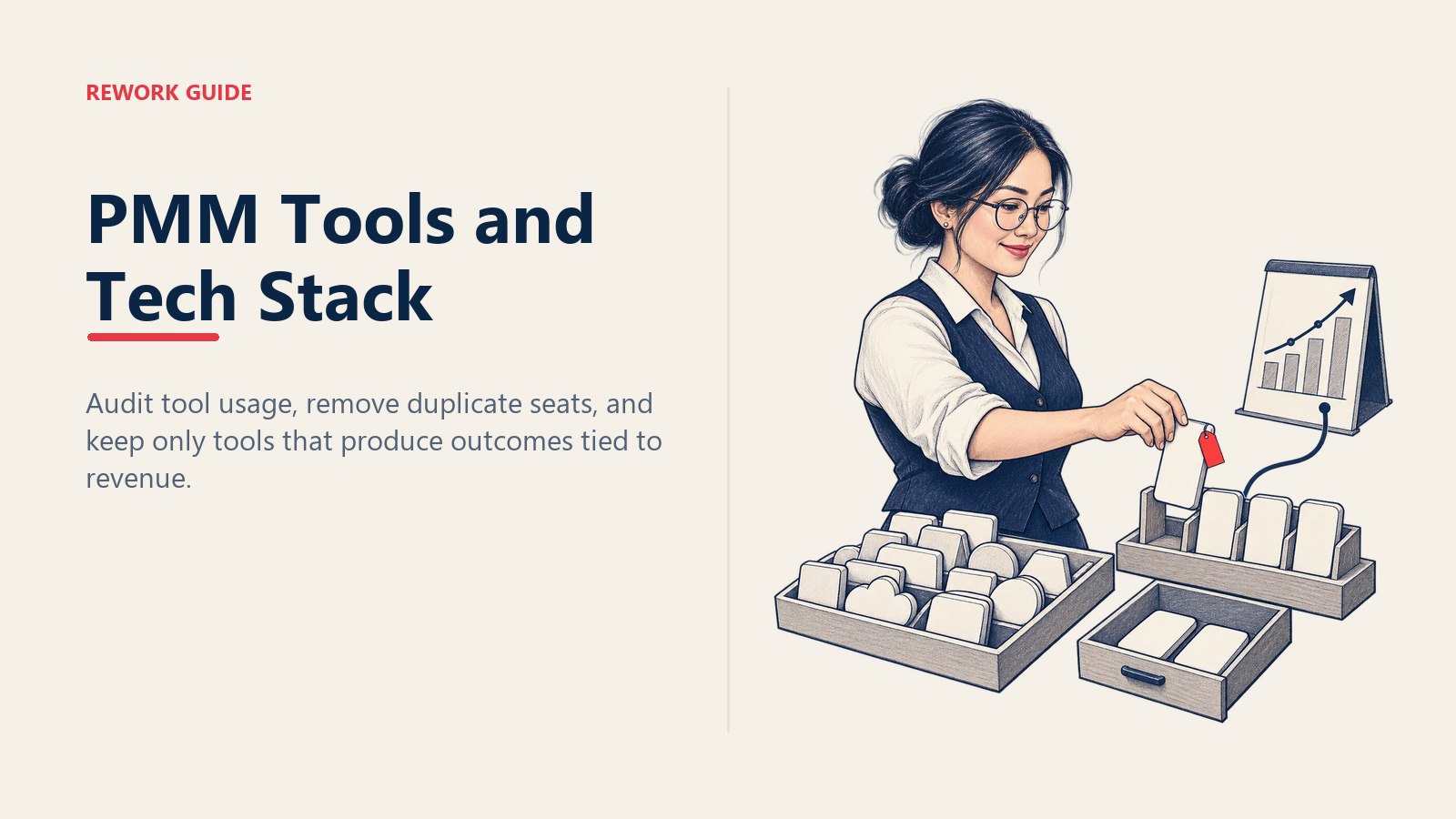
Week 1, Inventory. List every tool. Pull the contract. Note the renewal date, the seat count, the monthly cost, and the date of the last login per seat. The login-date column is the one that hurts. Half your seats haven't been used in 90 days.
Week 2, Outcome mapping. For every tool, write down 1-3 specific outcomes it produces (launches shipped, battlecards adopted, win-loss themes identified, research insights logged). If a tool can't tie to an outcome, flag it. If two tools produce the same outcome, flag both.
Week 3, Duplicate and ghost-seat purge. Identify (a) duplicate tools, (b) seats that haven't been used in 60+ days, (c) tools that produce outcomes nobody asked for. Send a "we're cutting these" email with a 7-day reply window. If nobody objects, the cuts go through.
Week 4, Consolidation memo. Write the one-pager: what you cut, what you saved, what you're keeping, and what you'll do with the savings. Send it to your manager, the CFO if you're brave, and the head of sales. The memo is the artifact that gets you taken seriously next time you ask for budget.
I've watched a solo PMM at a 60-person SaaS company find $42K/yr in ghost seats this way. Not because anyone was being wasteful, but because nobody had owned the audit, ever.
When to consolidate vs. when to add
Two rules, and only two:
Add a tool when a workflow breaks weekly. Not monthly. Not "sometimes." Weekly. If reps can't find the latest deck once a week, you have a content management problem worth solving. If you can't ship a battlecard in time once a month, you don't have a Crayon problem yet.
Consolidate when two tools serve the same outcome and one has 20% the usage of the other. Cut the lighter-usage one. The argument that "we'll lose the data" is almost always wrong; export the data, archive it, and move on.
And the rule that breaks more PMM stacks than any other: never add a tool to solve a process problem. If reps don't update opportunity stages, no CRM upgrade fixes that. If the launch checklist isn't getting followed, no launch-management platform fixes that. Tools amplify whatever process you already have. Bad process plus a $40K tool just produces bad process at scale.
The PMM stack maturity curve
Most PMMs try to operate at Stage 3 with Stage 1 budget and Stage 1 team. That's the real problem. Pick the stage you're actually at, build the stack for it, and stop apologizing for not having Highspot.
| Stage | Headcount signal | Recommended stack | Approximate spend per PMM |
|---|---|---|---|
| Stage 1: Solo PMM | <50 reps, 1 PMM | Notion + Google Drive + Rework CRM + Loom + Maze + Google Alerts | $200-400/mo |
| Stage 2: PMM team of 3 | 50-150 reps, 2-4 PMMs | Stage 1 + Gong + Crayon (or Klue) | $1,500-3,000/mo per PMM |
| Stage 3: PMM org | 150+ reps, 5+ PMMs, dedicated launch ops | Stage 2 + Highspot or Seismic + dscout | $4,000-7,000/mo per PMM |
Stage 1 is where most B2B SaaS PMMs actually live. Stage 1 done well (clean Notion, sharp messaging, weekly Loom updates, opportunity tagging in Rework, monthly customer interviews) beats Stage 3 done badly every single time.
What to do this week
If you read this far and you're sitting on a sprawling stack, here's the action: open a Notion page right now, list every tool and its monthly cost from memory, and write the renewal date next to each one. Don't look anything up yet. The gaps in what you know are the audit. Fill them in over the next week, run the consolidation in the three weeks after that, and ship the memo.
The PMMs who survive the next budget cycle aren't the ones with the fanciest stack. They're the ones who can say, in one sentence, what each tool produces and how much pipeline it touched last quarter. Be that PMM.
Learn More
- Product Marketing Manager Job Description
- Win-Loss Analysis Playbook for PMMs
- Sales Enablement That Reps Actually Use
- PMM Metrics: Launch, Win Rate, Adoption
- Rework Pricing

Principal Product Marketing Strategist
On this page
- Why this matters more in 2026
- The core 6 categories (with real prices)
- 1. Sales enablement (content management, version control, rep findability)
- 2. Competitive intelligence
- 3. Call recording and revenue intel
- 4. Survey and research
- 5. CRM and pipeline (the deal-influence layer)
- 6. Copy, design, and video
- The Rework PMM use case (specific, not generic)
- The 30-day stack audit (run this in your first month)
- When to consolidate vs. when to add
- The PMM stack maturity curve
- What to do this week
- Learn More