The Tier 1/2/3 Launch Playbook: How PMMs Decide What Gets a Big Rollout (and What Gets a Changelog)
Turn this article into takeaways for your work.


Each assistant summarizes the article only for you and suggests best practices for your work.
You walk out of the quarterly roadmap review with seven launches in the next 90 days. All of them are flagged "high priority." The PM Slack channel has three threads going about embargo dates. Sales is asking which deck to use. The CEO wants to know what we're announcing at the all-hands. And demand gen has already booked a paid campaign for a feature that, honestly, is a checkbox addition to an existing module.
Everything is Tier 1, which means nothing is.
This is the launch problem most PMMs inherit, and it's the one nobody teaches you in the role. The framework below is what we actually use to push back: a tiering system you can defend in a roadmap meeting, with concrete time costs, real definitions, and a debrief cycle that makes you smarter every quarter.
The Real Cost of Treating Everything as Tier 1
When every launch gets the full press push, three things happen, and none of them are good.
First, your launches get diluted. Analysts stop returning calls because you've cried wolf five times this year. Press coverage drops from 12 outlets on the launch that mattered to 2 outlets on the one that didn't. Your sales team stops opening the enablement deck because last month's deck is still half-read.
Second, your team burns out. A real Tier 1 launch consumes 60-80 hours of PMM time over a 6-8 week window: analyst pre-briefs, customer reference calls, deck rewrites, sales training, ad creative reviews, the post-launch debrief. Multiply that by seven launches a quarter and you've signed up one PMM for 480 hours in 90 days. That's 80 hours a week. Nobody does that without something breaking.
Third, you train the PM org that "Tier 1" is the price of admission. Once a PM sees their peer get the keynote slot for a feature that didn't deserve it, they expect the same. Tiering creep is contagious.
A defensible tiering call is the single highest-leverage thing a PMM does. Not the messaging doc. Not the deck. The "no, this is a Tier 3" conversation in the PM 1:1.
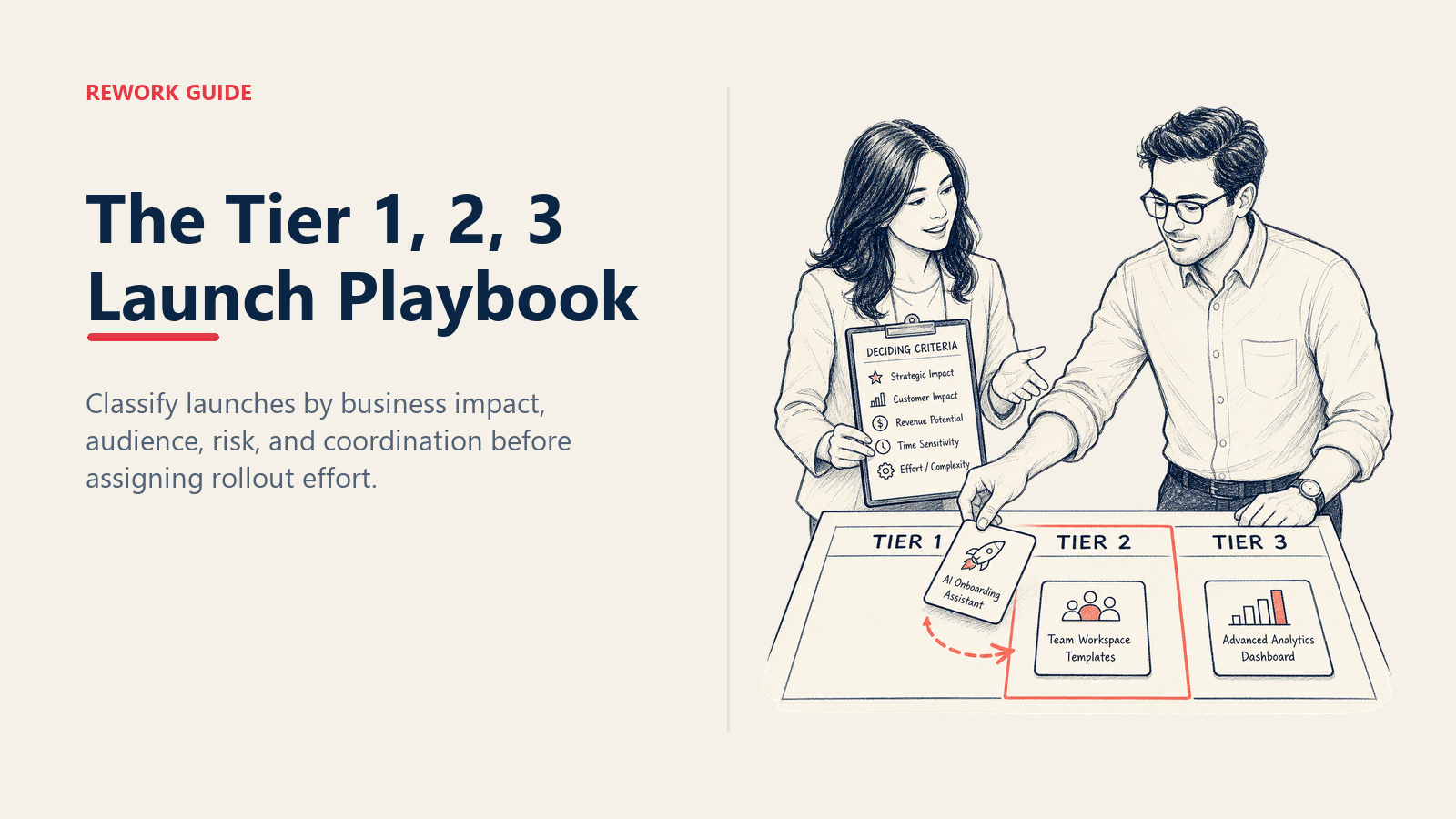
The Tier Definitions (Be Concrete or It Won't Hold)
Vague tiering ("Tier 1 is the big stuff") collapses the moment a PM pushes back. Tie each tier to specific tactics, time costs, and frequency caps. Then the conversation shifts from feelings to math.
Tier 1: Category-Defining Moves
What it gets: Mainstream press push, full sales enablement program (training + certified pitch + objection handling + role-play), paid media spend ($50K-$500K range), exec keynote slot, analyst pre-briefs, customer reference build-out, dedicated landing page, demand gen sequence, and a 30-day post-launch amplification plan.
What qualifies: New product line. Pricing model change. Major positioning shift. Acquisition announcement. Net-new ICP expansion. The kind of moves that change the answer to "what does your company do?"
Frequency cap: 2-4 per year. Hard cap. If you're trying to do 5, one of them isn't really Tier 1.
PMM time cost: 60-80 hours per launch.
Tier 2: Solid Feature Additions and Expansions
What it gets: Blog post (1,200-1,800 words), customer email to a segmented list, sales nudge in the Monday standup with a one-pager, organic social across LinkedIn and X, in-product announcement, and a single demand gen email.
What qualifies: Meaningful feature additions, integration launches, expansions into adjacent use cases, regional rollouts, and customer-facing reporting upgrades. The stuff that's worth talking about but doesn't require analyst phone time.
Frequency cap: 1-2 per month, max.
PMM time cost: 12-20 hours per launch.
Tier 3: Changelog Cadence
What it gets: Changelog entry, in-app tooltip, maybe a tweet from the product handle. That's it.
What qualifies: Bug fixes, small UX wins, performance improvements, settings page additions, minor API enhancements.
Frequency cap: Weekly is fine. Daily even.
PMM time cost: Under 4 hours, including QA on the tooltip. If you're spending a full day on a Tier 3, you're tiering it wrong.
Tier-Decision Matrix
| Signal | Tier 3 | Tier 2 | Tier 1 |
|---|---|---|---|
| Changes positioning? | No | No | Yes |
| New ICP or segment? | No | Adjacent only | Yes |
| Sales talk track changes? | No | Light update | Full rewrite |
| Pricing or packaging touched? | No | No | Yes |
| Press worth pre-briefing? | No | Industry blogs maybe | Tier-1 outlets |
| Customer reference required? | No | Optional | Required |
| 30-day amplification plan? | No | No | Yes |
Three or more "yes" answers in the right column? It's a Tier 1. Two? Probably a Tier 2 with a stretch goal. One or zero? Tier 3, and stop arguing.
The Launch Brief: Four Questions, Copy-Paste Block
Before any tiering call, the PM has to fill this out. Four questions, no exceptions. If they can't answer them, the launch isn't ready to be tiered yet.
LAUNCH BRIEF: [Feature/Release Name]

1. The Offer
   What is this, in one sentence a customer would understand?
   (Not a feature list. The "what does it do for me" answer.)

2. The Audience
   Who specifically cares? Name the segment by company size,
   role, and use case. "Users" is not an answer.

3. The Success Metric
   What will tell us this worked in 30 days?
   Pipeline created? Activation lift? Retention? Pick one
   primary metric and a target number.

4. The Kill Criteria
   What is the one thing that would make this fail in week one?
   (Not a vague risk. A specific, observable failure mode.)
If a PM hands you a brief that says "the audience is enterprise customers" and "the success metric is adoption," send it back. That's not a brief. That's a wishlist.
The kill criteria question is the one most teams skip, and it's the most useful. It forces a PM to name the assumption their launch rests on. Once it's named, you can plan around it, or downgrade the tier because the assumption is too shaky to bet ad spend on.
The Kickoff RACI
Most launches break on ownership ambiguity, not on bad ideas. Get the RACI written down in the kickoff and pinned in the launch channel. If you're new to RACI: R = Responsible (does the work), A = Accountable (one person, signs off), C = Consulted (gives input), I = Informed (gets a heads-up).
| Workstream | R | A | C | I |
|---|---|---|---|---|
| Tier call | PMM | PMM | PM, Head of Marketing | Sales lead, CSM lead |
| Launch date | PM | PM | PMM, Sales lead | Demand gen, CSM |
| Narrative & messaging | PMM | PMM | PM, Head of Product | Sales, CSM |
| Scope & feature definition | PM | PM | Engineering, Design | PMM |
| Sales enablement | Sales lead | PMM | Sales reps | CS, Support |
| Paid media & email | Demand gen | Demand gen | PMM | Sales, Finance |
| Customer comms | CSM | CSM | PMM, Support | Sales |
| Press & analyst outreach | PMM | PMM | CMO, CEO | PM, Sales |
| Day-of war room | PMM | PMM | All | Exec team |
The single most common breakdown: PMM is Accountable for the launch but isn't Consulted on the launch date. The PM picks a date, marketing finds out two weeks later, the press window is gone, and the launch ships into a void. Fix that one thing and you've solved 40% of your launch problems.
T-Minus Timeline by Tier
| Milestone | Tier 1 | Tier 2 | Tier 3 |
|---|---|---|---|
| Kickoff & brief signed | T-8 weeks | T-3 weeks | T-3 days |
| Tier call locked | T-7 weeks | T-3 weeks | T-3 days |
| Narrative draft v1 | T-6 weeks | T-2 weeks | N/A |
| Analyst pre-briefs (under NDA) | T-4 weeks | N/A | N/A |
| Press embargo outreach | T-3 weeks | N/A | N/A |
| Sales enablement training | T-2 weeks | T-1 week | N/A |
| Demand gen creative live | T-1 week | T-3 days | N/A |
| Customer email scheduled | T-1 week | T-2 days | N/A |
| In-app tooltip QA | T-3 days | T-1 day | T-1 day |
| Changelog entry drafted | T-2 days | T-1 day | T-1 day |
| Launch day | T-0 | T-0 | T-0 |
Tier 1 needs eight weeks because press and analyst calendars are not yours to control. Briefing a top-tier outlet 10 days out is how you get a polite "we'll pass." Tier 2 needs three weeks because sales reps need at least a full sprint to internalize a new pitch before customers ask about it. Tier 3 needs three days because you still have to QA the tooltip in production.
Day-Of Checklist
Short, tactical, printed if needed. Same template for any tier. Only the staffing differs.
- Status page reviewed and updated
- Support team briefed on top 5 expected questions with answers
- Monitoring dashboards open (error rates, conversion funnel, latency)
- One named PMM on Slack standby for the first 4 hours post-launch
- One named engineer on standby for the same window
- Sales reps confirmed they have the latest deck and one-pager
- Customer email queued and double-checked for the right segment
- Press contacts list has the launch link, not the staging link
- Pricing page reviewed if pricing changed (this is the one that gets missed)
- Internal Slack announcement scheduled for the all-hands channel
That last "internal announcement" item matters more than people think. If your own team finds out about the launch from a customer, you've already lost the room.
The Post-Launch Debrief: +2, +14, +30
This is where most teams quit, and it's why they keep making the same mistakes.
+2 days, the "did anything break" check. Quick standup with PM, support, and engineering. Any incidents? Any spikes in churn signals? Any customer escalations? Document it in a one-pager. This is not a retrospective. This is triage.
+14 days, early metrics vs. target. Now we look at the success metric the PM committed to in the launch brief. Pipeline created? Activation lift? Compare to target. If we're at 30% of target, that's a flag, not a verdict, but it's a flag we have to discuss now, not at +90.
+30 days, full retrospective. What would we tier differently next time? What broke in the kickoff? Did sales actually adopt the new talk track? Did the press push deliver against the analyst pre-briefs? This is the meeting that compounds. Skip it twice and your tiering judgment stops improving.
The +14 is the one most teams skip because it feels too early to call. It isn't. The early signal is almost always directionally correct, and acting on it gives you 16 more days of recovery time.
Diagnosis: "Second-Week Launch Death"
Here's a pattern worth naming. The launch hits big on day one: press picks it up, the demand gen email outperforms benchmark, the sales team is fired up. By day eight, traffic has flatlined. By day fourteen, the launch is functionally over. The team is already pivoting to next month's release.
This is Second-Week Launch Death. It happens because nobody planned the second wave.
A real Tier 1 launch has at least three more beats after day one: a customer case study at +10 days (proof that someone real is using it), a partner amplification moment at +14 days (a co-marketing post or webinar), and a comparison or competitive content piece at +21 days (so search picks up the long tail). Without these, your launch is a one-day spike.
If you keep seeing big peaks and short tails, you don't have a launch problem. You have a follow-through problem. Fix it by adding the +10/+14/+21 beats to your Tier 1 T-minus template.
Common Tier 1 Fails to Watch For
Three more diagnoses worth naming, because once you can name them, you can spot them:
Embargo Mismatch. Press goes out at 6am ET. Your blog post auto-publishes at 9am ET. So the press has the story for three hours before your own website confirms it. Reporters get spooked, customers see "is this real?" tweets. Fix: align the embargo lift with your own publish time, to the minute.
Enablement Lag. Press is talking about the new positioning. Sales is still pitching the old one. Two weeks in, a prospect asks a rep about something they read in TechCrunch and the rep says "let me check on that." Fix: lock sales enablement training at T-2 weeks, certify reps before launch day, audit live calls in week two.
Pricing Page Drift. Marketing site updated. Pricing page still shows the old plan. This is the single most common Tier 1 failure mode. It's also the one that's 100% preventable if you put pricing on the day-of checklist.
Analyst Cold Shoulder. You briefed analysts at T-1 week. They had no time to write anything thoughtful, so they wrote nothing. The launch ships without third-party validation. Fix: T-4 weeks minimum for analyst pre-briefs, and treat their schedule as fixed, not yours.
The Real PMM Skill
The PMM job isn't running every launch. It's saying "this is a Tier 3" to a PM who genuinely believes they shipped the iPhone. That conversation is uncomfortable. It's also where most of your value sits.
Every "no" you defend creates room for the right launches to land. A team running 4 Tier 1s a year and 60 Tier 3s ships more meaningful narrative than a team running 12 "Tier 1s" that all blur together. Tiering isn't bureaucracy. It's permission to focus.
The framework only works if you actually use it to say no. Print the matrix. Pin it in the launch channel. Bring it to the roadmap review. And when a PM pushes back, walk through the four launch brief questions out loud. Either the launch passes the bar, or it doesn't. The framework is the conversation.
Learn More
- The PMM Operating Cadence: Weekly, Monthly, Quarterly Rituals
- Sales Enablement That Reps Actually Use
- Positioning Doc Template (One Page, Not Twelve)
- Launch Metrics That Aren't Vanity
- Product Marketing Manager Job Description Template

Principal Product Marketing Strategist
On this page
- The Real Cost of Treating Everything as Tier 1
- The Tier Definitions (Be Concrete or It Won't Hold)
- Tier 1: Category-Defining Moves
- Tier 2: Solid Feature Additions and Expansions
- Tier 3: Changelog Cadence
- Tier-Decision Matrix
- The Launch Brief: Four Questions, Copy-Paste Block
- The Kickoff RACI
- T-Minus Timeline by Tier
- Day-Of Checklist
- The Post-Launch Debrief: +2, +14, +30
- Diagnosis: "Second-Week Launch Death"
- Common Tier 1 Fails to Watch For
- The Real PMM Skill
- Learn More