Your First 30/60/90 Days as a New Chief of Staff
Turn this article into takeaways for your work.


Each assistant summarizes the article only for you and suggests best practices for your work.
You walked in Monday expecting clean strategy work. By Wednesday you've learned that two VPs haven't spoken in three weeks, the CEO is forwarding you Slack threads at 11pm, and the company Notion has 47 half-built initiatives with no owner. None of this was in the job spec. Welcome to Chief of Staff.
The job isn't strategy. The job is making the leadership team work. Strategy work shows up around month four, after you've earned the right to do it. The first 90 days are about earning trust without overstepping, killing the right things at the right time, and arriving at day 90 with a defensible operating cadence and a metric of your own.
Why This Matters Now
Chief of Staff hires get fired faster than almost any other senior IC role. Median tenure in B2B SaaS sits around 18 to 22 months, and the failure mode is almost always set in the first 90 days. Move too fast and the leadership team treats you as the CEO's enforcer; every meeting goes quiet when you walk in. Move too slow and the CEO concludes you're "not operational enough" and you stop getting invited to the meetings that matter.
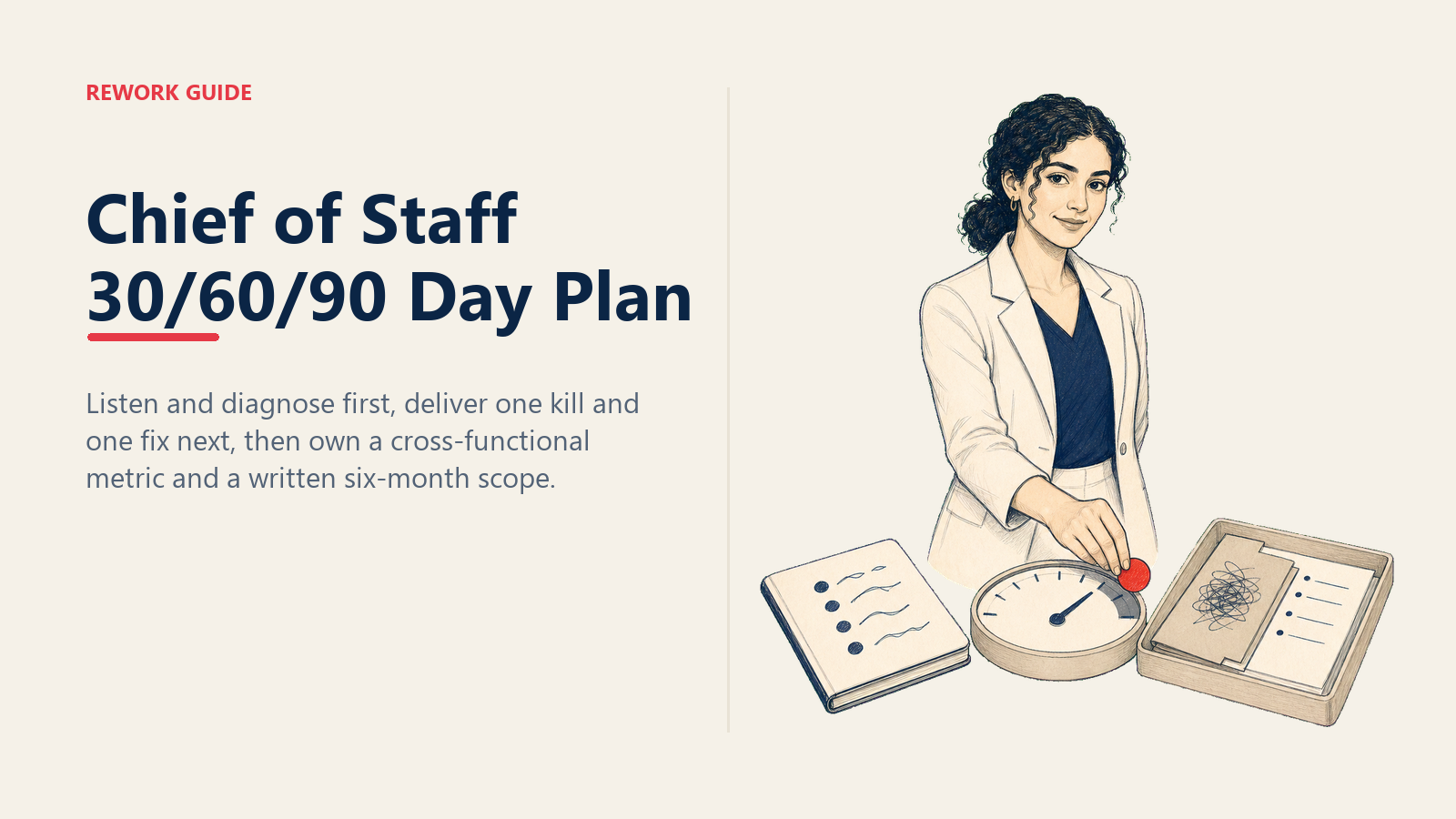
The 30/60/90 frame keeps you in the middle lane. Fast enough that the CEO sees you operate. Slow enough that the leadership team trusts you. Day 30 produces a diagnostic, not a plan. Day 60 produces one kill and one fix, not a transformation. Day 90 produces a metric you own and a strategy artifact with your name on it.
Days 1-30: Listen, Map, Diagnose (don't ship anything)
The hardest part of the first 30 days is doing nothing visible. You will feel useless. The CEO will ask what you're working on and you won't have a satisfying answer. Sit with that. The work here is invisible by design.
1:1s with all 6-10 leaders in the first 14 days
Get on every executive's calendar in the first two weeks. Same five questions, written notes, no recommendations.
- What's the most important thing happening in your function, and what's blocking it?
- What does a great quarter look like for you in 90 days?
- Where are we strong, and where do we have a real problem?
- What do you wish leadership team meetings actually produced?
- If you could change one thing about how decisions get made here, what would it be?
You're not solving anything. You're listening for patterns. The first time three leaders independently mention the same broken process, that's your first real signal. The first time two of them name each other as the blocker, that's your second.
Tell each leader the notes are private to you and the CEO unless they say otherwise. Mean it.
Audit the operating cadence
Build a spreadsheet of every recurring leadership meeting. Columns: name, owner, frequency, attendance rate (last four instances), stated purpose, actual decision produced. Most Series B-to-D companies have 12 to 25 recurring leadership meetings. Maybe four of them produce decisions. The rest are status theater.
Don't tell anyone what you found yet. You just know.
Map decision flows for the last 3 big company decisions
Pick the last three real decisions: a pricing change, a headcount cut, a GTM pivot. Map who actually made the call versus who showed up in the room. The gap between those two lists is where the dysfunction lives.
I once worked at a company where every "leadership decision" was technically made in a Tuesday exec meeting. The actual decisions were made on a 20-minute walk between the CEO and the head of revenue every Friday. The Tuesday meeting was ratification. Once I understood that, the rest made sense.
Identify the top 3 broken processes
By day 25, three broken processes will have surfaced. Almost always the same three: the weekly business review (no agenda, no decisions, runs over), hiring approvals (too many approvers, no SLA, hires lost to a slower yes), and cross-functional planning (Q3 roadmap shipped without GTM seeing it). Yours might differ. The point is to have three, named, with evidence from at least two leaders each.
Day-30 deliverable: 1-page diagnostic
Not a plan. A diagnostic. One page. What you heard, what's working, what's broken, what you'd like to spend the next 30 days on. No solutions yet. The restraint is political. Walk in with solutions on day 30 and every leader you interviewed will assume you used their words against them. Walk in with a diagnosis and an ask for permission, and you stay in the trust window.
Format I use:
Day 30 Diagnostic, [Your Name], CoS What I heard (top 3 themes): ... What's working: ... What's broken (top 3): ... What I'd like to work on next 30 days: ... What I need from you: ...
End with one specific ask. "I'd like to kill [initiative X]. I need your air cover." That's how day 31 starts.
Days 31-60: One Kill, One Fix, One Proposal
The temptation is to fix everything you saw in month one. Don't. Pick one kill, one fix, one proposal. Deliver all three before day 60. That's enough.
Kill 1 dead initiative
Find one initiative that meets all three criteria: low political cost, zero active sponsor, visible to the leadership team. Maybe a partnership program nobody's touched in four months. Maybe a "rebrand" with one slide deck and no owner.
Write the kill memo. One page: what it was, why it started, why it's not getting done, what we reclaim (engineering hours, OKR line item, mental load). Run it past the CEO first for air cover. Then send it to the leadership team with a hard 48-hour deadline for objections. If nobody objects, it's dead. Update the Notion. Tell the team in the next leadership meeting in one sentence.
The first time I killed an initiative, my hands were shaking when I sent the email. Nobody objected. The head of product DM'd me afterwards: "Should've killed that six months ago. Thank you." That's when you stop being the new CoS and start being the CoS.
Fix 1 broken meeting
Almost always this is the weekly leadership meeting. The fix is mechanical:
- Pre-reads required 24 hours in advance, three sections: numbers, decisions needed, risks. Status updates go async.
- Decision log in a shared doc, every decision dated and assigned. Read aloud at the end of every meeting.
- Hard stop at the scheduled time. Unfinished items go to next week or async.
- Owner rotation for note-taking. You take notes for three weeks, then it rotates.
Don't propose this as a redesign. Just start doing it. Week one, show up with the pre-read template filled in for the CEO. Week two, ask each function lead to fill in their section. Week four it's just how the meeting runs.
Propose operating cadence redesign
By day 50 you have enough data. Weekly business review (numbers and decisions, 60 min). Monthly leadership offsite (strategy and people, half day). Quarterly OKR review (commitments and retrospective, full day). Cross-functional planning sync (biweekly, separate from leadership meeting).
Write it as a one-page proposal. Show current state (your audit, summarized), proposed state, and what gets killed (probably 6 to 10 of those 25 recurring meetings). Show the math on hours saved per leader per week. The math is what gets it approved.
Show up in conflicts as a translator, not a judge
By month two, leaders will try to use you. Product pulls you aside to complain about engineering. The CRO asks you to "have a conversation" with the CFO about forecasts. This is the inflection point.
Don't take sides. Don't refuse to engage. Be a translator. "What I'm hearing from product is X. What I'm hearing from engineering is Y. Want me to broker a conversation?" You set up the room. You stay neutral. You don't render a verdict. The CEO does that, if it needs doing.
The first time a leader tries to make you their ally against another leader, politely decline and offer the broker move instead. Do this once and the team will know within a week you can be trusted in private. That's the asset you're building.
Days 61-90: Own a Metric, Present the Plan
Now you stop being invisible. The last 30 days are public ownership.
Own a leadership team metric
Pick one cross-functional metric. Candidates:
- Forecast accuracy (especially if your CRO is shaky on it)
- Hiring velocity (approved req to signed offer)
- Cross-functional cycle time (ask to delivery between functions)
- Leadership 1:1 completion rate (boring but high signal; when leaders stop doing 1:1s, things break in 60 days)
- Decision velocity (decisions logged per week, time from raised to resolved)
Pick one. Report on it weekly to the CEO. Put it in the leadership meeting pre-read. The metric is yours. You publish it whether it's good or bad.
Until you own a number, you're scaffolding. The day you own a number is the day you become a peer. It doesn't have to be the most important number in the company. It has to be a number you'd defend at the board.
Present the 90-day report
Day 88 or 89, present a 30-minute readout to the CEO and full leadership team. Four sections:
- What I found (the diagnostic, now public)
- What I killed (initiative by name, hours reclaimed)
- What I fixed (the meeting, before/after)
- What's next (cadence redesign, the metric you own, your H2 scope)
Keep it tight. Take questions for 15 minutes. Don't be defensive. If a leader pushes back on a kill, name what you'll do differently next time.
Propose the H2 strategy or operating plan
This is the artifact that converts "new CoS" into "the CoS." It can be an H2 operating plan, a quarterly OKR refresh, or a strategy doc on a specific bet. The format matters less than the byline. Your name is on it. The CEO endorses it. The leadership team executes against it.
Then get explicit buy-in on your scope for the next six months, in writing. A short doc, signed off by the CEO: what the CoS owns, what the CoS doesn't own, the metrics for evaluation. This document protects you in month seven when somebody on the leadership team decides you've overreached.
Real-World Friction
The two VPs who won't talk. They had a fight three quarters ago and now route everything through the CEO. Don't try to fix the relationship in month one. Set up a single small working session where they have to agree on one specific thing, usually a shared metric or handoff process. You broker. You don't moralize. After the session, both owe you a small favor. Bank those. Use them in month four.
The founder-CEO who plays favorites. Common under 200 people. There's a "first lieutenant," usually a cofounder or the first VP, and the rest of the team knows it. Your job is not to neutralize the favorite. Your job is to make sure the rest of the leadership team still hears what they need to hear. If decisions only get made in side conversations, formalize a forum where they have to be made in the open.
The head of product who treats every CoS as a threat. Senior heads of product sometimes read CoS as "the role that will eventually become COO." The defense is to be useful to them on day 12. Help them prep the next board update. By day 45 they're asking your opinion on roadmap. By day 90 they're an ally.
The 11pm Slack forwards. Every founder-CEO I've worked with does this. No context, sometimes no message. You train this in week one. Force a "what does success look like in 90 days" conversation and ask: how do you want to flag urgent things? What's the latest hour you expect a response? What's the difference between "FYI" and "do something"? If you don't set this in week one, you'll be answering Slack at 11pm in month six.
The CoS-as-therapist trap. In month two, leaders will vent to you. About each other. About the CEO. It feels good. They trust you. You feel important. By month six you've absorbed everyone's frustrations, you can't repeat any of them, and you've become emotionally responsible for the leadership team's mental health. That's not the job. Listen, then redirect: "That sounds hard. Have you raised it with [person] directly? Want me to broker that conversation?"
Common Pitfalls
- Trying to fix everything in month 1. You don't have the trust yet.
- Getting captured by the CEO's loudest direct report. Whoever talks to you most isn't necessarily the most important leader. Spend equal time with the quiet ones.
- Taking sides in conflicts before you understand them. Translator, not judge. At least until month four.
- A 90-day plan with no metric you own. If your day 90 report has no number with your name on it, you're still scaffolding.
- Skipping the scope agreement. Get it in writing. You'll need it.
Templates
- First-30-day 1:1 question set: the five questions above, identical for every leader.
- Operating cadence audit spreadsheet: meeting / owner / frequency / attendance / decision produced / keep-kill-redesign.
- Day-30 diagnostic memo: one page, format above, one specific ask at the bottom.
- Kill memo: one page; what it was, why it started, why it's not getting done, what we reclaim.
- Day-90 report: what found / what killed / what fixed / what's next / metric I own.
These are tools, not deliverables. The deliverable is trust earned.
Measuring Success at Day 90
You can name every leader's top three priorities and biggest blocker without notes. At least one dead initiative is formally killed with leadership team agreement. The weekly leadership meeting produces a written decision log. You own at least one cross-functional metric reported to the CEO weekly. The CEO has stopped forwarding 11pm Slack threads, or you've negotiated a different channel.
Four of those five and you're in the middle lane. The leadership team trusts you, the CEO sees you operate, and you have a defensible story for the next 90 days. Strategy work shows up around month four. You'll be ready.
Learn More

Principal Product Marketing Strategist
On this page
- Why This Matters Now
- Days 1-30: Listen, Map, Diagnose (don't ship anything)
- 1:1s with all 6-10 leaders in the first 14 days
- Audit the operating cadence
- Map decision flows for the last 3 big company decisions
- Identify the top 3 broken processes
- Day-30 deliverable: 1-page diagnostic
- Days 31-60: One Kill, One Fix, One Proposal
- Kill 1 dead initiative
- Fix 1 broken meeting
- Propose operating cadence redesign
- Show up in conflicts as a translator, not a judge
- Days 61-90: Own a Metric, Present the Plan
- Own a leadership team metric
- Present the 90-day report
- Propose the H2 strategy or operating plan
- Real-World Friction
- Common Pitfalls
- Templates
- Measuring Success at Day 90
- Learn More