Path From Chief of Staff to VP Roles: The Honest Exit Map
Turn this article into takeaways for your work.


Each assistant summarizes the article only for you and suggests best practices for your work.
It's month 30. You're in the same chair you started in, running the same Monday cadence, and the CEO just made the same joke at the offsite for the third quarter in a row: "Don't worry, you'll never leave." Everyone laughs. You laugh. Then you go back to your desk and notice that Priya, who joined the IC track the same month you did, just got her VP title at a Series C with a real number under her name.
That joke is not a compliment. It's a warning.
The Chief of Staff role is one of the best seats in modern tech. Proximity to the CEO, every strategic decision in your earshot, leverage that nobody on an org chart can fully explain. It's also a role that quietly eats people who treat it like a destination. Two and a half years in, the recruiters who used to call about VP Strategy roles start calling about Chief of Staff roles at smaller companies. That's lateral. That's the role telling you the runway is shorter than you think.
This is the conversation nobody has with you when you take the job. How to leave well. When to leave. What to build before you go. And how to make sure the next chair you sit in says VP on the door.
Why CoS Is a 2-3 Year Role, Not a Career
The math is uncomfortable, so let's get it out of the way.
The CoS role compounds influence faster than almost any seat in a company. What it does not compound is credentials. After two years you have a network, a feel for executive dynamics, and a notebook of frameworks. You don't have a P&L line. You don't have a team you built and lost people from. You don't have an investor update with your name on it. Recruiters reading your LinkedIn see a smart person who's been adjacent to decisions, not someone who's owned them.
There's a second clock running that nobody mentions in the offer letter: CEO transitions kill the role overnight. If your CEO leaves, gets pushed, or pivots, you have roughly 90 days before the next leader brings their own person in. I've watched four CoS friends find this out the hard way. The role does not transfer the way a VP role does, because the role is built on a single human relationship.
Then there's the compounding problem. Every year you stay past year two, you become more useful to your CEO and less legible to the outside market. Your CEO can describe what you do in fifteen ways. A hiring committee at the next company cannot. They will pattern-match you to "executive assistant with a strategy degree" unless you've engineered the resume to say otherwise.
Two to three years. That's the window where the role pays off. After that, the math turns on you.
The Five Real Exit Paths
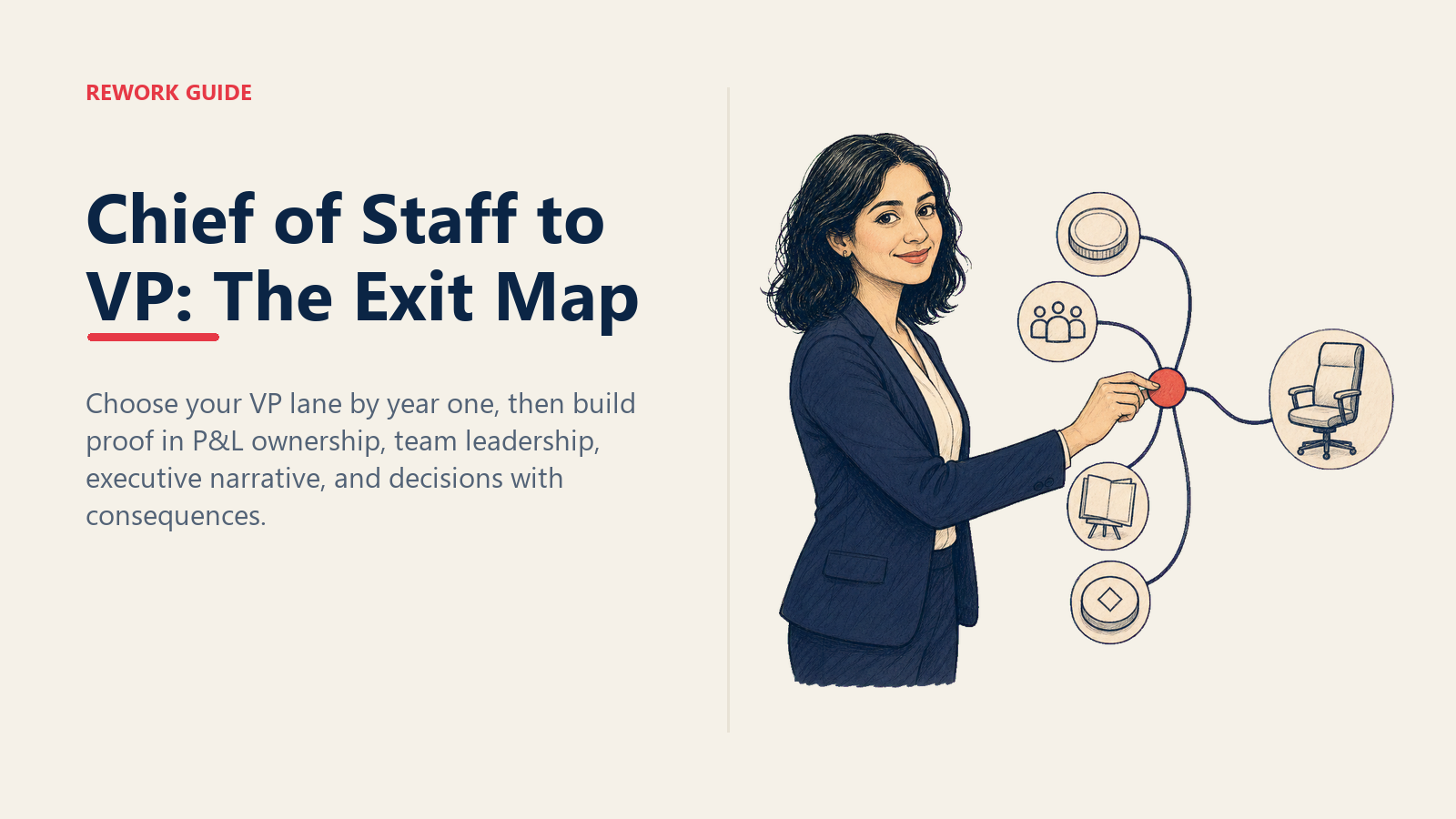
Most CoS exits cluster into five lanes. Each one rewards a different mix of the work you did, so the time to choose is year one, not year three.
VP Strategy or VP Corp Dev
This is the closest neighbor. Same building, different floor. It works if your CoS years included real strategy projects with named outcomes: pricing changes that moved gross margin, an acquisition you ran diligence on, a market entry where you owned the thesis. It does not work if your "strategy" was decks for the board that summarized other people's work.
Test yourself: can you name three projects where your analysis changed a meaningful decision and you can quantify the result? If yes, this lane is open. If no, you're aiming at it from too far away and you'll lose the interview to someone from McKinsey or BCG.
VP Business Operations or VP RevOps
The best path for operators, and statistically the most common landing spot. You already do most of the work: running the cadence, owning the dashboard, fixing cross-functional handoffs. The shift to VP BizOps is moving from doing it yourself to running a team that does it, with a number on your head.
Companies between $30M and $300M ARR are constantly hiring this role and they specifically value ex-CoS candidates because you've seen the executive view. If you don't have a strong opinion about which lane fits, this is the safest bet.
GM of a Business Unit
The P&L exit. Rare, but the most career-accelerating move available. You take over a product line, a region, or a segment, and you own revenue, cost, and headcount. The GM role usually requires the CEO to bet on you internally rather than hiring externally, which is why it almost always happens at your current company, not a new one. If your CEO has hinted at a GM seat, that's the moment to plant a flag and stop accepting "soon" as an answer.
A GM exit at year three is the single biggest comp jump in the CoS career arc. We'll get to numbers in a minute.
Founder
Roughly 15-20% of senior CoS go this way. You've watched the CEO job from a foot away, every day, for years. You either run toward that life or run away from it, but very few CoS land in the middle. The ones who start companies tend to do well in the first eighteen months because they already understand how a leadership team operates and how to ship board-quality narrative. They struggle with the parts the CEO had insulated them from, mostly fundraising as the face of the company and personally selling.
If you're founder-curious, the leave-by date matters more, not less. The longest-tenured CoS rarely become founders. The signal goes cold.
MBA at a Top 10 Program
The reset button. It works in two cases: you're under 30 and missing the credential to clear hiring filters at certain companies, or you're using the two years to pivot industries entirely (tech to climate, ops to investing). It does not work as an avoidance move. If you're considering an MBA because you can't see your next operator role, the MBA will not solve that. It will defer it by 24 months and add tuition.
The CoS-to-MBA-to-VP path exists, but it's slower than the direct VP exit. Use it on purpose, not as a hideout.
The Four Capabilities You Must Demonstrate Before Exiting
Here's where the year-one planning pays off. The VP interview, in any of the lanes above, tests four capabilities. If you can't show real evidence on all four, you'll lose to candidates from the operator track who built these in plain sight.
1. P&L Ownership
At least one project where you owned a number end to end. Revenue lift, cost takeout, headcount budget for a function, churn reduction in a segment. Doesn't matter which number. It matters that you owned it, you reported on it, and you either hit or missed and can talk about why.
Without this, you are a staffer, not an operator. Every VP I've watched get hired had a P&L story they could tell in two minutes, with the number, the lever, and the result. Without that story, the conversation never gets past round one.
The honest test: if a hiring manager asks "what number did you own and what happened to it," do you have an answer that includes a dollar amount? If the answer is "I supported the CEO on..." you're not ready yet, and you have to engineer a project that fixes that before you start applying.
2. Team Building
Hired, managed, and lost at least 2-3 people. The CoS who never builds a team cannot credibly run one, and every VP role is fundamentally a team-running role.
This is the capability most CoS underinvest in. You're so productive as a one-person operation that asking for headcount feels like extra friction. Ask anyway. Hire an analyst, a program manager, a junior CoS. Manage them through a real performance cycle. Lose one and learn what your management actually feels like under pressure.
The hiring manager wants to know you've sat across from someone you respected and told them they weren't performing. That conversation is a capability, and you can't fake having had it.
3. Exec Narrative
Owned a board slide, an investor update, a press moment, or an analyst conversation where your name was on the work. Not contributed to. Owned.
Translating CEO-brain into outside-world language is the VP skill. It's also the skill that the strongest CoS already have but rarely take credit for. Take credit. The board deck section on customer health that you wrote and the CEO presented is yours. The investor update where you drafted the narrative is yours. Make a list of these, with dates and audiences, and keep it current.
When the VP interview asks how you communicate strategy to senior stakeholders, you should be able to walk through three artifacts you produced and what landed.
4. Strategic Decision-Making With Skin in the Game
Made a recommendation, owned the outcome, lost on at least one. The lost one matters more than the wins.
CoS who only relay decisions never build the muscle. You have to be the person who said "we should kill this product line" or "we should hire ahead of plan in EMEA" and then watched what happened. The interviews will probe this. They'll ask about a decision you got wrong, and the answer "I don't really make decisions, I support the CEO" disqualifies you on the spot.
The fix is to volunteer for decisions, formally. Ask your CEO to let you own the recommendation on the next strategic question, not just the analysis. Take the meeting where you defend it. Take the loss when it doesn't work.
Comp Reality
Here are the bands as of late 2025 and early 2026, based on the offers I've seen and the recruiter conversations I trust. These are growth-stage to pre-IPO ranges in major US tech markets. Adjust down 15-25% for non-tech or smaller markets.
Chief of Staff at growth-stage SaaS ($30-100M ARR): $150K-220K base, 0.05-0.25% equity, $180K-260K total comp expected over four years. Some companies push higher on cash if equity is thin.
Chief of Staff at late-stage or pre-IPO ($150M+ ARR): $200K-280K base, smaller equity percentage but with real liquidity, $260K-380K total. The cash number looks great. The trap is that the equity is mostly already valued in, so the upside on staying long is small.
VP Strategy or VP BizOps exit: $200K-300K base, 0.1-0.5% equity at growth-stage, $300K-500K+ total with refresh grants over four years. You also get an option pool refresh on hiring, which is the part most CoS underestimate when comparing offers.
GM of a Business Unit exit: $250K-350K base plus a bonus tied directly to the BU's P&L. Total comp lands at $400K-700K when the BU performs, lower when it doesn't. The ceiling is meaningfully higher than VP BizOps because the bonus is uncapped and tied to outcomes.
The trap to avoid: lateral CoS moves at bigger companies pay better cash but kill your career velocity. A $250K CoS role at a household-name company looks great in the offer letter and adds 2-3 years before you can credibly interview for VP. The recruiter who placed you there knows this. You should too.
The "Stayed Too Long as CoS" Trap
This trap is real, and it has tells.
You spot it when the recruiter calls go quiet around month 30, after being constant for the previous year. You spot it when internal "VP" conversations with your CEO keep slipping by a quarter, then another quarter, with reasons that always sound like next time. You spot it when your CEO can describe in detail what you're doing now but can't articulate a single sentence about what's next for you.
It happens because the role is too useful to your CEO to let go of. That's not malice. That's compounding. Every quarter you make their life better, the cost of you leaving goes up for them and the muscle to plan your transition gets weaker. The CoS who stays five years almost always stayed because nobody (including them) drew a line.
The way out is mechanical. Set a leave-by date with yourself, not with your CEO. Write it down somewhere physical. When the date is six months out, start interviewing. When the date is three months out, line up the next role. When you have an offer signed, then you tell your CEO. Not before.
I know this sounds harsh. The first time I watched a friend tell their CEO at month 24 that they were "thinking about what's next" without an offer in hand, I watched them get talked into staying another 18 months. The conversation is unfair because the CEO is better at it than you. Have it after you've signed.
How to Position the CoS Experience on Your Resume
Resumes for ex-CoS candidates fail in predictable ways. They lead with access, not outcomes. They list responsibilities, not decisions. They quantify the cadence and forget the dollars.
Here's the rewrite pattern I use with every CoS preparing to leave.
Before: Supported CEO on strategic initiatives across the company.
After: Owned $4.2M cost-takeout initiative across G&A, delivered $3.8M in year one with 6-month payback.
Before: Ran weekly business review and quarterly OKR process.
After: Ran weekly business review covering $80M ARR across 4 BUs; reduced average decision time from 12 days to 4 days through escalation framework.
Before: Helped CEO prepare for board meetings and investor updates.
After: Owned investor update narrative and board deck strategy section across 8 quarters; led one Series D fundraise narrative with $90M raised at $720M valuation.
The pattern: lead with what you owned, name the dollars, name the time horizon, name the outcome. Hide the calendar work. Hide the inbox triage. Those things were 60% of your week and 0% of what you should put on paper.
Your LinkedIn headline matters too. The wrong headline is "Chief of Staff at Acme." The right headline says where you're going, not where you are. Try: "Operator | ex-CoS | targeting VP BizOps" or "Strategy and operations leader | building toward GM seat" or simply "Currently Chief of Staff | operator | next chapter coming." Recruiters scan for forward intent. Give them something to call you about.
A 12-Month Exit Prep Checklist
If you're between 18 and 24 months in, here's the checklist I'd run.
Months 18-21:
- Identify your target lane (VP Strategy, VP BizOps, GM, founder, MBA). Pick one.
- Audit your work against the four capabilities. Honestly. Where are the gaps?
- Negotiate a P&L-owning project with your CEO if you don't have one yet. This is non-negotiable.
- Start a "wins file" with named projects, dollar outcomes, and dates.
Months 22-26:
- Hire and manage at least one direct report if you haven't.
- Volunteer for one strategic recommendation where you own the call, not just the analysis.
- Rewrite resume bullets using the before/after pattern above.
- Update LinkedIn headline to forward-looking language.
Months 27-30:
- Reach out to three recruiters in your target lane. Tell them your timeline.
- Take 5-7 informational calls with VPs in roles you'd want next.
- Begin formal interviewing. Block 2 hours weekly.
Months 31-36:
- Land an offer. Sign. Then have the conversation with your CEO.
- Plan a clean 60-day transition. Document the cadence so the next person can run it.
- Leave on terms that keep you on every CEO's reference list for the next decade.
The Mindset Shift
Capabilities beat proximity when you're the one in the VP interview. The CEO who loves you and the recruiter who places you are not the same audience. The CoS who internalizes this in year one builds different work. The CoS who realizes it at month 30 has to scramble.
The role is a launchpad, not a landing pad. Your CEO is rooting for you, even when the role is using you up, and most of the CEOs I know want the CoS to leave well. They just need someone to give them the date.
That someone is you.
Learn More

Principal Product Marketing Strategist
On this page
- Why CoS Is a 2-3 Year Role, Not a Career
- The Five Real Exit Paths
- VP Strategy or VP Corp Dev
- VP Business Operations or VP RevOps
- GM of a Business Unit
- Founder
- MBA at a Top 10 Program
- The Four Capabilities You Must Demonstrate Before Exiting
- 1. P&L Ownership
- 2. Team Building
- 3. Exec Narrative
- 4. Strategic Decision-Making With Skin in the Game
- Comp Reality
- The "Stayed Too Long as CoS" Trap
- How to Position the CoS Experience on Your Resume
- A 12-Month Exit Prep Checklist
- The Mindset Shift
- Learn More