Exec Narrative and Board Prep Without Burning the Team
Turn this article into takeaways for your work.


Each assistant summarizes the article only for you and suggests best practices for your work.
It's 9:14pm on the Sunday before board day. Your CEO pings you: "Why does the revenue number on slide 14 not match slide 31?" You have 36 hours. Finance still hasn't sent final variance. Product's slide is in a different template. The CRO is on a flight and won't land until Tuesday morning. The board meeting is Tuesday at 2pm.
If this scene feels familiar, you are not alone, and the deck is not the problem. The deck is downstream of a missing narrative. Every board prep cycle I've watched fail follows the same pattern: each function builds their slides bottom-up, the Chief of Staff staples them together, and the CEO spends the weekend rewriting the connective tissue because no one ever decided what story the company was telling this quarter.
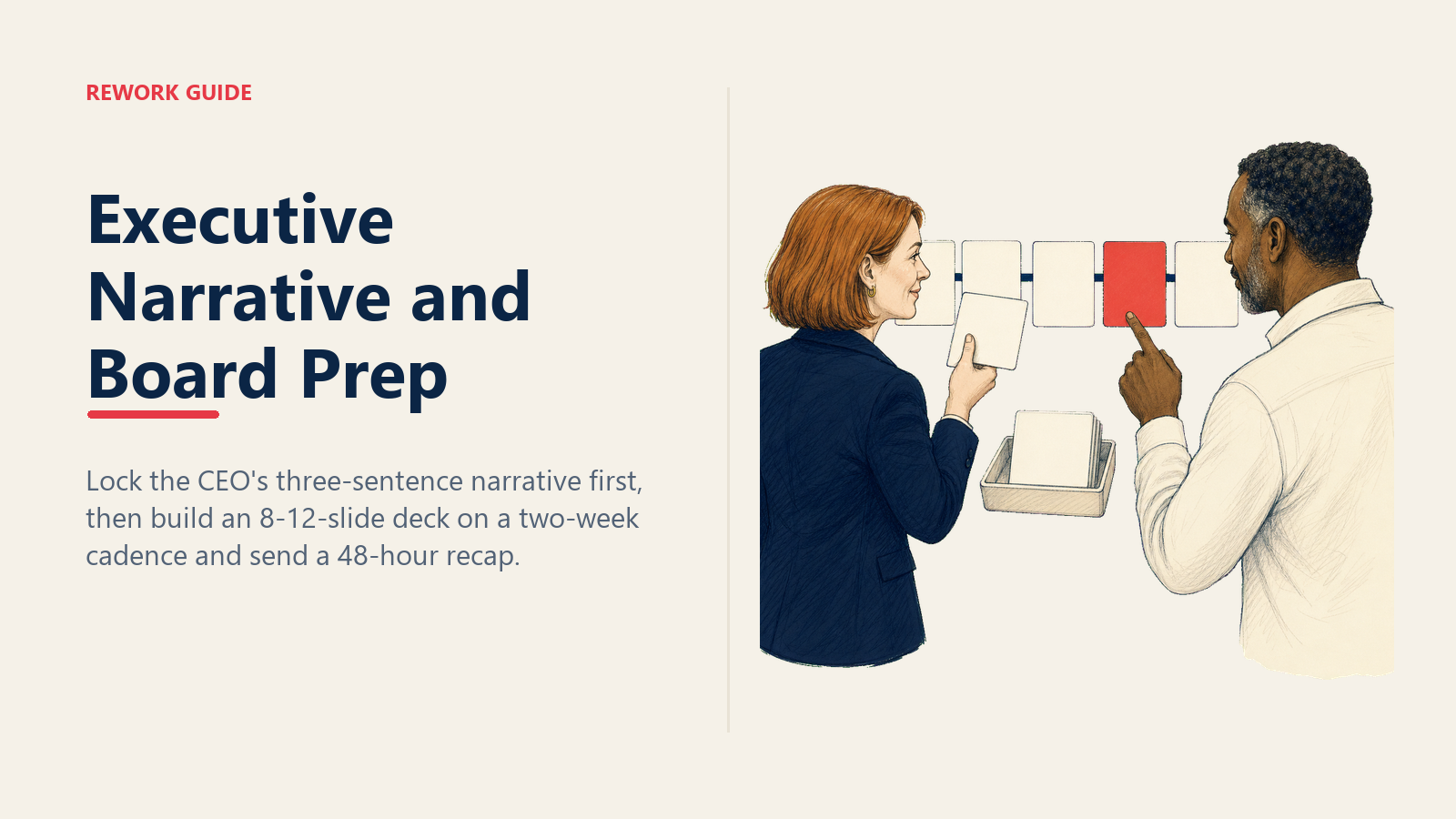
This playbook is the system I use to run a quarterly board cycle in two weeks instead of a fire drill, with an 8-12 slide narrative deck, a fixed prep cadence, and a post-board memo that closes the loop in 48 hours. It assumes you are the Chief of Staff or Strategy Lead running point with the CEO. If you're hiring for the role, the Business Operations Manager JD sets the bar.
Why every quarter feels like the first quarter
The first board prep I ran was a disaster. Forty-seven slides. Seven days of late nights. The CEO rewrote the opening on Sunday because the story he wanted to tell wasn't on any of the slides we'd built. The board read the deck for 11 minutes in the room and spent the rest of the meeting on three slides. I had spent 80 hours producing 36 slides nobody looked at.
The diagnosis was simple, and it took me two more cycles to actually believe it.
We were building bottom-up. Each function (Finance, Product, Sales, Marketing, CS) shipped their own slides built from their own internal review decks. My job, as I understood it, was to compile and format. The deck was a Frankenstein of operating-review artifacts pretending to be a board narrative. Numbers didn't tie. "What changed since last quarter?" required flipping through three appendices. Risk was buried because each function had an incentive to bury it. The asks, when they appeared at all, were vague.
The fix is to build top-down from the questions the board actually asks, and to be ruthless about what doesn't make the cut.
The 5 questions every board deck must answer
Boards are not your operating review. They are not subscribed to your weekly metrics. They are showing up four times a year to answer five questions, and if your deck doesn't answer them, they will ask anyway and you'll be doing it from memory.
- How are we tracking? Plan vs. actual on the 3-5 metrics that define the business. Not 17 metrics. Not vanity numbers. The ones the board signed up for when they wrote the check.
- What changed? Since last board: wins, losses, surprises. Named, specific, no euphemisms.
- Where's the risk? Top three risks, named and owned. If you're hiding risk, the board finds out anyway, and they trust you less the next time.
- What are we asking for? Capital, exec hires, intros to specific accounts, decisions on specific tradeoffs. Vague asks signal you don't know what you need.
- What's the bet? The one or two strategic moves you're making next quarter. The thing that, if it works, changes the trajectory.
That's it. Eight to twelve slides, depending on how many bets and risks you have. If your deck is longer, you don't know your story.
The 8-12 slide max rule
A 47-slide deck is a confession that you tried to anticipate every question instead of leading with your point of view. It says "I don't know what matters, so here's everything." Boards read it as low confidence even if the numbers are great.
Here is the skeleton I use. It maps cleanly to the five questions:
| Slide | Purpose | Maps to |
|---|---|---|
| 1 | Cover + meeting agenda (3 bullets) | (intro) |
| 2 | The narrative in 3 sentences (CEO's voice) | What's the bet |
| 3 | Metrics page (plan vs. actual) | How tracking |
| 4 | Cohort/retention page | How tracking |
| 5 | Variance-to-plan commentary | What changed |
| 6 | Wins since last board | What changed |
| 7 | Losses and surprises | What changed |
| 8 | Top 3 risks (named, owned) | Where's the risk |
| 9 | The bet for next quarter | What's the bet |
| 10 | Asks (3 specific items) | What asking for |
| 11 | Optional: org/hiring update | (context) |
| 12 | Optional: industry context | (context) |
Anything else lives in the appendix. Product roadmap details, cohort tables broken out by segment, the full hiring plan, every metric your team tracks internally: all appendix. The board can ask, and you'll have it. But it isn't part of the read-aloud story.
The metrics page (one slide, 5-7 numbers)
This is the slide most teams overbuild. The version that works:
- 5-7 numbers maximum, the ones that define the business.
- Four columns: Plan, Actual, Variance %, Trailing 4 quarters (sparkline or small numbers).
- Color-code variance: green if within ±5%, yellow ±5-10%, red >10%.
- Annotate red cells with a one-line diagnosis on the slide itself, not in a separate appendix.
For a SaaS business, the canonical 7: New ARR, Net New ARR, NRR, Gross margin, Cash burn, Cash runway, Headcount. For services: Bookings, Revenue, Utilization, Gross margin, Repeat revenue %, Cash, Headcount. The exact list depends on your model. What doesn't change is the discipline of picking 5-7 and refusing the 8th.
If a metric is on this slide, the CEO must be able to explain its movement in one sentence. If they can't, it shouldn't be on the slide.
The cohort/retention page
This is the slide that separates a board deck that proves the business compounds from one that just shows top-line growth. Top-line without retention is a leaky bucket dressed up.
For SaaS or usage businesses, the page shows:
- NRR by cohort (last 4-8 cohorts visible)
- Logo retention (gross and net)
- Expansion rate as a % of starting ARR
- One annotation: the cohort that's outperforming and why, or the cohort that's declining and why
For services or hybrid businesses, swap in:
- Utilization trend (last 4 quarters)
- Repeat revenue as a % of total
- Top-10 client concentration
The board uses this slide to decide whether your growth is durable or whether you're in a hamster wheel. Don't hide the cohorts that look bad. If a recent cohort is underperforming, name it on the slide and tie it to the diagnosis on the variance page.
The variance-to-plan page (no excuse theater)
Every miss has a named diagnosis and a named owner. Every beat has a named cause too. If you can't explain the upside, you can't repeat it, and the board knows it.
Bad variance commentary:
"Q1 ARR came in 12% below plan due to macro headwinds and longer sales cycles."
Better:
"Q1 New ARR came in $2.1M (12% below the $2.4M plan). Two named causes: (1) the SMB segment closed at 14-day cycles vs. the 9-day plan after we tightened qualification in February, owned by Sarah; (2) one $400K enterprise deal slipped to Q2, expected to close by April 30, owned by Marcus. Underlying win rate held at 28%."
The first version is filler. The second tells the board what happened, who owns it, and what they should expect next quarter. It also forces honest internal conversations because every named cause has a named owner who has to agree the diagnosis is fair.
I've stopped accepting variance commentary that uses the word "macro." It's almost never the real cause, and when it is, it's still not specific enough to act on.
The "ask" slide (three things, named)
The asks slide is where most decks lose the room. Vague asks like "support on go-to-market strategy" or "help with hiring" tell the board you haven't thought about what you actually need.
Good asks are specific and bounded:
- "Three intros to CROs at $100M+ retail SaaS companies. We have a target list of 12, attached as appendix."
- "Greenlight to hire a VP Marketing at the $260-300K base range, target start by July 1."
- "Decision on Series B timing. Recommend opening conversations in late Q3, materials draft ready by August 15."
Three items. Named. Bounded. Each one with a clear next step the board can take. If you have more than three, you have a prioritization problem, not an asks problem.
The 2-week prep cadence
The reason board prep used to take 80 hours is that it ran on calendar urgency instead of a cadence. Once I started running it as a 2-week sprint with fixed checkpoints, it dropped to about 25 hours of leadership time and zero weekend rewrites. The cadence:
| Day | Activity | Duration | Owner | Output |
|---|---|---|---|---|
| T-14 | CEO + CoS narrative session | 90 min | CEO + CoS | The 3-sentence narrative + slide skeleton |
| T-12 | Function lead briefing | 30 min × 4 | CoS | Each function knows their 1-pager prompt |
| T-10 | Function 1-pagers due | async | Function leads | One page each, no slides yet |
| T-9 | CoS first draft | 1 day | CoS | Slides 1-12, all numbers in placeholder |
| T-7 | Full draft circulated | async | CoS | Exec team has 48 hours to review |
| T-5 | Exec team review meeting | 60 min | CEO + execs | Comments, not rewrites |
| T-4 | CoS revision | 1 day | CoS | V2 with all comments addressed |
| T-3 | Dry run with exec team | 90 min | CEO + execs | Practice run, time the narrative |
| T-2 | Final numbers locked | async | CFO | All variance commentary final |
| T-1 | Final read-through | 30 min | CEO + CoS | Print, send to board |
| T-0 | Board meeting | 2-3 hours | Board | The meeting itself |
| T+2 | Post-board memo sent | async | CoS | 1-2 page summary to board |
The non-negotiables: the T-14 narrative session must happen with the CEO in the room, not over Slack. The function 1-pagers must be one page, not slides. Slides arrive at T-9 from the CoS, not from each function. The dry run at T-3 must be timed; if the CEO can't tell the story in 45-60 minutes, you cut slides until they can.
What to leave out
The discipline of the 8-12 slide rule is enforced by what you cut. Cut these every time:
- Detailed product roadmap by team. The board doesn't run sprint planning. One slide on the strategic bet is enough.
- Hiring plan line items by function. A summary on org slide is fine; the spreadsheet is appendix.
- Internal operating metrics. Pipeline coverage, MQL volume, NPS by segment, deploy frequency: these belong in your weekly business review, not the board deck.
- Competitor slides unless something changed. "Here's the competitive landscape" with the same logos as last quarter is filler.
- Any slide where the CEO would say "skip this one" in the room. If they'd skip it, cut it before printing.
The board is not your operating review. The operating review is where you go deep with the exec team weekly. The board is where you tell the story of the quarter and ask for what you need.
The post-board memo
The 48 hours after the board meeting are where most CoS teams lose three weeks of follow-up clarity. Decisions made in the room get remembered differently by different attendees. Asks get forgotten. Open items disappear.
The fix is a 1-2 page written memo, sent to the board within 48 hours. The structure:
Subject: [Company] Board Recap, [Quarter] [Year]

What we covered:
[3 bullets, the narrative arc]

What was decided:
[Numbered list, each with owner and date]

What's open:
[Items the board didn't resolve, with the date we'll come back to them]

What we committed to:
[Specific things the company said it would do before the next board]

Asks update:
[Status of each of the 3 asks: accepted, pending, declined]
Send it within 48 hours. Get the CEO's eyes on it before it goes. Two things happen as a result: board members reply with "yes that matches my notes" or "actually I thought we agreed on X", and you resolve the discrepancy in writing while it's fresh. And the company has a clear, dated list of commitments going into the next quarter, which is exactly what your operating cadence should be working from.
The deck is downstream of the narrative
The thing I wish someone had told me in my first year as a Chief of Staff: if your CEO can't tell the company's story in 90 minutes without slides, no amount of slide-making will fix it. The 47-slide deck was always a coping mechanism for a missing narrative. Once the narrative is locked at T-14, the deck becomes a translation exercise, not a creation exercise.
The 80-hour cycle becomes a 25-hour cycle. The Sunday-night fire drills go away. The CEO walks into the board room with a story they actually believe, and the board walks out with three specific next steps they can take.
That's the bar. Anything less and you're rebuilding the deck from scratch every quarter, which means you're rebuilding the story from scratch every quarter, which means you don't have a story.
Learn More

Principal Product Marketing Strategist
On this page
- Why every quarter feels like the first quarter
- The 5 questions every board deck must answer
- The 8-12 slide max rule
- The metrics page (one slide, 5-7 numbers)
- The cohort/retention page
- The variance-to-plan page (no excuse theater)
- The "ask" slide (three things, named)
- The 2-week prep cadence
- What to leave out
- The post-board memo
- The deck is downstream of the narrative
- Learn More