The Challenger Sale: Los 5 Perfiles Explicados

Turn this article into takeaways for your work.


Each assistant summarizes the article only for you and suggests best practices for your work.
The Challenger Sale transformó todos los supuestos sobre qué hace a un gran vendedor B2B. Cuando Matthew Dixon y Brent Adamson de CEB (hoy Gartner) publicaron su investigación en 2011, el hallazgo sacudió al mundo de las ventas: el tipo de vendedor que la mayoría de los gerentes comerciales contrataba y desarrollaba activamente era el que menos probabilidades tenía de ganar negocios complejos de alto valor.
Datos clave
- CEB encuestó a casi 6.000 vendedores de diversas industrias e identificó 5 perfiles de desempeño distintos. El perfil Challenger representó aproximadamente el 40% de los mejores vendedores en ventas complejas. (CEB/Gartner, 2011)
- En ventas transaccionales simples, el Relationship Builder es el perfil de mejor desempeño más común. En negocios complejos con múltiples responsables de la decisión, el Challenger domina. (Dixon & Adamson, The Challenger Sale, 2011)
- Los clientes que atraviesan una interacción de enseñanza comercial al estilo Challenger tienen un 53% más de probabilidades de realizar una compra de alta calidad y sin arrepentimiento. (CEB/Gartner, 2014)
¿Qué es The Challenger Sale?
The Challenger Sale es una metodología de ventas B2B desarrollada por Matthew Dixon y Brent Adamson a partir del análisis de CEB sobre casi 6.000 profesionales de ventas. El argumento central: los mejores vendedores no solo construyen relaciones ni responden a las necesidades del cliente. Enseñan algo nuevo sobre su propio negocio, adaptan el mensaje a lo que más importa a cada parte interesada y toman el control del proceso de venta.
La metodología surgió de una pregunta simple: durante la recesión de 2008, ¿por qué algunos vendedores prosperaron mientras la mayoría luchaba? La respuesta no estaba en la experiencia, el territorio ni el producto. Estaba en el comportamiento.
Los 5 Perfiles del Vendedor
La investigación de Dixon y Adamson categorizó a cada vendedor en uno de cinco perfiles según sus comportamientos, actitudes y habilidades dominantes. La mayoría de los vendedores tiene rasgos de varios perfiles, pero uno tiende a predominar.

| Perfil | Comportamiento central | Fortaleza | Debilidad |
|---|---|---|---|
| Hard Worker | Automotivado, alto volumen de llamadas, no se rinde | Esfuerzo constante y confiable | Depende del trabajo duro, no de la perspicacia |
| Relationship Builder | Construye campeones internos sólidos, evita el conflicto, generoso con su tiempo | Confianza a largo plazo | Evita la tensión, le cuesta contradecir al cliente |
| Lone Wolf | Sigue sus propios instintos, ignora los procesos, alta confianza en sí mismo | A menudo es un ejecutor natural | Impredecible, difícil de capacitar o escalar |
| Reactive Problem Solver | Orientado al detalle, confiable después de la venta, resuelve problemas rápidamente | Excelente en retención y renovaciones | Reactivo, no proactivo en nuevos negocios |
| Challenger | Enseña una nueva perspectiva, adapta los mensajes, toma el control del proceso | Gana negocios complejos con múltiples responsables de la decisión | Puede percibirse como confrontacional si se ejecuta mal |
En ventas transaccionales simples, varios perfiles tienen un desempeño similar. Pero en negocios complejos con múltiples responsables de la decisión, ciclos largos y riesgo organizacional real, los datos son contundentes: el perfil Challenger supera significativamente a todos los demás.
¿El hallazgo más revelador? El Relationship Builder es el perfil más común entre los vendedores de desempeño promedio en ventas complejas. Los vendedores que priorizan ser queridos, evitar conflictos y mantener cómodo al cliente también tienden a atascarse en la recta final.
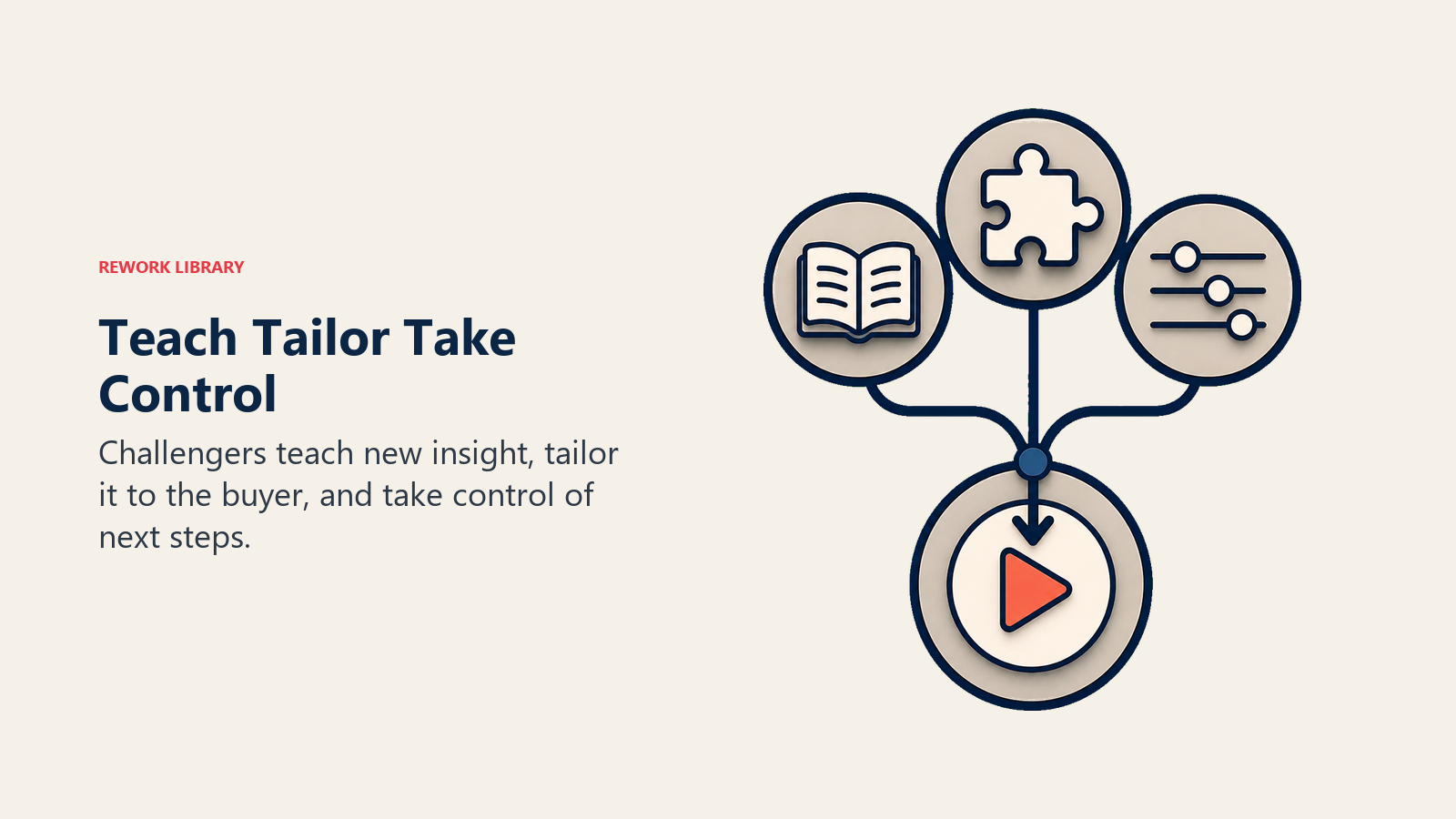
Teach, Tailor, Take Control
El método Challenger tiene tres movimientos distintos. Son secuenciales y omitir cualquiera de ellos arruina el enfoque.
Teach
Los Challengers abren con perspicacia, no con preguntas. En lugar de iniciar una llamada de descubrimiento con "cuénteme sobre su negocio", abren con un punto de vista: algo que el cliente no ha considerado, un problema que no sabía que tenía, o un patrón que el vendedor observa en empresas similares.
Esto se llama enseñanza comercial, y es la parte que la mayoría de los vendedores ejecuta mal. La enseñanza no es un argumento de venta disfrazado. Es una perspicacia genuina del negocio que reformula cómo el cliente piensa sobre su situación. La perspicacia debe generar incomodidad ("no sabíamos que nuestro proceso nos estaba costando tanto") que conduzca naturalmente a algo que su solución aborda.
Una buena enseñanza comercial es lo suficientemente específica para parecer creíble, lo suficientemente provocadora para generar urgencia, y lo suficientemente personalizada para que el cliente no sienta que está viendo una presentación genérica.
Tailor
No todas las partes interesadas de una empresa se preocupan por lo mismo. Un CFO se preocupa por la reducción de costos y riesgos. Un VP de Ventas se preocupa por la velocidad y el cumplimiento de cuotas. Un líder de operaciones se preocupa por la eficiencia y la plantilla.
Los Challengers ajustan su mensaje según quién esté en la sala. Entienden qué resultados económicos importan a cada rol y conectan la perspicacia del negocio directamente con lo que esa persona tiene que demostrar. Las presentaciones genéricas que tratan a todas las partes interesadas igual son territorio del Relationship Builder. Los Challengers hacen el trabajo para que sea personal.
Aquí es donde herramientas como el mapeo de partes interesadas dentro de su pipeline de ventas resultan útiles. Saber quién influye en un negocio y qué le importa a cada parte interesada es la base para adaptar bien el mensaje.
Take Control
Los negocios complejos se complican. Adquisiciones retrasa aprobaciones. Legal solicita renegociaciones. Los campeones dejan de responder. Las políticas internas descarrilan los cronogramas.
Los Challengers no entran en pánico ni persiguen al cliente. Mantienen el control al sentirse cómodos con la tensión constructiva. Cuando un cliente dice "necesitamos pensarlo", un Relationship Builder retrocede. Un Challenger pregunta qué está detrás de la duda y lo aborda directamente.
Tomar el control no significa ser insistente ni ignorar las preocupaciones del cliente. Significa estar dispuesto a contradecir, mantener firme el valor y guiar al cliente hacia una decisión en lugar de esperar a que surja. Esto es especialmente importante al descalificar prospectos que no son una buena opción. Un proceso claro de calificación de oportunidades respalda esto, porque los Challengers saben cuándo retirarse.
Challenger Sale vs Solution Selling vs Venta Consultiva
Estas tres metodologías se agrupan con frecuencia porque todas posicionan al vendedor como algo más que un tomador de órdenes. Pero tienen diferencias reales en énfasis y ejecución.
| Dimensión | Challenger Sale | Solution Selling | Venta Consultiva |
|---|---|---|---|
| Punto de partida | Perspicacia liderada por el vendedor (enseña primero) | Punto de dolor definido por el cliente (descubre primero) | Necesidades definidas por el cliente (comprende primero) |
| Rol principal del vendedor | Maestro y challenger | Solucionador de problemas y guía | Asesor de confianza |
| Estilo de interacción con el cliente | Provocador, reformula el problema | Colaborativo, confirma el punto de dolor | Diagnóstico, explora en profundidad |
| Maneja objeciones | Manteniendo la tensión y redirigiendo | Resolviendo preocupaciones con evidencia | Construyendo una comprensión más profunda |
| Mejor opción para | Negocios complejos donde los clientes no saben lo que no saben | Negocios donde el dolor es claro pero la solución es compleja | Ventas consultivas de ciclo largo con alta confianza |
| Riesgo si se ejecuta mal | Parece arrogante o fuera de lugar | Se estanca si el vendedor no puede diferenciarse en la solución | Pierde urgencia, el descubrimiento se vuelve indefinido |
The Challenger Sale fue en parte una respuesta a las limitaciones de Solution Selling. La investigación de CEB encontró que cuando los compradores contactan a los proveedores, ya han realizado una investigación significativa por su cuenta. Los vendedores que llegan a "descubrir el dolor" a menudo llegan demasiado tarde para moldear el pensamiento del cliente. Los Challengers intentan llegar antes de que el cliente haya definido completamente sus requisitos.
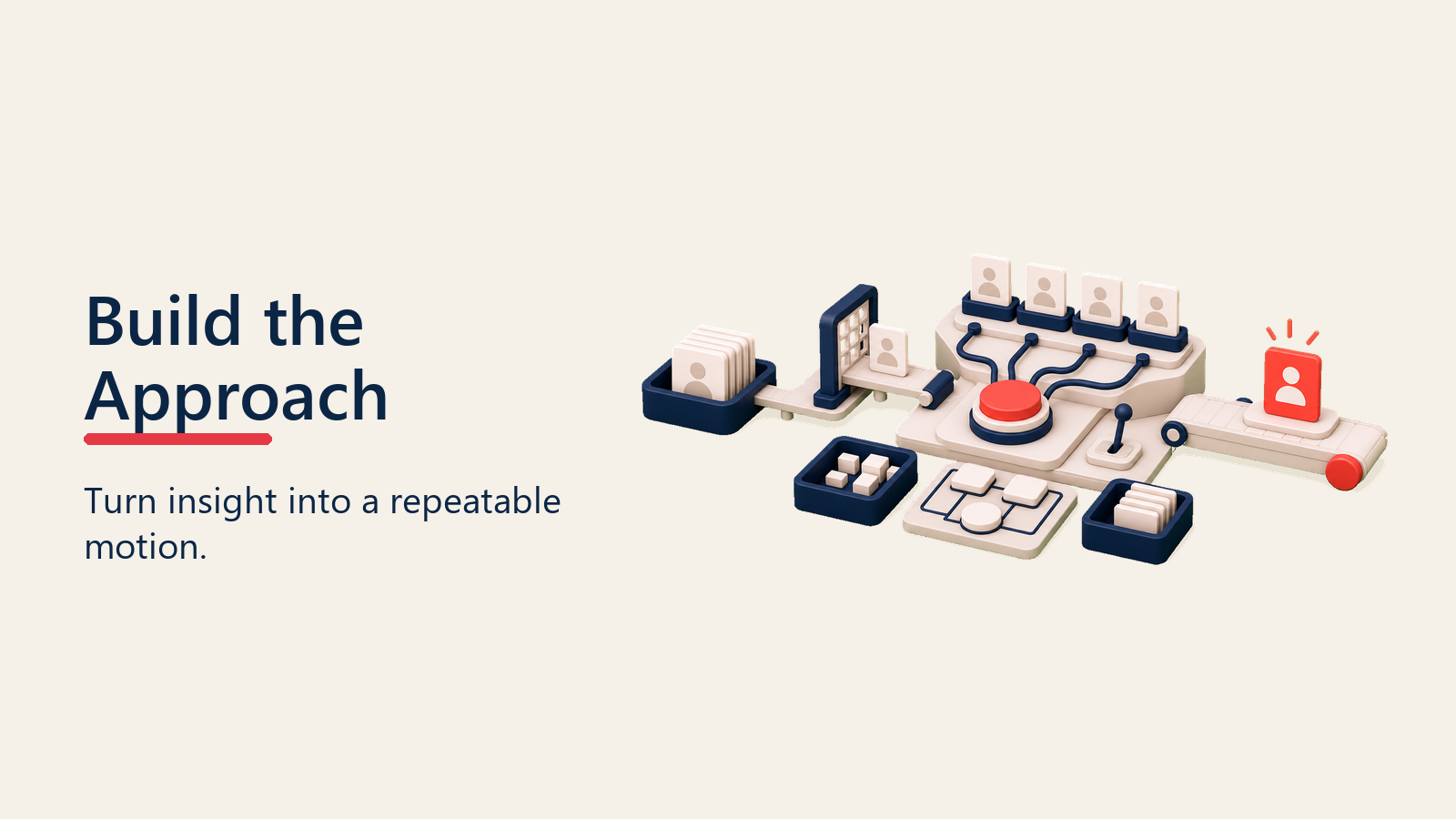
Cómo Construir un Enfoque de Ventas Challenger
No se contratan Challengers por accidente, y tampoco se pueden desarrollar por accidente. Así se construye la capacidad de forma intencional.

Evalúe su equipo actual según los cinco perfiles. Use grabaciones de llamadas, observaciones de gerentes y análisis de win/loss de negocios. Encontrará que la mayoría de los vendedores se concentran en Hard Worker y Relationship Builder. Ese es su punto de partida.
Construya una biblioteca de enseñanza comercial. Los Challengers necesitan perspicacias reales para enseñar. Trabaje con marketing, customer success y producto para desarrollar un conjunto de 5 a 10 perspicacias del negocio vinculadas a problemas comunes que enfrentan sus compradores. Cada perspicacia debe seguir el arco: "esto es lo que está pasando en su mundo, esto es por qué es un problema mayor de lo que cree, esto es lo que le cuesta, esta es una forma diferente de verlo".
Mapee las perspicacias a los roles de las partes interesadas. Para cada perspicacia, escriba una versión adaptada para cada perfil de comprador. ¿Qué significa esto para un CFO? ¿Para un COO? ¿Para un jefe de departamento? El trabajo de adaptación se hace de antemano, no durante la llamada.
Enseñe a sus vendedores a sostener la tensión. Esto es una habilidad, y la mayoría de los vendedores están condicionados a evitarla. Practique escenarios donde el cliente contradiga, solicite un descuento o quiera "pensarlo". Capacite a los vendedores para hacer preguntas clarificadoras en lugar de ceder.
Integre la calificación en el proceso. Los Challengers no pierden el tiempo en negocios que no cerrarán. Incorpore su marco MEDDIC o marco CHAMP en cada revisión de negocio para que los vendedores sepan cómo luce una oportunidad real antes de invertir en descubrimiento y adaptación completos.
Revise el pipeline usando criterios de avance del negocio. No se limite a preguntar "¿cómo fue la llamada?" Pregunte si el vendedor enseñó una nueva perspectiva, si adaptó el mensaje a cada parte interesada y si mantuvo el control cuando hubo resistencia. Consulte la gestión del avance del negocio para obtener criterios que puede aplicar por etapa.
Capacite el comportamiento, no solo el resultado. Un vendedor que sigue el método Challenger pero pierde el negocio aún hizo algo que vale la pena reforzar. Un vendedor que cierra mediante apalancamiento de relaciones solo podría estar construyendo un pipeline frágil bajo presión.
Ejemplos de The Challenger Sale
Así se ve un argumento de enseñanza comercial al estilo Challenger en la práctica.

Imagine que vende una plataforma de operaciones de ventas al VP de Revenue de una empresa SaaS de 200 personas. Un Relationship Builder abre con: "Cuénteme sobre su proceso de ventas actual y dónde está viendo desafíos". Un Challenger abre de manera diferente.
Apertura Challenger (enseñanza comercial):
"Hemos estado analizando datos de pipeline en unas 80 empresas SaaS de su tamaño, y seguimos viendo el mismo patrón. Aproximadamente el 60% de los negocios que llegan a etapas tardías terminan deteniéndose por más de 30 días sin un próximo paso claro comprometido por ambas partes. La mayoría de los líderes de nivel VP asumen que es un problema de productividad del vendedor, pero cuando profundizamos, casi siempre es un problema de visibilidad del pipeline. Los vendedores son optimistas sobre negocios que en realidad están atascados, y cuando aparece en el pronóstico, la recuperación es casi imposible. ¿Ese patrón coincide con algo que esté viendo?"
Esta apertura enseña algo específico. Nombra un patrón que el VP puede reconocer, reformula dónde deben estar mirando (visibilidad del pipeline, no productividad del vendedor) y crea una apertura natural para que el vendedor conecte su solución. No lidera con características ni siquiera con preguntas. Lidera con perspicacia.
Esa es la estructura de un argumento de enseñanza comercial: patrón, implicación, reformulación, pregunta.
Para contexto sobre cómo esto se intersecta con su enfoque de calificación, consulte los marcos de calificación de leads y el marco BANT para comparación.
Errores Comunes
Enseñar sin adaptar. Los vendedores aprenden el paso "Teach" y entregan la misma perspicacia comercial a todas las partes interesadas sin importar el rol. Un CFO que escucha un argumento diseñado para un COO se desconecta de inmediato. El paso de adaptación no es opcional.
Confundir el desafío con la confrontación. Tomar el control de un proceso significa guiar la conversación con propósito. No significa ser combativo, despectivo o arrogante. Los Challengers que pasan por alto las preocupaciones reales del cliente parecen fuera de lugar y pierden el negocio de todas formas.
Usar la enseñanza comercial como argumento de venta. La perspicacia debe crear un problema, no llevar directamente a su producto. Si el cliente escucha "aquí está el problema, aquí está nuestra solución" en los primeros cinco minutos, no es enseñanza. Es un argumento estándar con pasos adicionales.
Ignorar las relaciones existentes. La investigación no dice que las relaciones no importen. Dice que las relaciones solas no son suficientes para cerrar negocios complejos. Los Challengers también construyen confianza. Solo no dejan que el deseo de mantener esa confianza les impida decir cosas difíciles.
Capacitar la metodología sin construir el contenido. El Challenger selling falla si los vendedores tienen la técnica pero nada real que enseñar. La biblioteca de enseñanza comercial, los mensajes adaptados para cada parte interesada y el desafío respaldado por perspicacia requieren un trabajo serio de desarrollo de contenido antes de que los vendedores puedan usarlos eficazmente.
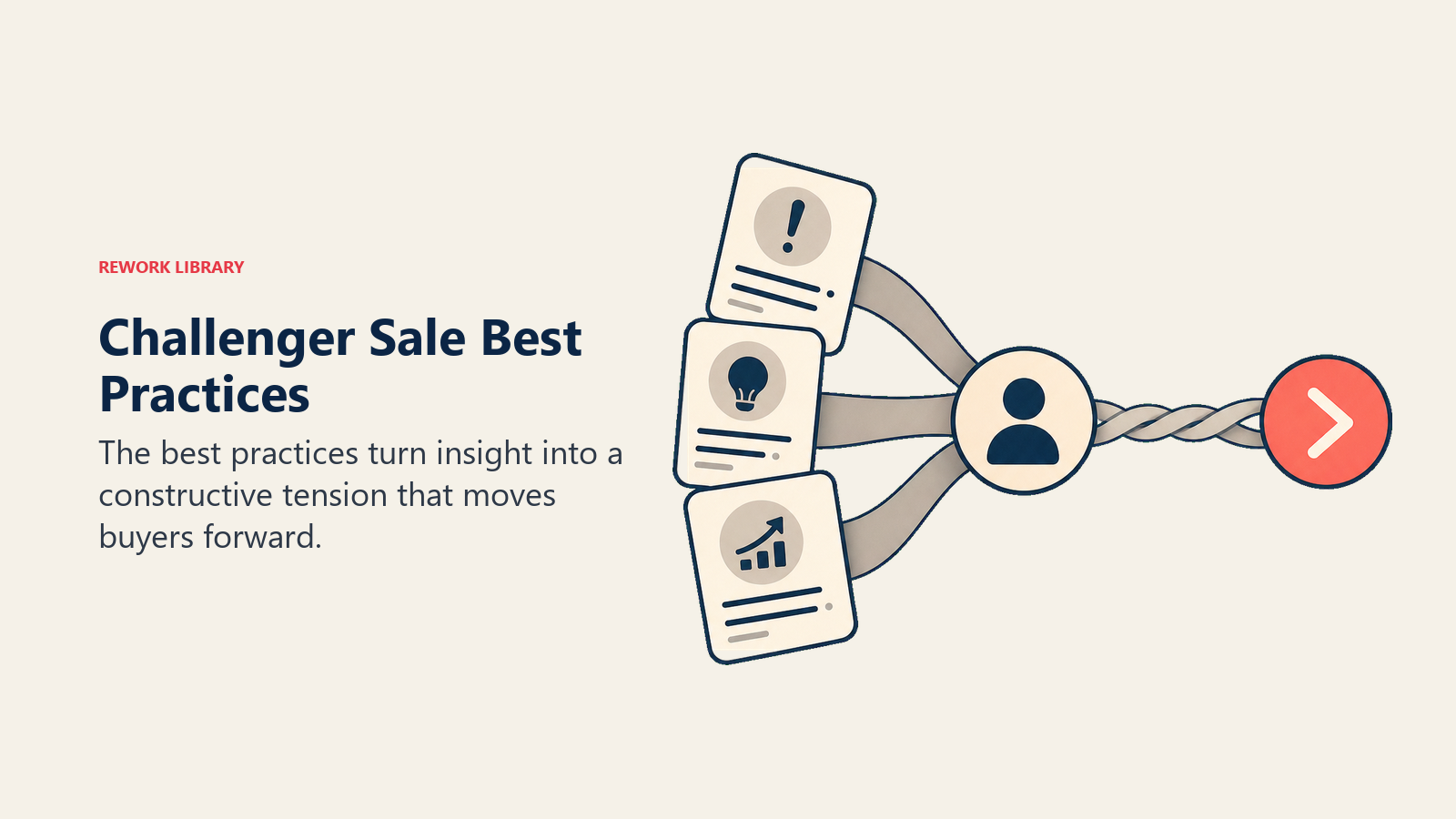
Mejores Prácticas
Use este recurso visual como referencia rápida para la sección siguiente.
- Realice análisis de win/loss preguntando específicamente: ¿el vendedor introdujo una nueva perspectiva que el cliente no había considerado?
- Mantenga las perspicacias comerciales actualizadas trimestralmente. Una perspicacia basada en las condiciones del mercado de 2022 pierde credibilidad rápidamente.
- Combine la capacitación en técnicas Challenger con coaching de llamadas en vivo. La única forma de desarrollar comodidad con la tensión es a través de la repetición y la retroalimentación.
- Use las técnicas de preguntas de SPIN Selling junto con la enseñanza comercial. Los dos no son mutuamente excluyentes. SPIN ayuda a identificar las implicaciones y el valor de la solución; las técnicas Challenger ayudan a enmarcarlos con urgencia.
- Alinee su enseñanza comercial con las etapas de su proceso de gestión de etapas del pipeline para que los vendedores sepan cuándo enseñar, cuándo adaptar y cuándo exigir un compromiso.
Ganar con Perspicacia, No Solo con Esfuerzo
The Challenger Sale no pide a los vendedores que trabajen más. Les pide que piensen de manera diferente sobre cuál es realmente su trabajo. El vendedor que llega con una perspicacia genuina, la adapta a cada parte interesada y guía el negocio hacia una decisión no está solo vendiendo. Está creando valor antes de que se firme el contrato.
La mayoría de la capacitación en ventas se centra en conocimiento del producto, manejo de objeciones y habilidades relacionales. Esas cosas importan. Pero en ventas B2B complejas, el vendedor que enseña al cliente algo nuevo sobre su propio negocio tiene una ventaja difícil de replicar. Eso es lo que Dixon y Adamson encontraron en los datos, y sigue siendo cierto.
La metodología requiere una inversión real para ejecutarse bien: desarrollo de contenido, mensajes adaptados y coaching continuo. Pero los equipos que la incorporan en su proceso superan consistentemente a los que se apoyan solo en la construcción de relaciones y la persistencia.

Head of Enterprise Solutions
On this page
- ¿Qué es The Challenger Sale?
- Los 5 Perfiles del Vendedor
- Teach, Tailor, Take Control
- Teach
- Tailor
- Take Control
- Challenger Sale vs Solution Selling vs Venta Consultiva
- Cómo Construir un Enfoque de Ventas Challenger
- Ejemplos de The Challenger Sale
- Errores Comunes
- Mejores Prácticas
- Ganar con Perspicacia, No Solo con Esfuerzo