Best Buffer Alternatives in 2026: 14 Tools for Growing Social and Agency Teams
Turn this article into takeaways for your work.


Each assistant summarizes the article only for you and suggests best practices for your work.
Hootsuite, Sprout Social, and Agorapulse top this list for teams that like how simple Buffer feels but have run into its limits: Sprout and Agorapulse for real analytics and a shared inbox, Hootsuite for the broadest feature set, and SocialPilot or Zoho Social if the goal is simply to stop paying more per channel added. This guide covers 14 alternatives, evaluated on pricing transparency, analytics and inbox depth, and how cost scales as a team adds accounts and teammates.
Buffer earns its reputation: it's still the cleanest scheduler in the category, it kept a genuinely usable free plan long after Hootsuite, Later, and Agorapulse dropped theirs, and its Team plan includes unlimited seats, a rarity in this market. But Buffer bills per connected channel, not per user, so cost scales with every new Instagram account, client brand, or regional page added, not with headcount. Pair that with thinner analytics, no real social inbox, and limited approval workflows for agencies, and it's easy to see why growing teams start shopping. For the wider category view, see Best Social Media Management Software; if Hootsuite is the alternative you're weighing most seriously, Hootsuite vs Buffer goes head to head on the two directly.
Key Facts
- Global social media reached 5.79 billion user identities by April 2026, and the typical user is active on 6.5 platforms a month, which is why a scheduler needs to cover more than two or three networks well. (DataReportal)
- 84% of US adults use YouTube and 71% use Facebook, with Instagram the only other platform past 50%, so most teams juggle at least three networks before TikTok or LinkedIn. (Pew Research Center)
- Over half of marketing leaders say poor integration between social tools and the rest of the tech stack is the top reason they can't prove social's business impact. (Sprout Social)
- Nearly three-quarters of consumers expect a brand to respond on social within 24 hours or sooner, a bar that's hard to clear without a shared inbox, which Buffer doesn't offer. (Sprout Social)
- Grand View Research values the global social media management software market at $29.9 billion in 2025, headed to $171.6 billion by 2033, a sign of how crowded the field competing for Buffer's outgrown customers has become. (Grand View Research)
Quick Comparison Table
Pricing bases differ by vendor, which is much of why teams leave Buffer in the first place: Buffer bills per channel; Hootsuite, Sprout, and Agorapulse bill per seat; Zoho and Metricool bill per brand; Planable bills per workspace; SocialPilot, Loomly, Vista Social, and CoSchedule bill a flat plan price with an account allowance. Compare like for like, not the bare number.
| Tool | Best For | Starting Price (basis) | Key Strength | Key Limitation |
|---|---|---|---|---|
| Hootsuite | All-round upgrade from Buffer | $99/user/mo annual, no free plan | Broadest feature set, app ecosystem | No free plan, pricier than Buffer per seat |
| Sprout Social | Deepest analytics and inbox | $79/seat/mo annual ($99 mo), 5 profiles | Best-in-class reporting, listening | Per seat; expensive fast for larger teams |
| Agorapulse | Inbox/reporting for mid-size teams | $79/user/mo annual ($99 mo), 10 profiles | Strong inbox, reporting under Sprout's price | No free plan; extra profiles $10-$15/mo each |
| Later | Visual scheduling near Buffer's simplicity | $18.75/mo billed annually, 3 mo free (8 profiles) | Best visual calendar, grid preview | No free plan; annual-only published rate |
| SocialPilot | Budget pricing, no per-channel math | $20/mo ($17/mo annual), 5 accounts | Cheapest per-account pricing, agency features | Lighter analytics/AI than Sprout, Agorapulse |
| Publer | Free plan, pay-as-you-grow pricing | Free (3 accounts, no X); from $5/mo (1 account) | Modular per-account, per-member pricing | Extra accounts and members billed separately |
| Zoho Social | Forever-free plan, Zoho ecosystem fit | Free (1 brand/6 channels); Standard $10/mo per brand billed annually | Permanent forever-free plan, not a trial | Free and Standard cap at 1 brand, 1 user |
| Metricool | Analytics-heavy scheduling, budget | Free (1 brand, no LinkedIn/X); Starter from $20/mo/5 brands | Strong free-tier analytics, competitor tracking | Paid pricing scales with brand count |
| Loomly | Calendar with built-in approvals | $65/mo ($49/mo annual), 12 accounts | Approval workflows, content prompts | No free plan; priciest per-account entry |
| Planable | Client/team approvals on every post | $33/workspace/mo, unlimited users (4 pages) | Purpose-built approval workflow | Per workspace; multi-client agencies add up |
| Vista Social | Inbox, reviews, scheduling together | $79/mo or $758/yr (flat plan, 15 profiles) | Reviews bundled with inbox, scheduling | No free plan; fewer profiles/dollar than SocialPilot |
| Sendible | Agencies, white-label, unlimited seats | From $35/mo (Core, 1 workspace, 6 profiles) | Unlimited users, white-label reporting | Prices render via JS on the pricing page |
| CoSchedule | Marketing calendar that includes social | Free calendar (15 posts per profile); Starter $29/mo billed annually | One calendar spans blog, email, social | Twitter/X billed separately, $16/profile/mo |
| Sprinklr | Enterprise scale across many brands | Quote-only; self-serve ended April 2026 | Governance/scale for very large orgs | No self-serve; months-long sales cycle |
1. Hootsuite: The Familiar All-Rounder, Without a Free Plan
Hootsuite is the tool most Buffer users already know by reputation: a single dashboard, a bulk composer, broad analytics, and the widest app and integration marketplace in the category. Where Buffer covers core scheduling cleanly, Hootsuite adds a fuller reporting suite, listening add-ons, and enough integrations that most marketing stacks plug in somewhere, fitting teams of 10-50 replacing three or four point solutions better than a 2-person team watching costs. The tradeoff: Hootsuite retired its free plan in 2022, so there's no way to try it unpaid, and its 10-account Standard tier caps out faster than Buffer's 10-channel structure. See Best Hootsuite Alternatives for a deeper look at Hootsuite specifically.
Team size fit: 10-50, scaling toward 50-200 on Professional, Advanced, and Enterprise as accounts and seats grow.
| What you get | What you don't |
|---|---|
| Wide app and integration marketplace | A free plan (retired in 2022) |
| Bulk composer and broad analytics suite | Buffer's simplicity and short learning curve |
| 14-day trial to test before buying | Published monthly pricing (only the annual rate is shown) |
| Unlimited accounts on Professional and up | A price advantage over Buffer at small team size |
Pricing: No free plan. Vendor FAQ: "$99 for a Standard plan, $199 for a Professional plan, and range up to $399 for an Advanced plan," billed annually; Standard = 10 accounts, Professional/Advanced = unlimited accounts, Enterprise custom. Monthly billing costs more but isn't published. 14-day trial. Best for: Teams of 10-50 wanting the widest feature set and app ecosystem in one dashboard. Not ideal for: Small teams wanting to try before they buy; there's no free tier to fall back on.
2. Sprout Social: The Deepest Analytics and Inbox, Priced Per Seat
Sprout Social's design philosophy is "prove it": cross-network reporting built for a stakeholder deck, a unified Smart Inbox, and social listening well beyond Buffer's basic engagement numbers. For a marketing leader who needs to show social's contribution to the business, not just publish on schedule, Sprout is usually the first name that comes up. That depth comes at the highest per-seat price of the mainstream options here, and it climbs fast: a 5-person team on Essentials pays for 5 seats, not one flat team price like Buffer's Team plan. See Best Sprout Social Alternatives if the per-seat cost is the sticking point rather than the feature depth.
Team size fit: 10-50 on Essentials and Standard, 50-200 on Professional and Advanced as seat count grows.
| What you get | What you don't |
|---|---|
| Cross-network reporting built for stakeholder decks | Buffer's flat, unlimited-seat pricing model |
| Unified Smart Inbox across all connected networks | A free plan (30-day trial only) |
| Genuine social listening, not just engagement stats | A budget entry point; Essentials starts at $79/seat/month |
| Unlimited profiles on Professional and Advanced | Cheap scaling for a large team; cost is per seat throughout |
Pricing: Essentials $79/seat/mo annual ($99 mo), 5 profiles; Standard $199/seat/mo annual, 5 profiles; Professional $299/seat/mo annual, unlimited profiles; Advanced $399/seat/mo annual, unlimited profiles; Enterprise custom. 30-day trial, no free plan. Best for: Teams of 10-50-plus needing to prove social's business impact with stakeholder-ready reporting. Not ideal for: Small teams watching per-seat cost; a 10-person team on Essentials runs close to $800/month.
3. Agorapulse: Inbox and Reporting Sized for Growing Teams
Agorapulse pitches itself as the tool between Buffer's simplicity and Sprout Social's price tag: a unified inbox for comments, mentions, and DMs, plus report-ready analytics, at a per-seat price that undercuts Sprout at the entry tier. Its 10-profile ceiling holds on every published tier, a constraint Best Agorapulse Alternatives takes apart. It's built for a team that has started fielding real engagement, not just publishing, and needs one queue instead of checking five apps for replies. It dropped its own free plan and now runs a 30-day trial only, and extra profiles beyond the 10 included run $10-$15/month each, so a team managing 20-plus accounts should model that add-on cost first.
Team size fit: 10-50, with Advanced and custom tiers reaching 50-200 for agencies managing several client accounts.
| What you get | What you don't |
|---|---|
| Unified inbox for comments, mentions, and DMs | A free plan (retired) |
| Report-ready analytics without Sprout's top-tier price | Sprout's depth in social listening |
| 10 social profiles included on every paid tier | Cheap scaling past 10 profiles ($10-$15/month each) |
| 30-day trial, longer than most competitors | Buffer's per-channel, not per-seat, pricing model |
Pricing: Standard $79/user/mo annual ($99 mo); Professional $119/user/mo annual ($149 mo); Advanced $149/user/mo annual ($199 mo); all three include 10 profiles. Custom tier available. Extra profiles $10-$15/mo each. 30-day trial, no free plan. Best for: Teams of 10-50 needing a real inbox and reporting without Sprout's top-tier price. Not ideal for: Teams managing 15-20-plus accounts on a single seat; the per-profile add-on cost adds up.
4. Later: Visual-First Scheduling, Closest to Buffer's Simplicity
Later built its reputation as the visual content calendar for Instagram-first teams: a drag-and-drop grid preview, a Linkin.bio landing page, and a design that still feels closer to Buffer's simplicity than to Hootsuite's or Sprout's denser dashboards, Buffer vs Later runs the cost math between the two directly, and Best Later Alternatives covers the wider field. It stays the least disruptive move for a Buffer user who just wants a nicer calendar. But Later's fame as a free Instagram scheduler is stale, which matters here since a reader shopping for a cheaper option often has that old free tier in mind. It's gone: Later runs a 14-day trial only now, with no permanently free plan, and pricing is structured around "social sets" (bundles of profiles) that multiply faster than Buffer's flat per-channel rate once a team adds a second brand.
Team size fit: 1-10 on Starter, 10-50 on Growth and Scale as social sets and seats increase.
| What you get | What you don't |
|---|---|
| Best visual content calendar and grid preview in the category | A free plan (retired; 14-day trial only) |
| Linkin.bio landing page included | Sprout or Agorapulse-level analytics and inbox depth |
| 3 months free on annual billing (advertised as 25% off) | A published month-to-month rate; only annual pricing renders |
| Lower learning curve, closest feel to Buffer | Room to scale past a handful of brands without a tier jump |
Pricing: Starter $18.75/mo billed annually, 3 months free (1 social set, 8 profiles, 1 user); Growth $37.50/mo annual (2 sets, 16 profiles, 2 users); Scale $82.50/mo annual (6 sets, 48 profiles, 4 users). These are annual-billing monthly-equivalent rates; Later doesn't publish a separate monthly figure, though it costs more. 14-day trial, no permanently free plan. Best for: Visual teams of 1-10 wanting a nicer content calendar without a big complexity jump from Buffer. Not ideal for: Teams needing deep analytics, listening, or a shared inbox; Later's strength is planning, not engagement.
5. SocialPilot: Budget Pricing That Bundles Accounts, Not Channels
SocialPilot's whole pitch is math that favors a growing team: pay for a tier that bundles a set number of accounts and users together, instead of Buffer's per-channel rate that climbs with every new Instagram page or client brand added. It's not the deepest tool here; analytics and AI features are lighter than Sprout's or Agorapulse's, and the interface feels more utilitarian than Buffer's polish. But for an agency or small team managing 10-40 accounts across multiple clients, the per-account math beats almost everything else on this list.
Team size fit: 1-10 on Essentials and Standard, 10-50 on Premium, 50-200 on Ultimate and Enterprise.
| What you get | What you don't |
|---|---|
| Cheapest per-account pricing on this list | Sprout or Agorapulse-level analytics depth |
| Multiple users included even on lower tiers | Buffer's interface polish and simplicity |
| Agency-friendly client management features | A free plan |
| Cheap add-ons ($4/account, $5/user) if you outgrow a tier | Deep social listening or competitive benchmarking |
Pricing: Essentials $20/mo ($17 annual), 5 accounts, 1 user; Standard $40/mo ($34 annual), 10 accounts, 3 users; Premium $100/mo ($85 annual), 20 accounts, 6 users; Ultimate $200/mo ($170 annual), 40 accounts, unlimited users. Extra accounts $4/mo, extra users $5/mo. Enterprise custom. 14-day trial. Best for: Agencies and small teams managing 10-40 accounts who want to stop paying more per channel added. Not ideal for: Teams needing Sprout-level reporting or Buffer-like editing polish.
6. Publer: A Free Plan and Pay-As-You-Grow Pricing
Publer advertises a free tier the way Buffer does, then paid pricing that scales in small increments as accounts and users get added, rather than a few large tier jumps, the closest thing to a like-for-like Buffer swap on cost structure. That similarity cuts both ways: Publer's paid pricing also multiplies per account and per user, so it suits a team wanting Buffer's economics with a few more features better than one trying to escape per-unit pricing altogether. Publer's marketing pricing page returns a redirect loop, but its help center (publer.com/help) is a vendor domain and publishes every tier in full, so the figures below are vendor-confirmed rather than reported.
Team size fit: 1-10, extending to 10-50 as accounts and users are added incrementally.
| What you get | What you don't |
|---|---|
| An advertised free tier (reported, not vendor-verified) | A vendor pricing page that loads directly (redirect loop) |
| Granular, pay-as-you-grow pricing (reported) | Sprout or Agorapulse-level inbox and analytics |
| Every 10th connected account free on paid tiers (reported) | A single flat-rate tier for a growing team |
| Modular per-account, per-member pricing | Deep social listening or competitor tracking |
Pricing: Confirmed on Publer's own help center (publer.com/help), which publishes what the marketing page will not: Free covers 3 social accounts (excluding X), 1 workspace, 10 pending posts per account and 25 drafts. Professional starts at $5/month for 1 social account, plus $4/month per extra account and $2/month per extra member, with a 7-day trial. Business starts at $10/month for 1 account, plus $7/month per extra account and $3/month per extra member, with a 14-day trial. Enterprise is a custom quote. Every 10th social account or member is free. Best for: Small teams who liked Buffer's free tier and want incremental, pay-as-you-grow pricing. Not ideal for: Teams trying to escape per-unit pricing altogether; Publer's model still scales with accounts and users.
7. Zoho Social: A Genuine Forever-Free Plan
Zoho Social is one of just four tools in this guide with a genuine free plan (alongside Buffer, Metricool, and CoSchedule), and unlike a trial, it's confirmed permanent: after a 15-day trial period, the account automatically moves to a "forever free plan with lifetime validity and limited features," no credit card required. The free plan includes 1 brand (6 channels), 1 team member, 24/5 email support, and 5 AI credits. Zoho's is the more generous free tier on channel count (6 versus Buffer's 3), though Buffer still allows 10 scheduled posts per channel within its limit. Zoho Social bills per brand, so free and Standard both cap at a single brand and user; its value shows up once a team needs Professional's collaboration, or the Agency tiers for managing multiple client brands, which is also where Zoho's ecosystem (CRM, Desk, Projects) starts to matter for existing Zoho customers.
Team size fit: 1-10 on Free through Premium, 10-50 on the Agency tiers.
| What you get | What you don't |
|---|---|
| A genuine forever-free plan (1 brand, 6 channels), no card required | Published paid-tier dollar figures on the vendor's own page |
| Deep discount on annual billing (confirmed 33% off) | Multi-brand support below the Agency tier |
| Zoho ecosystem fit (CRM, Desk, Projects) | Sprout or Agorapulse-level standalone analytics |
| Agency tiers built for managing multiple client brands | A published price above Premium without a sales call |
Pricing: Free plan confirmed permanent (1 brand, 6 channels, 1 user, 5 AI credits, 24/5 support). Paid tiers bill per brand; no dollar figures render on Zoho's own page, only "/Brand/month" placeholders. Third-party trackers report Standard around $15/month, Professional around $40/month, Premium around $65/month, Agency around $320/month, Agency Plus around $460/month, confirmed at 33% off annual billing (reported for dollar amounts, Capterra; the free plan and annual discount are vendor-confirmed). Best for: Solo marketers wanting a real free tier, or Zoho customers wanting social inside their existing ecosystem. Not ideal for: Teams needing more than one brand without a paid tier, or anyone wanting exact pricing before a sales call.
8. Metricool: Analytics-First Scheduling, Free to Start (With a Catch)
Metricool leads with analytics rather than scheduling: competitor tracking, link-in-bio, ad reporting, and detailed platform analytics bundled alongside the calendar, much of it available in some form on the free plan, which can close the "I can't see what's actually working" gap without a paid upgrade. The catch: that free plan (1 brand, 20 scheduled posts a month, 5 competitor profiles, 30 days of analytics) excludes LinkedIn and Twitter/X entirely, so it isn't a full swap for Buffer's free plan if either network matters to you. Paid pricing is tiered by brand count, not a flat number, published separately in EUR and USD with VAT excluded; team and client management, approvals, and full Twitter/X analytics only unlock on Advanced.
Team size fit: 1-10 on Free and Starter, 10-50 on Advanced as brand count scales.
| What you get | What you don't |
|---|---|
| Strong free-tier analytics, including competitor tracking | LinkedIn or Twitter/X on the free plan |
| Unlimited publishing on Starter and above | Agorapulse or Sprout-level inbox depth |
| Team and client management on Advanced | A published flat rate that doesn't scale with brand count |
| Up to 24% savings on annual billing | Sendible or SocialPilot-level account bundling clarity |
Pricing: Free: 1 brand, 20 posts/month, 5 competitor profiles, 30 days analytics, no LinkedIn/X. Starter: from EUR16/$20/mo for 5 brands, EUR29/$36 for 10. Advanced: from EUR43/$53 for 15 brands, EUR87/$107 for 25, up to EUR172/$210 for 50, adding team/client management, approvals, full Twitter/X analytics. Custom for larger counts. Annual saves up to 24%; VAT excluded. Verified on Metricool's pricing page. Best for: Teams of 1-10 wanting strong free or low-cost analytics who don't rely on LinkedIn or X in the free tier. Not ideal for: Larger agencies wanting one flat number, or anyone needing free LinkedIn/X coverage.
9. Loomly: Content Calendar With Approvals Built In
Loomly's core idea is the content calendar as the source of truth: post ideas, content guidance prompts, and a built-in approval flow that routes a draft to a client or manager before it goes live, worth the switch alone for a team chasing approvals over email or chat. It's priced higher per account than most of this list, and there's no free plan, but Starter includes 3 users and 12 accounts, more generous than Hootsuite's entry tier, and Beyond's unlimited users is a standout for a team that doesn't want seat math stacked on top of account math.
Team size fit: 1-10 on Starter, 10-50 on Beyond, 50-200-plus on custom Enterprise.
| What you get | What you don't |
|---|---|
| Built-in approval workflows inside the calendar | A free plan |
| Content idea prompts and post-type guidance | The lowest per-account price on this list |
| Unlimited users on the Beyond tier | Sprout-level analytics depth |
| 3 users included even on the entry Starter tier | A budget option for a 1-2 person team |
Pricing: Starter $65/mo ($49 annual, $588/yr), 12 accounts, 3 users; Beyond $332/mo ($249 annual, $2,988/yr), 60 accounts, unlimited users; Enterprise custom, 61-plus accounts. Verified on Loomly's pricing page. Best for: Marketing teams and agencies needing built-in content approvals, not email back-and-forth. Not ideal for: Small teams on a tight budget; Loomly's entry price sits well above Buffer's or SocialPilot's.
10. Planable: Approvals as the Whole Product, Not a Feature
Planable flips the usual order: approvals and content review are the core product, scheduling is what happens after a post is approved. Every post shows as a visual preview matching exactly how it'll appear on each platform, with threaded comments and a clear approve-or-reject flow, built for agencies where "did the client sign off" is a constant question. Pricing is per workspace, unlimited users on every plan, a genuinely different model from Buffer's per-channel or Sprout's per-seat pricing: an agency running five clients pays for five workspaces, not five times a per-user rate. There's no permanent free plan, only a usage-based free start (50 posts, no time limit, no card), and two features included elsewhere are priced separately: analytics adds $12/workspace/month, the social inbox adds $7.50/workspace/month.
Team size fit: any team size per workspace (unlimited users), typically 1-10 on Basic and 10-50 on Pro per client relationship.
| What you get | What you don't |
|---|---|
| Visual, platform-accurate post previews for approval | A permanent free plan (usage-based free start only) |
| Unlimited users per workspace, no per-seat math | Analytics or a social inbox included in the base price |
| Threaded comments and a clear approve/reject flow | A single price that covers many clients at once |
| 2 months free on annual billing | Deep publishing features beyond core scheduling |
Pricing: Basic $33/workspace/mo (4 pages, 60 posts/mo, 3 campaigns, unlimited users); Pro $49/workspace/mo (10 pages, 150 posts/mo, 10 campaigns, public API, unlimited users); both give 2 months free annually. Analytics +$12/workspace/mo; social inbox +$7.50/workspace/mo. Usage-based free start (50 posts, no time limit) before a paid workspace. Enterprise custom (50 pages). Verified on Planable's pricing page. Best for: Agencies where client or manager sign-off on every post is a hard requirement. Not ideal for: A single in-house brand, or anyone wanting analytics and inbox bundled rather than billed as add-ons.
11. Vista Social: Scheduling, Inbox, and Reviews in One Tool
Vista Social bundles review management (Google, Facebook, and other review sites) alongside scheduling and a unified inbox, a combination that suits local and multi-location businesses as much as agencies, competing directly with Agorapulse on inbox depth at a broadly similar price. At 15 profiles and 2 users on the entry Professional tier, it fits a small team managing several brand or location accounts more comfortably than Later's or Loomly's entry tiers, though it still costs more per profile than SocialPilot.
Team size fit: 1-10 on Professional, 10-50 on Advanced and Scale.
| What you get | What you don't |
|---|---|
| Review management bundled with scheduling and inbox | A free plan |
| 15 profiles and 2 users included on the entry tier | SocialPilot-level cost per profile |
| 20% savings on annual billing | Sprout-level social listening |
| Strong fit for local and multi-location businesses | The lightest possible onboarding |
Pricing: Professional $79/mo or $758/yr (20% off), 15 profiles, 2 users; Advanced $149/mo or $1,430/yr, 30 profiles, 4 users; Scale $349/mo or $3,638/yr, 70 profiles, 8 users; Enterprise custom. Verified on Vista Social's pricing page. Best for: Local or multi-location businesses or agencies wanting reviews, inbox, and scheduling in one login. Not ideal for: Teams whose only need is scheduling; the review-management strength goes unused.
12. Sendible: Agency-Built, Unlimited Users on Every Plan
Sendible's pitch is squarely at agencies: every plan includes unlimited users at no extra seat cost, with white-label reporting and pricing that scales by workspace and profile count rather than team size, hard to match for an agency that doesn't want a per-seat fee added on top of outgrowing Buffer. Sendible's pricing page uses a slider, so confirm current dollar figures with Sendible. The tier structure is: Core (1 workspace, 6 profiles), Plus (3/18), Premium (7/42), Elite (15/90), Enterprise (50/300), unlimited users throughout, 15% off annual billing. Every dollar figure below is third-party reported.
Team size fit: 1-10 on Core, 10-50 on Plus and Premium, 50-200 on Elite and Enterprise (users are unlimited on every tier; these counts reflect the accounts a workspace tier typically supports).
| What you get | What you don't |
|---|---|
| Unlimited users on every plan, confirmed by the vendor | Stable, directly verifiable vendor dollar pricing |
| White-label reporting built for agencies | A free plan (14-day trial only) |
| Pricing scales by workspace and profile, not by user | Sprout or Agorapulse-level native analytics depth |
| Content library and custom report builder (Elite+) | The lowest published price on this list |
Pricing: Vendor-confirmed structure, 15% off annual billing: Core (1 workspace, 6 profiles), Plus (3/18), Premium (7/42), Elite (15/90), Enterprise (50/300), unlimited users on every tier, 14-day trial. Reported dollar figures: Core $35/month, Plus $99, Premium $199, Elite $299 and Enterprise $750. Treat the figures as reported and confirm on Sendible's site before budgeting. Best for: Agencies wanting unlimited seats and white-label reporting without a per-user fee. Not ideal for: Anyone needing an exact confirmed price without contacting Sendible directly.
13. CoSchedule: A Marketing Calendar That Happens to Include Social
CoSchedule isn't a social-only tool; it's a marketing calendar, blog posts, email sends, campaigns, and social all on one timeline, solving a different problem than Buffer for a team whose real issue is that social lives in a separate calendar from everything else marketing ships. Its Free Calendar plan, confirmed "Free Forever" on CoSchedule's own page, caps at 1 user, 1 social profile, and 15 scheduled messages, useful mainly for testing the concept. Social Calendar is where scheduling becomes real, with a basic inbox for Facebook and Instagram, still one module inside a broader workflow tool rather than a dedicated social platform. One gotcha: Twitter/X profiles aren't part of any plan's allowance; they're billed separately at $16/profile/month on top of whatever tier you're on.
Team size fit: 1-10 on Free and Social Calendar, 10-50 on Agency Calendar and custom Marketing Suite.
| What you get | What you don't |
|---|---|
| One calendar spanning blog, email, and social | A dedicated, social-first feature set |
| A free calendar that is ongoing, not a trial | Twitter/X included in the base profile allowance |
| Basic social inbox for Facebook and Instagram | Agorapulse or Sprout-level cross-network inbox depth |
| AI content templates (1,600-plus on paid tiers) | A social-only pricing tier; you're paying for the calendar too |
Pricing: CoSchedule restructured its plans, so older comparisons of it are out of date. As of September 2026 its pricing page lists Starter at $29/month billed annually ($39/month billed monthly) with 1 included user and 3 social profiles, and Professional at $49/month billed annually ($59/month billed monthly) with 2 included users and 5 social profiles. Extra profiles cost $5/month each and an extra Professional seat costs $29/month. Suite is quote-only, described as starting at $69/month with unlimited users. A free calendar still exists, offered as a link rather than a plan card, limited to 15 posts per profile; the page states no profile count for it. Twitter/X profiles are excluded from every base plan and billed separately at $16 per profile per month. Verified on CoSchedule's pricing page. Best for: Marketing teams wanting social scheduling inside the same calendar as blog and email. Not ideal for: Teams whose only need is social scheduling, or anyone managing several X accounts; the surcharge adds up.
14. Sprinklr: Enterprise Scale, No Self-Serve Entry Point Left
Sprinklr sits at the opposite end of this list from Buffer: a unified customer experience platform where social is one module among many, built for very large organizations running dozens of brands and languages under one governance layer, With self-serve now retired, Best Sprinklr Alternatives is the fuller treatment. It remains the option for a team that has genuinely outgrown every mid-market tool here, not just Buffer. As of 2026, it no longer offers a self-serve entry point: Sprinklr discontinued its Self-Serve plan, which had public pricing starting around $199 per seat per month, on April 30, 2026, and the current product page directs every visitor to talk to an expert instead. Real enterprise deployments reportedly run into five and six figures a year, median around $129,000 based on Vendr benchmark data, plus separate implementation costs.
Team size fit: 200-plus, effectively enterprise-only now.
| What you get | What you don't |
|---|---|
| Governance and scale across dozens of brands and regions | Any self-serve or published pricing (discontinued April 2026) |
| Deep AI, listening, and customer-experience tooling | A fast implementation; expect months of onboarding |
| A platform built for very large, multi-brand organizations | A realistic option below enterprise budget and headcount |
| Sprinklr Service and Insights alongside Social | Buffer's, or anyone's, simplicity |
Pricing: Quote-only. Self-serve (formerly around $199/seat/month) was discontinued April 30, 2026; enterprise contracts reportedly run $50,000 to $150,000-plus/year (median around $129,000), plus separate implementation of $25,000 to $150,000 (reported, Chatarmin). Best for: Very large, multi-brand enterprises needing governance and CX tooling well beyond scheduling. Not ideal for: Any team below several hundred employees; no entry point fits a mid-market budget anymore.
Stage-Fit Matrix
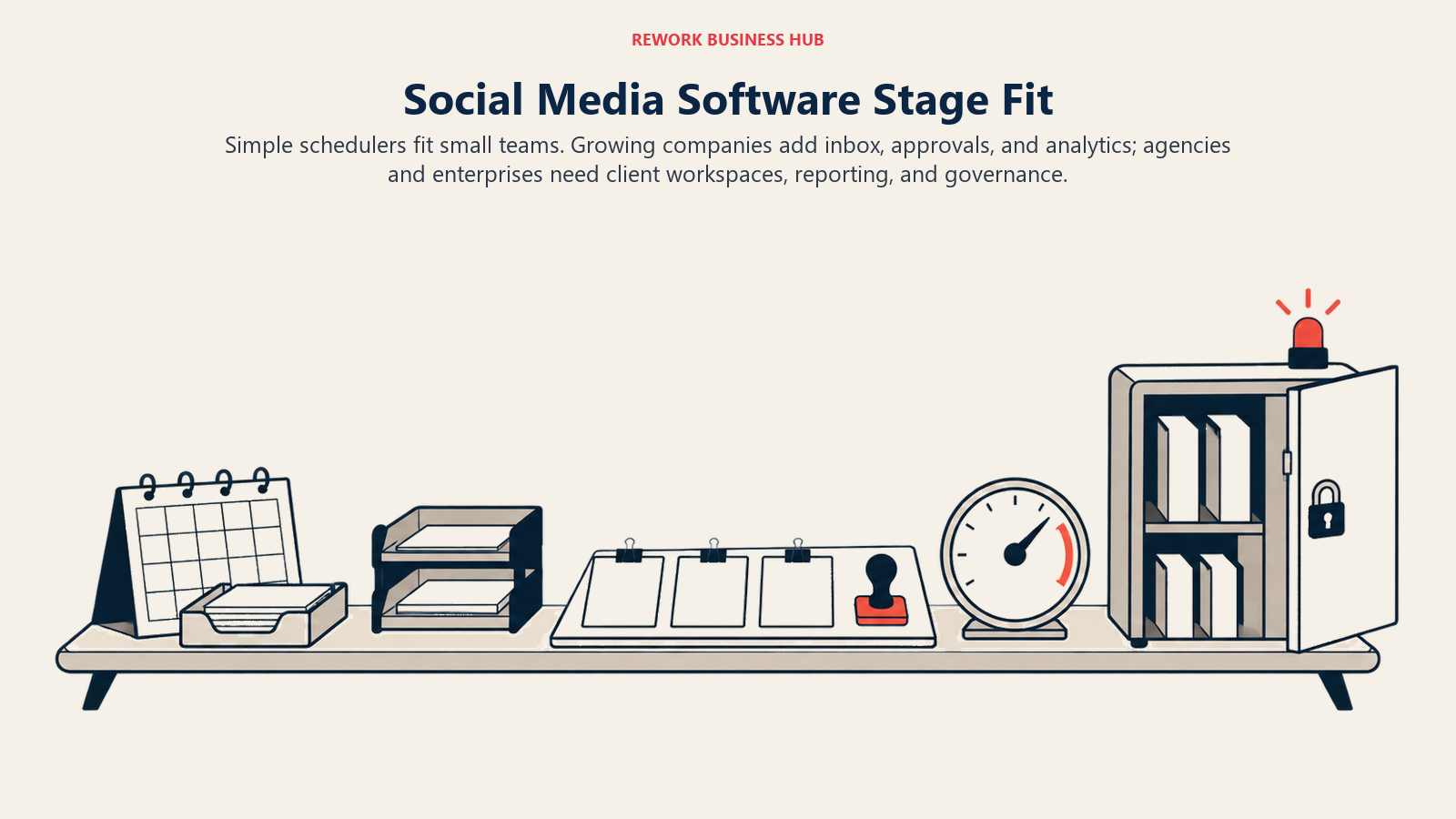
Account count, collaboration, and governance change platform fit. Simple schedulers suit small teams, while growing and enterprise teams need inbox, approvals, analytics, and control.
| Tool | Startup / Bootstrapped | Growing SMB | Mid-Market | Enterprise |
|---|---|---|---|---|
| Hootsuite | Workable | Good fit | Good fit | Workable |
| Sprout Social | Not ideal | Workable | Good fit | Good fit |
| Agorapulse | Workable | Good fit | Good fit | Workable |
| Later | Good fit | Good fit | Workable | Not ideal |
| SocialPilot | Good fit | Good fit | Workable | Not ideal |
| Publer | Good fit | Good fit | Workable | Not ideal |
| Zoho Social | Good fit | Workable | Workable | Not ideal |
| Metricool | Good fit | Good fit | Workable | Not ideal |
| Loomly | Workable | Good fit | Good fit | Workable |
| Planable | Workable | Good fit | Good fit | Workable |
| Vista Social | Workable | Good fit | Good fit | Not ideal |
| Sendible | Workable | Good fit | Good fit | Workable |
| CoSchedule | Workable | Good fit | Workable | Not ideal |
| Sprinklr | Not ideal | Not ideal | Not ideal | Good fit |
Sizing and Persona Table
| Tool | Team Size Sweet Spot | Primary Persona | Agency-Friendly |
|---|---|---|---|
| Hootsuite | 10-50 | Marketing generalist replacing multiple tools | Yes |
| Sprout Social | 10-100 | Data-driven social or marketing director | Limited (per-seat cost) |
| Agorapulse | 10-50 | Community or social manager fielding engagement | Yes |
| Later | 1-10 | Visual, Instagram-first content creator | Limited |
| SocialPilot | 5-50 | Agency account manager on a budget | Yes |
| Publer | 1-15 | Solo marketer or small business owner | Limited |
| Zoho Social | 1-10 | Solo marketer or Zoho-ecosystem business | Yes (Agency tiers) |
| Metricool | 1-20 | Analytics-focused marketer or freelancer | Yes (Advanced tier) |
| Loomly | 5-30 | Marketing team needing approval workflows | Yes |
| Planable | Any (per workspace) | Agency managing multiple client brands | Yes |
| Vista Social | 5-30 | Local or multi-location business, or agency | Yes |
| Sendible | 5-50 | Agency reselling social management | Yes |
| CoSchedule | 1-15 | Marketing generalist running a full calendar | Limited |
| Sprinklr | 200+ | Enterprise social or CX operations team | No (enterprise-only) |
Why Teams Leave Buffer
Buffer's strengths deserve stating first. It remains the cleanest, most approachable scheduler in the category: a visual composer, a straightforward calendar, and a genuinely usable free plan (3 channels, 10 scheduled posts per channel, 1 user), one of only four free plans among the tools in this guide (alongside Zoho Social, Metricool, and CoSchedule); Hootsuite, Later, and Agorapulse have all retired theirs. Its Team plan, $12/channel/month billed monthly or $120/channel/year billed annually (which works out to $10/channel/month), includes unlimited team members, a rarity most competitors charge extra for. At small scale, Buffer's per-channel pricing genuinely wins: a 5-person team on Team with 10 channels pays $120/month billed monthly, or $100/month billed annually, with every seat included, cheaper than a single seat of Sprout Standard ($199/month). And free-plan comparisons don't favor the alternatives the way you'd expect: Zoho's free tier covers more channels (6 versus 3) but Buffer allows 10 scheduled posts per channel within its limit, CoSchedule's free plan caps at one profile, and Metricool's excludes LinkedIn and Twitter/X. The reason to leave Buffer isn't what happens at 3 channels; it's what happens at 8 or 15.
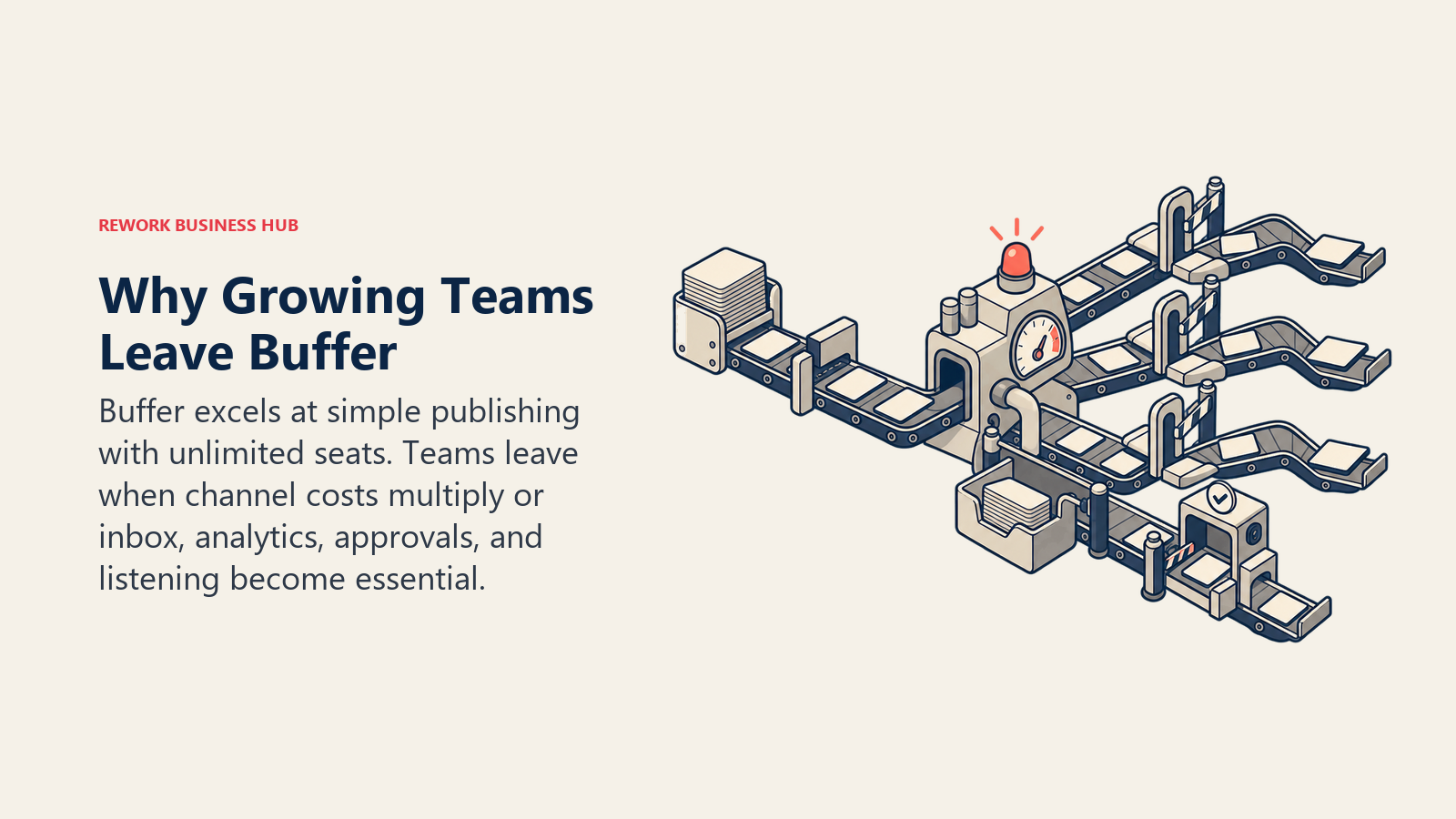
The reasons teams outgrow it anyway:
Per-channel pricing multiplies as you add networks and clients. Essentials runs $6/channel/month billed monthly ($60/channel/year annually, which is $5/channel/month) and Team runs $12/channel/month billed monthly ($120/channel/year annually, or $10/channel/month), for channels 1-10. Above 10 the rate drops, and Buffer publishes the bands: channels 11-25 cost $4 each on both plans, 26-50 cost $3, and 51 or more cost $1 on Essentials and $2 on Team. A team growing from 3 channels to 8 client brands sees its bill scale with every account added, regardless of headcount, and that's where Buffer's math stops winning: at 15 channels, Team runs $140/month billed monthly regardless of team size, while SocialPilot's Premium tier covers 20 accounts and 6 users for $85/month annual, and Zoho's per-brand pricing avoids the multiplier if accounts sit under one brand. That's the exact math SocialPilot, Sendible, and Planable are built to undercut.
Analytics stay thin next to Sprout Social or Agorapulse. Buffer's reporting covers engagement, reach, and post performance, not Sprout's cross-network benchmarking or Agorapulse's report-ready client dashboards, which matters once a leader needs to prove social's contribution to the business, exactly the gap over half of marketing leaders blame on poor tool integration.
No real social inbox. Buffer is built for publishing, not replying: no unified inbox for comments, mentions, and DMs the way Agorapulse, Sprout Social, and Vista Social all offer. With nearly three-quarters of consumers expecting a response within 24 hours or sooner, real engagement volume outgrows Buffer's publishing-only design fast.
Limited approval and client-management features. Buffer's approval flow is basic next to Loomly's or Planable's purpose-built review workflows, and it has no per-client workspace model. An agency juggling sign-off from five clients feels this gap first.
Lighter social listening. Buffer skips meaningful listening or competitive tracking, features Sprout Social, Metricool, and Hootsuite's add-ons all provide to varying degrees.
None of this makes Buffer bad. It's built for a specific stage: small teams publishing across a handful of channels who value simplicity over depth. That stage ends around the point a team starts reading a list like this one.
How to Choose: Decision Framework
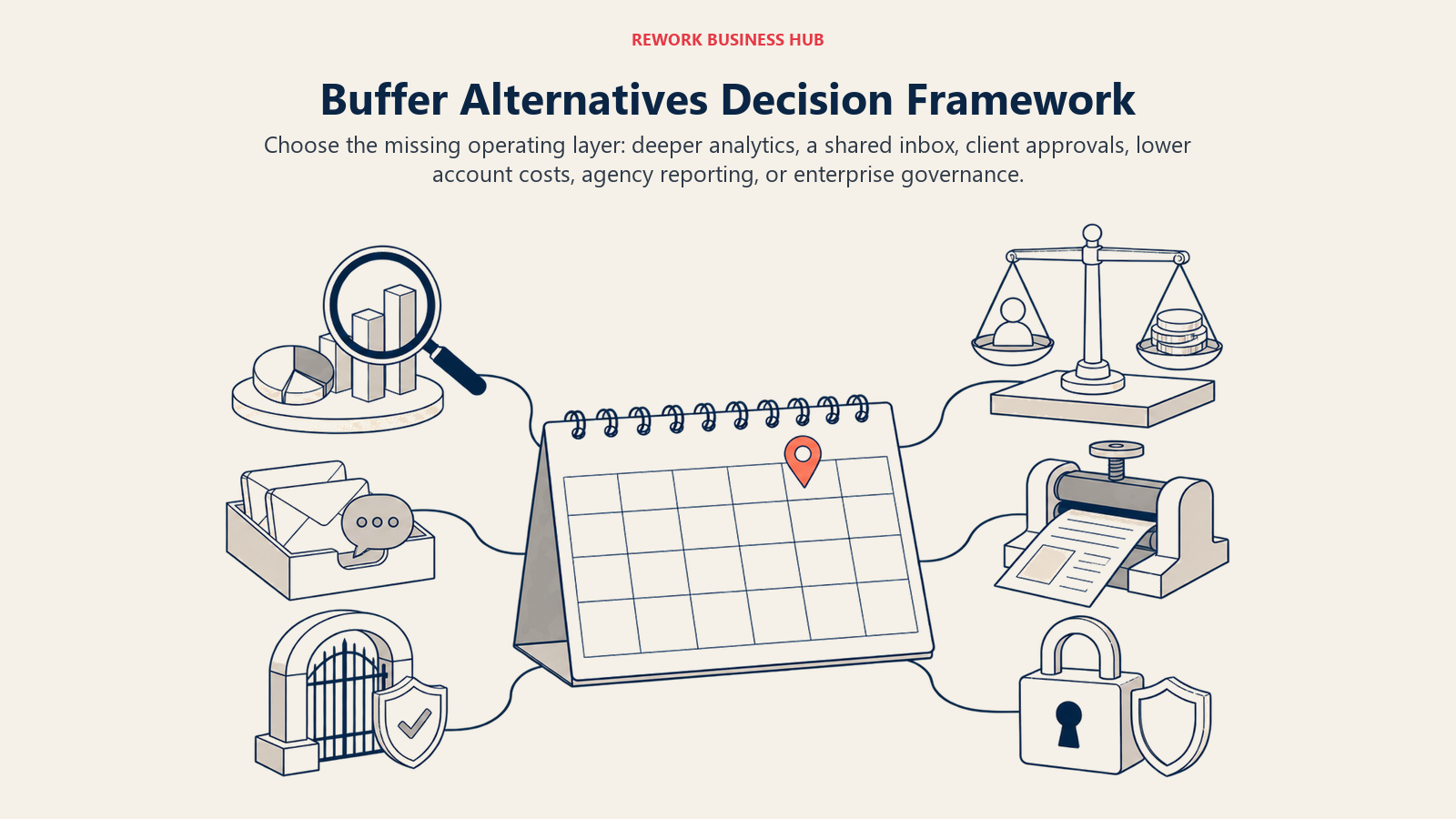
Run whichever pick survives this framework against a real week of your posting calendar and inbox volume, not a sandbox demo, before committing to an annual plan.
| If your team needs... | Best pick |
|---|---|
| To stop paying more per channel as accounts grow | SocialPilot or Zoho Social |
| The deepest analytics and a shared social inbox | Sprout Social |
| The broadest all-round feature set, one tool for everything | Hootsuite |
| Inbox and reporting depth without Sprout's top-tier price | Agorapulse |
| To keep Buffer's visual simplicity, just with a better calendar | Later |
| A free plan while budget is still tight | Publer or Zoho Social |
| Client sign-off and approvals as the core workflow | Planable or Loomly |
| Unlimited seats and white-label reporting for an agency | Sendible |
| Reviews, inbox, and scheduling for a local or multi-location business | Vista Social |
| One calendar spanning social, blog, and email together | CoSchedule |
| Governance and scale across dozens of enterprise brands | Sprinklr |
Outgrowing email or design tools too? Best Email Marketing Software and Best Mailchimp Alternatives cover email; Best Canva Alternatives and how to choose graphic design software cover visual content. If the real goal is consolidating your whole marketing stack, how to choose an all-in-one marketing platform is the broader framework.
Frequently Asked Questions about Buffer Alternatives
Why do teams leave Buffer?
Per-channel pricing that multiplies as a team adds networks or clients, analytics thinner than Sprout Social's or Agorapulse's, no real social inbox for comments and DMs, limited agency approval workflows, and lighter social listening.
Does Buffer still have a free plan?
Yes, 3 channels, 10 scheduled posts per channel, 1 user, confirmed on Buffer's pricing page. Of the tools here, only Zoho Social, Metricool, and CoSchedule also offer a genuine free plan; Hootsuite, Later, and Agorapulse have all retired theirs.
What's the cheapest Buffer alternative with a free plan?
Zoho Social's free plan (1 brand, 6 channels, confirmed permanent) is the most generous on channel count; CoSchedule's Free Forever plan covers 1 profile; Metricool's (1 brand, 20 posts/month) is strong on analytics but excludes LinkedIn and Twitter/X. Publer's free tier covers 3 accounts but excludes X, confirmed on its help center.
Which Buffer alternative has the best analytics?
Sprout Social, with cross-network benchmarking and listening built in. Agorapulse and Metricool offer strong reporting at a lower price if Sprout's per-seat cost doesn't fit.
Which Buffer alternative is best for agencies managing multiple clients?
Planable and Loomly build client approvals directly into the platform. Sendible and SocialPilot suit agencies wanting unlimited users or the lowest per-account cost instead.
Is Hootsuite really more expensive than Buffer?
For most teams, yes. Hootsuite Standard starts at $99/user/month annual with no free plan, while Buffer Team runs $12/channel/month billed monthly, or $10/channel/month billed annually, with unlimited users: a 5-person team on 5 channels pays $60/month billed monthly or $50/month billed annually on Buffer versus at least $99/month for one Hootsuite seat.
What happened to Sprinklr's self-serve plan?
Discontinued April 30, 2026 (it had public pricing around $199/seat/month). Sprinklr Social is now enterprise-only and quote-based, with reported annual contracts commonly $50,000 to $150,000-plus.
When does it make sense to stay with Buffer?
If you're publishing across a handful of channels, don't need a shared inbox, and value Buffer's simplicity and unlimited-seat Team plan, switching rarely pays off. Shop once per-channel costs, thin analytics, or missing inbox and approval features start costing more than switching would.
What to Do Next
Match your team's size, channel count, and biggest Buffer complaint, cost, analytics, inbox, or approvals, to the framework above, then run your top two picks against a real week of your posting calendar and inbox, not a sandbox demo. If cost is the main driver, start with SocialPilot or Zoho Social. If it's analytics and engagement, start with Sprout Social or Agorapulse. Either way, load your actual accounts in during the trial period: per-channel and per-seat math only becomes obvious once your real account list is connected.

Principal Product Marketing Strategist
On this page
- Key Facts
- Quick Comparison Table
- 1. Hootsuite: The Familiar All-Rounder, Without a Free Plan
- 2. Sprout Social: The Deepest Analytics and Inbox, Priced Per Seat
- 3. Agorapulse: Inbox and Reporting Sized for Growing Teams
- 4. Later: Visual-First Scheduling, Closest to Buffer's Simplicity
- 5. SocialPilot: Budget Pricing That Bundles Accounts, Not Channels
- 6. Publer: A Free Plan and Pay-As-You-Grow Pricing
- 7. Zoho Social: A Genuine Forever-Free Plan
- 8. Metricool: Analytics-First Scheduling, Free to Start (With a Catch)
- 9. Loomly: Content Calendar With Approvals Built In
- 10. Planable: Approvals as the Whole Product, Not a Feature
- 11. Vista Social: Scheduling, Inbox, and Reviews in One Tool
- 12. Sendible: Agency-Built, Unlimited Users on Every Plan
- 13. CoSchedule: A Marketing Calendar That Happens to Include Social
- 14. Sprinklr: Enterprise Scale, No Self-Serve Entry Point Left
- Stage-Fit Matrix
- Sizing and Persona Table
- Why Teams Leave Buffer
- How to Choose: Decision Framework
- What to Do Next