Glean vs Guru: Which One Solves the Knowledge Problem You Actually Have in 2026?
Turn this article into takeaways for your work.


Each assistant summarizes the article only for you and suggests best practices for your work.
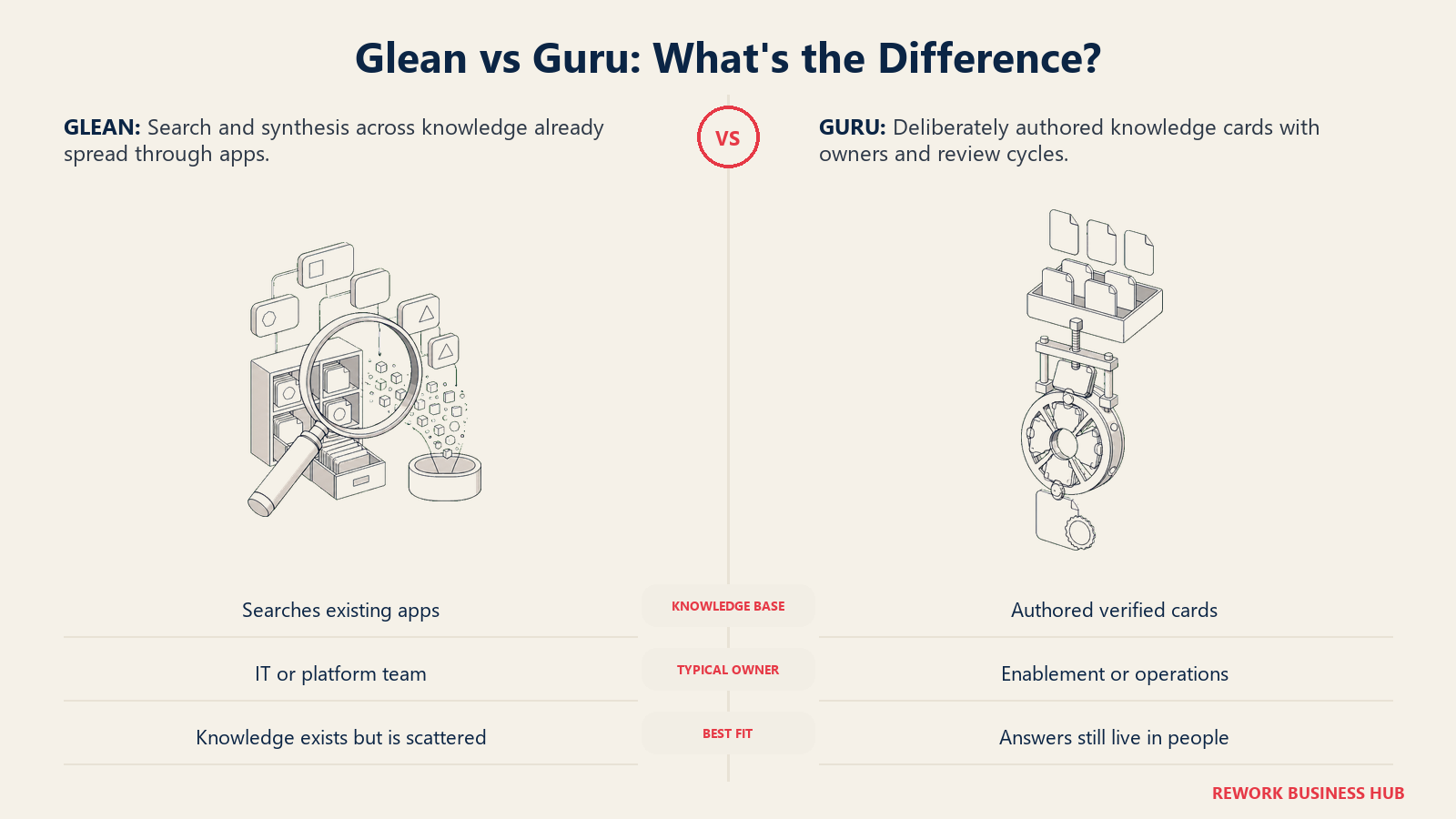
Most "Glean vs Guru" pages line these two up like they're fighting for the same budget line. They aren't, and the mismatch is the whole point of this article. Ask around a buying committee and you'll notice a pattern: the people pushing for Glean are frustrated that good documentation already exists and nobody can find it across ten apps. The people pushing for Guru are frustrated that no documentation exists at all, and the same question keeps getting answered from memory, differently, by whoever's online. Those are opposite problems, and buying the tool built for the other one won't fix either.
Glean is enterprise AI search and an assistant layer over knowledge that already exists, in Slack, Drive, Confluence, Jira, Salesforce, GitHub. It connects to 275+ apps out of the box and answers by retrieving and reasoning over whatever your systems already contain, respecting who's allowed to see what. It finds what was written. It doesn't make anyone write it.
Guru is card-based, deliberately authored knowledge: short, verified answers with a named owner and a review date, re-confirmed on a schedule instead of quietly rotting. It surfaces cards inside Slack, Microsoft Teams, Salesforce, and a browser extension, in the flow of work instead of a separate tab. It creates a trusted answer where none existed.
So the real question isn't which tool is better, it's diagnostic: is your knowledge written down but impossible to find, or not written down at all? Get that backwards and the wrong tool shows up: Guru bought for the first problem means re-authoring what already exists in Confluence, Glean bought for the second means a search engine pointed at almost nothing. Place yourself correctly before you spend a cent.
TL;DR
| Glean | Guru | |
|---|---|---|
| Core bet | Search and reasoning over knowledge that already exists | Authored, verified cards with an owner and a review date |
| Built for | Companies with real documentation scattered across many apps | Companies with tribal knowledge that lives in people's heads |
| How answers get created | Retrieved and synthesized from connected apps, on demand | Written deliberately, then reviewed on a set interval |
| Where it shows up | Web app, Slack, Microsoft 365, browser search, API and agents | Slack, Microsoft Teams, Salesforce, Chrome/Edge extension |
| App connectors | 275+ out of the box (Glean) | 100+ native, more via Zapier and Workato (Guru) |
| Pricing | Not published anywhere, demo only | Not published anywhere, "not a per-seat tool" |
| Best for | Teams drowning in search results across too many tools | Teams re-answering the same questions with no source of truth |
For the step-by-step buying process independent of which vendor you land on, see our guide to choosing knowledge base software.
Who Each Tool Is Built For
Neither company started where it is now, and that history explains what each product is actually good at.
Glean was founded in 2019 in Palo Alto by former Google search engineers, and has raised roughly $768 million, most recently a Series F at a $7.2 billion valuation in mid-2025. Named customers, Booking.com, Grammarly, Duolingo, Confluent, Databricks, lean toward companies with a lot of existing structured content to search. The problem isn't that nobody writes anything, it's that what gets written is scattered across a dozen systems nobody has time to check.
Guru is older: founded 2013 by Rick Nucci and Mitch Stewart in Philadelphia, well before "enterprise AI" was a category (Guru's about page). It grew up as a wiki-plus-verification tool for customer-facing teams, support, sales, success, who needed one trusted answer for a customer, not results to sift through mid-call. That DNA still shows.
Both hold 4.7 out of 5 on G2, on very different sample sizes: Glean around 160 reviews (G2) against Guru's roughly 2,300 (G2), tracking with Guru being older and more broadly deployed.
| Glean | Guru | |
|---|---|---|
| Founded | 2019, Palo Alto | 2013, Philadelphia |
| Category framing today | "Enterprise AI platform" | "Governed knowledge layer for enterprise AI" |
| Named customers | Booking.com, Grammarly, Duolingo, Confluent, Databricks | Primarily support, sales, and CS teams |
| G2 rating | 4.7 / 5, ~160 reviews | 4.7 / 5, ~2,300 reviews |
| Funding | $7.2B valuation, ~$768M raised (2025) | ~$68M raised across 6 rounds, last a 2020 Series C |
| Primary buyer | IT/platform or "AI enablement" leads, 1,000+ employees | Support, sales enablement, RevOps, or CS leaders, 50 to 2,000 employees |
| Buying trigger | "We have 15 apps and nobody can find anything" | "New reps take months to ramp, nothing is written down" |
Sources: Crunchbase on Glean's Series F, Guru's about page, G2 Glean reviews, G2 Guru reviews.
Two Bets on What "Knowledge" Even Means
Under the hood, the difference isn't cosmetic, it changes what each product is structurally capable of.
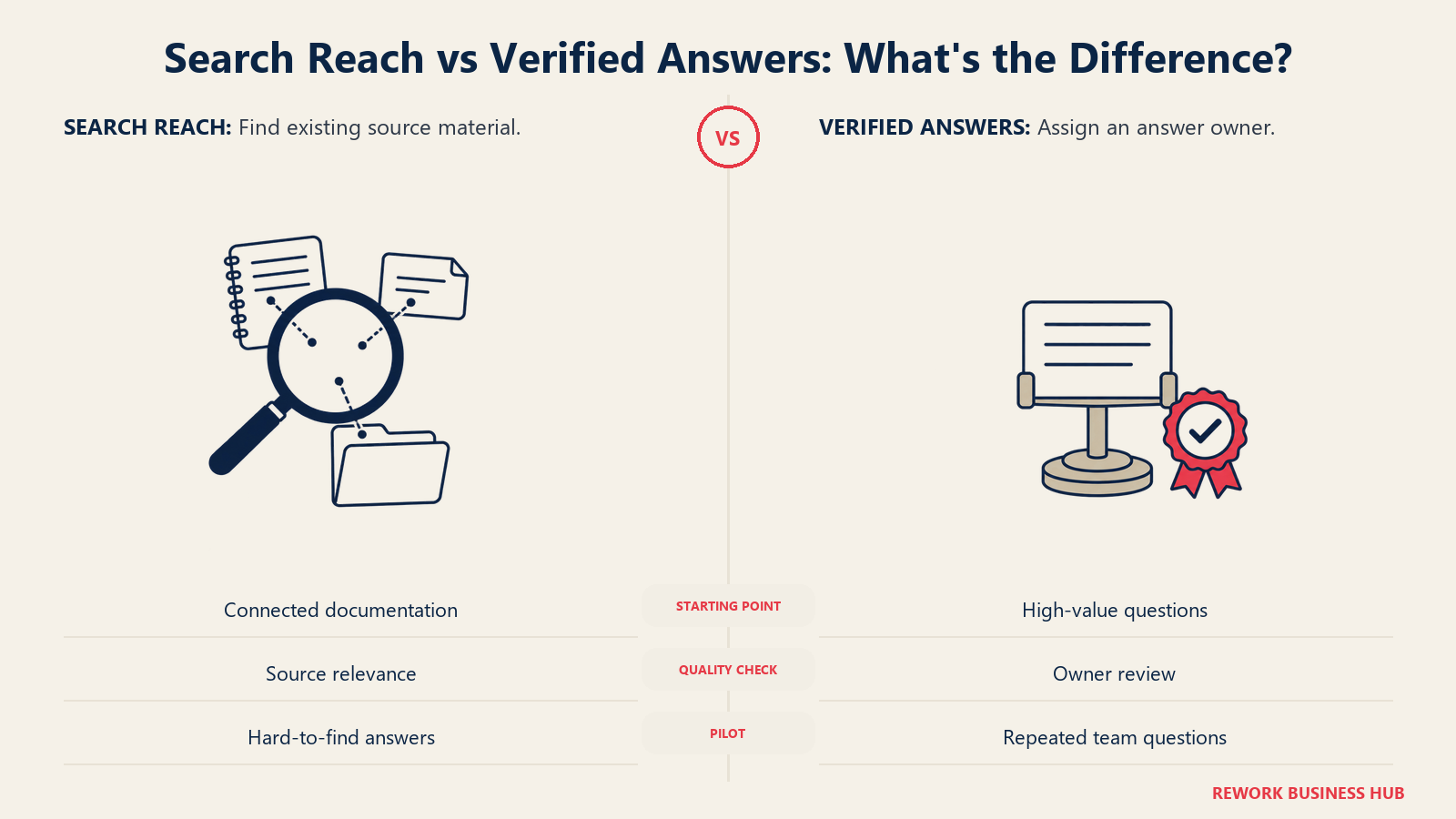
Glean runs retrieval-augmented generation against your connected apps. When someone asks a question, its index has already crawled and embedded content from every connected source, permissions attached at the document level, and it retrieves the most relevant passages, then has a model synthesize an answer with citations back to the original Slack message, Confluence page, or Jira ticket. Nothing is written for Glean, it reflects whatever's already in your systems, out-of-date quality included: if a Confluence page is three reorgs old, and it usually is somewhere, Glean will confidently cite it unless corrected. If Confluence itself is the rot, our Confluence alternatives guide is a more direct fix than layering search on top.
Guru runs on a much smaller, curated dataset: cards. A person, or increasingly an AI draft a person reviews, writes a short answer, assigns a verifier, and sets a review interval, weekly, monthly, quarterly, yearly, or a custom date. When a card comes due, its owner gets a nudge and re-confirms with one click, or updates it first. Cards that go unverified and unused queue up for archive review. Nothing in Guru is retrieved raw; every answer has passed through a human judgment call.
That's the trade: scale versus trust. Glean answers nearly anything your company has ever written, instantly, but inherits whatever accuracy problems that writing already had. Guru only answers what someone bothered to write a card for, but every answer carries a name and a date it was last confirmed true.
| Capability | Glean | Guru |
|---|---|---|
| Answers from content nobody wrote for this specific purpose | Yes, this is the whole product | No, only from authored cards |
| Requires ongoing content creation to stay useful | No, works against existing content | Yes, cards have to be written and maintained |
| Built-in expiration and re-verification cycle | Not by default, freshness depends on the source system | Yes, per-card interval with a named owner |
| Cites its sources | Yes, links back to the original document | Yes, cites the verified card and its verifier |
| AI-drafted content with human review | Agent responses reviewed case by case | AI can draft a card; a human still verifies it |
| Works well with little to no existing documentation | No, has nothing to retrieve | Yes, this is closer to its native use case |
| Works well with documentation spread across 10+ apps | Yes, this is the native use case | Partially, mostly through features like Knowledge Triggers that flag source changes for a human to review, not full-text search of every connected app |
Knowledge Freshness and Trust: Whose Job Is It to Keep Answers Right?
This is where the two products diverge hardest on philosophy, not just mechanics.
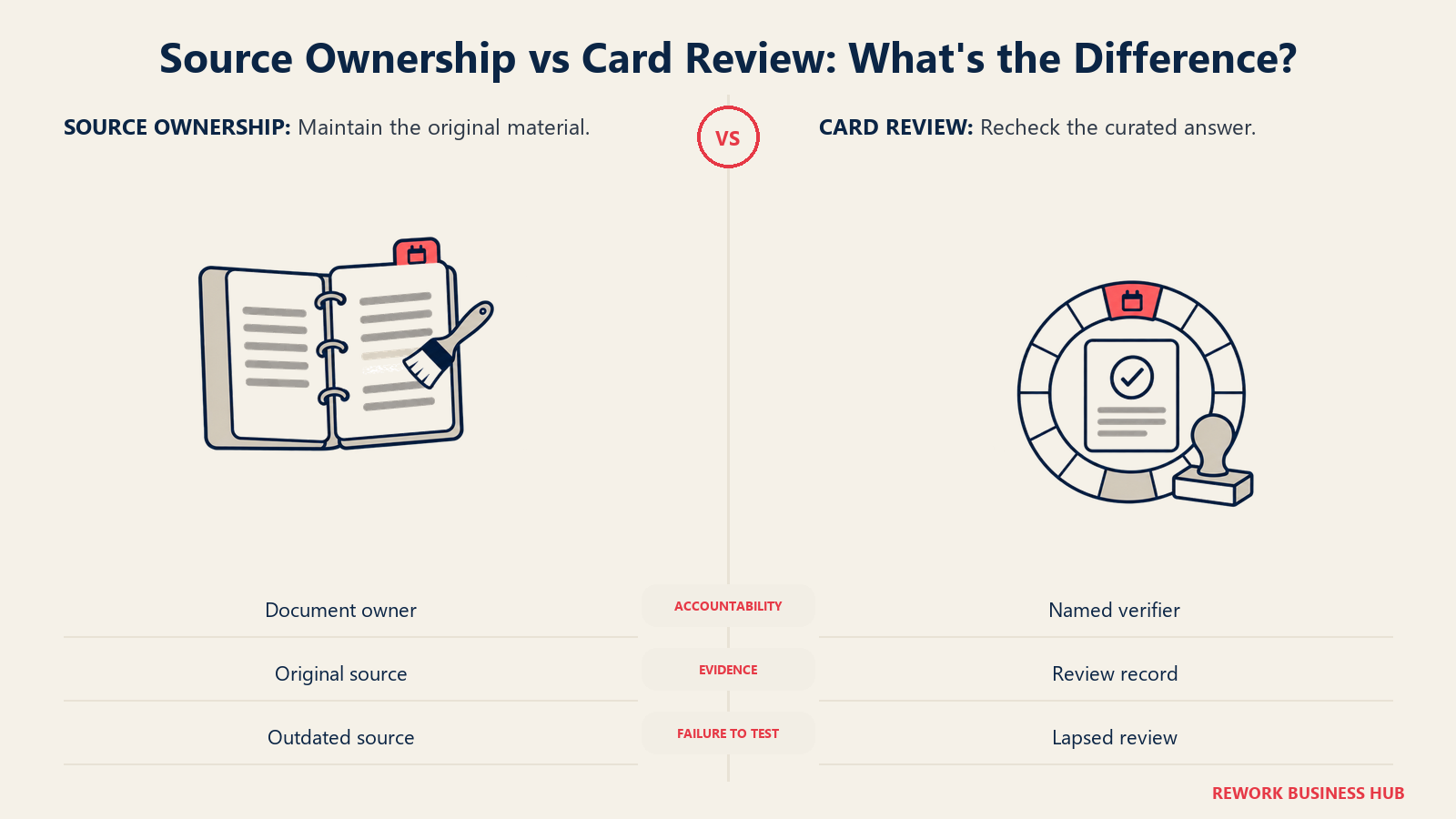
Glean doesn't fix stale content, it surfaces it faster. If three Confluence pages disagree about the PTO policy, Glean retrieves from whichever ranks most relevant, possibly the wrong one, and presents it with confidence. Its defense is retrieval quality and citation transparency, you can click through and judge the source yourself, not content governance. Fixing the underlying mess stays your team's job.
Guru builds staleness prevention in. Every card has an owner, a verifier, and a due date; conflicting cards get flagged for merge or archive rather than both quietly surfacing. Guru's site claims teams close gaps "from 60% to 100% of knowledge assessed and verified" over time (Guru), a vendor claim, not an audited figure, treat it as directional.
This matters more than it sounds: the two products face different failure modes documented in 2025 research on AI accuracy. A joint BBC and European Broadcasting Union study testing 3,000 AI assistant responses across 14 languages found 45% contained a significant issue and 81% had some problem, sourcing failures (31%) more common than factual errors (20%). That study covered general-purpose assistants, not Glean or Guru, but it names the exact failure mode a retrieval-only tool like Glean is exposed to when its sources are wrong, and the one Guru's verification workflow prevents.
| Glean | Guru | |
|---|---|---|
| Who is accountable for accuracy | Whoever owns the source document, outside Glean's control | A named verifier per card, inside the product |
| Conflict handling | Surfaces multiple sources, ranked by relevance | Flags duplicate or conflicting cards for merge or archive |
| Staleness signal shown to the reader | None built in beyond the source document's own last-edited date | Verified and unverified badges with a visible date |
| What happens to unused, unverified content | Nothing, it stays searchable indefinitely | Queued for admin archive review (Guru) |
Retrieval and Permissions: Where Your Data Actually Goes
Both vendors sell into security-conscious buyers, but the shape of the risk differs because the shape of the product differs.
Glean's permission model solves a genuinely hard problem: it indexes content from dozens of source systems, each with its own access rules, and has to guarantee results never surface something a user couldn't already see in the original app. It does this with single-tenant connectors and permissions inherited from each source, plus a retrieval architecture limiting how much raw data reaches the underlying model (Glean security). It holds SOC 2, ISO 27001, ISO 42001, HIPAA, GDPR, and TX-RAMP Level 2 certifications.
Guru's permission surface is smaller because the dataset it protects is smaller: cards, not your entire Confluence and Drive. It offers role-based access (only Authors, Workspace Owners, or Admins can verify content), enterprise SSO, audit trails, and DLP, and holds SOC 2 Type 2 with HIPAA readiness (Guru). Its browser extension is built not to read, change, or store data from visited pages; it only surfaces verified cards in context.
Practically: a Glean rollout is a bigger permissions project because it inherits every connected system's access-control mess. A Guru rollout is smaller because the content it protects was created inside Guru, under rules you set once.
| Glean | Guru | |
|---|---|---|
| Certifications | SOC 2, ISO 27001, ISO 42001, HIPAA, GDPR, TX-RAMP Level 2 | SOC 2 Type 2, HIPAA-ready |
| Permission source | Inherited and synced from each connected app | Set natively inside Guru per card or collection |
| Data exposed to the underlying model | Retrieved passages from source documents, scoped by a RAG architecture | Only the card content itself |
| Browser extension data handling | Not applicable, no general-purpose browser extension | Explicitly does not read, change, or store visited-page data |
Deployment, Integrations, and Time to First Value
Time-to-value differs between "point it at your existing mess" and "start writing cards."
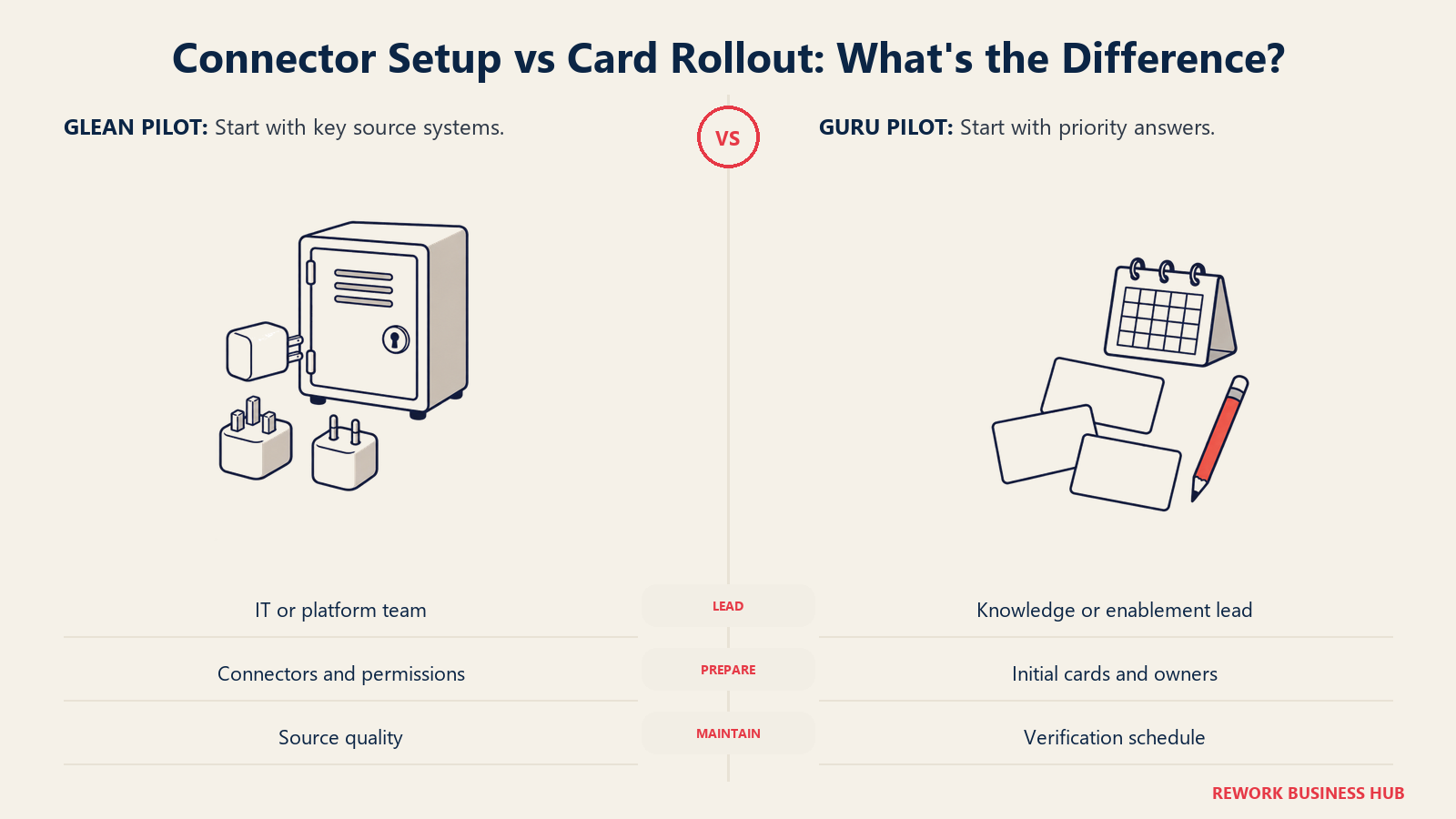
Glean's heavier lift is upfront: connecting up to 275 possible sources means IT has to decide which connectors matter, map permissions, and tune what gets indexed. A Total Economic Impact study Forrester ran on commission from Glean models a composite 10,000-employee organization reaching 93% adoption at full deployment, payback under six months, and a 141% three-year ROI, plus users saving 60 to 70 hours a year on search. Useful directionally, but it's Glean-commissioned, not independent, and your own curve depends on how many systems you connect.
Guru's heavier lift is ongoing: a knowledge manager or enablement lead has to sit down and author starting content before the product delivers value. The upside: a small pilot, even 50 to 100 cards for one team, can go live within days, since there's no permissions-mapping project blocking it. If the real bottleneck is that everything valuable gets said once in a Slack thread and never again, that's worth solving directly, see our Slack alternatives guide if the tool itself, not just the search layer on it, is the real issue.
| Glean | Guru | |
|---|---|---|
| Main setup task | Connecting and permission-mapping source systems | Authoring and assigning the first batch of cards |
| Who typically owns rollout | IT or platform engineering | Enablement, ops, or a knowledge manager |
| Time to first useful answer | Days to weeks, once core connectors are live | Days, as soon as the first cards are published |
| Ongoing maintenance burden | Mostly rests on the source systems staying accurate | Rests on card owners honoring their verification schedule |
| Where deployment risk concentrates | Permission-mapping errors, over- or under-sharing | Cards never get written, or verification lapses |
What Each One Costs to Buy
Here's the paragraph that matters most for your budget: as of August 2026, neither publishes a single dollar figure anywhere on its site.
Glean's pricing page offers exactly one call to action, "Get a Demo." There's never been a public Glean price list to go stale, it's an enterprise, sales-led product from day one, and it has stayed that way through a $7.2 billion valuation.
Guru's pricing page is more interesting, because it used to publish numbers. For years, the figure repeated across review sites was a self-serve tier around $25 per user per month with a 10-seat minimum, plus a free plan capped at three users. None of that appears on Guru's site today. Instead, the page now states Guru is "a platform and expertise solution, not just a per-seat tool," cost "tailored to your organization's scale, knowledge complexity, and AI maturity," and routes every visitor to "Talk to sales." Third-party trackers can't even agree on what replaced it: some still list the old $25-per-seat figure as current, others say Guru now offers only a 14- to 30-day trial with no permanent free tier. That disagreement is itself the signal, the free plan isn't published anywhere on Guru's site, pointing to a quiet discontinuation rather than a page merely hidden behind a login.
So the "$25 per user per month, 10-seat minimum" figure repeated across the internet is reported and historic, not Guru's current confirmed price. Treat any article, including older ones, that states it as today's fact with real skepticism.
| Glean | Guru | |
|---|---|---|
| What the vendor says drives cost | Not published; enterprise procurement, typically a platform fee plus a seat-based component | Organization's scale, knowledge complexity, and "AI maturity," per Guru's own pricing page |
| What's included in the quote, per the vendor | Not detailed publicly | "Full platform access, access to a team of solution engineers, knowledge architecture design, and ongoing optimization" |
| Free or trial option | None published | No confirmed permanent free tier; some trial availability, terms not published |
| Discount programs | Not published | Guru for Good, a discounted program for eligible nonprofits |
Get this in writing before you sign: the exact per-seat or platform-fee structure, what counts as a "seat" (named user versus active monthly user matters a lot at scale), what happens at renewal, and whether implementation is billed separately. Both vendors' quote-only pages exist precisely so you don't have that leverage before the first call.
One more honest note: both are enterprise-priced tools with no public floor, so a small team's best option is often neither. If you're under 50 people and the real problem is "we have a wiki and nobody updates it," the fix is frequently a cheaper tool plus an actual editorial habit, not a category upgrade. Confluence vs. Notion is a more honest starting point for that tier of the market.
When Glean Is the Right Call
- Documentation already exists, but it's split across Slack, Confluence, Drive, Jira, Salesforce, and GitHub, and nobody has the patience to search five tools before asking a coworker.
- You're past roughly 1,000 employees with real IT capacity to own a permissions-mapping project, and the payoff (fewer repeated questions, faster onboarding) is worth the upfront effort.
- You need an assistant that answers from dynamic, fast-changing systems (tickets, deal records, code) where authoring a static card for every question isn't realistic.
- You're building agentic AI workflows and need a platform other AI agents can query for grounded enterprise context, not just a chat interface for humans.
When Guru Is the Right Call
- Nobody has written the answer down anywhere, and the bottleneck is tribal knowledge living in a handful of senior employees' heads.
- You run a support, sales, or CS team where reps need one short, trusted answer mid-call, not a list of five documents to skim.
- New hire ramp time is a real, measured cost, and getting verified answers into Slack on day one, alongside solid process documentation, matters more than searching everything the company has ever written.
- You want built-in accountability for accuracy: a named owner and re-verification date on every answer, instead of trusting that whatever search surfaces is still true.
Decision Framework
| If you are... | Pick |
|---|---|
| Drowning in real documentation scattered across 10+ connected apps | Glean |
| Starting from close to zero, with knowledge stuck in people's heads | Guru |
| A support, sales, or CS team that needs one trusted answer per question | Guru |
| A 1,000+ employee company with IT capacity for a search and permissions rollout | Glean |
| Building AI agents that need grounded context pulled from many enterprise systems | Glean |
| Under 50 people, with an unloved wiki rather than a missing category | Neither, see Confluence vs. Notion |
What to Do Next
Answer the diagnostic question before you book a single demo. Pull ten questions your team asked a coworker in the last two weeks instead of searching for the answer, then check whether each one already exists somewhere written down. If most do, start your Glean evaluation with Glean's own connector list and confirm your five biggest source systems are actually supported before a demo call. If most don't exist in writing anywhere, skip straight to Guru's evaluation by drafting ten real cards yourself first, if that feels like a burden, it won't get easier at company scale. Either way, get pricing in writing, and if neither vendor's quote-only process fits a team your size, our knowledge management software roundup, best Glean alternatives, and best Guru alternatives cover the wider field, including options with published pricing.

Principal Product Marketing Strategist
On this page
- TL;DR
- Who Each Tool Is Built For
- Two Bets on What "Knowledge" Even Means
- Knowledge Freshness and Trust: Whose Job Is It to Keep Answers Right?
- Retrieval and Permissions: Where Your Data Actually Goes
- Deployment, Integrations, and Time to First Value
- What Each One Costs to Buy
- When Glean Is the Right Call
- When Guru Is the Right Call
- Decision Framework
- What to Do Next