Culture Amp vs Leapsome: Listening Depth or One People Platform in 2026?
Turn this article into takeaways for your work.


Each assistant summarizes the article only for you and suggests best practices for your work.
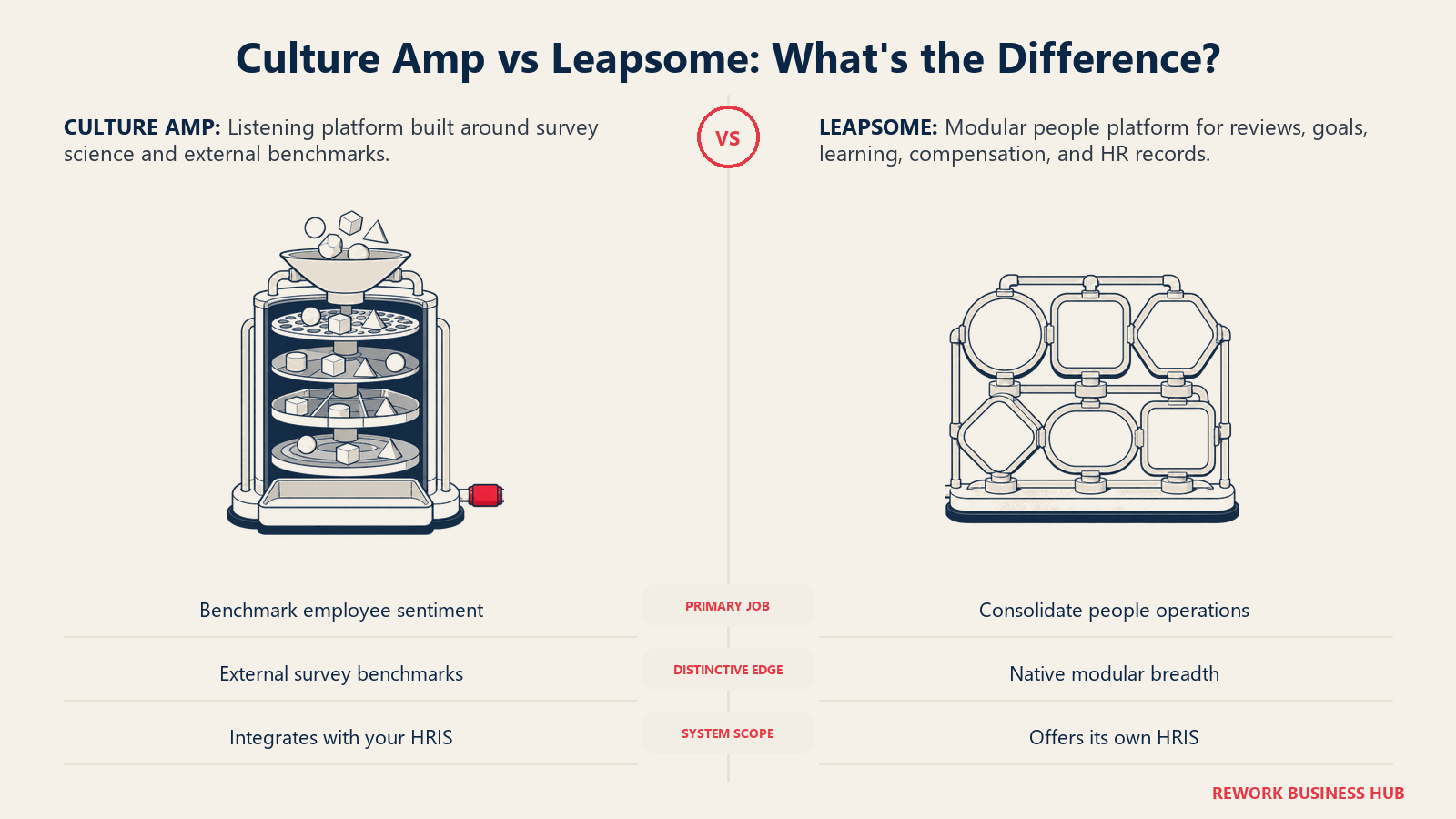
If you're comparing Culture Amp and Leapsome, you've probably already noticed the two vendors don't quite answer the same question. Culture Amp shows up when someone on the leadership team asks how engagement compares to last quarter, or to the rest of the industry. Leapsome shows up when the HR team is tired of running reviews in one tool, goals in a spreadsheet, and onboarding in a third system, and wants one contract instead of four.
That difference matters more than a feature checklist. Culture Amp is a people-science listening platform with performance built on top of it. Leapsome is a modular people-enablement suite, reviews, goals, surveys, learning, compensation and HRIS, where surveys are one module among several rather than the reason the company exists. So the real decision isn't which platform has more checkboxes. It's whether you're buying benchmark-grade listening depth, or one contract that covers several people processes at once.
TL;DR
| Culture Amp | Leapsome | |
|---|---|---|
| Started as | An employee listening and people science platform | A performance and engagement tool that grew into a modular HR suite |
| Organizing principle | Measure the culture: survey design, benchmarks, action planning | Enable people processes: reviews, goals, surveys, learning, compensation, HRIS in one modular platform |
| Module structure | Engage (listening) and Perform (performance), plus People Science Consulting as a paid add-on | Eight modules sold separately: Recruiting (Early Access), HRIS, Reviews, Surveys, Goals, Learning, Compensation, Time Tracking (Early Access) |
| Published pricing | No. Quote only, billed annually, by employee count, product and service tier | Partially. Comparison pages cite an entry point near $3 per user per month for one module; the pricing configurator instead quotes "pricing per user starts at 199/month" as a total, not a seat rate |
| Benchmark data | 1.61 billion questions answered, 74.15 million surveys completed, across 8,900+ organizations | No published external benchmark dataset of comparable scale |
| HRIS / system of record | Not offered; integrates with your HRIS | A named module: employee records, document storage, onboarding, absence and time tracking, payroll prep |
| Typical buyer | People Analytics lead or CHRO who owns the engagement number reported to the board | HR or People Ops leader who wants review, goals, survey and HR-record processes running on one platform |
| Scale claim | "More than 6,000 companies" | "2,000+ forward-thinking organizations" |
Key Facts
- Culture Amp publishes benchmark scale figures of 1.61 billion questions answered and 74.15 million surveys completed across 8,900+ organizations surveyed, on its own Benchmark Insights page.
- Leapsome states on its own pricing page that Recruiting and Time Tracking are both "Early Access," meaning neither is a mature, generally available module yet.
- Gallup's 11th-edition Q12 meta-analysis, covering 183,806 business units across 53 industries and 90 countries, found top-quartile engaged units outperform bottom-quartile units by 23% in profitability and 51% in turnover at low-turnover organizations, per Gallup.
- Managers account for at least 70% of the variance in employee engagement scores across business units, according to Gallup, which means the tool that reaches managers matters more than the tool that reports to HR.
- Leapsome's own homepage states it has "2,000+ forward-thinking organizations" as customers, a materially smaller claimed scale than Culture Amp's stated 6,000+.
Who Each Platform Is Really For
Culture Amp's pricing page segments customers by headcount: under 200 employees, 200 to 999, and 1,000-plus. Leapsome's own positioning leans toward companies with 50 to 2,000 employees, large enough to need formal HR processes but not yet running a heavy enterprise HRIS. On paper the two company-size ranges overlap almost completely. What actually separates the buyers is what they're accountable for.
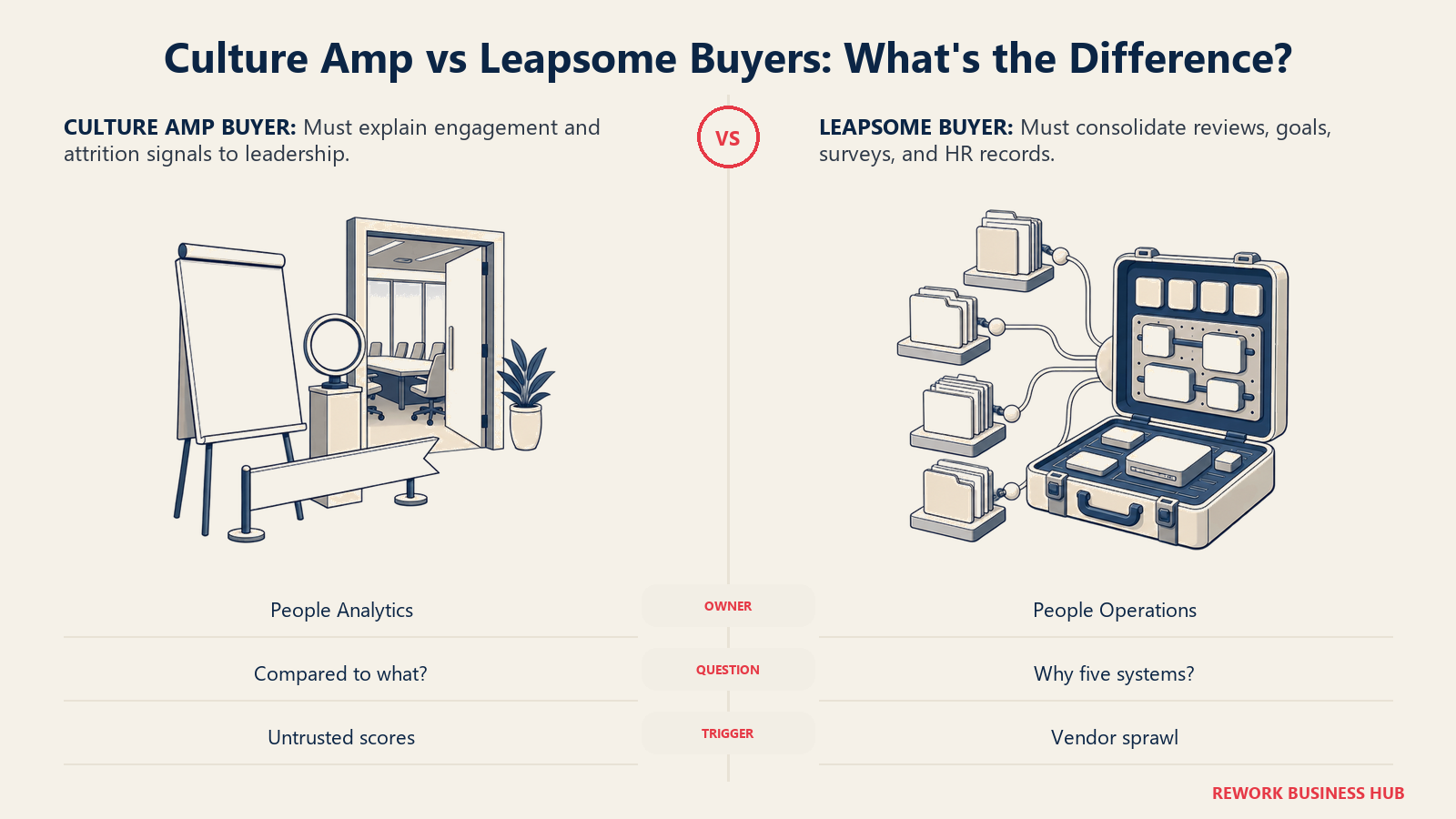
Culture Amp's natural buyer is a People Analytics lead, a CHRO, or a Head of People who has to explain a number to the board: an engagement score, an eNPS trend, a regretted-attrition rate by department. That person needs a comparison population to know whether a dip is a crisis or normal seasonal noise, and Culture Amp's whole product is built around supplying that comparison.
Leapsome's natural buyer is an HR or People Ops leader juggling four or five disconnected tools: a review tool, a survey tool, a spreadsheet for goals, a separate onboarding checklist, maybe a bare-bones HRIS. That person's pain isn't "we don't understand our culture." It's "we have too many logins and too many exports." Leapsome's pitch is that one modular contract, however imperfectly bundled, beats four separate ones.
| Culture Amp | Leapsome | |
|---|---|---|
| Company size fit | Published segments: under 200, 200 to 999, 1,000+ | Vendor-stated sweet spot: 50 to 2,000 employees |
| Primary budget owner | CHRO, Head of People Analytics, People Science-minded HR leader | HR Director or Head of People Ops consolidating tools |
| The question they're hired to answer | "Why is engagement moving, and how do we compare to peers?" | "Can we run reviews, goals, surveys, learning and HR records on one platform instead of five?" |
| Team maturity assumed | You already survey and want results that are statistically defensible | You have people processes scattered across tools and want to consolidate the contract |
| Buying trigger | Survey fatigue with no benchmark context, unexplained attrition, a board that keeps asking "compared to what" | Tool sprawl, renewal fatigue across several point solutions, a mandate to cut vendor count |
| Where it disappoints | Buyers who wanted a full HRIS or compensation module find neither | Buyers who wanted benchmark-grade external comparison data find none published |
Neither profile is more sophisticated than the other. A company that already runs a clean HRIS and just wants defensible engagement data doesn't need Leapsome's module breadth. A company drowning in five separate HR contracts doesn't need Culture Amp's benchmark depth as much as it needs consolidation. Most shortlists conflate the two problems, which is exactly why the checklist comparison misleads.
Employee Listening and Benchmarks
Both platforms will send a survey, and on a feature grid they look similar: engagement surveys, eNPS, pulse checks, some form of action planning. They aren't actually similar, because in employee listening the value sits upstream (question design) and downstream (interpretation), not in the send button.
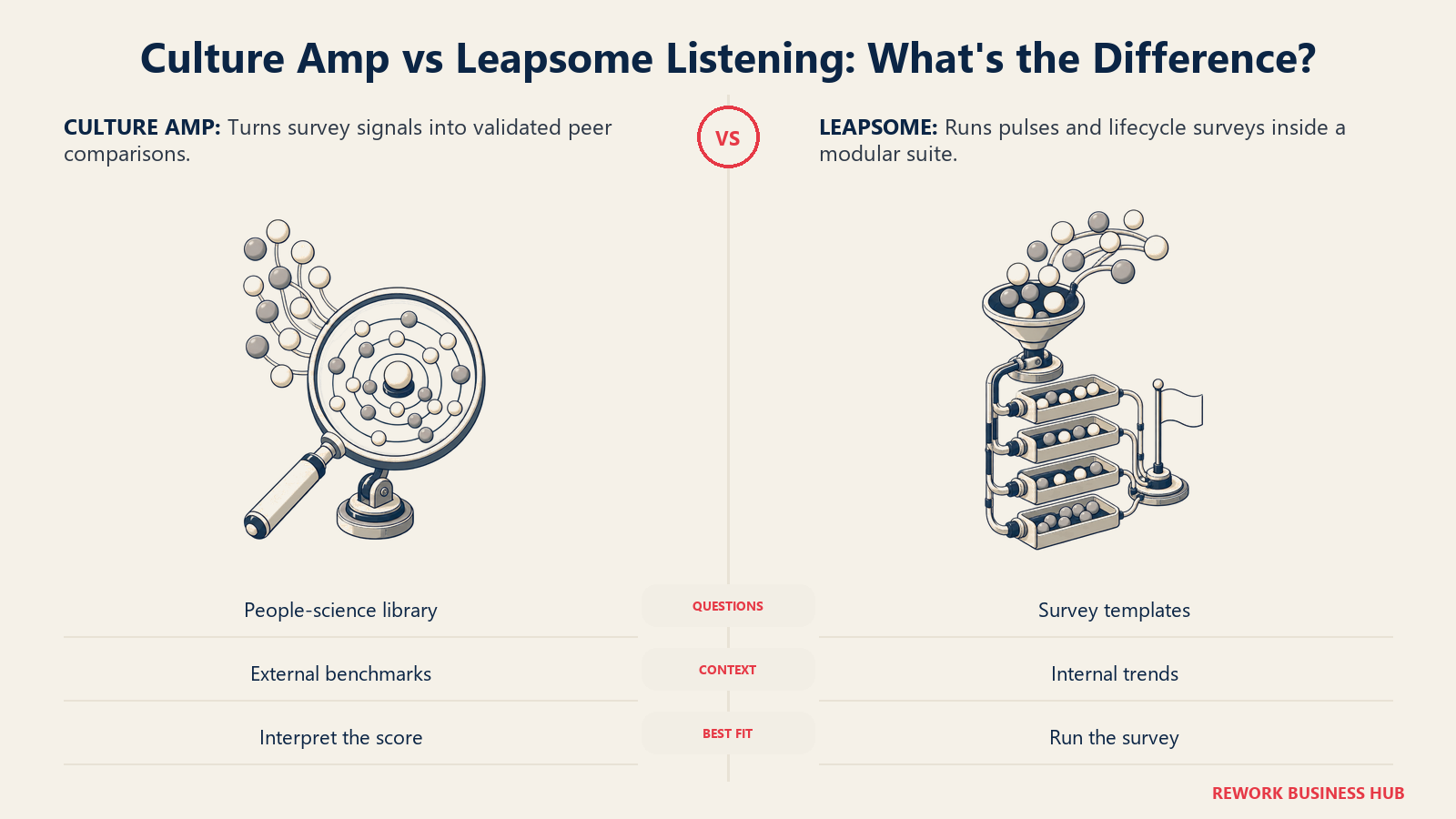
Culture Amp built its business on both ends. Its question sets are designed and maintained by an in-house people science team, and results are shown next to external benchmark comparisons cut by industry, geography and company size. Leapsome's Surveys module covers the same basic mechanics, pulse and lifecycle surveys, eNPS, DEI-related questions, but ships no published external benchmark dataset of comparable scale. If your listening problem is "we don't survey often enough," a Leapsome-style module solves it. If your problem is "we survey constantly and nobody trusts what a score of 68 means," you need a comparison population, and only one of these two vendors publishes one.
| Listening capability | Culture Amp | Leapsome |
|---|---|---|
| Engagement and pulse surveys | Yes, in Engage, the core product | Yes, in the Surveys module |
| eNPS | Yes, standard | Yes |
| Onboarding and exit surveys | Yes, plus wider lifecycle coverage | Covered within Surveys and the Learning/onboarding modules |
| Validated question library | Question sets designed and maintained by an in-house people science team | Template question sets, not positioned as a research function |
| External benchmark comparison | Core feature: industry, geography and company-size comparisons | Not a published feature |
| Human people science support | People Science Consulting, a paid add-on to Engage or Perform | Not offered as a named service |
| AI analysis of open text | AI Coach, included in all plans | AI Agents, listed among Leapsome's always-included platform features |
| DEI-specific measurement | Named DEI tooling inside Engage | Available through survey configuration, not a named standalone module |
| Benchmark and scale factor | Culture Amp | Leapsome |
|---|---|---|
| Published dataset scale | 1.61 billion questions answered, 74.15 million surveys completed, 8,900+ organizations | Not published |
| Customer count claimed | "More than 6,000 companies" | "2,000+ forward-thinking organizations" |
| Benchmark cuts available | Industry, geography, company size | Not applicable |
| Benchmark shown beside your own scores | Yes, peer comparison rendered with results | Not applicable |
Gallup's action-planning research is the useful reality check for either vendor. Workgroups in the top quartile on action-planning impact raised engagement scores by an average of 10%, while bottom-quartile workgroups saw scores fall by roughly 3%, per Gallup's guidance on survey results. Both platforms ship survey delivery and some form of action planning. Neither ships the management discipline that makes the plan happen, which is why a working employee engagement resource library is worth reading regardless of which tool you pick. If listening depth is genuinely your whole problem, our best employee engagement software guide for 2026 widens the field beyond these two.
Performance Reviews and Calibration
Culture Amp's Perform module is a real performance product: continuous feedback, 360-degree reviews, calibration framed around bias mitigation, 1-on-1s, goal management, shoutouts and employee development plans. It was built by extending a listening platform into the places measurement naturally reaches, feedback, fairness of evaluation, development, not by building a full talent-cycle operating system.
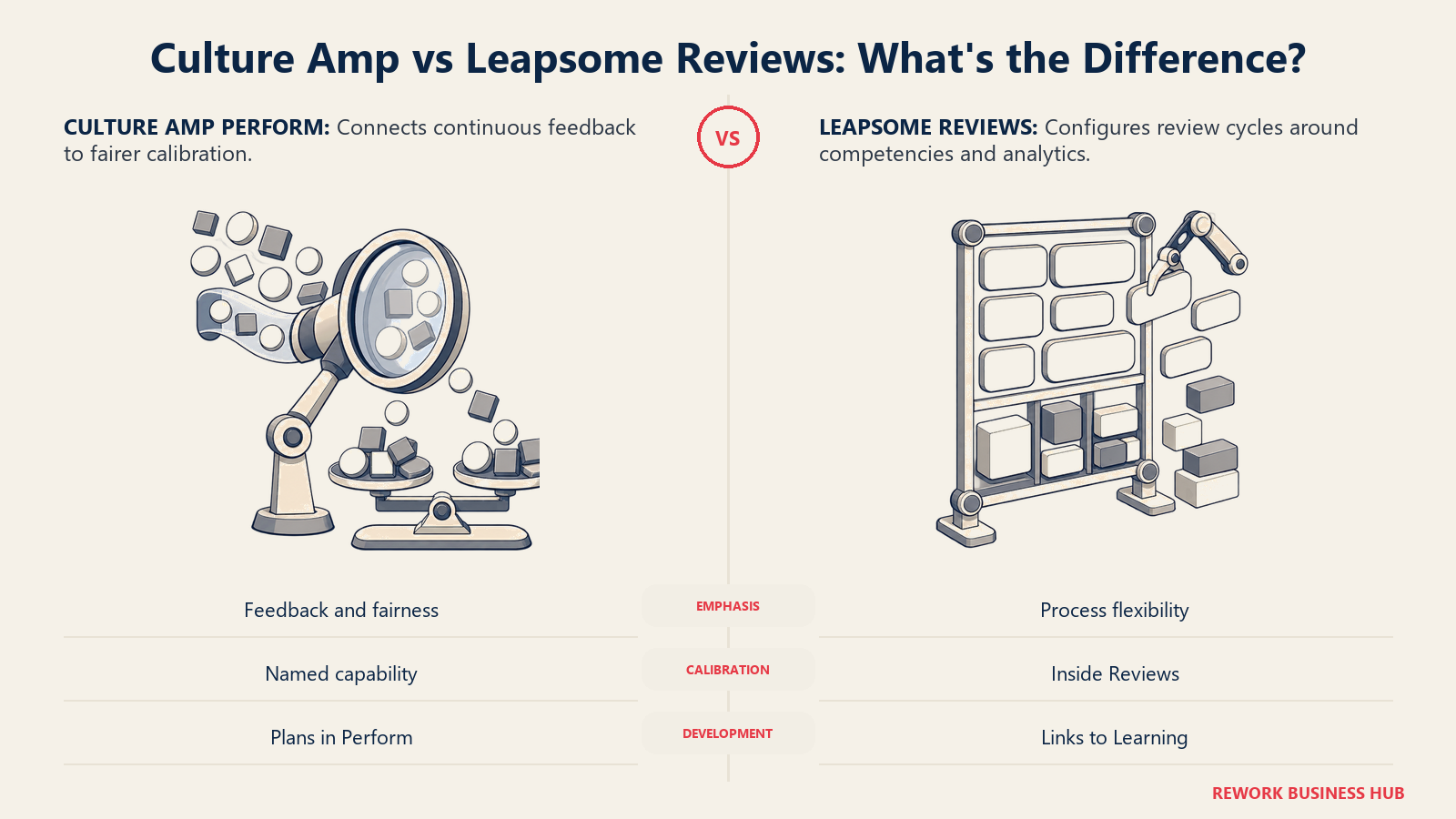
Leapsome's Reviews module covers structured performance reviews, customizable templates, 360-degree feedback and competency frameworks, with review analytics baked in. Where the two diverge is talent-cycle depth beyond the review itself. Neither vendor names a dedicated succession-planning module or a formal PIP workflow on its public feature pages, which is a real gap against a platform like Lattice that sells Talent Reviews, Succession Planning and PIPs as named SKU features. If succession and PIP workflows are a hard requirement, that's worth flagging on the sales call with both Culture Amp and Leapsome rather than assuming either one has it.
| Review capability | Culture Amp | Leapsome |
|---|---|---|
| Performance review cycles | Yes, in Perform | Yes, the Reviews module |
| Calibration sessions | Named feature, framed around bias mitigation | Supported within Reviews, not marketed as a standalone calibration product |
| 360-degree and peer feedback | Yes, continuous real-time 360 feedback | Yes, named as a core Reviews capability |
| Competency frameworks | Not a named module | Named as always-included platform feature, "Competencies" |
| Talent reviews / 9-box style rating | Performance insights, not a named talent-review module | Not a named module on the public pricing page |
| Succession planning | Not a named module | Not a named module |
| Performance improvement plans (PIPs) | Not a named module | Not a named module |
| 1-on-1s | Named feature in Perform | Covered under the always-included "Meetings" and "Instant Feedback" platform features |
| Development plans | Employee development plans included in Perform | Tied to the Learning module rather than Reviews |
Both vendors are honest about where they stop: neither is selling itself as a full talent-operating-system replacement for succession planning. A written performance review framework is worth having in hand before either demo, so you're testing the vendor against your actual process instead of the flow they'd rather show you.
Goals and OKRs
Leapsome sells Goals as one of its eight modules, individual, team and company-level OKRs with cascading alignment and tracking. Culture Amp includes goal management inside Perform rather than pricing it as a separate line item, which is simpler to buy but assumes goals are reviewed alongside performance rather than tracked as a continuous, standalone discipline.
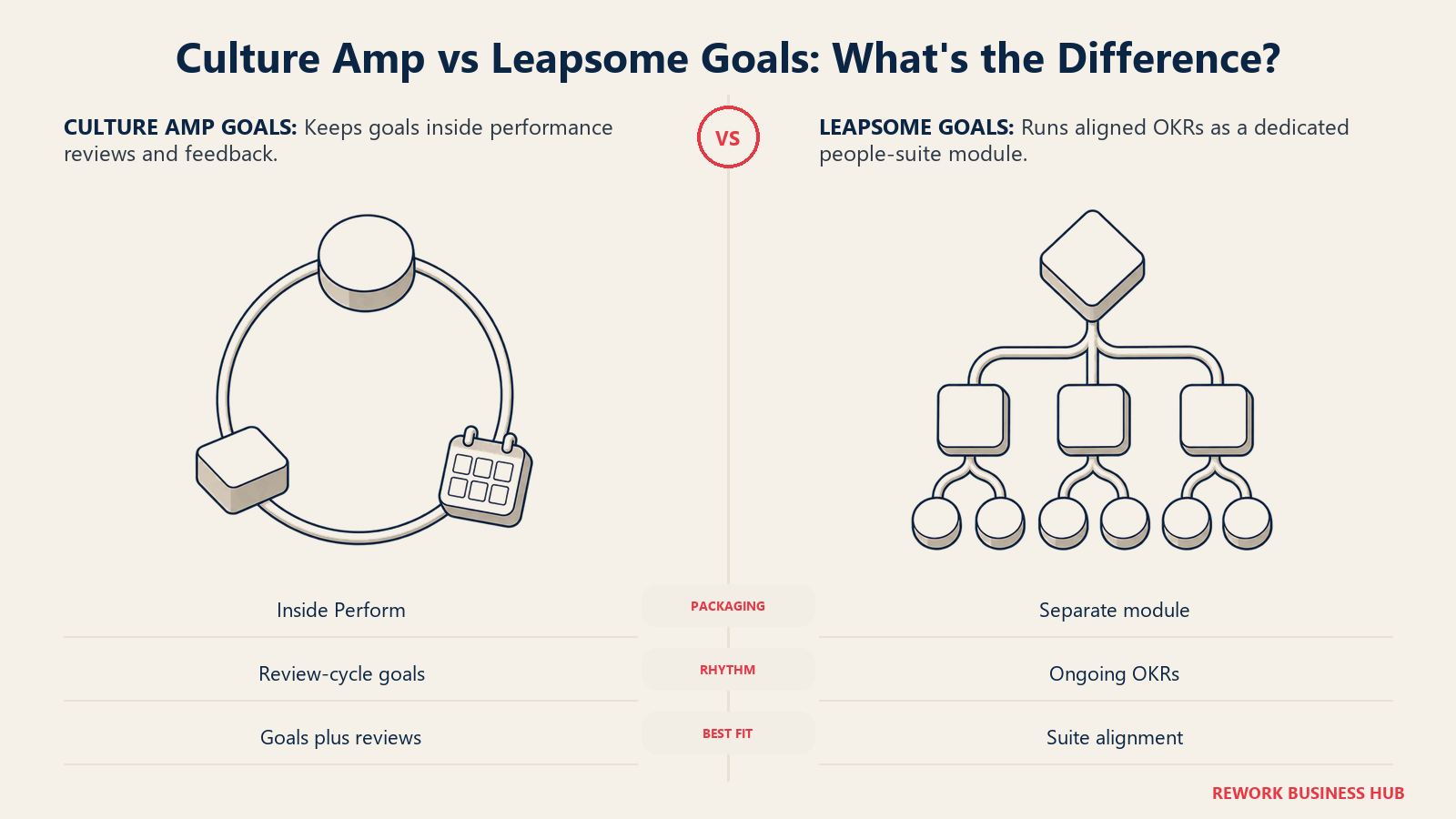
Neither vendor's public pages name the kind of operational integrations, Salesforce or Jira pulling live goal progress, that a dedicated OKR platform typically leads with. If your team runs quarterly OKRs that need to update automatically from the systems where work actually happens, both of these are review-and-survey platforms with a goals feature attached, not OKR-first software. Our best OKR software guide for 2026 is the better starting point if goal-tracking rigor, not reviews or surveys, is the primary problem you're solving.
| Goals capability | Culture Amp | Leapsome |
|---|---|---|
| Commercial model | Included inside Perform | Separate module, priced individually |
| Cascading and aligned goals | Yes, goal management with alignment | Yes, individual, team and company OKRs |
| Progress tracking | Yes, within Perform | Yes, within the Goals module |
| Operational system integrations for live progress (e.g. Salesforce, Jira) | Not a named goals integration | Not a named goals integration |
| Best fit | Annual or semiannual goals tied to the review cycle | Teams that want goals as one module among a wider modular HR stack |
If goal-tracking depth genuinely matters more than reviews or surveys to you, treat both of these as adequate but not purpose-built, and compare them against dedicated OKR software rather than against each other on this axis alone.
Learning and Development
This is the clearest capability gap in the whole comparison, and it runs in Leapsome's favor.
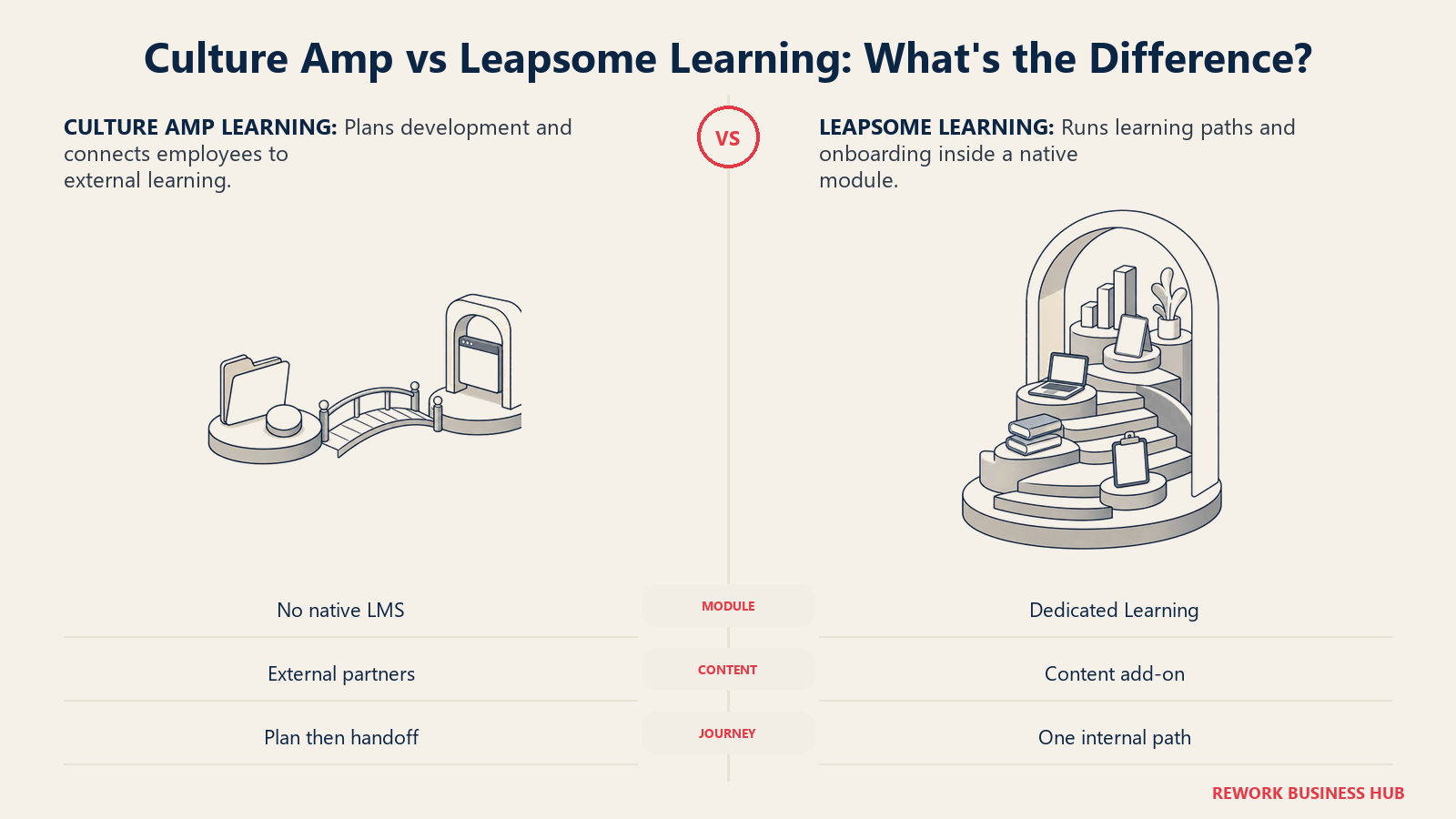
Leapsome sells Learning as a named module, onboarding, personalized learning paths and content integration, with a separate "Learning Content" add-on for pre-built course libraries. Combined with the Competencies platform feature and the HRIS module's onboarding workflows, Leapsome is positioned to run an employee's entire learning journey from first day to ongoing development inside one system.
Culture Amp has no equivalent named learning module. It covers employee development plans and a skills coach inside Perform, and its integrations page names Go1 and LifeLabs Learning as external learning partners, which is the honest tell: Culture Amp expects you to run structured learning somewhere else and connect it, the same way it expects you to run compensation through Pave.
| Learning and development factor | Culture Amp | Leapsome |
|---|---|---|
| Dedicated learning module | Not offered | Yes, the Learning module |
| Pre-built course content | Not offered natively | Learning Content add-on |
| Onboarding workflows | Basic, tied to survey lifecycle coverage | Structured onboarding inside the HRIS and Learning modules |
| Competency frameworks | Not a named module | Named always-included platform feature |
| Employee development plans | Included in Perform | Tied to Learning and Goals |
| External learning integrations | Go1, LifeLabs Learning named as partners | Not positioned as integration-dependent; learning is native |
If learning and development is a genuine near-term priority, that alone is a reasonable tiebreaker toward Leapsome. Culture Amp simply isn't building in that direction.
Compensation
Leapsome sells Compensation as a named module, pay reviews, budgeting and pay-gap analysis, with a separate "Compensation Benchmarks" add-on for external market-rate data. That benchmarks add-on is worth reading closely: it means Leapsome's own compensation benchmarking is not included in the base Compensation module, it's an extra line item on top of an extra module.
Culture Amp doesn't sell a compensation module at all. Its integrations page names Pave in the compensation category, the same honest pattern as its approach to learning: run comp somewhere else, connect it in.
| Compensation factor | Culture Amp | Leapsome |
|---|---|---|
| Compensation module | Not offered; integrates with Pave | Yes, named module: pay reviews, budgeting, pay-gap analysis |
| External market-rate benchmarking | Not applicable | Separate add-on: Compensation Benchmarks |
| Pay-gap analysis | Not applicable | Named feature of the Compensation module |
| Approval workflows for comp cycles | Not applicable | Not separately detailed on the public pricing page |
If pay decisions need to live in the same system as reviews and goals, Leapsome is the only one of these two that offers a path there at all, even though the benchmarking piece costs extra. If comp already runs cleanly through Pave or a well-governed spreadsheet, this gap costs a Culture Amp buyer nothing.
HRIS and System of Record
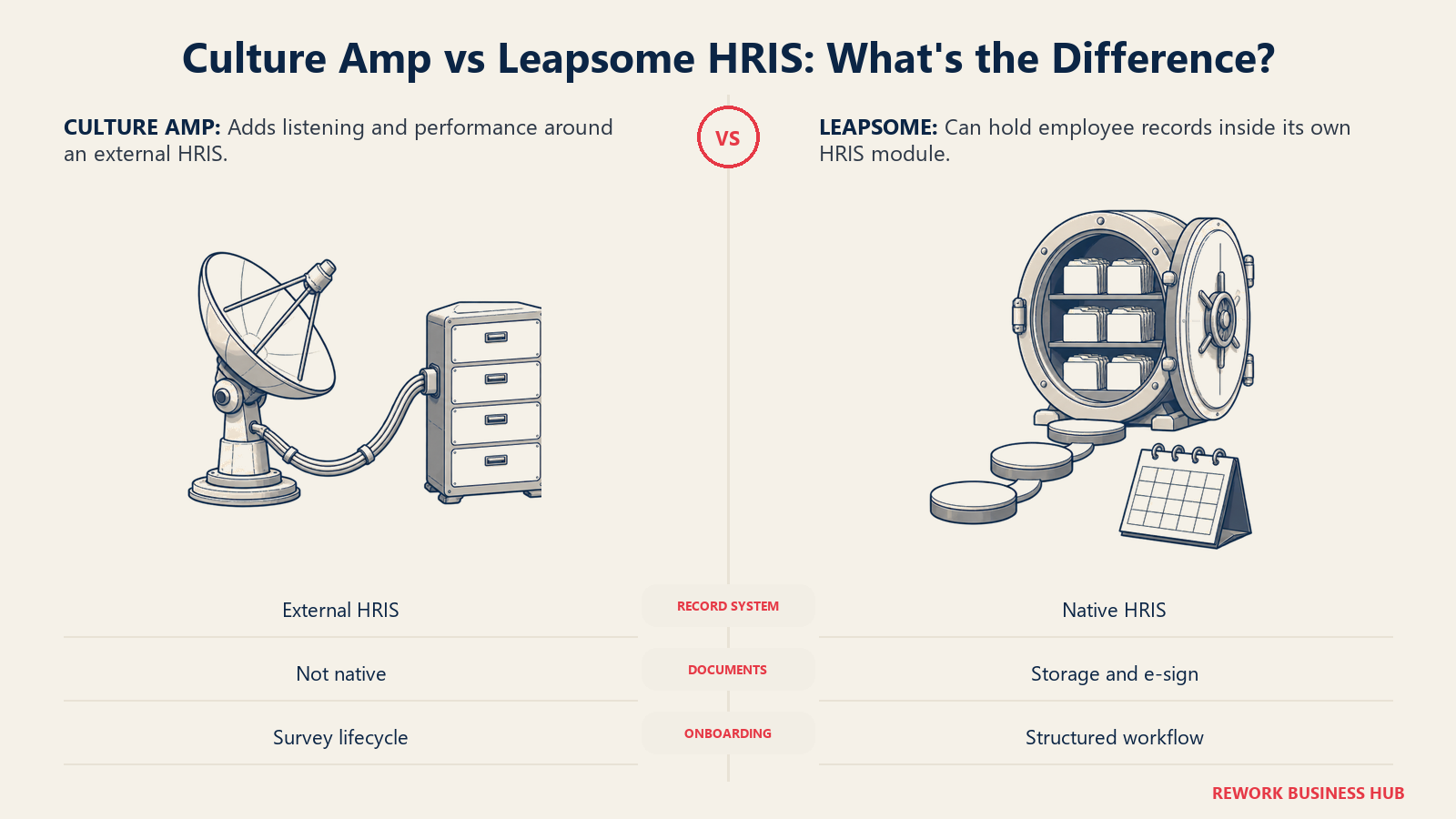
Here is the sharpest structural difference between the two, and it's worth being precise about it rather than reaching for a competitor comparison that doesn't apply here. Leapsome sells an HRIS module, employee records, secure document storage with e-signature, structured preboarding and onboarding, absence tracking, time recording and payroll preparation. Culture Amp has never sold one and has no plans signaled on its public pages; it integrates with whatever HRIS you already run.
It's tempting to reach for Lattice as a point of comparison here, since Lattice used to sell its own HRIS and payroll product too. That comparison is now out of date: Lattice discontinued both, payroll access ended March 31, 2026 and HRIS access ended July 31, 2026, refocusing entirely on its performance products, per Outsail's HR tech reporting. Both dates are in the past. Leapsome's HRIS module, by contrast, is a current, actively sold part of its platform today, not a discontinued one, so the two situations aren't parallel. Don't let a reader walk away thinking "HRIS modules from performance vendors don't work out," because that's not what's happening here.
The caveat that does matter: two of Leapsome's eight modules, Recruiting and Time Tracking, are both marked "Early Access" on Leapsome's own pricing page. That's vendor language for "not yet a mature, generally available product." If your consolidation plan depends on Leapsome handling hourly time tracking or full-cycle recruiting on day one, confirm the Early Access scope and timeline in writing before you count on it.
| HRIS and system-of-record factor | Culture Amp | Leapsome |
|---|---|---|
| Own HRIS / employee records | Not offered; integrates with your HRIS | Yes, named HRIS module |
| Document storage and e-signature | Not applicable | Named feature of the HRIS module |
| Onboarding workflows | Basic, survey-lifecycle level | Structured, part of HRIS and Learning |
| Absence and time tracking | Not applicable | Absence tracking in HRIS; standalone Time Tracking module is Early Access |
| Payroll preparation | Not applicable | Named feature of the HRIS module |
| Recruiting / ATS | Not offered | Early Access |
| Maturity signal | Long-standing integration-only approach | HRIS is current and sold; Recruiting and Time Tracking are explicitly Early Access |
If core HR records are your bigger unmet need and you want a platform built around that rather than added to a performance suite, our best HR software guide for 2026 is a more direct starting point than either of these two.
Analytics and Reporting
Both platforms report, but for different readers. Culture Amp's reporting is built to answer to a board: engagement drivers, sentiment trends, benchmark position against a comparison population. Leapsome's reporting is built to answer to an HR operations team: review completion, goal progress, survey participation, and increasingly, HR-record-level reporting now that HRIS lives in the same platform.
| Reporting dimension | Culture Amp | Leapsome |
|---|---|---|
| Primary reporting object | Engagement drivers, sentiment trends, benchmark position | Review, goal and survey completion; HR-record reporting |
| External comparison built in | Yes, industry, geography and company size | Not a published feature |
| Open-text analysis | AI Coach, included in all plans | AI Agents, an always-included platform feature |
| Cross-module reporting (HR data plus performance data) | Not applicable; performance and HR data live in separate systems | Possible in principle since HRIS and Reviews sit on one platform, though depth isn't detailed on the public pricing page |
| Who typically reads it | CHRO, exec team, sometimes the board | People Ops, HR operations, line managers |
The failure mode Gallup's research points to applies to both: a report nobody is accountable for changes nothing. Whichever platform produces the number, decide in advance who owns the follow-through action.
Integrations and Admin Burden
Culture Amp is explicit that it plugs into a broader stack rather than replacing it: HRIS integrations, Slack and Microsoft Teams, Pave for compensation, Go1 and LifeLabs Learning for development, plus a developer API. That's the natural shape of a listening-and-performance product with no HRIS ambitions of its own.
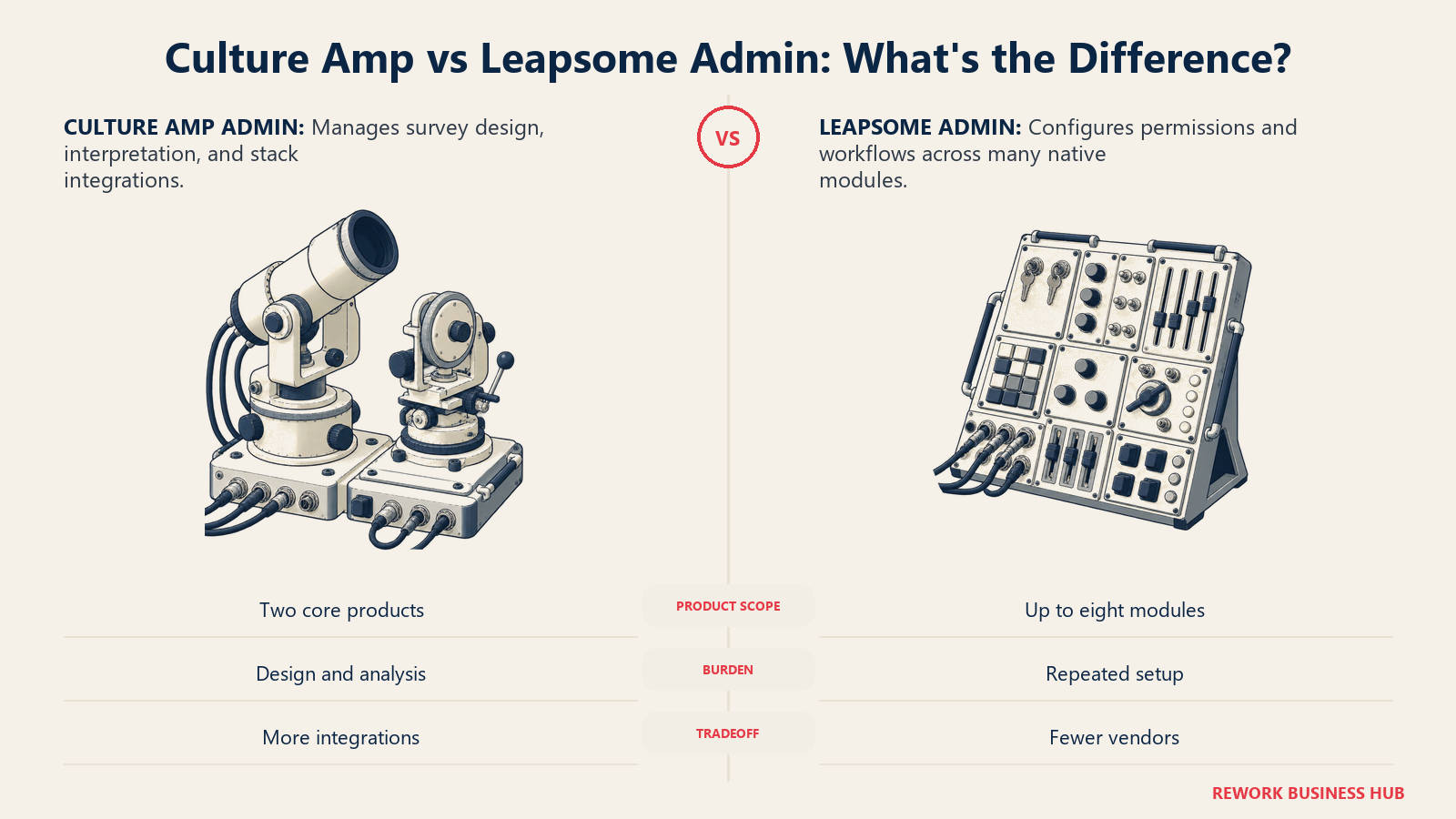
Leapsome's admin story is different in kind, not just degree. Because Recruiting, HRIS, Reviews, Surveys, Goals, Learning and Compensation are separate modules with separate configuration, an admin managing all of them is running seven-plus systems inside one login rather than genuinely one system. That can still beat seven separate vendor contracts, but it doesn't automatically mean less configuration work, especially during initial setup when someone has to map org hierarchy, permissions and workflows once per module.
| Integration and admin factor | Culture Amp | Leapsome |
|---|---|---|
| HRIS integrations | Yes, named as a product category | Native HRIS module reduces the need for a separate integration |
| Slack / Microsoft Teams | Yes | Not detailed as a named integration on the public pricing page |
| Compensation tool integration | Pave named as a partner | Native Compensation module; Compensation Benchmarks as a paid add-on |
| Learning integration partners | Go1, LifeLabs Learning named | Native Learning module; Learning Content add-on |
| Developer API | Yes | Not detailed on the public pricing page |
| Number of modules an admin configures | Two (Engage, Perform) plus optional People Science Consulting | Up to eight, priced and configured separately |
| Where admin burden concentrates | Survey design and benchmark interpretation | Per-module setup: permissions, org data and workflows repeated across modules |
Fewer modules is not automatically less work if the two modules don't cover what you need. More modules is not automatically more work if consolidating five vendor contracts into one login is the actual goal. Weigh this against what you're consolidating away from, not against an abstract ideal.
Pricing and What Each One Actually Costs
Neither vendor publishes a clean price you can drop into a budget line, which makes this section about how to run the procurement conversation rather than a simple price table.
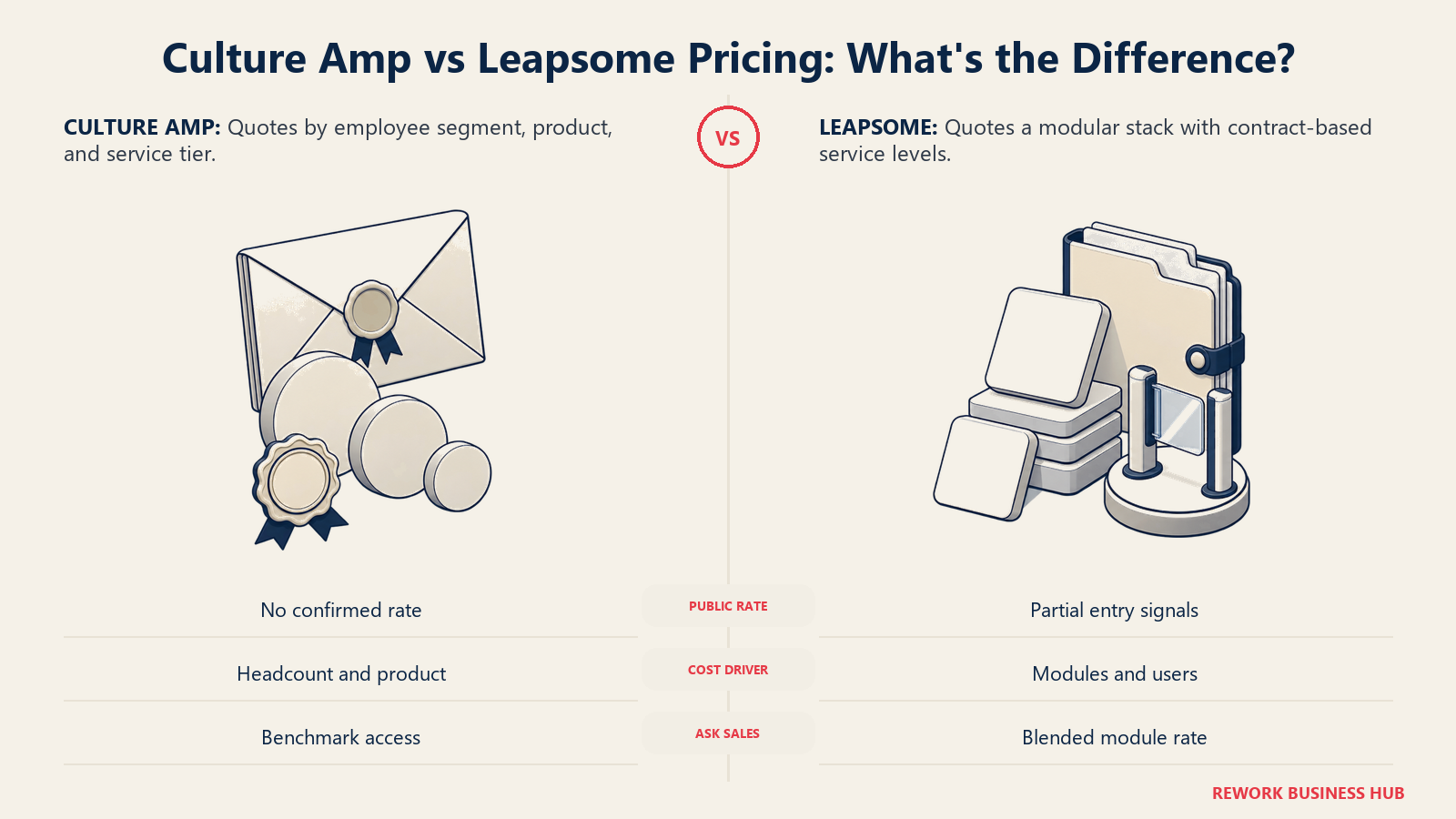
Culture Amp publishes no pricing at any tier. Its pricing page states that price depends on the number of employees, the product chosen and the service tier, billed annually, with published segments of under 200, 200 to 999, and 1,000-plus employees. There is no vendor-confirmed per-employee rate anywhere on its site. Third-party marketplaces publish estimates, commonly somewhere in the $10,000 to $45,000 annual range depending on headcount and module mix, but none of those figures are confirmed by Culture Amp, and treating a third-party guess as a real number would make this comparison less accurate, not more.
Leapsome is opaque in a different way. Its pricing page states plainly, "pricing per user starts at 199/month," which reads as a starting total rather than a seat rate. Leapsome's own comparison pages elsewhere on its site put the entry point closer to $3 per user per month for a single module. Those two figures, on the same vendor's domain, don't reconcile into one number. That's ordinary modular enterprise pricing, not a scandal, but it does mean you can't build a budget line from the marketing site alone.
| Leapsome pricing detail | What the vendor states |
|---|---|
| Entry point (per comparison pages) | Near $3 per user per month, for one module |
| Entry point (pricing configurator) | "Pricing per user starts at 199/month," a starting total, not a per-seat rate |
| Minimum contract term | 1 year |
| Setup fees | None stated: "no setup fee and no additional or hidden costs" |
| Multi-module and volume discounts | Yes, available, "contact sales for a customized quote" |
| Free trial | 14 days, no credit card required |
| Customer Success Manager and professional implementation | Requires an annual contract of at least US$6,000 (or €6,000); below that, email support and online resources apply |
Because neither vendor gives you a real number without a sales call, the more useful exercise is an illustrative model, clearly labeled as such, built from Leapsome's own stated entry point rather than a guess.
| Illustrative model (Leapsome, not a quote) | Basis | 100 employees | 250 employees |
|---|---|---|---|
| Single module at the low end of the cited range | $3/user/month | $3,600/year | $9,000/year |
| Three modules (e.g. Reviews, Goals, Surveys) at the cited $3-7/user/month range, blended at $5 | $5/user/month | $6,000/year | $15,000/year |
| Full modular stack (Reviews, Goals, Surveys, Learning, Compensation, HRIS) at the higher end of the cited range, blended at $8 | $8/user/month | $9,600/year | $24,000/year |
This table is illustrative only, built from figures reported on third-party pricing pages describing Leapsome's per-module range rather than a vendor-issued quote, and it should be treated as a conversation starter, not a number to defend to finance. Ask Leapsome directly which modules land in which price band for your headcount before using any figure from this table in a budget request.
For Culture Amp, the only responsible move is to ask for specifics in writing, the same way you would for any quote-only vendor.
| Ask for | Why it decides the comparison |
|---|---|
| Per-module rate for Engage and for Perform, per employee per year | The only way to compare Culture Amp's cost against Leapsome's per-module figures |
| Which employee-count segment you're quoted in, and the rate on both sides of the boundary | A company at 195 employees needs to know what happens at 200 |
| Price and scope of People Science Consulting, if you want it | It's a real part of the value and a real part of the cost |
| Minimum contract term and whether year one is discounted | A discounted first year with an undisclosed year-two rate isn't a price |
| A renewal uplift cap, written into the contract | Without a cap, your three-year cost is unknowable |
| Whether benchmark access is included at your tier or gated | Benchmarks are the reason to buy Culture Amp; confirm you're getting them |
Ask Leapsome the mirror-image questions: which modules you actually need, the blended per-module rate at your headcount, whether the $6,000 Customer Success threshold applies to you, and what "Early Access" means contractually for Recruiting or Time Tracking if either is part of your plan.
Implementation and Time to Value
| Implementation factor | Culture Amp | Leapsome |
|---|---|---|
| First visible output | A survey result set with benchmark context | A completed review cycle or a functioning HRIS record set, depending on which module launches first |
| Realistic time to that output | Weeks, gated by survey design and comms | Weeks per module; a full multi-module rollout stretches longer since each module has its own setup |
| Heaviest configuration work | Survey instrument selection, demographic and hierarchy mapping | Org data migration into HRIS, plus per-module permissions and workflow setup |
| Who does the work internally | People Analytics or HR, plus comms for participation | HR Ops, often across several module owners if responsibilities are split |
| Vendor-side human help | People Science Consulting, a paid add-on | Included support below the $6,000 CS threshold; dedicated CSM and professional implementation above it |
| What kills the rollout | A survey that runs and produces no visible action | Rolling out too many modules at once and stalling on the heaviest one, usually HRIS migration |
The practical advice is the same for both: launch one module or one survey cycle first, prove the follow-through action happens, then expand. A wall-to-wall Leapsome rollout across all eight modules on day one is the likeliest way to repeat Culture Amp's most common failure mode, results with no visible action, just spread across more systems.
Switching Considerations
If you're currently on Culture Amp and evaluating Leapsome, or vice versa, the practical friction isn't the feature list, it's data continuity and contract timing.
| Switching factor | What to check |
|---|---|
| Historical survey and review data | Ask both vendors what exports in what format; benchmark history tied to Culture Amp specifically doesn't transfer, since the comparison population is Culture Amp's dataset, not yours |
| Contract overlap | Run a parallel period rather than a hard cutover, especially if HR records are moving into a new HRIS |
| Minimum term lock-in | Leapsome states a 1-year minimum; Culture Amp's minimum term is undisclosed until quoted, so ask before signing |
| Module vs platform migration | Moving from Culture Amp to Leapsome usually means adding HRIS, Learning and Compensation for the first time, not just swapping a survey tool |
| Change management load | Employees relearn a new survey cadence and UI either direction; managers relearn review and 1-on-1 workflows if switching performance tooling too |
Switching is rarely just a tooling decision. If HR records are moving for the first time, that's a bigger project than a survey-tool swap, and it deserves its own timeline separate from the performance or listening decision.
When Culture Amp Is the Right Call
- Your engagement number gets challenged at the board level. If someone asks "compared to what" every quarter, you need a comparison population, and Culture Amp is the only one of these two that publishes its benchmark scale and the cuts available.
- You survey often and the instrument itself is the problem. Question design is a real discipline. Culture Amp maintains its question sets through an in-house people science function and sells access to that team as a paid add-on.
- Your HR records already live somewhere that works. If your HRIS is stable and you don't need Leapsome's module breadth, paying for consolidation you don't need is waste.
- You want fewer moving parts in the contract. Engage and Perform, with AI Coach included on all plans, is a simpler surface than managing up to eight separately configured Leapsome modules.
If Culture Amp fits the diagnosis but the quote comes back above budget, the best Culture Amp alternatives roundup covers listening-first tools that compete for the same buyer at published prices.
When Leapsome Is the Right Call
- You're consolidating several HR tools into one contract. If reviews, goals, surveys, learning and HR records currently live in four or five separate systems, Leapsome's modular structure, however imperfectly bundled, is built to replace that sprawl.
- You need an HRIS and don't want to buy one separately. Leapsome's HRIS module covers employee records, document storage, onboarding and payroll prep as a named, currently-sold part of the platform, unlike Culture Amp, which has no HRIS ambitions at all.
- Learning and development is a near-term priority. Leapsome's Learning module and Learning Content add-on have no equivalent on Culture Amp's side, which relies on external partners like Go1.
- You're comfortable buying modules incrementally and negotiating. Because pricing isn't a single published number, buyers who are prepared to negotiate a multi-module bundle can likely do better than the headline entry figures suggest.
- You don't need Recruiting or Time Tracking on day one. Both are Early Access; if either is core to your plan, get the maturity timeline in writing first.
If Leapsome fits the shape of the problem but the module math stacks up past what you can defend, our best Leapsome alternatives roundup lists other modular and all-in-one people platforms worth a look.
Decision Framework
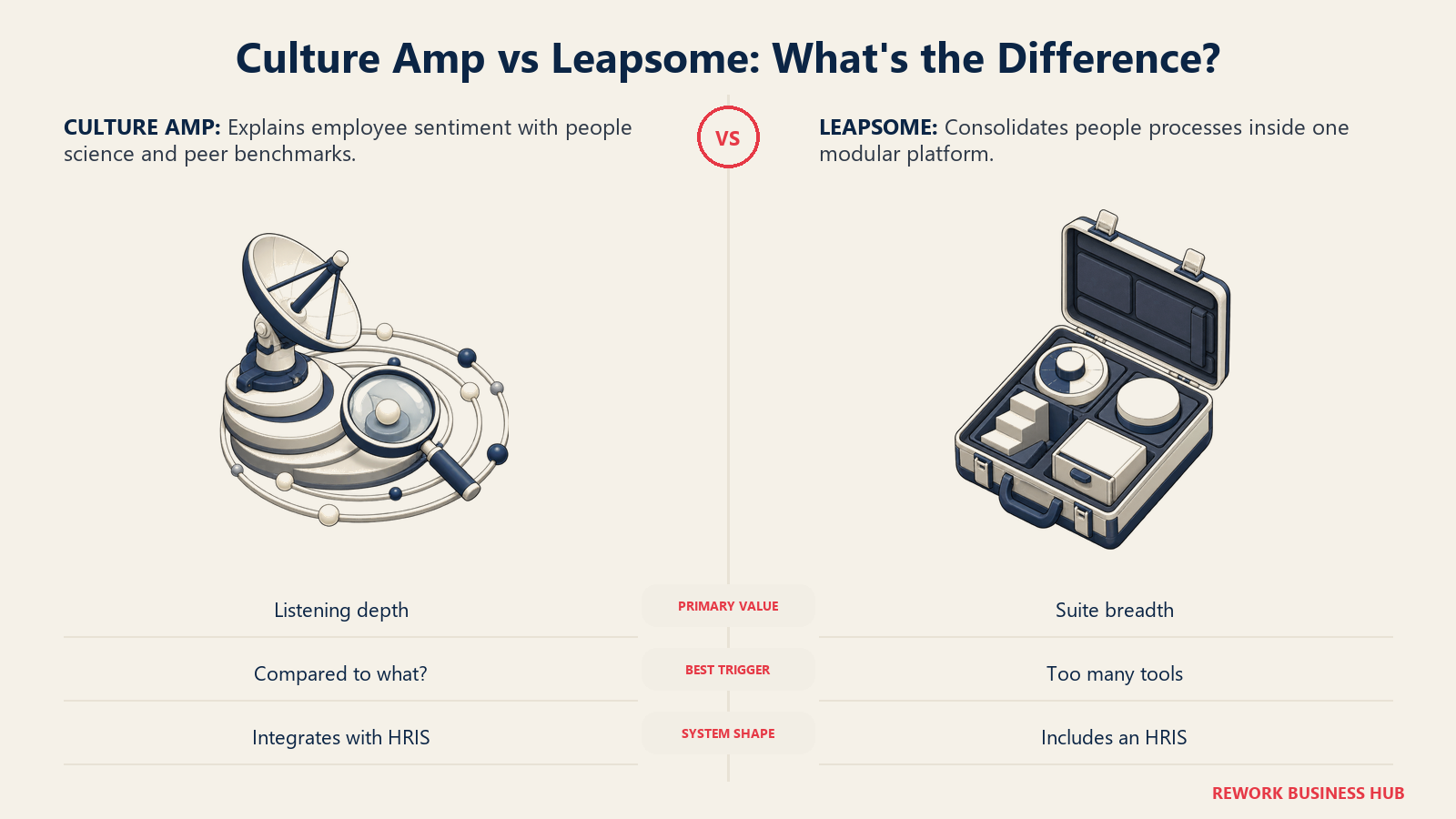
Choose between the operating problems before comparing secondary features. Culture Amp fits benchmark-grade listening, while Leapsome fits people-process consolidation.
| If this is true for you | Pick |
|---|---|
| Your board asks how engagement compares to peers | Culture Amp |
| You're consolidating reviews, goals, surveys, learning and HR records into one contract | Leapsome |
| You need HRIS functionality and don't already have one you like | Leapsome |
| You've surveyed for years and nobody trusts the questions | Culture Amp |
| Learning and development is a near-term build priority | Leapsome |
| You want paid access to people scientists, not just software | Culture Amp |
| You need mature recruiting or time-tracking tooling today, not Early Access | Neither; keep a dedicated ATS or time-tracking tool for now |
| Your HR records already live in a system you're happy with | Culture Amp, since it won't force an HRIS migration |
| Comparing the whole category rather than these two | See the 2026 performance management software guide |
What to Do Next
- Diagnose before you demo. Write one sentence naming your actual problem: weak benchmark data about culture, or too many disconnected HR tools. Those are different problems and these two vendors solve different halves of them.
- Model Leapsome using its own stated ranges. Take your headcount and the modules you'd actually use, and build the illustrative table above into a real estimate, then confirm it on a sales call rather than trusting the marketing page alone.
- Send Culture Amp the six-question list in writing. Per-module rate, segment boundary, consulting price, minimum term, renewal uplift cap, and benchmark access at your tier. Ask by email so the answers are documented.
- Ask both vendors about maturity, not just features. Confirm what "Early Access" means contractually for Leapsome's Recruiting and Time Tracking, and confirm what Culture Amp's roadmap is for anything it doesn't currently offer, like compensation or a native HRIS.
- Name the manager who owns follow-through. Whichever platform you pick, identify who's accountable for the first action after the first survey or review cycle, with a date. Gallup's data says that single choice moves engagement more than the software does.
Frequently Asked Questions about Culture Amp vs Leapsome
Does Culture Amp publish pricing?
No. Culture Amp's pricing page states only that pricing depends on the number of employees, the product chosen and the service tier, billed annually. It publishes three employee-count segments (under 200, 200 to 999, and 1,000+) but no rates. Any dollar figure you find online is a third-party estimate, not a vendor-confirmed price.
How much does Leapsome cost?
Leapsome doesn't publish one flat rate either. Its own comparison pages cite an entry point near $3 per user per month for a single module, while its pricing configurator states "pricing per user starts at 199/month," a starting total rather than a seat rate. The two figures don't reconcile on their own site, so get a written quote naming your specific modules before budgeting.
Does Leapsome have an HRIS?
Yes. HRIS is a named, currently-sold Leapsome module covering employee records, document storage with e-signature, onboarding workflows, absence tracking and payroll preparation. Culture Amp has no HRIS product and integrates with whatever HRIS you already use.
Are all of Leapsome's modules fully available?
No., Leapsome's own pricing page marks Recruiting and Time Tracking as "Early Access," meaning neither is a mature, generally available product yet. The other six modules, HRIS, Reviews, Surveys, Goals, Learning and Compensation, are not marked Early Access.
Which one has better benchmark data for employee engagement?
Culture Amp, by a wide margin on published scale. It states 1.61 billion questions answered and 74.15 million surveys completed across 8,900+ organizations, with comparisons cut by industry, geography and company size. Leapsome has not published an external benchmark dataset of comparable scope.
Can you use both at the same time?
Some companies do during a transition, running Culture Amp for listening while migrating HR records and reviews into Leapsome, but it means paying for overlapping survey features and asking employees to use two systems. Treat it as a temporary migration state, not a long-term setup, unless the benchmark data and the HRIS consolidation are both genuinely non-negotiable.
Related Resources:

Principal Product Marketing Strategist
On this page
- TL;DR
- Key Facts
- Who Each Platform Is Really For
- Employee Listening and Benchmarks
- Performance Reviews and Calibration
- Goals and OKRs
- Learning and Development
- Compensation
- HRIS and System of Record
- Analytics and Reporting
- Integrations and Admin Burden
- Pricing and What Each One Actually Costs
- Implementation and Time to Value
- Switching Considerations
- When Culture Amp Is the Right Call
- When Leapsome Is the Right Call
- Decision Framework
- What to Do Next