Best OKR Software in 2026: 13 Tools for Goal-Driven Teams
Turn this article into takeaways for your work.


Each assistant summarizes the article only for you and suggests best practices for your work.
The best OKR software in 2026 depends on whether you want a dedicated goal-tracking tool or a module bolted onto a performance suite you already pay for. Perdoo wins for small teams that need real OKR discipline without an enterprise price tag. Peoplebox wins when the actual problem is that key results never get updated because nobody wants to open one more app. WorkBoard wins at the top end, where strategy execution across thousands of people matters more than a friendly interface, and it now carries Quantive's old customer base too. Betterworks wins for large organizations running formal goal cascades and calibration. Lattice, 15Five, Leapsome and Engagedly are the right call when you'd rather buy OKRs as one module inside a performance suite than run a separate tool, and Asana or ClickUp make sense if your team already lives in one of them and just wants goals visible next to the work.
This guide ranks 13 platforms for CHROs, chiefs of staff, HR leads, founders and department heads at companies from a handful of people to global enterprises. Evaluation criteria: how much of the OKR methodology the tool actually enforces instead of just labeling a text field "Key Result," whether key results update automatically from your other systems or need to be typed in by hand, what a rollout costs at your real headcount once minimums and add-ons are included, and whether you need reviews and engagement in the same system or just the goals.
Key Facts
- The OKR software market is projected to grow from $1.51 billion in 2025 to $1.73 billion in 2026, and to $5.15 billion by 2034, a 14.60% compound annual growth rate, according to Fortune Business Insights.
- Just 49% of employees strongly agreed they know what's expected of them at work in the first half of 2026, up from 47% in 2025 but still well below the 61% peak recorded in 2015, per Gallup. Goal clarity is the exact gap OKRs are built to close.
- 56% of C-suite leaders say they're clear on their organization's must-win battles, but that drops to 27% at middle management, according to McKinsey's State of Organizations research. That's the cascade problem an OKR tool is supposed to fix.
- Fewer than 5% of employees understand their company's strategy well enough to act on it, a finding from Robert Kaplan and David Norton's Harvard Business Review research that remains the most cited data point on the strategy-to-execution gap (HBR, "The Office of Strategy Management").
- 67% of leaders expect their competitive edge over the next three years to come from being fast and nimble rather than from scale, based on a survey of more than 9,000 business and HR leaders across 89 countries in Deloitte's 2026 Global Human Capital Trends. That's the argument for quarterly OKR cycles over annual planning.
Quick Comparison Table
| Tool | Best For | Starting Price | Key Strength | Key Limitation |
|---|---|---|---|---|
| Perdoo | Small teams that need OKR discipline before a review platform | Free up to 5 users, then EUR 8/user/mo (Premium) | Strategy, OKR and KPI separated, plus a real free tier | No compensation or review tooling |
| WorkBoard | Enterprises running strategy execution above the HR layer | Quote only | Executive-grade OKR rhythm, now including Quantive | Enterprise pricing, no self-serve tier |
| Peoplebox | OKR-driven teams that live in Slack and want key results to auto-update | $8/employee/mo (Performance Management, includes OKRs), billed annually | Key results pull progress from Jira, Salesforce and HRIS data | Modules priced separately, no free tier |
| Weekdone | Very small teams that want a lightweight weekly OKR habit | Free for up to 3 users, paid from $108/mo for 4-10 users | Weekly planning-progress-problems ritual baked into the tool | Pricing is banded by team size, not a clean per-seat rate |
| Mooncamp | Mid-market teams wanting a highly customizable OKR workspace | EUR 7/user/mo (Essential), billed annually, 5-user minimum | Flexible goal types and dashboards beyond classic OKRs | Newer entrant with a smaller integration library |
| Profit.co | Enterprises wanting OKRs tied to task execution and a BSC layer | Quote only, custom built from modules | Deep integration between OKRs and daily task management | No published pricing at all, no self-serve signup |
| Lattice (Goals & OKRs) | Companies that want OKRs on the same record as performance reviews | $8/seat/mo (Goals & OKRs module), billed annually, $4,000 minimum | OKRs sit next to reviews, engagement and compensation | Buying OKRs alone still means a performance-suite contract |
| 15Five | Companies where the OKR habit needs a weekly check-in to survive | $11/user/mo (Perform, includes goals), billed annually | Weekly check-ins keep OKRs current between formal cycles | Goal tooling is lighter than a dedicated OKR platform |
| Leapsome | Mid-market teams wanting OKRs connected to learning and reviews | Modular, quote based (no single flat seat rate published) | Goals tie directly into development plans and reviews | Vendor's own pages publish conflicting entry figures |
| Betterworks | 500+ employee organizations running formal goal cascades | $8/user/mo (Performance, regular price) | Deepest cascading and calibration rigor at enterprise scale | Built for 500+ employees, heavy for smaller teams |
| Engagedly | Mid-market teams wanting OKRs bundled with reviews and recognition | $5-8/user/mo (Manage Performance, includes OKRs), minimum $7,500/yr | OKRs, reviews, feedback and competencies in one module | $7,500 annual floor hurts under roughly 100 seats |
| Asana | Teams that want goals inside the project tool they already use | $24.99/user/mo annual (Advanced, required for Goals) | Goals connect directly to the tasks and projects driving them | Not a dedicated OKR methodology tool, goals need the top tier |
| ClickUp | Teams that want lightweight goal tracking inside existing workflows | $12/user/mo annual (Business, required for Goals) | Goals and Portfolios sit next to docs, tasks and dashboards | Shallow OKR methodology support compared to dedicated tools |
What Actually Changed in This Category in 2026
Three things moved in the last year and a half, and a lot of older OKR roundups still write around them.
| Change | What happened | What it means for your shortlist |
|---|---|---|
| Microsoft Viva Goals retired | Microsoft retired Viva Goals on December 31, 2025, after stopping new feature development on December 5, 2024, and told customers to export their data before the retirement date (Microsoft Learn) | If a rep or an old blog post pitches Viva Goals, it isn't purchasable. Its retirement is a real reason the OKR-tool market is busier than it used to be |
| Quantive folded into WorkBoard | WorkBoard acquired Quantive on May 28, 2025, and Quantive customers are transitioning onto the WorkBoard platform (WorkBoard) | Quantive no longer sells standalone with its old free tier. Evaluate it as WorkBoard, at WorkBoard's quote-only enterprise pricing |
| The Betterworks promo has lapsed | The regular rate for Betterworks Performance is $8 per user per month. The $1 promotional rate covered the first contract year only, required a 3-year agreement, and expired August 31, 2026 | If you're budgeting Betterworks off a "$1" number you saw somewhere, that promo is over. Use $8, or $9 with Talent Intelligence |
The pattern underneath all three: point-solution OKR tools that don't keep shipping either get retired, get acquired into a bigger strategy-execution platform, or start competing on price against the OKR modules bundled into Lattice, 15Five and Leapsome. Budget for where the category is going, not where a 2024 comparison article left it.
Stage Fit Matrix
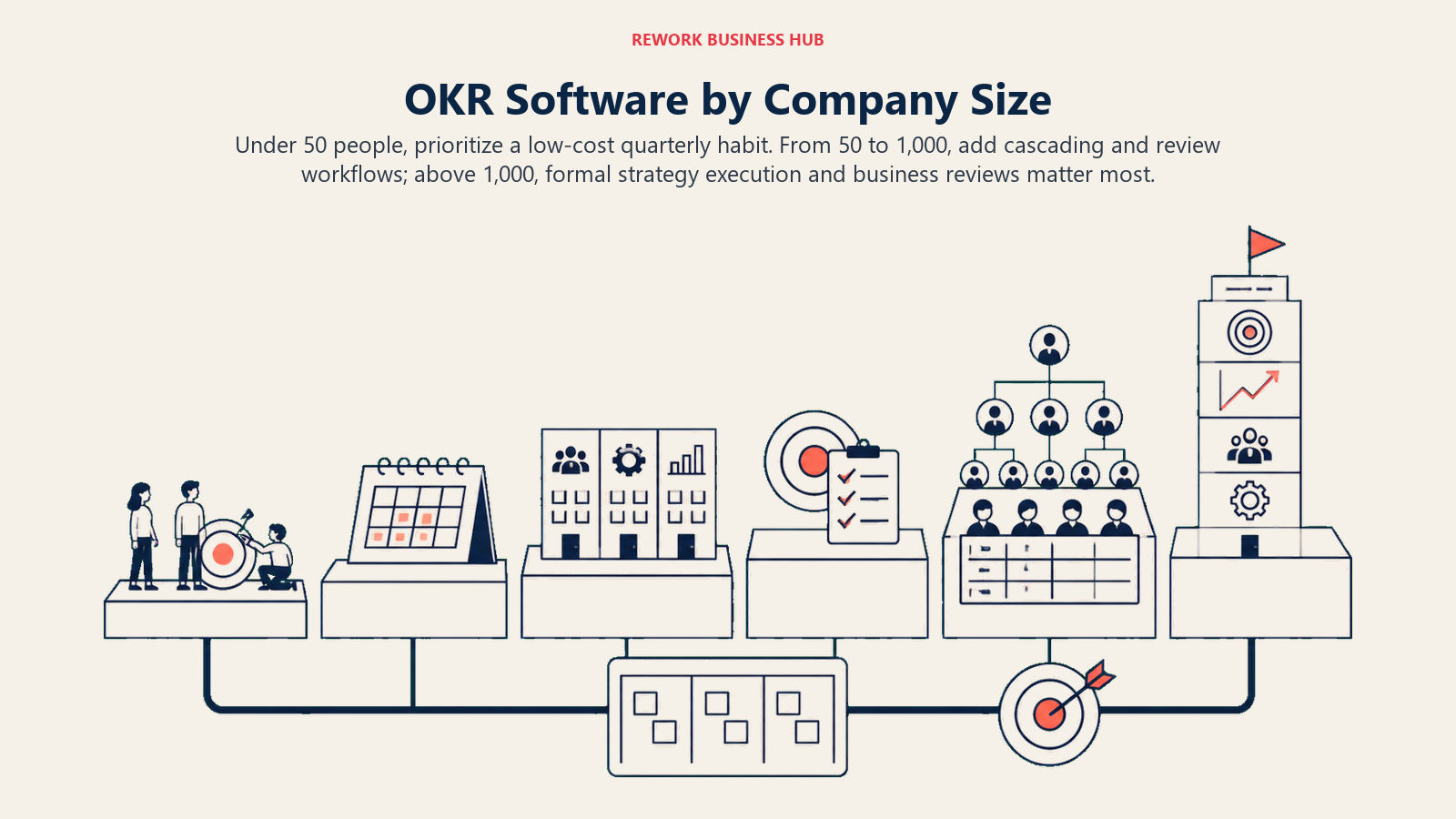
The right OKR system changes with headcount: small teams need habit and price discipline, while larger organizations need cascades, calibration, and business reviews.
| Company stage | What OKRs actually need to do here | Best fits |
|---|---|---|
| Under 10 people | Nothing formal yet, or a free tool to build the habit | Weekdone (free up to 3 users), Perdoo (free up to 5 users) |
| 10 to 50 people | First real quarterly cycle, usually run by a founder | Perdoo, Weekdone, Mooncamp |
| 50 to 250 people | OKRs need to cascade across departments without a full-time OKR admin | Peoplebox, Mooncamp, Profit.co, Lattice Goals & OKRs |
| 250 to 1,000 people | Goals, reviews and engagement start needing to live in one contract | Lattice, 15Five, Leapsome, Engagedly |
| 1,000 to 5,000 people | Formal cascades, calibration, business reviews across many managers | Betterworks, WorkBoard |
| 5,000+ people | Strategy execution sits above HR, run by a chief of staff or strategy office | WorkBoard |
| Already living in a project tool | No separate OKR budget, want goals next to the work | Asana, ClickUp |
Sizing and Persona Table
| Who owns OKRs | Their real problem | What to buy | What to skip |
|---|---|---|---|
| Founder, no HR team | Getting a quarterly rhythm to exist at all | Perdoo, Weekdone | Anything quote-only or enterprise-priced |
| First HR or ops hire, 30 to 150 people | OKRs get written once and never revisited | Peoplebox, Mooncamp, Lattice Goals & OKRs | Enterprise strategy-execution suites |
| People ops team, 150 to 500 | Goals, reviews and engagement live in three separate tools | Lattice, Leapsome, 15Five, Engagedly | Standalone OKR tools bought in isolation |
| CHRO, 500 to 2,000 | Cascading goals defensibly through calibration | Betterworks, Lattice | Lightweight OKR-only tools |
| Chief of Staff or Head of Strategy | Company OKRs drifting from what teams actually ship | WorkBoard, Peoplebox, Profit.co | Review-cycle platforms with weak goal tooling |
| PM or engineering lead | Wants goals visible next to sprints and tasks, no new login | Asana, ClickUp | Dedicated OKR platforms nobody outside HR will open |
1. Perdoo: OKR Discipline at a Price a Small Team Can Carry
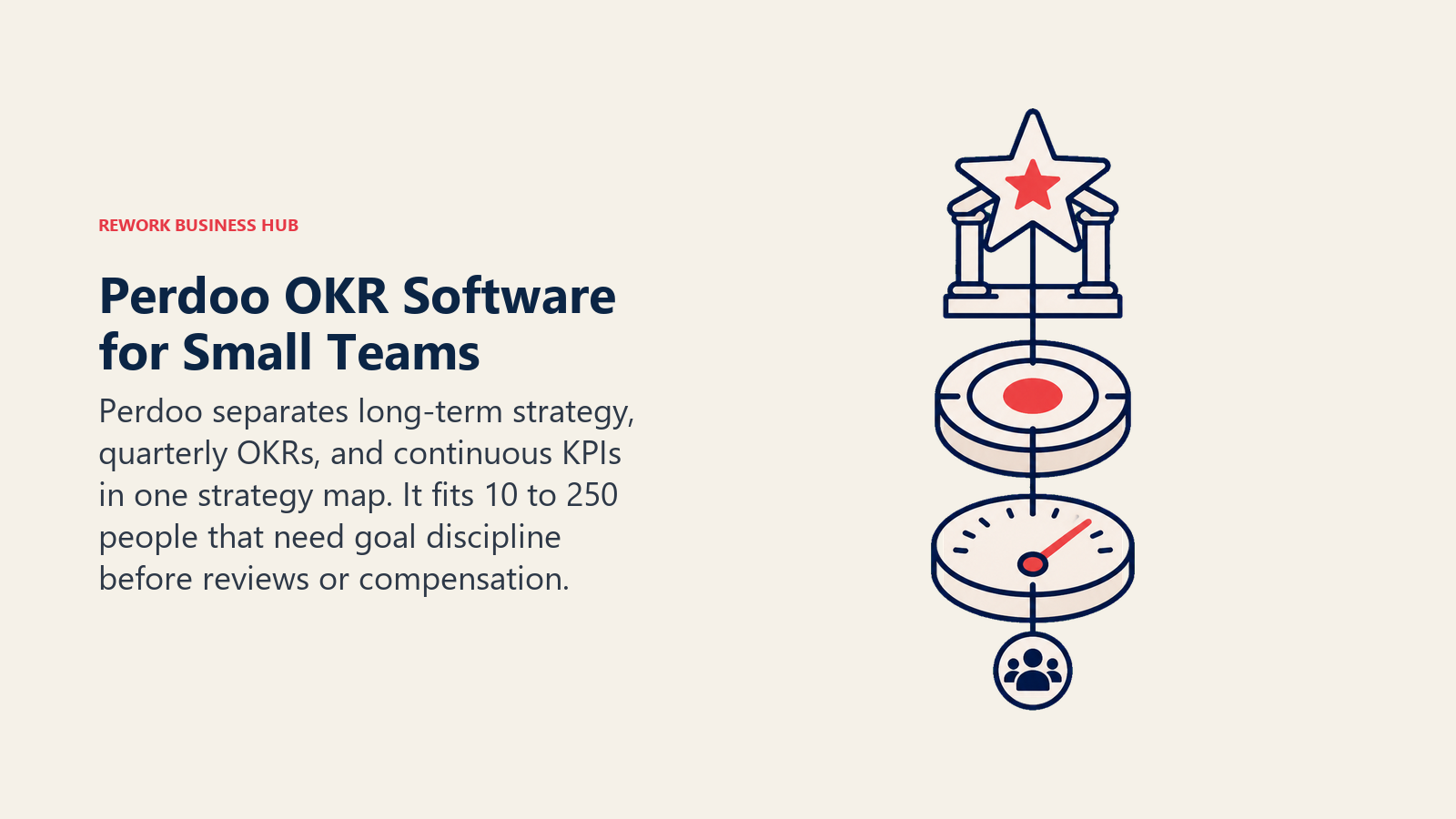
Perdoo is a pure OKR and strategy platform, and the cheapest credible one on this list. Its model separates strategy (the long-term ambition and strategic pillars), OKRs (what changes this quarter) and KPIs (what you monitor continuously), which prevents the common mess where every metric on a dashboard gets rewritten as a key result. The strategy map view is the piece teams keep using after the first quarter, because it makes the line from a squad's objective up to company direction visible in one screen instead of buried in a spreadsheet.
Pricing: a Free tier for a maximum of 5 users, Premium at EUR 8 (about $9) per user per month, and Supreme at EUR 10 (about $11) per user per month. Paid tiers require a minimum of 5 paid licenses, view-only licenses cost EUR 1.50 (about $1.75) per user per month, and annual billing runs about 10% cheaper than quarterly. Those view-only seats matter more than they look: they let the rest of the company see goals without paying full rate for people who only read.
The limitation is scope. Perdoo won't run a performance review cycle and has no compensation tooling, so most companies that use it pair it with a separate review tool, which is a fine stack until roughly 250 people. Microsoft's retirement of Viva Goals pushed a real wave of OKR buyers toward exactly this kind of dedicated tool. For the review side of that stack, see best performance management software.
| Pros | Cons |
|---|---|
| Cheapest structured OKR tool with a real free tier | Does not run performance reviews |
| Strategy, OKR and KPI separation prevents metric soup | Prices in EUR, which complicates USD budgeting |
| View-only licenses at EUR 1.50 for company-wide visibility | No compensation or engagement modules |
| Strong built-in OKR coaching content | 5 paid license minimum on paid tiers |
Best for: 10 to 250 person teams that need goal discipline before they need a review platform. If Perdoo is already on your shortlist and you want the head-to-head field around it, the Perdoo alternatives guide covers 12 of them with pricing. Sizing fit: 5 to 250. Stage fit: Seed through Series B.
2. WorkBoard: Enterprise Strategy Execution, Now Including Quantive
WorkBoard sits above the HR layer. It's bought by chiefs of staff, strategy leaders and COOs who need company objectives, business reviews and resource decisions running on one operating rhythm across thousands of people. The unit of work is the strategic initiative rather than the individual goal, and executive business reviews get built from live data instead of assembled from slides the night before. The platform has leaned hard into AI agents for this: a portfolio analyst agent that surfaces execution bottlenecks, a chief-of-staff agent that helps orchestrate the OKR cadence, and a coaching agent for performance conversations.
The 2025 change matters for anyone building a shortlist: WorkBoard acquired Quantive on May 28, 2025, and Quantive customers are transitioning onto the WorkBoard platform. Quantive no longer sells as an independent product with its old free tier or published per-seat rate, so any comparison table that still lists both as separate options is out of date. WorkBoard does not publish pricing anywhere on its site; every deal runs through a demo and a quote shaped by headcount and scope.
Where it fits: 1,000-plus employee organizations running formal strategy execution. Where it doesn't: anywhere the actual need is a review cycle. WorkBoard won't calibrate ratings or run compensation, and pairing it with a performance platform is the normal pattern.
| Pros | Cons |
|---|---|
| Executive-grade strategy and OKR rhythm | Quote-only, priced for enterprise budgets |
| Absorbed Quantive's product and customer base | Will not run performance reviews or calibration |
| AI agents built specifically around the OKR cadence | Overkill below roughly 500 employees |
| Strong business-review and reporting automation | Requires executive sponsorship to land well |
Best for: 1,000+ employee organizations where strategy execution, not review administration, is the problem. If you arrived here as a Quantive customer, that product no longer sells standalone and quantive.com now redirects to WorkBoard: the Quantive alternatives guide walks through the migration options. Sizing fit: 500 to 20,000+. Stage fit: Late-stage private and public enterprises.
3. Peoplebox: OKRs That Update Themselves, Inside Slack
Peoplebox aims at the specific failure mode where OKRs get written in January, entered into a tool once, and never touched again. Its answer is integration: key results pull progress automatically from Jira, Salesforce, HRIS platforms and spreadsheets, and check-ins and reviews run inside Slack or Microsoft Teams so managers never have to open a separate app. The vendor states it connects with 35-plus tools and serves more than 600 companies and 100,000-plus employees. For a product or revenue org that already lives in those systems, adoption friction drops sharply because updating an OKR stops being a separate chore.
Pricing is per employee per month, billed annually, and priced by module: Performance Management (which includes OKR tracking) runs $8, 360 Degree Feedback $8, Individual Development Plans $3, Compensation $5 and Engagement $2. Nova, the AI recruiting product, is quote-only. There's no free tier, so the entry point is a paid annual contract.
Buy Peoplebox when goal execution is the problem and formal reviews are secondary. Its review tooling is competent but not the reason to choose it over Lattice; the reason is that key results update themselves. If you want the methodology before the tooling, our OKR framework guide covers how to write key results a tool can actually measure.
| Pros | Cons |
|---|---|
| Key results update automatically from source systems | Modules priced separately, so the bundle adds up |
| Slack and Teams native, high real-world adoption | No free tier to pilot with |
| AI summaries flag blockers before a check-in happens | Smaller brand presence with executive buyers |
| Reasonable per-module pricing at $8 for OKRs and performance | Review builder less flexible than a dedicated tool like PerformYard |
Best for: 50 to 1,000 employee companies where OKR execution matters more than review ceremony. Sizing fit: 50 to 1,000. Stage fit: Series A through growth stage, tech-heavy orgs.
4. Weekdone: A Lightweight Weekly OKR Habit for Very Small Teams
Weekdone pairs quarterly OKRs with a weekly "Plans, Progress, Problems" status report, so a team sets an objective once a quarter but stays honest about it every week instead of rediscovering the goal at the next check-in. Objectives and key results render as a visual hierarchy tree, alignment links show which team goals ladder up to which company goals, and 1:1 tools, pulse surveys and recognition sit alongside the OKR tracking itself. It's a smaller, simpler product than most of this list, and that's deliberate.
Weekdone is free for up to 3 users, with paid plans banded by team size rather than priced per seat in the usual sense. The vendor's own published starting figure is roughly $108 a month for a 4-to-10-person team, and finer seat-level tiers only show up in the on-site pricing calculator rather than on the page itself. A 14-day free trial is available at the 4-plus user tier, and annual billing saves about 20% over monthly.
The honest limit is depth. Weekdone will get a 15-person team doing OKRs correctly for the first time; it will not replace Betterworks or WorkBoard once you have several hundred people and multiple layers of management to cascade goals through.
| Pros | Cons |
|---|---|
| Weekly PPP ritual keeps quarterly OKRs from going stale | Pricing is banded by team size, not a clean per-seat rate |
| Genuinely free for teams of 3 or fewer | Feature depth thins out well before enterprise scale |
| Visual OKR trees make alignment easy to see | Smaller integration library than Mooncamp or Peoplebox |
| Pulse surveys and 1:1s bundled in at no extra module cost | Marketing site renders pricing detail in a calculator, not plainly |
Best for: Teams of 3 to 40 running their first structured OKR cycle. Sizing fit: 1 to 40. Stage fit: Pre-seed through seed.
5. Mooncamp: A Highly Customizable OKR Workspace
Mooncamp's pitch is flexibility. Goal hierarchies, initiative types and dashboards are all customizable rather than locked to a single OKR template, and higher tiers add a goal-tree visualization that gives a genuine one-screen view of how a company's strategy connects down to individual key results. Multi-alignment lets a single goal support more than one parent objective, which real organizations need more often than rigid OKR tools admit. The customer list, which the vendor names as including Tinder, Deutsche Bank and Cambridge University, spans from consumer tech startups to large regulated institutions.
Pricing, billed annually: Essential is EUR 7 (about $8) per user per month with a 5-user minimum, and Professional is EUR 10 (about $11) per user per month, also with a 5-user minimum, adding the goal-tree view, health dashboards and more shared dashboards. Enterprise is a custom quote with a 100-user minimum, SSO, SCIM and a dedicated account manager. A 14-day free trial is available with no credit card required.
Where Mooncamp fits: a mid-market team that has outgrown a rigid, single-template OKR tool and wants the goal system to match how the organization actually plans, not the other way around.
| Pros | Cons |
|---|---|
| Customizable goal hierarchies instead of one fixed template | Newer entrant, smaller integration library than Peoplebox |
| Goal-tree visualization shows strategy-to-execution in one view | Premium integrations like Salesforce are gated to higher tiers |
| Multi-alignment supports goals with more than one parent | 5-user minimum on both paid tiers |
| Slack, Teams, Jira and spreadsheet integrations included | Enterprise tier's 100-user minimum locks out mid-size buyers |
Best for: 20 to 1,000 employee companies that want OKR structure without a rigid template. Sizing fit: 5 to 1,000+. Stage fit: Series A through late-stage private and public.
6. Profit.co: OKRs Tied Directly to Daily Task Execution
Profit.co's core argument is that OKRs fail when they live apart from the work that's supposed to achieve them, so the platform wires objectives directly into task and project management rather than treating OKRs as a quarterly reporting layer. Beyond OKR cascading, it adds a Balanced Scorecard for tracking financial, customer, process and growth metrics, a Hoshin Kanri module for multi-year priority translation using X-Matrix frameworks, and an AI agent called Athena that drafts OKRs, scores their quality and flags at-risk key results automatically.
Profit.co does not publish per-user pricing anywhere on its site. The pricing page states plans scale from core OKR tracking to enterprise suites based on user count and selected modules, with SSO, SCIM and dedicated support at the enterprise tier, and routes every visitor to a 30-day free trial or a quote. Entry pricing is reportedly about $7 per user per month.
The tradeoff for that task-level integration is complexity: Profit.co has more modules and configuration surface than Perdoo or Weekdone, which is the right amount of power for a PMO-run rollout and more than a 20-person startup needs.
| Pros | Cons |
|---|---|
| OKRs wire directly into task and project execution | No published pricing at any tier, quote only |
| Balanced Scorecard and Hoshin Kanri for strategy-level planning | Configuration surface is heavier than lightweight OKR tools |
| AI agent drafts and quality-scores OKRs automatically | Third-party "reported" prices circulating online are unreliable |
| Serves enterprise, mid-market and small business segments | No self-serve signup, every deal goes through a quote |
Best for: Mid-market to enterprise teams that want OKRs, task execution and a Balanced Scorecard in one system. Sizing fit: 50 to 5,000+. Stage fit: Series B through large enterprise.
7. Lattice (Goals & OKRs): OKRs as One Module in a Broader Suite
Lattice is what most 100-to-1,000-person companies shortlist first for performance management, and its Goals & OKRs module is the reason it shows up here too. Goals sit on the same employee record as reviews, engagement and compensation, so a manager reviewing someone's cycle sees the OKRs they carried alongside the feedback they received, instead of cross-referencing a separate tool. The goal model is flexible enough to run classic OKRs without pretending to be a dedicated strategy-execution platform like WorkBoard.
Pricing is modular and billed annually. Goals & OKRs runs $8 per seat per month on its own, Performance is $10, Engagement is $4, with Compensation as a $6 add-on and Grow as a $4 add-on. There's a $4,000 minimum annual agreement, and Lattice bills in USD only. A 200-person company buying Goals & OKRs plus Performance lands at $18 per employee per month, or $43,200 a year.
The trap is the same one that shows up across Lattice's whole module lineup: below roughly 35 to 40 people, the $4,000 floor pushes your effective per-seat rate well above the sticker price. If you're weighing this against a dedicated OKR tool, best Lattice alternatives covers the switching case, and our Lattice vs 15Five comparison covers the two head to head.
| Pros | Cons |
|---|---|
| OKRs live on the same record as reviews and comp | Buying OKRs alone still means a performance-suite contract |
| Flexible goal model supports OKRs without forcing a template | $4,000 annual minimum, USD only |
| Mature integrations with major HRIS platforms | Not a dedicated strategy-execution tool like WorkBoard |
| Managers already in Lattice for reviews adopt goals faster | Entry price moved in 2026, so old quotes are stale |
Best for: 75 to 1,000 employee companies that want OKRs on the same contract as performance reviews. Sizing fit: 50 to 1,000+. Stage fit: Series A through pre-IPO.
8. 15Five: OKRs Backed by a Weekly Check-In Habit
15Five's core insight is that OKRs die from neglect, not from bad key results, so the platform wraps goal tracking in the same weekly check-in ritual that drives its performance product. Employees answer a short set of questions every week, goal progress gets logged as part of that habit, and by the time a quarterly OKR review happens the update already exists instead of getting reconstructed from memory the night before.
Pricing, billed annually: Engage is $4 per user per month, Perform (which includes goal and OKR tracking) is $11, and Total Platform is $16, adding manager microlearning on top of Engage and Perform. Add-ons include Compensation at $9 to $11 per employee per month and Kona Coach at $19 per manager per month. A 300-person company on Perform alone pays $39,600 a year for reviews and goals together.
The honest comparison people get backwards: Perform at $11 costs more per seat than Lattice's Goals & OKRs module at $8, so 15Five isn't the budget OKR option, it's the "we also want the check-in habit" option. If your managers are already disciplined about weekly updates, you're paying for a layer you don't need. More detail in best 15Five alternatives.
| Pros | Cons |
|---|---|
| Weekly check-in habit keeps OKR progress current | Costs more per seat than Lattice's equivalent OKR module |
| Goals and performance reviews share one record | Goal tooling is lighter than Betterworks or WorkBoard |
| AI meeting assistant available as an add-on | Total Platform is the only tier that feels fully complete |
| Genuine manager-enablement content, not just goal tracking | Coaching add-ons priced per manager escalate quickly |
Best for: 50 to 800 employee companies that want OKRs sustained by a weekly habit, not a quarterly scramble. Sizing fit: 50 to 800. Stage fit: Series A through growth stage.
9. Leapsome: OKRs Connected to Learning and Development
Leapsome treats an OKR as the start of a development story, not the end of one. When a review surfaces a skill gap tied to a missed key result, the platform can turn that into an assigned course in the same tool, rather than a note that gets forgotten by the next cycle. Beyond OKRs, Leapsome covers reviews, surveys, learning, compensation, time tracking and an HRIS layer, with a recruiting product in early access.
Pricing needs a careful read, because Leapsome's own site disagrees with itself. Leapsome prices per module and doesn't publish a single flat per-seat rate: its comparison pages put the entry point near $3 per user per month for one module, while the live pricing configurator quotes a starting total instead of a seat rate. Minimum contract term is one year, there are no setup fees, and Customer Success support requires an annual contract of at least $6,000. Treat the spread as a signal about the sales process rather than a red flag about the product; you'll get quoted on a bundle, and the bundle is where the OKR-plus-learning value actually sits.
For teams weighing a switch either direction, see best Leapsome alternatives, and for the engagement-first comparison, Culture Amp vs Leapsome.
| Pros | Cons |
|---|---|
| OKR gaps can convert directly into assigned learning | No clean published per-seat price for the OKR module |
| Strong European footprint and multi-language support | Vendor's own pages carry conflicting entry figures |
| Modular, so you can start with just goals | Support tier gated behind a $6,000 annual contract |
| Compensation and time tracking available in the same suite | Module sprawl complicates the final quote |
Best for: 100 to 1,000 employee companies, especially in Europe, that want OKRs tied to development plans. Sizing fit: 50 to 1,000. Stage fit: Series A through late stage.
10. Betterworks: Goal Cascades for Organizations Over 500
Betterworks approaches performance from the goals end, which is why it belongs on an OKR list and not just a review-software one. Its core assumption is that reviews are downstream of alignment, so the platform is strongest at cascading objectives across departments, tracking progress against them in real time, and using that trail during calibration. The vendor states plainly that it adds the most value for organizations with over 500 employees, which is honest self-selection most vendors don't offer.
Pricing deserves a careful read. The regular rate is $8 per user per month for Performance and $9 for Performance plus Talent Intelligence, with Enterprise on a custom quote. Betterworks ran a promotion at $1 and $2 per user per month respectively, on terms that covered the first contract year only and required a signed three-year agreement. That offer expired August 31, 2026 and no longer appears on the pricing page, so treat $8 and $9 as the prices.
The promo is the most misquoted number in this category. A three-year commitment where years two and three run at $8 per user is the real deal you're signing, so model the three-year total, not the headline year-one rate. If you're weighing it against the field, best Betterworks alternatives covers the switching case in both directions.
| Pros | Cons |
|---|---|
| Best-in-class goal cascading and alignment at scale | Built for 500+ employees, heavy for smaller teams |
| Calibration and talent-review tooling included | Headline promo price requires a 3-year contract |
| Talent Intelligence layer connects goals to skills data | Implementation cost is separate and quoted |
| Handles complex, multi-layer org hierarchies well | Interface is more corporate than consumer-grade tools |
Best for: 500 to 10,000 employee organizations running formal goal cascades and calibration. Sizing fit: 500 to 10,000. Stage fit: Late-stage private and public companies.
11. Engagedly: OKRs Bundled With Reviews and Recognition
Engagedly positions OKRs as one piece of a wider "Performance Suite" rather than a standalone product, with AI-driven goal management that the vendor says adds predictive insight into which objectives are trending off track. Goals connect to performance reviews, AI-assisted 360-degree feedback, and integrated meetings and check-ins, so a manager working a review cycle sees the same OKRs the employee has been updating all quarter. The vendor reports serving more than 5,000 HR professionals globally across technology, healthcare, manufacturing and professional services.
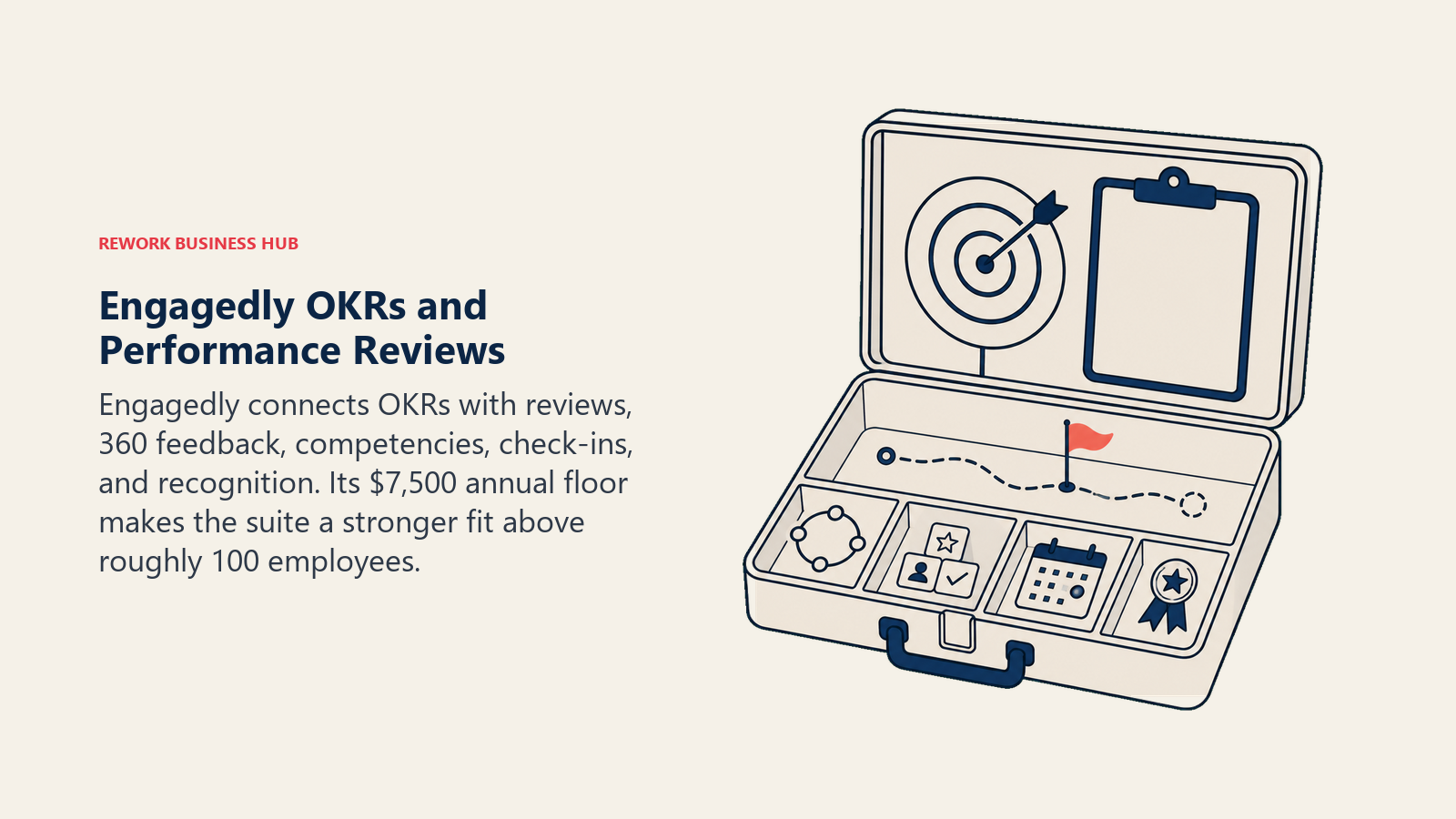
Pricing, all per user per month and billed annually: Manage Performance, which includes OKRs alongside reviews, meetings, feedback and competencies, runs $5 to $8. Learn & Grow is $3 to $5, Recognize & Reward and Engage & Listen are $2 each, and add-on suites include Mentoring at $8 and Manage Compensation at $10. The number that changes the math for smaller buyers: there's a $7,500 minimum annual spend, a floor that a lot of third-party listicles quote the $5 entry price without mentioning.
Below roughly 100 employees, that $7,500 floor pushes the effective per-seat rate well past the headline number, which is exactly the kind of gap this guide exists to flag before you build a budget around it. For the switching case either direction, see best Engagedly alternatives.
| Pros | Cons |
|---|---|
| OKRs, reviews, feedback and competencies in one module | $7,500 annual minimum hurts under roughly 100 seats |
| AI flags objectives trending off track before the cycle ends | Range pricing ($5-8) means the real number needs a quote |
| Recognition and engagement modules available at low add-on cost | Smaller brand recognition with enterprise executive buyers |
| Serves a broad base across regulated and non-regulated industries | Full suite adoption requires several modules stacked together |
Best for: 100 to 2,000 employee companies wanting OKRs bundled with reviews and recognition in one contract. Sizing fit: 100 to 2,000. Stage fit: Series B through established mid-market.
12. Asana: Goals Attached to the Work That's Actually Driving Them
Asana isn't an OKR methodology tool, and it doesn't pretend to be one. What it offers is goals that link directly to the projects, portfolios and tasks a team is already tracking, so progress updates automatically as work gets marked complete instead of requiring someone to eyeball a percentage and type it in. Objectives, key results and individual goals get built from templates, and sub-goals break a large objective into pieces a team can actually own.
Goals are available on Advanced, Enterprise and Enterprise+ plans, not on Asana's cheaper tiers. Advanced runs $10.99 per user per month billed annually ($13.49 billed monthly), and that's the entry point for anyone who wants Goals specifically rather than Asana's task and project features alone. Enterprise pricing is quote-only.
The right buyer here is a team that already runs its work in Asana and wants leadership to see whether that work is adding up to something, not a company shopping for a dedicated OKR platform. If cascading, alignment scoring or an executive strategy view matters more than task-linked progress bars, look at Peoplebox or Betterworks instead.
| Pros | Cons |
|---|---|
| Goals update automatically from linked projects and tasks | Not a dedicated OKR methodology tool, no alignment scoring |
| No new tool to adopt if the team already runs Asana | Goals gated behind the Advanced tier and up |
| Templates for objectives, key results and sub-goals | Weak cross-functional cascading compared to Peoplebox or WorkBoard |
| Familiar interface lowers the adoption curve | Enterprise pricing is quote-only |
Best for: Teams already running projects in Asana that want goal visibility without a second tool. Sizing fit: 10 to 500. Stage fit: Any stage already standardized on Asana.
13. ClickUp: Lightweight Goal Tracking Inside an Existing Workflow
ClickUp Goals works the same logic as Asana's: connect an objective to the tasks driving it and let progress update automatically rather than manually. It supports a few different tracking shapes, including Task Targets (all tasks in a sprint roll up to one Goal), Numerical Targets (progress tracked as a count or a true/false), and Goal Folders that group related Goals, whether that's sprint cycles, OKRs, or weekly scorecards, into one view of percentage complete.
ClickUp's own Goals page doesn't state which tier unlocks the feature directly, but Goals and Portfolio Management sit at the Business tier and above in ClickUp's plan structure, which runs $12 per user per month billed annually ($19 billed monthly). Unlimited is $7 per user per month annual but doesn't include Goals; Enterprise is a custom quote.
This is the same tradeoff as Asana: fine for a team or department that wants lightweight goal tracking next to its existing task board, and the wrong tool if you need real OKR methodology, cross-team alignment scoring, or an executive rollup across hundreds of managers.
| Pros | Cons |
|---|---|
| Goals connect directly to tasks and sprints already in ClickUp | Shallow OKR methodology support, no alignment scoring |
| Multiple tracking types (task, numerical, folder rollups) | Goals require the Business tier, not the cheaper Unlimited plan |
| No new login for teams already running ClickUp | Not built for company-wide strategy cascades |
| Flexible enough for sprint goals as well as quarterly OKRs | Enterprise rollup features require a custom quote |
Best for: Teams already running work in ClickUp that want lightweight goal tracking, not a dedicated OKR platform. Sizing fit: 10 to 500. Stage fit: Any stage already standardized on ClickUp.
Buying Mistakes to Avoid
| Mistake | What it looks like | What to do instead |
|---|---|---|
| Buying a review tool when you needed an OKR tool | HR picks Lattice or 15Five for reviews, and strategy still has no real cascade | Decide who owns the OKR process (HR or strategy) before you demo anything |
| Quoting a promotional price in the budget | A three-year Betterworks deal modeled at the year-one $1 promo rate | Model the full contract term at the standing $8 rate, then treat the promo as savings |
| Assuming a range is a price | Engagedly budgeted at $5 when the quote lands at $8, or the $7,500 floor gets missed entirely | Ask where in the published range you land, and confirm any annual minimum on the first call |
| Picking a tool with no automatic progress tracking | Key results sit untouched for a full quarter because updating them means a separate login | If your team lives in Jira, Salesforce or Slack, weight tools that pull progress automatically, like Peoplebox |
| Treating OKRs as a software problem | New tool, same vague objectives, same annual-only check-in | Fix how objectives get written and how often they're reviewed first; our goal setting guide covers that groundwork |
| Carrying last year's figures forward | An internal deck still pricing Quantive as a standalone product | Re-verify every price against the vendor's own page in the month you buy, and check whether the vendor still exists standalone |
That second-to-last row is the expensive one. Only 27% of middle managers say they're clear on their organization's must-win battles, per McKinsey, and swapping one goal-tracking tool for another doesn't fix that gap on its own. If the objectives themselves are vague, the tool just makes vague objectives easier to miss on schedule.
How to Choose: Decision Framework
The final choice comes down to the operating problem the tool must solve, not the length of its feature list.
| If you need... | Pick... | Why |
|---|---|---|
| Cheap, disciplined OKRs for a small team | Perdoo | Free up to 5 users, EUR 8 per user after that, view-only seats at EUR 1.75 |
| Company-wide strategy execution above the HR layer | WorkBoard | Executive business-review rhythm, now including Quantive's former base |
| OKRs that update themselves from Jira and Salesforce | Peoplebox | Automatic key-result tracking inside Slack and Teams |
| A free, lightweight weekly OKR habit for a very small team | Weekdone | PPP weekly check-ins keep quarterly OKRs from going stale |
| A customizable OKR workspace that doesn't force one template | Mooncamp | Flexible hierarchies plus a genuine goal-tree strategy view |
| OKRs wired directly into daily task execution | Profit.co | Balanced Scorecard and Hoshin Kanri alongside task-level OKR tracking |
| OKRs on the same contract as performance reviews and comp | Lattice | Goals & OKRs module at $8 per seat, sharing a record with reviews |
| OKRs sustained by a weekly check-in ritual | 15Five | Perform bundles goal tracking with the habit that keeps it current |
| OKRs connected to learning and development plans | Leapsome | A missed key result can become an assigned course in the same tool |
| Goal cascades and calibration across 500+ people | Betterworks | Enterprise-grade alignment tooling, priced at $8 per user regularly |
| OKRs bundled with reviews and recognition in one module | Engagedly | Manage Performance covers OKRs, reviews, feedback and competencies |
| Goals inside the project tool your team already runs | Asana or ClickUp | Progress updates automatically from linked tasks, no new login |
What to Do Next
Pick two platforms, not five, and make them different on purpose: one dedicated OKR tool sized to your budget today, and one suite-embedded module you'd grow into if goals, reviews and engagement need to consolidate later. Then run both through the same three tests before a contract goes near legal.
First, build one real OKR cycle in each trial account using your actual company objective and one team's actual key results, not the vendor's demo data. A tool that can't model how your teams actually cascade goals is out, no matter how good the pitch deck looked. Second, get the fully loaded first-year number in writing: base module, minimum annual commitment, any promo pricing and what it reverts to, and what integrations cost extra. Third, check whether progress updates automatically from the tools your team already uses or whether someone has to type a percentage in every week, because that single detail predicts whether the OKRs are still current in week ten of the quarter.
If the shortlist still feels wide, name the actual problem before you demo anything else. A team that can't keep key results updated needs Peoplebox's integrations, not a prettier dashboard. A team whose goals never cascade past the leadership offsite needs WorkBoard's structure, not a cheaper tool. And a team that just needs its first quarterly rhythm to happen at all needs Perdoo, not a twelve-module enterprise suite.

Principal Product Marketing Strategist
On this page
- Key Facts
- Quick Comparison Table
- What Actually Changed in This Category in 2026
- Stage Fit Matrix
- Sizing and Persona Table
- 1. Perdoo: OKR Discipline at a Price a Small Team Can Carry
- 2. WorkBoard: Enterprise Strategy Execution, Now Including Quantive
- 3. Peoplebox: OKRs That Update Themselves, Inside Slack
- 4. Weekdone: A Lightweight Weekly OKR Habit for Very Small Teams
- 5. Mooncamp: A Highly Customizable OKR Workspace
- 6. Profit.co: OKRs Tied Directly to Daily Task Execution
- 7. Lattice (Goals & OKRs): OKRs as One Module in a Broader Suite
- 8. 15Five: OKRs Backed by a Weekly Check-In Habit
- 9. Leapsome: OKRs Connected to Learning and Development
- 10. Betterworks: Goal Cascades for Organizations Over 500
- 11. Engagedly: OKRs Bundled With Reviews and Recognition
- 12. Asana: Goals Attached to the Work That's Actually Driving Them
- 13. ClickUp: Lightweight Goal Tracking Inside an Existing Workflow
- Buying Mistakes to Avoid
- How to Choose: Decision Framework
- What to Do Next