Lattice vs Culture Amp: Performance System or Listening Platform in 2026?
Turn this article into takeaways for your work.


Each assistant summarizes the article only for you and suggests best practices for your work.
If you run people operations at a company somewhere between 100 and 2,000 employees, Lattice and Culture Amp almost certainly landed on the same shortlist. Both are well funded, both are on every analyst grid, both sell reviews and surveys, and both will happily quote you for the whole platform. Your CFO wants one line item. Your CHRO wants to stop running review cycles in spreadsheets and stop guessing why the sales org keeps losing people. So you put the two logos side by side and start comparing feature checklists.
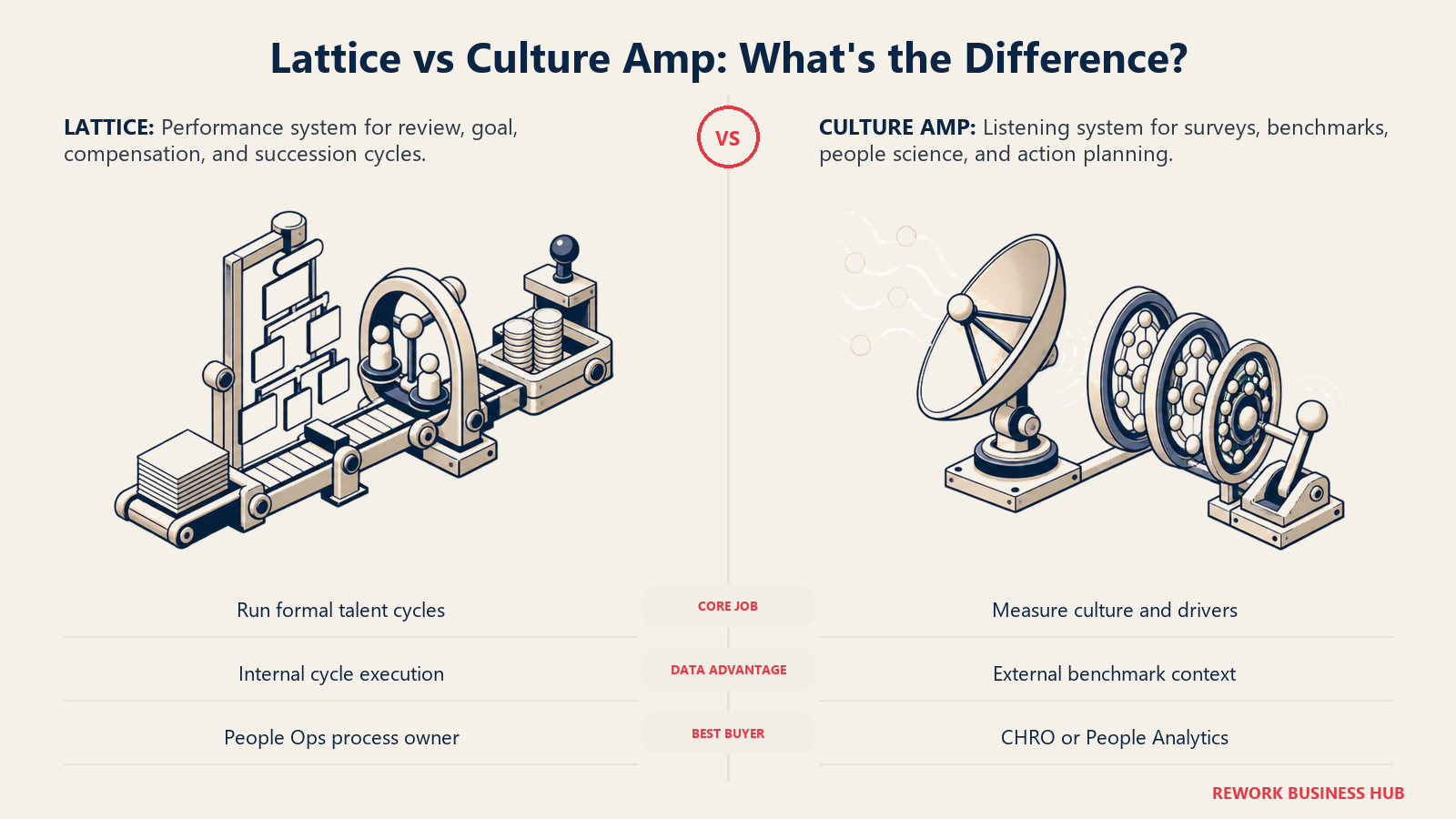
That comparison usually goes badly, because the checklists overlap almost completely and the products don't. Culture Amp started as an employee listening company and built performance on top of it. Lattice started as a performance operating system and added engagement as a $4 module on the side. The practical question isn't which platform is better. It's which half of your problem is bigger right now, and whether you'd rather have excellent data about a weak process or a well run process with thinner data. If you're still building the shortlist itself, our best performance management software guide for 2026 covers the wider field before you narrow to these two.
TL;DR
| Lattice | Culture Amp | |
|---|---|---|
| Started as | A performance operating system (reviews, goals, 1:1s) | An employee listening and people science platform |
| Organizing principle | Run the cycle: reviews, calibration, comp, succession | Measure the culture: survey design, benchmarks, action planning |
| Engagement position | A $4 per seat per month module bolted to a performance core | The core product, with Perform added on top |
| Published pricing | Yes. $10 Performance, $8 Goals & OKRs, $4 Engagement, +$6 Compensation, +$4 Grow | No. Quote only, by employee count, product and service tier |
| Benchmark data | AI analysis and trends inside your own results | 1.61 billion questions answered across 8,900+ organizations |
| Compensation, succession and PIPs | Comp is a +$6 add-on; succession, PIPs and talent reviews sit inside Performance | None of these are named modules in Perform |
| Typical buyer | People Ops leader who owns review and goal cycles | People Analytics lead or CHRO who owns the engagement number |
| Scale claim | "5,000+ forward-thinking teams" | "More than 6,000 companies" |
Key Facts
- Gallup's 11th-edition Q12 meta-analysis, covering 183,806 business units across 53 industries and 90 countries, found top-quartile engaged units outperform bottom-quartile units by 23% in profitability, 18% in productivity (sales) and 51% in turnover at low-turnover organizations, per Gallup.
- Voluntary turnover costs US businesses about $1 trillion a year, and replacing one employee costs "one-half to two times the employee's annual salary," with 52% of exiting employees saying their manager or organization could have prevented the exit, according to Gallup.
- Running a survey is not the intervention. Gallup found workgroups in the top quartile on action-planning impact raised engagement scores by an average of 10%, while bottom-quartile workgroups saw scores fall by an average of 3%, per Gallup's guidance on survey results.
- Managers account for at least 70% of the variance in employee engagement scores across business units, which means the tool that reaches managers matters more than the tool that reports to HR, per Gallup.
- Culture Amp publishes benchmark scale figures of 1.61 billion questions answered and 74.15 million surveys completed across 8,900+ organizations surveyed, on its own Benchmark Insights page.
Who Each Platform Is Actually Built For
Culture Amp's pricing page segments the market by headcount: under 200 employees, 200 to 999, and 1,000-plus. But headcount isn't really what separates its customers from Lattice's. The separator is who owns the budget and what question keeps that person up at night.
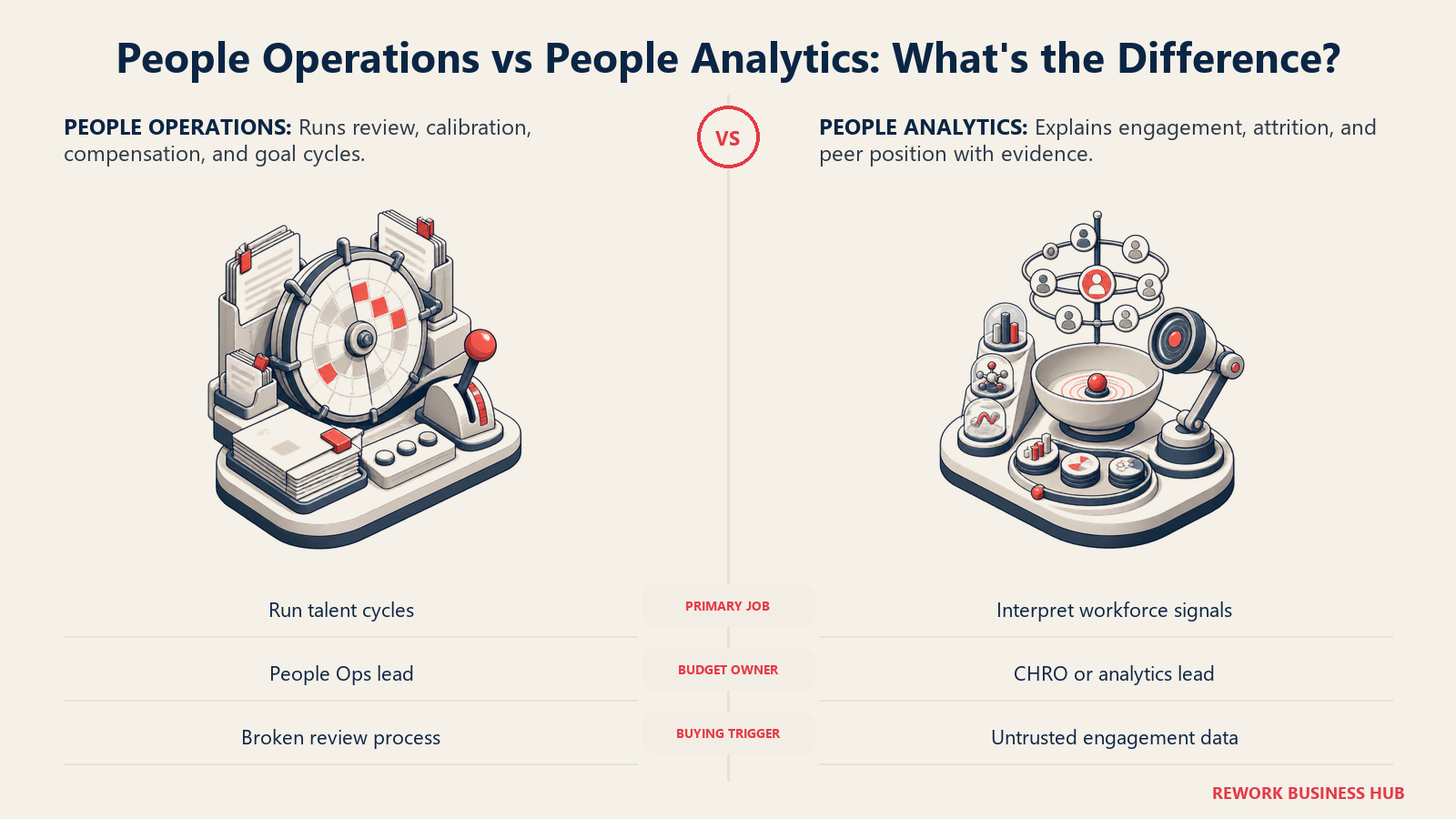
Culture Amp's natural buyer is a People Analytics lead, a CHRO, or a Head of People who is accountable for a number that gets reported to the board. Engagement score. eNPS. Regretted attrition by team. That person needs to know whether an 18-point drop in the engineering org's manager-support score is a crisis or a normal Q3 dip, and they can't answer that from internal data alone. They need a comparison population. Culture Amp's whole product design assumes that reader.
Lattice's natural buyer is a People Ops owner who runs cycles. Someone whose actual calendar is "kick off midyear reviews on 15 September, calibration sessions the first week of October, comp recommendations to finance by 20 October." That person's pain is operational: chasing 340 self-assessments, keeping calibration honest, making sure promotion decisions survive a legal review. Culture Amp measures whether the process feels fair. Lattice runs the process.
| Lattice | Culture Amp | |
|---|---|---|
| Company size sweet spot | 50 to 2,000 employees, strongest in the 100 to 1,000 band | Published segments: under 200, 200 to 999, 1,000+ |
| Primary budget owner | People Ops lead, HR Business Partner lead, sometimes a COO | CHRO, Head of People Analytics, People Science-minded HR leader |
| The question they're hired to answer | "Can we run a review and comp cycle without it falling apart?" | "Why is engagement moving, and how do we compare to peers?" |
| Team maturity assumed | You already have a review cadence and want to systematize it | You already survey and want results that are statistically defensible |
| Buying trigger | Spreadsheet review cycles, inconsistent calibration, manual comp planning | Survey fatigue with no action, no benchmark context, unexplained attrition |
| Where it disappoints | Buyers who wanted deep listening science get a competent survey tool | Buyers who wanted a full performance operating system find gaps in comp and succession |
Neither profile is more sophisticated than the other. A company with a healthy culture and chaotic review operations shouldn't buy a listening platform, and a company with a clean review process and a mystery attrition problem shouldn't buy a review platform. Most buyers get this backwards because the demo they saw was good, not because the diagnosis was right.
Engagement and Employee Listening
This is where the two products separate most clearly, and where feature checklists mislead most badly. Both platforms let you send a survey. Both give you eNPS, both do onboarding and exit surveys, both have some form of action planning. On a grid, they look like a tie.
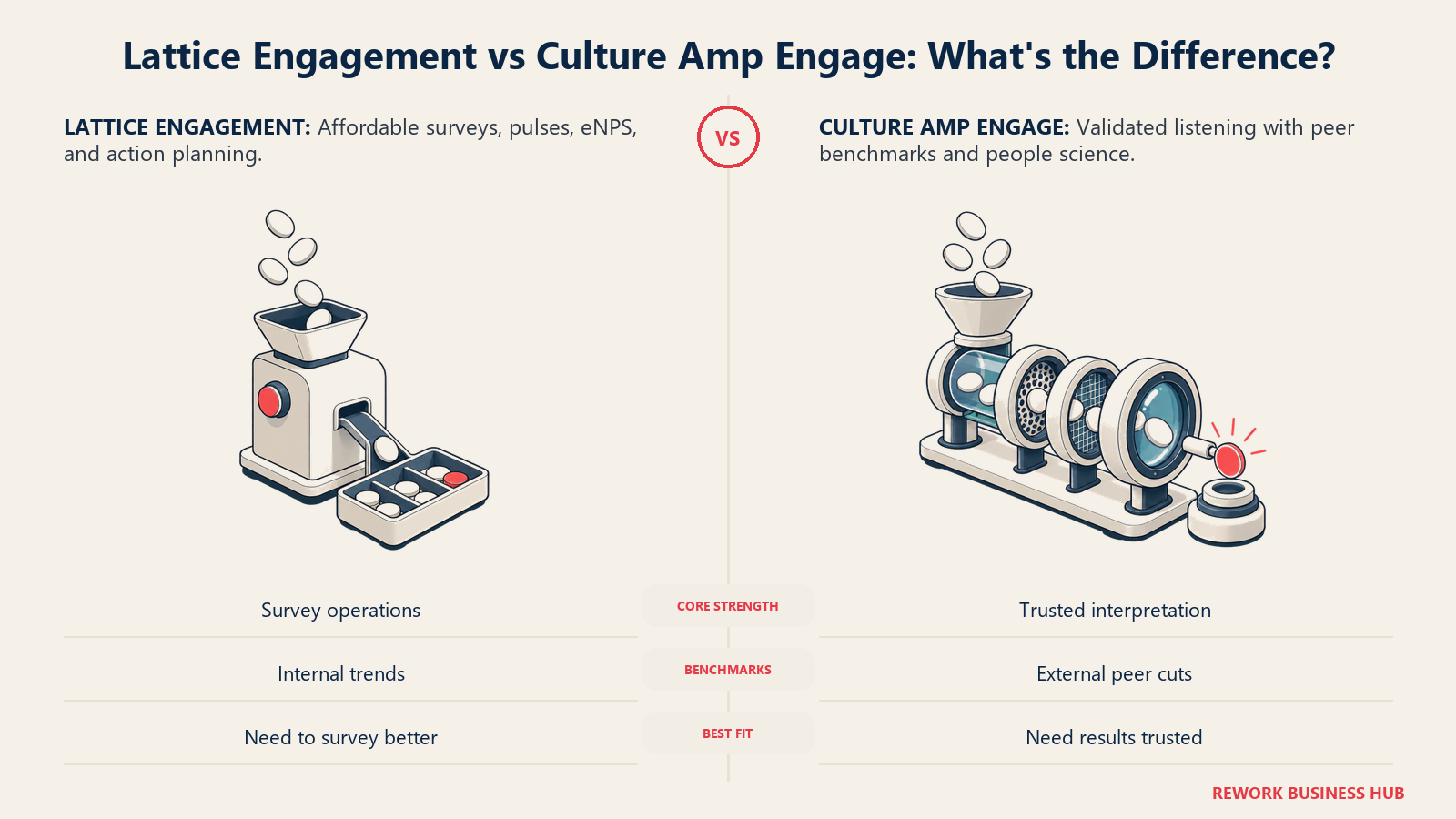
They aren't a tie, because in employee listening the differentiators sit upstream and downstream of the survey itself. Upstream is question design: whether the items you're sending have known psychometric properties or whether someone in HR wrote them last Tuesday. Downstream is interpretation: whether a 72 on "I see myself here in two years" is good, bad, or unremarkable for a 400-person software company in your region. Culture Amp built its business on both ends. Lattice built a solid survey engine in the middle.
| Listening capability | Lattice | Culture Amp |
|---|---|---|
| Engagement and pulse surveys | Yes, in the Engagement module | Yes, in Engage, the core product |
| eNPS | Yes, named on the pricing page | Yes, standard |
| Onboarding and exit surveys | Yes, named on the pricing page | Yes, plus wider lifecycle coverage |
| Validated question library | Templates available inside the product | Question sets designed and maintained by an in-house people science team |
| External benchmark comparison | Not a published feature | Core feature: industry, geography and company-size comparisons |
| Action planning | Yes, named as a module feature | Yes, plus manager-level guidance and templated plans |
| AI analysis of open text | Yes, "AI Analysis & Trends" is named on the pricing page | Yes, plus AI Coach included in all plans |
| Human people science support | Not offered | People Science Consulting, a paid add-on to Engage or Perform |
| DEI-specific measurement | Available through custom surveys | Named DEI tooling inside Engage |
Read that table for what it implies rather than what it lists. If your listening problem is "we don't survey often enough," Lattice's $4 per seat per month Engagement module solves it at a price that's hard to argue with. If your listening problem is "we survey constantly and nobody trusts the results," you have a question-design and interpretation problem, and a cheaper survey tool makes it worse by producing more untrusted data faster.
Gallup's action-planning finding is the useful check here. Top-quartile action planners gained an average of 10 engagement points while bottom-quartile action planners lost 3. Both platforms ship action planning. Neither ships the management discipline that makes it work, which is why the employee engagement resource library is worth reading before either demo. If listening is genuinely your whole problem and performance is fine, widen the shortlist with our employee engagement software guide for 2026 instead of paying performance-platform prices for survey delivery.
Benchmarking and People Science: Culture Amp's Actual Wedge
Vendors love the word "benchmark," and most of the time it means a chart comparing this quarter's score to last quarter's. Culture Amp means something narrower and more useful: a comparison population large enough that the number tells you something you couldn't have learned from your own data.
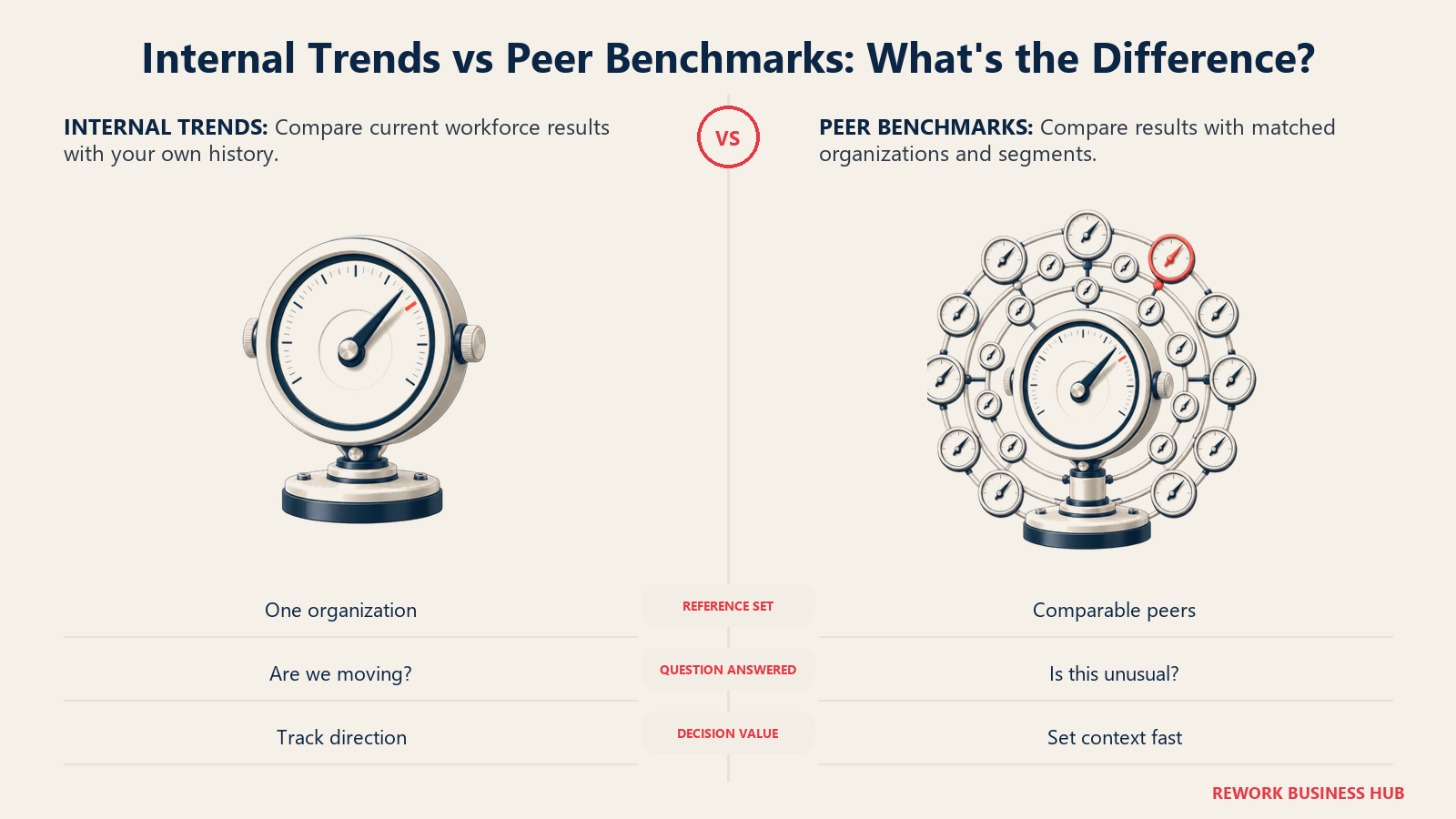
Its own Benchmark Insights page publishes the scale: 1.61 billion questions answered, 74.15 million surveys completed, and 8,900+ organizations surveyed. Those are the figures Culture Amp currently publishes, and any other number you see quoted around the web is secondhand. The same page organizes hundreds of comparisons by industry, geography and company size, which is the part that actually changes a decision. A benchmark drawn from four lookalike companies is a rumor with a chart around it. A benchmark drawn from a segment of a population that size is an argument-ender. Ask which specific cuts you get access to at your tier, because that access is the whole reason to buy.
| Benchmarking and science factor | Lattice | Culture Amp |
|---|---|---|
| Published dataset scale | Not published | 1.61b questions answered, 74.15m surveys, 8,900+ organizations |
| Benchmark cuts available | Not a published feature | Industry, geography, company size, high-performing companies |
| Benchmark shown beside your own scores | Not applicable | Yes, peer comparison rendered with your results |
| Benchmark data visible before you buy | Not applicable | Yes, hundreds of comparisons published openly |
| In-house research function | Not a named part of the product | People science team plus a published research library |
| Human help interpreting results | Customer success and support | People Science Consulting add-on: manager training, coaching, results calls |
| Included AI guidance | AI Agent for employees, managers and leaders | AI Coach, included in all plans |
The practical value of a benchmark is that it changes what happens next. Without one, a manager-support score of 68 triggers an argument about whether 68 is bad. With a credible peer comparison, that argument ends in ninety seconds and the meeting moves on to what to do about it. If your leadership team relitigates the meaning of every survey result, that's the problem you're buying Culture Amp to solve, not survey delivery.
The honest counterweight: a benchmark is a decision aid, not a decision. Gallup's finding that managers drive at least 70% of the variance in team engagement means the fix almost always lives with frontline managers, not in the analytics layer. A beautiful benchmark that never reaches the manager who owns the team is an expensive report. If your managers can't yet run a hard conversation, tooling won't close that gap. Something like the radical candor feedback model and basic feedback skills training does more per dollar than either platform.
Performance Reviews and Calibration
Here the direction of travel reverses. Culture Amp's Perform module is a real performance product, not a checkbox: it ships continuous 360-degree feedback, performance reviews with calibration, 1-on-1s, goal management, shoutouts, employee development plans and performance insights. Companies run full review cycles on it and publish results. Culture Amp's own customer evidence cites Wave saving 28 days on performance management reporting per cycle and Tonkin + Taylor recording an 8-point increase in the belief that performance evaluations are fair.
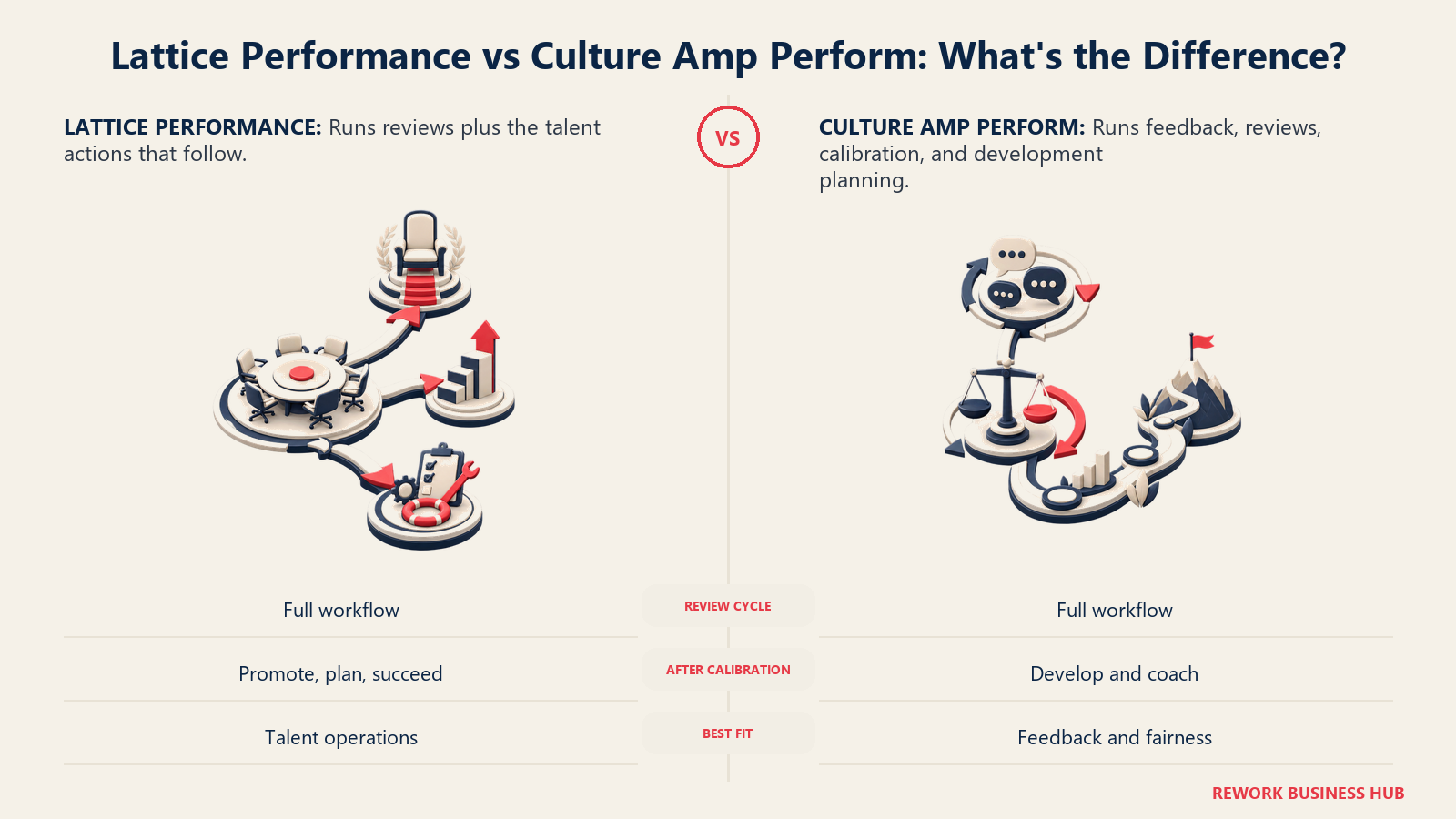
What Perform doesn't do is the back half of the talent cycle. Lattice's Performance product, on its own pricing page, lists Performance Reviews, Succession Planning, Promotions, PIPs, Talent Reviews and Calibration as named features of the same $10 per seat per month SKU. Succession planning and PIPs are not small additions. They are the difference between a platform that evaluates people and a platform that decides what happens to them next, which is exactly where HR leaders spend their October.
| Review capability | Lattice | Culture Amp |
|---|---|---|
| Performance review cycles | Yes, the core Performance product | Yes, in Perform |
| Calibration sessions | Named feature of Performance | Named feature, framed around bias mitigation |
| 360-degree and peer feedback | Yes, plus continuous feedback in Habits | Yes, continuous real-time 360 feedback |
| Talent reviews and 9-box style rating | Named feature: Talent Reviews | Performance insights, not a named talent-review module |
| Succession planning | Named feature of Performance | Not a named module |
| Promotion workflows | Named feature: Promotions | Handled through review outcomes, not a named module |
| Performance improvement plans (PIPs) | Named feature: PIPs | Not a named module |
| 1-on-1s | Included in the Habits layer on every base product | Named feature in Perform |
| Development plans | In the Grow add-on (+$4) | Employee development plans included in Perform |
The pattern is consistent with each product's origin. Lattice built the operating system for the whole talent cycle and priced the pieces separately. Culture Amp built the measurement layer and extended into performance where measurement naturally reaches: feedback, reviews, fairness of evaluation, development. Neither is hiding a gap; they simply stopped building at different places. Before you judge either one against your own process, it's worth having a written performance review framework to test the demo against, otherwise you're evaluating screens rather than fit.
Goals and OKRs
Goals are the quietest difference and the one that most often surfaces three months after signature.
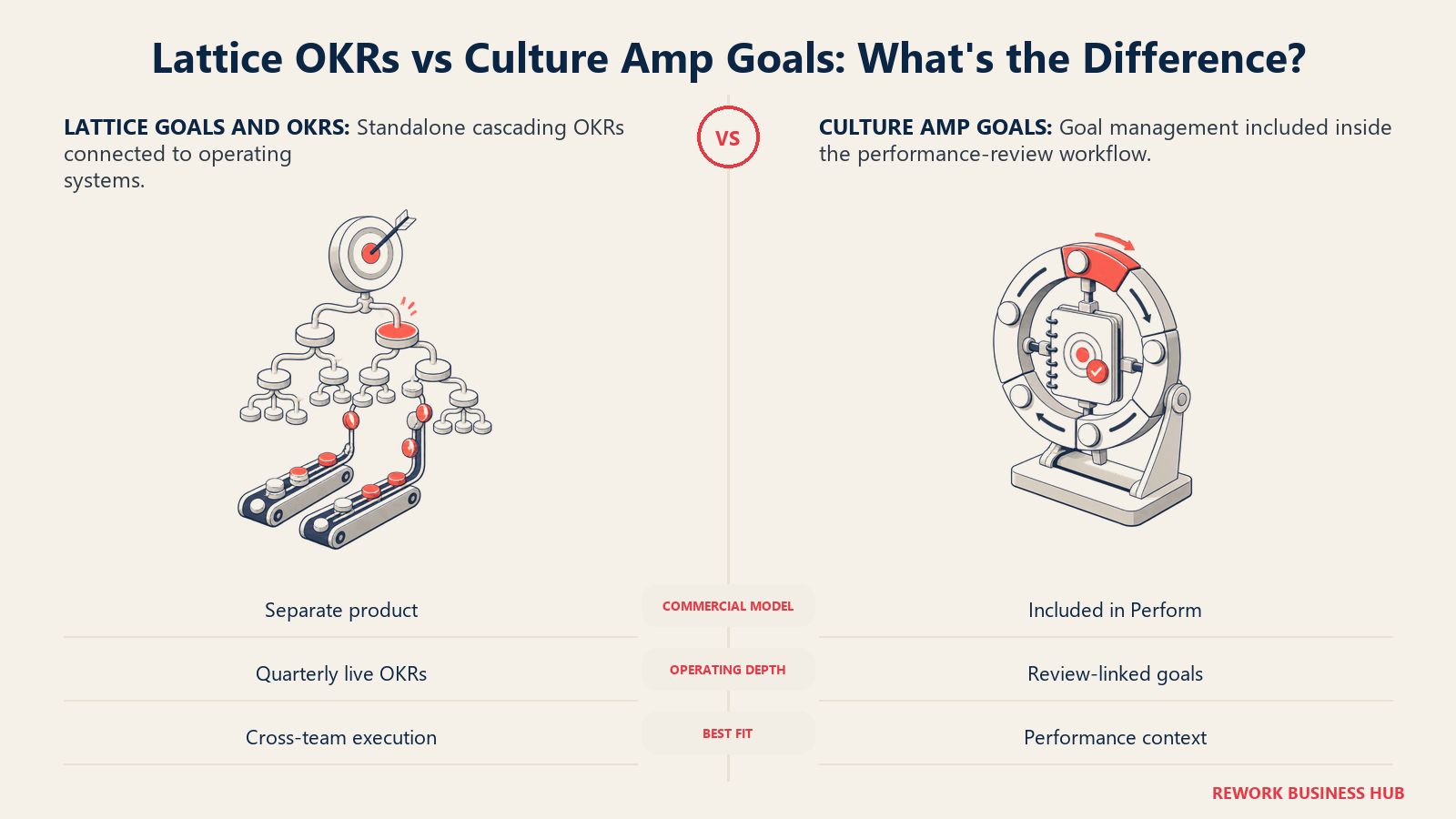
Lattice sells Goals & OKRs as a separate base product at $8 per seat per month. That's a real decision: if you buy Performance alone, you get reviews, calibration and succession, but goal management is not in the box. The upside of that structure is that the goals product is built to stand on its own, with cascading goals, progress updates, reminder notifications, and named Salesforce and Jira integrations so goals can update from the systems where work actually happens.
Culture Amp includes goal management inside Perform rather than pricing it separately. That's simpler to buy and adequate for companies where goals are an HR artifact reviewed twice a year. It's thinner for companies running true quarterly OKRs across product, engineering and revenue teams, where the goal system needs to pull progress from operational tools rather than wait for someone to type a percentage into a text box.
| Goals capability | Lattice | Culture Amp |
|---|---|---|
| Commercial model | Separate base product, $8 per seat per month | Included in Perform |
| Cascading and aligned goals | Named feature | Yes, goal management with alignment |
| Progress updates | Named feature, plus Weekly Updates in Habits | Yes, within Perform |
| Automated reminders | Named feature | Not separately named |
| Salesforce integration for goal data | Named on the pricing page | Not a named goals integration |
| Jira integration for goal data | Named on the pricing page | Not a named goals integration |
| Best fit | Quarterly OKRs pulled from operational systems | Annual or semiannual goals tied to the review cycle |
If OKR rigor is the reason you're buying, the honest read is that Lattice sells a goal product and Culture Amp includes a goal feature. If your goals mostly exist so reviews have something to reference, paying $8 per seat for the standalone product would be waste. Our Lattice vs 15Five comparison covers the same tradeoff against a vendor that bundles goals differently again.
Compensation and Career Development
This is the cleanest capability gap in the whole comparison, and it's worth being blunt about it.
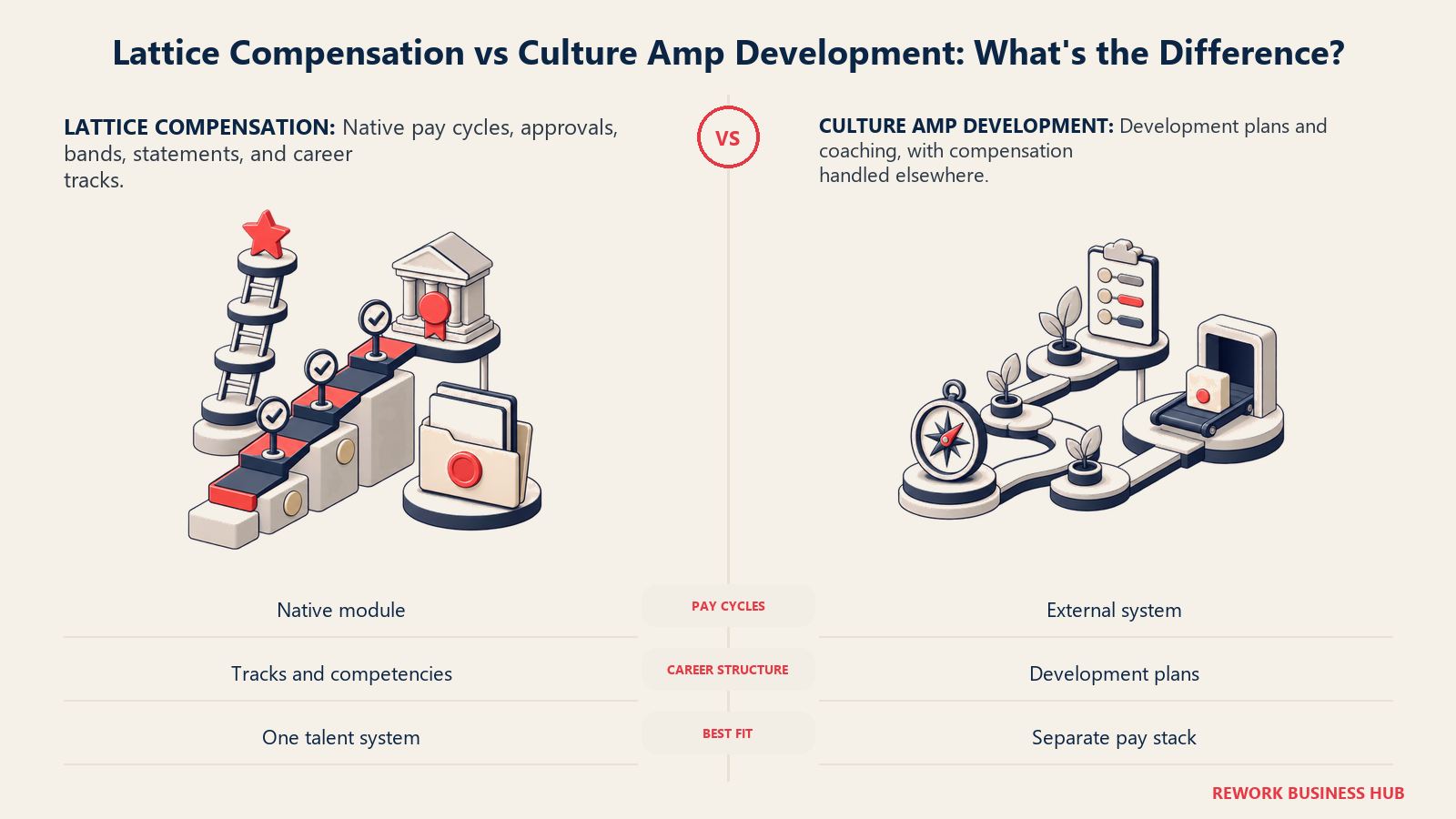
Lattice sells Compensation as an add-on at +$6 per seat per month, and its pricing page names what's inside: global benchmarks, comp bands, cycle management, analytics, compensation statements and multi-chain approvals. Multi-chain approvals is the detail that matters operationally. A merit cycle at 500 people involves managers, skip-levels, HRBPs and finance, all approving in sequence, and that routing is what turns a comp cycle from a spreadsheet war into a process.
Culture Amp does not sell a compensation module. Its own pricing page lists Engage, Perform, AI Coach and People Science Consulting, and compensation isn't among them. Its integrations page names Pave in the compensation category, which is the honest answer: Culture Amp expects you to run comp somewhere else and connect it.
Career development runs the same way. Lattice sells Grow as a +$4 per seat per month add-on covering competencies, individual development plans, career tracks, 1:1 integration and AI-powered growth areas. Culture Amp includes employee development plans and a skills coach inside Perform, without competency frameworks or career tracks as named modules.
| Compensation and development | Lattice | Culture Amp |
|---|---|---|
| Compensation module | Yes, add-on at +$6 per seat per month | Not offered; integrates with Pave |
| Comp bands and global benchmarks | Named features of the Compensation add-on | Not applicable |
| Multi-chain approval routing | Named feature | Not applicable |
| Compensation statements | Named feature | Not applicable |
| Competency frameworks | In Grow (+$4) | Not a named module |
| Individual development plans | In Grow (+$4) | Employee development plans included in Perform |
| Career tracks and ladders | In Grow (+$4) | Not a named module |
| Learning integrations | Standard integration set | Named partners including Go1 and LifeLabs Learning |
The buying implication is direct. If pay decisions and the review cycle need to live in the same system, Lattice is structurally the only one of the two that does it, and you should budget $10 plus $6 as a floor rather than $10. If comp already runs cleanly in Pave, your HRIS or a well-governed spreadsheet, that gap costs you nothing and Culture Amp keeps a simpler surface area.
Analytics and Reporting
Both platforms report. They report different things, for different readers, and that distinction predicts which one your executive team will actually open.
| Reporting dimension | Lattice | Culture Amp |
|---|---|---|
| Primary reporting object | Cycle completion, goal progress, review and calibration outcomes | Engagement drivers, sentiment trends, benchmark position |
| External comparison built in | No | Yes, industry, geography and company size |
| Open-text analysis | AI Analysis & Trends in the Engagement module | AI-assisted analysis plus AI Coach across plans |
| Manager-level views | Yes, tied to the manager's own cycle work | Yes, plus manager action-planning guidance |
| Attrition and retention insight | Derived from engagement and performance data in-platform | Retention insights named as an Engage feature |
| Executive readout | Performance and goal operations dashboards | Board-ready engagement and culture reporting |
| Who typically reads it | People Ops and line managers | CHRO, exec team, sometimes the board |
The failure mode to plan for is the same one Gallup documents: reporting that never converts into a manager conversation. Whichever platform you choose, decide up front who receives which number, on what date, with what obligation attached, and write it down before the first survey or cycle goes out. A well designed report nobody is accountable for changes nothing.
Integrations and HRIS Fit
Neither product wants to be your system of record, but they resolve that differently.
Culture Amp is explicit that it integrates rather than replaces. It publishes HRIS integrations as a category, plus Slack and Microsoft Teams for flow-of-work delivery, Pave for compensation, and Go1 and LifeLabs Learning for development, along with a developer API. Its own pricing page confirms HRIS integrations, SSO and encryption, and Slack and Teams integrations are included in all plans rather than gated behind a tier, which removes a common negotiation trap.
Lattice used to sell an HRIS and a payroll product, and that is now the most out-of-date thing you will read about it. Lattice reversed course and discontinued both to refocus on performance: payroll access ended March 31, 2026 and HRIS access ended July 31, 2026, with customers credited for subscription fees through the transition, per Outsail's HR tech reporting. Its pricing page now prices five things and only five: Performance, Goals & OKRs, Engagement, Compensation and Grow. So neither platform on this page is your system of record. Both sit on top of one. If core HR records are the bigger need, you're in a different category entirely, and our best HR software guide for 2026 is the better starting point.
| Integration and platform fit | Lattice | Culture Amp |
|---|---|---|
| HRIS integrations | Yes | Yes, and included on all plans per the pricing page |
| Slack and Microsoft Teams | Yes | Yes, included on all plans |
| SSO and encryption | Yes | Included on all plans |
| Compliance posture published | Enterprise security messaging | Full GDPR and SOC 2 compliance named on the pricing page |
| Compensation tool integration | Not needed; native Compensation add-on | Pave named as a compensation partner |
| Learning integration partners | Standard set | Go1 and LifeLabs Learning named |
| Developer API | Yes | Yes |
| Own system of record | No; its HRIS and payroll products were discontinued, HRIS access ended July 2026 | No, integrates with your HRIS |
Pricing and What Each One Actually Costs
This section is asymmetric, and pretending otherwise would be the most useful thing to get wrong. Lattice publishes per-seat rates for every product it sells. Culture Amp publishes none. You can model Lattice to the dollar before you take a call. You cannot model Culture Amp at all until a salesperson gives you a number, and that difference should factor into your evaluation timeline.
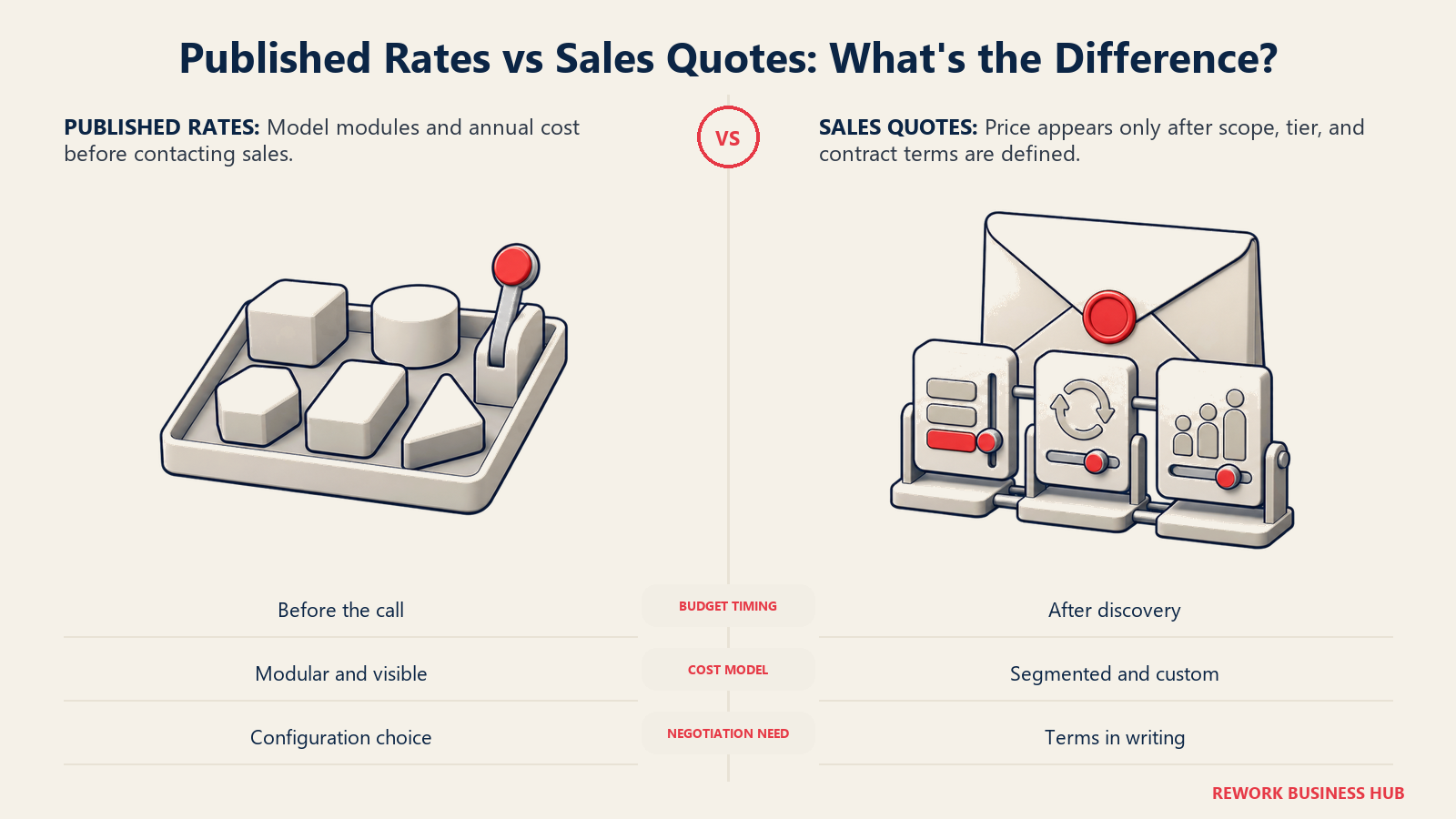
Start with what Lattice publishes. Every contract bills annually, in US dollars only, with a $4,000 minimum annual agreement.
| Lattice product | Type | Price per seat per month |
|---|---|---|
| Performance | Base product | $10 |
| Goals & OKRs | Base product | $8 |
| Engagement | Base product | $4 |
| Compensation | Add-on | +$6 |
| Grow | Add-on | +$4 |
| Minimum annual agreement | Contract floor | $4,000 |
Note that these are current figures. Several published comparisons still quote $11 as Lattice's entry rate, which is out of date; the pricing page says $10 for Performance today.
Now the math, because the modular structure means your real number depends entirely on which combination you buy. Below are annual totals at three headcounts, calculated as seats multiplied by the blended monthly rate multiplied by twelve.
| Configuration | Blended rate | 100 employees | 250 employees | 500 employees |
|---|---|---|---|---|
| Performance only | $10 | $12,000 | $30,000 | $60,000 |
| Performance + Engagement | $14 | $16,800 | $42,000 | $84,000 |
| Performance + Goals & OKRs | $18 | $21,600 | $54,000 | $108,000 |
| Performance + Goals + Engagement | $22 | $26,400 | $66,000 | $132,000 |
| All five (Performance, Goals, Engagement, Compensation, Grow) | $32 | $38,400 | $96,000 | $192,000 |
Two things fall out of that table. First, the head-to-head configuration most buyers actually want against Culture Amp is Performance plus Engagement at $14 per seat per month, which is $33,600 a year at 200 employees. Second, the $4,000 minimum bites harder than it looks on the cheap end: Engagement alone at $4 per seat per month works out to $48 per seat per year, so any company under roughly 84 employees buying only Engagement pays the $4,000 floor rather than the headline rate.
Culture Amp is the opposite situation. Its pricing page states that pricing depends on the number of employees, the product chosen and the service tier, and that all Culture Amp products are billed on an annual basis. It publishes three employee-count segments (under 200, 200 to 999, 1,000+) and its modules (Engage, Perform, People Science Consulting as an add-on, AI Coach included), but no rate for any of them. There is no vendor-confirmed number to put in this article, so there isn't one here. Third-party marketplaces and review sites publish estimates, but none of them are confirmed by Culture Amp, and building a side-by-side cost table on a guessed figure would produce a comparison that looks precise and isn't.
The useful move is to close the gap yourself. Ask Culture Amp for these seven things in writing during your first pricing call, and you'll have everything you need to finish the comparison against the Lattice table above.
| Ask for | Why it decides the comparison |
|---|---|
| Per-module rate for Engage and for Perform, stated per employee per year | The only way to line Culture Amp up against Lattice's $10 / $8 / $4 structure |
| Which employee-count segment you're quoted in, and the rate on both sides of the boundary | A company at 195 employees needs to know what happens at 200 |
| What the service tier includes, and the separate price of People Science Consulting | The consulting add-on is a real part of the value and a real part of the cost |
| Minimum contract term, and whether year one is discounted | A discounted first year with an undisclosed year-two rate is not a price |
| A renewal uplift cap, written into the contract | Without a cap, your three-year cost is unknowable |
| Headcount true-up terms if you grow or shrink mid-term | Fast-growing companies get repriced mid-contract without this |
| Whether benchmark access is included at your tier or gated | Benchmarks are the reason to buy Culture Amp; confirm you're getting them |
If the answers come back vague on the renewal cap and the true-up, that's your signal to keep the Lattice quote live as a negotiating position, whichever way you're leaning.
Implementation and Time to Value
| Implementation factor | Lattice | Culture Amp |
|---|---|---|
| First visible output | A completed review or goal cycle | A survey result set with benchmark context |
| Realistic time to that output | Weeks, gated by your own cycle calendar | Weeks, gated by survey design and comms |
| Heaviest configuration work | Review templates, rating scales, calibration rules, comp bands | Survey instrument selection, demographic and hierarchy mapping |
| Who has to do the work internally | People Ops, plus finance if Compensation is in scope | People Analytics or HR, plus comms for participation |
| Manager training load | High: managers run reviews, calibration and 1:1s in-product | Moderate at launch, high at action planning |
| Vendor-side human help | Customer success and support | People Science Consulting available as a paid add-on |
| What kills the rollout | A cycle that slips and never restarts | A survey that runs and produces no visible action |
Both risks in that last row are organizational, not technical. Lattice rollouts fail when a review cycle gets postponed for a reorg and the platform becomes a place people log into twice a year. Culture Amp rollouts fail when results land in a deck, get presented once, and nothing changes, which is precisely the pattern behind Gallup's finding that bottom-quartile action planners lose engagement points rather than hold steady. Decide who owns the first follow-through action before you sign either contract.
The 2024 "Digital Workers" Episode, in Proportion
Worth addressing because it still comes up in vendor bake-offs. On 9 July 2024, Lattice announced that AI agents could be given employee records, onboarding, goals and a manager inside the platform. The reaction from HR practitioners was immediate and hostile, and Lattice pulled the plan on 12 July, three days later, saying it would not pursue digital workers in the product, as SHRM reported at the time.
Two years on, the honest read is that this was a positioning misstep that was reversed quickly, not a live product problem. It is not a reason to exclude Lattice from a shortlist in 2026. It is a fair thing to raise in a sales call if you want to understand how the company handles AI decisions, alongside the AI Agent it does ship today.
When Culture Amp Is the Right Call
- Your engagement number is reported upward and gets challenged. If a board member or an exec team asks "compared to what?" every quarter, you need a comparison population, and Culture Amp is the only one of these two that publishes its benchmark scale and the cuts it offers. Lattice has no published external benchmark feature.
- You survey often and nobody trusts the instrument. Question design is a real discipline. Culture Amp maintains its question sets through an in-house people science function and sells access to that team as People Science Consulting. If your last three surveys produced arguments about whether the questions were leading, that's the gap you're paying to close.
- Performance matters but comp and succession live elsewhere. Perform handles reviews, calibration, 360 feedback, 1-on-1s, goals and development plans. If pay decisions already run cleanly in Pave or a governed spreadsheet, and succession is a conversation rather than a system, Perform covers what you need without paying for modules you won't use.
- You want fewer moving parts in the contract. Engage and Perform, with AI Coach included on all plans and HRIS, SSO, Slack and Teams integrations included rather than tier-gated, is a simpler surface than five separately priced Lattice SKUs.
If Culture Amp fits the diagnosis but the quote comes back above budget, the best Culture Amp alternatives roundup covers the listening-first tools that compete for the same buyer at published prices.
When Lattice Is the Right Call
- You own cycles, not culture reporting. If your year is organized around review kickoffs, calibration sessions and a merit cycle, Lattice's Performance product ships Talent Reviews, Calibration, Promotions, PIPs and Succession Planning inside one $10 per seat per month SKU. Culture Amp does not name succession or PIPs as modules.
- Pay and performance need to sit in the same system. The Compensation add-on at +$6 per seat per month brings comp bands, cycle management, statements and multi-chain approvals. Culture Amp has no compensation module and integrates with Pave instead. That's a structural difference, not a feature-depth difference.
- You run real OKRs. Goals & OKRs at $8 per seat per month includes cascading goals, progress updates and named Salesforce and Jira integrations, so goal progress can flow from operational systems rather than depend on someone updating a percentage by hand.
- Finance needs a number before the sales call. Lattice publishes every rate. You can build the budget line, get it approved, and use the modeled figure as your negotiating floor. With Culture Amp, budget approval waits on a quote.
If Lattice fits the shape of the problem but the modular pricing stacks up past what you can defend, our Lattice alternatives guide lists the platforms that bundle more into a single rate.
Decision Framework
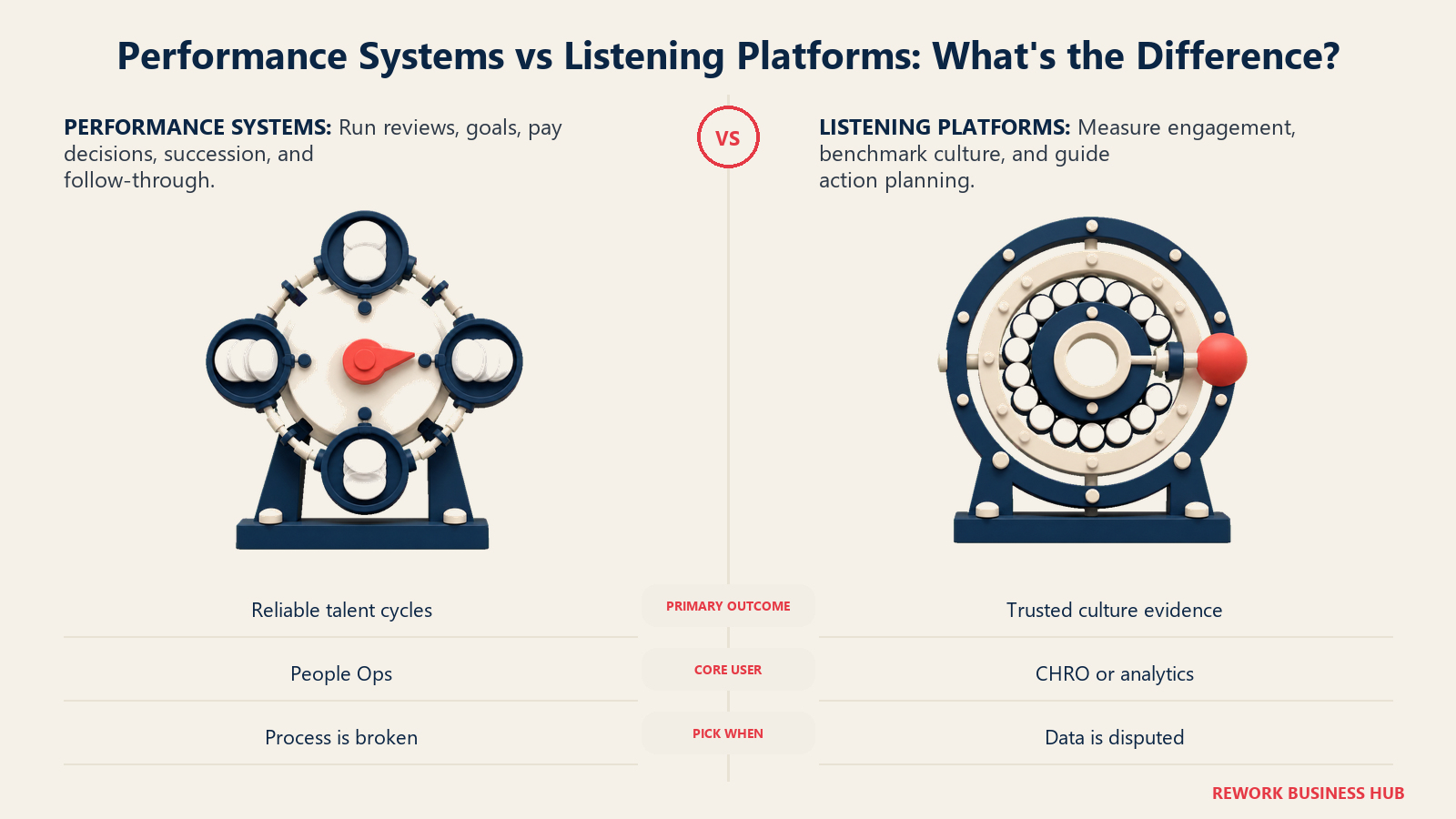
The decision comes down to whether you need an operating system for talent cycles or an evidence system for workforce listening. Use the matrix below to map that distinction to the budget, process, and reporting constraints already in front of your team.
| If this is true for you | Pick |
|---|---|
| Your board asks how engagement compares to peers | Culture Amp |
| Your review cycle currently lives in spreadsheets and email | Lattice |
| You need compensation cycles and performance in one system | Lattice |
| You've surveyed for years and nobody trusts the questions | Culture Amp |
| You run quarterly OKRs that should update from Salesforce or Jira | Lattice |
| You want paid access to people scientists, not just software | Culture Amp |
| Succession planning and PIPs are on your roadmap this year | Lattice |
| Finance requires a modeled annual cost before any vendor call | Lattice |
| Engagement is the board-level metric and performance is already fine | Culture Amp |
| Comparing the whole category rather than these two | See the 2026 performance management software guide |
What to Do Next
- Diagnose before you demo. Write one sentence naming your bigger problem: weak data about the culture, or a broken process. If you can't choose, you're not ready for a demo, and both vendors will happily sell you the half you didn't need.
- Model the Lattice number yourself. Take your headcount, pick the configuration, and use the annual table above. Walk into the call with a figure. It changes the conversation from discovery to negotiation.
- Send Culture Amp the seven-question list in writing. Per-module rate, segment boundary, service tier and consulting price, minimum term, renewal uplift cap, headcount true-up, and whether benchmark access is included. Ask by email so the answers are documented.
- Pressure-test both against your own framework. Bring a written performance review framework and a shortlist of the process steps you actually run into each demo, and make the vendor show those steps rather than their preferred flow. The performance management resource library is a fast way to build that checklist.
- Name the manager who owns follow-through. Whichever platform you pick, identify the person accountable for the first action after the first survey or cycle, with a date. Gallup's data says that single choice moves engagement more than the software does.
Frequently Asked Questions about Lattice vs Culture Amp
How much does Lattice cost per employee?
Lattice publishes its rates: $10 per seat per month for Performance, $8 for Goals & OKRs, $4 for Engagement, plus $6 for the Compensation add-on and $4 for Grow. All contracts are billed annually in US dollars, with a $4,000 minimum annual agreement. Older comparison articles quoting $11 as the entry rate are out of date.
Does Culture Amp publish pricing?
No. Culture Amp's pricing page states only that pricing depends on the number of employees, the product chosen and the service tier, and that all products are billed annually. It publishes three employee-count segments (under 200, 200 to 999, and 1,000+) and its modules, but no rates. Any dollar figure you find online is a third-party estimate, not a vendor-confirmed price.
Which one is better for employee engagement surveys?
Culture Amp, on the strength of external benchmarking and people science rather than survey delivery. It publishes benchmark scale of 1.61 billion questions answered across 8,900+ organizations, cuts comparisons by industry, geography and company size, and sells consulting access to its people science team. Lattice's Engagement module covers pulse surveys, eNPS, onboarding and exit surveys, action planning and AI trend analysis, but has no published external benchmark comparison.
Does Culture Amp handle compensation reviews?
No. Culture Amp's pricing page lists Engage, Perform, AI Coach and People Science Consulting, with no compensation module, and its integrations page names Pave as a compensation partner. Lattice sells Compensation as an add-on at +$6 per seat per month with comp bands, cycle management, statements and multi-chain approvals.
Is Lattice's 2024 AI employees announcement still a concern?
Not as a product issue. Lattice announced in July 2024 that AI agents could hold employee records inside the platform, then reversed the plan three days later after industry backlash and said it would not pursue digital workers. Two years on it reads as a positioning misstep that was corrected quickly, though it's a fair question to raise when you ask how the company approaches AI decisions today.
Can you buy both?
Some companies do, running Culture Amp for listening and Lattice for the performance and comp cycle. It works, but you're paying twice for overlapping survey and review features and asking managers to log into two systems. Only do it if the benchmark data and the comp cycle are both genuinely non-negotiable.
Related Resources:

Principal Product Marketing Strategist
On this page
- TL;DR
- Key Facts
- Who Each Platform Is Actually Built For
- Engagement and Employee Listening
- Benchmarking and People Science: Culture Amp's Actual Wedge
- Performance Reviews and Calibration
- Goals and OKRs
- Compensation and Career Development
- Analytics and Reporting
- Integrations and HRIS Fit
- Pricing and What Each One Actually Costs
- Implementation and Time to Value
- The 2024 "Digital Workers" Episode, in Proportion
- When Culture Amp Is the Right Call
- When Lattice Is the Right Call
- Decision Framework
- What to Do Next