Best Microsoft Viva Goals Alternatives in 2026: 12 OKR Platforms for Microsoft 365 Teams
Turn this article into takeaways for your work.


Each assistant summarizes the article only for you and suggests best practices for your work.
WorkBoard, Mooncamp and Perdoo are the strongest replacements for a Microsoft 365 shop that ran its OKRs inside Viva Goals, because they are the only three of the twelve tools below that let someone actually create and edit OKRs inside a Microsoft Teams tab instead of just pinging Teams with a notification. That distinction matters more than it sounds. Most performance suites bolt on a Teams connector that fires a reminder or a praise message, and treat the real OKR record as something you manage in a separate browser tab. If the reason you picked Viva Goals in the first place was that goals lived where your company already worked, a notification-only integration is a downgrade you will feel in week two.
This guide exists because Microsoft retired Viva Goals on December 31, 2025, and there is no way to buy it, trial it, or renew it today. Each alternative below is ranked on Microsoft 365 and Teams integration depth, published pricing transparency, and fit for the size of program a former Viva Goals customer is likely running.
Key Facts
- The global OKR software market was worth an estimated $1.51 billion in 2025 and is projected to grow to $1.73 billion in 2026, then to $5.15 billion by 2034 at a 14.6% compound annual growth rate, according to Fortune Business Insights. Demand for OKR tooling is expanding at the same moment Microsoft is exiting the category.
- 72% of employees cite goal setting as a strong motivator for their performance, according to McKinsey research on what drives workplace performance. The framework you switch to still has to earn that motivation, not just replace the login screen.
- Ally.io, the startup Microsoft acquired and rebranded as Viva Goals, had already been adopted by more than 1,000 organizations in over 80 countries by the time of the October 2021 acquisition, according to Microsoft's own announcement. A genuinely large installed base still was not enough to keep the product alive inside a bigger platform.
- Microsoft's own retirement FAQ states plainly that "overall adoption and usage of Viva Goals across the Viva Suite customer base hasn't grown," despite the wider Viva suite reporting more than 66 million active users, per Microsoft Learn. The product did not fail on merit alone; it failed to reach the scale Microsoft needed inside a much larger platform.
- The largest empirical study of OKRs in a real engineering organization, a 2023 academic paper covering 47 interviews and a 512-person survey across a multinational software company's 4,000-plus engineers, found that "tracking, measuring and setting goals is hard work, regardless of tools used," and that middle management is the critical link that turns a company OKR into actual work, per the research paper on arXiv. No tool on this list fixes a weak management layer by itself.
What Happened to Viva Goals
Viva Goals was not a young, half-built product when Microsoft shut it down. It had real lineage, real customers, and a real Microsoft launch event behind it. Here is the full arc, sourced to Microsoft's own pages.
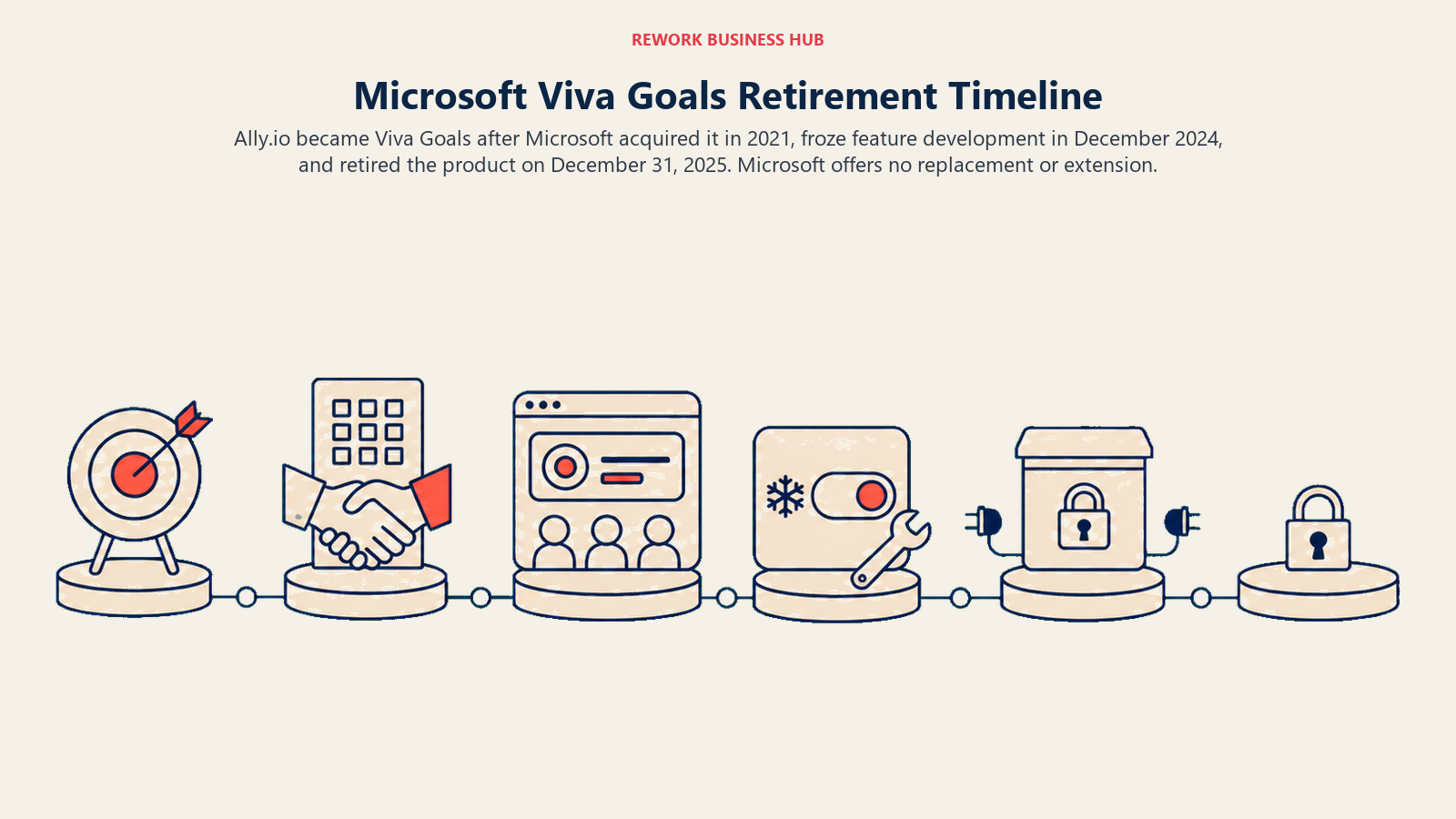
| Date | What happened |
|---|---|
| 2018 | Ally.io launches as an independent OKR software company. |
| October 7, 2021 | Microsoft acquires Ally.io, by then used by more than 1,000 organizations in 80-plus countries, to build goal management into the Viva employee experience platform (Microsoft announcement). |
| May 2022 | The Ally.io technology relaunches as Viva Goals, a new paid module inside Microsoft Viva. |
| December 5, 2024 | Microsoft freezes new feature development. All open design change requests are closed, and no new ones are accepted (retirement notice). |
| December 31, 2025 | Viva Goals is officially retired. The web app, the Teams app, and the Azure DevOps, Teams and Power BI connectors all stop working the same day. |
| Today (August 2026) | Viva Goals is not accessible at any price, on any plan, for any customer. Microsoft has confirmed there is no extension path. |
Microsoft was direct about why, which is unusual for a retirement notice. Its own FAQ says the call came down to scale: "While some customers have recognized value, overall adoption and usage of Viva Goals across the Viva Suite customer base hasn't grown. Microsoft has been unable to reach the scale and impact needed to continue further investment." The wider Viva suite was not struggling. It reports more than 66 million active users. Goals specifically just never became one of the modules people opened.
The part that should shape your shortlist is what Microsoft said next: "Microsoft will not be replacing Viva Goals with another solution or integrating its features into other products. We encourage customers to begin exploring third-party OKR tools." Viva Glint (employee listening surveys) and Viva Engage (a Teams-connected communication tool, formerly Yammer) both still exist, and both get suggested by well-meaning IT admins who see "Viva" in the name and assume continuity. Neither does OKRs. Glint measures sentiment; Engage handles internal communication and communities. If someone on your team is holding out hope that Copilot or a future Viva release quietly absorbs goal tracking, Microsoft has already answered that question, and the answer is no.
For readers who remember Viva Goals as Ally.io: that product is also gone. Ally.io stopped existing as an independent brand the day the Viva Goals rename shipped in 2022, so there is no path back to it either.
Quick Comparison Table
| Tool | Best For | Starting Price | Microsoft 365 / Teams Integration | Key Limitation |
|---|---|---|---|---|
| WorkBoard | Enterprises that want the deepest Microsoft ecosystem fit, now including Quantive's former base | Quote only, no published price | Deep: OKRs in Teams chat and meetings, plus Outlook, Planner and native Azure DevOps | No self-serve pricing at all; every deal starts with a sales call |
| Mooncamp | Running OKRs entirely inside a Teams tab without a second app | EUR 7 per user/month (Essential), billed annually | Deep: full create/edit/pin OKR management in a Teams tab, plus Power BI and Azure AD SSO | Small vendor; Enterprise tier requires a 100-user minimum |
| Perdoo | A transparent, EUR-priced OKR program with a native Teams app | EUR 0 for up to 5 users; EUR 8/user/month (Premium) | Native Teams app: create, edit and pin OKRs to a channel | Goals only; no reviews, surveys or compensation |
| Peoplebox | The cheapest published OKR-plus-reviews stack that lives in Teams and Slack | $8 per employee/month (Performance), billed annually | Native: OKRs, check-ins and 360 feedback managed directly in Teams | No free tier; learning and compensation are thin |
| Profit.co | Teams-based check-ins across OKRs, Performance and Balanced Scorecard modules | Custom quote only, no published price | Teams app for check-ins, task updates and 130 notification types | No public pricing anywhere; every evaluation starts with a call |
| Weekdone | Very small teams that want free OKRs with a Teams check-in app | Free for up to 3 users; paid from $108/month for 4-10 users | Teams app for viewing and updating weekly check-ins and OKRs | Seat-level paid pricing is hidden behind an on-site calculator |
| Lattice | A published-rate performance suite with a dedicated Goals & OKRs module | $8 per seat/month (Goals & OKRs), billed annually | Moderate: goals tie into Teams notifications; OKRs are still edited in Lattice, not Teams | $4,000 minimum annual agreement; modules compound fast |
| Leapsome | Teams shops that also want reviews, surveys and learning on one contract | Modular; entry near $3/user/month per module (vendor's own figure) | Light: Teams gets praise, review and meeting reminders, not OKR editing | No single flat rate; 1-year minimum term |
| Betterworks | Enterprise goal cascading above 500 employees | $8 per user/month (Performance), regular price | Light: Teams surfaces prompts and nudges; OKR work happens in the web app | The advertised $1 promo expired August 31, 2026; $8 is the standing rate |
| 15Five | Manager-led check-ins where OKRs are one part of a bigger habit | $11 per user/month (Perform), billed annually | Recognition only: the Teams app covers "High Fives," not goals | No standalone OKR module; goals live inside Perform |
| Engagedly | Pairing OKRs with a full learning and development budget | $5-8 per user/month (Manage Performance) | Light: Teams delivers feedback and goal-reminder notifications only | $7,500 per year minimum locks out small teams |
| Asana | Teams that would rather keep goals inside the project tool they already run | $24.99/user/month annual (Advanced, where Goals lives) | Standard: Teams app covers tasks and projects; no dedicated Goals surface in Teams | Goals is a top-tier feature, not a dedicated OKR product |
What to Do About Your Exported Data (and How to Rebuild an OKR History)
Two different readers land on this article, and the advice splits hard between them.
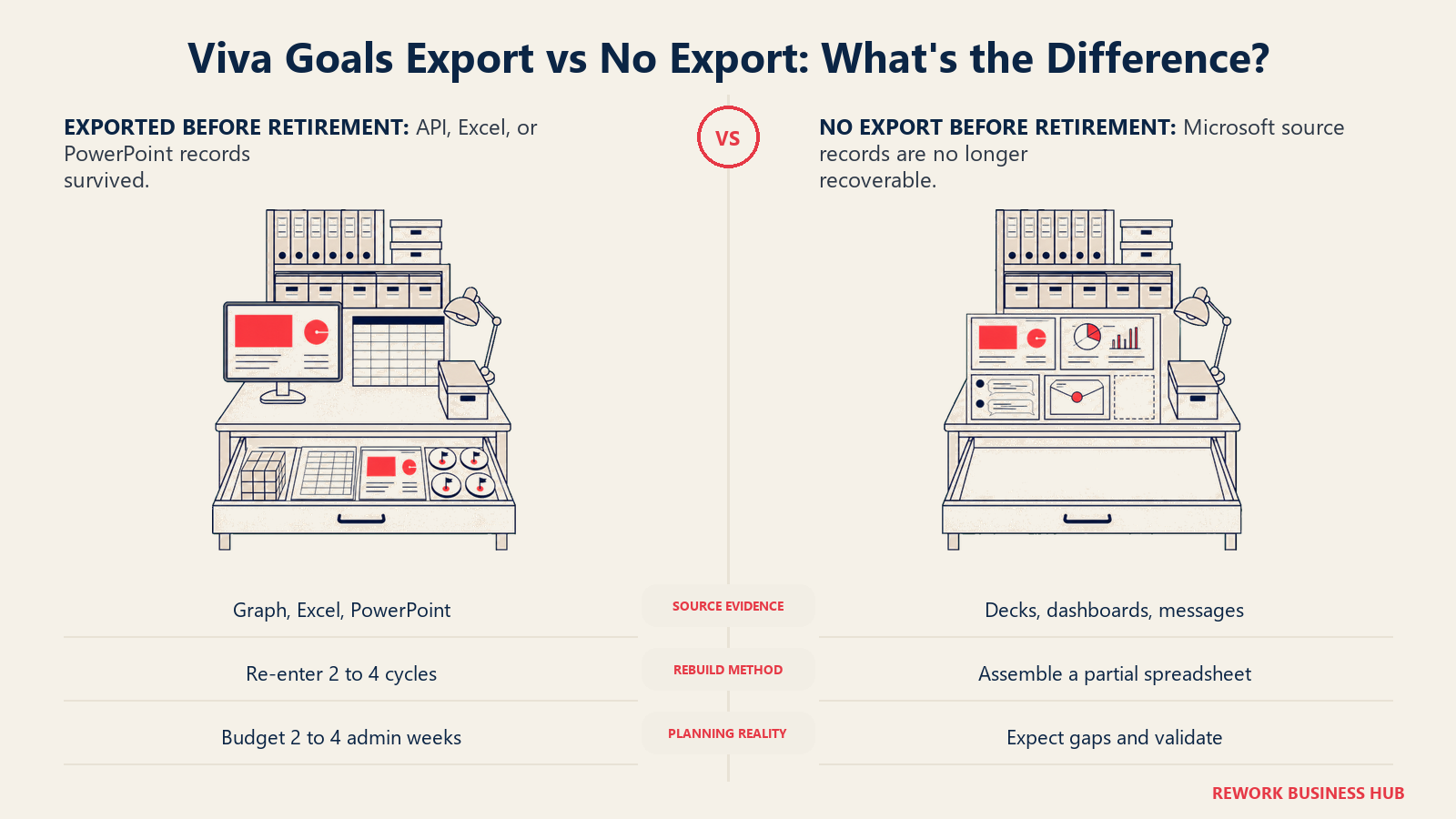
If you exported before December 31, 2025. Microsoft offered three export paths: the Goals API, an Excel export from the goals explorer, and a PowerPoint export for presenting cycles. If your admin pulled any of these, you have a usable historical record, but do not expect it to import cleanly into a new vendor. The API export follows Microsoft Graph's own schema, not a portable OKR standard, so there is no one-click restore into Perdoo, Lattice, WorkBoard or anyone else. Treat the Excel and PowerPoint exports as your source-of-truth reference deck, and plan on manually re-entering the last two to four completed cycles into the new tool as read-only historical records rather than live, editable objectives. Budget two to four weeks of admin time for this, not a weekend.
If you did not export in time. Be honest with your leadership team about where you stand. Microsoft's own FAQ is unambiguous: "the Viva Goals product will be shut down entirely on December 31, 2025, and we won't be able to extend usage past this date." There was no grace period and there is no support ticket that reopens it now. Your OKR history likely is not recoverable from Microsoft directly. Before you write it off completely, check the secondary places a cycle's content tends to survive: PowerPoint decks from quarterly business reviews, Power BI dashboards that had Viva Goals data connected and cached, Teams channel messages and pinned tabs referencing specific objectives, and email threads where check-ins were summarized. None of this reconstructs a clean database, but it is usually enough to rebuild a lightweight spreadsheet of "what we set out to do and what we hit" for the last few quarters, which is what most leadership teams actually reference anyway.
Either way, a few vendors are actively courting former Viva Goals customers. Mooncamp advertises a free, time-limited migration service specifically for Viva Goals customers, handled by its own transition team. Several others in this list publish "Viva Goals alternative" migration guides aimed at the same audience. Ask directly during your sales calls whether a white-glove migration is currently on offer. These programs come and go, so confirm current availability rather than assuming last year's offer still stands.
The one thing not to do is try to hit a hard replatform deadline in a single sprint. A rushed cutover into a tool nobody trained on is how a company ends up blaming the new software for a rollout problem that was really a change-management problem.
Stage Fit Matrix
| Tool | Startup 0-50 | Growth 50-250 | Mid-Market 250-1,000 | Enterprise 1,000+ |
|---|---|---|---|---|
| WorkBoard | Weak | Weak | Moderate | Strong |
| Mooncamp | Strong | Strong | Moderate | Weak |
| Perdoo | Strong | Strong | Moderate | Weak |
| Peoplebox | Moderate | Strong | Strong | Moderate |
| Profit.co | Moderate | Strong | Strong | Moderate |
| Weekdone | Strong | Moderate | Weak | Weak |
| Lattice | Weak | Strong | Strong | Moderate |
| Leapsome | Weak | Moderate | Strong | Moderate |
| Betterworks | Weak | Weak | Strong | Strong |
| 15Five | Moderate | Strong | Strong | Moderate |
| Engagedly | Weak | Moderate | Strong | Moderate |
| Asana | Moderate | Strong | Strong | Moderate |
Sizing and Persona Table
| Tool | Headcount sweet spot | Primary buyer | Secondary buyer |
|---|---|---|---|
| WorkBoard | 1,000 to 20,000+ | CSO / CHRO | VP of Strategy or PMO |
| Mooncamp | 20 to 500 | COO / Head of Strategy | IT admin (Microsoft 365) |
| Perdoo | 20 to 500 | COO / Strategy Lead | Head of Operations |
| Peoplebox | 75 to 1,500 | Head of People / Chief of Staff | RevOps or Strategy Lead |
| Profit.co | 100 to 2,000 | VP of Strategy / PMO | IT admin |
| Weekdone | 3 to 50 | Founder / Team lead | Operations manager |
| Lattice | 150 to 2,000 | VP of People / CHRO | Compensation Manager |
| Leapsome | 150 to 1,500 | VP of People / CHRO | People Ops manager |
| Betterworks | 500 to 10,000 | CHRO / VP Strategy | L&D Lead |
| 15Five | 50 to 1,000 | VP of People | Manager enablement lead |
| Engagedly | 200 to 1,500 | VP of People / L&D Manager | HRBP |
| Asana | 20 to 1,000 | Ops Lead / PMO | IT admin (Microsoft 365) |
1. WorkBoard - The Deepest Microsoft Ecosystem Fit, Now With Quantive's Base
WorkBoard is the closest thing to a like-for-like Microsoft-shop replacement on this list, and not by accident. It built its OKR product specifically around enterprise Microsoft environments years before Viva Goals existed, with OKRs surfacing inside Teams chat threads and meetings, native integration with Outlook and Planner, and a dedicated Azure DevOps connector for engineering teams tracking work against objectives. On 28 May 2025, WorkBoard acquired Quantive, the OKR platform formerly known as Gtmhub. Quantive no longer sells standalone: its old pricing page now redirects to WorkBoard's site, and its free tier is gone. That consolidation is worth noting for a different reason too. If your worry after Viva Goals is "will this vendor still exist in three years," WorkBoard just got bigger and more entrenched in the category, not smaller.
Methodology. WorkBoard treats OKRs as an operating rhythm rather than a quarterly form: objectives cascade with real-time roll-up reporting, and Biz Reviews turn the quarterly readout into a structured meeting format inside the tool itself, not a slide deck assembled the night before.
Target audience and fit. CSOs, CHROs and PMO leaders at 1,000-plus employee organizations, typically enterprises with an existing Microsoft 365 and Azure footprint who need OKR visibility to survive contact with a real reporting hierarchy. Below a few hundred employees, the enterprise sales process and implementation weight outweigh the payoff.
| Pros | Cons |
|---|---|
| Deepest Teams, Outlook, Planner and Azure DevOps integration on this list | No published pricing anywhere; every deal starts with a sales call |
| Absorbed Quantive's customer base, signaling durability in the category | Built for enterprise scale; overkill for a 50-person team |
| Biz Reviews turn OKR reporting into a real meeting workflow, not a slide deck | Implementation is a real project, not a self-serve signup |
Pricing: WorkBoard publishes no pricing on its website. Every plan is quote-based and scoped to headcount and modules.
Best for: Large Microsoft 365 organizations that want the Viva Goals level of ecosystem integration without the risk of buying from a division that might deprioritize it again. For the broader category view, see the best OKR software for 2026 roundup.
2. Mooncamp - OKRs That Never Leave a Teams Tab
Mooncamp made a specific bet: most people will not open a fifth app to update a goal, so put the entire OKR workflow inside the app they already have open all day. The result is a Teams integration that goes further than a notification bridge. You can create, edit, comment on and check in on OKRs directly inside a Teams tab, pin Company or Group OKRs to a channel, and query your assigned goals through a chatbot command without leaving the conversation. It also connects to Power BI, which matters specifically for former Viva Goals users, since Power BI was one of the connectors Microsoft killed at retirement.
Methodology. The product philosophy is adoption over feature count: fewer clicks between "I have an update" and "the OKR reflects it," delivered through Teams, Slack or the standalone web app depending on where your company actually lives.
Target audience and fit. COOs, heads of strategy and IT admins at 20 to 500 employee Microsoft 365 shops who want Viva Goals' Teams-native feel without Viva Goals' scale requirements. Mooncamp is also actively running a migration offer for former Viva Goals customers, worth asking about directly since these programs have a shelf life.
| Pros | Cons |
|---|---|
| OKRs are fully editable inside a native Teams tab, not just notified about | Enterprise tier requires a 100-user minimum, an odd floor for a growing team |
| Power BI and Planner integrations replace two of the connectors Viva Goals lost | Smaller vendor with a thinner analyst and case-study footprint than the enterprise names |
| Azure AD SSO and SCIM provisioning out of the box | Reviews, compensation and learning are out of scope; OKRs only |
Pricing: Billed annually. Essential is EUR 7 per user/month with a 5-user minimum, Professional is EUR 10 per user/month. Enterprise is custom-quoted and requires a 100-user minimum.
Best for: Mid-size Microsoft 365 companies whose Viva Goals usage was genuinely daily and Teams-centric, not occasional. Pair it with the OKR framework guide if you are also refreshing how the program itself runs.
3. Perdoo - Transparent EUR Pricing With a Native Teams App
Perdoo is the most transparent vendor on this list and one of only three with real OKR management built into Microsoft Teams. Its Teams app, listed openly on the Microsoft Teams marketplace, lets you access team pages and create, edit and update goals without leaving Teams, and pin Company or Group OKRs to a relevant channel. Unlike most of this list, Perdoo publishes exact EUR rates instead of routing everyone into a sales call.
Methodology. Strategy and execution are deliberately separated: a strategy map holds the long-term goal and strategic pillars, OKRs sit beneath it for the quarter, and KPIs track business-as-usual health alongside them. It is an opinionated method, which helps a team that is new to OKRs and constrains a team that wants to bend the framework.
Target audience and fit. Strategy leads, COOs and Heads of Operations at 20 to 500 employee companies, with a strong European customer base. The free tier covers 5 users, which is enough for a leadership team to trial the method before it spreads company-wide.
| Pros | Cons |
|---|---|
| Published EUR pricing including a genuinely usable free tier at 5 users | Goals only; no performance reviews, surveys or compensation |
| Native Teams app with real create/edit access, not just notifications | The opinionated strategy-map method resists heavy customization |
| View-only licenses let observers follow goals cheaply | You will run a second vendor for review cycles |
Pricing: Free is EUR 0 for up to 5 users. Premium is EUR 8 per user/month and Supreme is EUR 10 per user/month, both with a 5 paid-license minimum. View-only licenses are EUR 1.50 per user/month. Annual billing runs about 10% cheaper than quarterly.
Best for: Teams whose Viva Goals usage was 90% about the OKR mechanics and almost never about reviews. Pair it with the OKR resource collection if you are designing the program itself, not just picking the tool.
4. Peoplebox - OKRs and Reviews at the Lowest Published Rate, Native in Teams and Slack
Peoplebox is the pick for a team that wants Viva Goals' scope, which paired goals with performance conversations, but at a fraction of the stacked cost of an enterprise HR suite. Its OKRs sync bidirectionally with the systems already holding your data, including Jira, Salesforce and HubSpot, so progress updates itself instead of depending on a Friday check-in ritual. Both Slack and Microsoft Teams are treated as first-class surfaces, not afterthought connectors.
Methodology. Goal alignment and performance conversations should happen where work already happens, so OKRs, 360 feedback and one-on-ones run through chat-native prompts rather than a separate destination app.
Target audience and fit. Software and revenue-driven companies of 75 to 1,500 employees that already run OKRs and currently hold the process together with a spreadsheet and good intentions. Below 75 employees the machinery outweighs the problem.
| Pros | Cons |
|---|---|
| OKRs, check-ins and 360 feedback are all manageable directly inside Teams | No free tier and no published trial pricing |
| Bidirectional sync with Jira, Salesforce and HubSpot removes manual updates | Learning and compensation coverage is thinner than the bigger suites |
| Lowest published per-module rates of any full performance platform here | Smaller vendor with a lighter enterprise reference base |
Pricing: Per employee per month, billed annually. Performance Management is $8, 360 Degree Feedback $8, Individual Development Plans $3, Compensation $5 and Engagement $2. Nova, the AI recruiting add-on, is quote-only.
Best for: Teams that liked Viva Goals' combination of goals and lightweight performance conversations and want that same shape at a lower, published cost.
5. Profit.co - Broad Module Coverage With a Real Teams App
Profit.co covers more ground than most of this list, spanning OKRs, Performance, Portfolio management and Balanced Scorecard as separate modules on one platform. Its Microsoft Teams integration is functional rather than flashy: check in on key results, update linked tasks, and receive any of 130 different notification types without leaving Teams.
Methodology. OKRs cascade downward while tasks link directly to key results, so a Teams-based check-in updates both the goal and the underlying work item in the same action. Balanced Scorecard sits alongside OKRs for teams that need a second, complementary measurement framework.
Target audience and fit. VPs of Strategy and PMO leaders at 100 to 2,000 employee organizations that want OKRs, portfolio tracking and performance reviews without stitching together three separate vendors. The lack of published pricing makes this a harder sell to a budget-conscious small team.
| Pros | Cons |
|---|---|
| Teams app covers check-ins, task updates and a wide notification range | Publishes no pricing at all; every evaluation starts with a quote request |
| Balanced Scorecard as a built-in second framework is rare in this category | No published pricing; every deal is a custom quote |
| Broadest module coverage of the smaller vendors on this list | No stated free tier |
Pricing: Profit.co's own pricing page publishes no figures. Cost is built from the modules selected (OKRs, Performance, Portfolio, Balanced Scorecard), user count and deployment model (cloud versus on-premise), and requires a custom quote. Entry pricing is reportedly about $7 per user/month.
Best for: Mid-market teams that want OKRs and portfolio management on one contract and are comfortable with a quote-first sales process.
6. Weekdone - Free OKRs for a Very Small Team
Weekdone is the honest answer for a team that ran Viva Goals for three people and does not want to pay an enterprise vendor to replace it. It is free for up to 3 users with all features included, and its Teams app covers the two things a small team actually checks weekly: the OKRs themselves and the weekly check-in.
Methodology. The weekly check-in is the core loop: plans, progress and problems get logged on a fixed weekly cadence, and OKRs roll up from that same rhythm rather than sitting in a separate quarterly ritual.
Target audience and fit. Founders and small operations teams of 3 to 50 employees who want a lightweight weekly cadence without a procurement process. Above 50 employees, most teams outgrow Weekdone's calibration and review depth quickly.
| Pros | Cons |
|---|---|
| Genuinely free for up to 3 users, all features, vendor-confirmed | Paid tier pricing is a banded team rate, not a clear per-seat number, until you open the calculator |
| Teams app covers both weekly check-ins and OKRs in one place | Marketing pricing page renders key figures in JavaScript, making them hard to compare at a glance |
| 14-day free trial available at 4-plus users | Depth thins out fast above small-team scale |
Pricing: Free for up to 3 users, all features included. Paid plans start at $108 per month for 4 to 10 users, a banded team price rather than a pure per-seat rate; exact per-seat tiers require the on-site calculator. Annual billing saves 20%, and a 14-day free trial is available at 4-plus users.
Best for: A small team or single department that wants OKRs and weekly check-ins in Teams without an enterprise sales cycle.
7. Lattice - The Published-Rate Suite With a Dedicated Goals & OKRs Module
Lattice is the most likely landing spot for a company that used Viva Goals for OKRs but always wanted reviews, engagement and compensation on the same record. Every module carries a listed rate, so you can model a three-year cost on a Tuesday afternoon rather than waiting on a sales call, which is the opposite of the quote-gated experience several other suites on this list still require.
Methodology. The employee record is the spine, with Goals & OKRs, performance, engagement and compensation hanging off it and sharing one dataset, so a rating, an engagement score and an OKR outcome can be read together.
Target audience and fit. Mid-market People teams of 150 to 2,000 employees, typically Series B through pre-IPO software and professional services companies, with at least one dedicated HR operations person to run the configuration.
| Pros | Cons |
|---|---|
| Published per-module rates make budgeting possible without a sales call | OKR editing still happens in Lattice itself; Teams gets notifications, not the editing surface |
| Compensation planning ties directly to goal and review data | Modules compound fast: a full stack easily reaches $22 per seat/month |
| Deep configurability for cycles, calibration and rating scales | $4,000 minimum annual agreement, USD only |
Pricing: Billed annually, USD only. Goals & OKRs is $8 per seat/month, Performance is $10, Engagement is $4, with Compensation and Grow available as $6 and $4 add-ons. Minimum annual agreement is $4,000.
Best for: Teams that want a full performance suite with a rate card attached rather than a quote. The Lattice vs 15Five comparison and the Lattice vs Culture Amp comparison cover the adjacent decisions.
8. Leapsome - A Full People Suite That Happens to Include OKRs
Leapsome is the broadest modular people suite most likely to come up in the same conversation as Viva Goals, since it ships reviews, goals, surveys, learning, compensation and meetings as one connected product. Its Teams integration is real but narrower than the OKR-first tools above: it delivers praise, performance review reminders and meeting-agenda notifications into a Teams channel, but OKR editing still happens inside Leapsome, not in a Teams tab.
Methodology. One platform, opinionated defaults, and a European data-residency posture that survives a Works Council conversation, with OKRs positioned as one module among several rather than the centerpiece.
Target audience and fit. CHROs and VPs of People at 150 to 1,500 employee companies who want one connected people platform instead of stitching four vendors together, and are comfortable that goals will be one module of several rather than the primary interface.
| Pros | Cons |
|---|---|
| Reviews, goals, surveys, learning and compensation on one connected record | Teams integration is notification-only; no OKR editing surface in Teams |
| GDPR posture and EU data residency out of the box | Pricing is modular with no single flat rate; hard to budget in advance |
| 14-day free trial available | One-year minimum contract term removes the option of a short paid pilot |
Pricing: Modular, no single flat per-seat rate published. Leapsome's own comparison pages put the entry point near $3 per user/month for one module, while its pricing configurator quotes a starting total rather than a seat rate. Minimum contract term is one year, and Customer Success support requires an annual contract of at least $6,000.
Best for: Teams whose real gap after Viva Goals is a full people platform, not just OKRs specifically. The Leapsome alternatives guide covers the rest of that field, and Culture Amp vs Leapsome settles the engagement-first comparison.
9. Betterworks - Enterprise Goal Cascading Above 500 Employees
Betterworks is the specialist for cascading objectives across a large, multi-department organization, which is a genuinely different problem than running OKRs for a 40-person team. The vendor is direct that its value case starts above roughly 500 employees, and its Teams integration reflects an enterprise-software mindset: Teams delivers prompts and nudges at the right moment, while the actual OKR system of record stays in the Betterworks web app.
Methodology. Objectives cascade from company level through departments to individuals with real-time roll-up reporting, and Talent Intelligence layers succession and skills analytics on the same underlying data.
Target audience and fit. CHROs and VPs of Strategy at 500 to 10,000 employee organizations running formal, cross-departmental goal programs. Below 250 employees the platform is heavier than the problem it solves.
| Pros | Cons |
|---|---|
| Best-in-class goal cascading and roll-up reporting at large headcounts | Teams integration is a notification channel, not an editing surface |
| Talent Intelligence adds skills and succession analytics on the same data | The advertised $1 promotional rate expired August 31, 2026, so $8 is the entry price |
| Enterprise-grade governance and permissions | Implementation is a separate one-time cost on top of the subscription |
Pricing: Regular pricing is $8 per user/month for Performance and $9 for Performance plus Talent Intelligence. A promotion dropped those to $1 and $2 respectively, but only for the first contract year, only with a signed 3-year agreement, and it expired August 31, 2026. Budget against the $8/$9 regular rate.
Best for: Large organizations whose alignment problem spans real departmental silos. Read the performance management resource library before shortlisting a vendor at this scale.
10. 15Five - Manager Habit-Building, With Goals as a Supporting Feature
15Five sells manager behavior more than it sells OKR software. The weekly check-in, the 1-on-1 agenda and the coaching layer exist to change what a manager does on a Monday, and goals live inside the Perform product as a supporting feature rather than a standalone module. Worth knowing before you shortlist it for Teams integration specifically: 15Five's Microsoft Teams app is built for "High Fives," its peer recognition feature, not for goals or OKRs at all.
Methodology. The core loop is a weekly check-in where employees answer a short set of questions and managers respond, feeding into one-on-ones and review cycles instead of sitting unread in a dashboard.
Target audience and fit. US-centric companies of 50 to 1,000 employees where headcount is growing faster than management experience, and the mandate includes making managers better, not just tracking objectives.
| Pros | Cons |
|---|---|
| Manager coaching and the weekly check-in habit drive real voluntary adoption | Teams integration covers recognition only; OKRs are not manageable in Teams at all |
| US-based support and a US-first integration ecosystem | No standalone OKR module; goals live inside a broader Perform product |
| Total Platform bundles engagement, performance and manager coaching | Per-manager add-ons for coaching and content stack quickly |
Pricing: Billed annually. Engage is $4 per user/month, Perform is $11, and Total Platform (Engage plus Perform plus manager microlearning) is $16. Add-ons include Compensation at $9 to $11 per employee/month and manager-specific coaching products priced separately.
Best for: Companies whose real problem is undertrained managers, not a missing OKR system. If OKR editing inside Teams is the requirement, look higher on this list first; the 15Five alternatives guide covers the rest of that field.
11. Engagedly - OKRs Paired With a Full Learning Budget
Engagedly is the pick for a team that used Viva Goals for objectives but has been separately shopping for a learning management system, since Engagedly prices performance, learning, recognition, engagement, talent mobility and compensation as distinct modules on one contract. Its Teams integration mirrors Leapsome and Betterworks: real-time notifications for feedback and goal reminders, not a Teams-native OKR editing surface.
Methodology. Performance improves through development rather than measurement alone, so review outcomes feed learning recommendations and mentoring matches, and cascading OKRs run from company level down to individual contributors.
Target audience and fit. Mid-market People and L&D teams at 200 to 1,500 employees where development budget and performance budget sit in the same plan, common in professional services, financial services and healthcare organizations with an established L&D function.
| Pros | Cons |
|---|---|
| Learning, mentoring and talent mobility are priced openly as separate modules | $7,500 per year minimum prices out small teams |
| Cascading OKRs and 360 feedback are mature, established features | Teams integration is notifications only, no in-Teams OKR editing |
| A module rate card lets you rebuild a familiar Viva Goals-plus-training basket | Full-platform bundle pricing is quote-only |
Pricing: Per user/month, billed annually. Manage Performance (including OKRs) is $5 to $8, Learn & Grow is $3 to $5, with Recognize & Reward, Engage & Listen and Talent Mobility each at $2. Minimum pricing is $7,500 per year regardless of headcount.
Best for: Teams that need OKRs and a real learning budget on the same contract and can clear the $7,500 annual floor. The best employee engagement software roundup covers the engagement-first alternative path.
12. Asana - OKRs Inside the Project Tool You Already Run
Asana is the pragmatic option for a team that would rather not add a dedicated OKR vendor at all and instead keep goals inside the work-tracking tool everyone already opens daily. Goals in Asana connect directly to the projects and tasks that roll up to them, so progress can update automatically as linked work closes, which a purpose-built OKR tool cannot do unless it is deeply wired into your task system.
Methodology. Goals sit above Portfolios and Projects in Asana's hierarchy, so a company objective visibly traces down to the actual project work behind it, rather than living as a separate check-in ritual disconnected from where the work happens.
Target audience and fit. Operations leads and PMO teams at 20 to 1,000 employee companies already standardized on Asana for project and task management, who want goal visibility without introducing a second system of record.
| Pros | Cons |
|---|---|
| Goals connect directly to the projects and tasks that drive them | Goals is a top-tier feature; there is no dedicated OKR product underneath it |
| Teams already using Asana daily do not need to adopt a new habit | Teams app covers tasks and projects; there is no dedicated Goals surface inside Teams |
| Familiar interface removes rollout friction for existing Asana shops | No performance reviews, engagement surveys or compensation features at all |
Pricing: Personal is free. Starter is $10.99 per user/month billed annually ($13.49 billed monthly). Advanced, the tier where Goals and Portfolios live, is $24.99 per user/month billed annually ($30.49 billed monthly). Enterprise is custom-quoted.
Best for: Teams that never wanted a standalone OKR vendor in the first place and would rather goals lived inside project management. It is a reasonable fallback, not a like-for-like Viva Goals replacement.
How to Choose: Decision Framework
Start with Teams integration depth, then narrow the field by company size and whether you need OKRs alone or a broader performance suite.
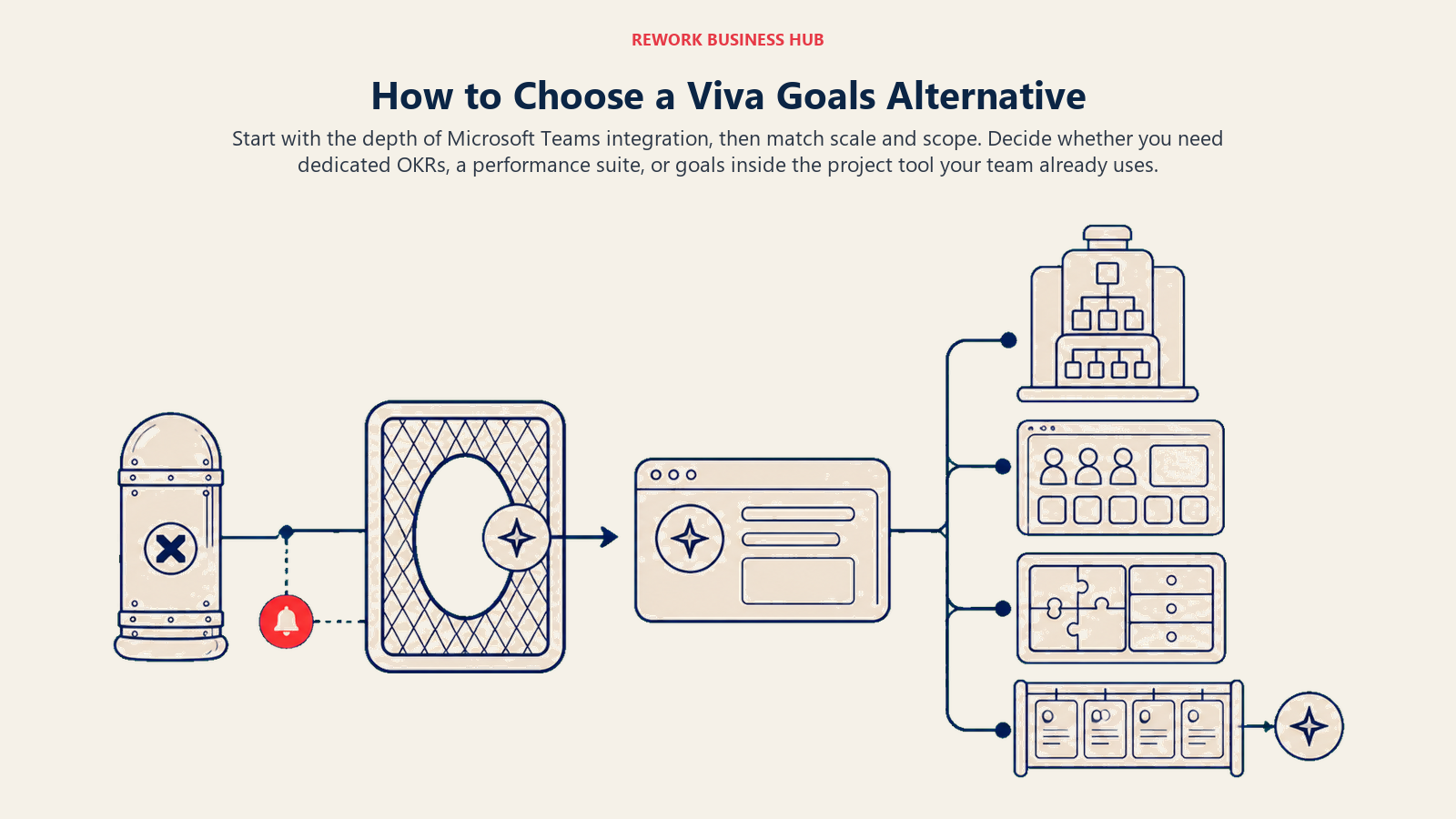
| If you need... | Choose |
|---|---|
| The closest match to Viva Goals' Microsoft ecosystem depth, at enterprise scale | WorkBoard |
| Full OKR creation and editing inside a Teams tab, mid-size company | Mooncamp |
| Transparent EUR pricing with a native Teams app and a real free tier | Perdoo |
| The cheapest published OKR-plus-reviews stack, native in Teams and Slack | Peoplebox |
| OKRs plus portfolio and Balanced Scorecard tracking on one contract | Profit.co |
| Free OKRs for a team of 3 or fewer, with a lightweight Teams check-in app | Weekdone |
| A published-rate performance suite with a dedicated Goals & OKRs module | Lattice |
| Reviews, surveys, learning and OKRs together on one connected platform | Leapsome |
| Goal cascading across departments at 500-plus employees | Betterworks |
| Manager coaching and weekly check-ins, with goals as a secondary feature | 15Five |
| OKRs paired with a real learning and development budget | Engagedly |
| To keep goals inside the project tool your team already runs daily | Asana |
Frequently Asked Questions about Microsoft Viva Goals Alternatives
Is Microsoft Viva Goals still available to buy or trial?
No. Microsoft retired Viva Goals on December 31, 2025. New feature development stopped a year earlier, on December 5, 2024, and the product cannot be purchased, trialed or renewed today. Microsoft has stated it will not replace Viva Goals with another solution or fold its features into another Microsoft product.
What happened to Ally.io, the OKR tool Viva Goals was based on?
Microsoft acquired Ally.io in October 2021 and relaunched it as Viva Goals in May 2022, which retired the Ally.io brand entirely. Ally.io does not exist as an independent product to go back to; it only continued inside Viva Goals, which is now also gone.
Can I still access my Viva Goals data?
Only if you exported it before December 31, 2025 using the API, Excel or PowerPoint export options Microsoft provided. Microsoft's own retirement FAQ states the product "will be shut down entirely" with no extensions available. If you missed the export window, check secondary sources like Power BI dashboards, Teams channel messages and quarterly review decks for whatever data survived there.
Is Viva Glint or Viva Engage a replacement for Viva Goals?
No, and this is a common point of confusion because both carry the Viva name. Viva Glint is an employee listening and engagement survey tool, and Viva Engage is a Teams-connected communication tool (formerly Yammer). Neither does objectives and key results tracking; you need a dedicated third-party OKR tool.
Which alternative has the deepest Microsoft Teams integration?
WorkBoard, Mooncamp and Perdoo are the only three tools in this guide where OKRs can be created and edited directly inside a Microsoft Teams tab rather than just triggering a notification. WorkBoard adds native Outlook, Planner and Azure DevOps integration on top for enterprise scale; Mooncamp and Perdoo cover the same depth at small and mid-market pricing.
What is the cheapest way to replace Viva Goals?
Weekdone is free for up to 3 users with all features included, and Perdoo's free tier covers up to 5 users. For a slightly larger team, Mooncamp starts at EUR 7 per user/month and Perdoo's paid tier starts at EUR 8 per user/month, both with published rates and no sales call required.
Do any of these vendors help migrate data from Viva Goals?
Mooncamp has advertised a free, time-limited migration service specifically for former Viva Goals customers. Several other vendors in this category publish Viva Goals migration guides aimed at the same audience. Ask directly during a sales call whether a migration program is currently active, since these offers change over time.
What to Do Next
Start with the Teams-integration test, since it is the fastest way to cut twelve options down to three. If OKRs genuinely need to be editable inside Teams, not just mentioned there, your real shortlist is WorkBoard, Mooncamp and Perdoo. If a notification is enough and what you actually miss is the combined reviews-and-goals experience, Lattice, Leapsome or Peoplebox are the stronger fit.
Then run a real two-week pilot with your top two picks, not five vendor demos. Load one department, migrate whatever historical OKR data you managed to export, and run one full check-in cycle. Watch which tool people update without a reminder. Microsoft's own numbers on Viva Goals are the cautionary tale here: even inside a suite with more than 66 million active users, a goal tool that people did not open on their own eventually got cut. The tool that survives your next budget review will be the one your team actually uses, not the one with the longest feature list.
Camellia covers performance, engagement and HR tooling for B2B teams.

Principal Product Marketing Strategist
On this page
- Key Facts
- What Happened to Viva Goals
- Quick Comparison Table
- What to Do About Your Exported Data (and How to Rebuild an OKR History)
- Stage Fit Matrix
- Sizing and Persona Table
- 1. WorkBoard - The Deepest Microsoft Ecosystem Fit, Now With Quantive's Base
- 2. Mooncamp - OKRs That Never Leave a Teams Tab
- 3. Perdoo - Transparent EUR Pricing With a Native Teams App
- 4. Peoplebox - OKRs and Reviews at the Lowest Published Rate, Native in Teams and Slack
- 5. Profit.co - Broad Module Coverage With a Real Teams App
- 6. Weekdone - Free OKRs for a Very Small Team
- 7. Lattice - The Published-Rate Suite With a Dedicated Goals & OKRs Module
- 8. Leapsome - A Full People Suite That Happens to Include OKRs
- 9. Betterworks - Enterprise Goal Cascading Above 500 Employees
- 10. 15Five - Manager Habit-Building, With Goals as a Supporting Feature
- 11. Engagedly - OKRs Paired With a Full Learning Budget
- 12. Asana - OKRs Inside the Project Tool You Already Run
- How to Choose: Decision Framework
- What to Do Next