Gusto vs Paychex: Which Payroll Platform Fits Your Business in 2026?
Turn this article into takeaways for your work.


Each assistant summarizes the article only for you and suggests best practices for your work.
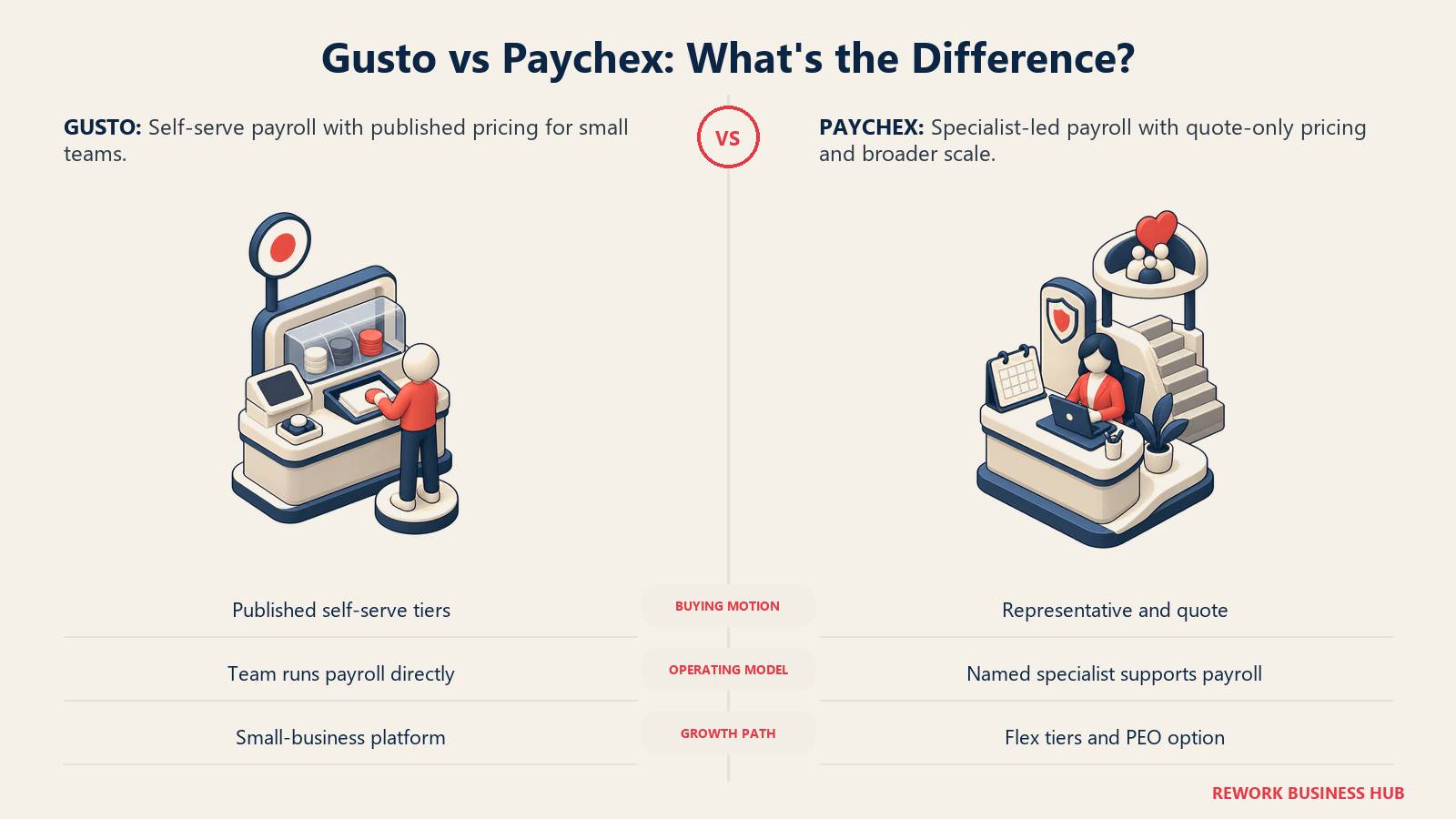
Gusto and Paychex sit on opposite sides of a line that has nothing to do with features and everything to do with how you're allowed to shop. Gusto puts real numbers on its pricing page for two of its four tiers and lets you build a budget before you've talked to anyone. Paychex puts no numbers on its pricing page at all; a figure for its entry tier circulates across third-party pricing trackers, but Paychex itself confirms nothing until you call.
That's not a small distinction. If you can price your whole shortlist from your desk, you compare Gusto against itself at different headcounts. With Paychex, you're never comparing a real number, only a reported estimate against a quote you haven't gotten yet, and the real question becomes what makes a specialist-priced relationship worth that tradeoff. That's the story this comparison answers, for the founder, office manager, bookkeeper, or HR lead who owns payroll at a US company somewhere between 5 and 250 employees.
TL;DR
| Gusto | Paychex | |
|---|---|---|
| What it is | Self-serve payroll and HR platform, published pricing on three of four tiers | National payroll processor that publishes no pricing on any tier |
| Entry tier | Simple, $49/mo base + $6/person/mo, vendor-published | Flex Essentials, reported (unverified) around $39/mo base + $5/person/mo, for teams under roughly 20 employees |
| Most relevant tier for growing teams | Plus, $80/mo base + $12/person/mo, unlocks multi-state payroll and time tracking | Flex Select or Flex Pro, both quote only, no reliable public figure |
| Top tier | Premium, quote only (reported around $180/mo + $22/person/mo) | Flex Enterprise and Paychex PEO (Paychex Oasis), both quote only |
| Pricing model | Published self-serve rates on Simple, Plus, and Contractor Only; Premium is quoted | No published pricing anywhere; every dollar figure attached to Paychex's name is a third-party estimate |
| Multi-state payroll | Plus and Premium only, not Simple | Handled inside Flex; more complex multi-state or multi-location work is a common reason to move off Essentials into a quote |
| Best for | Teams that want a real number today and are comfortable running payroll themselves | Teams that want a named payroll specialist and decades of tax-filing history, and don't mind a quote-only process |
| Not really built for | Companies needing a named payroll specialist, certified payroll for government contracts, or a large PEO-scale benefits bench | Anyone who wants a vendor-confirmed dollar figure without booking a call, at any tier |
Who Each Tool Is Built For
Gusto's entire pitch is that a non-expert can run payroll without training. Sign up online, enter company and employee details, and Gusto calculates pay, withholds and files taxes, and deposits money into employee accounts, all inside a self-serve interface with a published price. It has expanded into benefits, time tracking, and light HR tools over the years, but it still reads as something a founder or office manager operates directly, not something that needs a payroll department.
Paychex has been filing payroll taxes since 1971, and that history shapes the product. Paychex Flex is one platform family meant to scale from a two-person shop to an enterprise with thousands of employees, moving customers through internal tiers as they grow rather than swapping products the way ADP does with RUN and Workforce Now. None of that ladder carries a public price, not even entry-level Flex Essentials; the figure that circulates on third-party pricing sites is a reported estimate, not a number Paychex confirms. Essentials, Select, Pro, Enterprise, and Paychex PEO (branded Paychex Oasis) are all sold through a sales conversation with a payroll specialist assigned to the account.
| Gusto | Paychex | |
|---|---|---|
| Natural buying trigger | Want a real price before a demo or sales call | Want a dedicated payroll specialist and a vendor with decades of compliance history |
| Team maturity assumed | Comfortable configuring and running payroll directly | Comfortable getting priced through a rep, at every tier from a small account up |
| Primary champion | Founder, office manager, or bookkeeper running payroll as one part of a broader role | HR or finance lead who wants a named point of contact owning part of the compliance risk |
| Company profile that fits best | Single-entity US small businesses, agencies, startups comfortable with self-serve tools | Businesses that want a specialist relationship from the first call, need non-desk workforce support, or want a real PEO option later without switching vendors |
Neither company sells to only one size of business, but the split holds: Gusto builds around a published price you can act on immediately for most tiers, and Paychex builds around a named specialist who prices your account once they understand your headcount and complexity, with no public rate card to start from.
Key Facts
- The IRS Failure to Deposit penalty starts at 2% for a payroll tax deposit 1 to 5 calendar days late and climbs to 15% once the IRS has sent a notice demanding immediate payment, according to the IRS's own penalty page.
- Employers make an average of 15 corrections per pay period, according to EY's payroll analysis reported by HR Dive.
- 78% of workers in America say they would face financial difficulty if their paycheck were delayed by a week, according to PayrollOrg's 2025 Getting Paid In America survey of more than 25,900 respondents, reported via PR Newswire.
- 34% of small businesses hand payroll off to an external firm and another 21% run it through third-party software, according to NSBA's 2025 Small Business Taxation Survey.
- Small business owners spend nearly five hours per pay period calculating, filing, and paying payroll taxes by hand, according to a Kelton Global survey commissioned by Intuit, reported by Bloomberg Tax.
Pricing Transparency: What Each Company Actually Publishes
This section decides most of the rest of the comparison, and it's more nuanced than "one is open, one is closed."
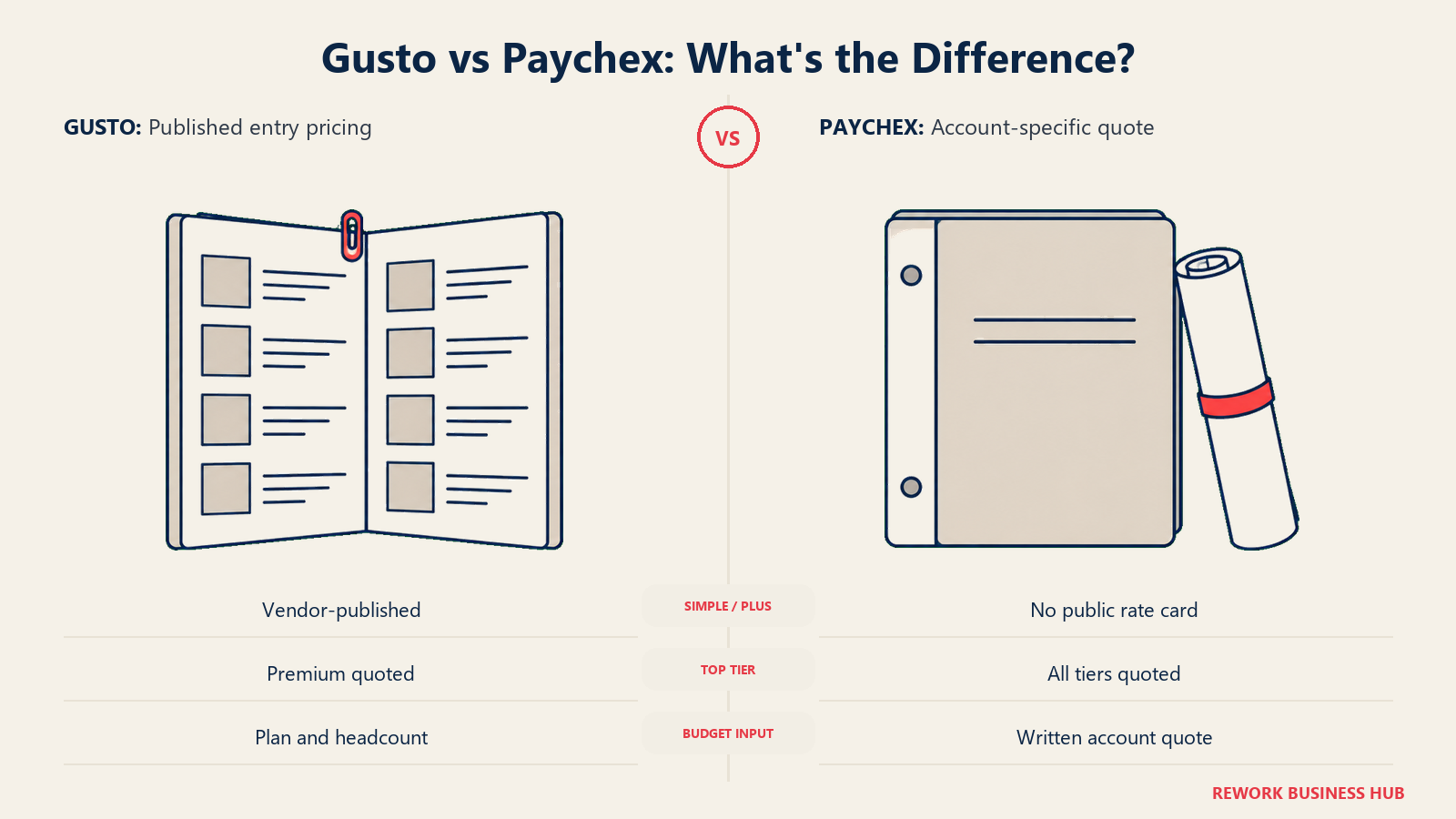
Gusto publishes real numbers for three of its four tiers and quotes the top one. Simple runs $49 a month base plus $6 per person, single-state payroll for a company that doesn't need much beyond running paychecks accurately. Plus runs $80 base plus $12 per person, and is where multi-state payroll and time tracking actually live, a gate worth flagging since Gusto's "everything's included" reputation is a little stale. Contractor Only, for companies with no W-2 employees, runs $35 base plus $6 per contractor. Premium is quote-only, Gusto won't bill you until you've talked to its team, though third-party trackers commonly report it around $180 plus $22 per employee. Worth noting against an older article: Simple rose from $40 to $49 in a March 2026 price increase.
Paychex publishes no pricing at all, on any tier. There's no rate card, no "starting at" number anywhere on its site, nothing you can act on without a phone call. A figure recurs across third-party pricing blogs, Flex Essentials reported around $39 a month base plus $5 per employee for teams under roughly 20 employees, but that number comes from independent sources, not Paychex, and should be treated as directional rather than confirmed. Select, Pro, and Enterprise carry no reliable public figure, and neither does Paychex PEO. One number to retire if you've seen it elsewhere: a previously reported Pro starting point of $47 plus $3 per employee is stale.
| Gusto | Paychex Flex Essentials | Paychex Flex Select / Pro / Enterprise | Paychex PEO (Paychex Oasis) | |
|---|---|---|---|---|
| Pricing published on the vendor's site | Yes, three of four tiers | No; a reported figure circulates, unconfirmed by Paychex | No | No |
| How you get a real number | Read the pricing page for Simple, Plus, or Contractor Only | Call or request a quote | Call or request a quote | Call or request a quote |
| Billing structure once reported | Flat monthly base plus per-person add-on, vendor-confirmed | Reported around $39/mo base + $5/employee/mo, not vendor-confirmed | Custom, scaled to size, tier, and modules | Structured around a per-employee PEO fee, confirmed only in the quote |
| Positioned employee range | No published cap; built for small business | Under roughly 20 employees, per third-party trackers | Growing teams past Essentials, through enterprise | Not headcount-gated; small business through mid-market |
| Monthly or annual billing | Monthly, no separately discounted annual rate published | Reported as monthly | Set in the quote | Set in the quote |
The practical difference: with Gusto you can put a real number in a spreadsheet today for two of its four tiers. With Paychex, there's no vendor-confirmed number at any size, only a repeated third-party estimate for very small teams and a quote for everyone else.
Payroll Mechanics and Tax Filing
Both companies do the fundamental job correctly: calculate gross-to-net pay, withhold the right taxes, file the required forms, and deposit pay on time, through different structures.
Gusto runs on one unified platform across every tier. Enter hours or salaries, and Gusto calculates pay and taxes, automatically files federal, state, and local payroll tax forms, and handles deposits with the relevant agencies. Tax filing accuracy is backed on every plan, not sold as an upsell, and same-day or next-day direct deposit is available depending on tier.
Paychex's payroll engine has more than five decades of tax-filing history behind it, and that track record is what Paychex sells: a named specialist and a company with a long audit history standing behind your filings. You pay for that depth through a sales-negotiated price at every tier, since none of them, including Essentials, carry a vendor-published rate, and the exact filing cadence and guarantee terms depend on which Flex tier you land in.
| Capability | Gusto | Paychex |
|---|---|---|
| Automatic federal, state, and local tax filing | Yes, included on every tier | Yes, across all Flex tiers |
| Tax filing accuracy backed by a guarantee | Yes | Yes, backed by decades of processing history |
| Same-day or next-day direct deposit | Available depending on plan | Available, terms set by tier |
| Unified platform across tiers | Yes, one product, four tiers | Yes, one platform family (Flex), scaling through internal tiers |
| Where pricing for this capability lives | Published on Simple, Plus, and Contractor Only | Not published on any tier; only a reported estimate exists for Essentials |
Multi-State Payroll
The two companies' pricing philosophies produce two different kinds of friction here.
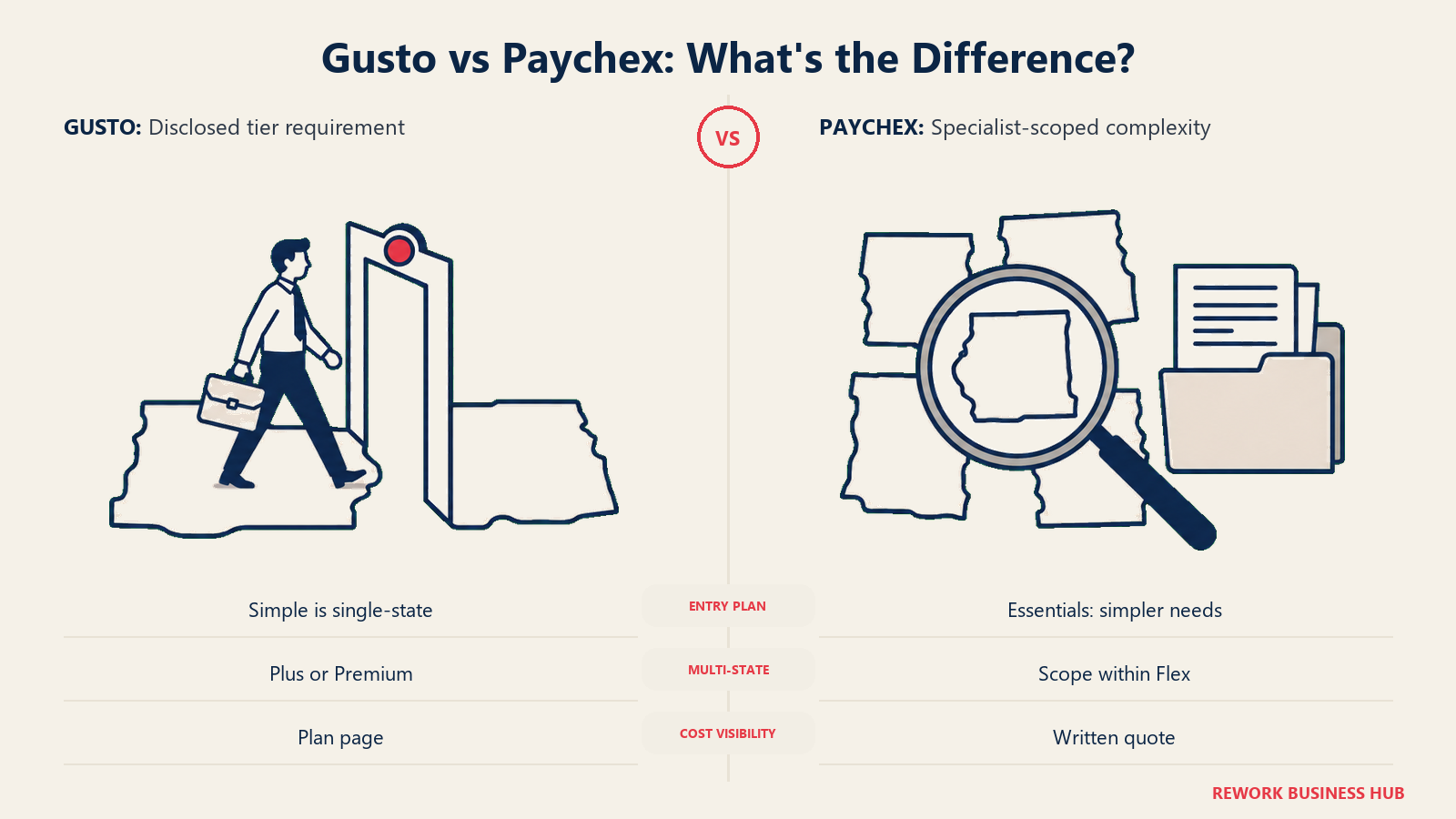
Gusto's gate is disclosed and specific: Simple is single-state only, and one employee working from a second state pushes you to Plus at minimum, $80 base plus $12 per person. You can read that before you sign up, so there's no surprise, just a real cost jump some buyers don't expect from a "starter" plan.
Paychex's gate is structural rather than disclosed. Flex handles multi-state payroll as part of the platform, but Essentials is positioned for the simpler, usually single-location case a very small team represents. Real multi-state complexity, several states and localities with varying tax rules, tends to push a buyer past Essentials into a Select or Pro conversation, where a specialist prices the account around your actual footprint. You don't see that cost until the quote comes back, but you also aren't guessing at a tier boundary the way a Gusto Simple customer has to.
| Capability | Gusto | Paychex |
|---|---|---|
| Multi-state payroll included on entry tier | No, Simple is single-state only | Available within Flex, but multi-state complexity is a common reason to move past Essentials |
| Tier needed for real multi-state complexity | Plus ($80/mo + $12/person/mo) or Premium | Typically Select or Pro, priced in the quote |
| How you learn about the gate | Read on the pricing page before signing up | Learn it once a specialist scopes your states and localities |
| State tax registration help | Available as part of onboarding | Available, scope set by the specialist assigned to your account |
Benefits Administration
Both companies sell into benefits, but from different starting points: Gusto as a licensed broker built into payroll, Paychex as a company that can also put your employees into a full PEO relationship once the need outgrows a broker model.
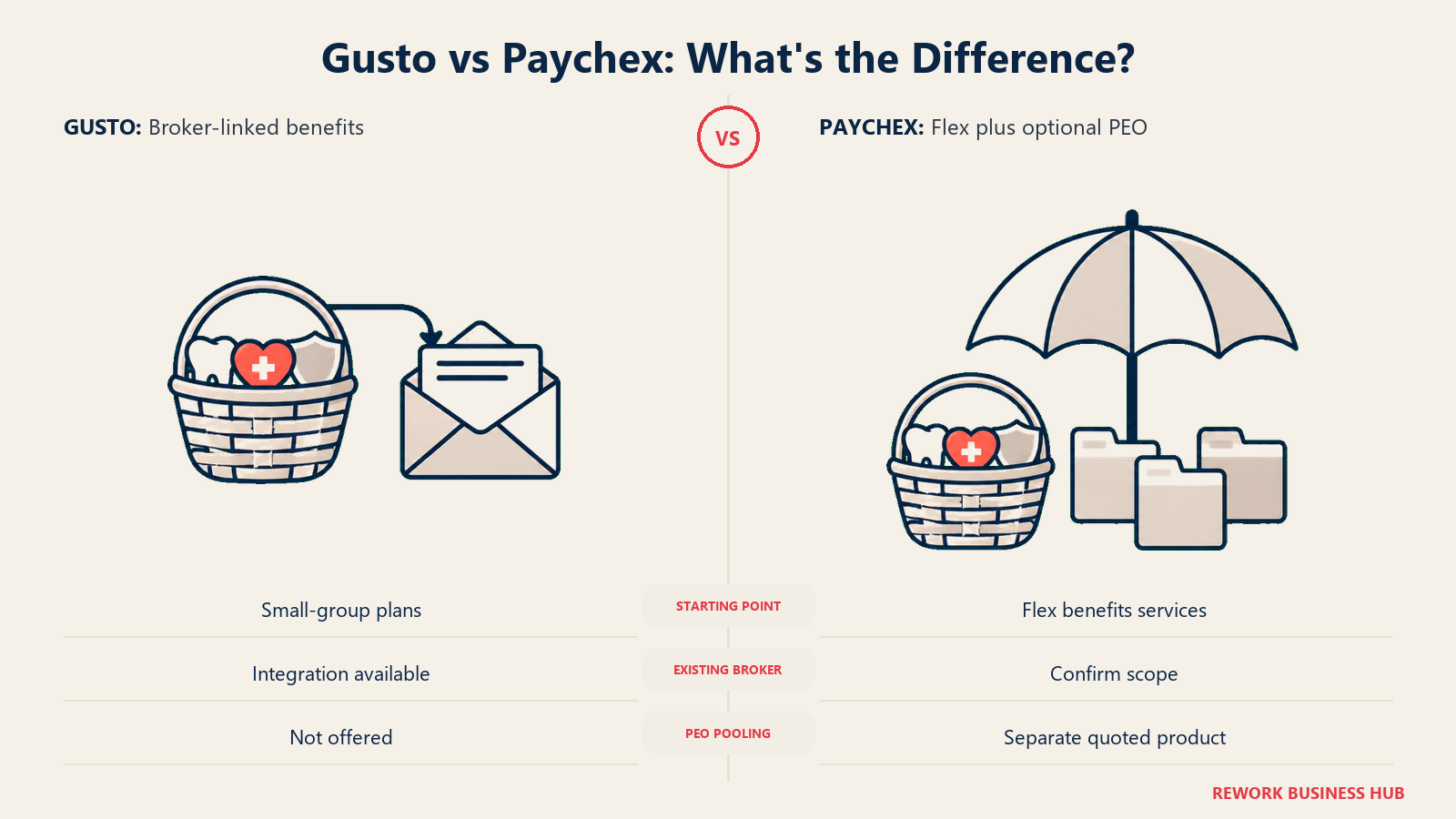
Gusto acts as a licensed health insurance broker in a defined set of states, where you shop and enroll employees in medical, dental, and vision plans from small-group carriers directly inside the dashboard, deductions flowing straight into payroll. Broker integration, keeping your existing broker and connecting their plans in, is free on Premium and $6 per employee a month on Plus. Coverage extends to life, disability, and HSAs/FSAs, sized around what a small-group carrier can offer.
Paychex's benefits story has two layers. Inside Flex, it offers group health insurance access and retirement plan administration, including 401(k) recordkeeping, a long-standing business line that predates most of its self-serve competitors. Where a company needs benefits leverage a small-group broker relationship can't match, Paychex PEO puts employees into co-employment and pools them into a much larger risk group for pricing, the same structural move ADP TotalSource makes. That's a materially different offer than Gusto's broker model, and it's quote-only from the first conversation.
| Capability | Gusto | Paychex |
|---|---|---|
| Licensed insurance broker built into the product | Yes, in Gusto-brokered states | Group health access available within Flex |
| 401(k) / retirement plan administration | Not a core focus | Yes, a long-standing Paychex service line |
| Large-group benefits pooling via co-employment | Not offered | Yes, via Paychex PEO (Paychex Oasis), quote only |
| Keep your existing broker | Yes, via broker integration | Available, scope set with your specialist |
| Broker integration cost | Included free on Premium, $6/employee/mo on Plus | Set in the quote |
Time Tracking
Time tracking looks universally included until you check which tier it actually sits on, for both vendors.
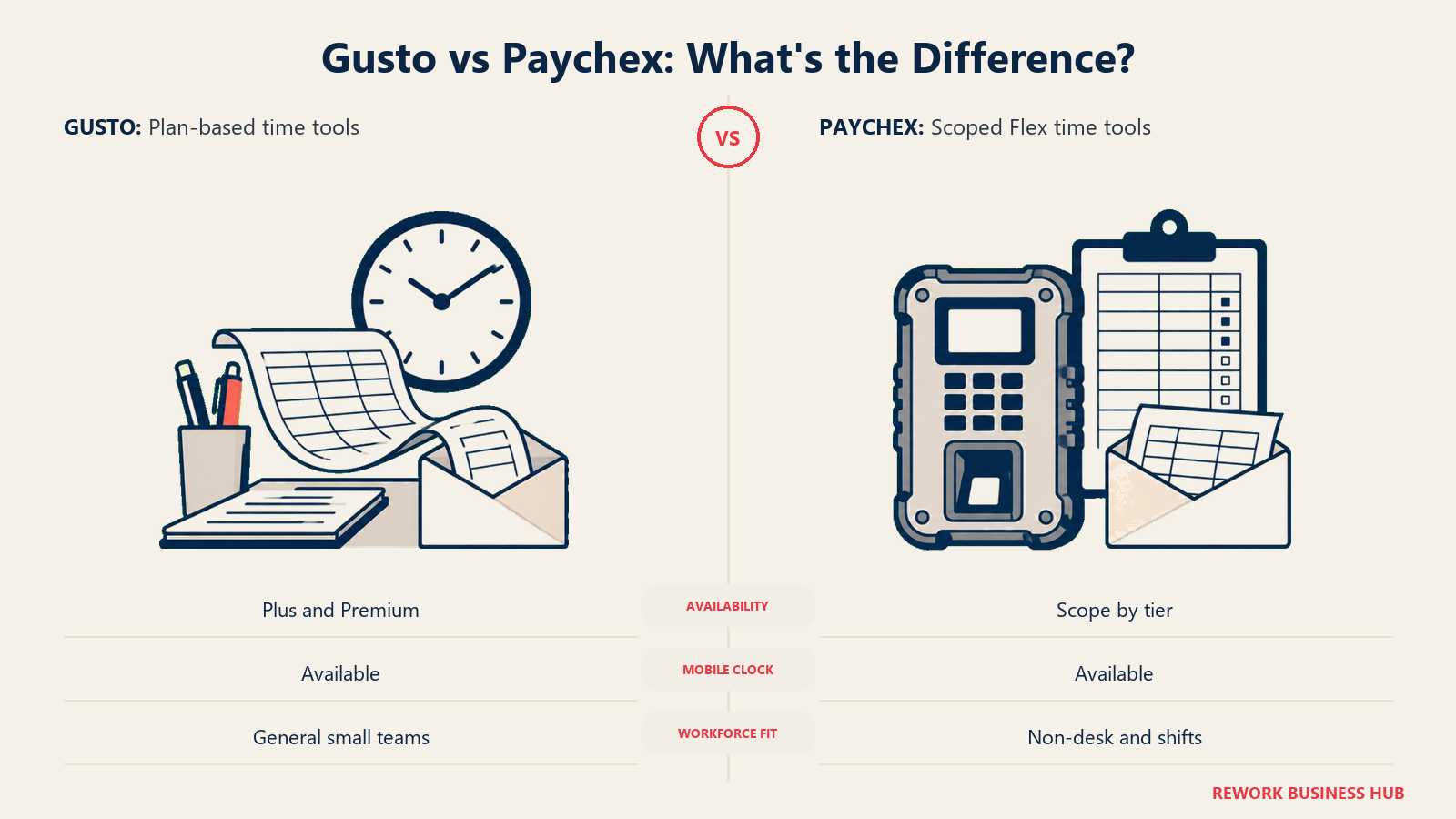
Gusto's time tracking, clock-in/out, timesheets, and PTO flowing straight into payroll calculations, is a Plus and Premium feature, the same gate as multi-state payroll. Simple doesn't include it, which pushes the real entry price for "payroll plus time tracking" to Plus's $80 base plus $12 a head, not Simple's $49 plus $6.
Paychex offers time and attendance as part of the Flex family, with the specific feature set and cost determined once a specialist scopes your account. Non-desk and shift-based workforces, construction crews, healthcare shifts, hospitality staff, are a genuine strength here, reflecting the breadth of industries Paychex already serves.
| Capability | Gusto | Paychex |
|---|---|---|
| Time tracking included | Plus and Premium only, not Simple | Available within Flex, scope and cost set by tier |
| PTO tracking | Included alongside time tracking on Plus and Premium | Included as part of the time and attendance offering |
| Mobile clock-in/out | Yes | Yes |
| Strength with shift-based, non-desk teams | Available, not a specialty | A recognized strength, common in construction, healthcare, and hospitality accounts |
| Extra cost above base payroll | Requires upgrading from Simple to Plus | Priced into the quote |
HR Features and Compliance
Gusto's HR layer is useful but intentionally lighter than a dedicated HRIS: onboarding checklists, offer letters, an employee directory, basic org chart tools, and, on Premium, certified HR experts and a dedicated service advisor.
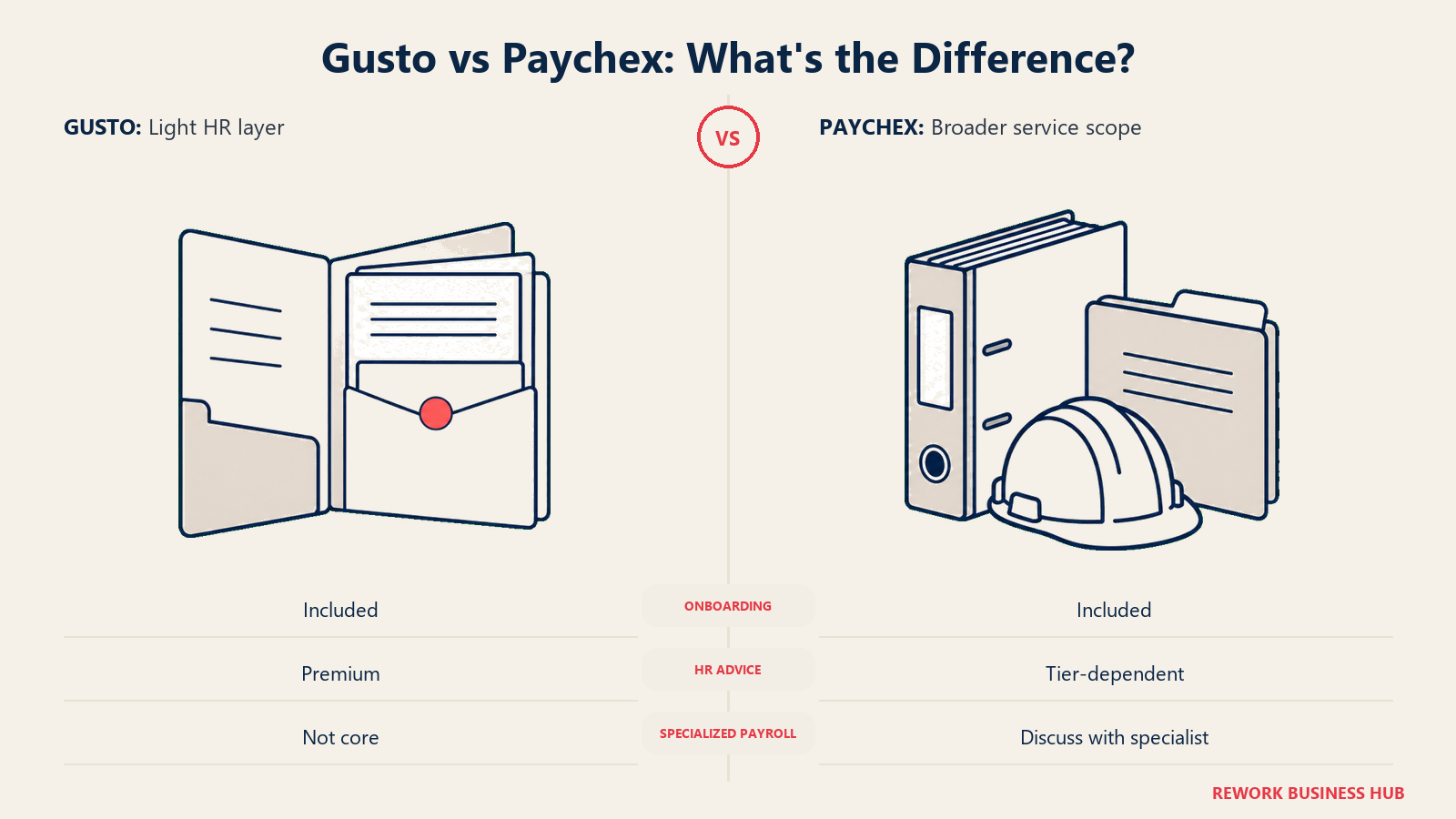
Paychex's HR and compliance tooling runs deeper across the Flex tiers, consistent with a company built to serve everything from a two-person shop to an enterprise account. Higher tiers layer in HR support, compliance monitoring, and workers' comp administration, and for employers doing government-contract or prevailing-wage work, certified payroll reporting is exactly the kind of specialized task that tends to require a Paychex specialist rather than a self-serve tool. That depth is why Paychex, not Gusto, keeps coming up for regulated or compliance-heavy hiring.
| Capability | Gusto | Paychex |
|---|---|---|
| Onboarding and offer letters | Included | Included |
| Employee handbook tools | Basic templates | Available within higher Flex tiers |
| HR help desk / certified HR access | Premium only | Available, tied to tier and account |
| Certified payroll for government contractors | Not a core feature | A realistic reason to move to a quoted Flex tier |
| Workers' comp administration | Not a core feature | Available, especially relevant for non-desk and regulated employers |
| Overall HR depth | Light, payroll-first | Deeper across the Flex tiers and PEO, priced by scope |
Reporting
Gusto ships pre-built payroll, tax, and workforce reports across all tiers, with Premium adding custom reports, straightforward and without a learning curve.
Paychex's reporting reflects the same breadth-over-decades story as its compliance tooling: standardized reports built for companies that need to answer to auditors, lenders, or a board, a genuine strength once an account moves into Select, Pro, or Enterprise. The specific report library and export options depend on which tier a specialist puts you in.
| Capability | Gusto | Paychex |
|---|---|---|
| Pre-built payroll and tax reports | Yes, all tiers | Yes, across Flex |
| Custom report builder | Premium only | Available, more robust at higher tiers |
| Headcount and labor cost reporting | Yes | Yes, with deeper cross-location rollups at scale |
| Audit-ready compliance reporting | Basic | A recognized strength, backed by decades of processing history |
Integrations and Accounting Sync
Gusto's accounting sync is clean and specific: native integrations with QuickBooks Online, Xero, and FreshBooks push payroll journal entries into your books after every run. Its App Directory adds time tracking (When I Work, Deputy, Homebase), Expensify, hiring tools (Greenhouse, JazzHR), retirement via Guideline, plus Zapier and an API.
Paychex maintains its own marketplace of integrations spanning accounting, time and attendance, and point-of-sale systems, reflecting the range of industries it serves. Named accounting connections are available, but the exact list and depth is worth confirming with your specialist rather than assuming parity with a self-serve tool's published list.
| Capability | Gusto | Paychex |
|---|---|---|
| QuickBooks Online sync | Native, automatic journal entries per run | Available via Paychex's integration marketplace |
| Xero sync | Native | Available, confirm current scope with your rep |
| FreshBooks sync | Native | Not a named core integration |
| Time tracking integrations | When I Work, Deputy, Homebase, QuickBooks Time | Available, including Paychex's own time and attendance modules |
| Marketplace breadth | Focused App Directory | Broader marketplace across accounting, time, and POS |
| Open API for custom builds | Yes | Available, scope set by tier |
Implementation Time
Gusto is designed to get a first payroll run out the door in days, not weeks. Since pricing and features are visible upfront, most setup time is data entry, employees, tax IDs, bank details, rather than a scoping or sales cycle. A small company with clean records can be running payroll inside a week.
Paychex's timeline scales with which Flex tier and which specialist-scoped services you land in. Since every tier, including Essentials, starts with a quote rather than a checkout page, onboarding begins with a sales conversation regardless of size, but a small, straightforward Essentials-range account tends to move through that process faster than one heading into Select, Pro, Enterprise, or a PEO transition, where there's genuinely more being configured, more compliance to verify, and, for a PEO move, a co-employment relationship to set up correctly.
| Stage | Gusto | Paychex |
|---|---|---|
| Time to first payroll run (small team, clean data) | Days | Faster once quoted for a small Essentials-range account; longer for Select, Pro, Enterprise, or a PEO transition |
| Sales/quote cycle before setup starts | None, sign up directly | Required at every tier, including Essentials, since none of them are self-checkout |
| Dedicated implementation contact | Not a named service | Yes, tied to the payroll specialist assigned to your account |
| Mid-year provider switch support | Self-serve guidance and support | Structured migration support, especially for PEO and larger Flex tiers |
Support and Onboarding
Gusto's support scales with plan tier: every plan gets a 24/7 help center plus phone and chat during business hours, with Plus and Premium getting two extra daily hours, and Premium adding a dedicated service advisor, certified HR experts, priority support, and migration help.
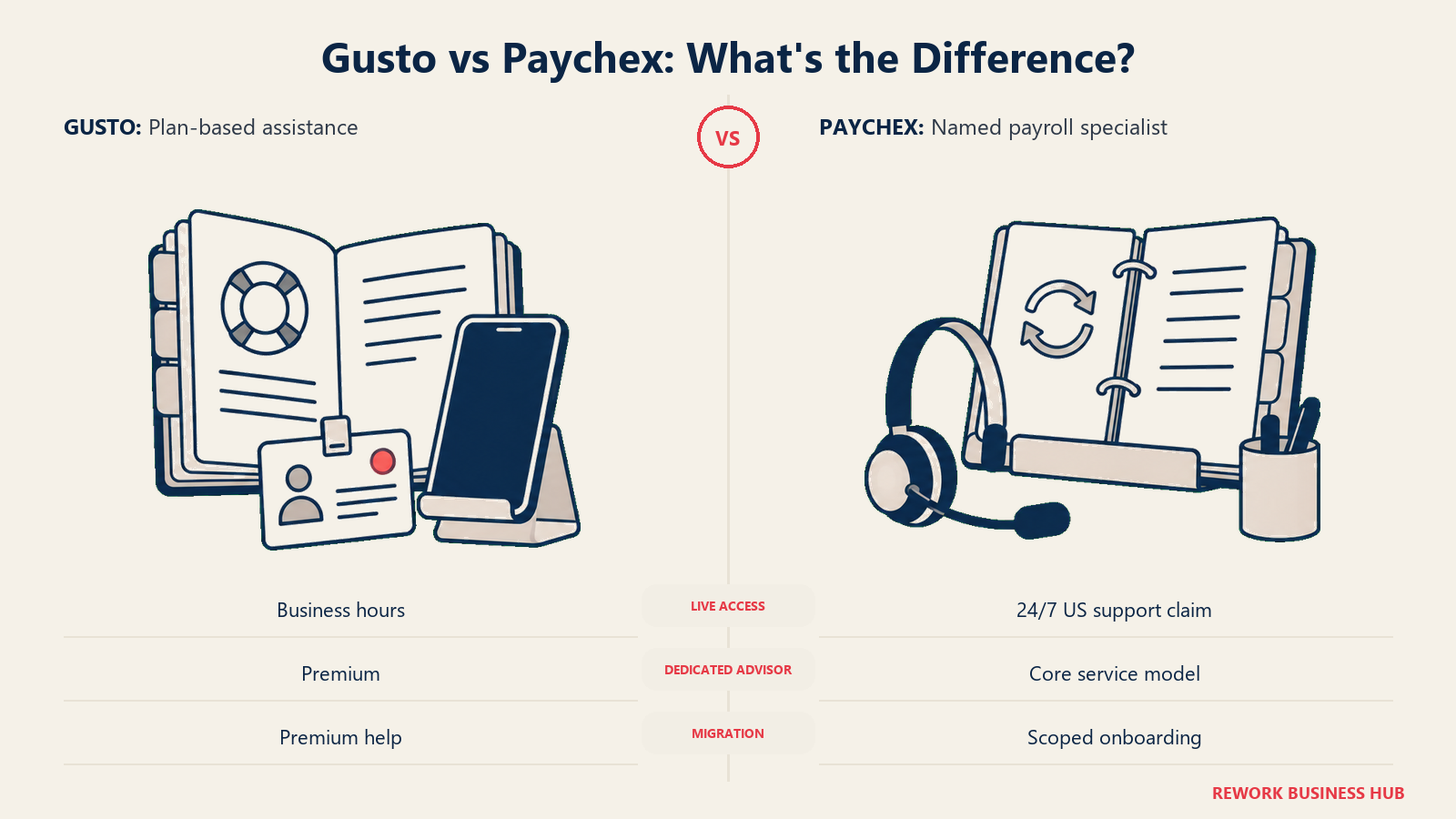
Paychex leans on people as its core differentiator: a dedicated payroll specialist assigned to your account, plus 24/7 US-based support. That "a person who knows your account picks up the phone" model is a big part of why companies with real compliance exposure, or teams running shifts around the clock, choose Paychex over a purely self-serve tool. The tradeoff runs through this whole comparison: that specialist relationship is priced through a quote, not a rate card.
| Capability | Gusto | Paychex |
|---|---|---|
| 24/7 help center | Yes, all tiers | Yes, 24/7 US-based support |
| Live phone support | Business hours, extended on Plus/Premium | Included, positioned as a core Paychex strength |
| Dedicated account rep or specialist | Premium only | Standard across Paychex's support model |
| Migration help moving from another provider | Included on Premium | Structured, part of onboarding for Select, Pro, Enterprise, and PEO |
Scaling Path: Where a Buyer Actually Outgrows Gusto
Read this section slowly if you're deciding not just which tool fits today, but which one you won't be replacing in eighteen months.
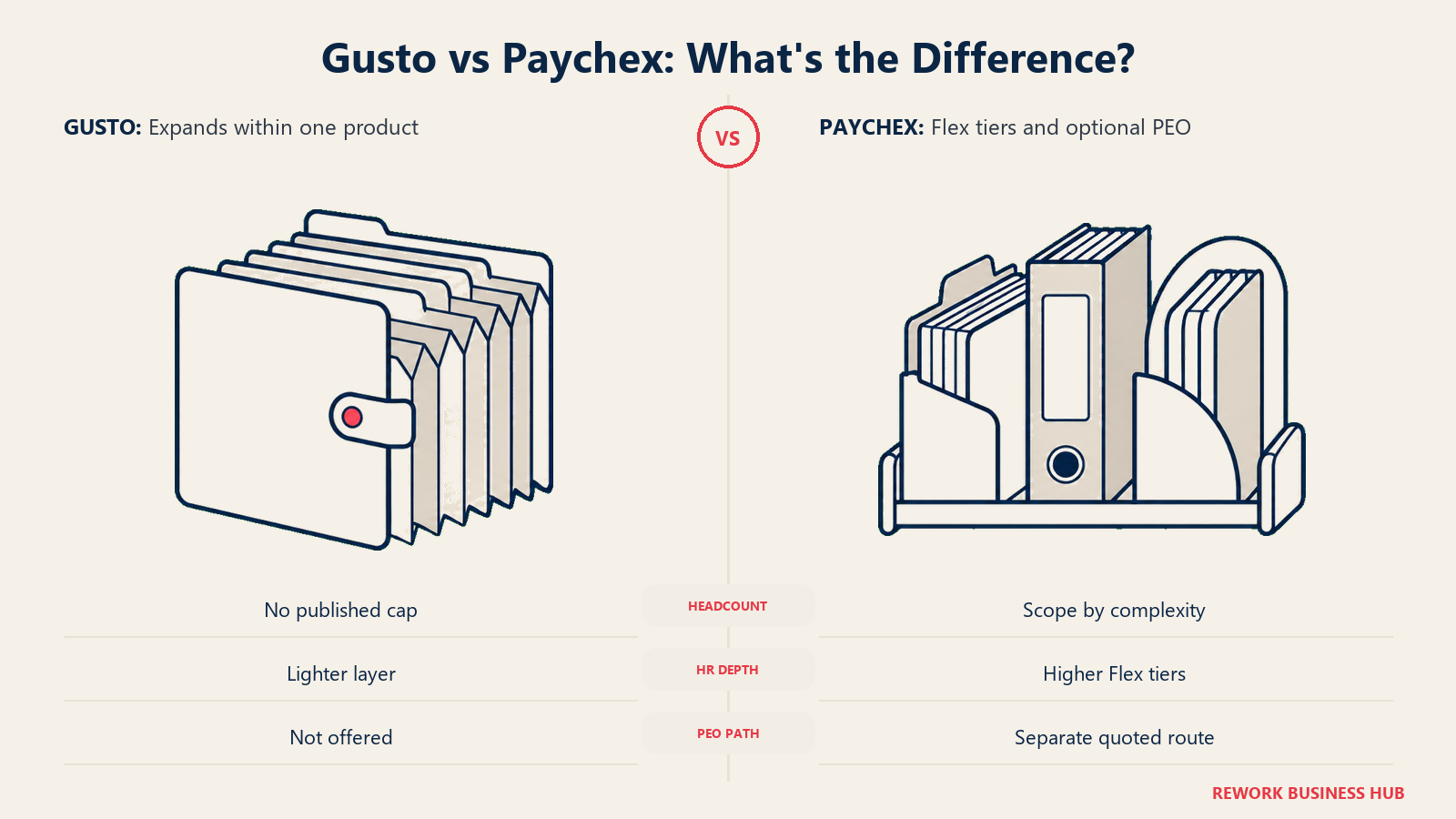
Gusto has no published employee cap, and companies well past 100 employees do run on it, but the product is built around small-business simplicity: one self-serve platform, four tiers, a light HR layer, and a broker model for benefits. The ceiling shows up in recognizable moments: a government contract requiring certified payroll reporting, a multi-state footprint complicated enough that you want a specialist double-checking it, a 401(k) program you want actively administered, or a benefits need big enough that a small-group broker relationship can't get you competitive rates anymore.
Paychex is built to absorb a company at exactly that point, inside one platform family instead of forcing a full product switch. Flex Essentials, reported, not published, around $39 plus $5 per employee, is positioned for teams under roughly 20 employees with straightforward needs, close in spirit to Gusto Simple or Plus. Cross that threshold, or hit one of the complexity triggers above, and Paychex moves you into Select, then Pro, then Enterprise, each a quoted conversation with no public figure to begin with. If the need is bigger than software, Paychex PEO (Paychex Oasis) puts employees into co-employment, unlocking the larger benefits pool a growing company often wants, priced entirely through a quote.
| Product | Positioned for | What it is | Pricing model |
|---|---|---|---|
| Gusto (Simple/Plus/Premium) | No published cap, built for small business | Single self-serve payroll and light HR platform | Published rates on Simple and Plus; Premium quoted (reported ~$180/mo + $22/employee/mo) |
| Paychex Flex Essentials | Under roughly 20 employees, per third-party trackers | Entry-level self-contained payroll | Not published; reported ~$39/mo + $5/employee/mo |
| Paychex Flex Select / Pro | Growing teams past Essentials | Added HR depth, compliance tooling, and specialist support | Quote only, no reliable public figure |
| Paychex Flex Enterprise | Large, complex accounts | Full Flex platform depth for bigger, more complex organizations | Quote only, no reliable public figure |
| Paychex PEO (Paychex Oasis) | Not headcount-gated | Co-employment PEO, employer benefits pooling and risk transfer | Quote only, no reliable public figure |
If your growth plan is "keep adding people to the same simple product," Gusto absorbs a good chunk of that on its own. If it involves certified payroll, a specialist you'd rather not hire in-house, or benefits leverage a broker model can't deliver, that's the handoff point Paychex's tier ladder is built for. A PEO isn't the only route there either. Our roundup of the best PEO services for small business puts Paychex PEO against Justworks, TriNet, and the rest of the field, and our best Paychex alternatives guide covers the full field if neither name here ends up being the fit.
Contractor Payments
Both companies pay 1099 contractors alongside W-2 employees rather than forcing a separate tool, but Gusto is more explicit about pricing that slice of the workforce.
Gusto includes contractor payments and year-end 1099-NEC filing in Simple, Plus, and Premium, so a mixed workforce doesn't need a second product. It also sells a Contractor Only plan, $35 a month base plus $6 per contractor, for companies with no W-2 employees.
Paychex handles contractor payments as part of its broader Flex platform rather than as a standalone feature, folded into whichever tier a specialist quotes you into, with 1099 filing handled the same way as W-2 tax filing.
| Capability | Gusto | Paychex |
|---|---|---|
| Pay 1099 contractors alongside W-2 employees | Yes, included on Simple, Plus, and Premium | Yes, included within Flex |
| Year-end 1099-NEC filing | Included | Included |
| Contractor-only plan available | Yes, $35/mo + $6/contractor/mo | Not positioned as a standalone contractor-only product |
| International contractor payments | Not a core feature | Not a core Flex feature |
Cost at 5, 25, 50 and 100 Employees
Gusto's published rates let you build a real, vendor-confirmed number for Simple or Plus at any headcount in seconds. Paychex never publishes a number at any size; the closest you get is a third-party reported figure for Flex Essentials, and only up to the roughly 20-employee range that tier is reported to cover. Past that, the honest answer is a quote, not a number. The table runs the Gusto math on Simple and Plus, shows the reported Essentials calculation at 5 employees labeled as such, and marks every cell past that reported range as quote-only rather than stretching an unconfirmed formula somewhere Paychex doesn't sell it. All figures are platform fees only, none include wages, employer payroll taxes, or benefits premiums.
| Employees | Gusto Simple ($49 + $6/person, vendor-published) | Gusto Plus ($80 + $12/person, vendor-published) | Paychex Flex Essentials ($39 + $5/person, reported, unverified by Paychex) | Paychex Flex Select / Pro / Enterprise |
|---|---|---|---|---|
| 5 | $79/mo | $140/mo | $64/mo (reported) | Not typically needed at this size |
| 25 | $199/mo | $380/mo | Past the reported ~20-employee range for Essentials | Quote required, no reliable public figure |
| 50 | $349/mo | $680/mo | Past the reported ~20-employee range for Essentials | Quote required, no reliable public figure |
| 100 | $649/mo | $1,280/mo | Past the reported ~20-employee range for Essentials | Quote required, no reliable public figure |
Two things stand out. At 5 employees, the reported Paychex Essentials figure of $64 a month undercuts Gusto Simple's vendor-confirmed $79, worth knowing for a very small, single-state team, though it's still an unconfirmed number rather than a rate Paychex stands behind. Cross roughly 20 employees, add a second state, or need HR depth beyond the basics, and the Paychex side stops being a number you can compute at all and becomes a call, while Gusto keeps giving you a real, vendor-confirmed figure on Simple and Plus at every row.
Who Should Pick Gusto
- You want to see the actual price before talking to anyone, at every tier except the very top
- You're a single-entity US business, comfortable running payroll directly inside a self-serve product
- Your team is under roughly 100 to 150 employees and HR needs are still light
- You want payroll, basic benefits brokering, and light HR in one place, no stitching vendors together
- You're fine paying more for Plus once you need multi-state payroll or time tracking, since that gate is disclosed upfront
Who Should Pick Paychex
- You want a named payroll specialist as part of the deal, not just software, and you're past the size where that seems like overkill
- You're doing certified payroll for government or prevailing-wage contracts, or carry compliance exposure that benefits from a specialist's eyes
- You're past the roughly 20-employee range third-party trackers associate with Essentials, where a quoted Select or Pro conversation is the realistic path
- You want a 401(k) program administered by the same vendor running your payroll, or benefits leverage a small-group broker can't match
- You're comfortable trading price transparency for a quoted relationship with decades of tax-filing history behind it
Decision Framework
| If you are... | Pick |
|---|---|
| Under about 20 employees and want a number you can act on today | Gusto (Simple, vendor-published); treat any Paychex Essentials figure as a reported estimate, not a quote |
| Comfortable running payroll yourself inside a clean self-serve product | Gusto |
| Doing certified payroll for government contracts or prevailing-wage work | Paychex |
| Past roughly 20 to 50 employees and want a named specialist managing complexity | Paychex (Select or Pro) |
| Wanting a 401(k) program and benefits depth a broker model can't match | Paychex, including a look at Paychex PEO |
| Prioritizing price transparency you can budget against without a call | Gusto |
| Still comparing the wider category before narrowing down | See our full payroll software roundup |
The verdict: at a small, single-state headcount, this is genuinely close, close enough that Paychex Flex Essentials' reported $39 plus $5 a head can beat Gusto Simple's vendor-confirmed price, if that reported figure holds for your account. Past that size, or the moment certified payroll, deeper multi-state work, or serious 401(k) and benefits administration enters the picture, the two companies stop being comparable on price at all. Gusto keeps giving you a real number on two of its tiers. Paychex gives you a specialist and a quote request at every tier, and for a lot of growing companies, that trade is exactly what they're looking for.
What to Do Next
- Check your headcount against the roughly 20-employee range third-party trackers associate with Flex Essentials. Under that line, compare Gusto Simple's vendor-published $79 at 5 employees against Paychex Essentials' reported $64, keeping in mind only one of those numbers is confirmed. Above that range, you're pricing a quote, not a rate card, on the Paychex side.
- List out any certified payroll, multi-state, or 401(k) needs before you call anyone. These are the triggers that tend to push a Paychex conversation into Select or Pro rather than Essentials, and Gusto's Premium tier is the equivalent trigger on that side.
- Request a real Paychex quote instead of relying on a third-party estimate, so you're comparing an actual number against Gusto's published rate, not a reported figure that may already be stale.
- Run a real payroll cycle in Gusto's trial before signing with either vendor. The biggest practical difference here is how much you configure yourself versus how much a specialist configures for you, and that's easier to feel than to read about.
- Not sure payroll is the whole gap? Gusto vs ADP covers the other consultative-pricing incumbent, our best Paychex alternatives roundup covers 12 platforms including both names here, and our guide to choosing payroll software is worth reading if you're still defining the requirements list. If what you actually want is one flat published number with no tier to climb, our best OnPay alternatives roundup starts from that premise.
Frequently Asked Questions about Gusto vs Paychex
Is Gusto or Paychex cheaper?
It depends on your headcount, and one side of this comparison is more certain than the other. At a small, single-state team, a commonly reported Paychex Flex Essentials figure of $39 plus $5 per employee would be cheaper than Gusto Simple's vendor-confirmed $49 plus $6, but that Paychex number is a third-party estimate, not something Paychex publishes. Past roughly 20 employees, the comparison breaks down entirely because Paychex has no published pricing at any tier, so there's no confirmed number to compare against Gusto's published Plus rate or quoted Premium tier.
Why doesn't Paychex publish any pricing?
Paychex doesn't publish a rate card for any Flex tier, including entry-level Essentials. A figure commonly reported by third-party trackers puts Essentials around $39 plus $5 per employee for teams under roughly 20 employees, but that number comes from independent sources, not Paychex. Select, Pro, Enterprise, and Paychex PEO are priced by a specialist based on headcount, state footprint, industry, and the services you need, so no single rate card could represent all of them accurately.
At what point does a company typically outgrow Gusto for Paychex?
The common triggers are certified payroll reporting for government or prevailing-wage contracts, multi-state complexity beyond what a self-serve tool handles comfortably, wanting a 401(k) program actively administered rather than bolted on, or needing benefits leverage a small-group broker relationship can't provide. Any one is a reasonable reason to get a Paychex quote even if headcount alone hasn't crossed 20 employees yet.
Does Gusto include multi-state payroll and time tracking on every plan?
No. Both are Plus and Premium features, confirmed on Gusto's own pricing page. Simple, at $49 a month plus $6 per person, is single-state only and doesn't include time tracking.
What is Paychex PEO, and how is it different from Paychex Flex?
Paychex PEO, branded Paychex Oasis, is Paychex's professional employer organization product. Your employees enter a co-employment arrangement with Paychex, which can unlock a larger benefits risk pool than a standalone small business typically qualifies for. It's a separate, quote-only product from Flex, similar in structure to how ADP TotalSource sits apart from ADP RUN.
Can I get a real Paychex price without talking to a specialist?
No. Paychex doesn't publish a rate card for any tier, including Flex Essentials; every real number comes from a quote request or a call. Gusto, by comparison, publishes real numbers for three of its four tiers, Simple, Plus, and Contractor Only, and only quotes its Premium tier.
Which is better for a company doing government contract or certified payroll work?
Paychex. Certified payroll reporting for prevailing-wage government contracts is the kind of specialized compliance work that tends to require a Paychex specialist rather than a self-serve tool built for general small business payroll. It's a reasonable trigger to get a quote even at a headcount where Essentials might otherwise look sufficient.
Related Resources:
- Gusto vs ADP: Which Payroll Software Fits Your Business
- Best Paychex Alternatives in 2026
- Best Payroll Software for Small Business in 2026
- Best PEO Services for Small Business in 2026
- Best Justworks Alternatives in 2026
- Best Gusto Alternatives in 2026
- Best HR Software in 2026
- How to Choose Payroll Software
- AI Payroll Agent Overview

Principal Product Marketing Strategist
On this page
- TL;DR
- Who Each Tool Is Built For
- Key Facts
- Pricing Transparency: What Each Company Actually Publishes
- Payroll Mechanics and Tax Filing
- Multi-State Payroll
- Benefits Administration
- Time Tracking
- HR Features and Compliance
- Reporting
- Integrations and Accounting Sync
- Implementation Time
- Support and Onboarding
- Scaling Path: Where a Buyer Actually Outgrows Gusto
- Contractor Payments
- Cost at 5, 25, 50 and 100 Employees
- Who Should Pick Gusto
- Who Should Pick Paychex
- Decision Framework
- What to Do Next