Best Cin7 Alternatives in 2026: 12 Inventory Platforms Compared
Turn this article into takeaways for your work.


Each assistant summarizes the article only for you and suggests best practices for your work.
If you run Cin7 Core and the bill has outgrown your order volume, Katana, Zoho Inventory and inFlow are the three most common landing spots; if you run Cin7 Omni, the honest replacements are Linnworks, Brightpearl by Sage or NetSuite, and Rework (at #6 here) fits mid-size teams that would rather keep stock, orders, invoices and the customer record on one platform than stitch four tools together with integrations. That split matters more than any feature table, because Cin7 sells two different products under one name, and most alternatives lists quietly treat them as one.
This guide compares 12 platforms on pricing fetched from vendor pages this month, on which Cin7 product each one actually replaces, and on the order volume and user counts you get before the price moves. Anything a vendor doesn't publish is labeled No published price rather than filled in with a guess. For the category view, see Best Inventory Management Software in 2026, and for the closest head-to-head, Cin7 vs Katana.
Key Facts
- Inventory distortion, the combined cost of out-of-stocks and overstocks, runs about $1.7 trillion a year worldwide, equal to roughly 6.2% of global retail sales, with out-of-stocks at $1.2 trillion and overstocks at $554 billion. (IHL Group, 2026 Inventory Distortion Study)
- Shoppers sent back $849.9 billion of merchandise in 2025, and an estimated 19.3% of online sales get returned, which lands back in inventory as restock, refurb or write-off. (NRF and Happy Returns, 2025 Retail Returns Landscape)
- 73% of warehouse decision makers have accelerated or plan to accelerate modernization projects, and 69% have automated or plan to automate workflows. (Zebra Warehousing Vision Study)
- Cin7 renamed its product line on January 9, 2023: DEAR Systems became Cin7 Core, and the original Cin7 product became Cin7 Omni. They are still two separate platforms with separate pricing models. (Cin7 newsroom)
- Descartes Systems Group acquired Finale Inventory on August 4, 2025 for about $40 million up front, plus up to $15 million tied to revenue targets in the first two years. (Descartes)
What Cin7 Does Well, and Why Teams Shop Anyway
Most comparison articles get this wrong: Cin7 sells two products, not one.
Cin7 Core is the former DEAR Systems: an SMB and mid-market inventory, order and light-manufacturing platform with published pricing and a self-serve trial. Cin7 Omni is the original Cin7: a larger multi-channel retail operations platform sold on a quote, aimed at brands running EDI, 3PL and wholesale alongside their own channels. A third product, Cin7 Orderhive, is gone. Cin7 acquired it in February 2021, announced the discontinuation on April 18, 2023, and took it out of service on March 31, 2024. If you were an Orderhive user who got migrated rather than choosing, you're a large slice of the people reading this page.
| Cin7 product | What it is | Published price | Included users | Sales order volume |
|---|---|---|---|---|
| Cin7 Core (formerly DEAR Systems) | SMB and mid-market inventory, orders, light manufacturing | Standard $349/mo, Pro $599/mo, Advanced $1,199/mo | 5 / 10 / 15 | 6,000 / 24,000 / 120,000 per year |
| Cin7 Omni (formerly Cin7) | Multi-channel retail operations, EDI, 3PL, wholesale | Quote on request, nothing published | 8 | Described as flexible, no figure published |
| Cin7 Orderhive | Discontinued | None. Out of service since March 31, 2024 | n/a | n/a |
Cin7 earns its position honestly. The integration catalog is one of the widest in the category, covering marketplaces, carts, 3PLs, EDI partners and carriers, so a brand selling across five channels can usually connect everything without custom work. Accounting depth is strong too: two-way Xero and QuickBooks sync, landed cost, multi-currency and proper COGS handling, which is why finance teams tend to like it more than operations teams do. And the volume headroom is real, since Cin7 Core Advanced allows 120,000 sales orders a year, a ceiling most tools here never reach without a custom contract.
So why do teams shop?
Cost at small scale. Cin7 Core starts at $349 a month for 5 users and 6,000 orders a year, roughly 500 orders a month. A seller doing 400 orders a month is paying Cin7 Core prices for volume Zoho Inventory covers at $29 a month billed annually. And flag this precisely: Cin7's pricing page prints a monthly figure but does not disclose whether it is billed monthly or annually, publishes no annual discount, and publishes no extra-user rate. Extra users are described as available for purchase, without a price. Budget for a quote, not a calculation.
Implementation effort. Core is not a weekend setup. Landed cost rules, BOMs, multi-warehouse and channel mapping all need decisions made up front, and a bad configuration is painful to unwind six months later. Many buyers end up paying an implementation partner, a line item nobody quotes you during the trial.
Support experience. This is the most common complaint in Cin7 review threads, and it bites hardest during migration, exactly when a growing seller can least afford it. It isn't universal, and enterprise Omni accounts report a different experience than self-serve Core accounts do, but it comes up often enough to belong here.
Quick Comparison Table
Every price below names the specific product it belongs to. More than one vendor here sells two, and a figure attached to the wrong one is how a comparison table goes quietly wrong.
The names deserve a note of their own, because this category has consolidated hard. Cin7 Core was DEAR Systems, Brightpearl is now Brightpearl by Sage, SkuVault is now SkuVault Core inside the Linnworks portfolio, Unleashed is owned by The Access Group, Descartes Finale was Finale Inventory, and Cin7 Orderhive was shut down outright. Picking a vendor here in 2026 means picking an owner as much as a product.
| Tool | Best For | Starting Price | Key Strength | Key Limitation |
|---|---|---|---|---|
| Katana | Small manufacturers replacing Cin7 Core's light BOM tools | Katana Free; Katana Core from $299/mo (usage-based, monthly or annual) | Live production planning and shop-floor visibility | Routings and manufacturing insights are a $199/mo add-on, near $498/mo together |
| Zoho Inventory | Sellers whose Cin7 Core bill outruns their order volume | Zoho Inventory Free; Standard $29/mo billed annually (500 orders/mo) | Cheapest serious multi-channel option here | Order caps per tier, and depth trails Cin7 Core |
| inFlow Inventory | Teams wanting flat-rate pricing and a real warehouse app | inFlow Inventory $129/mo billed annually ($161/mo billed monthly) | Flat rate, not per seat, with strong barcode workflows | $0.20 per order over the plan allowance |
| Unleashed | Wholesalers and light manufacturers needing real costing | Unleashed Core $399/mo billed monthly, or $4,389/yr annual | Perpetual costing and margin reporting done properly | Only 100 sales orders a month included on both tiers |
| Fishbowl Inventory | Warehouse and manufacturing depth, cloud or self-managed | Fishbowl Inventory Essentials $229/mo billed annually | Deep WMS and MRP, plus a QuickBooks heritage | Manufacturing sits in a separate, pricier product line |
| Rework | Stock, orders, invoices and the customer on one platform | Quote on request | One record from lead to invoice, plus a unified inbox | Not a manufacturing MRP and not an Omni-depth retail ops platform |
| Linnworks (and SkuVault Core) | Cin7 Omni users running high-volume multi-channel retail | No published price, quoted on monthly order volume | Channel and listing management at Omni scale | Quote-only, plus a one-time onboarding fee |
| Brightpearl by Sage | Retail brands that want automation built in | No published price, quoted per business | Automation engine, unlimited users at no extra cost | No self-serve entry point at all |
| Oracle NetSuite | Companies that have outgrown inventory software entirely | No published price, quoted annually | Full ERP with finance, inventory and demand planning | Cost and implementation timeline of an ERP project |
| Descartes Finale (formerly Finale Inventory) | High-volume ecommerce sellers needing fast, accurate counts | Descartes Finale Essentials from $499/mo | Built for multi-channel ecommerce velocity | User and order limits per tier are not published |
| Odoo Inventory | Budget-first teams willing to configure their own stack | Free for one app, unlimited users; Odoo Standard from $7.25/user/mo billed yearly, $7.79/user/mo at the regular yearly rate | Genuinely free as a first app, with a huge module library | The second app switches you to per-user pricing |
| Extensiv | 3PLs and brands running distributed fulfillment | No published price, quoted per operation | Multi-warehouse and 3PL network depth | Overkill unless you run or use multiple warehouses |
1. Katana: Cloud MRP for Makers, No Longer the Cheap One
Katana is the alternative most Cin7 Core users hear about first, and for a reason: it does properly what Core does adequately, which is making things rather than just moving them. Live inventory updates as production orders consume raw materials, a visual planner showing what can actually be built from stock on hand, and a shop-floor app operators will use without a training program. If you're leaving Cin7 Core because its BOM and assembly tools feel bolted on, Katana is the honest upgrade.
One thing will surprise you if you last looked two years ago. Katana is no longer the cheap MRP. Its pricing page lists Free at $0 (30 SKUs, unlimited users), Core starting at $299/month, and Advantage on a custom annual contract. Manufacturing Management is a separate $199/month add-on that, in Katana's own wording, gives you "manufacturing routings, and manufacturing insights": production-step sequencing plus cost and usage analysis. So budget nearer $498/month for a full production-planning setup, before Traceability ($249/mo) or Warehouse Management ($149/mo). Core is usage-based too, billed on the sales orders, locations and add-ons you actually use, so $299 is a floor rather than a price.
| What you get | What you don't |
|---|---|
| Real production planning, not assembly as an afterthought | Routings and manufacturing insights inside the base price |
| Unlimited users on every tier, including Free | A predictable flat bill, since Core is usage-based |
| A shop-floor app operators will actually use | Cin7 Core's breadth of accounting and channel integrations |
| A free tier that is genuinely usable up to 30 SKUs | The budget reputation it earned three years ago |
Pricing: Katana Free $0 (30 SKUs); Katana Core from $299/mo, usage-based, monthly or annual; Advantage custom annual. Manufacturing Management (routings and insights) is a separate $199/mo add-on, so a full production-planning setup lands near $498/mo. Best for: Small and mid-size manufacturers (roughly 5 to 50 people) who need genuine production control and are past the point where Cin7 Core's light manufacturing module is enough. Not ideal for: Pure resellers with no production at all, who would be paying MRP prices for a stock ledger. If Katana is already your incumbent rather than your target, read Best Katana Alternatives.
2. Zoho Inventory: The Cheapest Serious Multi-Channel Option
Zoho Inventory answers the most common Cin7 Core complaint: the bill is sized for volume you don't have yet. Cin7 Core Standard is $349/month for 6,000 orders a year. Zoho Inventory Standard is $29/month billed annually for 500 orders a month, the same 6,000 a year at roughly a twelfth of the price. For a seller under a few hundred orders a month, that gap is the whole argument.
Zoho publishes the full ladder and states the figures are billed annually: Free $0 (50 orders a month, 1 user, 1 location), Standard $29/mo (500 orders, 3 users, 2 locations), Premium $79/mo (3,000 orders, 5 users, 4 locations), Plus $129/mo (7,500 orders, 10 users, 6 locations) and Enterprise $249/mo (15,000 orders, 10 users, 10 locations). One quirk to know before you quote a tier at anyone: Zoho serves more than one regional pricing page, and the tier names and included-user counts differ between them even though the dollar figures match. The numbers above are the US page, so compare on price and order cap rather than tier name. The real trade-off is depth. Zoho handles multi-channel selling, warehouses, serial and batch tracking and shipping well, but it doesn't match Cin7 Core on landed-cost sophistication or on the count of native EDI and 3PL connectors.
| What you get | What you don't |
|---|---|
| A published price roughly a twelfth of Cin7 Core's entry | Cin7 Core's depth on landed cost and assembly |
| A free tier and a clear per-tier order ladder | Unlimited orders at any price point |
| The wider Zoho suite (Books, CRM, Commerce) alongside it | The breadth of Cin7's native EDI and 3PL catalog |
| Cheap itemized add-ons instead of a forced tier jump | A single flat bill that ignores order volume |
Pricing: Zoho Inventory Free $0; Standard $29/mo through Enterprise $249/mo, all billed annually. Extra user $7.50/mo, 500 extra orders $7.50/mo, extra location $10/mo. Best for: Growing ecommerce and wholesale sellers under roughly 7,500 orders a month who want multi-channel inventory without an enterprise-shaped bill, especially teams already on Zoho Books or Zoho CRM. Not ideal for: Brands whose whole reason for running Cin7 Core is its landed-cost and EDI depth. For the reverse view, see Best Zoho Inventory Alternatives.
3. inFlow Inventory: Flat-Rate Pricing and a Warehouse App That Works
inFlow lands squarely on Cin7 Core's soft spot: pricing that doesn't punish you for adding people. It charges a flat rate per plan rather than per seat, includes a set number of team members, and bundles one of the better barcode and warehouse apps in this price band. For a team of 5 to 10 running pick, pack and receiving on scanners, inFlow feels less abstract than Cin7 Core on day one.
inFlow publishes both billing cycles, and the distinction matters more here than anywhere else on this list. inFlow Inventory Entrepreneur is $161/month billed monthly or $1,548/year billed annually, which works out to $129/month; Small Business is $436/month or $4,188/year ($349/month); Mid-Size is $874/month or $8,388/year ($699/month); Enterprise is quoted. Annual billing saves 20%. Entrepreneur gets 2 team members, 1,200 orders a year and 1 integration; Small Business 5 members, 12,000 orders and 3 integrations; Mid-Size 10 members, unlimited orders and 5 integrations. Orders above the allowance cost $0.20 each. Onboarding is $499, optional on inFlow Inventory plans and required on inFlow Manufacturing.
| What you get | What you don't |
|---|---|
| Flat plan pricing instead of a per-seat meter | Unlimited orders below the Mid-Size tier |
| A barcode and warehouse app teams actually adopt | Cin7 Core's integration count at the same price |
| Published monthly and annual figures, no sales call | Manufacturing inside the same subscription |
| A 20% annual discount stated on the page | A free tier of any kind |
Pricing: inFlow Inventory $129/mo billed annually ($1,548/yr) or $161/mo billed monthly at Entrepreneur, up to $699/mo annually at Mid-Size; Enterprise quoted. Overage $0.20 per extra order. Onboarding $499, optional on Inventory plans and required on Manufacturing. inFlow Manufacturing is a separate product from $179/mo billed annually ($2,148/yr) or $224/mo billed monthly. Best for: Teams of 2 to 10 who want predictable flat-rate pricing and real barcode workflows, especially warehouses that never needed Cin7 Core's channel breadth. Not ideal for: High-volume sellers, where the $0.20 per-order overage stacks up faster than a higher flat tier elsewhere.
4. Unleashed: Wholesale and Light Manufacturing With Real Costing
Unleashed sits closest to Cin7 Core in shape: a wholesale-and-light-manufacturing platform with serious costing behind it. Its differentiator is perpetual weighted-average costing applied consistently across purchases, assemblies and sales, so the margin report reflects landed reality rather than a spreadsheet reconciliation. For distributors and food and beverage producers living on gross margin per SKU, that's a better answer than most tools here manage. It's owned by The Access Group but still sold under the Unleashed name.
Unleashed publishes both billing cycles openly. Unleashed Core is $399/month billed monthly or $4,389/year annually ($366/month equivalent), and Unleashed Pro is $729/month or $8,019/year ($668/month), under the page's own "Save up to 10%" wording. Core includes 3 user licences, Pro includes 5, and extra users cost $69/month on Core or $89/month on Pro. Here's the number that decides most Unleashed evaluations, and it's easy to miss: both tiers include only 100 sales orders a month. Not a thousand, a hundred. Order upgrades are priced separately and modules stack on top, from $69/mo to $450/mo. If you're leaving Cin7 Core over price, model your real order volume before assuming Unleashed is cheaper.
| What you get | What you don't |
|---|---|
| Perpetual costing and margin reporting done properly | Generous included order volume, at either tier |
| Both monthly and annual prices published openly | A single all-in bill, since modules are separate |
| Strong B2B and wholesale workflows | Cin7 Omni's multi-channel retail depth |
| Multi-currency pricing in USD, AUD, NZD and GBP | A free plan or low-cost entry tier |
Pricing: Unleashed Core $399/mo billed monthly or $4,389/yr annually; Pro $729/mo or $8,019/yr. Extra users $69/mo (Core) or $89/mo (Pro). Both tiers include only 100 sales orders a month. Best for: Wholesalers, distributors and light manufacturers of 10 to 100 people where per-SKU margin accuracy is the point, and monthly order counts stay modest but order values are high. Not ideal for: High-volume, low-value ecommerce sellers, who will blow through 100 orders a month in a week and pay for it.
5. Fishbowl: Deep Warehouse and Manufacturing, Now Sold by Subscription
Fishbowl is what a Cin7 Core user reaches for when the real gap is warehouse and manufacturing depth rather than channels. It's the long-standing QuickBooks-adjacent platform, with mature multi-location warehouse management, work orders, BOMs and manufacture orders, and a wholesale and light-industrial track record that predates most of this list.
One widely repeated claim is out of date, so correct it before you budget. Fishbowl no longer publishes a one-time perpetual licence. Its pricing page lists subscriptions only: Fishbowl Inventory Essentials at $229/month billed annually (2 users), Growth at $429/month (5 users) and Scale at $729/month (10 users), all finished goods with no manufacturing. Manufacturing and deep warehouse capability live in a second line, Fishbowl Advanced, where Advanced Warehouse starts at $595/month and Advanced Manufacturing at $675/month, both billed annually and priced by users and deployment for teams from 2 to 200-plus. Any figure around $4,395 you find on a third-party site is not on Fishbowl's price list.
| What you get | What you don't |
|---|---|
| Genuine WMS and MRP depth for a mid-market operation | Manufacturing on the Fishbowl Inventory tiers |
| A self-managed deployment option most rivals dropped | A published perpetual licence price |
| Deep QuickBooks and accounting heritage | Cin7 Omni's marketplace and channel breadth |
| Clear per-tier user counts on the published plans | A cheap entry point for a small seller |
Pricing: Fishbowl Inventory Essentials $229/mo billed annually (2 users) through Scale $729/mo (10 users), finished goods only. Fishbowl Advanced Warehouse from $595/mo and Advanced Manufacturing from $675/mo, billed annually. No perpetual licence price is published. Best for: Wholesalers and manufacturers of 10 to 200 people that need warehouse and production depth, and teams that want the option of running self-managed rather than pure cloud. Not ideal for: Small ecommerce sellers, who would pay for warehouse machinery they'll never switch on. If Fishbowl is your incumbent, see Best Fishbowl Alternatives.
6. Rework: Stock, Orders, Invoices, and the Customer on One Platform
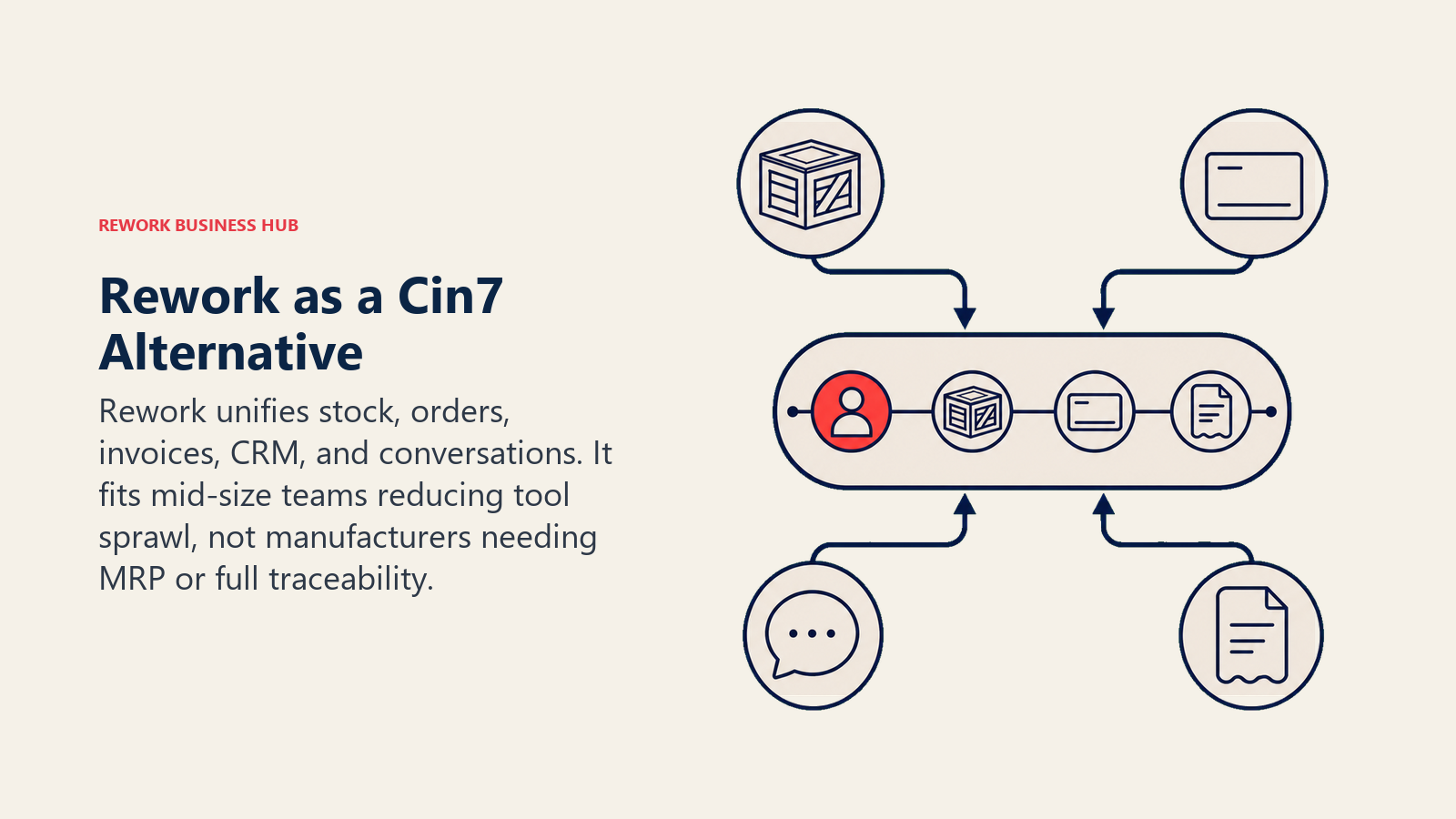
Rework takes a different angle than everything above it. Its Inventory module sits on the same platform as Sales CRM, Lead, Commerce, Invoice, Product, Work Ops and People, so the stock count, the sales order, the invoice and the customer record live in one system rather than four tools joined by integrations. If your Cin7 Core setup is really Cin7 plus a CRM plus an invoicing tool plus a chat inbox, held together by syncs that break at month end, the pitch is consolidation rather than depth. Rework also runs a unified multi-channel inbox (WhatsApp, Messenger, Instagram DM, TikTok, Zalo and web chat on one contact timeline), which matters for sellers whose orders arrive as conversations. If the CRM side weighs as heavily as the stock side, read Best CRM Software in 2026 too.
Pricing for Rework Inventory is quoted per organization; see rework.com/pricing.
| What you get | What you don't |
|---|---|
| Stock, orders, invoices and the customer on one platform | Multi-level BOMs, routings or production scheduling |
| A unified inbox across WhatsApp, Messenger, IG, TikTok, Zalo, chat | Shop-floor control or full lot and serial genealogy |
| CRM, Work Ops and People apps alongside inventory | Bin-level slotting, wave picking or carrier rate shopping |
| Seats come in blocks of 5 rather than one at a time | A free tier or a single-user plan |
Pricing: Quote on request. Pricing for Rework Inventory is quoted per organization. See rework.com/pricing. Best for: Mid-size operators, roughly 10 to 200 people, whose real problem is tool sprawl rather than warehouse sophistication, especially social-commerce and B2B sellers who want stock and the customer conversation on one record. Not ideal for: Manufacturers. Rework is not an MRP: no multi-level BOMs, production scheduling, shop-floor control or full lot and serial traceability, so a contract manufacturer or a regulated food or supplement producer needing genealogy and recall reporting should look at Katana, Fishbowl Advanced or NetSuite. It's also not a multi-channel retail ops platform at Cin7 Omni or Linnworks depth, which is the exact gap a Cin7 Omni user needs filled. And it isn't for solo or single-user buyers.
7. Linnworks and SkuVault Core: Multi-Channel Retail Ops at Omni Scale
If you're on Cin7 Omni rather than Cin7 Core, Linnworks is the most direct like-for-like here. It's built for high-volume multi-channel retail: listing management across marketplaces and carts, order routing across warehouses and 3PLs, and stock sync at a scale where a mis-synced SKU costs real money in overselling. The portfolio now includes SkuVault Core, the warehouse inventory product for growing retailers, sold alongside Linnworks Advanced for connected commerce. They're two packages from one company, not one product renamed.
Linnworks publishes no price. Its pricing page states plainly that "Plans are priced on order volume, not revenue, no percentage fees, ever," and sends every visitor to a quote form. Add-on modules (Listing, WMS, Forecasting) are charged separately, and the FAQ confirms onboarding is a one-time fee based on your package and implementation timing. Fairer than a percentage-of-revenue model, and it still means you can't budget without a call.
| What you get | What you don't |
|---|---|
| Channel and listing management at Cin7 Omni scale | Any published price, at any tier |
| Order-volume pricing with no percentage-of-revenue fee | A self-serve trial you can start tonight |
| Two packages: SkuVault Core and Linnworks Advanced | Manufacturing or BOM capability |
| Onboarding with a named specialist per package | A cheap entry point for a small seller |
Pricing: No published price. Linnworks and SkuVault Core are quoted on monthly order volume, with modules charged separately and a one-time onboarding fee. Best for: Multi-channel retailers doing high order volume across marketplaces, carts and 3PLs, which is the Cin7 Omni profile rather than the Cin7 Core profile. Not ideal for: Manufacturers, and any team that needs a number before it will take a sales call.
8. Brightpearl by Sage: Retail Operations Built Around Automation
Brightpearl, acquired by Sage and now sold as Brightpearl by Sage, is the other serious Cin7 Omni replacement. Its distinguishing feature is the automation engine: rules firing on order events to handle allocation, fraud screening, routing, fulfilment and accounting entries without a person touching each order. Retailers hitting seasonal peaks choose it for exactly that reason, since the automation absorbs volume that would otherwise mean temporary staff.
Brightpearl doesn't publish a price. Its pricing page promises "simple, tailored pricing so you never pay for more than you need" and confirms one thing that matters here: "Unlimited users are always part of the deal, at no extra cost." That's a real difference from Cin7 Core, where seats are capped per tier and the extra-user rate isn't published at all. There are no named tiers and no stated order or revenue minimum, only a quote form. Treat any dollar minimum on a third-party blog as reported and confirm it directly.
| What you get | What you don't |
|---|---|
| An automation engine built for order-volume peaks | Any published price or named plan tiers |
| Unlimited users at no extra cost, vendor-stated | A self-serve signup path |
| Retail accounting and inventory in one system | Manufacturing or MRP capability |
| Sage ownership behind the roadmap | A cheap starting point for a small brand |
Pricing: No published price. Brightpearl by Sage is quoted per business, with unlimited users stated as included at no extra cost. Best for: Retail and wholesale brands with meaningful order volume and seasonal peaks, especially teams that would otherwise add headcount to process orders manually. Not ideal for: Small sellers, manufacturers, and buyers who need a published figure to build a budget around.
9. Oracle NetSuite: The ERP Endpoint
NetSuite is where a Cin7 customer lands when the honest diagnosis is that they've outgrown inventory software altogether. It's a full cloud ERP: general ledger, AR and AP, revenue recognition, procurement, CRM and inventory in one data model, with Advanced Inventory Management as an add-on module for demand planning and multi-location replenishment. Nothing else here gives finance and operations the same single ledger.
Oracle publishes no price for NetSuite. The licence is a core platform fee plus optional modules plus a user count on an annual contract, with a one-time implementation fee on top. Any per-user or base figure you've seen in a comparison table is third-party and should be labelled (reported) with a source named. What's safe to say is the shape: a multi-year commitment with an implementation project attached, usually measured in months, and not a decision an operations manager makes alone. If ERP is genuinely the direction, compare the field in Best NetSuite Alternatives and check what you'd leave behind in Best QuickBooks Alternatives.
| What you get | What you don't |
|---|---|
| Finance, inventory and CRM on one ledger | Any published price to plan against |
| Advanced demand planning and replenishment modules | A short implementation |
| Real multi-entity, multi-currency, multi-subsidiary support | The ability to switch it on this quarter |
| A platform you won't outgrow | Cin7 Core's self-serve simplicity |
Pricing: No published price. Oracle quotes NetSuite annually as core platform licence plus modules plus user count, with a one-time implementation fee. Best for: Companies past roughly $20 million in revenue, or any multi-entity operation where the finance system and the inventory system genuinely need to be the same system. Not ideal for: Anyone shopping because Cin7 Core costs too much. NetSuite is a step up in cost and complexity, not a way down.
10. Descartes Finale (Formerly Finale Inventory): High-Volume Ecommerce Inventory
Descartes Finale, formerly Finale Inventory, took the new name after The Descartes Systems Group acquired it in August 2025, and its own site now describes it as "cloud-based inventory management software for your growing ecommerce brand". Its strength is throughput: fast barcode-driven receiving and picking, multi-warehouse stock sync across channels, and reorder forecasting tuned for sellers moving thousands of units rather than dozens. Descartes positions it alongside Sellercloud as part of an ecommerce growth stack.
Finale publishes partial pricing: Essentials "Starting at $499 /month", Growth "Starting at $799 /month", Enterprise custom. Two caveats. First, the page doesn't say whether those figures are billed monthly or annually, though it notes most customers choose 12, 24 or 36-month terms. Second, user counts and order limits per tier are not published, so "starting at" is doing real work. The 300 users, 1.5 million orders a month and 1.5 million products figures elsewhere on the site are platform ceilings, not plan inclusions. Standard onboarding is stated as included.
| What you get | What you don't |
|---|---|
| Throughput built for high-volume ecommerce picking | Published user counts or order limits per tier |
| Multi-warehouse sync across marketplaces and carts | A stated monthly-versus-annual billing basis |
| Standard onboarding included in the subscription | Manufacturing or BOM depth |
| Descartes backing and a wider logistics portfolio | A cheap entry point, since Essentials starts at $499/mo |
Pricing: Descartes Finale Essentials from $499/mo, Growth from $799/mo, Enterprise custom. The page states no monthly-versus-annual basis and publishes no per-tier user or order limits. Best for: Ecommerce sellers moving high unit volume across several channels and warehouses, where picking speed and count accuracy are the operational bottleneck. Not ideal for: Small sellers, and buyers who need to know how many seats $499 a month buys before signing.
11. Odoo Inventory: Free Forever as Your First App
Odoo is the budget answer, and a genuinely serious one. Odoo Inventory covers multi-warehouse stock, putaway and removal strategies, lot and serial tracking, barcode operations and replenishment rules, and it plugs into a large library of other Odoo apps (Manufacturing, Purchase, Sales, Accounting) that a Cin7 Core customer typically buys separately today.
The headline is real, so don't hedge it away. Odoo's Inventory page states the app is "Free, forever, with unlimited users," and explains the policy: "Your first app is always free with Odoo, including free hosting and support. You'll only have to pay if you install more applications." The honest caveat is the second app. Install one and you're on per-user pricing: Standard at $7.25 per user per month billed yearly, against a regular yearly rate of $7.79, and Custom at $10.90 billed yearly, with monthly billing higher (Odoo shows $11.20 as the undiscounted monthly Standard rate), and a note that "The discount is valid for 12 months, for initial users ordered." The real cost of Odoo is rarely the licence: it's the configuration time, or the partner you pay to do it.
| What you get | What you don't |
|---|---|
| A genuinely free first app with unlimited users | A free ride once you install a second app |
| A huge module library covering the rest of the stack | An out-of-the-box configuration like Cin7 Core's |
| Self-hosted or cloud, your choice | Vendor hand-holding at the free tier |
| Per-user pricing that stays low at small headcount | Predictable cost as headcount grows |
Pricing: Odoo Inventory is free forever with unlimited users as your first app, hosting and support included. Beyond one app, Standard is $7.25 per user per month billed yearly, $7.79/user/mo at the regular yearly rate and Custom $10.90 billed yearly, both promotional for 12 months. Odoo renders its rates dynamically and varies them by region, so confirm the figure for your own country. Best for: Cost-sensitive teams with technical capacity (in-house or a partner) who want inventory now and the option to add manufacturing, purchasing and accounting later without changing vendors. Not ideal for: Teams that need it working next week with no configuration project. For the wider view, see Best Odoo Alternatives.
12. Extensiv: For 3PLs and Brands Running Distributed Fulfillment
Extensiv (formerly 3PL Central, and home to what used to be Skubana) is the specialist here, and it solves a problem the rest of this list mostly doesn't: inventory spread across warehouses you don't own. Its products cover 3PL Warehouse Manager, Warehouse Management, Order Management, Integration Manager, Network Management and Billing Manager, which together let a brand run distributed fulfilment across several 3PLs, or let a 3PL run its own operation and bill clients accurately.
Extensiv publishes no price for Order Manager, Warehouse Manager, Inventory Planner or 3PL Warehouse Manager. Everything is quoted per operation. The one figure that circulates, roughly $39 a month, appears in Extensiv's own help content in reference to Integration Manager specifically. Don't apply it to Order Manager: different product, different price, and presenting one as the other is exactly what makes a comparison table untrustworthy.
| What you get | What you don't |
|---|---|
| Multi-warehouse and 3PL network depth nothing here matches | A published price for any core product |
| Billing tools built for charging 3PL clients | A fit for a single-warehouse operation |
| Order, warehouse and integration products that stack | A self-serve path into the core platform |
| A real answer to distributed fulfilment | Manufacturing or BOM capability |
Pricing: No published price for any core product. All are quoted per operation. A "from $39/month" figure exists in Extensiv's own help content but is scoped to Integration Manager only. Best for: Third-party logistics providers, and brands running inventory across multiple 3PLs or fulfilment centres who need one view of stock across all of them. Not ideal for: Single-warehouse sellers, who would be buying network machinery for a network they don't have.
Stage Fit: Which Alternative Matches Where You Are
Stage matters more than category here. The most expensive mistake in this market is buying for the volume you hope to hit rather than the volume you have.
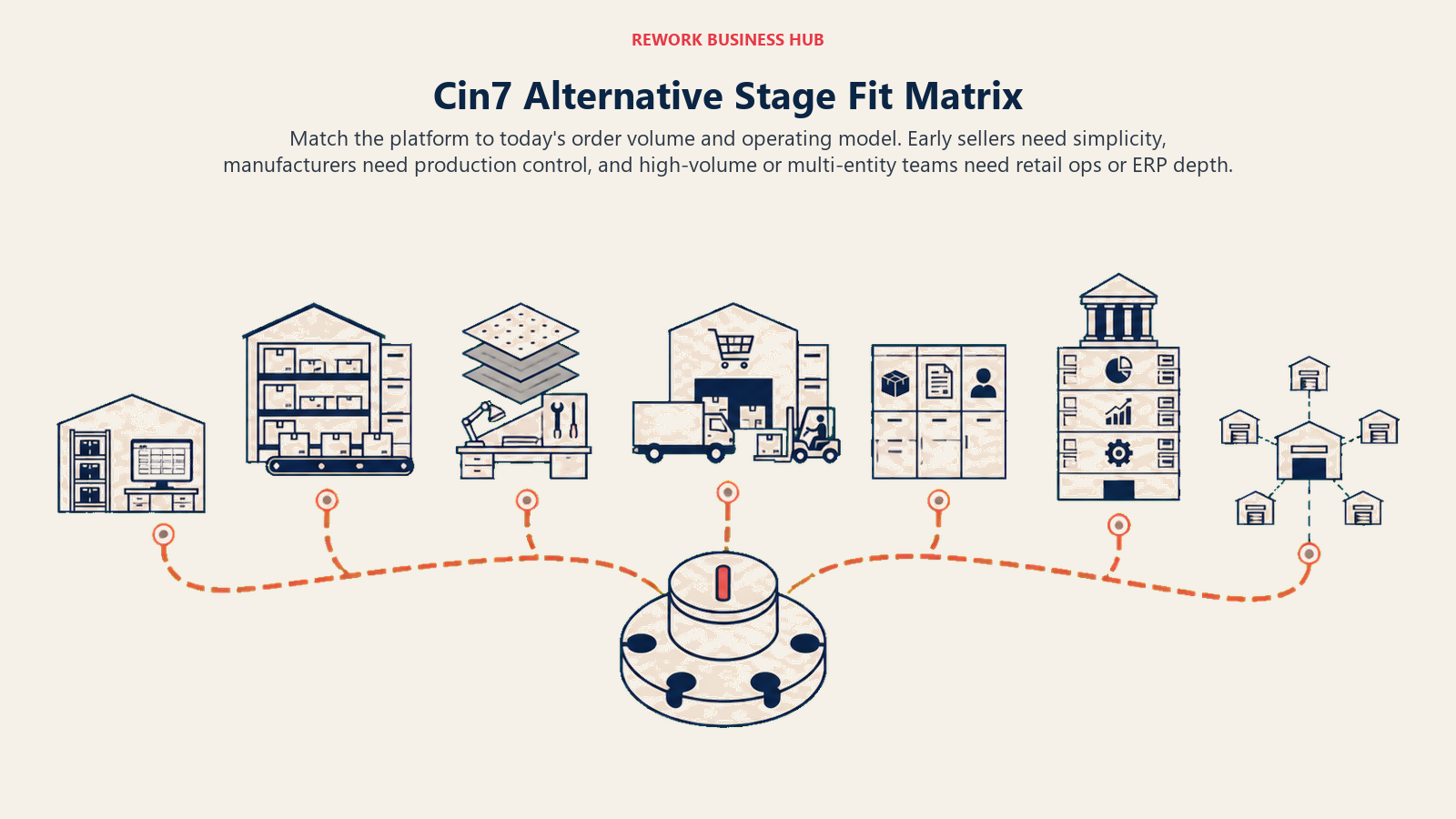
| Stage | What it looks like | Which Cin7 you'd be replacing | Best picks |
|---|---|---|---|
| Just past spreadsheets | Under 500 orders a month, one location, one or two channels | Cin7 Core Standard, and overpaying for it | Zoho Inventory, Odoo Inventory, inFlow Inventory |
| Scaling multi-channel | 500 to 5,000 orders a month, 2 to 4 channels, one or two warehouses | Cin7 Core Pro | inFlow Inventory, Zoho Inventory, Descartes Finale |
| Making things, not just moving them | Production orders, BOMs, raw materials, work in progress | Cin7 Core with its light manufacturing module | Katana, Fishbowl Advanced, Odoo with Manufacturing |
| High-volume multi-channel retail | 10,000-plus orders a month, marketplaces, 3PLs, EDI | Cin7 Omni | Linnworks and SkuVault Core, Brightpearl by Sage |
| Consolidating a stack | Inventory plus CRM plus invoicing plus a chat inbox, held together by syncs | Cin7 Core plus three other tools | Rework, Odoo, NetSuite |
| Outgrown inventory software | Multi-entity, multi-currency, finance needs the same ledger | Cin7 Omni, or Core with a bolt-on ERP | Oracle NetSuite |
| Fulfilment you don't own | Stock sitting in several 3PLs or fulfilment centres | Cin7 Omni's 3PL connections | Extensiv, Linnworks |
Sizing and Persona Fit
Headcount is a proxy for how much configuration you can absorb, usually the real constraint. Included user counts differ wildly here, and that difference decides more budgets than the headline price does.
| Team size | Typical buyer | What they need most | Best picks | Watch out for |
|---|---|---|---|---|
| 1 to 9 | Founder-operator, ops generalist | Cheap, fast to set up, no implementation project | Zoho Inventory, Odoo Inventory, Katana Free | Cin7 Core, Unleashed and Finale are all sized above you |
| 10 to 50 | Operations manager, warehouse lead | Barcode workflows, multi-channel sync, predictable bill | inFlow Inventory, Katana, Rework, Zoho Inventory Plus | Per-seat creep and per-order overages |
| 50 to 200 | Head of operations, supply chain manager | Costing accuracy, warehouse depth, real reporting | Unleashed, Fishbowl, Brightpearl by Sage, Descartes Finale | Module stacking, where the quoted base is half the bill |
| 200-plus | COO, CFO, IT director | One ledger, multi-entity, governance | Oracle NetSuite, Linnworks Advanced, Extensiv | Implementation timelines measured in quarters |
| Any size, 3PL or multi-warehouse | Fulfilment lead, 3PL operator | Stock visibility across sites you don't control | Extensiv, Linnworks | Buying network tooling for a single warehouse |
How to Choose: Decision Framework
Start by naming whether you are replacing Cin7 Core or Cin7 Omni, then match the alternative to the operating gap you actually need to fix.
| If you need... | Best pick |
|---|---|
| The same job as Cin7 Core at a fraction of the price | Zoho Inventory |
| Real production control, not light assembly | Katana (budget for the $199/mo Manufacturing add-on) |
| Tier pricing with included seats rather than per-seat billing | inFlow Inventory |
| Perpetual costing and per-SKU margin accuracy | Unleashed |
| Warehouse and manufacturing depth, cloud or self-managed | Fishbowl (Inventory tiers, then Fishbowl Advanced) |
| Stock, orders, invoices and the customer on one platform | Rework |
| A true Cin7 Omni replacement at high order volume | Linnworks and SkuVault Core, or Brightpearl by Sage |
| Finance and inventory on one ledger across entities | Oracle NetSuite |
| Picking throughput for high-volume ecommerce | Descartes Finale |
| The lowest possible software cost | Odoo Inventory, free as your first app |
| Visibility across warehouses you don't own | Extensiv |
What to Do Next
Start by naming which Cin7 you're actually leaving, because that one answer removes two thirds of this list. Cin7 Core users should shortlist by order volume and manufacturing need: Zoho Inventory or Odoo if the bill is the problem, Katana or Fishbowl if production is, inFlow if per-seat pricing is, Rework if the issue is four tools that don't talk. Cin7 Omni users have a shorter list: Linnworks, Brightpearl by Sage or NetSuite, and all three start with a quote, so book those calls first.
Then test with your own data rather than a demo catalog. Load 50 real SKUs, one month of real orders and your actual location or channel setup into your top two finalists, and run a full cycle including a return, since returns are where inventory tools quietly fall apart and roughly 19.3% of online sales come back. (NRF and Happy Returns) Check the accounting side while you're there, whether that's Best Xero Alternatives or a channel review in Best Ecommerce Platforms in 2026. And if consolidating inventory onto the same platform as your CRM and invoicing is the outcome you want, put Rework on the shortlist and compare it on the same week of orders.

Business Consultant
On this page
- Key Facts
- What Cin7 Does Well, and Why Teams Shop Anyway
- Quick Comparison Table
- 1. Katana: Cloud MRP for Makers, No Longer the Cheap One
- 2. Zoho Inventory: The Cheapest Serious Multi-Channel Option
- 3. inFlow Inventory: Flat-Rate Pricing and a Warehouse App That Works
- 4. Unleashed: Wholesale and Light Manufacturing With Real Costing
- 5. Fishbowl: Deep Warehouse and Manufacturing, Now Sold by Subscription
- 6. Rework: Stock, Orders, Invoices, and the Customer on One Platform
- 7. Linnworks and SkuVault Core: Multi-Channel Retail Ops at Omni Scale
- 8. Brightpearl by Sage: Retail Operations Built Around Automation
- 9. Oracle NetSuite: The ERP Endpoint
- 10. Descartes Finale (Formerly Finale Inventory): High-Volume Ecommerce Inventory
- 11. Odoo Inventory: Free Forever as Your First App
- 12. Extensiv: For 3PLs and Brands Running Distributed Fulfillment
- Stage Fit: Which Alternative Matches Where You Are
- Sizing and Persona Fit
- How to Choose: Decision Framework
- What to Do Next