FieldEdge vs ServiceM8 vs Simpro: Which Field Service Platform Fits Your Trade and Region in 2026?
Turn this article into takeaways for your work.


Each assistant summarizes the article only for you and suggests best practices for your work.
Most field service comparisons quietly assume you're shopping in one country for one kind of work. This one can't, because FieldEdge, ServiceM8, and Simpro don't really compete for the same customer. They're built for three different trades and, unusually for this category, three different regions with three genuinely different price lists.
FieldEdge is the American HVAC and plumbing shop's tool: a flat-rate price book and service agreement tracking, with a QuickBooks relationship (Desktop and Online) deeper than almost anything else in the category. ServiceM8 is the small-operator favorite that grew up in Australia, expanded hard into the UK, and still assumes a business of one to fifteen people running the whole operation from a phone, often an iPhone specifically. Simpro is the outlier on scale: also Australian by birth, now backed by a large investment group buying up adjacent field service brands, and built for contractors running quoted, multi-stage commercial projects alongside ordinary service calls, work ServiceM8's job-volume pricing was never meant to price.
Read the regional and trade fit below before anything else here. A US HVAC shop weighing FieldEdge against Simpro is having a different conversation than a UK electrical contractor weighing ServiceM8 against Simpro, and pretending there's one universal winner across both would be the easy, useless version of this article.
TL;DR
| FieldEdge | ServiceM8 | Simpro | |
|---|---|---|---|
| Built for | US HVAC, plumbing, and electrical shops running QuickBooks | Solo operators to roughly 15-person crews, strongest in Australia and the UK | Commercial contractors mixing project work and service calls |
| Home region | United States (owned by Xplor) | Australia (founded 2009), heavy UK and US expansion | Australia (founded 2002), now backed by a US/UK-based investment group |
| Pricing model | Per office user plus per technician, reported only | Flat tier by job volume, unlimited users on every paid plan, published | Per user, reported only |
| Published pricing? | No, quote-only across all 3 tiers | Yes, published separately in USD, AUD, and GBP | No, quote-only, no public pricing page at all |
| Reported or published starting cost | Roughly $100/office user + $125/technician/month (reported) | $29/month (Starter, 50 jobs/month, unlimited users) | Roughly $70/user/month starting (reported) |
| Setup fee | $500 to $2,000 (reported) | None | $3,000 to $10,000-plus (reported) |
| Typical time to go live | About 5 weeks | Days, self-serve | 2 to 3 months |
| Accounting sync | Native two-way QuickBooks Desktop and Online | Xero, QuickBooks Online, MYOB (no Desktop) | Native Xero; QuickBooks support centers on Online |
| Capterra rating | 4.2/5 (312 reviews) | 4.5/5 (311 reviews) | 4.0/5 (148 reviews) |
| Best for | Established single-region HVAC/plumbing shop staying on QuickBooks | Small crew anywhere, especially AU/UK, that wants a real published price | Commercial contractor running projects and service, ready for real onboarding |
What Each Tool Is Actually Built For
FieldEdge: American HVAC and plumbing, built around QuickBooks
FieldEdge, now owned by Xplor alongside sister brand Service Autopilot, has sold to HVAC, plumbing, and electrical contractors since 1980, and the product still assumes that buyer: a US shop already on QuickBooks that wants a flat-rate price book and service agreement tracking built around the accounting side, not bolted onto it. Xplor named a new President of Field Services in July 2026, a sign the vertical is getting real ongoing investment.
FieldEdge's site names three tiers, Select, Premier, and Elite ("Most Popular"), with no dollar figures published on any of them. Select ships basic dispatching and single-option quotes with 2 mobile licenses; Premier adds advanced dispatching, multi-option quotes, 4 licenses, 10 saved reports, and prospect tracking; Elite goes to 6 licenses, unlimited saved reports, and folds in Proposal Pro and MarketingEdge, both paid add-ons below it. QuickBooks Online and Desktop support ships free on all three.
ServiceM8: the small-operator favorite built outside the US
ServiceM8 launched in 2009 as a private Australian company and didn't officially push into the US until 2016. It says it has managed more than 50 million jobs worth over $50 billion in billed work across 40-plus countries, with Australia and the UK remaining its strongest markets outside the US. The product has leaned Apple-first from the start: time tracking still only works on iOS, and the Android app is a trimmed-down version that trails iOS on feature updates, real friction for a crew that isn't standardized on iPhones.
What separates ServiceM8 from the other two is the pricing shape. It charges by monthly job volume, not by seat, with unlimited users on every paid tier, so a business adds a dispatcher or a part-time bookkeeper without a new line item. It's also the only one of the three publishing real self-serve pricing anywhere, and it does so separately in three currencies, which matters more than a footnote.
Simpro: commercial project and maintenance work, built for scale
Simpro was founded in Brisbane, Australia in 2002 and grew into the commercial end of the category: a Job WIP (work in progress) report tying costs, billed amounts, and what's still owed into one view, Gantt-style scheduling for multi-phase projects, and inventory control for a contractor running several complex jobs at once, not a single-visit residential call. Parent company Simpro Group took a $350 million-plus growth investment from K1 Investment Management in 2021 and has used it to acquire AroFlo, ClockShark, and, in October 2024, BigChange; January 2026 added Delight, an AI customer-engagement platform. That's a company still actively consolidating the category.
Unlike FieldEdge's three named tiers, Simpro publishes no tier names and no pricing page at all. Every deal is scoped by trade count, module selection, and negotiated terms, the least transparent structure of the three by a clear margin.
Core capability comparison
| Capability | FieldEdge | ServiceM8 | Simpro |
|---|---|---|---|
| Dispatch board | Standard dispatch, tiered mobile license counts | Simple job diary, built for one owner-operator or a small team | Multi-phase Gantt-style scheduling across service and projects |
| Price book | Flat-rate price book (FieldEdge Flat Rate), built in | Not a dedicated price-book feature | Native, tied into job costing |
| Service agreements / membership | Native, tracked through to QuickBooks | Not a dedicated module | Native, tied to WIP reporting |
| Job costing / WIP reporting | Reporting depth gated by tier (10 saved reports on Premier, unlimited on Elite) | Gated to the Premium tier and above | Job WIP report is the signature feature |
Who each platform is actually built for
| Dimension | FieldEdge | ServiceM8 | Simpro |
|---|---|---|---|
| Sweet-spot crew size | Small to mid HVAC/plumbing shops, roughly 5 to 50 techs | Solo operator through about 15 people | Commercial contractors, roughly 10 to 200-plus field and office users |
| Trade focus | HVAC, plumbing, electrical | Broad trades: electrical, plumbing, HVAC, refrigeration, pest control, lawn care, cleaning, locksmith | Electrical, mechanical/HVAC, plumbing, fire/life safety, security, solar |
| Primary region and currency | United States, USD only | Australia and UK strongest outside the US; publishes USD, AUD, GBP separately | Australia by origin; now also sells in the US, UK, and NZ |
Accounting Integration: The Question That Decides More Than Features
This deserves real weight, not a line on a feature table, because it often decides more of the purchase than the dispatch board does. QuickBooks holds roughly 62% of the SMB accounting software market to Xero's 9%, and construction is the single highest-adopting industry for QuickBooks, at just over 17% of its user base, according to Ace Cloud Hosting's April 2026 market share analysis. Whichever of these three you pick has to talk to whatever already runs your payroll and taxes, and the three take noticeably different approaches to that.
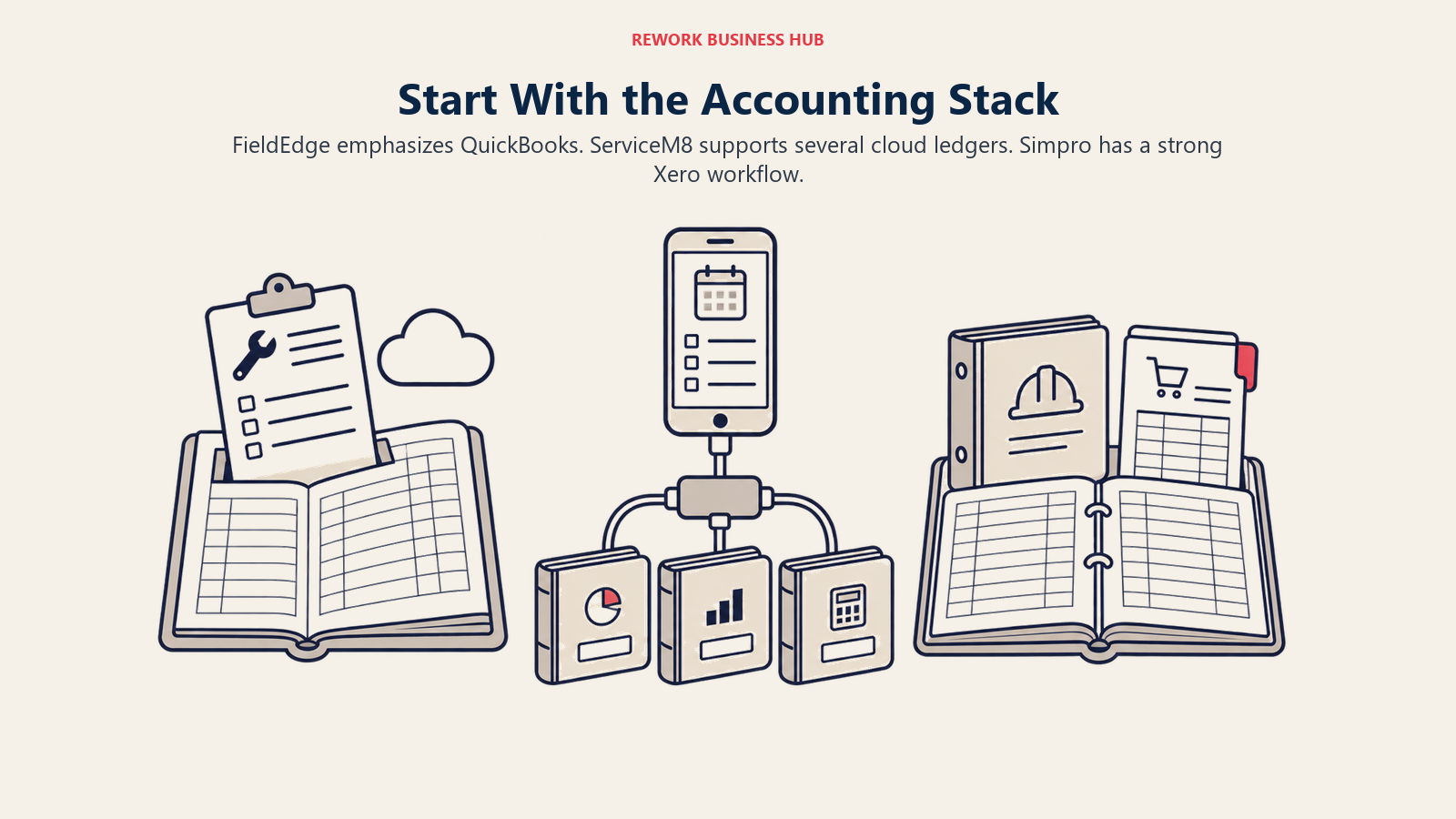
FieldEdge's whole reputation rests on QuickBooks depth, specifically real-time, two-way Desktop sync: an invoice posts the moment a technician closes a job, not on a batch delay. QuickBooks Online is supported too, both included free on every tier. The catch: Intuit stopped selling new QuickBooks Desktop Pro Plus and Premier Plus subscriptions on September 30, 2024, Desktop 2024 is the last version that will ever ship, and mainstream support ends September 30, 2027, with only Desktop Enterprise remaining for sale after that, according to Method. A shop building its buying decision around FieldEdge's Desktop Live Sync is also, knowingly or not, betting on a product line Intuit is winding down outside Enterprise.
ServiceM8 connects to Xero worldwide, QuickBooks Online worldwide, and MYOB Business in Australia and New Zealand only, confirmed on ServiceM8's own help center. QuickBooks Desktop isn't on that list. A shop leaving FieldEdge for ServiceM8's simplicity or unlimited-user pricing needs to know that move also drops Desktop-native sync entirely. An Automated Timesheet Sync add-on pushes staff clock-on and clock-off times to Xero, MYOB, or QuickBooks Online as employee timesheets.
Simpro's deepest accounting relationship is with Xero, syncing customer details, invoices, payments, and purchase orders, with a finalized Simpro invoice auto-creating the matching Xero sales invoice and bank payments reconciling back. Simpro also lists QuickBooks as an integration partner, and payroll hours push to Xero, Reckon, or QuickBooks in one click, but the practical weight sits on Xero, the default in Australia, New Zealand, and the UK far more than the US. Reckon is the tell: an ANZ-only accounting package, its presence here underlines how much of Simpro's design still assumes an ANZ or UK back office.
| Accounting package | FieldEdge | ServiceM8 | Simpro |
|---|---|---|---|
| QuickBooks Desktop | Yes, native, real-time, invoice-on-close | No | Not a first-party focus |
| QuickBooks Online | Yes, native | Yes, native | Listed as an integration partner |
| Xero | Not offered | Yes, native | Yes, native, the deeper of its two accounting relationships |
| MYOB | Not offered | Yes (Australia and New Zealand only) | Not documented as a native integration |
| Reckon | Not offered | Not offered | Yes, for payroll hours |
The honest read: if your books live in QuickBooks Desktop and you want to keep it that way, FieldEdge is close to the only real option here. If your books live in Xero, especially in Australia, New Zealand, or the UK, ServiceM8 or Simpro fit that world far better, since FieldEdge doesn't support Xero at all.
Key Facts
- QuickBooks holds roughly 62% of the SMB accounting software market to Xero's 9%, and construction is the single highest-adopting industry for QuickBooks at just over 17% of its own user base, according to Ace Cloud Hosting's April 2026 market share analysis.
- Intuit stopped selling new QuickBooks Desktop Pro Plus and Premier Plus subscriptions on September 30, 2024, and mainstream support for the final Desktop 2024 release ends September 30, 2027, according to Method.
- ServiceM8 has managed more than 50 million jobs and over $50 billion worth of billed work across more than 40 countries since its 2009 founding in Australia, according to ServiceM8's own about page.
- Simpro Group took a $350 million-plus growth investment from K1 Investment Management in 2021 and has since acquired AroFlo, ClockShark, BigChange, and, in January 2026, the AI customer-engagement platform Delight, according to VentureBeat.
- Switching field service platforms typically costs 6 to 12 months of the new vendor's annual pricing once contract overlap, data migration, and retraining are counted, according to fieldservicesoftware.io's switching-cost analysis.
Decision by Business Goal
| Goal | Best fit | Why |
|---|---|---|
| Keep a real-time, invoice-on-close sync to QuickBooks Desktop | FieldEdge | The only one of the three with native two-way Desktop sync, included on every tier |
| Get live this week with a real number you can see today | ServiceM8 | The only one with published, self-serve pricing in every region it sells into |
| Run multi-phase commercial projects with WIP reporting alongside service calls | Simpro | Purpose-built Job WIP report and Gantt-style project scheduling |
| Add technicians without the software bill jumping | ServiceM8 | Unlimited users on every paid tier; price is set by job volume, not headcount |
| Run a UK or Australian trades business and want software priced for that market | ServiceM8 | Publishes real GBP and AUD pricing on its own regional pages, not a relabeled US number |
| Keep the books on Xero instead of QuickBooks | Simpro or ServiceM8 | Both built their accounting story around Xero; FieldEdge doesn't support Xero at all |
Team and Role Fit
| Role | FieldEdge | ServiceM8 | Simpro |
|---|---|---|---|
| Owner / GM | Sees price book and service agreement revenue in one view | Usually runs dispatch, quoting, and invoicing personally at this scale | Sees job WIP and multi-project margin together |
| Office admin / CSR | Works the price book and QuickBooks sync daily | Manages the job diary and quotes; no dedicated CSR tooling | Manages purchase orders, subcontractors, multi-stage billing |
| Field technician | Mobile app tied to price book and job record, iOS and Android | Full-featured iOS app; Android app trimmed, no time tracking | Mobile app tied to WIP, timesheets, and job records |
| Dispatcher / project coordinator | Standard dispatch board, tiered mobile license counts | Simple, built around one dispatcher, often the owner | First-class role: Gantt-style multi-phase scheduling |
| Bookkeeper / accountant | Works directly in QuickBooks Desktop or Online via native sync | Works in Xero, QuickBooks Online, or MYOB; no Desktop option | Works primarily in Xero; QuickBooks support is thinner |
Pricing at 3, 10, and 25 Users
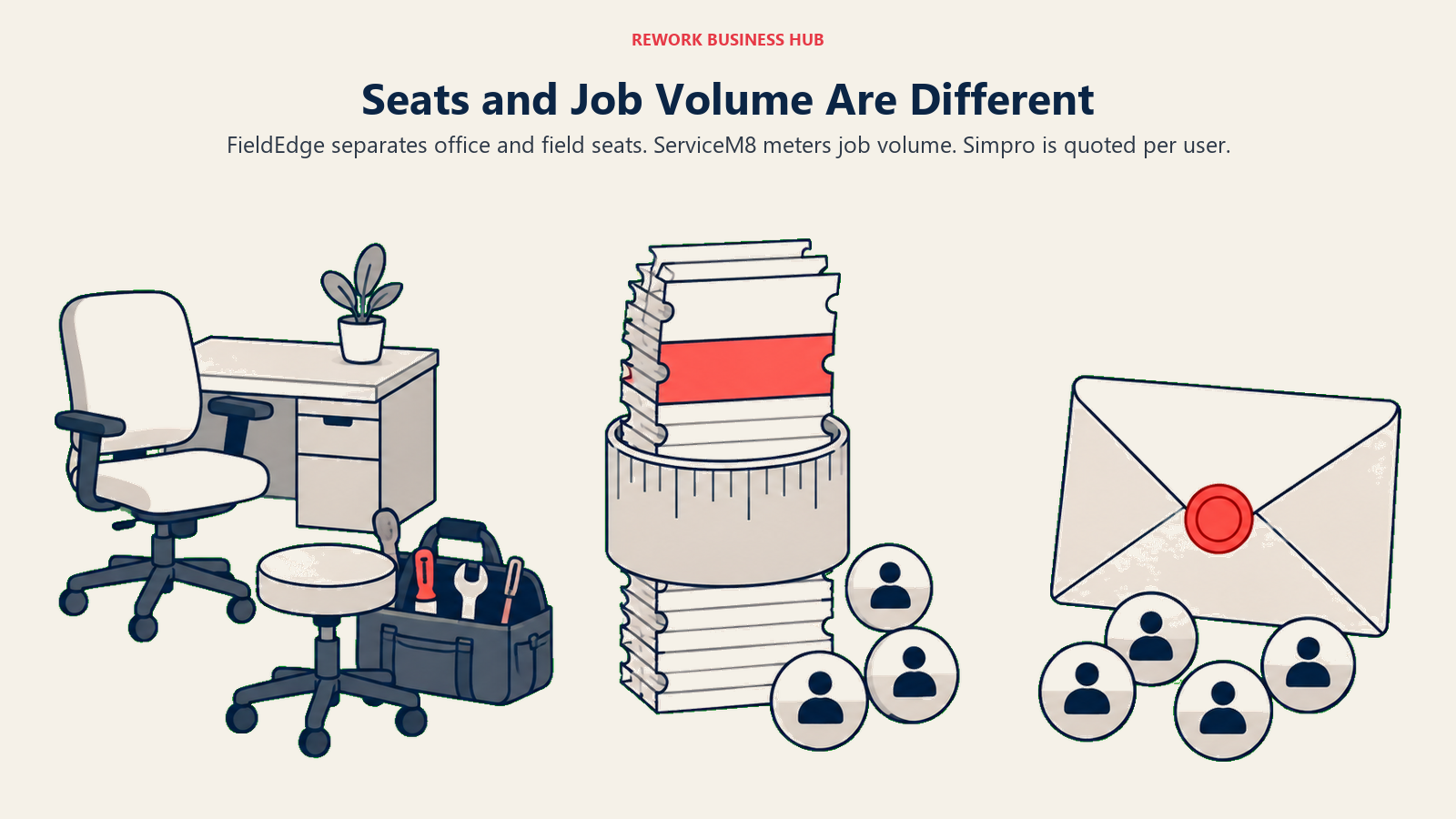
These three don't even charge for software the same way, so "at 3, 10, and 25 users" means something different for each one before a single dollar figure shows up.
FieldEdge: reported, two separate rates that don't roll up into one number
FieldEdge's rate, per third-party analyses since FieldEdge itself publishes nothing, is really two numbers: roughly $100 a month per office user (CSRs, dispatchers, managers) and $125 a month per technician, according to ServiceAgent.ai and corroborated by Workyard. There's no single per-seat figure without picking an office-to-field split, so the table below states the assumed split plainly.
| Tier | Mobile licenses included | Saved reports | Prospect tracking | Proposal Pro | MarketingEdge |
|---|---|---|---|---|---|
| Select | 2 | None | No | Paid add-on | Paid add-on |
| Premier (most popular) | 4 | 10 | Yes | Paid add-on | Paid add-on |
| Elite | 6 | Unlimited | Yes | Included | Included |
Source: FieldEdge's own pricing page. No dollar amounts are published on any tier; QuickBooks Online and Desktop support is included free on all three. Inventory management and advanced reporting stack on top as separate paid add-on modules per third-party breakdowns.
ServiceM8: published, but the number depends on which country's page you land on
ServiceM8 posts real self-serve pricing, separately, on its US, Australian, and UK sites. All paid tiers include unlimited users; job costing is gated to Premium and above.
| Plan | Jobs/month | United States (USD) | Australia (AUD, inc. GST) | United Kingdom (GBP, ex. VAT) |
|---|---|---|---|---|
| Free | 30 | $0 | $0 | £0 |
| Starter | 50 | $29 | $29 | £25 |
| Growing | 150 | $79 | $79 | £59 |
| Premium | 500 | $149 | $149 | £119 |
| Premium Plus | 1,500+ | $349 | $349 | £269 |
Source: ServiceM8 US, Australia, and UK pricing pages. The US and Australian lists share identical digits in two different currencies, so an Australian shop's real bill is smaller even before GST. The UK list isn't a currency relabel: it's a separately structured, lower price ladder, not a straight FX conversion.
Simpro: reported, and the reports don't agree with each other
Simpro publishes no pricing page at all; its own site returns nothing. Third-party trackers disagree meaningfully. Field Service Guide reports $150 to $300 per user a month for a full deployment. ITQlick reports a $70 starting point, with a 10-user deployment at $700 to $1,200 a month and 100 users at $7,000 to $10,000, implying a lower blended rate at scale. Treat both as directional, the same caveat applied to Workiz and BuildOps pricing elsewhere in this collection.
What that means for your actual bill
| Crew size | FieldEdge (reported) | ServiceM8 (published, US) | Simpro (reported) |
|---|---|---|---|
| 3 users (1 office + 2 field, assumed) | ~$350/month, ~$4,200/year | Growing, $79/month, up to 150 jobs, $948/year | $210 to $900/month, $2,520 to $10,800/year |
| 10 users (2 office + 8 field, assumed) | ~$1,200/month, ~$14,400/year | Premium, $149/month, up to 500 jobs, $1,788/year | $700 to $1,200/month, $8,400 to $14,400/year |
| 25 users (4 office + 21 field, assumed) | ~$3,025/month, ~$36,300/year | Premium Plus, $349/month, 1,500+ jobs, $4,188/year | $1,750 to $3,000/month, $21,000 to $36,000/year |
The ServiceM8 row assumes a moderate, illustrative workload (not a researched benchmark) of roughly 50 jobs per technician a month; a busier crew tips into the next tier sooner. Per-job and per-message metering is real here specifically: SMS overage runs about 10 cents a message in the US, and Premium Plus bills extra jobs at 20 cents each past the included 1,500. FieldEdge and Simpro don't meter by job or message; their cost climbs by seat instead.
Implementation and Change Management
| FieldEdge | ServiceM8 | Simpro | |
|---|---|---|---|
| Typical time to go live | About 5 weeks | Days, self-serve | 2 to 3 months |
| Free trial | None | 14 days, no credit card required | None |
| Setup / implementation fee | $500 to $2,000 one time (reported) | None | $3,000 to $10,000-plus for small/midsize teams (reported), can exceed $20,000 for complex rollouts |
| Data migration and training | $150 to $400 migration, $600 to $1,200 training, roughly (reported) | Self-serve; no formal migration program | Often requires a Simpro partner to configure correctly, per user reviews |
| Contract commitment | Month to month, no long-term contract, per third-party pricing research | No lock-in; upgrade or downgrade anytime | Annual contract typically required |
FieldEdge's onboarding clock bills from setup, not go-live, so the roughly 5-week window is time you're paying for before the tool works for you. ServiceM8 is the clear opposite: quoting and invoicing the same afternoon you sign up. Simpro sits furthest from both; reviewers describe the interface as dated and menu-heavy for new users during that 2-to-3-month window, the tradeoff for the WIP and Gantt depth it's bought for.

Risk and Governance
| FieldEdge | ServiceM8 | Simpro | |
|---|---|---|---|
| Capterra rating | 4.2/5 (312 reviews) | 4.5/5 (311 reviews) | 4.0/5 (148 reviews) |
| Pricing transparency | None; quote-only, 3 named tiers with no dollar figures | Full; published separately in 3 currencies | None; no public pricing page of any kind |
| Contract commitment | Month to month, reported | No lock-in | Annual, typically |
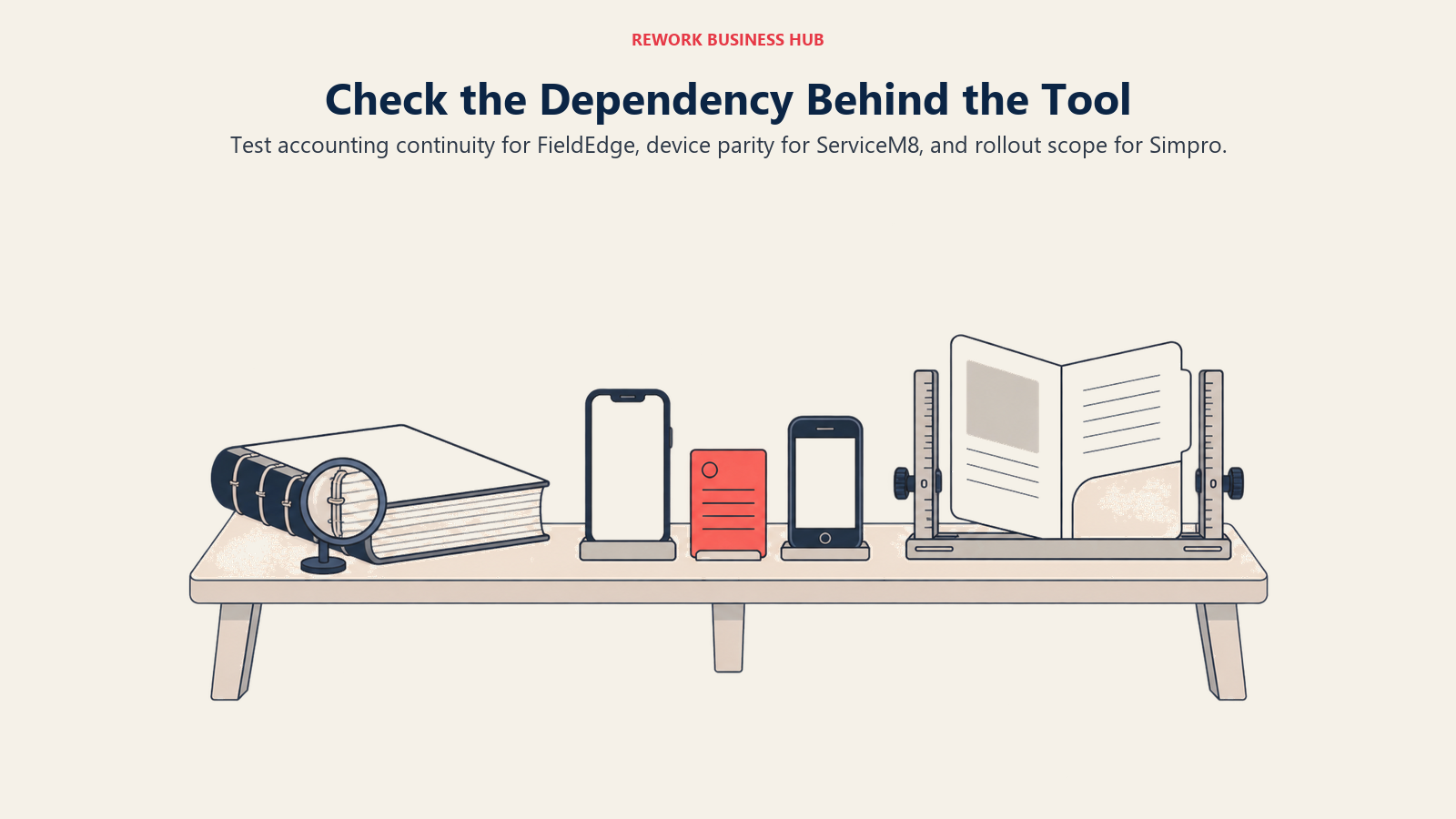
| Single biggest dependency risk | Built around QuickBooks Desktop, a product line Intuit is winding down outside Enterprise | Time tracking and full feature parity are iOS-only; Android is a second-class app | Implementation cost and timeline are the least documented of the three, and third-party estimates disagree by more than 2x |
The pricing-transparency gap here is unusually wide even for this category. ServiceM8 shows you a real number, in your own currency, before you've talked to anyone; FieldEdge and Simpro both make you ask first, and Simpro doesn't even have a page to redirect you to a sales form from. Budget the sales cycle itself as part of the real cost of evaluating either one.
When FieldEdge Is the Right Call
- You're a US HVAC, plumbing, or electrical shop already on QuickBooks Desktop or Online, and losing that native sync would create real accounting friction
- Flat-rate pricing and service agreement tracking are core to how you sell, not a nice-to-have
- You have budget for a $500 to $2,000 setup fee and can absorb roughly 5 weeks before the tool is fully live
- You want month-to-month flexibility rather than an annual contract, per third-party pricing research
When ServiceM8 Is the Right Call
- You're a solo operator or a crew up to roughly 15 people, and want to add people without adding a line item to the bill
- You're based in Australia, the UK, or anywhere outside the US, and want pricing actually built for your market, not a relabeled US number
- Your books run on Xero, QuickBooks Online, or MYOB, with no need for QuickBooks Desktop specifically
- You want to see a real price today and be live this week, no sales call required
When Simpro Is the Right Call
- You're a commercial contractor running multi-phase projects (rough-in, fit-off, commissioning) alongside reactive service calls, not just single-visit jobs
- Job WIP reporting, tying costs, billed amounts, and what's still owed into one view, is a real gap in how you track margin today
- Your books run on Xero, and you're comfortable with an annual contract and a 2-to-3-month implementation for that project-costing depth
- You've already outgrown what a residential-first tool like ServiceM8 or a QuickBooks-centric tool like FieldEdge was ever built to track
Decision Framework
| If you are... | Pick |
|---|---|
| A US HVAC or plumbing shop that wants to keep its QuickBooks Desktop workflow intact | FieldEdge |
| A solo operator or small crew anywhere, especially outside the US, wanting real published pricing | ServiceM8 |
| Growing headcount fast and don't want the software bill to grow with it | ServiceM8 |
| A commercial contractor mixing project work and service calls, needing WIP reporting | Simpro |
| Running your books on Xero rather than QuickBooks | Simpro or ServiceM8 |
| Comparing the full category rather than just these three | See the full field service software roundup |
| Only trying to replace one of these three specifically | See Best FieldEdge Alternatives, Best ServiceM8 Alternatives, or Best Simpro Alternatives |
The verdict: there's no single winner because there's barely a single market. FieldEdge wins for a US shop whose accounting already depends on QuickBooks, especially Desktop. ServiceM8 wins on transparency for a small crew almost anywhere, and specifically for a UK or Australian business tired of comparing its bill against a US number. Simpro wins when the job is part service, part construction project, and WIP reporting is worth the cost and onboarding time it asks for. Match the tool to your trade and region before you match it to a feature list.
What to Do Next
- Confirm where your books actually live first. QuickBooks Desktop points toward FieldEdge; Xero or QuickBooks Online points toward ServiceM8 or Simpro. That one fact eliminates one of the three for most readers immediately.
- Check which of these three even sells into your region at a price you can see. Outside the US, get ServiceM8's quote from its own regional page rather than assuming US figures apply.
- Get FieldEdge's and Simpro's real quotes in writing, setup fee and timeline included, before comparing either to ServiceM8's published number; neither publishes pricing, and reported estimates vary widely between trackers.
- If the actual gap is project costing, not dispatch, compare Simpro against BuildOps, since the two solve an overlapping problem from different starting points.
- Still deciding between a small-crew tool and something bigger? ServiceTitan vs Jobber and Jobber vs Housecall Pro vs Workiz cover the US small-to-mid segment these three sit alongside.
Frequently Asked Questions about FieldEdge vs ServiceM8 vs Simpro
Which of FieldEdge, ServiceM8, or Simpro is cheapest?
ServiceM8 is the only one with published pricing, starting at $29 a month with unlimited users. FieldEdge and Simpro are both quote-only, but third-party estimates put FieldEdge around $100 per office user plus $125 per technician a month, and Simpro around $70 to $300-plus per user a month, both well above ServiceM8's published entry rate.
Do any of these three sync natively with QuickBooks Desktop?
Only FieldEdge. It's the signature feature: a real-time, two-way sync posting an invoice to QuickBooks Desktop the moment a technician closes a job. ServiceM8 supports QuickBooks Online, Xero, and MYOB (Australia and New Zealand only), no Desktop. Simpro's QuickBooks integration centers on Online, with Xero as its deeper accounting relationship.
Does ServiceM8 really cost different amounts depending on the country?
Yes, genuinely, not a currency relabel. Its US and Australian pricing pages show identical digits in USD and AUD respectively, so the real cost differs by currency. Its UK page uses an entirely different, lower number scale (Starter at £25, not a straight conversion of $29), confirmed on ServiceM8's own regional pricing pages.
Which of these three fits a small residential crew under 10 people best?
ServiceM8, for most small residential crews: a genuinely usable free tier, unlimited users on every paid plan, and the lowest published entry price of the three. FieldEdge's QuickBooks Desktop depth and Simpro's project-costing tools both suit a different kind of business.
Which of these three is built for commercial project work rather than single-visit service calls?
Simpro, clearly. Its Job WIP report and Gantt-style multi-phase scheduling are built for contractors running quoted projects (rough-in, fit-off, commissioning) alongside reactive service work. FieldEdge and ServiceM8 are both built around single-visit residential and light-commercial jobs.
Can a business switch between these three later as it grows?
Yes, though budget it as a real project. Switching field service platforms typically costs 6 to 12 months of the new vendor's annual pricing once contract overlap, migration, and retraining are counted, and FieldEdge's and Simpro's implementation timelines (roughly 5 weeks and 2 to 3 months) mean a switch away from either rarely happens fast.
Related Resources:
- Best Field Service Management Software in 2026
- Best FieldEdge Alternatives in 2026
- Best ServiceM8 Alternatives in 2026
- Best Simpro Alternatives in 2026
- BuildOps vs Zuper vs ServiceTitan
- ServiceTitan vs Jobber
- Jobber vs Housecall Pro vs Workiz
- How to Choose Accounting Software
- How to Choose ERP Software
- SaaS Vendor Evaluation Scorecard
- The True Cost of Software Sprawl

Business Consultant
On this page
- TL;DR
- What Each Tool Is Actually Built For
- FieldEdge: American HVAC and plumbing, built around QuickBooks
- ServiceM8: the small-operator favorite built outside the US
- Simpro: commercial project and maintenance work, built for scale
- Core capability comparison
- Who each platform is actually built for
- Accounting Integration: The Question That Decides More Than Features
- Key Facts
- Decision by Business Goal
- Team and Role Fit
- Pricing at 3, 10, and 25 Users
- FieldEdge: reported, two separate rates that don't roll up into one number
- ServiceM8: published, but the number depends on which country's page you land on
- Simpro: reported, and the reports don't agree with each other
- What that means for your actual bill
- Implementation and Change Management
- Risk and Governance
- When FieldEdge Is the Right Call
- When ServiceM8 Is the Right Call
- When Simpro Is the Right Call
- Decision Framework
- What to Do Next