Xero vs Zoho Books: Which Accounting Platform Fits Your Business in 2026?
Turn this article into takeaways for your work.


Each assistant summarizes the article only for you and suggests best practices for your work.
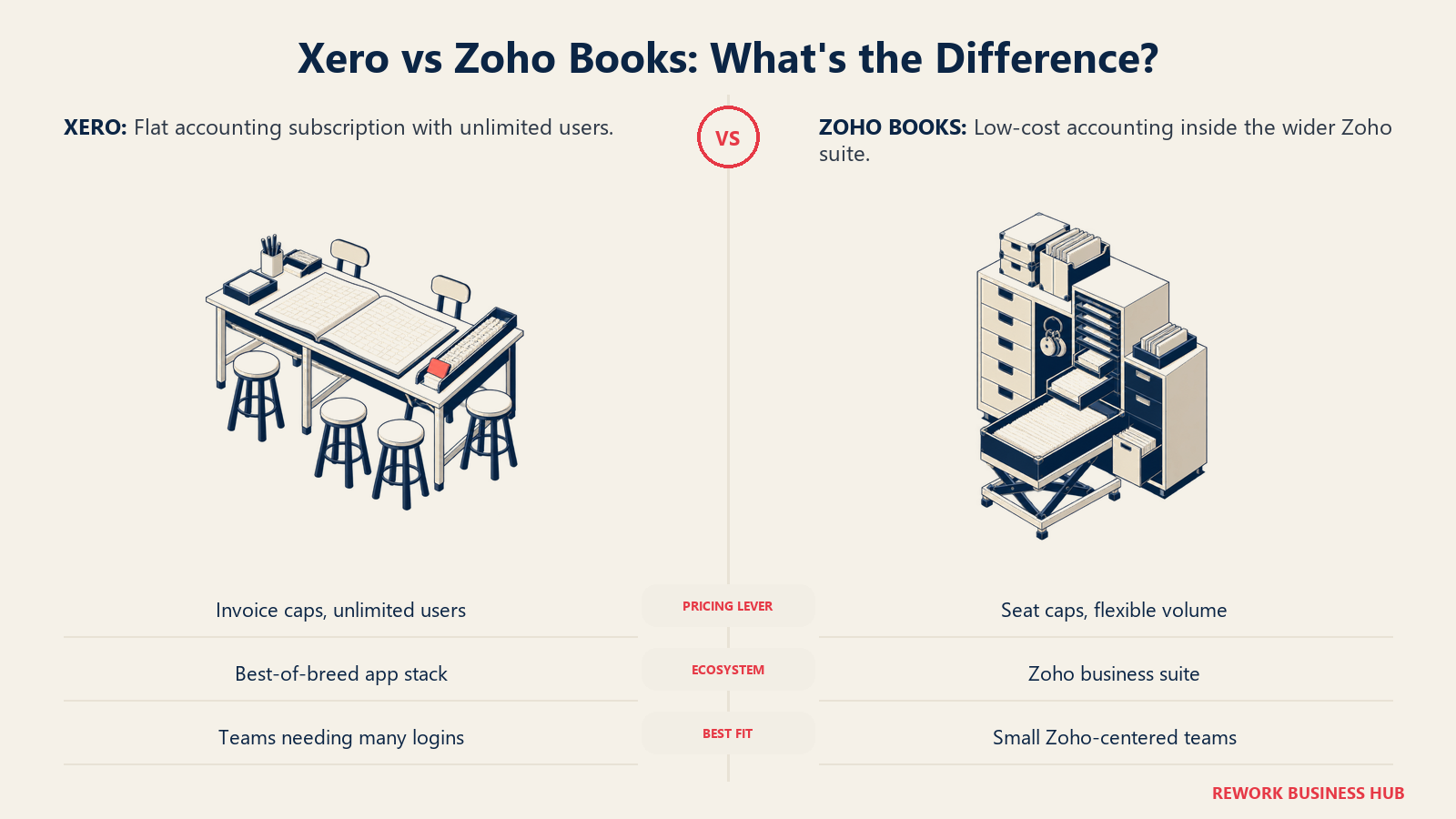
If you've narrowed a new accounting platform down to Xero and Zoho Books, you're probably not choosing between two products with a feature gap. Both run full double-entry books, connect to your bank, send invoices, and handle multi-currency work without complaint. What actually separates them is structural. Xero charges nothing extra for adding a person to your books, but caps how many invoices and bills you can send on its cheapest plan. Zoho Books charges nothing extra for transaction volume, but meters how many people can log in. Layer in which platform your accountant already knows, and where each one's payroll product actually operates, and the better tool stops being a feature checklist question and starts depending on where you're based and how your team is shaped.
This comparison prices both platforms at real headcounts, checks Zoho Books' free tier against the revenue ceiling that actually gates it, and covers the part most roundups skip: Xero's and Zoho Payroll's native markets don't overlap the way you'd assume, and that gap alone can decide the platform for you before pricing enters the conversation. Every price below traces back to each vendor's own pricing or product page.
Key Facts
- Xero charges no per-user fee on any of its three US plans, while Zoho Books meters users across all six of its plans, 1 to 15 included depending on tier, plus a per-seat add-on past that, per each vendor's own pricing page.
- Zoho Books' Free plan requires annual revenue to stay under $50,000 to remain eligible indefinitely in the US, per Zoho's US pricing page; the same Free plan in India carries a lower ₹25 lakh (roughly $28,000 to $30,000) ceiling, per Zoho's India pricing page.
- Xero's US list prices rise on October 1, 2026: Early moves from $25 to $27 a month, Growing from $55 to $59, and Established from $90 to $97, increases of roughly 7 to 8%, per Xero's pricing update as reported by Insightful Accountant.
- Zoho Payroll is natively available in exactly four markets: the US, Canada, India, and the GCC countries, per Zoho's own payroll product page. Australia isn't one of them, while Xero has run native, compliance-built payroll there for years.
- In 6sense's Accounting category, Xero holds a 6.28% share across roughly 31,300 tracked customers, ranked 3rd; Zoho Books holds 0.83% across about 4,124 tracked customers, ranked 20th, per 6sense's Xero and Zoho Books market share pages.
TL;DR: Xero vs Zoho Books at a Glance
| Xero | Zoho Books | |
|---|---|---|
| Entry price (US) | Early, $25/mo, unlimited users, capped at 20 invoices/quotes and 5 bills a month | Free, $0/mo, 1 user plus 1 accountant, capped at $50K annual revenue and 1,000 invoices/year |
| Per-user fee | None, on any plan | Yes. 3 to 15 users included by tier, $3/user/mo past that |
| Top published plan | Established, $90/mo, unlimited users | Ultimate, $275/mo, 15 users included |
| Price change to know about | US prices rise October 1, 2026 (Early to $27, Growing to $59, Established to $97) | None announced |
| Multi-currency | Established only, $90/mo | Standard and up, $20/mo |
| Inventory tracking | Basic from Growing ($55/mo); Inventory Plus add-on, $39/mo, for Shopify/Amazon sync | Gated behind Elite, $150/mo |
| Native payroll markets | Australia (mature, bundled), US (new, Gusto-powered) | US, Canada, India, GCC. Not Australia |
| Best for | Teams of 3 or more that want one flat price regardless of headcount | Teams already running Zoho CRM, Inventory, or other Zoho apps |
What Each Platform Is Actually Built For
Xero's whole pitch rests on one idea: everyone touching the books, the owner, the bookkeeper, an ops manager, the outside accountant, should get their own login without anyone doing seat math. It ships a comparatively tight core (invoicing, bills, bank reconciliation, reporting) and expects you to fill in the rest, industry depth, deeper inventory, payroll, through its own add-ons or its marketplace of more than 1,000 connected apps.
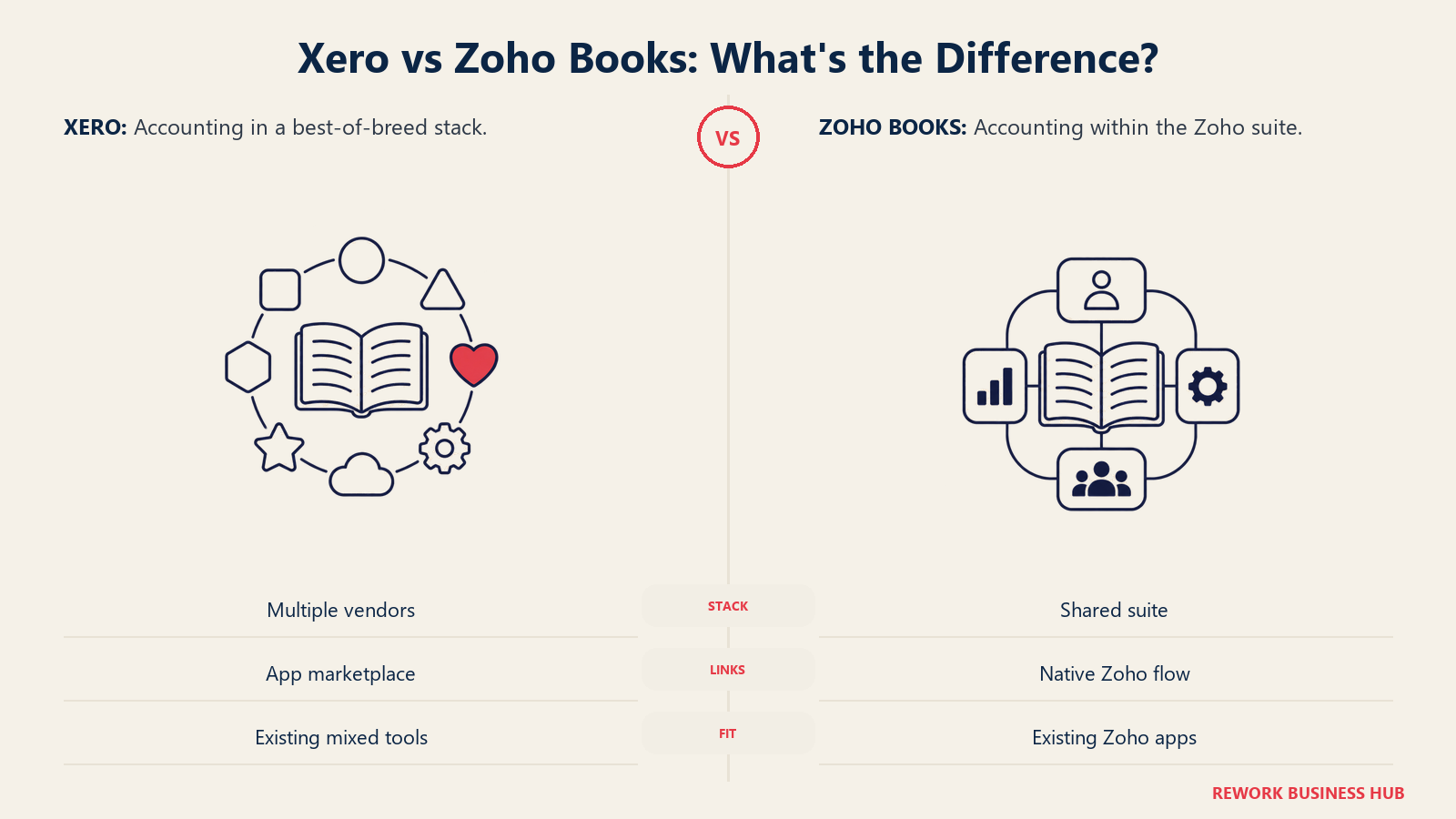
Zoho Books runs the opposite trade. It's the accounting layer inside a much larger suite. Standalone, it's a genuinely capable SMB ledger at a low price. Inside the Zoho stack, alongside Zoho CRM, Zoho Inventory, Zoho Expense, Zoho Projects, and Zoho People, it becomes something closer to an ERP module: invoices generate automatically from closed CRM deals, stock levels sync from Zoho Inventory, expense reports land from Zoho Expense without a manual import. The trade runs the reverse of Xero's. Depth is close to free inside the Zoho walls and noticeably thinner the moment you step outside them.
Neither approach is wrong. It just means the "best" platform here depends less on a feature you're missing and more on whether you're building a best-of-breed stack from several vendors or standardizing on one.
Pricing at Real Headcounts: 1, 3, 5, 10, and 25 Users
Xero plans (US, current list price; October 2026 price in parentheses)
| Plan | Current price | From October 1, 2026 | What's included |
|---|---|---|---|
| Early | $25/mo | $27/mo | 20 invoices/quotes and 5 bills a month, 30-day cash flow forecast, unlimited users |
| Growing | $55/mo | $59/mo | Unlimited invoices and bills, unlimited users |
| Established | $90/mo | $97/mo | Multi-currency, projects, expense claims, 180-day forecast, unlimited users |
Zoho Books plans (US, monthly price; annual-billed price in parentheses)
| Plan | Monthly | Annual (per mo) | Users included | Invoices/year cap |
|---|---|---|---|---|
| Free | $0 | $0 | 1 plus 1 accountant | 1,000 |
| Standard | $20 | $15 | 3 | 5,000 |
| Professional | $50 | $40 | 5 | 10,000 |
| Premium | $70 | $60 | 10 | 25,000 |
| Elite | $150 | $120 | 10 | 100,000 |
| Ultimate | $275 | $240 | 15 | 100,000 |
Additional Zoho Books users cost $3/mo each ($2.50 billed annually) past a tier's included count, which matters if you're just a seat or two over a cap and don't need the next tier's other features.
Monthly cost at real headcounts
| Users who need access | Zoho Books (cheapest named tier that fits) | Xero (flat, any headcount) |
|---|---|---|
| 1 | Free, $0/mo, if under $50K revenue | Early, $25/mo |
| 3 | Standard, $20/mo | Early, $25/mo |
| 5 | Professional, $50/mo | Growing, $55/mo |
| 10 | Premium, $70/mo | Growing, $55/mo |
| 15 | Ultimate, $275/mo | Established, $90/mo |
| 25 | Ultimate, $275/mo, plus $3/user for 10 extra seats, $305/mo | Established, $90/mo |
At 1 and 3 users, Zoho Books is flatly cheaper than Xero's Early plan, assuming you fit inside its invoice cap and revenue ceiling. At 5 users the two sit within $5 of each other. Past that, the lines cross hard: a 10-person team costs $70 a month on Zoho Books' Premium tier against $55 flat on Xero Growing, and once you need more than 10 real logins, Zoho Books' Ultimate plan at $275 a month runs three times what Xero Established charges for the same headcount, because Xero simply has no headcount line item to bill against. The one thing worth checking before you assume Zoho Books loses at scale: its $3-per-seat add-on can cover a user or two past a tier's cap far cheaper than jumping to the next named plan, since Ultimate's real upgrade is the Advanced Analytics module, not the extra five seats.
The Constraints That Aren't in the Price
Every "free" or "cheap" entry plan gates something. Knowing what before you commit saves a mid-year, mid-invoice-cycle migration.
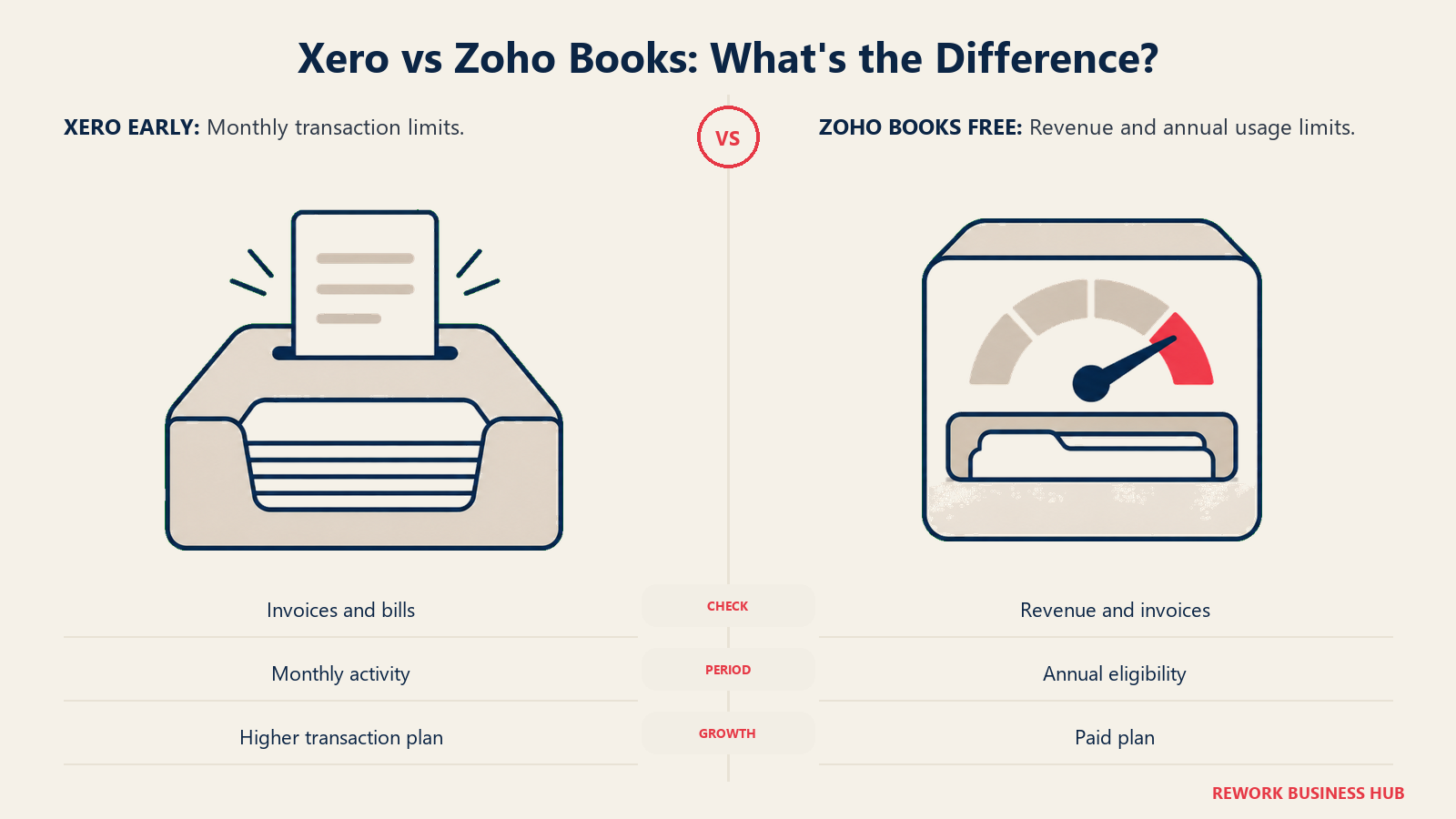
Zoho Books' Free plan is bounded by revenue, not just features: annual revenue has to stay under $50,000 in the US for the plan to remain eligible indefinitely, on top of a 1,000-invoice-a-year cap, a 1-user-plus-1-accountant limit, and 50 receipt autoscans a month. Cross $50K in revenue and Zoho expects you to upgrade, regardless of how light your actual bookkeeping needs are. And that ceiling isn't a single global number: Zoho Books India's Free plan caps out at ₹25 lakh a year, roughly $28,000 to $30,000, a noticeably lower bar than the US version despite carrying the same plan name.
Xero's Early plan takes the opposite shape. It never limits users, that's true on every Xero plan, but it caps transactions: 20 invoices or quotes and 5 bills a month. A business invoicing more than about once a business day blows through that cap well before the month ends. Growing removes the limit entirely at $55, which is the real reason most businesses past the freelance stage end up comparing Growing to Zoho Books rather than Early.
Core Accounting Depth
| Capability | Xero | Zoho Books |
|---|---|---|
| Multi-currency | Established only ($90/mo) | Standard and up ($20/mo) |
| Basic inventory tracking | Growing and Established | Not included until Elite ($150/mo) |
| Multi-channel inventory sync | Inventory Plus add-on, $39/mo, Shopify and Amazon FBA | Native on Elite and Ultimate |
| Budgeting | Present, deeper on Established | Premium and up ($70/mo) |
| Project or job tracking | Established only | Tracked via tags and custom fields, not a distinct module |
| Revenue recognition | Not a distinct feature | Basic on Premium, Advanced on Elite and Ultimate |
| Client or vendor portal | Via connected apps | Included from Standard |
| Bank feed automation | Strong, broad US bank connectivity | Strong, broad US bank connectivity |
The multi-currency gap is the one worth pausing on. Xero gates it behind its $90 Established plan; Zoho Books includes it from its $20 Standard plan. If you invoice international clients or hold a foreign-currency account and don't need anything else Established adds, that's a real $70-a-month difference for the identical capability.
Automation and Workflow
Zoho Books leans harder into workflow automation out of the box: auto-sent payment reminders, overdue-invoice flags, expense-to-project assignment, and recurring invoices generated on a schedule, all native on paid plans. Xero's automation is real but narrower without a connected app layered on top.
| Automation factor | Xero | Zoho Books |
|---|---|---|
| Recurring invoices | Yes, all plans | Yes, all plans |
| Automated payment reminders | Yes, all plans | Yes, all plans |
| Custom workflow rules on records | Limited without a connected app | Native workflow engine on paid plans |
| Bank rules | Keyword and contact matching | Rule-based auto-categorization |
| Client or vendor self-serve portal | Via connected apps only | Native, included from Standard |
Ecosystem and Integrations
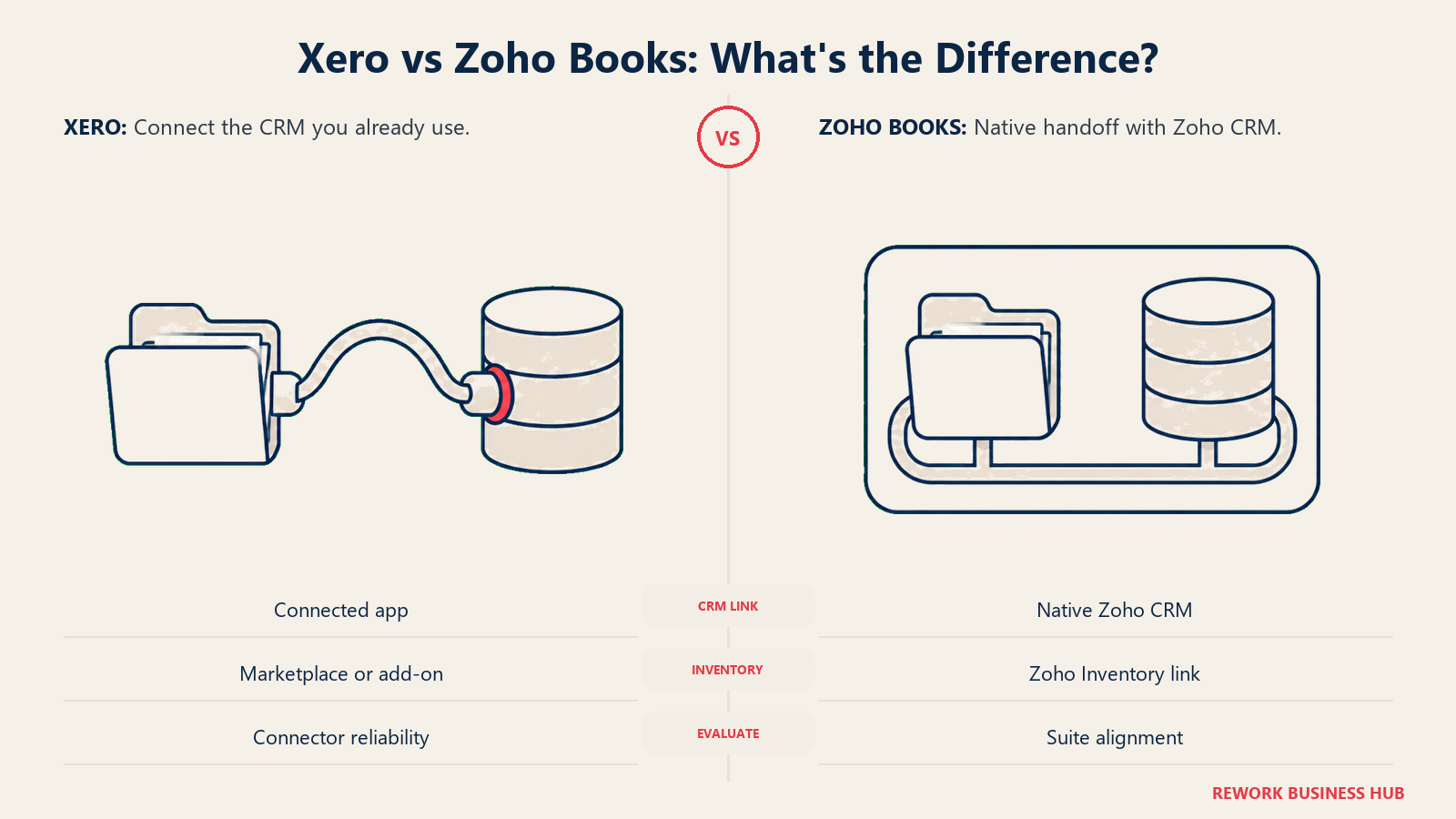
A deal-to-invoice handoff depends on how well accounting connects to the existing CRM.
| Ecosystem factor | Xero | Zoho Books |
|---|---|---|
| Published app marketplace | 1,000+ apps across 30+ categories | Zoho's own 55+ app suite (CRM, Inventory, Expense, Desk, Projects, People), plus a narrower outside marketplace |
| Native CRM integration | Via Salesforce, HubSpot, and other connected apps | Native, real-time with Zoho CRM |
| Native inventory integration | Via Inventory Plus add-on or connected apps | Native with Zoho Inventory (Zoho Books' own inventory module stays Elite-and-up only) |
| Native HR or payroll tie-in | Via Gusto (US) or region-specific payroll apps | Native with Zoho People and Zoho Payroll |
| Best fit | Businesses assembling a best-of-breed stack across several vendors | Businesses standardizing on Zoho as their vendor of record |
This is where Zoho Books' pull toward the wider Zoho stack earns its keep. If your CRM is already Zoho CRM, deals close and invoices generate without a Zapier step in between. If your CRM is HubSpot or Salesforce, you're one more connected app away from the same result, and at that point Xero's broader outside-in marketplace stops being a real disadvantage. If you're weighing the CRM side of a Zoho stack on its own, Zoho alternatives covers how Zoho CRM holds up against the field.
Which One Your Accountant Actually Works In
Software choice matters less than who closes your books every month, and that's the constraint most buyers underweight until a bookkeeper or CPA firm they want to hire says they don't run the platform.
| Availability factor | Xero | Zoho Books |
|---|---|---|
| Certified partner network | 250,000+ accountants and bookkeepers in Xero's global partner program, per Xero's own partner program page | No published partner headcount; Zoho runs Consulting, Implementation, Training, Support, and Development partner tracks without a public firm count |
| Share of the Accounting category (6sense) | 6.28%, ranked 3rd, about 31,300 tracked customers | 0.83%, ranked 20th, about 4,124 tracked customers |
| Share of tracked customer base that's US-based | 16.70% | 27.72%, proportionally higher than Xero's despite the smaller absolute count |
| Where the bench runs deepest | UK (32.40%) and Australia (30.78%), both ahead of the US | India (45.86%), well ahead of the US (27.72%) and UAE (10.52%) |
None of this means you can't find strong outside help on either platform. But the base rate is real. Hire a random US bookkeeping firm and ask if they run Xero, and you'll get a yes more often than asking about Zoho Books, and the gap widens outside major metro areas. If your books stay entirely in-house, this section matters less. If they don't, ask your bookkeeper which platform they already run before you pick one on their behalf.
Payroll and Regional Availability: The Constraint That Decides It for Some Buyers
Neither platform runs the same payroll story everywhere, and the gap is wide enough to decide the software before pricing ever enters the conversation.
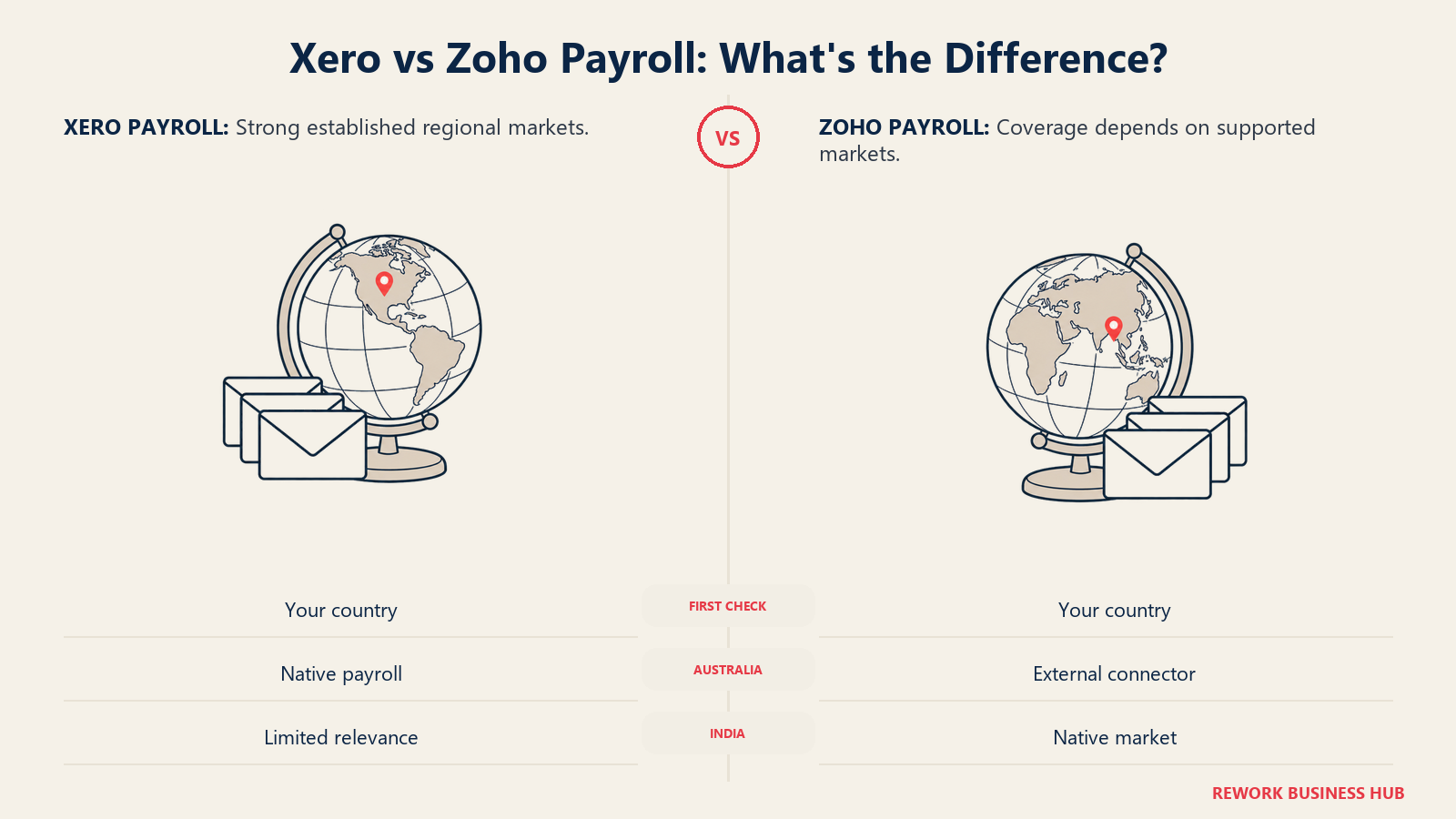
In the US, the order of arrival actually favors Zoho. Zoho Payroll's US edition, covering all 50 states, launched December 12, 2024, giving it nearly two years of US track record by the time you're reading this. Xero Payroll, powered by Gusto, only launched August 12, 2026, a few weeks before this comparison was last updated. It's a real, full-featured product (unlimited runs, automated federal, state, and local tax filing, direct deposit, W-2 and 1099-NEC support, benefits calculations, PTO, employee self-service), but it's new. That flips the usual assumption that Zoho isn't built for the US market, at least on the payroll question specifically.
| Xero + Gusto-powered payroll | Zoho Payroll Standard | Zoho Payroll Professional | |
|---|---|---|---|
| Base price | $36/mo | $39/mo ($29/mo annual) | $59/mo ($49/mo annual) |
| Per employee | $6 | $6 | $8.50 |
| At 5 employees | $66/mo | $69/mo ($54/mo annual) | $101.50/mo ($84/mo annual) |
| At 10 employees | $96/mo | $99/mo ($79/mo annual) | $144/mo ($119/mo annual) |
| Multi-state payroll | Included | Not included | Included |
| Live in the US since | August 12, 2026 | December 12, 2024 | December 12, 2024 |
Outside the US, the picture reverses hard. Xero has run native, compliance-built payroll in Australia for years, and since June 1, 2025, that payroll (plus automated superannuation) has been bundled into every Australian business plan rather than sold as an add-on. Plan tiers there scale directly with payroll headcount: Ignite at roughly $37 AUD a month covers 1 payroll person, Grow around $78 covers 2, Comprehensive near $107 covers 5, and Ultimate 10 near $143 covers 10, climbing to a new Ultra tier introduced in July 2026 (figures reported across multiple Australian accounting-software trackers; confirm current pricing with Xero). Single Touch Payroll reporting to the ATO is included on every tier.
Zoho Payroll doesn't reach Australia at all. Per Zoho's own payroll product page, it's natively available in exactly four markets: the US, Canada, India, and the GCC countries. An Australian business running Zoho Books has to connect a third-party payroll tool, commonly marketed as a Payroll Hub for Zoho built on Employment Hero, rather than a native Zoho option.
| Payroll factor | Xero | Zoho Books (via Zoho Payroll) |
|---|---|---|
| US payroll | Add-on, powered by Gusto, live since August 12, 2026 | Native, live since December 12, 2024 |
| Australia payroll | Native, bundled into every plan since June 2025, STP and super included | Not available; requires a third-party connector |
| India payroll | Not a core Xero market | Native, one of Zoho Payroll's original three launch markets |
| Canada and GCC payroll | Not covered in this comparison | Native |
| Where the vendor's payroll runs deepest overall | Australia, New Zealand, and the UK as long-standing core markets, plus a new US offering | Exactly four countries: US, Canada, India, GCC |
The practical read: if you're a US business, both platforms now have functioning payroll, and Zoho's has two years more runway than Xero's. If you're an Australian business, Xero's payroll is mature, bundled, and compliance-native, and Zoho Books' isn't available at all, which alone is often reason enough to lead with Xero. If you're in India, the read flips again: Zoho Payroll is a native, original-market product, and Xero doesn't meaningfully compete there. Check your own country against both lists before assuming either platform "does payroll" the way its US marketing implies.
Support
| Support factor | Xero | Zoho Books |
|---|---|---|
| Phone support | None. Xero states any phone number claiming to be Xero support is a scam | Not on Free or Standard; added from Professional up |
| Standard channel | Email and case-based, with a callback option | Email only on Free and Standard |
| Higher-tier channels | Same model across every plan, no phone tier | Voice added on Professional; live chat added on Premium and up |
| Self-service | Xero Central, a large help base plus community | Zoho Books help center plus community forums |
Implementation and Migration
| Implementation factor | Xero | Zoho Books |
|---|---|---|
| Typical clean setup | 1 to 2 weeks | 1 to 2 weeks |
| Migration from spreadsheets | Straightforward, guided setup | Straightforward, guided setup |
| Migration from QuickBooks | Import tools available; a common switch path | Import tools available, with Zoho's own migration guidance |
| Who usually leads it | In-house bookkeeper or a Xero-certified partner firm | In-house bookkeeper, or a Zoho partner if you're already implementing the wider suite |
When Xero Is the Right Call
- You've got 3 or more people who need real logins. Xero's flat pricing wins on cost the moment you're past a couple of users, and it keeps winning as the team grows.
- You're an Australian, New Zealand, or UK business. Xero's payroll and compliance depth in these markets is mature and, in Australia's case, bundled into every plan by default.
- You're assembling a best-of-breed stack. With 1,000+ marketplace apps, Xero fits neatly next to whatever CRM, inventory, or payments tool you already run.
- You want one price regardless of who joins later. Whether it's your 4th hire or your 20th, the plan price doesn't move.
If Xero's transaction caps or US ecosystem still don't fit, our best Xero alternatives guide covers the wider field, and Xero vs FreshBooks is worth a look if invoicing-first tools are also on your list.
When Zoho Books Is the Right Call
- You're already running Zoho CRM, Inventory, Expense, or People. The native, real-time data flow between those apps and Zoho Books is the platform's clearest advantage, and it's difficult for Xero to match without stitching in a connected app.
- You're a solo operator or a team of 3 to 5 watching cost closely. Zoho Books is cheaper than Xero at these headcounts, and its Free plan covers a genuinely usable set of features under the $50K revenue ceiling.
- You need multi-currency without paying for Xero's top tier. Zoho Books includes it from its $20 Standard plan; Xero gates the same capability behind its $90 Established plan.
- You're a US business and payroll timing matters. Zoho Payroll has been live in the US for close to two years longer than Xero's Gusto-powered offering.
If you're not sold on Zoho Books specifically, our best Zoho Books alternatives roundup covers the broader field, and our guide to choosing accounting software for a small business is a useful step before you commit to any platform.
Decision Framework
| If this is true for you | Pick |
|---|---|
| You need 3 or more real logins and want flat pricing | Xero |
| You're a solo operator or 3 to 5 person team watching cost | Zoho Books |
| You're based in Australia, New Zealand, or the UK | Xero |
| You're already running other Zoho apps (CRM, Inventory, Expense) | Zoho Books |
| You need multi-currency without paying for a top-tier plan | Zoho Books |
| You're a US business that needs payroll running today, not next quarter | Zoho Books, on payroll maturity alone |
| You're building a stack from several best-of-breed vendors | Xero |
| You need inventory tracking on an entry-level budget | Xero (Growing, $55/mo) over Zoho Books (Elite, $150/mo) |
What to Do Next
- Check your country against both payroll lists before anything else. An Australian business ruling out Xero over price is ruling out the only one of the two with native payroll in that market.
- Model your real headcount 12 months out, not today's. The Zoho-to-Xero crossover sits around 6 to 10 users; know which side of that line you'll be on before you commit.
- Ask your bookkeeper or accountant which platform they already run. Their fluency and availability often matter more than either vendor's monthly fee.
- Confirm Zoho Books' free tier actually fits. Pull your last 12 months of revenue and invoice count against the $50K and 1,000-invoice ceilings before assuming it applies to you.
- If neither vendor's core plan fits, widen the search. Our best accounting software for 2026 hub covers the full category, and QuickBooks vs Xero or QuickBooks vs Sage are worth reading if a third option belongs on your shortlist.
Frequently Asked Questions about Xero vs Zoho Books
Does Xero charge per user?
No. Xero charges no per-user fee on any of its three US plans (Early, Growing, Established). Every plan includes unlimited users; what changes by plan is the invoice, quote, and bill volume you're allowed each month.
Does Zoho Books charge per user?
Yes. Zoho Books includes a set number of users by tier (1 on Free, 3 on Standard, 5 on Professional, 10 on Premium and Elite, 15 on Ultimate), and additional users cost $3/mo each ($2.50 billed annually) past that count.
What's the revenue limit on Zoho Books' free plan?
In the US, annual revenue has to stay under $50,000 for the Free plan to remain eligible indefinitely. In India, the same plan's ceiling is lower, ₹25 lakh, roughly $28,000 to $30,000. Both plans also cap at 1,000 invoices a year and 1 user plus 1 accountant.
Is Zoho Payroll available in Australia?
No. Per Zoho's own payroll product page, Zoho Payroll is natively available in exactly four markets: the US, Canada, India, and the GCC countries. Australian Zoho Books users typically connect a third-party payroll tool instead of a native Zoho option.
Does Xero have native payroll in the US?
Yes, as of August 12, 2026. "Xero Payroll, powered by Gusto" runs as an add-on priced at $36/mo plus $6 per employee or contractor, and includes unlimited payroll runs, automated tax filing, and direct deposit. It's new; Zoho Payroll's US edition has been live since December 2024.
Which platform is cheaper for a 10-person team?
Xero, by a real margin. A 10-person team fits Xero's Growing plan at a flat $55/mo. The same team needs Zoho Books' Premium plan at $70/mo, since Premium and Elite both cap at 10 included users.
Is Xero's price about to increase?
Yes. Effective October 1, 2026, Xero's US plans rise from $25 to $27 (Early), $55 to $59 (Growing), and $90 to $97 (Established), increases of roughly 7 to 8%. Zoho Books hasn't announced a comparable change.
Which platform has more US-based accountants who already know it?
Xero. It reports 250,000-plus accountants and bookkeepers in its global partner program, and 6sense's Accounting-category data puts Xero at a 6.28% share (3rd place) versus Zoho Books at 0.83% (20th place). Zoho doesn't publish a comparable partner headcount.
Related Resources:

Principal Product Marketing Strategist
On this page
- Key Facts
- TL;DR: Xero vs Zoho Books at a Glance
- What Each Platform Is Actually Built For
- Pricing at Real Headcounts: 1, 3, 5, 10, and 25 Users
- The Constraints That Aren't in the Price
- Core Accounting Depth
- Automation and Workflow
- Ecosystem and Integrations
- Which One Your Accountant Actually Works In
- Payroll and Regional Availability: The Constraint That Decides It for Some Buyers
- Support
- Implementation and Migration
- When Xero Is the Right Call
- When Zoho Books Is the Right Call
- Decision Framework
- What to Do Next