Copper vs Zoho CRM: Is the Google-Native Premium Worth It in 2026?
Turn this article into takeaways for your work.


Each assistant summarizes the article only for you and suggests best practices for your work.
If you've priced out Copper and Zoho CRM side by side, you've hit the number that makes this comparison worth writing. Copper's Business plan runs $99 a seat a month billed annually. Zoho CRM's Standard plan, the cheapest paid tier either vendor sells, runs $14. That's close to a sevenfold gap on sticker price alone, the kind of gap that makes a comparison either useless (pick the cheap one) or genuinely useful (explain what the expensive one buys, and when the cheap one costs more elsewhere).
This one aims for the second kind. You're evaluating CRMs for a team of 10 to 100 people, likely already inside Google Workspace, and probably suspecting "cheaper per seat" and "cheaper overall" aren't the same claim. They're not. Zoho CRM's license price is lower at every seat count here, but its five-edition ladder, Blueprint automation, and tier-gated Zia AI mean someone spends real hours configuring it, hours Copper mostly eliminates by design. Whether that trade is worth it depends on how many hours you have, and how deep your sales process needs to go.
We priced both platforms from their own pricing pages at 10, 25, and 100 seats, checked what the Zoho One bundle changes if you're weighing the wider Zoho suite instead of CRM alone, and put the admin-effort question next to the invoice rather than ignoring it. For the wider field before narrowing to these two, our guide to the best CRM software of 2026 covers the category; for a structured way to score any CRM against your own requirements, the CRM evaluation criteria checklist does that work for you.
Key Facts
- Copper's Business plan costs $99/seat/month billed annually ($134 billed monthly), the top of a three-tier ladder with no published Enterprise tier (Copper pricing).
- Zoho CRM's Standard edition costs $14/user/month billed annually, the cheapest of five editions running up to Ultimate at $52/user/month (Zoho CRM pricing).
- Copper caps contacts by tier: 2,500 on Basic and 15,000 on Professional, unlimited only on the $99/seat Business plan (Copper pricing).
- Zoho CRM's cheapest paid edition, Standard, already allows 100,000 records; Professional and Enterprise scale to 5 million and 7.5 million depending on org size (Zoho CRM data storage documentation).
- Copper connects natively to Gmail, Google Calendar, Drive, Sheets, and Chat, but has no native Outlook or Microsoft 365 connector, only third-party tools like Zapier (Copper integrations).
- Zoho CRM integrates natively with both Google Workspace and Microsoft 365, and Zoho markets it as the most downloaded CRM app in the Google Workspace Marketplace, a vendor claim (Zoho CRM for Google Workspace).
- Zoho One's Flexible User plan bundles Zoho CRM with 50-plus apps at $90/user/month billed annually. The All Employee plan drops that to $37/employee/month but requires licensing your entire headcount (Zoho One pricing).
Copper vs Zoho CRM at a Glance
| Factor | Copper | Zoho CRM |
|---|---|---|
| Best known for | The deepest native Gmail and Google Workspace embedding of any mainstream CRM | The widest CRM tier ladder in the category, with a full app suite behind it |
| Entry price | Basic, $23/user/mo billed annually. No free plan | Free for up to 3 users, then Standard at $14/user/mo billed annually |
| Top published tier | Business, $99/user/mo billed annually | Ultimate, $52/user/mo billed annually |
| Where it lives | Inside Gmail as a sidebar, built specifically for Google Workspace | A standalone app with native connectors to both Google Workspace and Microsoft 365 |
| Contact or record ceiling | 2,500 (Basic) up to unlimited (Business) | 100,000 records (Standard) up to 7.5 million (Enterprise) |
| Setup effort | Low. Auto-populates from Gmail with little configuration required | Higher. Five editions, Blueprints, custom modules, and tiered Zia AI all need setup |
| AI and automation depth | Light. Workflow automation from Professional, no named AI assistant brand | Zia, tier-gated from Standard, full agent capability at Enterprise and Ultimate |
| Ecosystem play | None. Copper is CRM only | Zoho One: 50-plus apps from $37 to $90/user/mo depending on plan |
| Best for | Small Google Workspace teams, roughly 5 to 30 people, that want zero-friction adoption | Budget-conscious teams willing to spend setup time for a much deeper ceiling |
What Each Tool Is Actually Built For
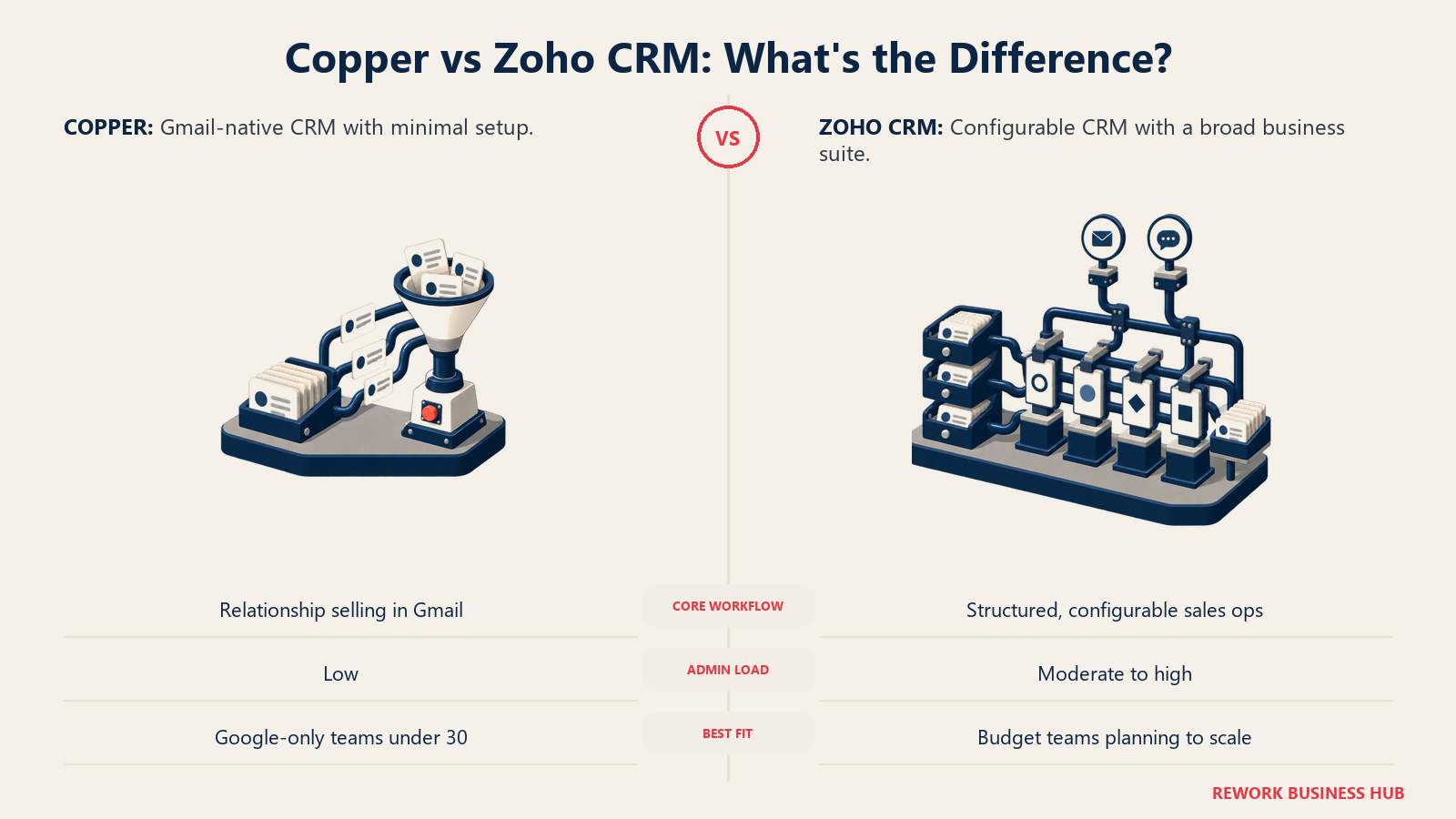
Copper's philosophy is that your CRM should live where you already work: Gmail, Calendar, and Drive. It auto-logs emails, creates contacts from Gmail conversations, attaches Drive files to records, and surfaces deal context inside a Gmail sidebar without asking anyone to switch tabs. It's a different design goal from most CRMs: reduce the friction of logging activity, rather than reduce the price of running a sales operation. That friction-first pitch is what Copper leads with against a platform-agnostic rival too, in our Copper vs Pipedrive comparison.
The tradeoff shows up in scope. Copper is CRM and light project tracking, full stop: no help desk, no marketing suite, no HR module. At $23 to $99 a seat, its automation depth doesn't go much further than what Zoho ships free on its no-cost tier. Copper's scope gets tested against a bundled competitor instead of a broad one in our Copper vs Freshsales comparison, where the rival packs phone and chat into the same seat price rather than a 50-app ecosystem.
Zoho CRM's philosophy is the opposite bet: breadth at a price nobody else in the category matches. Five editions, from a free tier capped at 3 users up to Ultimate, let a 3-person team and a 300-person team run the same product without switching platforms as they grow. Zia, Zoho's AI layer, scales the same way: light on Standard, fully autonomous Zia Agents at Enterprise and Ultimate. Zoho CRM is also one module inside a company selling 50-plus apps under one login (Zoho One), a different bet than Copper's single-product focus. Zoho runs that same low-price argument against a narrower, pipeline-first rival in our Pipedrive vs Zoho CRM comparison.
| Capability | Copper | Zoho CRM |
|---|---|---|
| Pipeline and deal tracking | Yes, all tiers | Yes, all tiers including Free |
| Contact auto-population from email | Yes, Gmail only, all tiers | Requires connector setup even with native integrations |
| Workflow automation | From Professional ($59/seat/mo) | From Free (10 rules per module), scaling to 150 on Ultimate |
| Guided sales process enforcement | Not a named feature | Blueprints, from Professional ($23/user/mo) |
| Custom modules or objects | Limited customization across tiers | 10 (Standard) up to 500 (Ultimate) |
| Native AI assistant | No named AI brand, light automation only | Zia, tier-gated, full agent capability at Enterprise and Ultimate |
| Built-in project tracking | Yes, Basic and up | Not core to CRM; lives in the separate Zoho Projects app |
| Multi-currency support | Business tier only | Included from Professional |
| Bundled wider app suite | None, Copper is CRM only | Zoho One, 50-plus apps |
Google Workspace and Microsoft Integration: The Real Difference
Copper's whole pitch rests on one design decision: build the CRM inside Gmail rather than beside it, a real, measurable difference, not just marketing copy. Copper natively connects to Gmail, Google Calendar, Drive, Sheets, and Chat, plus Slack, Mailchimp, QuickBooks, and DocuSign, with Zapier bridging roughly 3,000 more apps (Copper integrations). What it doesn't do natively is Outlook or Microsoft 365. If any part of your team runs on Microsoft's stack, Copper's core advantage disappears for those seats, and you're paying premium pricing for a mid-tier CRM stitched together through a third-party layer.
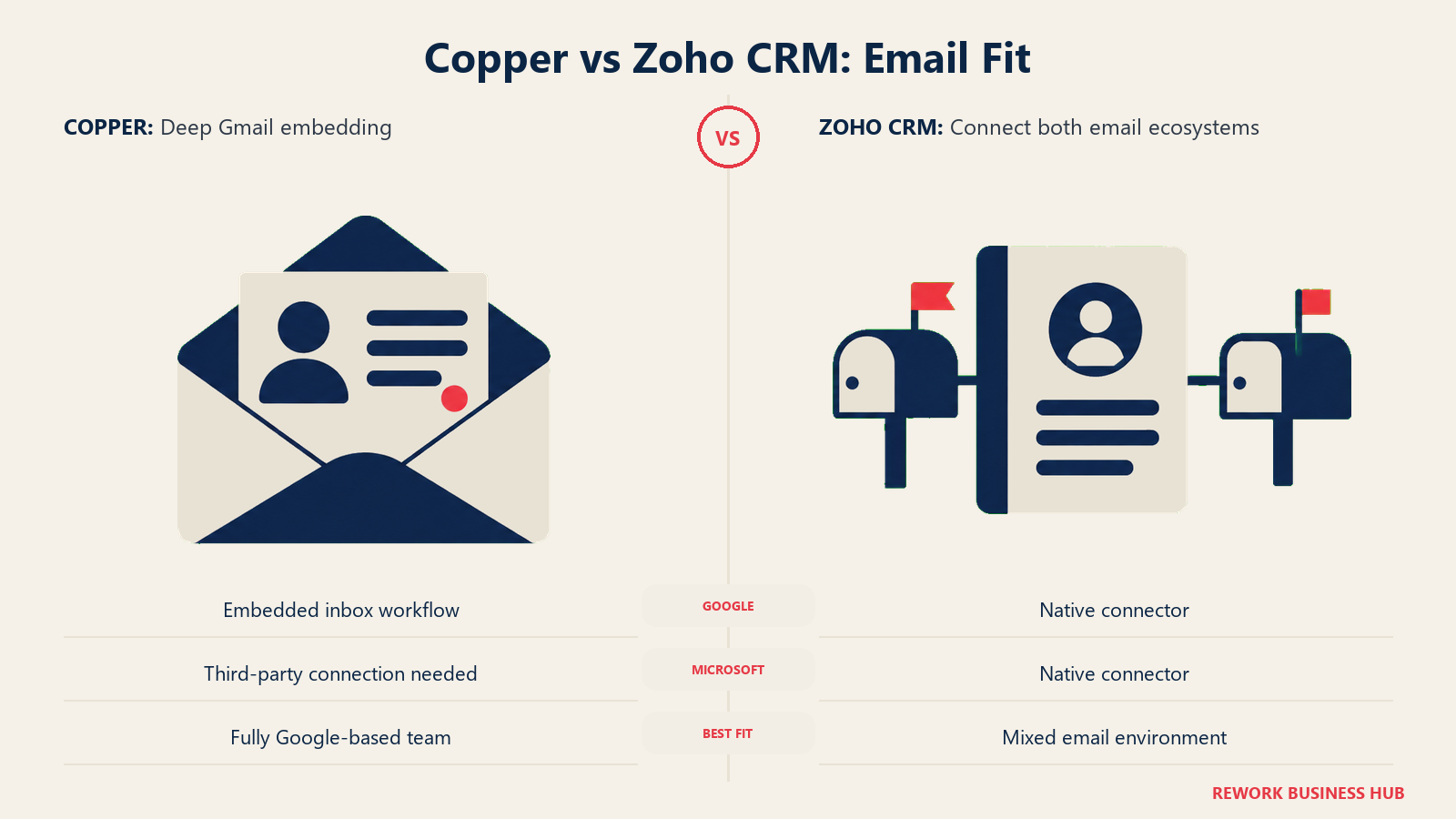
Zoho CRM plays it the other way: native connectors to both ecosystems. It syncs Gmail, Calendar, Drive, and Sites on the Google side, and Outlook, Word, and the rest of Microsoft 365 on the other, including CRM dashboards inside Microsoft Teams. Zoho's own marketing calls it the most downloaded CRM app in the Google Workspace Marketplace, a vendor claim worth flagging as such, but the dual-platform native support is a real structural difference: Zoho doesn't force you to bet your CRM on which email platform your company runs.
If your team is, and will stay, 100 percent Google Workspace, Copper's embedded-in-Gmail model removes friction a native connector doesn't fully replicate. If your team is mixed, or might switch platforms later, that Google-only design is a lock-in risk you're paying a premium to accept.
| Integration | Copper | Zoho CRM |
|---|---|---|
| Gmail and Google Workspace | Native, deepest in the category (in-inbox sidebar) | Native, syncs Gmail, Calendar, Drive, Sites, Google Ads |
| Outlook and Microsoft 365 | Not native. Third-party automation only (Zapier, Make) | Native, syncs Outlook, Word, Microsoft Teams |
| Team chat | Slack, native | Available via the Zoho Marketplace |
| Accounting | QuickBooks, native | Via Zoho Books (Zoho's own product) or the Marketplace |
| Broader automation reach | Zapier, roughly 3,000 connected apps | Zoho Flow, Zapier, and the Zoho Marketplace |
Decision by Business Goal
| Business goal | Better fit | Why |
|---|---|---|
| Get reps logging activity without fighting the tool | Copper | Auto-populates from Gmail; there's nothing to remember to log |
| Keep license cost near zero while the team is small | Zoho CRM | Free for up to 3 users, Standard at $14/seat after that |
| Enforce a multi-step sales process with approvals | Zoho CRM | Blueprints (Professional) hard-block stage changes until steps complete |
| Run a Google-only agency or consulting team under 20 people | Copper | Purpose-built for exactly this profile |
| Support both Gmail and Outlook users on the same team | Zoho CRM | Native connectors to both; Copper only natively supports Google |
| Consolidate CRM with finance, HR, and support under one vendor | Zoho CRM, via Zoho One | 50-plus apps under one login; Copper has no adjacent product line |
| Avoid hiring or training a dedicated CRM administrator | Copper | Fewer editions and a smaller configuration surface mean faster time to value |
| Plan for 100,000-plus contact records without re-platforming | Zoho CRM | Standard already allows 100,000 records; Copper's Basic caps at 2,500 |
Team and Role Fit
| Role | Copper | Zoho CRM |
|---|---|---|
| Account managers and relationship-first reps | Strong fit. Gmail-native history removes logging friction | Adequate, but needs more manual entry without the Gmail embed |
| Sales ops or RevOps lead | Weak fit past small teams. Thin reporting, no native lead routing | Strong fit. Blueprints and workflow rules give real process control |
| Marketing | Not a fit. No bundled marketing tools | Fit via Zoho Campaigns or Marketing Automation, a separate app and login |
| IT or systems admin | Minimal admin burden, little to manage | A real ongoing role past Standard: someone owns modules, Blueprints, Zia tiering |
| Founder or owner at a small agency | Strong fit if 100 percent Google Workspace | Strong fit if budget matters more than setup time |
| Customer success | Not covered. Copper is sales-pipeline only | Covered only if you add Zoho Desk, a separate product |
Pricing at 10, 25, and 100 Seats
Start with what each vendor actually publishes, since that's the part most comparisons get wrong or leave stale.
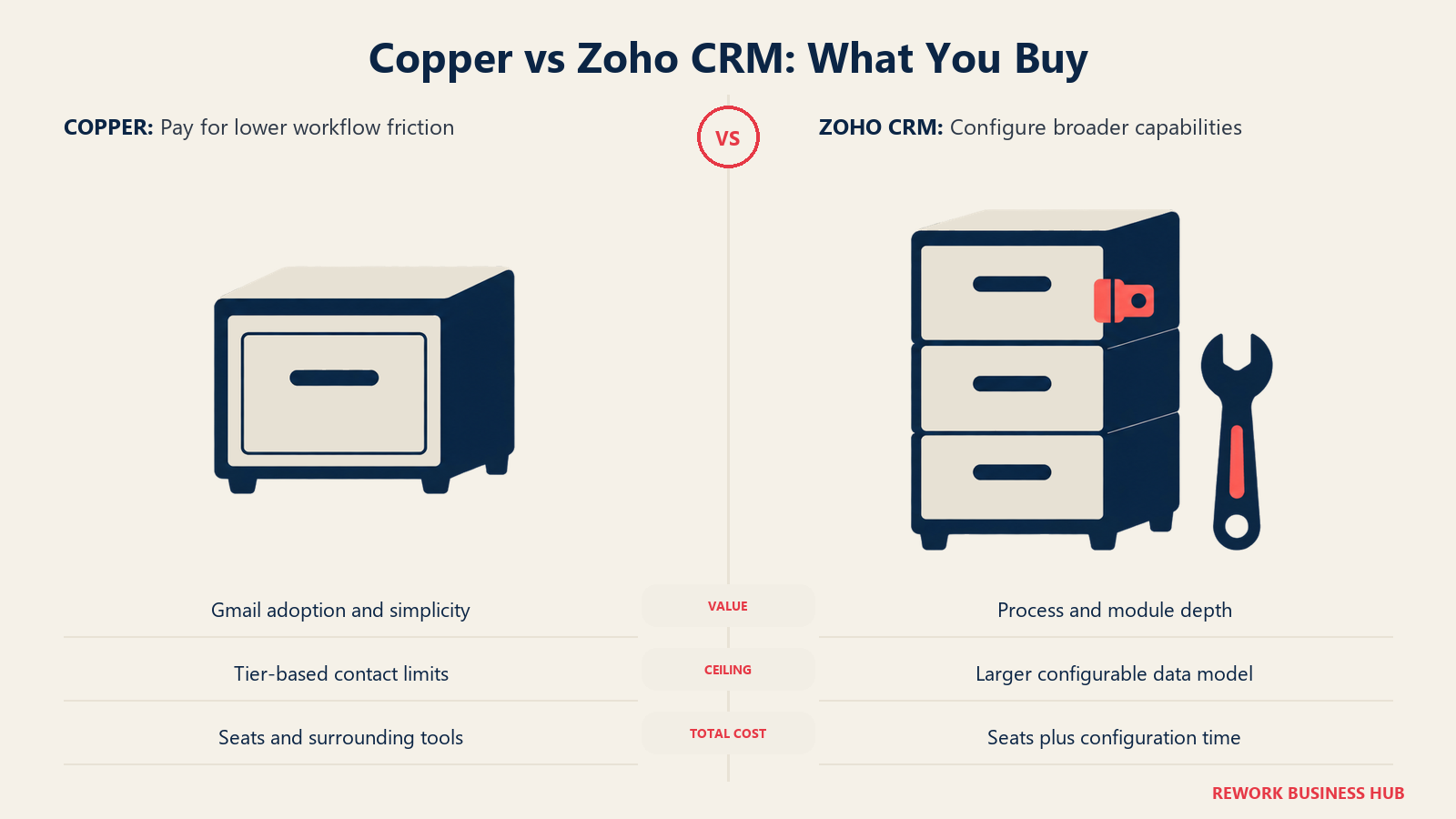
Copper runs three tiers, no free plan, and no published Enterprise pricing:
| Copper plan | Monthly billing | Annual billing (per seat/mo) | Contact limit |
|---|---|---|---|
| Basic | $29/seat/mo | $23/seat/mo | 2,500 |
| Professional | $69/seat/mo | $59/seat/mo | 15,000 |
| Business | $134/seat/mo | $99/seat/mo | Unlimited |
Source: Copper pricing. Copper offers a free trial with no credit card required and does not state a seat minimum on its pricing page. Some older roundups still cite a lower-cost Starter plan around $9/seat/month; that tier no longer appears on Copper's current pricing page, so treat any listing that still cites it as stale.
Zoho CRM runs five editions, including a genuine, permanent free tier:
| Zoho CRM edition | Monthly billing | Annual billing (per user/mo) | Users |
|---|---|---|---|
| Free | $0 | $0 | Up to 3 |
| Standard | $20/user/mo | $14/user/mo | 4 and up |
| Professional | $35/user/mo | $23/user/mo | 4 and up |
| Enterprise | $50/user/mo | $40/user/mo | 4 and up |
| Ultimate | $65/user/mo | $52/user/mo | 4 and up |
Source: Zoho CRM pricing. The Free edition supports exactly 3 users; a 4th user forces an upgrade to Standard.
Now the math that actually matters: what 10, 25, and 100 seats cost across every tier, billed annually.
| Seats | Copper Basic | Copper Professional | Copper Business | Zoho Standard | Zoho Professional | Zoho Enterprise | Zoho Ultimate |
|---|---|---|---|---|---|---|---|
| 10 | $2,760 | $7,080 | $11,880 | $1,680 | $2,760 | $4,800 | $6,240 |
| 25 | $6,900 | $17,700 | $29,700 | $4,200 | $6,900 | $12,000 | $15,600 |
| 100 | $27,600 | $70,800 | $118,800 | $16,800 | $27,600 | $48,000 | $62,400 |
Read the Copper Basic column at 100 seats as a warning, not a live option. A team that size has almost certainly blown past Basic's 2,500-contact cap long before hiring seat 100, so that number looks cheap on paper but isn't actually purchasable at that scale.
Here's the number worth sitting with: Copper Basic and Zoho Professional cost exactly the same per seat, $23/month billed annually, at every seat count above. Not close, identical. At that price, the two vendors hand you completely different products.
| At $23/seat/month, billed annually | Copper Basic gets you | Zoho Professional gets you |
|---|---|---|
| Workflow automation | Not included, starts at Professional ($59/seat) | Included, up to 80 rules per module |
| Process enforcement | Not available | Blueprints: a guided, multi-step sales process |
| AI assistance | Not available | Zia, expanded lead and deal intelligence |
| Contact or record ceiling | 2,500 contacts | Up to 5 million records (10GB of storage) |
| Custom modules | Not meaningfully available | 25 custom modules |
At the opposite end, Copper Business ($99/seat) costs nearly double Zoho's top tier, Ultimate ($52/seat), which already includes Zoho's deepest automation and AI. Whatever Copper's premium buys there, it isn't more capability than Zoho offers for less.
The Zoho One Bundle Option
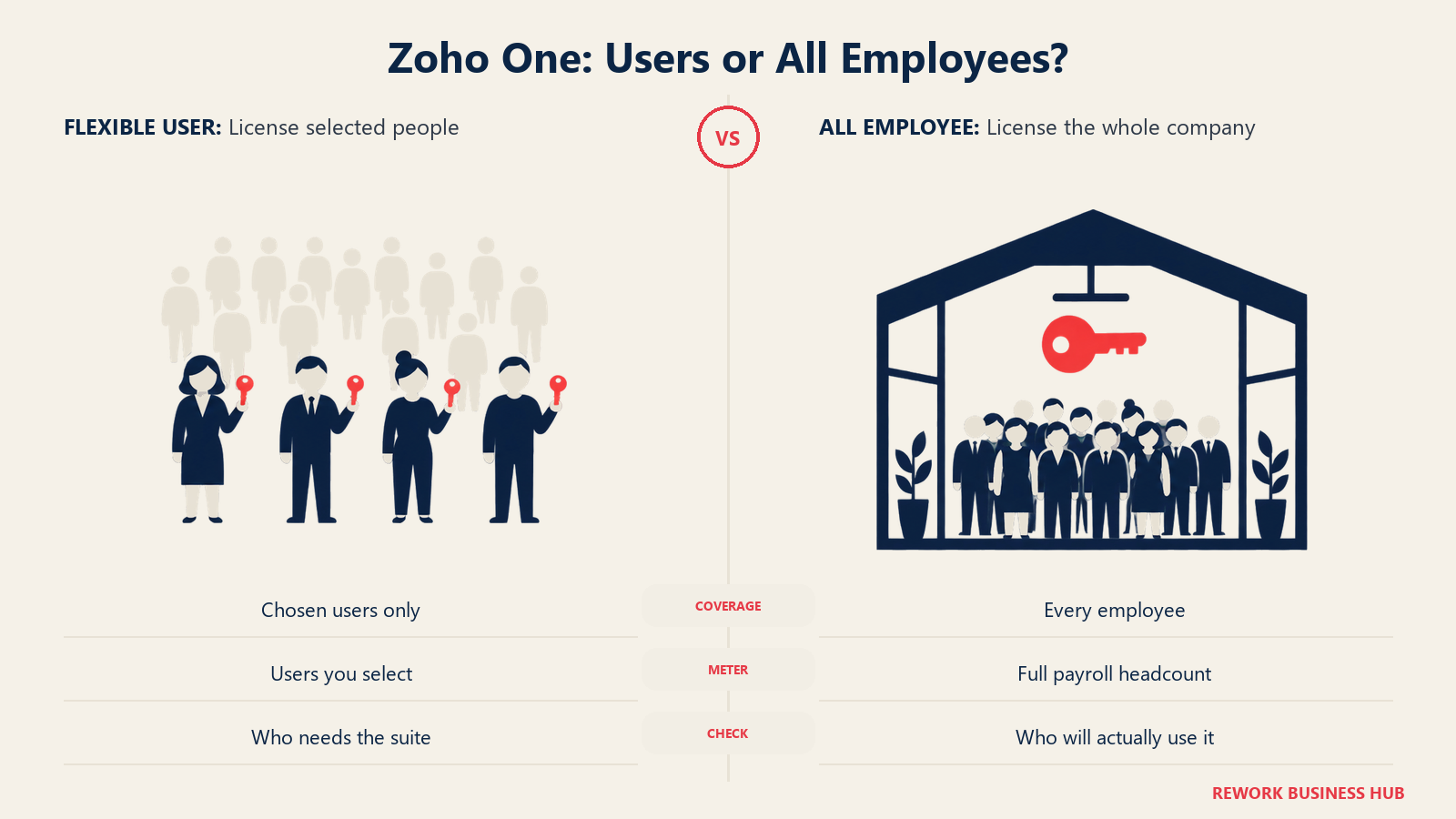
If you're weighing Zoho CRM as part of a bigger consolidation move rather than deciding on a standalone CRM, Zoho One changes the math. It bundles Zoho CRM with 50-plus apps (Books, Desk, Projects, People, Campaigns, and more) under two different pricing models.
| Zoho One plan | Price | Who it covers | 10 seats/yr | 25 seats/yr | 100 seats/yr |
|---|---|---|---|---|---|
| Flexible User Pricing | $90/user/mo billed annually | Only the users you choose to license | $10,800 | $27,000 | $108,000 |
| All Employee Pricing | $37/employee/mo billed annually | Every employee on payroll, whether they use Zoho or not | $4,440 | $11,100 | $44,400 |
Source: Zoho One pricing.
The All Employee plan looks dramatically cheaper, but reread the condition: it requires licensing your entire headcount, not just CRM users. It's a genuine bargain if most of your company would actually use some Zoho app (Books, Desk, People). It's a bad deal if you only want CRM for a 10-person team inside a 100-person company, since you'd pay for 90 people who never touch it, or fall back to Flexible User Pricing.
Worth noticing: Zoho One's Flexible plan, at $90/seat, actually undercuts Copper's own top tier, Business, at $99/seat, while bundling 50-plus apps beyond CRM. Copper has no equivalent bundle; it is, and will only ever be, a CRM. If ecosystem consolidation matters at all, that's a gap no amount of Copper configuration closes. If Zoho CRM alone still feels heavier than a very small team needs, our Zoho Bigin alternatives guide covers that lighter tier.
The Admin Effort Gap: What Cheap Actually Costs
Zoho's per-seat price wins at every tier and seat count in this article. What the pricing page doesn't show is who spends the time making the product actually work for your process, and that person's time isn't free just because the software is.
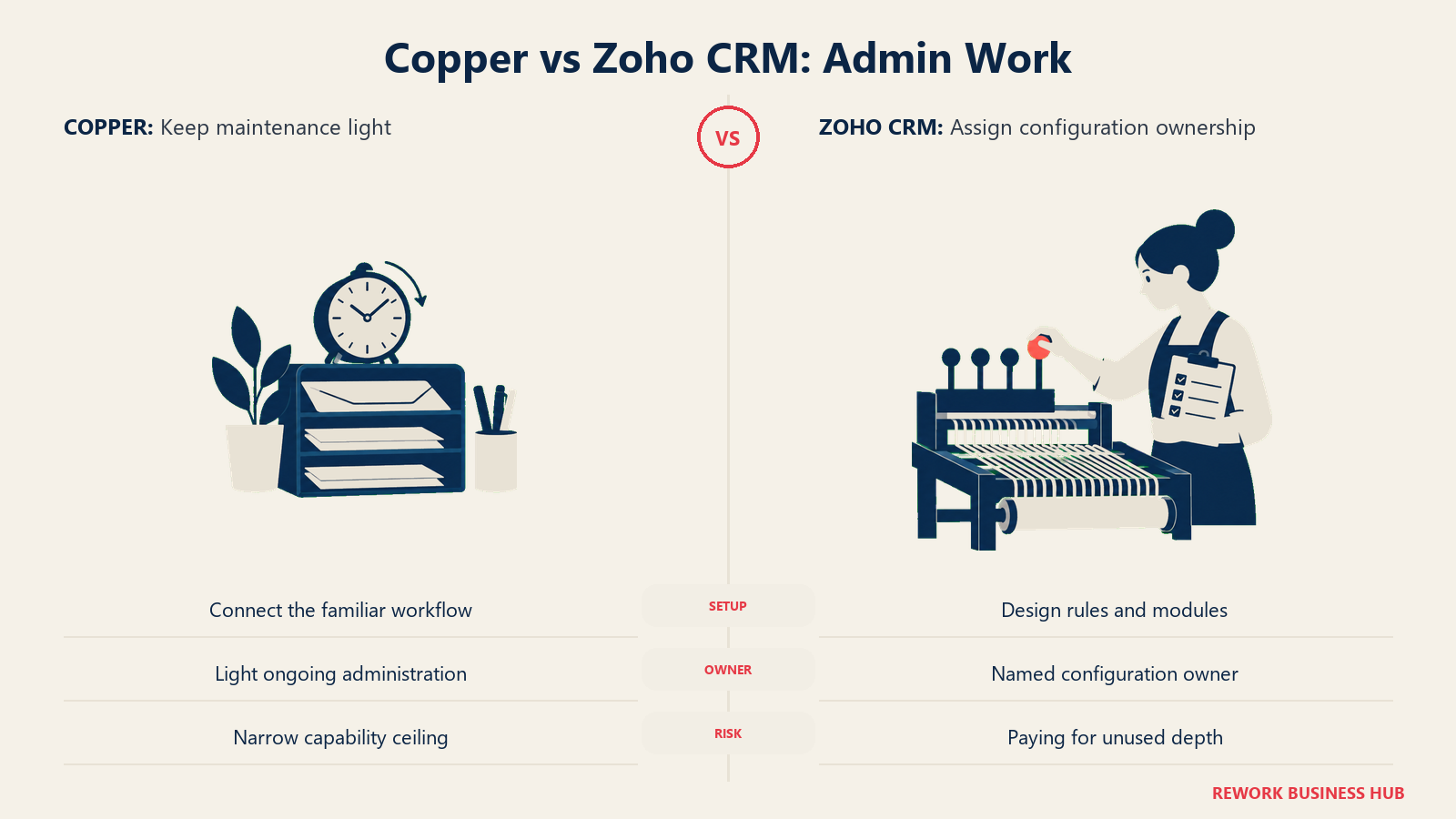
Copper's design minimizes that cost. There's little to configure because there's little the product tries to do: it reads your Gmail, populates the contact record, and shows the pipeline. Reviewers rate it well on ease of use and setup, and Copper's own pitch leans on that: automatic contact enrichment, close to zero manual entry.
Zoho CRM asks more in exchange for that ceiling. Five editions mean a real decision at signup that compounds: which workflow rules to build, whether to invest in Blueprints to enforce your process, and which of Zia's capabilities are worth a whole tier to unlock. None of that makes Zoho bad software, it's the direct cost of depth at a fraction of Copper's price. A team that never assigns anyone to own that configuration ends up using Zoho CRM like a cheaper, more powerful contact list, paying for capability it never activates.
| Admin factor | Copper | Zoho CRM |
|---|---|---|
| Editions to choose between | 3 | 5 |
| Setup before first productive use | Minutes to hours, mostly connecting Gmail | Hours to days for Standard; weeks if Blueprints and custom modules are in scope |
| Ongoing configuration owner needed | Rarely. The product is largely self-maintaining | Usually, once past Standard: someone owns workflow rules, Blueprints, and Zia tiering |
| Where the time cost actually shows up | Almost nowhere, that's the whole pitch | Blueprint design, custom module structure, choosing which Zia tier to buy |
| G2 rating, 2026 | 4.5/5, based on roughly 1,150 reviews | 4.1/5, based on roughly 2,900 reviews |
Sources for the ratings: Copper reviews on G2, Zoho CRM reviews on G2, both approximate and current as of 2026.
Implementation and Change Management
| Factor | Copper | Zoho CRM |
|---|---|---|
| Typical time to first value | Same day to a few days | Days for Standard; weeks once Blueprints and custom modules are configured |
| Who needs training | Reps only. The workflow mirrors Gmail they already know | Reps plus whoever owns configuration, with more terminology to learn (modules, Blueprints, Zia) |
| Migration tooling | Standard CSV import, no dedicated migration wizard | Native import plus a Zoho-built migration wizard for common CRM sources |
| Multi-department rollout | Not applicable, Copper is single-purpose | Realistic via Zoho One, though each added app carries its own onboarding curve |
Risk and Governance
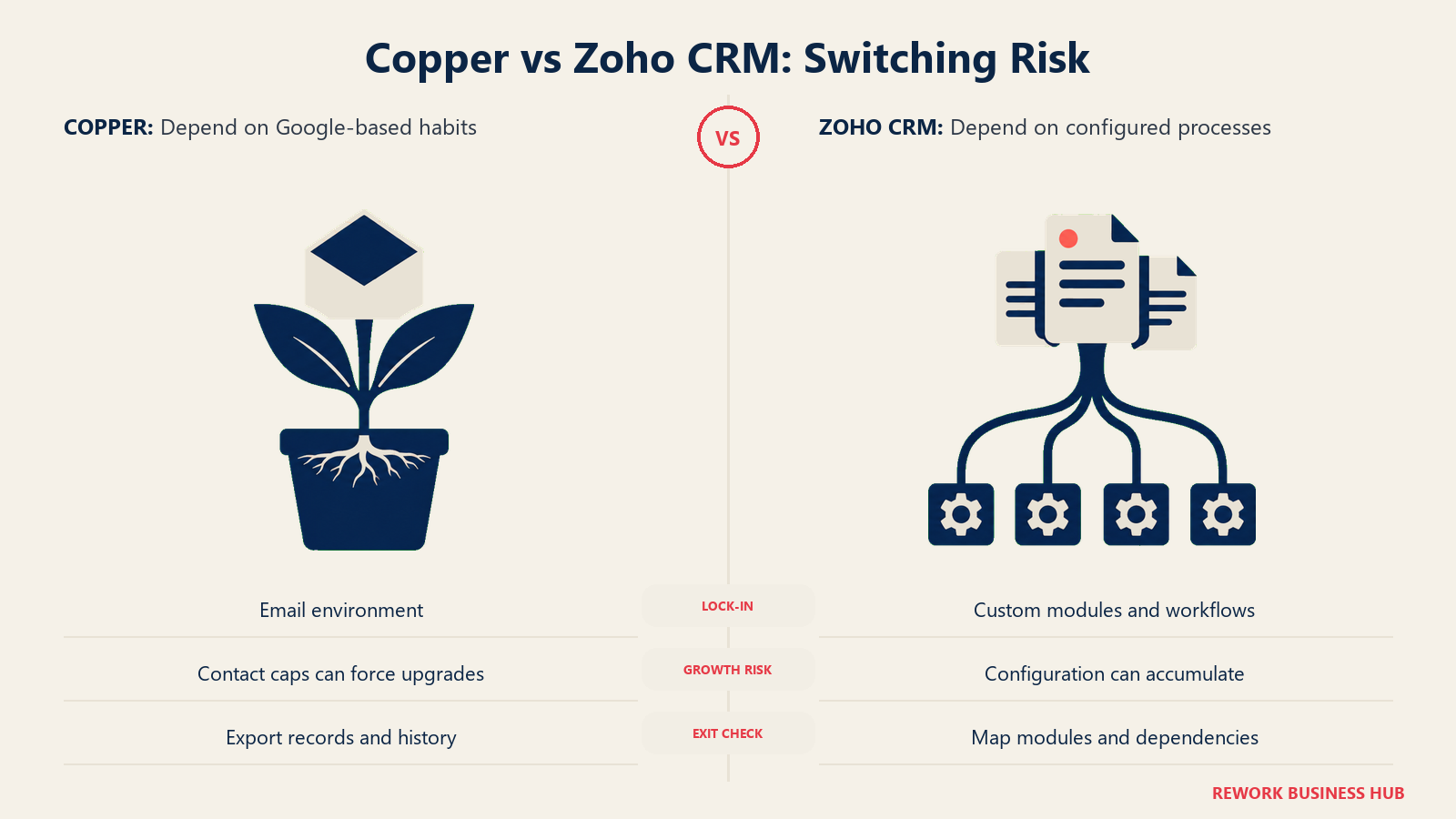
Copper depends on Google-based habits. Zoho becomes harder to unwind as custom modules and processes grow.
| Risk dimension | Copper | Zoho CRM |
|---|---|---|
| Platform lock-in | High if Google-only by design; painful if you add Outlook users later | Lower, native support for both major email and calendar ecosystems |
| Vendor scope | Single-product company; CRM is the whole business | Multi-product company (55-plus apps); CRM is one line among many |
| Data ceiling risk | Real. Basic's 2,500-contact and Professional's 15,000-contact caps can force an unplanned upgrade | Low. Standard already allows 100,000 records |
| Switching cost if you outgrow it | Moderate, Copper's narrow scope means less to unwind | Higher once Blueprints, custom modules, and workflow rules are built out |
| Enterprise-grade governance | No published Enterprise tier; Business is the ceiling | Ultimate exists, but confirm SSO and audit-log detail with sales before buying at scale |
When Copper Is the Right Call
- Your team is 100 percent Google Workspace, with no Outlook users anywhere, and you don't expect that to change soon.
- You're roughly 5 to 30 people, likely an agency or account-management-heavy team running relationships mostly through email. Our guide to choosing a CRM for small business covers the broader criteria.
- Getting reps to actually log activity has been your biggest CRM adoption problem in the past.
- You don't need marketing automation, a help desk, or process enforcement, just a clean pipeline attached to your inbox.
- You'd rather pay more per seat than assign anyone to own ongoing CRM configuration.
When Zoho CRM Is the Right Call
- Budget per seat is a real constraint, and you're willing to spend setup time for more capability.
- Your team spans both Gmail and Outlook users, or might within the next couple of years.
- You need process enforcement through Blueprints, or you're planning to grow past a few thousand contact records.
- You're already considering other Zoho apps (Books, Desk, Projects, People) and the Zoho One bundle math.
- You have, or can assign, someone to own CRM configuration as a real, ongoing responsibility, not a one-time setup task.
Decision Framework
| If you are... | Pick |
|---|---|
| A Google Workspace-only team under 30 people that wants zero setup friction | Copper |
| Budget-constrained and willing to spend setup time for more depth | Zoho CRM |
| Running both Gmail and Outlook users on the same team | Zoho CRM |
| Planning to enforce a multi-step sales process with hard stage gates | Zoho CRM, Professional or above, for Blueprints |
| Choosing Copper mainly because it feels premium, without a specific Google-only reason | Price out Zoho CRM Standard first. The gap is bigger than it looks |
| Considering consolidating CRM with finance, HR, or support under one vendor | Zoho CRM, via Zoho One |
| Comparing more than just these two | See our best sales pipeline software guide |
What to Do Next
- Count how many users are on Outlook versus Gmail. If it's not 100 percent Google, Copper's core advantage doesn't apply to your whole team, and that alone may settle it.
- Price Zoho CRM Professional against Copper Basic before assuming Copper is simply "the expensive one." At $23/seat billed annually, they cost exactly the same, so the real question is whether you'll use Blueprints and Zia, or Copper's simplicity is worth paying nothing extra for.
- If you're weighing more than CRM, get a real Zoho One quote on the Flexible User plan before assuming standalone Zoho CRM pricing is your ceiling.
- Decide who owns CRM configuration before buying Zoho CRM past Standard. If the honest answer is "no one," Copper's lower-maintenance model may be worth its premium regardless of the sticker price gap.
- Still narrowing the field? Our Copper alternatives and Zoho alternatives guides cover what else sits in each tier, and Zoho CRM vs Freshsales is worth reading if Zoho's price is right but its complexity gives you pause.
Neither tool solves a problem outside CRM. If leads arrive through WhatsApp or Instagram with no route into Gmail or a Zoho module, that's a different problem than either tool fixes. Rework packages CRM, lead management, and a multi-channel inbox in one product, as its Revenue Engine, from $159/month billed yearly with 5 marketing and 5 sales seats (rework.com/pricing). It isn't a Google Workspace specialist like Copper and doesn't carry Zoho's ecosystem, so it's not the answer if either strength is why you're choosing between these two. But if the real gap is somewhere neither tool covers, it's worth a look.
Frequently Asked Questions about Copper vs Zoho CRM
Is Copper or Zoho CRM cheaper?
Zoho CRM is cheaper at every tier and seat count. Standard starts at $14/user/month billed annually versus Copper Basic at $23/user/month. At the top end, Zoho Ultimate costs $52/user/month versus Copper Business at $99/user/month, nearly double.
Why would anyone pay more for Copper if Zoho CRM is cheaper?
Copper's price buys deep, native Gmail embedding and a much lower setup and admin burden. Zoho CRM's five-edition ladder, Blueprints, and tiered Zia AI give more capability per dollar, but someone has to configure it. If your team is 100 percent Google Workspace and nobody wants to own CRM configuration, Copper's premium can be a reasonable trade.
Does Zoho CRM work as well as Copper inside Gmail?
Not quite as deeply. Zoho CRM has a native Google Workspace connector covering Gmail, Calendar, Drive, and Sites, and Zoho markets it as the most downloaded CRM app in the Google Workspace Marketplace. But Copper's whole product is built around living inside the Gmail inbox as a sidebar, a deeper embedding than a connector provides. Zoho's edge is that the same connector approach also supports Outlook and Microsoft 365 natively, which Copper does not.
What's the real cost difference at 25 seats?
On matched entry tiers, Copper Basic and Zoho Professional both cost exactly $23/user/month billed annually, so 25 seats runs $6,900/year on either platform. At that identical price, Zoho gives you workflow automation, Blueprints, and Zia AI, while Copper gives Gmail-native embedding and a 2,500-contact ceiling. At the top tier, Copper Business runs $29,700/year versus Zoho Ultimate at $15,600/year, less than half.
Is Zoho One worth it instead of buying Zoho CRM alone?
Only if your company would genuinely use several of its 50-plus apps. Flexible User pricing runs $90/user/month annually for just the users you license, more than Zoho CRM Ultimate alone but still cheaper than Copper's top tier. All Employee pricing drops to $37/employee/month but requires licensing your entire headcount, a good deal only if most of your company would actually use a Zoho app.
Does Copper have a free plan?
No. Copper has no free tier, only a free trial with no credit card required. Zoho CRM does have a genuine, permanent free plan, capped at 3 users, with no custom modules and minimal AI.
Can Copper connect to Outlook or Microsoft 365?
Not natively. Copper is built for Google Workspace, and connecting it to Outlook or Microsoft 365 requires a third-party tool like Zapier or Make. Zoho CRM natively supports both Google Workspace and Microsoft 365 out of the box.
What happens if my team outgrows Copper's contact limits?
You upgrade tiers. Basic caps at 2,500 contacts and Professional at 15,000; only the $99/seat Business plan removes the cap. Zoho CRM's cheapest paid tier, Standard, already allows up to 100,000 records, so the ceiling is far less likely to force an unplanned upgrade.

Head of Enterprise Solutions
On this page
- Key Facts
- Copper vs Zoho CRM at a Glance
- What Each Tool Is Actually Built For
- Google Workspace and Microsoft Integration: The Real Difference
- Decision by Business Goal
- Team and Role Fit
- Pricing at 10, 25, and 100 Seats
- The Zoho One Bundle Option
- The Admin Effort Gap: What Cheap Actually Costs
- Implementation and Change Management
- Risk and Governance
- When Copper Is the Right Call
- When Zoho CRM Is the Right Call
- Decision Framework
- What to Do Next