Shopware vs Salesforce Commerce Cloud vs Webflow Ecommerce: Which Fits Your Actual Scale?
Turn this article into takeaways for your work.


Each assistant summarizes the article only for you and suggests best practices for your work.
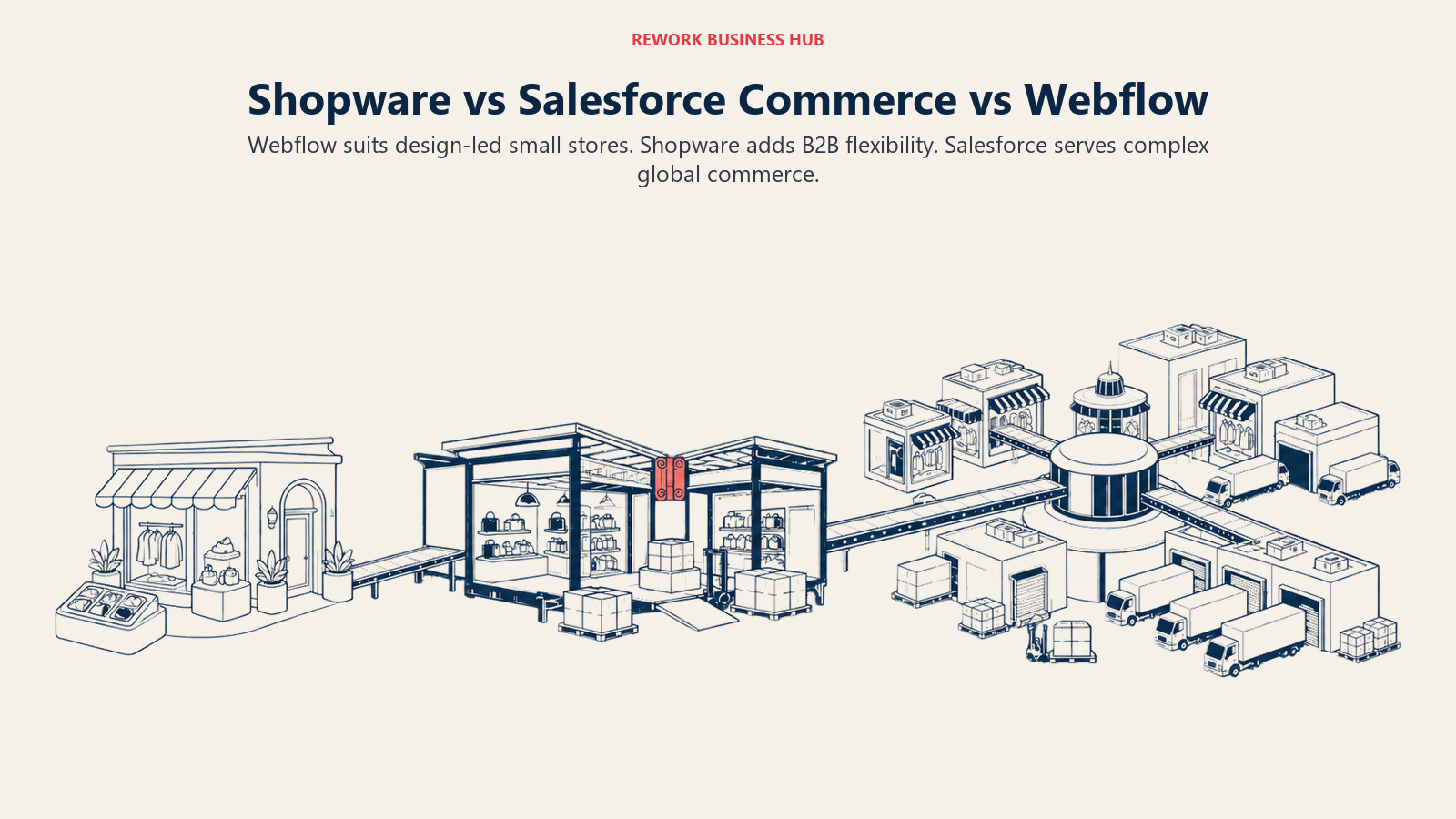
Shopware, Salesforce Commerce Cloud, and Webflow Ecommerce land on the same shortlist more often than they should, and that shortlist is usually the mistake, not the research. These three platforms are not built for the same store. Webflow Ecommerce is a design-led site builder with a store attached: genuinely beautiful, fast to launch, and honestly capped on catalog size, tax automation, multi-currency, and anything past straightforward fulfillment. Shopware is the European, open-source-rooted platform with a commercial cloud layered on top, strongest in B2B and mid-market brands that want real customization without Adobe-scale spend, and far better known across the DACH region than in the US. Salesforce Commerce Cloud is enterprise commerce: revenue-share pricing, implementations measured in months, delivery through a certified partner, and a platform that only earns its cost above a GMV line most readers of this page have not crossed yet.
That's the whole spine of this article, stated plainly instead of buried in the ninth paragraph: pick the section that matches your actual annual sales, not the platform with the most familiar name. We priced all three at $500,000, $5 million, and $50 million in annual GMV so the crossovers are visible, using every figure each vendor publishes and labeling every third-party number (reported) with its source, since two of these three vendors publish close to nothing.
Key Facts
- Shopware's Fair Usage Policy, effective since March 24, 2025, caps free Community Edition use at 1 million euros in annual GMV. Past that, a merchant "must subscribe to Shopware Rise, Evolve, or Beyond to retain access to the Shopware Account and Shopware Store." (Shopware)
- Shopware's own pricing page lists Rise "From €600/month (excl. VAT)" and Evolve "From €2,400/month (excl. VAT)," with Beyond priced custom. (Shopware)
- Confirm current Salesforce commerce pricing with Salesforce. Third-party implementation partners report GMV-based pricing of roughly 1% to 3% of gross merchandise value for the B2C product and 1% to 2% for B2B. (reported, Elogic)
- Salesforce's own newsroom has published multiple 2026 press releases and product pages branding its commerce line "Agentforce Commerce," positioned as the next generation of Commerce Cloud with AI shopping and buying agents built in. (Salesforce newsroom)
- Webflow's Ecommerce Standard plan carries a 2% Webflow-side transaction fee on top of card processing; Plus and Advanced both drop that fee to 0%. (reported, BKND Development)
- Webflow Ecommerce has no native multi-currency support ("there's no native multi-currency support, all prices display in one currency"), and automatic tax calculation covers only the United States, Canada, the European Union, and Australia, powered by TaxJar. (Webflow's own documentation, reproduced at webflow.tenten.co)
TL;DR: Shopware vs Salesforce Commerce Cloud vs Webflow Ecommerce at a Glance
| Webflow Ecommerce | Shopware | Salesforce Commerce Cloud | |
|---|---|---|---|
| What it actually is | A visual site builder with a store layered on | An open-source commerce core with a commercial cloud on top | An enterprise commerce suite, now marketed as Agentforce Commerce |
| Realistic GMV range | Roughly under $2 million, single currency | Roughly $500,000 to $50 million and beyond | Realistically $10 million-plus, often much higher |
| Pricing shape | Flat Ecommerce plan fee, plus a separate Site plan | Free (capped) or flat monthly fee in euros | Percentage of GMV, quote-only, no rate card |
| Where it's strongest | Design control, speed to launch, small teams | B2B depth, European support, mid-market customization | Multi-brand, multi-region, deep Salesforce ecosystem tie-in |
| The honest ceiling | No native multi-currency, thin fulfillment, catalog tops out in the low thousands of SKUs | Free tier legally caps at about €1M GMV; paid tiers priced in euros | Implementation alone can exceed a small merchant's entire annual revenue |
| Who runs it day to day | A designer or a small marketing team, no developer required | An ecommerce manager plus a developer or Shopware partner agency | A CTO or solution architect plus a certified implementation partner |
| The trap to avoid | Assuming the low platform fee means there's no ceiling | Assuming Community Edition stays free forever regardless of sales volume | Budgeting the GMV percentage and forgetting the implementation line |
What Each Platform Is Actually Built For
All three answer "how do I sell online," and that's roughly where the resemblance ends. Webflow's starting point is design: a visual canvas that outputs real markup, with Ecommerce added as a layer for teams that already build marketing sites there and don't want to stand up a second platform for a modest catalog. Shopware's starting point is commerce itself, architected API-first and headless-ready from the beginning rather than adapted from a general CMS, with genuine open-source ownership underneath a paid cloud for teams that outgrow self-hosting. Salesforce Commerce Cloud's starting point is the enterprise customer record: commerce data living in the same platform as Marketing Cloud, Service Cloud, and Sales Cloud, sold and delivered the way the rest of enterprise Salesforce is, through a negotiated contract and a certified partner.
| Webflow Ecommerce | Shopware | Salesforce Commerce Cloud | |
|---|---|---|---|
| Platform type | Website builder with a commerce layer | Open-source core plus commercial cloud editions | Enterprise SaaS commerce suite |
| Primary buyer | A designer, agency, or small marketing team | An ecommerce manager at a mid-market B2B or B2C brand | A CTO, VP Ecommerce, or enterprise architect already on Salesforce |
| Self-hostable | No, SaaS only | Yes, on Community Edition | No, cloud only |
| Where it feels natural fastest | A content-led or portfolio-style site adding a small shop | A B2B brand needing company accounts, negotiated pricing, or multi-shop catalogs | A multi-brand retailer already running Marketing or Service Cloud |
| Where it gets uncomfortable fastest | Multi-currency, complex tax, or a catalog past a few thousand SKUs | A team with no developer and no budget for an agency relationship | Any business below roughly eight figures in annual GMV |
| Official managed option | Yes, that's the only option there is | Yes, Rise, Evolve, and Beyond are all Shopware-hosted | Yes, that's the only option there is |
If your real need is a small catalog bolted onto a design-first marketing site, our best Squarespace alternatives roundup covers that lighter end alongside Webflow. If you've already ruled out all three because your catalog or B2B rules have outgrown a SaaS platform entirely, BigCommerce vs Adobe Commerce and our best Magento alternatives roundup cover the other end of enterprise commerce, and the full field sits in best ecommerce platforms in 2026.
Naming and Editions: What You're Actually Buying Right Now
Older comparison content still ranks shut-down products and quiet rebrands as current, so here is where each vendor's naming and editions actually stand before any price comes into it.
Shopware has a stable edition structure: Community, Rise, Evolve, and Beyond are the four live tiers, and the older "Professional at €199/month" tier some guides still cite is retired. What's new, and what most comparison content still misses, is the Fair Usage Policy: since March 24, 2025, Community Edition is only free below about 1 million euros in trailing annual GMV. Cross that line and Shopware "reserves the right to restrict access to the Account and Store" until you subscribe to a paid edition. Merchants report GMV through a dedicated extension or a yearly form. This matters directly for the pricing math below, because "Shopware is free" stops being true well before most mid-market brands would expect.
Salesforce Commerce Cloud is mid-rebrand. Salesforce's own newsroom now markets the product as "Agentforce Commerce," positioned as the next generation of Commerce Cloud with AI shopping and buying agents built in, and recent Salesforce press releases use that name for major 2026 feature releases. The underlying contractual products, B2C Commerce and B2B Commerce, and the GMV-based pricing model, continue under the new marketing name the same way Sales Cloud's contracts didn't change when it started being marketed as Agentforce Sales. We use "Salesforce Commerce Cloud" through this article because that's still what almost every buyer searches and what most contracts reference, but expect "Agentforce Commerce" on anything Salesforce publishes from mid-2026 forward. Confirm current pricing with Salesforce.
Webflow Ecommerce sits downstream of a real pricing change. On May 13, 2026, Webflow retired its old CMS and Business site plans entirely, replacing them with a single Premium site plan at $25/month billed yearly ($39/month billed monthly), a $2,500/month Team platform plan, and a custom Enterprise tier. That change touched the Site plan layer, not the Ecommerce plan layer specifically, so Standard, Plus, and Advanced continue to exist as their own add-on tier. The detail worth flagging directly: an Ecommerce store needs both a Site plan and an Ecommerce plan as separate charges, plus a Workspace plan for the builder itself. Treating the Ecommerce plan's sticker price as the whole bill is the single most common mistake in Webflow cost estimates. Every figure below carrying (reported) comes from published third-party pricing breakdowns rather than webflow.com itself, so confirm current pricing with Webflow.
Catalog, Tax, and Currency: Where the Limits Actually Bite
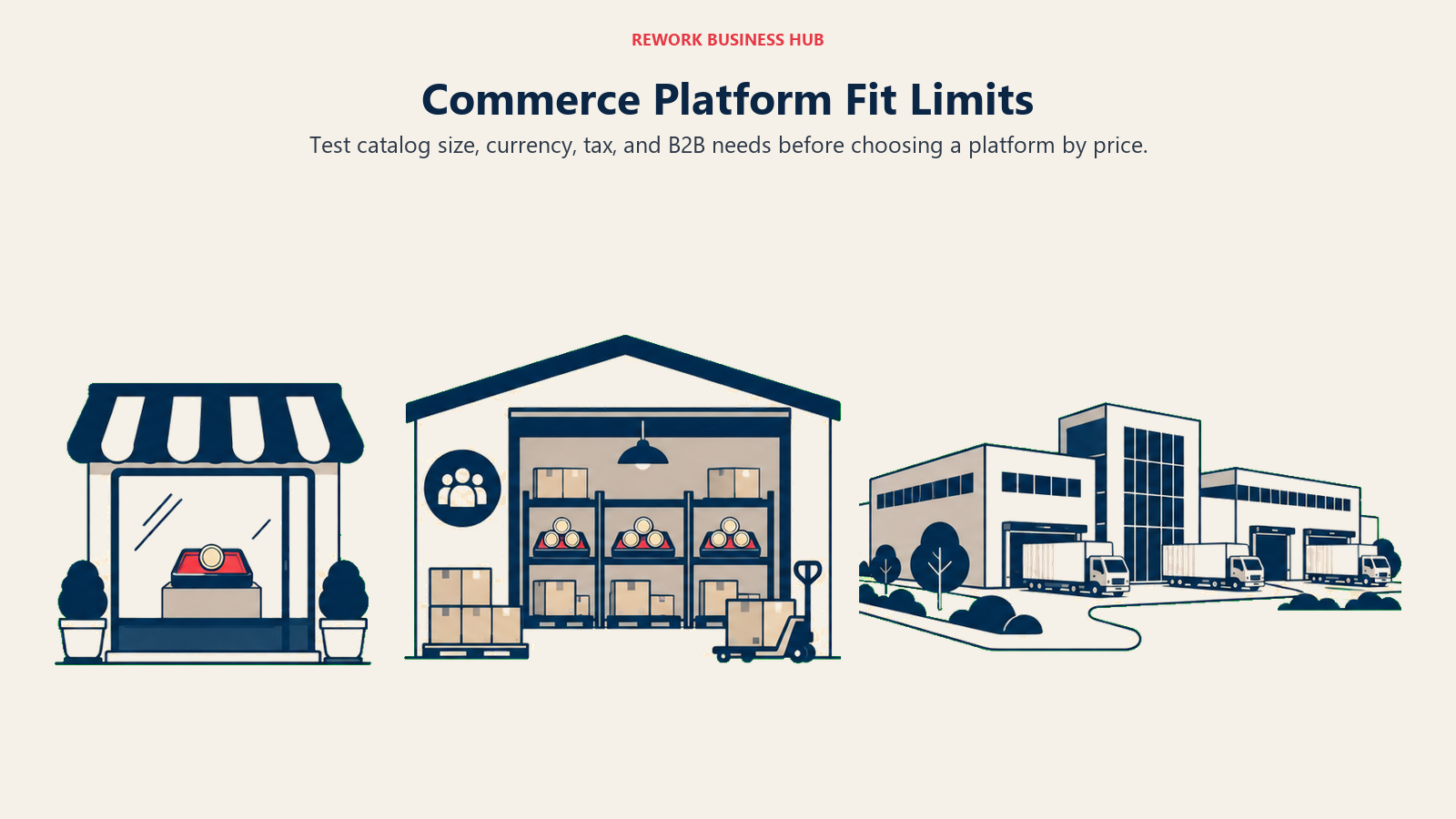
Price rarely disqualifies a platform on this shortlist before features do. This is the section that decides more shortlists than the pricing tables further down, so it earns its own space before we get there.
| Webflow Ecommerce | Shopware | Salesforce Commerce Cloud | |
|---|---|---|---|
| Catalog ceiling | Roughly 500 items on Standard up to several thousand products (about 15,000 SKUs with variants) on Advanced (reported) | No published hard cap; scales with hosting and infrastructure | No published hard cap; built for catalogs with millions of SKUs |
| Multi-currency checkout | Not natively supported; all prices display in one currency | Native, standard for a European commerce platform | Native, a core enterprise requirement |
| Automatic tax calculation | US, Canada, EU, and Australia only, via TaxJar; manual elsewhere | Native EU VAT handling; broader coverage depends on the edition and any tax add-on | Native, configurable tax and duty handling across regions |
| B2B features (company accounts, negotiated pricing) | Not a native feature | Core to Evolve and Beyond specifically | Core to the B2B Commerce product |
| Complex fulfillment (multi-warehouse, dropshipping) | Not natively supported; needs a third-party app | Supported through the platform and its module ecosystem | Supported, often tied into a separate Order Management product |
| Where this actually rules a platform out | International, multi-currency, or large-catalog sellers | Rarely; this is the platform's designed range | Sub-eight-figure merchants who don't need any of the above yet |
Read that table as the honest version of "beautiful but limited." A single-currency US brand selling a few hundred SKUs will never notice Webflow's ceiling. A brand adding a European market with local-currency checkout hits a wall Webflow was never built to solve, and no app fully closes that gap without real engineering. Shopware and Salesforce both treat multi-currency and B2B pricing as table stakes, which is exactly why they cost more and take longer to launch.
Decision by Business Goal
| If your goal is... | The platform that fits | Why |
|---|---|---|
| Launch a real storefront this quarter without hiring a developer | Webflow Ecommerce | Visual builder, no server, a single designer can own it end to end |
| Sell B2B with negotiated pricing, company accounts, or multiple shops, without Adobe or Salesforce-scale cost | Shopware | Evolve and Beyond ship company accounts, shared catalogs with custom pricing, and multi-shop architecture natively |
| Put commerce data on the same customer record as Marketing, Service, and Sales Cloud | Salesforce Commerce Cloud | Native Agentforce and Einstein tie-in across the whole Salesforce estate, not a bolted-on integration |
| Keep the platform fee flat as sales grow past a small store | Webflow Ecommerce (Plus or Advanced) | Both tiers charge 0% transaction fee; the plan price barely moves with GMV once you're past Standard |
| Sell in more than one currency to real international demand | Shopware or Salesforce Commerce Cloud | Both support native multi-currency checkout; Webflow structurally does not |
| Prove to a board that the platform survives 10x today's volume without a re-platform | Salesforce Commerce Cloud, if the ecosystem tie-in is real; Shopware otherwise | Salesforce is built for that ceiling by design; Shopware's Evolve and Beyond tiers get most mid-market brands there for a fraction of the cost |
Team and Role Fit
| Role | Webflow Ecommerce | Shopware | Salesforce Commerce Cloud |
|---|---|---|---|
| Who typically owns the evaluation | A designer, marketer, or small ecommerce generalist | An ecommerce manager, sometimes with a CTO for the Evolve or Beyond tiers | A CTO, VP Ecommerce, or enterprise architect |
| Who builds it | The same person who owns the evaluation, in most cases | A Shopware partner agency (Silver, Gold, or Platinum tier) or an in-house developer | A certified Salesforce implementation partner, almost without exception |
| Ongoing technical need | Minimal; most changes are visual | A developer relationship or agency retainer for updates and custom modules | A dedicated admin or dev team, often shared with other Salesforce clouds |
| Hiring pool | Broad; Webflow designers are common and inexpensive | Narrower than WooCommerce or Shopify; strongest across the DACH region | Deep but specialized; Salesforce and Commerce Cloud developers bill enterprise rates |
| Governance and approvals | Minimal; usually one or two people can ship a change | Moderate; B2B features on Evolve and Beyond introduce real role and pricing logic to govern | Extensive; enterprise change management, sandboxes, and release cycles apply |
Pricing at Real Scale: $500K, $5M, and $50M in Annual GMV
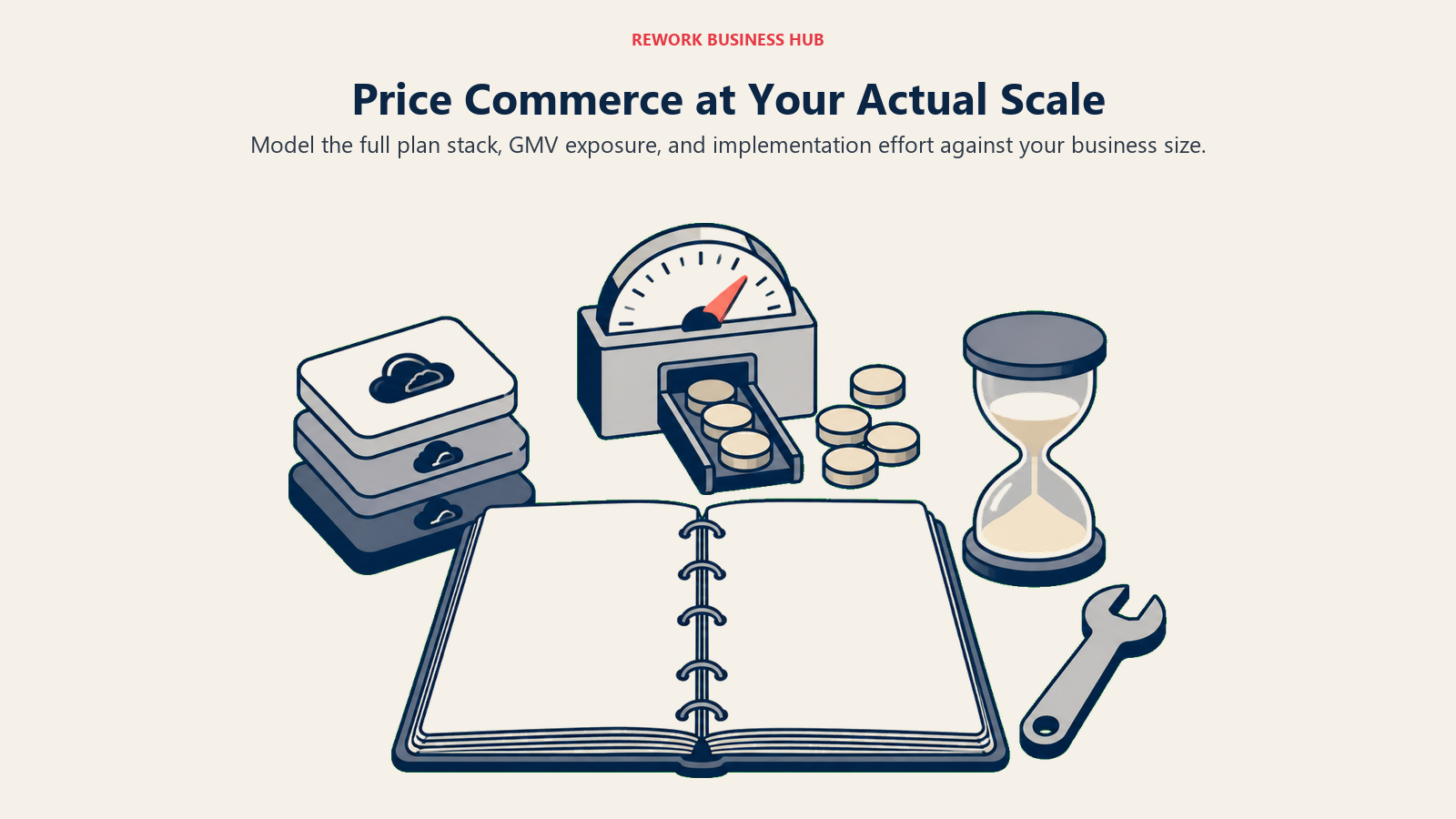
Every figure in this section that isn't a direct vendor quote is our own arithmetic, built from each vendor's published numbers where they exist and clearly labeled (reported) where we relied on third-party estimates because the vendor wouldn't publish or wouldn't let us fetch a page. Card processing (roughly 2.5% to 2.9% plus a flat fee per transaction on all three) is excluded from every table below so the platform costs stay comparable; budget it separately, since it's genuinely similar across all three.
The published plan lineup
| Platform | Entry tier | Mid tier | Top tier |
|---|---|---|---|
| Webflow Ecommerce | Standard: $29/month billed yearly, 2% transaction fee, roughly 500 items (reported) | Plus: $74/month billed yearly, 0% fee, roughly 5,000 items (reported) | Advanced: $212/month billed yearly, 0% fee, several thousand products (reported) |
| Shopware | Community: free, capped at about €1M (roughly $1.17M) trailing annual GMV | Rise: from €600/month excl. VAT (about $8,400/year) | Evolve: from €2,400/month excl. VAT (about $33,700/year); Beyond is custom-priced |
| Salesforce Commerce Cloud | No published entry tier | No published mid tier | Quote-only; reported 1% to 3% of GMV for B2C, 1% to 2% for B2B (reported) |
A Webflow store also needs a separate Site plan underneath the Ecommerce plan (Premium at $25/month billed yearly, or a Team or Enterprise plan for bigger teams), so add that line before comparing Webflow's number to the other two. Standard's own crossover is worth doing the arithmetic on directly: Plus costs $540 a year more than Standard, and Standard's only advantage is avoiding Plus's fee, so any store selling more than $540 divided by 2%, or $27,000 a year, is already better off on Plus. Below that, almost nobody is evaluating enterprise commerce platforms in the first place.
At $500,000 in annual GMV
| Webflow Ecommerce | Shopware | Salesforce Commerce Cloud | |
|---|---|---|---|
| Realistic plan | Plus ($888/year) plus Site Premium ($300/year) | Community, still free and legal under the €1M cap, or Rise (~$8,400/year) for commercial support | Not a realistic fit at this scale |
| Platform fee, annualized | $1,188/year, 0% transaction fee | $0 (Community) to ~$8,400/year (Rise) | Reported ~$5,000 to $15,000/year at 1% to 3% of GMV (reported) |
| Hosting | Included in the plan | $0 to roughly $6,000/year self-hosted (reported), included on Rise's cloud | Included |
| Implementation | A solo designer or small studio; days to a few weeks, rarely separately costed | Reported $15,000 to $30,000 for a small self-serve or Rise build (reported) | Reported $200,000 to $560,000 minimum, even at this scale (reported) |
| Rough first-year total | About $1,200 to $3,000 | About $6,000 (lean, self-hosted) to $40,000 (Rise, agency-built) | $205,000-plus before the store takes a single order |
| Honest verdict | The obvious fit on price; catalog and currency limits rarely bite at this size | A legitimate, well-priced option on either tier | Wrong page. Implementation alone would run 40% or more of the store's entire annual revenue |
At $5,000,000 in annual GMV
| Webflow Ecommerce | Shopware | Salesforce Commerce Cloud | |
|---|---|---|---|
| Realistic plan | Advanced ($2,544/year) plus Site Premium ($300/year), if the catalog fits | Rise ($8,400/year) or Evolve ($33,700/year); Community is no longer legally free above about $1.17M GMV | Technically possible, rarely the rational choice |
| Platform fee, annualized | $2,844/year, 0% transaction fee | $8,400 to $33,700/year depending on edition | Reported ~$145,500/year total cost of ownership at this revenue level (reported, Swell) |
| Implementation | Same small-studio build, though a $5M brand often adds custom app work | Reported $40,000 to $80,000 for a mid-complexity B2B build (reported) | Reported $200,000 to $560,000, rarely smaller at this GMV (reported) |
| Ongoing agency or dev retainer | Modest; most changes are still visual | Reported $500 to $1,500/month maintenance (reported) | Reported $2,000 to $10,000-plus/month agency retainer (reported) |
| Structural ceiling that actually bites | Yes: no multi-currency, four-region tax automation, catalog nearing its cap | Not really; this is Shopware's designed range | Not at all; this is what the platform was built for |
| Honest verdict | Price is fine; the catalog and currency ceiling is the real question now | The sweet spot this comparison promised: real customization without Adobe or Salesforce-scale cost | Possible only if you're already deep in the Salesforce ecosystem; otherwise overbuilt for the price |
At $50,000,000 in annual GMV
| Webflow Ecommerce | Shopware | Salesforce Commerce Cloud | |
|---|---|---|---|
| Realistic plan | Not a realistic fit regardless of budget | Evolve, or Beyond for multi-inventory and customer-specific pricing | B2C or B2B Commerce Cloud (marketed today as Agentforce Commerce), the platform's designed tier |
| Platform fee, annualized | N/A, ruled out on features before price is even relevant | ~$33,700/year (Evolve) or custom (Beyond) | Reported roughly $1.1 million to $1.2 million/year, extrapolating the same reported cost curve (our estimate, based on reported figures) |
| Implementation | N/A | Reported $100,000-plus for a multi-store enterprise build (reported) | Reported $200,000 to $560,000-plus (reported), now under 1% of annual GMV |
| Why the ranking flips here | Catalog ceiling, no multi-currency, and thin fulfillment logic rule it out structurally | Still proportionate, though Beyond's custom pricing and partner-led delivery start to resemble enterprise procurement | The percentage-of-GMV math finally looks proportionate, especially with existing Marketing, Service, or Sales Cloud investment |
| Honest verdict | Wrong page, full stop | Still viable, now closer to a genuine enterprise engagement than a mid-market one | Right page, if the Salesforce ecosystem tie-in is real and not just inertia |
The pattern across all three tables is the whole point of pricing this at three scales instead of quoting one headline number. Webflow's platform fee barely moves once you're past its entry tier, so price stops being the constraint and the catalog and currency ceiling becomes the entire decision. Shopware scales close to linearly with complexity, staying proportionate to GMV across a wide range because its editions map to real feature tiers rather than a straight revenue cut. Salesforce Commerce Cloud looks wildly disproportionate at $500,000, still hard to justify at $5 million, and only starts to look rational once GMV and existing Salesforce investment are both large enough to amortize a six-figure implementation and a percentage-of-GMV license.
Implementation and Change Management
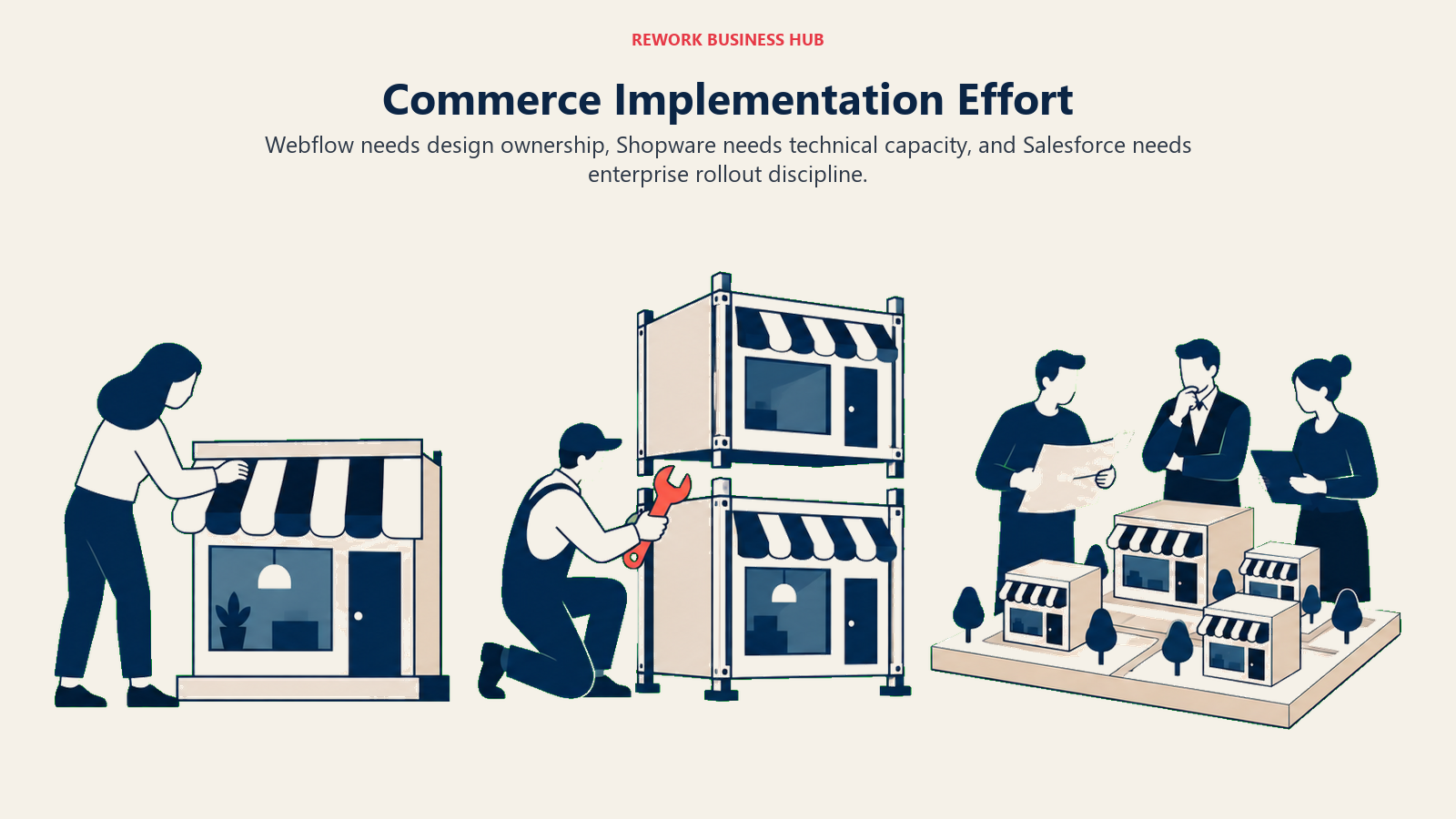
Webflow needs design ownership, Shopware needs technical capacity, and Salesforce needs enterprise rollout discipline.
| Webflow Ecommerce | Shopware | Salesforce Commerce Cloud | |
|---|---|---|---|
| Typical time to launch | Days to a few weeks | Weeks (Rise) to a few months (Evolve or Beyond with custom work) | Months, reported 4 to 6 months minimum for a standard build |
| Who delivers it | The buyer's own team, often without a developer | An in-house developer or a Shopware partner agency | A certified Salesforce implementation partner, almost always |
| Training load | Low; the visual builder is the main skill to learn | Moderate; B2B pricing and catalog rules need real onboarding | High; admins, developers, and merchandisers all need role-specific training |
| Change management overhead | Minimal; a single person can ship most changes | Moderate; changes to pricing or catalog logic typically route through a developer | Significant; enterprise release cycles, sandboxes, and approval chains are standard |
| What breaks the timeline | Custom interactions or complex CMS structures | ERP or ERP-adjacent integrations, and B2B pricing logic | Any integration beyond the standard Salesforce estate, and org-wide data migration |
Risk and Governance
| Webflow Ecommerce | Shopware | Salesforce Commerce Cloud | |
|---|---|---|---|
| Self-hosting option | No, SaaS only | Yes, on Community Edition; Rise, Evolve, and Beyond are Shopware-hosted | No, cloud only |
| Data residency control | Fixed to Webflow's infrastructure | Full control on Community; fixed to Shopware's cloud on paid tiers | Fixed to Salesforce's infrastructure |
| Vendor lock-in shape | Shallow; a rebuild is real work but rarely a multi-month project | Operational on Community (you own a stack that needs maintaining); commercial but with a genuine self-host exit path on the paid tiers | Deep; custom implementation code and Agentforce or Einstein integrations are tied to the wider Salesforce estate |
| Realistic cost to replatform off it | Low; weeks, mostly a design and content rebuild | Moderate, proportional to how customized the build is; Community gives a real downgrade path other SaaS platforms don't | High; often a new implementation-scale project measured in months and six figures |
| PCI and compliance depth | Standard, vendor-handled | Standard, plus stronger role and approval tooling on Evolve and Beyond | Deep; built for enterprise governance, approval chains, and audit requirements |
| If you stop paying | The store goes offline | Community keeps running on your own host; paid tiers go offline | The store goes offline, and so does everything tied into the wider Salesforce org |
When Webflow Ecommerce Is the Right Call
- You want design and code control without hiring a developer for every change. The visual builder is the whole appeal, and Ecommerce inherits it directly.
- Your catalog is a few hundred to a couple thousand SKUs, in one currency. Below that ceiling, Webflow is genuinely the fastest and cheapest of these three platforms to launch and run.
- You already build marketing sites in Webflow and don't want a second platform. Adding Ecommerce to an existing Webflow site is a much smaller lift than standing up Shopware or Salesforce from nothing.
- You want the platform fee to stop scaling with sales. Once you're on Plus or Advanced, the 0% transaction fee means your platform cost barely moves whether you sell $500,000 or $5 million a year, right up until the catalog ceiling, not the price, forces a move.
When Shopware Is the Right Call
- You sell B2B, or B2B and B2C together, and need company accounts or negotiated pricing. Evolve and Beyond ship this natively rather than as a bolted-on extension.
- You want genuine open-source ownership with a real commercial fallback. Community Edition is free code you can self-host; Rise, Evolve, and Beyond are the same core with Shopware running the infrastructure, so the exit path is real in both directions.
- Your customers, support relationships, or team are stronger in Europe than the US. Shopware's commercial tiers and partner network are built primarily around EU-based merchants and price in euros accordingly.
- You need real customization without Adobe Commerce or Salesforce-scale cost. Evolve at roughly $33,700 a year is a fraction of what a comparable Adobe Commerce or Salesforce Commerce Cloud build typically costs, for a genuinely API-first, headless-ready core.
When Salesforce Commerce Cloud Is the Right Call
- You're already running Marketing Cloud, Service Cloud, or Sales Cloud and want commerce on the same customer record. This is the integration value nothing else on this list matches, and it's the real reason to pay Salesforce's price rather than Shopware's.
- Your GMV is comfortably into eight figures, or you're a multi-brand or multi-region retailer. The percentage-of-GMV pricing and six-figure implementation only amortize sensibly at real enterprise scale.
- You need deep, native multi-currency, multi-region tax, and enterprise governance out of the box. These are core to the platform rather than add-ons, which matters once a compliance or audit team is involved.
- You have, or are ready to fund, a certified implementation partner relationship for the long term. Salesforce Commerce Cloud is not a platform a single in-house generalist runs; budget for that reality before you budget the GMV percentage.
If None of These Three Fits
If the storefront question is settled but the real gap is that orders, inventory, and the customer record live in three or four separate tools stitched together with integrations that quietly drift out of sync, that's a different problem than a platform choice, and none of these three solves it; none of them was built to. Rework's Commerce module runs order and commerce operations inside a wider platform that also carries Sales CRM, Lead, Inventory, Invoice, Product, and Work Ops, so the order, the customer record, and the stock count sit on one platform instead of three synced tools. It is not a storefront builder: there's no themed storefront, no template gallery, and no D2C checkout, so it sits behind or beside whichever platform you pick from this list rather than in place of it. Rework doesn't publish a price for Commerce; it's quoted per organization at rework.com/pricing, and it's built for mid-size operators of roughly 10 to 200 people, not solo sellers or Salesforce-scale enterprises. If that's closer to your actual problem, our best order management software in 2026 roundup is a more useful starting point than another storefront comparison.
Decision Framework
| If this is true for you | Pick |
|---|---|
| Your catalog is a few hundred to a couple thousand SKUs, single currency, and you have no developer | Webflow Ecommerce |
| You want the platform fee to stay flat as sales grow, up to a real catalog ceiling | Webflow Ecommerce (Plus or Advanced) |
| You sell B2B with company accounts or negotiated pricing and want European support | Shopware |
| You want open-source ownership with a genuine commercial cloud fallback | Shopware |
| Your GMV sits roughly between $500,000 and $50 million and you want customization without enterprise cost | Shopware |
| You're already deep in the Salesforce ecosystem and your GMV is comfortably eight figures or higher | Salesforce Commerce Cloud |
| You need native multi-currency, multi-region tax, and enterprise governance out of the box | Salesforce Commerce Cloud or Shopware |
| Your annual GMV is under a few million dollars and someone quoted you Salesforce Commerce Cloud | Get a second quote; you are very likely not the buyer this platform was priced for |
| The real gap is orders, inventory, and the customer record, not the storefront | See "If None of These Three Fits" above |
| You want a broader shortlist than these three | See best ecommerce platforms in 2026 |
What to Do Next
- Write down your actual trailing twelve-month GMV before you take a single sales call. It's the single number that eliminates two of these three platforms fastest, and it's the number Salesforce's own pricing model is built around whether they publish it or not.
- Check whether you need multi-currency checkout today, not eventually. If the answer is yes, Webflow is out regardless of price, and that's a features question, not a budget one.
- If Shopware is on your list, confirm your GMV against the €1 million Community Edition cap. A store that has already crossed it needs to budget Rise or Evolve from day one, not discover the requirement after launch.
- If Salesforce Commerce Cloud is on your list, request a quote before you build a business case around any published range. Every figure in this article past Salesforce's own edition names is a third-party estimate; get your own number with your real GMV attached.
- Price the implementation and the retainer, not just the license. On Shopware and especially on Salesforce, the build and the ongoing partner relationship are usually the larger line, and skipping that step is how a platform choice turns into a budget surprise eighteen months in.
- If none of these three quite fits, start from best ecommerce platforms in 2026 for the wider field, or read Shopify vs BigCommerce and Shopify vs WooCommerce if a hosted mid-market platform belongs on your shortlist too. For a full evaluation framework rather than a single matchup, see how to choose an ecommerce platform.
Frequently Asked Questions about Shopware vs Salesforce Commerce Cloud vs Webflow Ecommerce
Is Salesforce Commerce Cloud now called Agentforce Commerce?
Salesforce's own newsroom markets the product as "Agentforce Commerce" as of its 2026 releases, positioning it as the next generation of Commerce Cloud with AI shopping and buying agents built in. The underlying contractual products, B2C Commerce and B2B Commerce, and the GMV-based pricing model continue under the new marketing name. Most buyers still search and contract under "Salesforce Commerce Cloud," so expect both names in the wild for a while.
How much does Shopware actually cost?
Shopware's Community Edition is free to self-host, but only below about 1 million euros in trailing annual GMV under Shopware's Fair Usage Policy. Paid tiers are Rise, from €600 a month excluding VAT (roughly $8,400 a year), and Evolve, from €2,400 a month excluding VAT (roughly $33,700 a year), with Beyond priced custom. All figures are Shopware's own published prices, converted at roughly $1.17 per euro.
Is Shopware Community Edition really free forever?
No, and this is one of the most commonly missed details in older comparison content. Since March 24, 2025, Shopware's Fair Usage Policy requires merchants above about 1 million euros in annual GMV to subscribe to Rise, Evolve, or Beyond, or risk losing access to their Shopware Account and Store. Below that threshold, Community Edition remains genuinely free, aside from your own hosting and development costs.
How much does Webflow Ecommerce cost?
These figures come from third-party pricing breakdowns (reported), so confirm current pricing with Webflow. Reported pricing runs Standard at $29 a month billed yearly with a 2% transaction fee, Plus at $74 a month with a 0% fee, and Advanced at $212 a month with a 0% fee, each layered on top of a separate Webflow Site plan.
Does Webflow Ecommerce charge a transaction fee?
Only on the Standard plan, at a reported 2% on top of your card processor's own fee. Plus and Advanced both drop Webflow's own transaction fee to 0%, leaving only your payment processor's rate. Because the fixed cost difference between Standard and Plus is small, most stores doing meaningful volume are better off on Plus well before they'd guess from the sticker price alone.
How much does Salesforce Commerce Cloud cost?
Salesforce publishes no rate card anywhere we could access. Third-party implementation partners report GMV-based pricing of roughly 1% to 3% of gross merchandise value for B2C and 1% to 2% for B2B, plus a reported implementation cost of $200,000 to $560,000 or more. Treat any specific percentage you see online, including ours, as a reported estimate and get a quote against your own GMV before budgeting around it.
Which of the three supports multiple currencies?
Shopware and Salesforce Commerce Cloud both support native multi-currency checkout as a core feature. Webflow Ecommerce does not: Webflow's own documentation states there is no native multi-currency support and all prices display in one currency, which structurally rules it out for merchants with real international, multi-currency demand.
Can I self-host any of these three?
Only Shopware, through its free Community Edition. Webflow Ecommerce and Salesforce Commerce Cloud are both SaaS-only with no self-hosted option. Shopware's Rise, Evolve, and Beyond tiers are also Shopware-hosted, so self-hosting is specifically a Community Edition choice, not a Shopware-wide one.
Which platform is right for a small, design-led store?
Webflow Ecommerce, as long as the catalog stays in the low thousands of SKUs, sales stay in one currency, and fulfillment stays reasonably simple. Its visual builder and flat, low platform fee make it the fastest and cheapest of these three to launch and run at that scale, and neither Shopware nor Salesforce Commerce Cloud is proportionate at a small store's GMV.
Which platform is right for B2B?
Shopware for most mid-market B2B sellers, since Evolve and Beyond ship company accounts, shared catalogs with custom pricing, and multi-shop architecture natively at a fraction of enterprise cost. Salesforce Commerce Cloud's B2B product goes deeper still, with tighter Salesforce ecosystem integration, but it's the right call mainly for sellers already at real enterprise scale or already invested in the wider Salesforce platform.

Principal Product Marketing Strategist
On this page
- Key Facts
- TL;DR: Shopware vs Salesforce Commerce Cloud vs Webflow Ecommerce at a Glance
- What Each Platform Is Actually Built For
- Naming and Editions: What You're Actually Buying Right Now
- Catalog, Tax, and Currency: Where the Limits Actually Bite
- Decision by Business Goal
- Team and Role Fit
- Pricing at Real Scale: $500K, $5M, and $50M in Annual GMV
- The published plan lineup
- At $500,000 in annual GMV
- At $5,000,000 in annual GMV
- At $50,000,000 in annual GMV
- Implementation and Change Management
- Risk and Governance
- When Webflow Ecommerce Is the Right Call
- When Shopware Is the Right Call
- When Salesforce Commerce Cloud Is the Right Call
- If None of These Three Fits
- Decision Framework
- What to Do Next