Jasper vs ChatGPT: Which One Actually Fits Your Marketing Content Team in 2026?
Turn this article into takeaways for your work.


Each assistant summarizes the article only for you and suggests best practices for your work.
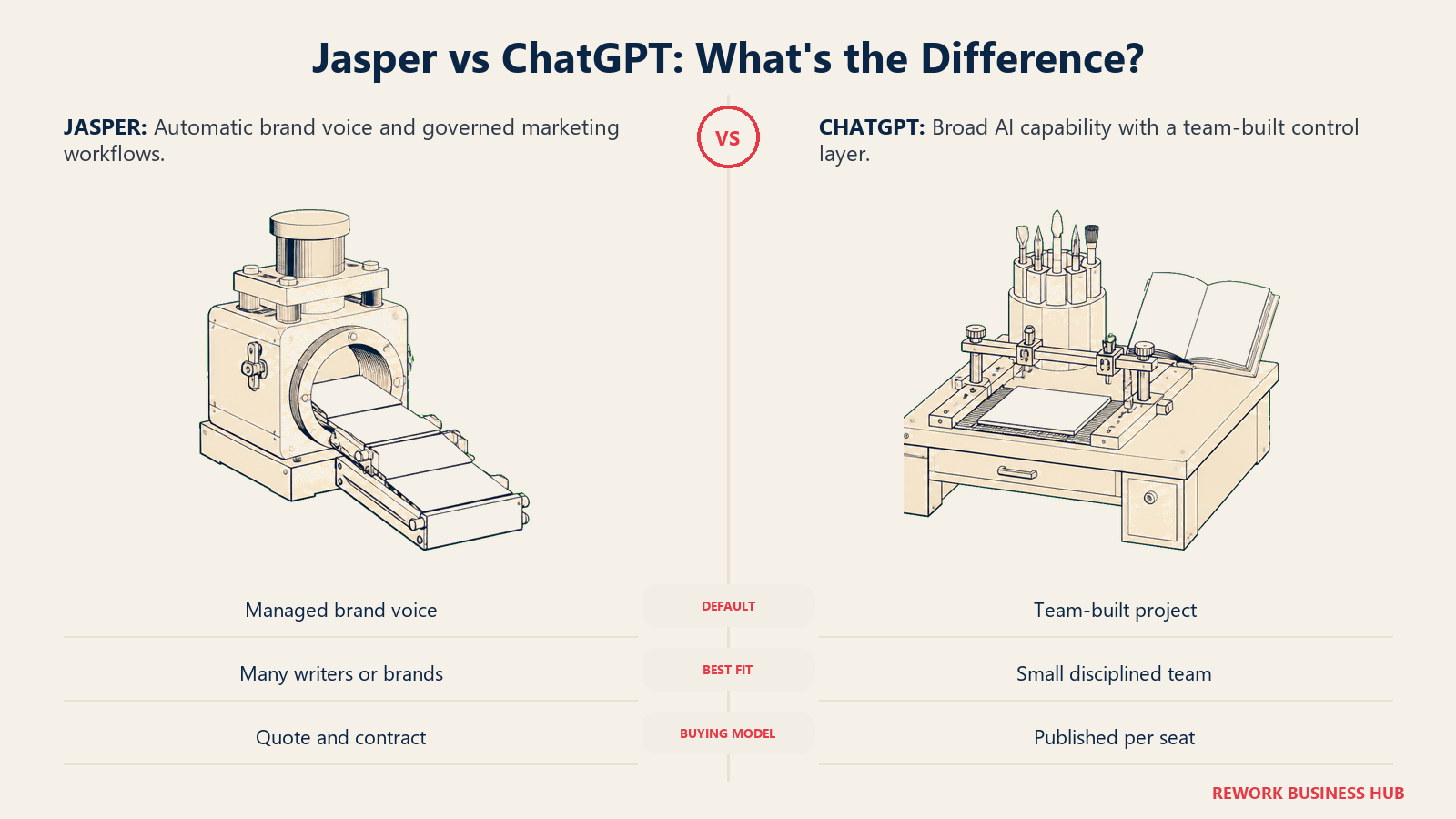
You're a CMO, VP of Marketing, or Head of Content at a company with a marketing team somewhere between 5 and 100 people, and you're staring at a real budget line. Keep letting the team use ChatGPT the way they already do, informally, on whatever plan someone expensed, or sign a contract for Jasper, a tool built specifically to sit on top of models like GPT, Claude, and Gemini and enforce your brand voice automatically. Both tools can write a blog post, an ad variant, and an email sequence. That was never really the question.
The real question is narrower and more honest than most vendor pages let it be: are you paying for something ChatGPT genuinely can't do, or for something a skilled operator could build themselves with an afternoon and a well-written Project? Jasper's case rests on brand voice enforcement, structured campaign workflows, templates, and governance across a team of writers who don't all prompt the same way. ChatGPT's case rests on the fact that a capable person with custom instructions and a shared Project gets close to that outcome for a fraction of the price. Both cases are real. This comparison is about finding out which one is true for your team, not which one has the better landing page.
TL;DR
| Dimension | Jasper | ChatGPT (Business) |
|---|---|---|
| Built for | A governed content layer for teams producing marketing copy at volume | A general-purpose assistant your whole company can use for anything |
| Underlying models | Model-agnostic; routes work across GPT, Claude, and Gemini-class models rather than running its own | OpenAI's own GPT-5.6 model family (Sol, Terra, Luna) |
| Brand voice | Jasper IQ applies a configured Brand Voice automatically to every generation | No built-in brand voice; teams build their own with custom instructions and Projects |
| Entry plan seats | Pro plan: 1 seat only, no path to add more | Business Standard: 2-seat minimum, scales per seat from there |
| Entry price | $69/mo (monthly) or $59/mo (annual), 1 seat | $25/user/mo (monthly) or $20/user/mo (annual) |
| Team pricing | Business tier: custom quote, unlimited seats, 12-month minimum | Business Standard: published, linear per seat, no long-term minimum stated |
| Free option | None; 7-day free trial only | Yes, plus a $20/mo Plus tier for individuals |
| Weakest spot | Real team cost is unknowable until a sales call | Consistency depends entirely on someone building and maintaining the layer |
| Best fit | Teams where brand drift across many writers is already a costly, visible problem | Teams under about 10 people, or disciplined teams running a shared Project well |
Key Facts
- 91% of marketers now actively use AI in their work, up from 63% a year earlier, but only 41% can prove AI ROI, down from 49%, per Jasper's State of AI in Marketing 2026 report.
- Among marketers who updated how they measure AI's impact, 60% report returns of 2 to 3x or higher, per the same report, a sign that the ROI gap is often a measurement problem, not a tool problem.
- 66% of office professionals have used an AI tool at work despite believing company policy prohibited it, and 43% have pasted work correspondence into a public AI platform like ChatGPT, Claude, or Gemini, per Wakefield Research's 2026 Shadow AI Survey, commissioned by PagerDuty (n=1,250 office professionals, April 2026).
- CMOs now allocate 15.3% of marketing budget to AI, but only 30% say their team is actually ready to scale it, per Gartner's 2026 CMO Spend Survey.
What Each Tool Is Actually Built For
Jasper doesn't build its own foundation model, and it doesn't pretend to. Its own marketing draws a hard line between general-purpose models with "no built-in knowledge of your brand" and what it calls being built specifically for marketing. Under the surface, Jasper describes itself as having an LLM-agnostic architecture that routes different jobs to different models: a GPT-class model for a first draft, a Claude-class model to tighten it, Gemini for visuals, then it wraps the output in your configured Brand Voice before a writer ever sees it. If you're also weighing the underlying models themselves rather than a layer built on top of them, see Claude vs ChatGPT vs Gemini for that comparison.
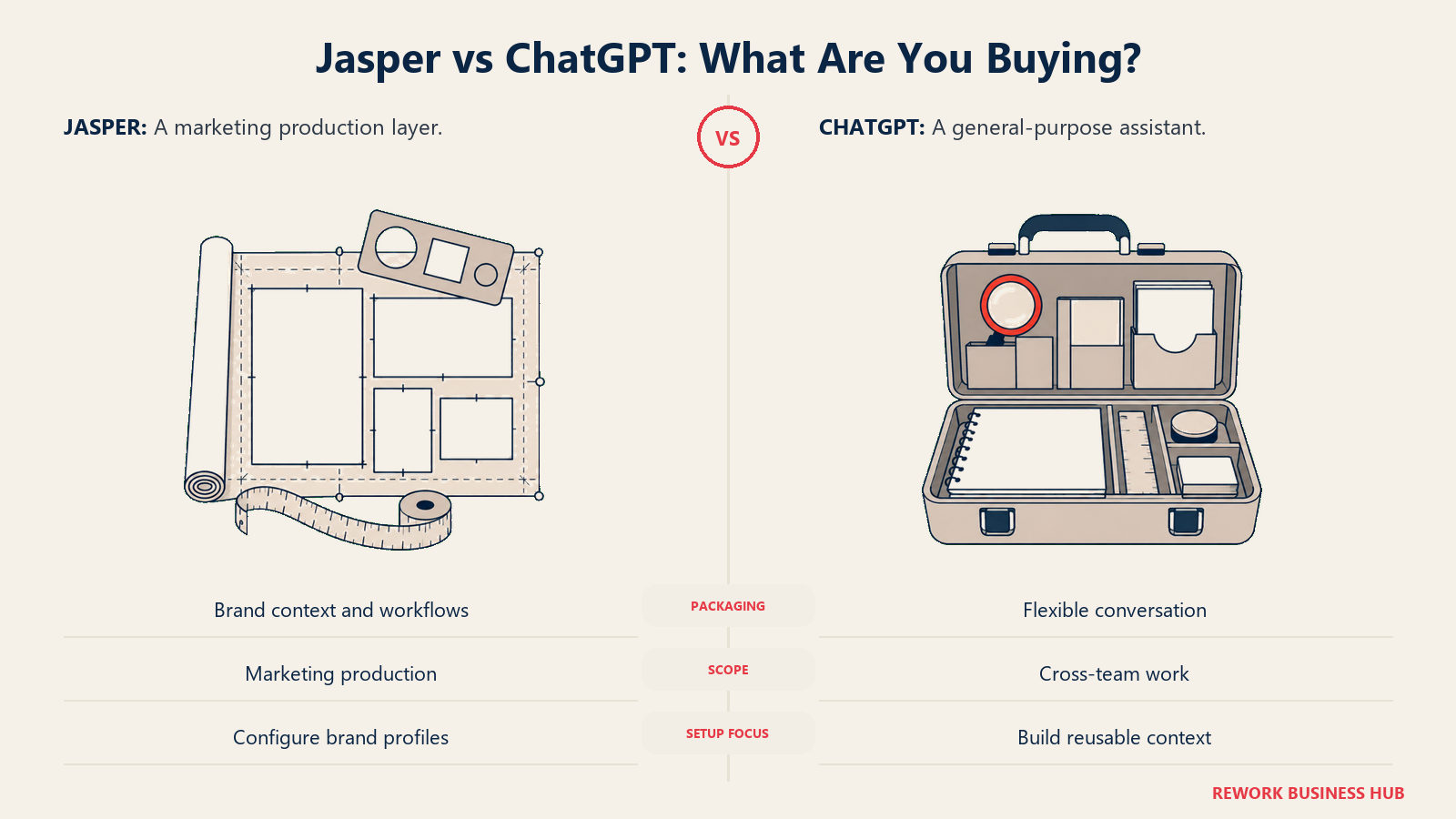
The product people actually touch is Jasper IQ: a system that stores your brand voice, style guides, audience profiles, and product knowledge once, then applies that context automatically to everything the platform generates. An admin sets it up. Every writer's output follows it without anyone having to remember to paste guidelines into a prompt. On top of that sit more than 100 specialized agents and what Jasper calls content pipelines, structured workflows that carry a campaign from brief to a published, on-brand asset across SEO, email, social, and paid, inside tools named Canvas, Studio, and Grid. Teams whose output is mostly long-form SEO articles rather than campaign copy should also see best AI tools for content writers, which covers the research and drafting layer specifically.
ChatGPT doesn't have an equivalent built-in layer, but it has the raw material to build one. Two features carry most of the weight for a marketing team trying to replicate what Jasper ships by default. Projects turn a normal chat into a persistent workspace: you upload your style guide, brand facts, and past campaign examples as files, add a standing custom instruction, and every chat inside that Project inherits the context. Project sharing, now extended to Business, Enterprise, and Edu workspaces, lets a whole team work inside the same shared Project instead of each person quietly rebuilding their own version of it. Custom GPTs go a step further: a marketer with some patience can configure a reusable assistant with a fixed system prompt, uploaded knowledge files, and defined behavior, then share it by link or list it inside the company workspace so anyone on the team opens it instead of a blank chat.
The gap between the two tools isn't really capability. It's what happens by default. Jasper's Brand Voice applies automatically because an admin configured it once at the platform level. A ChatGPT Project or Custom GPT only helps the person who opens it instead of starting a fresh chat, and nothing in the product stops a rushed writer from doing exactly that.
| Capability | Jasper | ChatGPT |
|---|---|---|
| Underlying model approach | Model-agnostic, routes tasks across GPT, Claude, and Gemini-class models | OpenAI's own GPT-5.6 family (Sol, Terra, Luna) |
| Brand voice applied automatically | Yes, via Jasper IQ, admin-configured once | No; depends on the user opening the right Project or GPT |
| Templates for marketing formats | 50+ templates spanning ads, email, social, and long-form | None built in; format quality depends on the prompt |
| Structured multi-step workflows | Yes, content pipelines carry a brief to a published asset | No native pipeline; requires the API, Zapier, or manual steps |
| Multiple brand voices (sub-brands, regions, clients) | Yes, unlimited on Business | Manual: one Project or Custom GPT per brand |
| General-purpose work outside marketing | Not the focus | Yes: research, data, decks, code, any department |
| Image generation | Yes, built in | Yes, built in |
That "general layer" extends to visual content too: ChatGPT's built-in image generation is bundled at no extra cost, though it's no substitute for a real design tool. Canva vs ChatGPT covers how far that built-in generator actually goes against one built for the job.
Integration depth follows the same split: Jasper is a dedicated app your marketing stack plugs into, while ChatGPT is a general layer your team plugs into whatever it already uses.
| Integration | Jasper | ChatGPT |
|---|---|---|
| CMS / web | WordPress, Webflow | Via Zapier, the API, or connectors |
| CRM | HubSpot, Salesforce | Via Zapier or the API; no native CRM connector |
| Docs / collaboration | Google Docs | Google Drive and Docs via connectors (Business/Enterprise) |
| Automation | API access (Business plan) | API, Zapier, and custom GPT Actions |
| Where the work lives | A dedicated marketing workspace | Wherever your team already opens ChatGPT |
Decision by Business Goal
| Your primary goal | Best fit | Why |
|---|---|---|
| Keep 15+ writers and contractors sounding like one brand without manual review | Jasper | Jasper IQ applies Brand Voice automatically; nobody has to remember to paste in guidelines |
| Get a 3-person content team productive this week for under $100/month | ChatGPT | Business Standard starts at $20 to $25 per seat with a 2-seat minimum; Jasper Pro is one seat at $59 to $69 |
| Run a repeatable pipeline from SEO brief to published post to social variants | Jasper | Content pipelines and 100+ agents are built for exactly that hand-off; see our best AI SEO tools roundup for tools built for the scoring layer underneath |
| Avoid a 12-month contract while your content operation is still taking shape | ChatGPT | Business Standard carries no published long-term minimum; Jasper's plans do |
| Serve multiple client brands or sub-brands from one workspace | Jasper | Unlimited Brand Voices, Knowledge assets, and Audiences on Business |
| Use the same tool for content, research, spreadsheets, and code across departments | ChatGPT | General-purpose by design; Jasper is scoped to marketing |
| Prove to the CFO that AI spend maps to a governed, auditable workflow | Jasper | Admin controls, Groups, and an in-app AI audit log on Business |
| Keep the budget line fully transparent at every headcount | ChatGPT | Business Standard pricing is published and linear; Jasper Business is quote-only past one seat |
Team and Role Fit
| Role | Recommended tool | Why |
|---|---|---|
| CMO / VP Marketing | Jasper, once past roughly 10 writers | Governance and reporting start to matter more than any single draft |
| Head of Content / Content Marketing Manager | Jasper | Templates and pipelines are built for exactly this job |
| Marketing Ops / RevOps | Either | Jasper's API and Business admin tools, or a maintained ChatGPT Project plus Zapier |
| Brand / Creative Lead | Jasper | Multiple Brand Voice profiles for sub-brands and campaigns |
| Solo marketer or founder-led team | ChatGPT | Jasper Pro is one seat at $59 to $69/mo; Plus is $20/mo with no marketing-specific lock-in |
| Freelance or contractor writers on rotation | ChatGPT | No long-term seat commitment tying you to a headcount that changes monthly |
| Agency serving many client brands | Jasper | A separate Brand Voice per client without separate logins; see our best AI tools for marketing agencies guide |
| Marketing generalist also doing research, decks, and data work | ChatGPT | One tool covers work outside marketing content too; see best AI tools for small business for the wider toolkit at that stage |
Brand Voice and Governance: The Actual Difference
This is the section worth reading slowly, because it's where most of the "$69 versus $20 for basically the same thing" complaints come from, and where they stop being fair.
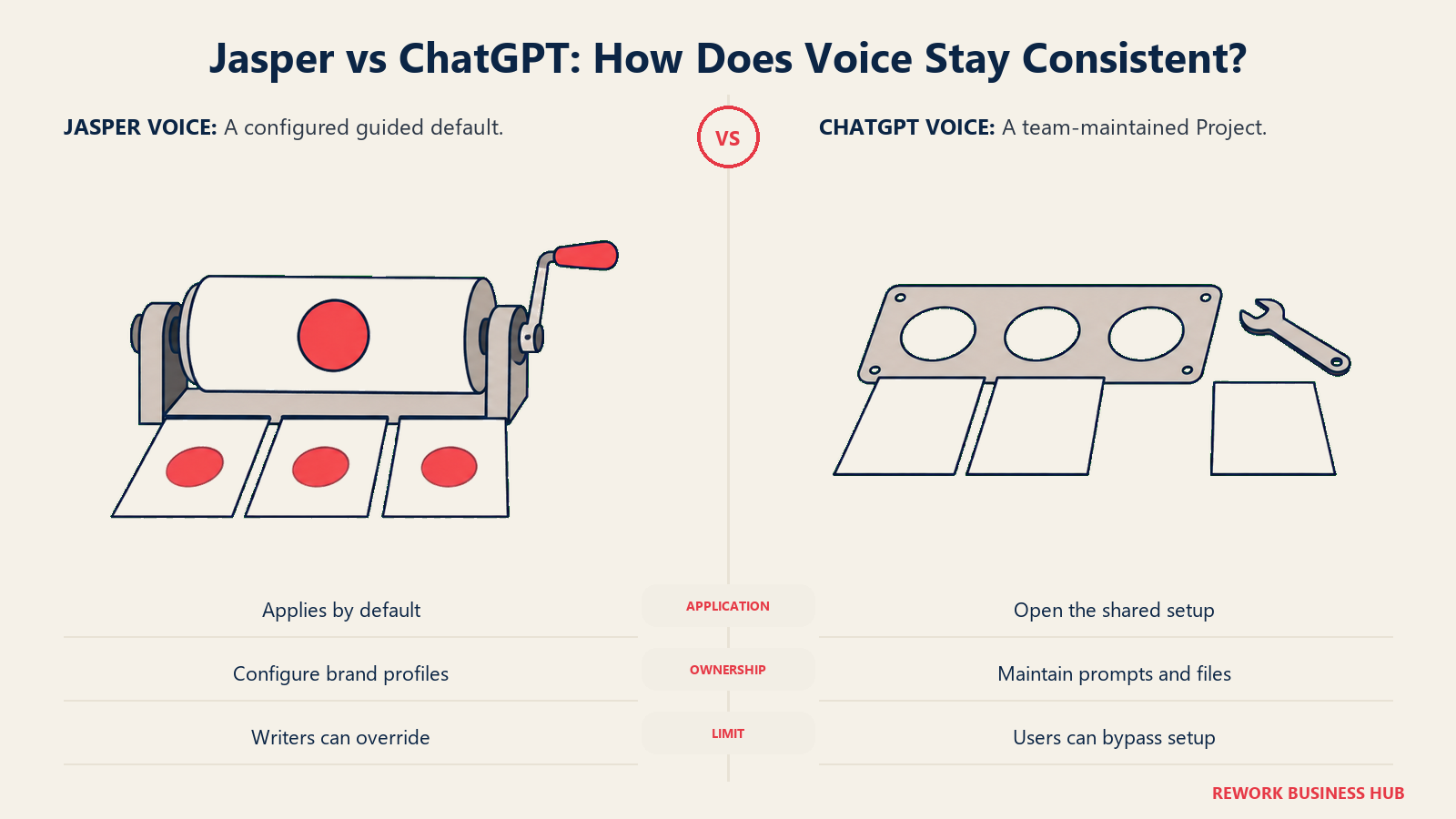
Jasper's Brand Voice profile isn't just a saved prompt. Once an admin builds one, commonly a few hours of work the first time, longer if the style guide is scattered across several documents, it applies to every generation from every seat on the workspace, without the writer doing anything except pick which Brand Voice to use if there's more than one. Business plans get unlimited Brand Voices, Knowledge assets, and Audiences, plus Groups and admin controls that let a marketing ops lead see who generated what and which voice applies to which team. It's worth being precise about what this is not: Jasper's own comparison against Writer, a governance-first competitor, is telling here too. Jasper's voice controls are a strong guided default the model follows, not a hard gate that blocks off-brand copy before it ships. A writer can still override or ignore it. If hard enforcement, not just a strong default, is the actual requirement, that's closer to what Writer does; see Jasper vs Copy.ai vs Writer for how that three-way comparison plays out.
ChatGPT has none of this as a platform feature. What it has is Projects and Custom GPTs, and both work well when someone owns them. A marketing ops lead can build a Project with the brand voice guide, ten strong examples, and a clear custom instruction, then share it across the whole Business workspace. A well-built Custom GPT can do more or less what a single Jasper Brand Voice does. The difference is who's responsible for it happening. Jasper ships the default. ChatGPT ships the parts, and someone on your team has to assemble them, keep them updated when the style guide changes, and get 25 or 100 people to actually open that Project instead of a blank chat window.
| Governance feature | Jasper | ChatGPT Business |
|---|---|---|
| Brand voice applied automatically to every generation | Yes, Jasper IQ, admin-configured once | No; depends on the user opening the right Project or GPT |
| Enforcement style | Guided default; writers can override | None built in; entirely dependent on custom setup |
| Multiple brand voices for sub-brands or clients | Yes, unlimited on Business | Manual, one Project or GPT per brand |
| Who has to build and maintain it | Jasper, out of the box | Your marketing ops lead, on an ongoing basis |
| Admin visibility into usage | Groups and admin controls on Business | Workspace admin console (usage stats, not content review) |
| Audit log of generations | Yes, in-app AI audit log on Business | Not a built-in content-governance feature |
That "someone has to build and maintain it" line is the real cost ChatGPT's cheaper sticker price hides, and it scales badly with headcount.
| Team size | Building the brand layer in ChatGPT | What Jasper replaces it with |
|---|---|---|
| 1 to 3 people | One well-written Project, built once; low drift risk since it's the same one or two people using it | Jasper Pro (1 seat) offers a similar automatic default for $59 to $69/mo, mostly redundant at this size |
| 5 to 25 people | Someone has to own, document, and update a shared Project or Custom GPT, and get everyone to actually use it instead of a blank chat | Jasper IQ applies the same voice to every seat automatically, at the cost of a Business quote |
| 25 to 100+ people | Enforcement gets close to impossible without a mandate; expect real brand drift, plus, per the Shadow AI data above, a meaningful share of the team defaulting to personal accounts | This is the exact scenario Jasper Business, Groups, and admin controls exist for |
Pricing at Real Team Sizes
| Plan | Monthly billing | Annual billing | Seats |
|---|---|---|---|
| Jasper Pro | $69/mo | $59/mo | 1 seat only, no path to add seats |
| Jasper Business | Custom, contact sales | Custom, contact sales | Unlimited, 12-month minimum commitment |
| ChatGPT Business Standard | $25/user/mo | $20/user/mo | 2-seat minimum, scales per seat |
| ChatGPT Business Premium | $125/user/mo | $100/user/mo | 5x the usage of Standard, no 5-hour cap; mixable with Standard seats |
| ChatGPT Enterprise | Custom, negotiated | Custom, negotiated | No published minimum |
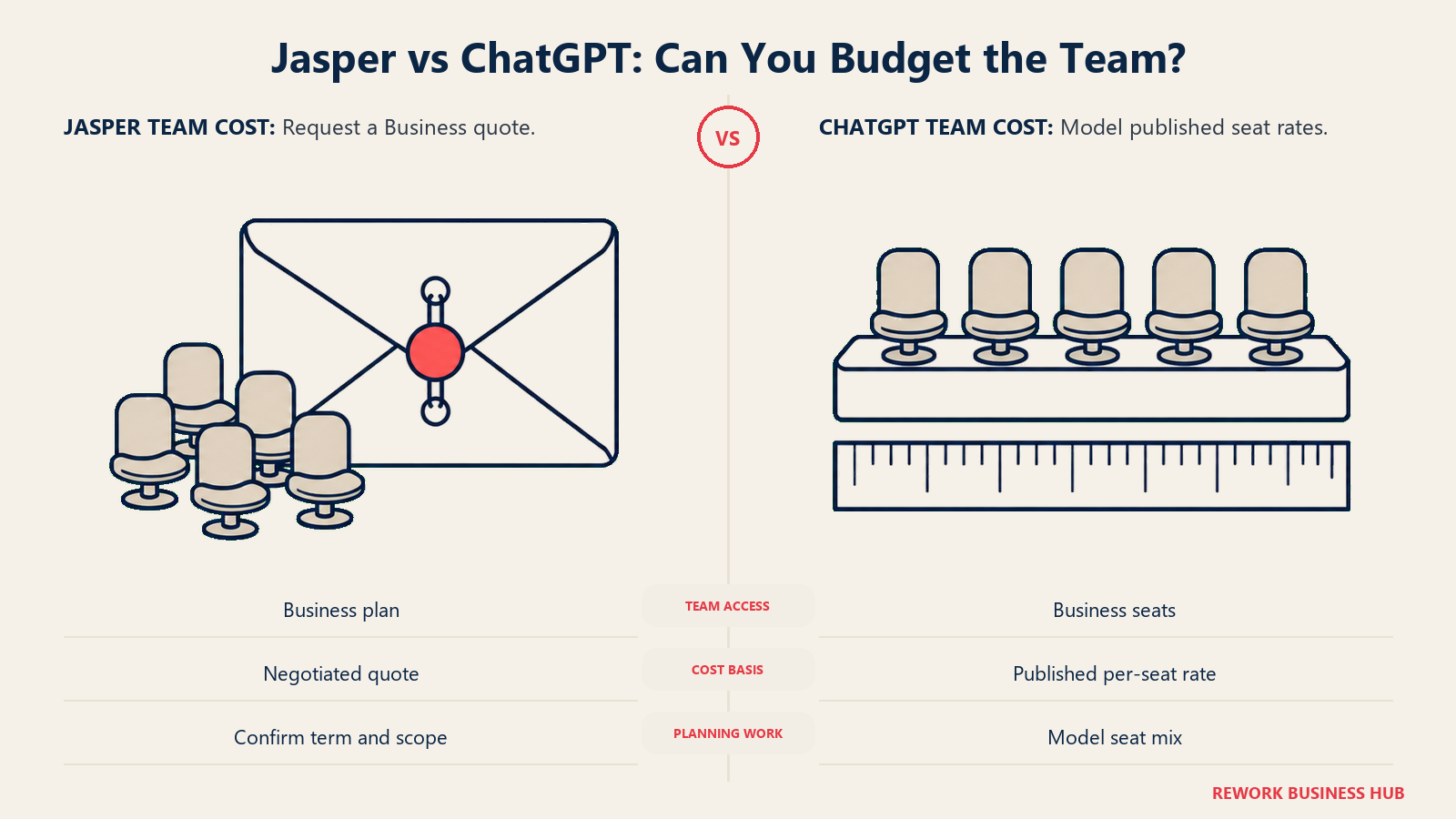
Two things happened on the OpenAI side worth knowing before you compare a number. OpenAI renamed ChatGPT Team to ChatGPT Business and cut the Standard seat price by $5 a month in April 2026, so any pricing you find under the old "Team" name is stale. On the Jasper side, the Pro plan quietly stopped being a team plan at all. It's one seat, full stop, and Jasper doesn't publish what Business costs. The closest independent number available is from Vendr, which aggregates real negotiated SaaS contracts: it reports a median annual spend of $25,000 across all Jasper tiers combined (reported, based on 48 tracked purchases), a useful sense of scale, not a quote you can budget against.
| Team size | ChatGPT Business Standard (annual billing) | ChatGPT Business Standard (monthly billing) | Jasper |
|---|---|---|---|
| 5 seats | $1,200/year ($20 x 5 x 12) | $1,500/year ($25 x 5 x 12) | Pro covers 1 seat for $708 to $828/year; the other 4 aren't available on Pro at any price, only on a quote-only Business plan |
| 25 seats | $6,000/year ($20 x 25 x 12) | $7,500/year ($25 x 25 x 12) | Business only, quote-only |
| 100 seats | $24,000/year ($20 x 100 x 12) | $30,000/year ($25 x 100 x 12) | Business only, quote-only, likely negotiated below list per Vendr's note on multi-year discounts |
There's no version of this table where Jasper's number is directly comparable to ChatGPT's, and that's the finding, not a gap in the comparison. ChatGPT's team cost is a fact you can put in a budget spreadsheet before you've talked to anyone. Jasper's is a negotiation that starts the moment you need a second seat. If your team is 5 people, you're effectively choosing between a known $1,200 to $1,500 a year and an unknown five-figure-and-up commitment for a governance layer you may or may not need yet at that size.
Implementation and Change Management
Both need brand setup; ChatGPT also needs consistent use of the shared Project.
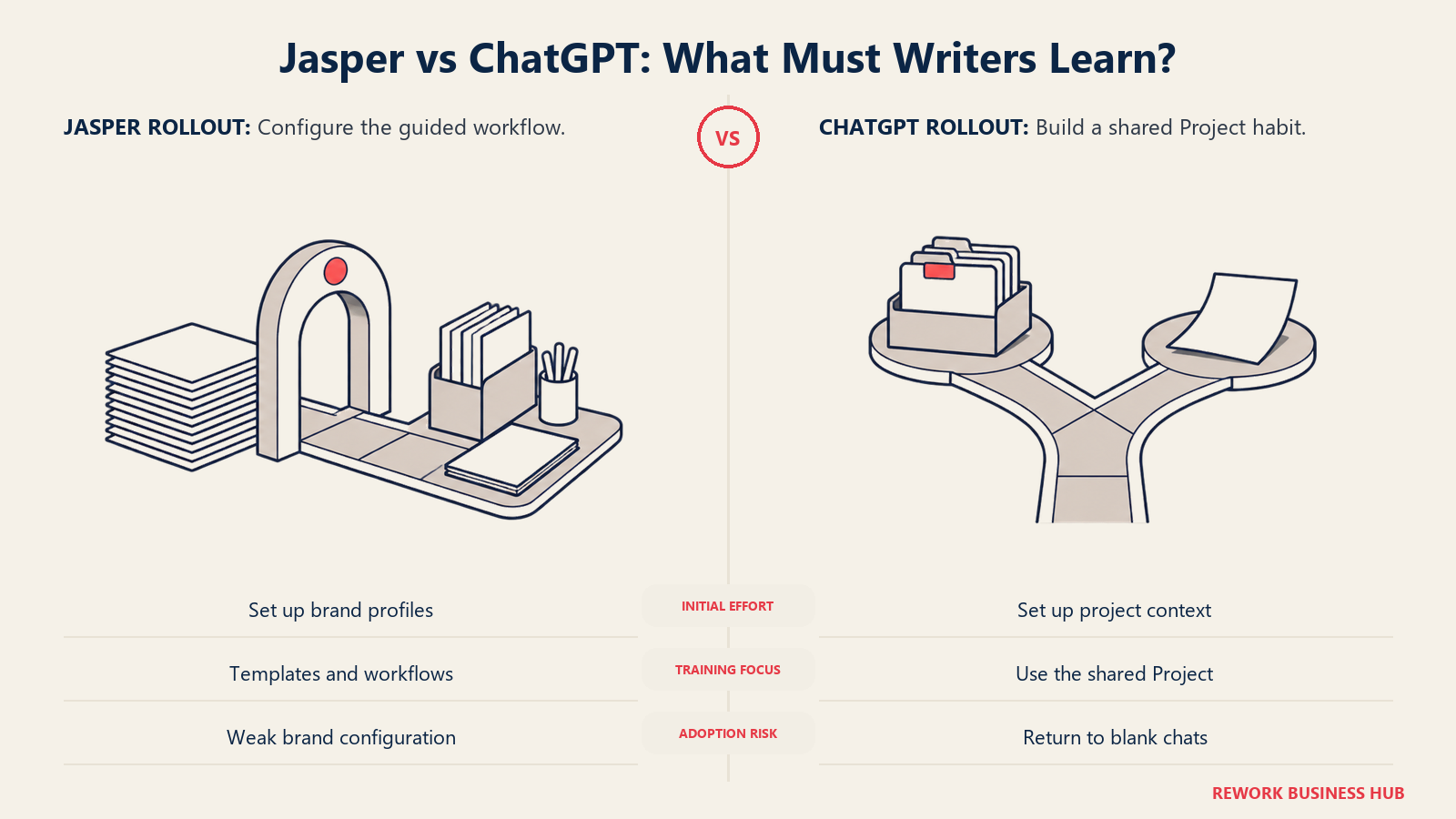
| Factor | Jasper | ChatGPT Business |
|---|---|---|
| Time to first output | Same day | Same day; most teams have already used it informally |
| Brand voice setup time | A few hours per profile, longer if the style guide is scattered across documents | Similar effort, but optional, and often skipped entirely |
| Who owns setup | Whoever configures Jasper IQ, usually content or brand ops | Whoever volunteers to build the shared Project or Custom GPT |
| Contract commitment | 12-month minimum on both Pro and Business | No published minimum term on Business Standard |
| Training load | Low; templates and pipelines guide the writer | Low for chat itself; moderate if you want consistent Project use |
| Rollout risk | Low, if the Brand Voice is built well the default just works | Moderate; adoption of the shared Project is voluntary unless mandated |
Risk and Governance
Content-level governance and workspace usage visibility answer different management questions.
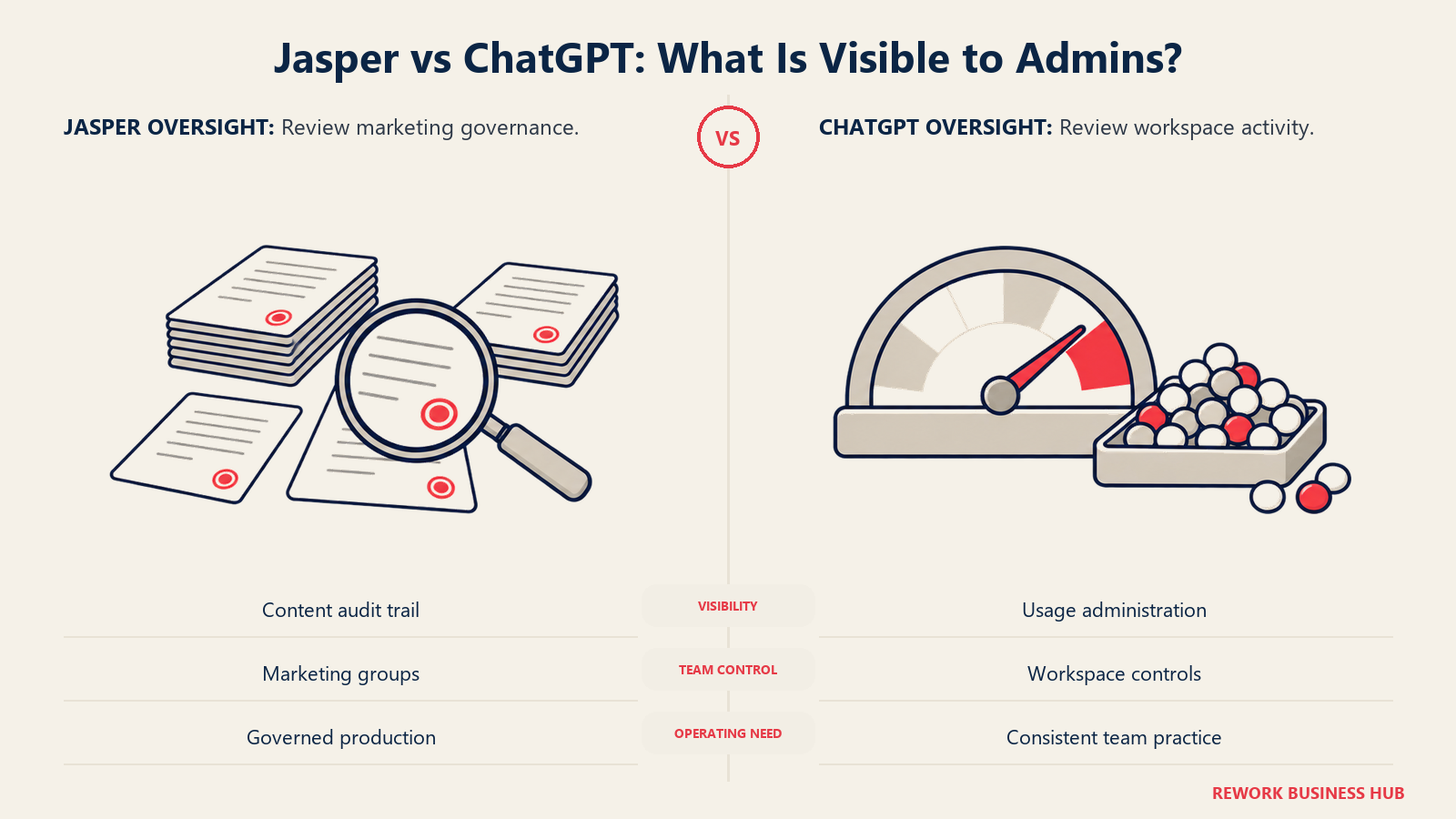
| Risk dimension | Jasper | ChatGPT Business |
|---|---|---|
| Training on your data | No; Jasper states customer content isn't used to train the underlying models, per its security documentation | OpenAI states Business and Enterprise workspace data isn't used to train its models by default |
| SOC 2 | Type II certified; report available on request via Jasper's compliance portal | OpenAI publishes SOC 2 reporting for Business and Enterprise workspaces |
| GDPR / CCPA | Compliant, DPA available | Compliant, DPA available on Business/Enterprise |
| Admin audit trail of content | Yes, in-app AI audit log (Business) | Workspace admin console tracks usage, not content-level review |
| Shadow AI / personal-account risk | Lower; the workspace is purpose-built, so there's less reason to reach for a personal account | Real risk if seats aren't provisioned to everyone who needs one; see the Shadow AI data above |
| Vendor concentration | Model-agnostic by design; not locked to one AI lab | Locked to OpenAI's model family, though your prompts and files stay portable |
| Contract flexibility | Low; both tiers carry a 12-month minimum | Higher; Business Standard has no published long-term minimum |
When Jasper Is the Right Call
- Your content team has grown past the point where one or two people can eyeball every piece for brand consistency, generally somewhere past 10 to 15 regular writers or contractors.
- You run multiple brand voices, whether that's sub-brands, regional variants, or an agency serving several clients from one workspace.
- You've already tried the ChatGPT-Project route and watched it drift: people reverted to blank chats, the style guide went stale, nobody owned it.
- Marketing leadership wants an admin-visible, auditable system (Groups, an AI audit log, role-based access) without building that tooling in-house.
- You can commit to a 12-month contract and are prepared to negotiate a Business quote rather than budget against a published number.
When ChatGPT Is the Right Call
- Your team is under about 10 people, small enough that one person can realistically own and keep a shared Project updated.
- You need the budget line fully transparent and linear at every headcount, since Business Standard pricing is published and doesn't require a sales call.
- Your content operation is still taking shape, and a 12-month minimum commitment is the wrong bet right now.
- The same team also needs AI for research, data analysis, decks, and work outside marketing, where a general-purpose tool covers more ground than a marketing-scoped one.
- Your roster includes contractors and freelancers whose seat count changes monthly; per-seat billing with no long-term minimum fits that churn better than a 12-month contract does.
If the need is narrower than full campaign governance, just ads, landing pages, and email, our best AI tools for copywriting guide covers more specialized options at that scope.
Decision Framework
| Pick this | If this describes your situation |
|---|---|
| Jasper | 15+ regular writers or contractors need to sound like one brand without manual review |
| Jasper | You manage multiple brand voices, sub-brands, or client accounts from one workspace |
| Jasper | You want an auditable, admin-governed system and are willing to negotiate a 12-month Business contract |
| ChatGPT | Your team is under 10 people and budget transparency matters more than a built-in brand layer |
| ChatGPT | You need one tool for marketing content and everything else your team does |
| ChatGPT | You're not ready for a 12-month commitment while your content operation is still forming |
| Run a pilot first | You're genuinely unsure; test a real ChatGPT Project for 30 days before signing anything with Jasper |
What to Do Next
- Build one real ChatGPT Project before you evaluate Jasper, even if you expect to end up buying it. Upload your actual style guide and five of your best recent pieces, write a real custom instruction, and hand it to three writers for two weeks. That costs a $20 to $25 seat, not a 12-month contract, and it tells you exactly how much of Jasper's value you can already get for a fraction of the price.
- Measure two things from that pilot: how often writers actually opened the Project instead of a blank chat, and whether a second editor, blind to which piece came from where, can tell the difference in brand consistency.
- If the pilot holds up at your team's size, you likely don't need Jasper yet. Scale the same Project pattern and revisit the decision at your next real headcount milestone.
- If the pilot breaks down, mainly because people stop using the shared Project, that's your signal. Jasper's automatic default is worth pricing out. Get an actual Business quote for your real seat count before comparing it to any number in this article.
- Keep the underlying model question separate from this one. If your team is also choosing between the models themselves, not just the layer built on top of them, see Claude vs ChatGPT vs Gemini for that decision, and our best AI marketing tools and best AI writing tools roundups if you're still comparing the wider field rather than just these two. And if the real question isn't marketing governance at all but ChatGPT against a grounded workspace assistant, ChatGPT vs Notion AI covers that separate comparison.
Frequently Asked Questions about Jasper vs ChatGPT
Does Jasper have its own AI model, or is it built on ChatGPT?
Neither, exactly. Jasper doesn't train its own foundation model; it's model-agnostic and routes different jobs across GPT, Claude, and Gemini-class models, then wraps the output in your configured Brand Voice. It isn't built on ChatGPT specifically, it can draw on OpenAI's models as one option among several.
Can a 5-person marketing team actually use Jasper?
Only awkwardly. Jasper's Pro plan is a single seat at $69/mo, or $59/mo billed annually, so a 5-person team needs the Business plan, which is custom-quoted and carries a 12-month minimum. Compare that to ChatGPT Business Standard, which covers 5 seats for $1,200 to $1,500 a year with no published long-term commitment.
Is ChatGPT's brand voice as good as Jasper's without a paid add-on?
It can get close if someone builds and maintains a shared Project with your style guide, examples, and a clear custom instruction, and if your team actually uses it instead of opening a blank chat. Jasper's advantage is that its Brand Voice applies automatically to every generation because an admin configures it once at the platform level. ChatGPT's version only works for the people who open the right Project.
Does Jasper train its AI on our content?
No. Jasper states customer content and intellectual property entered into the platform aren't used to train the underlying models, and the company says it doesn't permit third parties to train on customer data either, per its published security documentation.
Which is cheaper for a 25-person marketing team?
On paper, ChatGPT Business Standard is transparent: 25 seats runs $6,000 a year billed annually or $7,500 billed monthly. Jasper doesn't publish a number at that size; you'd need a Business quote. Vendr's aggregated contract data puts the median Jasper spend across all tiers at $25,000 a year, though that's a blended figure across every team size, not a 25-seat rate.
Do marketing teams need both tools?
Some do, and it's a reasonable setup: ChatGPT for the general drafting, research, and ad hoc work that doesn't touch brand voice, and Jasper for the campaign content that needs to stay consistent across many writers. The overlap is real, so this only makes sense once you've confirmed a shared ChatGPT Project genuinely isn't holding brand consistency together on its own.

Senior Customer Retention Strategist
On this page
- TL;DR
- Key Facts
- What Each Tool Is Actually Built For
- Decision by Business Goal
- Team and Role Fit
- Brand Voice and Governance: The Actual Difference
- Pricing at Real Team Sizes
- Implementation and Change Management
- Risk and Governance
- When Jasper Is the Right Call
- When ChatGPT Is the Right Call
- Decision Framework
- What to Do Next