Best AI Tools for Restaurants in 2026
Turn this article into takeaways for your work.


Each assistant summarizes the article only for you and suggests best practices for your work.
If you're evaluating AI tools for restaurants in 2026, ChatGPT is the fastest way to draft menus, specials copy, and shift notes with zero setup, Toast IQ and Restaurant365's R365 AI turn the POS and back office data you already generate into daily decisions, SoundHound, Presto, and ConverseNow handle voice ordering at the drive-thru and phone, and specialists like 5-Out, MarginEdge, and Marqii solve forecasting, food cost, and reviews better than a generalist ever will. This guide ranks 14 tools by the job they actually do, not by hype.
Adoption is real but uneven. 26% of restaurant operators say they're using AI-related tools today, according to the National Restaurant Association's State of the Restaurant Industry 2026 report, but only 6% have deployed it for taking customer orders. That gap between category buzz and actual kitchen and counter use is exactly what this list is built to close. Every tool below was evaluated on real-world deployment, the specific workflow it solves, and honest limitations.
What Changed in 2026
- Toast IQ crossed real usage volume, with over 125,000 restaurant locations on the Toast platform using the AI assistant in Q1 2026 alone, per Toast's Q1 2026 Restaurant Trends Report.
- Voice AI ordering moved from pilot to multi-hundred-store rollout at chains like Wingstop and Domino's franchisees running ConverseNow, and Dairy Queen expanding its Presto drive-thru test, a sign the "prove it" phase of drive-thru AI is turning into real deployment.
- Restaurant365 shipped R365 AI, an intelligence engine built directly on the restaurant P&L, with AI Dashboards and Labor Management now generally available and AI Scheduling in early access.
- Back-office AI (MarginEdge, R365, 5-Out) is pulling ahead of front-of-house voice AI in actual adoption, since food cost and labor forecasting pay back faster and need no guest-facing risk tolerance.
Key Facts
- 26% of restaurant operators say they're using AI tools at their restaurant, but only 6% have deployed AI for taking customer orders, per the National Restaurant Association's State of the Restaurant Industry 2026 report.
- 19% of full-service and 15% of limited-service operators use AI to assist with marketing, the single most common AI use case in restaurants today, per the same NRA report.
- 69% of U.S. restaurants are now adopting AI, with 44% already using it and another 25% planning to start, per Popmenu's 2026 Restaurant Trends Report.
- Full-service restaurant employment remained 174,000 jobs (3.3%) below its pre-pandemic level as of May 2026, and roughly 8 in 10 short-staffed operators say understaffing limits their ability to grow, per Nation's Restaurant News.
- SoundHound's voice AI offers an upsell on 100% of drive-thru orders, compared with an industry baseline of 42% for human-staffed lanes, per SoundHound's own platform data (vendor-reported).
- 13% of restaurants on Toast opened a conversation about labor costs and efficiency through Toast IQ in Q1 2026, behind sales and revenue questions at 47% and menu and inventory at 34%, per Toast's Q1 2026 Restaurant Trends Report.
Quick Comparison Table
| Tool | Best For | Standout Capability | Starting Price | Free Tier? |
|---|---|---|---|---|
| ChatGPT | General AI assistant for any restaurant task | Drafting menus, specials, and training notes in plain language | Free; Plus $20/mo | Yes |
| Toast AI (Toast IQ) | Toast POS users wanting an AI assistant on existing data | Conversational sales, labor, and menu insights inside the POS | Free (Starter Kit); POS from $69/mo/terminal | Yes (limited) |
| SoundHound AI | Chains automating drive-thru and omnichannel voice ordering | End-to-end voice AI with no human in the loop, 100% upsell attempts | Quote-only (five-figure setup typical) | No |
| Presto Voice | QSR chains testing or scaling drive-thru automation | Up to 95% non-intervention rate on drive-thru orders | Quote-only; $3K-$10K capex + $300-$1,000/mo per location | No |
| ConverseNow | National QSR brands automating phone and drive-thru at scale | Deployed across 1,200+ stores integrating with major POS systems | Quote-only, enterprise implementation | No |
| Slang.ai | Independent restaurants drowning in ringing phones | AI phone answering and reservations, flat monthly price regardless of call volume | $399/mo (Core) | No |
| Rework (People app) | Multi-location groups unifying HR, attendance, and timesheets | HRIS + clock-in/out + timesheets on one platform, not spreadsheets per store | Contact for pricing | No |
| 7shifts | Teams wanting AI-assisted staff scheduling | Auto-scheduling that reads sales trends to recommend headcount | Free (Comp, 1 location, 15 staff); paid from $39.99/mo/location | Yes |
| 5-Out | Operators wanting AI demand forecasting for labor and purchasing | Predicts sales, staffing, and prep needs from POS and weather data | Quote-only | No |
| Restaurant365 (R365 AI) | Multi-unit groups wanting AI on top of accounting and labor | Intelligence engine built on the full restaurant P&L | Custom quote | No |
| MarginEdge | Operators wanting real-time food cost without manual entry | AI invoice digitization drives food cost visibility in 24-48 hours | $350/mo per location (unlimited invoices) | No |
| Marqii | Multi-location brands managing reviews and listings at scale | AI + human review responses across Google, Yelp, OpenTable, and delivery apps | ~$74.99/mo per location | No |
| PopMenu | Independents wanting AI marketing plus an AI phone agent | Auto-generated email, text, and social campaigns per location | $179/mo (Starter) | No |
| Owner.com | Restaurants rebuilding their website and direct ordering | AI-powered website and marketing automation that drives reorders | $249/mo (Flexible) + per-order fee | No |
How to Choose: Decision Framework
| If you need... | Pick... | Why |
|---|---|---|
| Fast, general-purpose drafting, research, and menu copy | ChatGPT | No setup, no restaurant-specific learning curve, works for any task |
| An AI layer on data you already generate through your POS | Toast AI (Toast IQ) | Conversational access to sales, labor, and menu data already sitting in Toast |
| Fully automated drive-thru voice ordering at scale | SoundHound AI or ConverseNow | Both run end-to-end voice AI with no human in the loop, proven at 1,000+ store volume |
| A lighter drive-thru voice pilot before a full rollout | Presto Voice | Vendor-reported 95% non-intervention rate, integrates into existing drive-thru hardware |
| Nobody answering the phone during the rush | Slang.ai | Flat monthly price for AI phone answering and reservations, no per-call fee |
| Unified HR, attendance, and timesheets across locations | Rework (People app) | One HRIS instead of spreadsheets per store; pairs with, doesn't replace, your POS |
| AI-assisted scheduling without replacing your whole stack | 7shifts | Auto-scheduling reads sales trends; free tier covers a single small location |
| Demand forecasting to cut food waste and overstaffing | 5-Out | Predicts sales and staffing needs to drive purchasing and prep decisions |
| AI across accounting, labor, and multi-unit reporting | Restaurant365 (R365 AI) | Intelligence engine built on the full restaurant P&L, not a bolt-on dashboard |
| Real-time food cost without manual invoice entry | MarginEdge | AI digitizes invoices in 24-48 hours; flat per-location price |
| Reviews and listings management across many locations | Marqii | AI plus human review responses across every major review and delivery platform |
| AI-generated marketing campaigns without a marketing hire | PopMenu | Auto-produces email, text, and social content per location every month |
| A rebuilt website and direct ordering that drives reorders | Owner.com | AI-powered website and marketing automation bundled with online ordering |
Framework: By Restaurant Size
| Restaurant Type | Budget Signal | Best Fits |
|---|---|---|
| Single independent restaurant | Free to under $100/mo | ChatGPT, Toast IQ (bundled with POS), 7shifts free tier |
| Small group, 2-5 locations | Under roughly $1,000/mo | Slang.ai, PopMenu Starter/Essentials, MarginEdge, 7shifts paid tiers |
| Regional group or franchisee, 6-25 locations | Ready for a real ops-tech budget | Rework People app, Restaurant365, 5-Out, Marqii, Owner.com |
| National chain or enterprise QSR | Enterprise data, compliance, and multi-year contracts | SoundHound AI, ConverseNow, Presto Voice, Restaurant365 enterprise |
1. ChatGPT: General AI Assistant for Any Restaurant Task
ChatGPT isn't a restaurant tool, and that's exactly why it leads this list: it's the AI most operators already have open on a phone or laptop. Managers use it to draft specials copy, rewrite a job posting, prep talking points for a health inspection, or turn a vendor invoice dispute into a polite email, all before a dedicated tool ever enters the picture.
Best for: Any owner, GM, or shift lead who wants one flexible tool for writing, research, and day-to-day admin
Key strengths:
- Fastest way to draft or rewrite anything, from menu descriptions to a LinkedIn post for a hiring push
- Custom GPTs and saved prompts let a manager build repeatable templates for training docs or comp analysis
- Useful outside food service too: lease negotiation prep, basic financial modeling, local marketing ideas
Limitations:
- No POS connection, no sales data, no scheduling; everything has to be typed or pasted in manually
- No restaurant-specific guardrails (food cost formulas, labor law nuances) without a custom prompt library
- Not built for guest-facing ordering or phone answering
| What you get | What you don't |
|---|---|
| General-purpose drafting, research, and reasoning | No POS, sales, or labor data pulled automatically |
| Free tier plus a low-cost Plus tier | No restaurant-specific compliance or food cost tools |
| Works across every part of the operation, not just one task | No guest-facing ordering or phone-answering capability |
Pricing: Free tier available. Plus is $20/month for individuals. Business is $20/user/month billed annually (2-seat minimum).
For the AI layer built directly on your point-of-sale data, see Toast AI below, or the broader best AI tools for small business in 2026 for tools that reach beyond food service.
2. Toast AI (Toast IQ): AI Assistant Built on Your POS Data
Toast IQ is the conversational AI layer Toast has been rolling into its POS platform, and its differentiator is data it already owns: sales, labor, and menu performance across the location. Rather than exporting reports and asking ChatGPT to interpret them, an operator can ask Toast IQ directly and get an answer grounded in that day's real numbers.
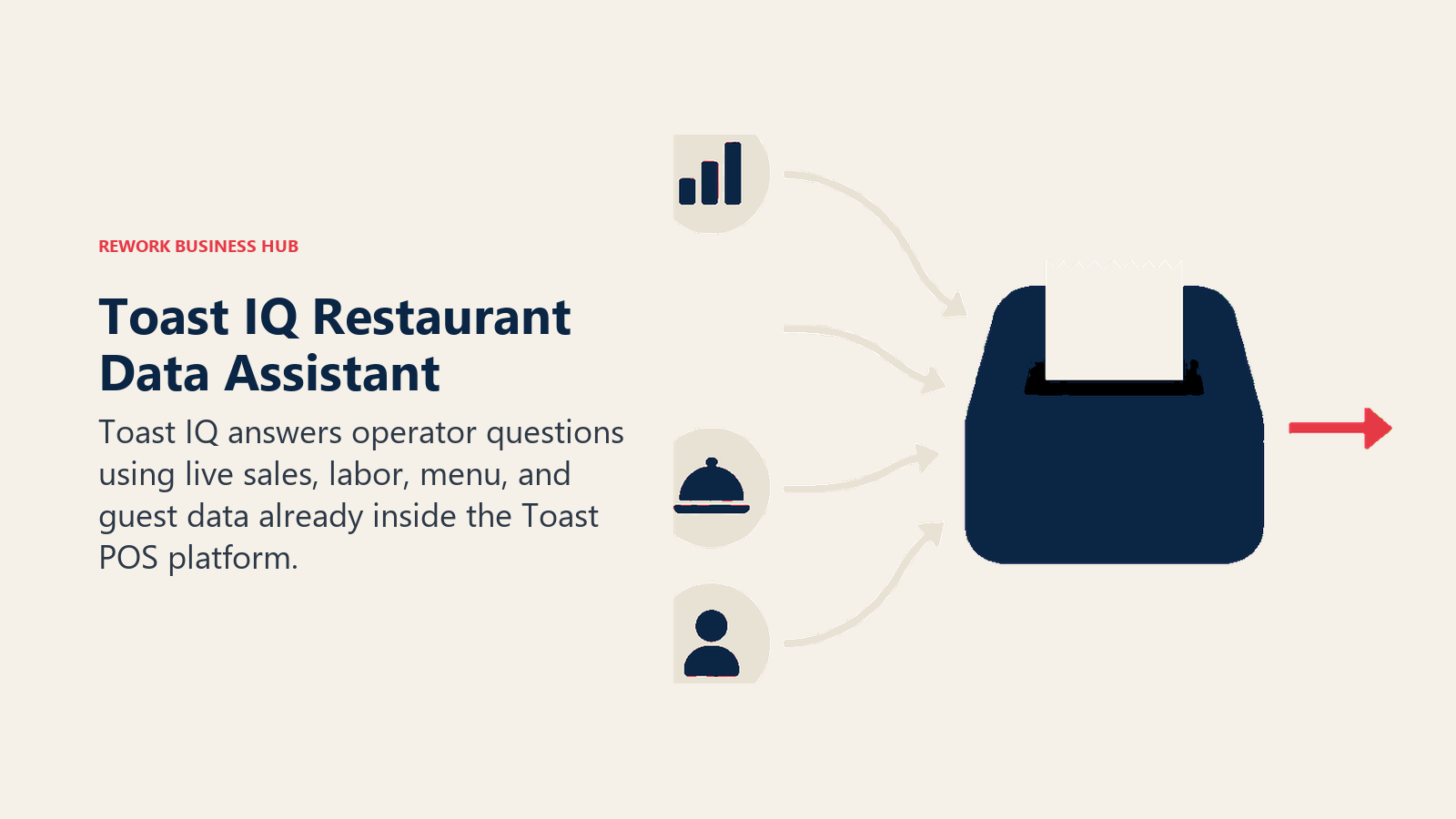
Usage data backs up where the value actually lands. Sales and revenue questions make up the largest share of Toast IQ conversations at 47%, with menu and inventory questions at 34% and guest and marketing at 32%, while only 13% of restaurants used it for labor-cost conversations, a gap that points to real headroom for that specific use case.
Best for: Restaurants already running Toast POS that want an AI assistant without adding a separate platform
Key strengths:
- Grounded in live sales, labor, and menu data instead of a manual export
- No new login or system for staff already using Toast
- Rapid adoption: over 125,000 locations used it in a single quarter
Limitations:
- Only useful if you're already on Toast POS; not a standalone product
- Headline software pricing understates real cost once add-ons and processing fees stack up
- Labor-cost use is still the least-adopted conversation type, meaning the workflow is younger than sales reporting
| What you get | What you don't |
|---|---|
| AI assistant grounded in your live POS data | Only works if you're already running Toast POS |
| No added login for staff already on Toast | Real all-in monthly cost often runs 2-3x the base quote |
| Fast-growing usage across sales, menu, and marketing questions | Labor-cost AI use still trails other question types |
Pricing: Starter Kit is free. Point of Sale runs $69/month per terminal. A single-location restaurant typically pays $150-$500/month all-in with add-ons, plus 2.49%-2.99% + $0.15 per transaction in processing.
3. SoundHound AI: End-to-End Voice AI for Drive-Thru and Omnichannel Ordering
SoundHound runs voice AI that takes an entire order with no human in the loop, and its 2026 platform update extended that beyond the drive-thru lane to call-to-order, text-to-order, scan-to-order, and in-car voice ordering. The pitch to a multi-unit operator is consistency: every guest gets an upsell offer, every time, which a busy human crew simply can't match during a rush.
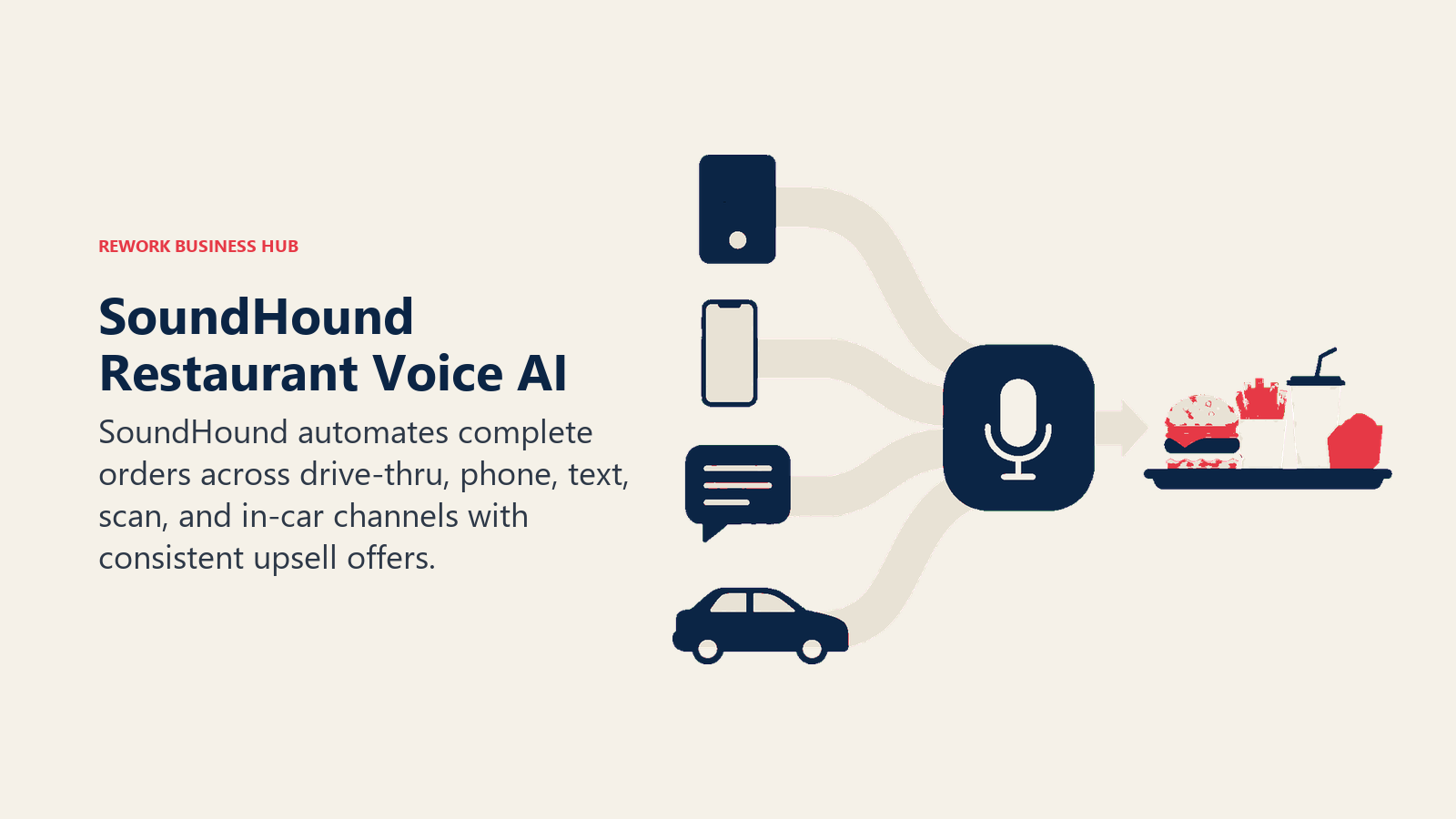
That consistency shows up directly in the vendor's own performance data: SoundHound's AI offers an upsell on 100% of orders, compared with a reported 42% baseline for human-staffed lanes, a gap worth treating as vendor-reported until you see it validated in your own locations.
Best for: Multi-unit chains ready to automate ordering across drive-thru, phone, and other channels at once
Key strengths:
- Fully automated voice AI with no human fallback required in normal operation
- Upsell offered on every order, not dependent on crew training or shift energy
- Expanding beyond drive-thru into call, text, and in-car ordering under one platform
Limitations:
- Implementation commonly runs over $10,000 with 12-24 month contracts
- Enterprise sales process; not built for a single independent restaurant
- Requires reliable connectivity and hardware investment at each location
| What you get | What you don't |
|---|---|
| Fully automated, no-human-in-the-loop voice ordering | Five-figure setup cost typical, long contract terms |
| Consistent 100% upsell attempt rate | Enterprise sales process, not self-serve |
| Expanding to phone, text, and in-car ordering | Requires per-location hardware and connectivity investment |
Pricing: Not publicly published. Enterprise implementation commonly starts with a five-figure setup fee and a 12-24 month contract.
4. Presto Voice: Drive-Thru Voice AI for QSR Chains
Presto has spent 2026 moving from pilot programs to production rollouts, including an expanded Dairy Queen franchisee test, backed by a fresh $10 million raise to scale deployments. Its Voice product integrates into existing drive-thru hardware and POS systems rather than requiring a rip-and-replace, which lowers the barrier for a chain running a phased test across a handful of stores before a full commitment.
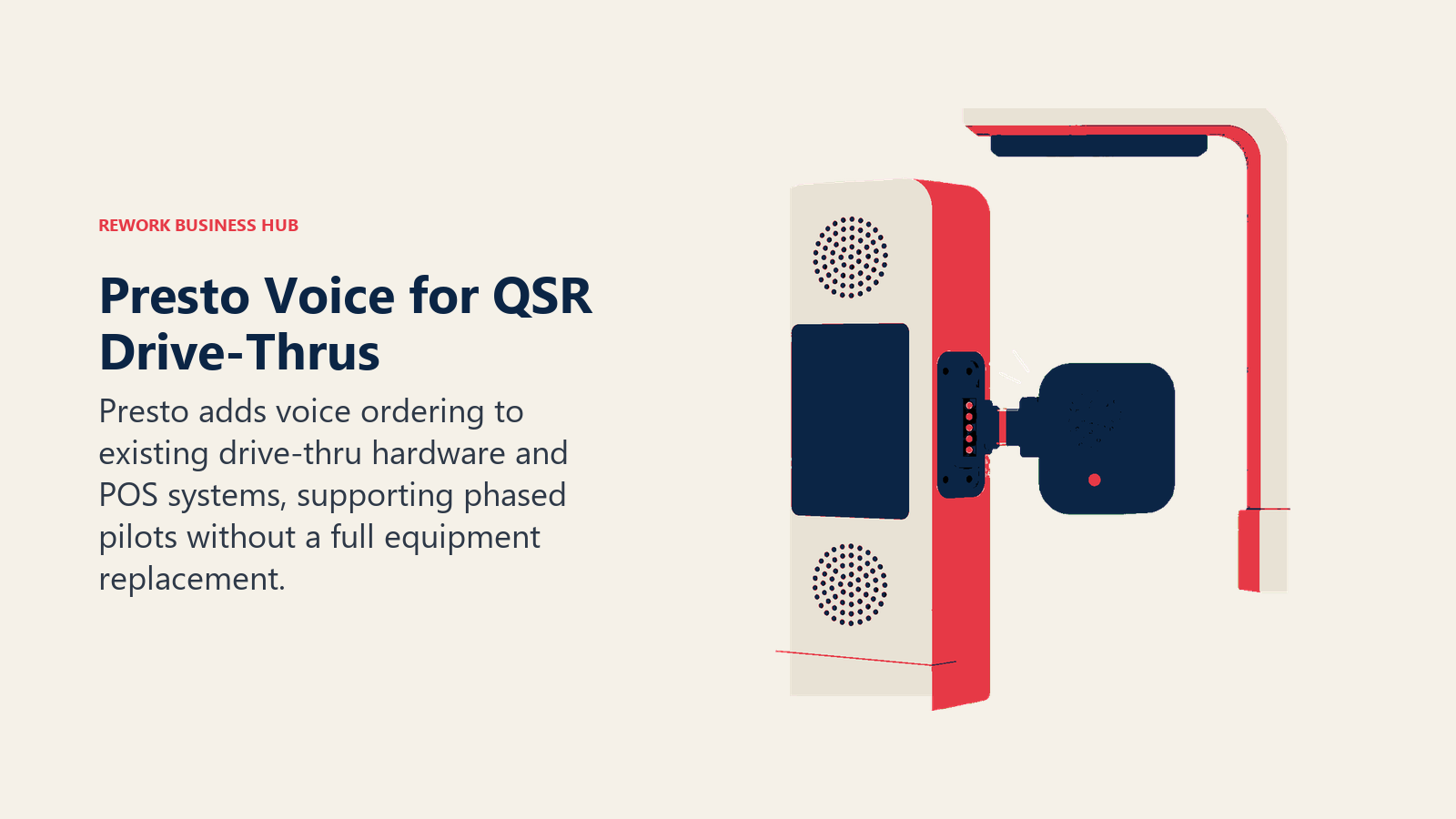
Presto reports up to a 95% non-intervention rate on the orders it handles, meaning staff rarely need to step in, alongside vendor-reported labor savings in the range of 5-10 hours per location per day.
Best for: QSR chains piloting or scaling drive-thru voice automation without replacing existing hardware
Key strengths:
- Integrates into existing drive-thru hardware and POS rather than requiring new equipment
- Vendor-reported non-intervention rate up to 95% on handled orders
- Active customers include Taco John's, Hardee's/Carl's Jr., Fazoli's, and an expanding Dairy Queen test
Limitations:
- Pricing is quote-only; capex for headsets and edge hardware runs $3,000-$10,000 per location
- Operating cost adds roughly $300-$1,000/month per location on top of capex
- Accuracy and labor-savings figures are vendor-reported, not independently audited
| What you get | What you don't |
|---|---|
| Works with existing drive-thru hardware, no full replacement | Meaningful upfront capex per location ($3K-$10K) |
| Vendor-reported 95% non-intervention rate | Ongoing monthly service cost on top of hardware |
| Proven multi-brand QSR deployment in 2026 | Performance figures are vendor-reported, not third-party audited |
Pricing: Quote-only. Typical capex of $3,000-$10,000 per location plus $300-$1,000/month in operating costs.
For a comparison of AI phone and voice tools outside the drive-thru specifically, see the best AI voice generators in 2026.
5. ConverseNow: Voice AI at National QSR Scale
ConverseNow is the voice AI platform national chains reach for once they need proof at real volume: it's deployed across more than 1,200 stores in 43 states, serving brands like Domino's and Wingstop franchisees, and automates order-taking across both drive-thru and phone with conversational AI that integrates into major POS systems. A 2026 partnership with Deliverect folded voice ordering directly into unified order and menu management, reducing the integration work a chain's IT team has to do to roll it out.
Best for: National QSR brands and large franchise groups needing voice AI proven at hundreds of locations
Key strengths:
- Deployed at 1,200+ stores, among the largest live footprints in restaurant voice AI
- Handles both drive-thru and phone ordering under one system
- 2026 Deliverect partnership unifies voice ordering with order and menu management
Limitations:
- Built for large chains; multi-week implementations aren't sized for a single independent
- No public pricing; sales-led enterprise process
- Requires POS and menu-management integration work upfront
| What you get | What you don't |
|---|---|
| Proven deployment across 1,200+ stores in 43 states | No public pricing, enterprise sales process only |
| Drive-thru and phone ordering in one system | Multi-week implementation, not suited to a single location |
| Deliverect integration unifies order and menu management | Requires real IT lift to integrate with existing POS |
Pricing: Not publicly published. Positioned for large chains with multi-week enterprise implementations.
6. Slang.ai: AI Phone Answering for Independent Restaurants
Slang.ai solves a narrow, painful problem: the phone that rings during a Friday dinner rush while every staff member is slammed. Its voice AI answers, takes reservations, and handles common questions like hours and menu items, and it prices flat per month regardless of call volume, which means a slow month costs the same as a busy one.
That flat pricing is also the honest tradeoff to weigh: at $399-599/month per location, it costs roughly 8x more than a general-purpose AI receptionist charging closer to $49/month, a premium that only pencils out if you're processing real call volume or specifically need native reservation-platform integration.
Best for: Independent restaurants and small groups losing reservations and orders to unanswered calls
Key strengths:
- Flat monthly price regardless of call volume, no per-call fee
- Handles reservations and common questions without a host stepping away from the floor
- Native integration with restaurant reservation platforms
Limitations:
- Sales-led pricing with no self-serve trial, opaque until you talk to sales
- At $399-599/month, materially pricier than general-purpose AI answering services
- Single-purpose tool: no ordering, no marketing, no back-office functionality
| What you get | What you don't |
|---|---|
| Flat-rate AI phone answering and reservations | No self-serve pricing or trial, sales-led process |
| No missed calls during peak rush hours | Meaningfully pricier than general AI answering services |
| Native restaurant reservation-platform integration | No ordering, marketing, or back-office capability |
Pricing: $399/month (Core) to $599/month (Premium) per location.
For phone and chat tools built for support teams more broadly, see the best AI tools for customer support in 2026.
7. Rework (People App): Unified HR, Attendance, and Timesheets for Restaurant Groups
Rework's fit in restaurants is specific: multi-location groups where hourly staff clock in and out, shift schedules move fast, and timesheets currently live in a different spreadsheet or app per store. The People app bundles a full HRIS with time and attendance and timesheets on one platform, so a regional operations director can see headcount, attendance, and payroll-ready hours across every location instead of stitching reports together by hand.
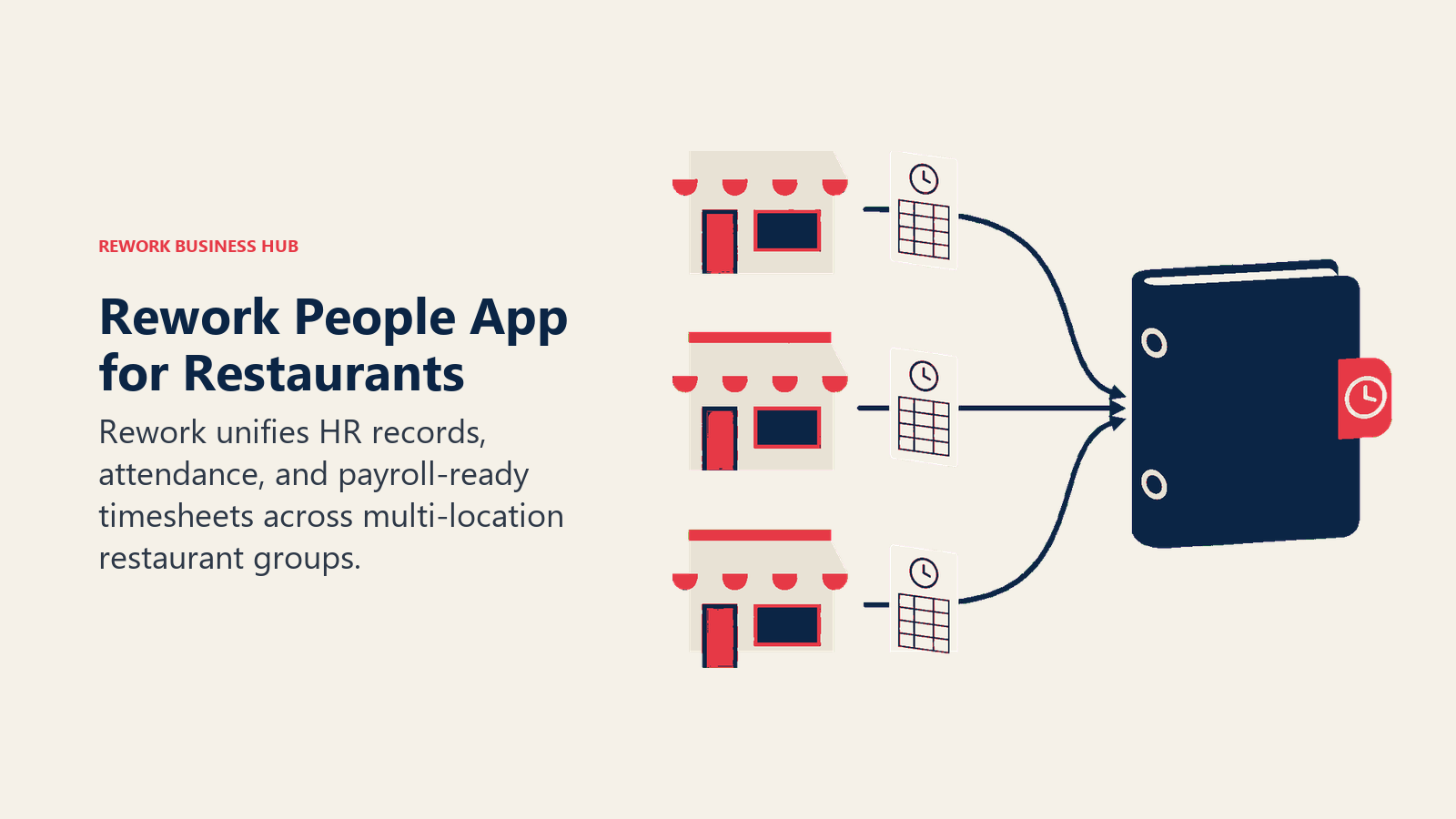
This isn't a POS, ordering, or menu tool, and it doesn't try to be. It pairs with whatever ordering and inventory stack you already run (Toast, Restaurant365, or otherwise) and solves the HR and workforce-data layer sitting underneath it.
Best for: Restaurant groups and franchisees with 5+ locations wanting one HR system instead of spreadsheets per store
Not ideal for: A single-location restaurant (Rework sells packages, not single-location licenses), or operators wanting an all-in-one POS-plus-HR bundle
Key strengths:
- Full HRIS, time and attendance, and timesheets in one platform, not three disconnected tools
- Built for teams coordinating across multiple locations, not a single-site operation
- Pairs with existing POS and inventory tools rather than replacing them
Limitations:
- Not a POS, ordering, or drive-thru tool; those still come from Toast, SoundHound, or similar
- People app pricing isn't published; requires a sales conversation
- Not sized or priced for a single independent restaurant
| What you get | What you don't |
|---|---|
| HRIS + attendance + timesheets in one platform | Not a POS, ordering, or drive-thru voice tool |
| Built for coordination across multiple locations | Not priced or sized for a single-location restaurant |
| Pairs with your existing POS and inventory stack | Published pricing isn't public yet |
Pricing: Contact for pricing. See rework.com/pricing for Rework's published product lines.
For the broader HR software category outside restaurants specifically, see the best HR software in 2026 and the how to choose HR software for small business guide.
8. 7shifts: AI-Assisted Staff Scheduling
7shifts built its name on restaurant scheduling before layering AI on top, and the addition that matters most is auto-scheduling: the system reads a location's sales trends and recommends the right headcount for a given shift instead of a manager guessing off last week's memory. Its free Comp plan supports a single location with up to 15 employees, giving a small independent a genuine on-ramp before paying for anything.
Best for: Restaurants wanting AI-assisted scheduling without replacing their broader tech stack
Key strengths:
- Auto-scheduling recommends headcount based on actual sales trend data
- Free tier covers a single small location with core scheduling functionality
- Per-location pricing with no per-user fees, favorable for high-headcount operations
Limitations:
- Deeper AI scheduling and labor forecasting sit in the higher-priced Premium tier
- Scheduling-only; no POS, ordering, or food cost functionality
- Value scales with headcount and shift complexity; overkill for a very small team
| What you get | What you don't |
|---|---|
| AI-assisted scheduling based on sales trend data | No POS, ordering, or food cost tracking |
| Free tier for a single small location | Full AI labor forecasting locked to the top tier |
| Per-location, not per-user, pricing | Less value for a very small, simple schedule |
Pricing: Free (Comp plan, 1 location, up to 15 employees). Paid tiers from $39.99/month per location up to $149.99/month for the Premium tier.
For a broader look at scheduling software selection beyond restaurants, see the how to choose scheduling software guide.
9. 5-Out: AI Demand Forecasting for Labor and Purchasing
5-Out's whole premise is that most restaurant waste and overstaffing comes down to a forecasting problem: not knowing how busy tomorrow will actually be. Its AI predicts sales using real-time POS data plus external signals, then turns that forecast directly into staffing recommendations and purchasing guidance, with an automated prep-list feature aimed at cutting kitchen waste.
Industry sentiment backs the category: 58% of hospitality professionals surveyed said AI forecasting and pricing tools will have the biggest operational impact in 2026, ahead of any other AI use case they were asked about.
Best for: Multi-location operators wanting AI-driven forecasting to cut food waste and labor overspend
Key strengths:
- Sales forecasting feeds directly into staffing and purchasing recommendations, not a standalone report
- Automated prep-list generation aimed at reducing kitchen waste
- Built specifically around the forecasting workflow rather than as an add-on feature
Limitations:
- Pricing isn't publicly disclosed; requires a sales conversation
- Forecasting accuracy depends on clean, consistent POS data feeding the model
- Not a scheduling, POS, or ordering system on its own
| What you get | What you don't |
|---|---|
| AI sales forecasting tied directly to staffing and purchasing | No public pricing, sales-led process |
| Automated prep planning aimed at reducing waste | Depends on clean POS data quality to forecast well |
| Purpose-built around the forecasting workflow | Not a scheduling or POS system by itself |
Pricing: Not publicly disclosed. Contact sales for a quote.
10. Restaurant365 (R365 AI): AI Across Accounting, Labor, and Multi-Unit Reporting
Restaurant365 built its reputation as restaurant-specific accounting and back-office software, and R365 AI is the intelligence layer it added on top of that existing data foundation: accounting, inventory, labor, scheduling, and POS data living together so a multi-unit operator can see across locations instead of reconciling separate reports. AI Dashboards and the Labor Management Suite are generally available, while AI Advisor, AI Scheduling, and secure data sharing are rolling out through early access.
Best for: Multi-unit restaurant groups wanting AI insight across accounting, labor, and operations in one system
Key strengths:
- AI runs on a unified data foundation spanning accounting, inventory, labor, and POS
- Purpose-built for multi-location visibility, not single-store reporting
- Actively expanding AI features (Advisor, Scheduling) through early access in 2026
Limitations:
- Pricing isn't public; described only as a "simple pricing model" requiring a sales conversation
- Some AI features (Advisor, Scheduling) are still early access, not fully mature
- Overkill for a single independent restaurant without multi-unit complexity
| What you get | What you don't |
|---|---|
| AI across accounting, labor, inventory, and POS in one system | No public pricing, requires a sales call |
| Built for multi-location visibility and reporting | Some AI features still in early access |
| Actively expanding AI roadmap through 2026 | Heavier than what a single-location restaurant needs |
Pricing: Not publicly disclosed. Contact sales for a quote based on locations and modules.
11. MarginEdge: AI Invoice Digitization and Real-Time Food Cost
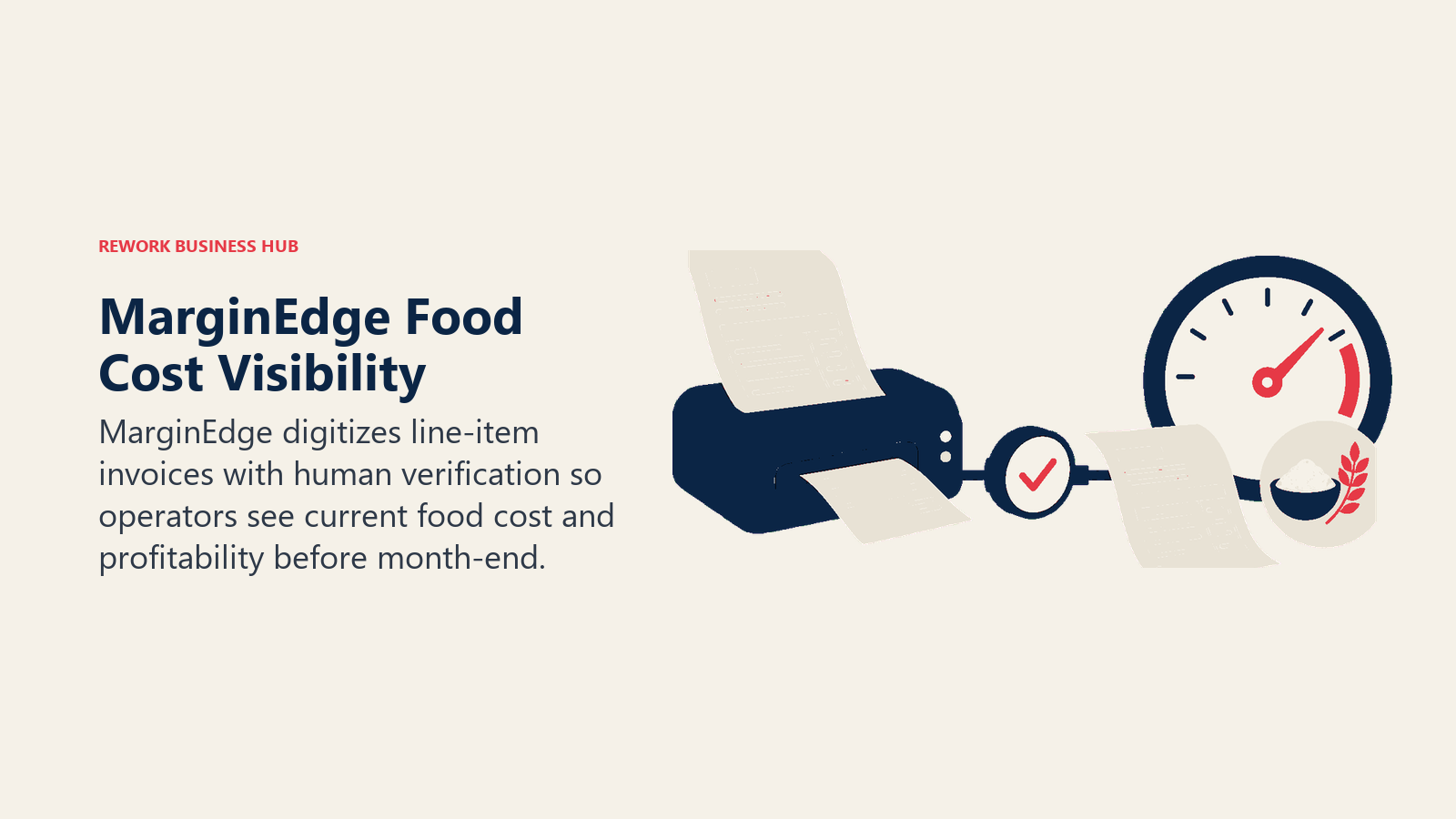
MarginEdge attacks a specific, tedious problem: invoices that sit in a drawer until someone manually keys them into a spreadsheet weeks later, by which point the food cost number is already stale. Its AI digitizes line-item invoices in roughly 24 hours, backed by a human verification team for accuracy, so operators and accounting see an up-to-date view of food cost, prime cost, and daily profitability within 24-48 hours of a delivery instead of at month-end.
Best for: Operators wanting real-time food cost visibility without manual invoice entry
Key strengths:
- AI plus human verification digitizes invoices in about 24 hours
- Flat, transparent per-location pricing with unlimited invoices and U.S. bill pay included
- Integrates with 50+ POS systems and 15 accounting systems
Limitations:
- $350/month per location adds up quickly for a large multi-unit group
- Focused specifically on invoices and food cost, not scheduling or ordering
- Value depends on consistently uploading invoices; gaps in input mean gaps in insight
| What you get | What you don't |
|---|---|
| AI invoice digitization with human verification | No scheduling, ordering, or guest-facing features |
| Real-time food cost visibility within 24-48 hours | Flat $350/mo/location cost scales with location count |
| Broad POS and accounting system integration | Insight quality depends on consistent invoice upload |
Pricing: $350/month per location, flat, with unlimited invoices and U.S. bill pay included.
12. Marqii: AI Reputation and Listings Management
Marqii is purpose-built for the review sprawl a multi-location restaurant brand accumulates across Google, Yelp, OpenTable, Uber Eats, Grubhub, and more. Its AI, backed by a human review layer it calls "HI," drafts on-brand, timely responses across every platform from one dashboard, and it extends into menu and listings accuracy so a guest doesn't show up to a closed location because the hours were never updated everywhere at once.
Best for: Multi-location brands managing reviews, menus, and listings consistency at scale
Key strengths:
- AI plus human review response layer across every major review and delivery platform
- Menu and listings sync keeps hours and details consistent across locations
- Tiered pricing scales from a single location up to custom enterprise plans
Limitations:
- Review response, not review generation; it can't fix an operational problem driving bad reviews
- Higher tiers needed for meaningful response volume (up to ~500/month)
- Less value for a single location with low review volume
| What you get | What you don't |
|---|---|
| AI + human review responses across every major platform | Can't fix the operational issue behind a bad review |
| Menu and listings consistency across locations | Higher response volume requires a higher tier |
| Tiered pricing scaling to multi-location brands | Limited value for a single low-volume location |
Pricing: From roughly $74.99/month per location (Base) up to $149.99/month (Pro+Advanced); custom pricing for 5+ locations.
13. PopMenu: AI Marketing and AI Phone Agent for Independents
PopMenu bundles the marketing work an independent restaurant rarely has staff time for: AI-generated email, text, and social content produced automatically each month, tailored per location, plus an add-on AI phone agent for calls a host can't get to. Its 10,000+ restaurant customer base across the U.S., U.K., and Canada makes it one of the more established names in restaurant marketing AI.
Best for: Independent restaurants and small groups wanting AI marketing without hiring a marketer
Key strengths:
- Auto-generated email, SMS, and social content unique to each location, monthly
- AI phone agent add-on covers calls during peak hours
- Established platform serving 10,000+ restaurants
Limitations:
- Core plans focus on marketing and website; online ordering and AI phone agent are separate add-ons
- Costs climb quickly once add-ons and multi-location fees stack ($300/mo/location extra)
- SMS message caps on lower tiers can run out during a busy promotional month
| What you get | What you don't |
|---|---|
| Auto-generated marketing content per location, monthly | Online ordering and AI phone agent cost extra |
| Established, widely deployed restaurant marketing platform | Costs add up fast across add-ons and multi-location fees |
| AI phone agent option for uncovered calls | SMS caps on lower tiers can run out |
Pricing: Starter $179/month, Essentials $299/month, Premier $499/month (roughly 10% off prepaid annually). AI phone agent add-on $149/month; AI marketing add-on $300/month.
For AI marketing tools built beyond a single vertical, see the best AI marketing tools in 2026.
14. Owner.com: AI Website and Direct Ordering That Drives Reorders
Owner.com's bet is that most independent restaurant websites are actively costing them money: slow, generic, and pushing guests to third-party delivery apps that take a cut and own the customer relationship. Its AI-powered website and branded ordering app are paired with marketing automation that runs proven email and text campaigns to drive repeat orders without a marketer managing campaigns by hand.
Best for: Independent restaurants wanting a rebuilt website and direct ordering channel to reduce third-party delivery dependence
Key strengths:
- AI-built website and branded ordering app replace a generic or outdated site
- Marketing automation drives reorders without manual campaign management
- Flat Standard plan available with no per-order fee if a predictable bill matters more
Limitations:
- Flexible plan carries a 5% customer-paid order fee on direct orders
- Implementation fee of roughly $1,000, plus $299 per additional location
- Not a POS, scheduling, or back-office tool; solves the guest-facing website and ordering layer only
| What you get | What you don't |
|---|---|
| AI website, branded app, and direct ordering in one platform | Implementation fee plus per-location fees for multi-unit |
| Marketing automation built to drive repeat orders | No POS, scheduling, or back-office functionality |
| Flat Standard plan option with no per-order fee | Flexible plan carries a 5% customer-facing order fee |
Pricing: Flexible $249/month plus a 5% customer-paid order fee. Standard $499/month flat, no order fee. Roughly $1,000 implementation, $299 per additional location.
Restaurant AI Buying Mistakes to Avoid
Most restaurant AI spend goes to the wrong layer of the stack, or to the flashiest tool instead of the one solving the actual bottleneck. Here's where operators commonly get it wrong.
| Mistake | What It Looks Like | What to Do Instead |
|---|---|---|
| Jumping straight to drive-thru voice AI before fixing the basics | Signing a five-figure voice AI contract while food cost and scheduling are still spreadsheets | Fix back-office visibility (food cost, forecasting, scheduling) first; voice AI pays off faster once the fundamentals are solid |
| Buying a single-location tool once you've opened store #2 or #3 | Individual scheduling or marketing tools with no cross-location visibility once you're multi-unit | Move HR, attendance, and reporting to a platform built for multiple locations, like Rework's People app or Restaurant365 |
| Trusting AI-generated content without a human read | Publishing AI marketing copy or menu descriptions with no review before it goes live | Keep a human review step, especially for pricing, allergen, and promotional claims |
| Assuming one AI tool covers ordering, marketing, and back office | Trying to make ChatGPT alone replace a POS, a forecasting tool, and a marketing platform | Stack 2-4 specialized tools around your POS instead of asking a generalist to do everything poorly |
| Signing an enterprise voice AI contract before validating call or drive-thru volume | Committing to SoundHound or ConverseNow-scale infrastructure for a single location | Trial a lighter, self-serve option like Slang.ai or 7shifts's free tier first, then scale up once volume justifies it |
| Treating headline software pricing as the real bill | Budgeting off a $69/month POS quote and getting hit with a $400+/month all-in invoice | Ask every vendor for the realistic all-in monthly cost including add-ons and transaction fees before signing |
For a broader look at picking software before layering AI tools on top of it, the how to choose HR software for startups guide and the best AI agents in 2026 are both useful next reads.
Where Restaurant AI Is Headed
Two shifts are converging fast. First, AI is consolidating into the systems restaurants already run instead of staying a pile of separate point tools, an intelligence engine inside the POS (Toast IQ), inside the accounting platform (R365 AI), and inside the scheduling tool (7shifts auto-scheduling), rather than one more login for a manager to check. Second, the gap the NRA identified, 26% adoption but only 6% using AI for actual customer orders, means the operators who win in 2026 won't be the ones running the most AI tools, they'll be the ones who fixed the highest-leverage bottleneck first: food cost, labor forecasting, or the phone nobody's answering during the rush. For groups whose real bottleneck is HR and scheduling fragmented across locations rather than a single missing point feature, the best HR software in 2026 is a good place to map that out before adding another tool to the stack.
Frequently Asked Questions about AI Tools for Restaurants
What is the best AI tool for restaurants in 2026?
There's no single best tool. ChatGPT is the fastest general-purpose assistant for drafting and admin, Toast IQ turns your existing POS data into daily answers, SoundHound and ConverseNow lead fully automated drive-thru voice ordering at scale, and specialists like 5-Out, MarginEdge, and Marqii solve forecasting, food cost, and reviews better than a generalist tool can. Match the tool to the bottleneck you actually have.
What AI tool handles drive-thru voice ordering?
SoundHound AI and ConverseNow both run fully automated, no-human-in-the-loop voice ordering at national QSR scale, with ConverseNow deployed across 1,200+ stores. Presto Voice is a lighter-weight option that integrates into existing drive-thru hardware, reporting up to a 95% non-intervention rate, often used for a phased pilot before a larger rollout.
Are there free AI tools for restaurants?
Yes. ChatGPT's free tier, Toast's free Starter Kit, and 7shifts's free Comp plan (one location, up to 15 employees) all give operators real, usable AI functionality with no subscription.
What AI tool helps with restaurant staff scheduling?
7shifts uses AI to read sales trends and recommend headcount for upcoming shifts, with a free tier for a single small location. For groups managing HR, attendance, and timesheets across multiple locations rather than scheduling alone, Rework's People app unifies that data on one platform instead of a spreadsheet per store.
Does Rework work for a single-location restaurant?
No, and it isn't priced to. Rework's People app is built for multi-location groups coordinating HR, attendance, and timesheets across several sites; a single-location restaurant gets more value from a lighter tool like 7shifts's free tier or a general payroll provider until they've opened a second or third location.
What AI tool tracks food cost automatically?
MarginEdge digitizes invoices with AI plus human verification, giving operators an updated food cost and prime cost view within 24-48 hours of a delivery instead of waiting for month-end. Restaurant365's R365 AI layers similar visibility on top of its broader accounting and labor platform for multi-unit groups.
How much does AI phone answering cost for a restaurant?
Slang.ai runs $399-599/month per location at a flat rate regardless of call volume. PopMenu offers a lighter-weight AI phone agent add-on for $149/month on top of its marketing platform. Both cost meaningfully more than a general-purpose AI answering service, a premium worth it mainly for restaurants losing real reservation or order volume to unanswered calls.
Is AI actually reducing labor costs in restaurants yet?
Only partially, and unevenly. Just 13% of restaurants using Toast IQ asked about labor costs and efficiency in Q1 2026, well behind sales and menu questions, and full-service employment was still 3.3% below pre-pandemic levels as of May 2026. AI is helping with forecasting and scheduling recommendations, but it hasn't closed the labor shortage on its own.
What to Do Next
Pick the single workflow costing you the most time, waste, or missed revenue right now, whether that's a phone ringing unanswered during the dinner rush, a food cost number you only see once a month, or timesheets scattered across five different spreadsheets, and shortlist one or two tools against the decision framework above. Trial the free or low-cost options first (ChatGPT, Toast's Starter Kit, 7shifts's free plan) before committing to an enterprise voice AI contract. And if your real bottleneck is HR and scheduling fragmented across multiple locations rather than a single missing point feature, Rework's pricing covers the People app built for exactly that consolidation.

Principal Product Marketing Strategist
On this page
- What Changed in 2026
- Key Facts
- Quick Comparison Table
- How to Choose: Decision Framework
- Framework: By Restaurant Size
- 1. ChatGPT: General AI Assistant for Any Restaurant Task
- 2. Toast AI (Toast IQ): AI Assistant Built on Your POS Data
- 3. SoundHound AI: End-to-End Voice AI for Drive-Thru and Omnichannel Ordering
- 4. Presto Voice: Drive-Thru Voice AI for QSR Chains
- 5. ConverseNow: Voice AI at National QSR Scale
- 6. Slang.ai: AI Phone Answering for Independent Restaurants
- 7. Rework (People App): Unified HR, Attendance, and Timesheets for Restaurant Groups
- 8. 7shifts: AI-Assisted Staff Scheduling
- 9. 5-Out: AI Demand Forecasting for Labor and Purchasing
- 10. Restaurant365 (R365 AI): AI Across Accounting, Labor, and Multi-Unit Reporting
- 11. MarginEdge: AI Invoice Digitization and Real-Time Food Cost
- 12. Marqii: AI Reputation and Listings Management
- 13. PopMenu: AI Marketing and AI Phone Agent for Independents
- 14. Owner.com: AI Website and Direct Ordering That Drives Reorders
- Restaurant AI Buying Mistakes to Avoid
- Where Restaurant AI Is Headed
- What to Do Next