Best AI Tools for Literature Review in 2026: 13 Tools for Search, Screening, and Synthesis
Turn this article into takeaways for your work.


Each assistant summarizes the article only for you and suggests best practices for your work.
A literature review isn't one task, it's a pipeline: you search for every relevant paper, screen thousands of titles and abstracts against inclusion criteria, extract and synthesize what survives, verify that your citations actually say what you think they say, and manage the reference library that ties it all together. Rayyan and Covidence dominate the screening stage because that's where a review lives or dies on reviewer-hours, ASReview and DistillerSR add active-learning and enterprise-grade options at that same stage, and Elicit, Consensus, Scite.ai, and Zotero cover extraction, evidence synthesis, citation verification, and reference management. This guide ranks 13 tools by where they sit in that PRISMA-style workflow, not by generic popularity, so you can build a defensible review stack instead of picking one app and hoping it does everything.
Every tool below was evaluated on real systematic and scoping review workflows, not a vendor demo. If you're after a broader research stack that also covers general reading, drafting, and manuscript polish, see our best AI tools for academic research guide instead. This one stays narrow: search, screening, synthesis, and citations for a formal literature review.
Key Facts
- Rayyan is used by more than 1,000,000 researchers across 190+ countries and 20,000+ institutions for screening, per Rayyan's own usage figures.
- Covidence reports 2,500+ daily active users across 200 countries, with 450+ universities and institutions holding unlimited-access site licenses, per Covidence's about page.
- Only 71.9% of the 8,137 Cochrane review protocols published between 2003 and 2024 progressed to a completed review, taking a median of 25.7 months from protocol to publication, per a 2025 bibliographic study in Cochrane Evidence Synthesis and Methods.
- AI-assisted eligibility screening cut reviewer time by 72% in one validation study, from 41 hours 33 minutes of manual screening to 11 hours 48 minutes with automation, per a 2025 study in Systematic Reviews.
- A pragmatic review of 17 studies on AI in evidence synthesis found screening time reductions above 50%, with some abstract-review workloads dropping 5 to 6 times, according to Frontiers in Pharmacology.
- Comprehensive literature searches alone can take 3 to 8 months, and a full systematic or scoping review typically needs a year or more, per the Cochrane Handbook as cited by University of Arizona Libraries.
- The PRISMA reporting statement has been cited in more than 60,000 published reports and endorsed by nearly 200 journals and review organizations, per PRISMA 2020's own literature count.
Quick Comparison Table
| Tool | Best For | Starting Price | Key Strength | Key Limitation |
|---|---|---|---|---|
| Semantic Scholar | Free literature search to seed a review | Free | 214M+ papers, TLDR summaries, no paywall | No screening, extraction, or PRISMA tools |
| ResearchRabbit | Visual citation-network discovery | Free (RR+ $10/mo) | Spotify-style discovery across 280M+ papers | Not a screening or extraction tool |
| Litmaps | Tracking how a citation network evolves over time | Free (Pro $10/mo) | Timeline-based citation maps, alert digests | Free tier caps at 20 inputs, 100 articles per map |
| Undermind | Deep search when keywords keep missing papers | Free trial (Pro $16/mo) | Agent reasons across literature iteratively | Slower per search than keyword tools |
| Rayyan | AI-assisted title/abstract screening at any budget | Free (Essential $4.99/seat/mo) | Blind screening, duplicate detection, mobile app | Free tier capped at 3 reviews, 2 reviewers |
| Covidence | Cochrane-standard, end-to-end review management | $339/year (1 review) | PRISMA diagrams, conflict resolution, risk of bias | No monthly plan; per-review pricing adds up fast |
| ASReview | Free, open-source active-learning screening | Free (open source) | Nature Machine Intelligence-validated algorithm | Self-hosted setup, steeper learning curve |
| DistillerSR | Enterprise systematic reviews at pharma/HTA scale | Custom (Student $19.95/mo) | Dual-reviewer workflow, audit trails, PRISMA reports | Enterprise pricing is quote-only, not public |
| EPPI-Reviewer | Academic systematic, scoping, and mixed-method reviews | Free for Cochrane authors | Coding, meta-analysis, thematic synthesis in one tool | Per-review + per-user fees can surprise small teams |
| Elicit | Structured data extraction across large paper sets | Free (Pro $49/mo) | Screens up to 5,000 papers, exports to tables | Pro tier needed for real systematic review workflows |
| Consensus | Fast, evidence-weighted answers to narrow questions | Free (Premium ~$9/mo) | Consensus meter shows agreement across studies | Not built for full systematic review screening |
| Scite.ai | Verifying whether a citation supports your claim | Free trial (from ~$12/mo) | Smart Citations classify 1.6B+ citations | Coverage depends on publisher partnerships |
| Zotero | Reference management across the whole review | Free (storage from $20/yr) | Open source, huge citation style library | No native AI; screening plugins are third-party |
The Literature Review Workflow: Where Each Tool Fits
A systematic or scoping review follows roughly the same five stages whether you're using Covidence or a spreadsheet. Most of the reviewer-hours, and most of the argument for bringing in AI, sit in the middle three.
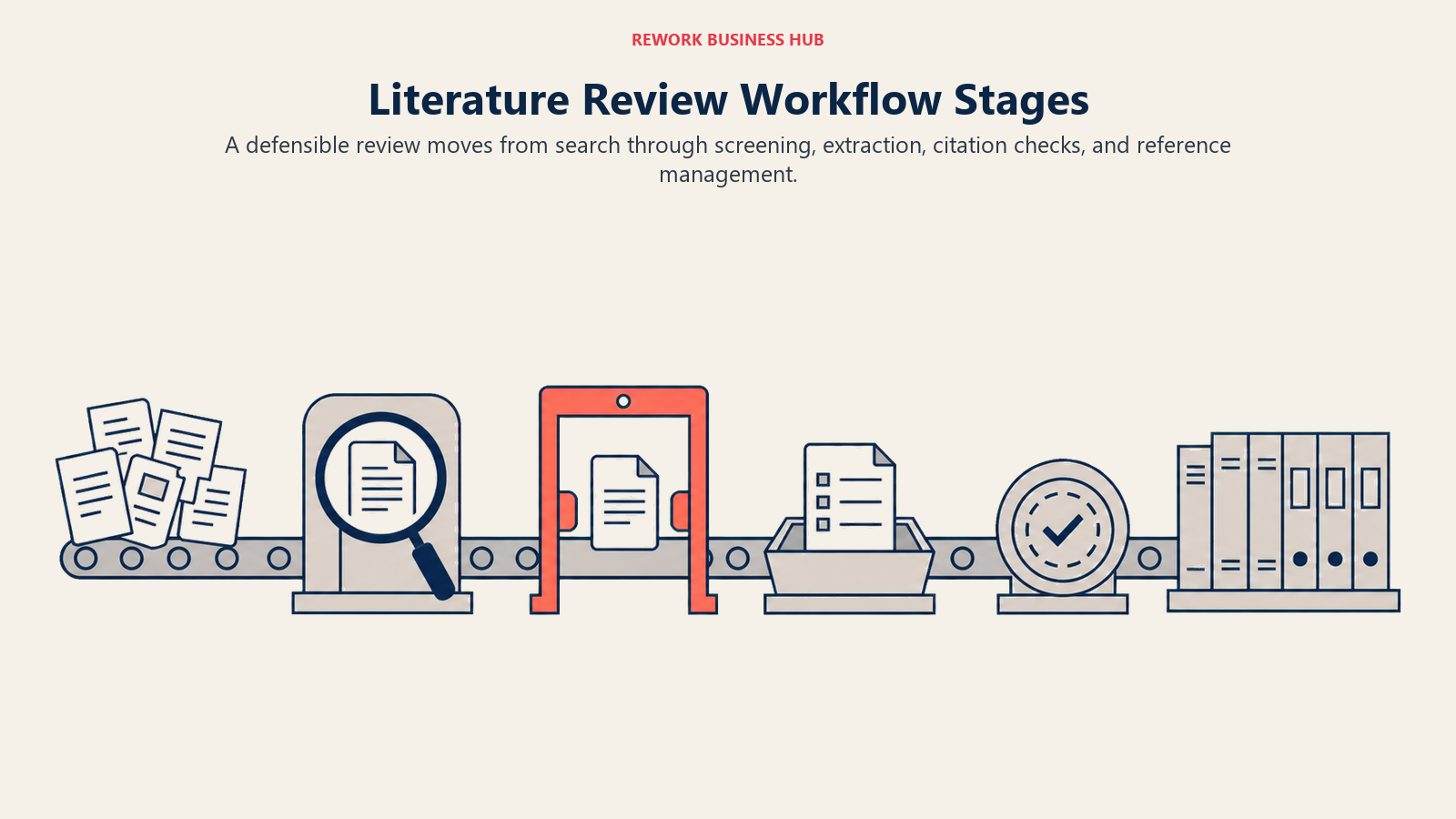
- Search. Cast a wide enough net that you can defend your search strategy in a methods section.
- Screening. Apply inclusion and exclusion criteria to titles, abstracts, and then full texts, ideally with two independent reviewers.
- Extraction and synthesis. Pull comparable data points out of every included study into a table or narrative synthesis.
- Citation verification. Confirm that a source actually supports the claim you're attaching it to, not just that it exists.
- Reference management. Keep the whole citation library organized, deduplicated, and formatted for your target journal.
PRISMA Workflow Fit Matrix
| Tool | Search | Screening | Extraction/Synthesis | Citation Check | Reference Mgmt |
|---|---|---|---|---|---|
| Semantic Scholar | Strong | - | - | Possible | - |
| ResearchRabbit | Strong | - | - | - | - |
| Litmaps | Strong | - | - | Possible | - |
| Undermind | Strong | Possible | Possible | - | - |
| Rayyan | Possible | Strong | Possible | - | - |
| Covidence | Possible | Strong | Strong | - | - |
| ASReview | - | Strong | - | - | - |
| DistillerSR | Possible | Strong | Strong | - | - |
| EPPI-Reviewer | Possible | Strong | Strong | - | Possible |
| Elicit | Possible | Possible | Strong | Possible | - |
| Consensus | Strong | Possible | Possible | Possible | - |
| Scite.ai | Possible | - | - | Strong | - |
| Zotero | - | - | - | - | Strong |
Sizing and Persona Table
| Tool | Ideal User | Primary Use Case |
|---|---|---|
| Semantic Scholar | Any researcher, any discipline | Free literature search and citation graph exploration |
| ResearchRabbit | Graduate students starting a new review | Visual mapping of citation networks and related work |
| Litmaps | Researchers tracking a fast-moving subfield | Timeline-based citation maps with alert digests |
| Undermind | Researchers stuck with keyword search failing them | Adaptive, agent-driven deep literature search |
| Rayyan | Individual researchers to small review teams | Blind title/abstract screening with duplicate detection |
| Covidence | Cochrane authors, health researchers, review teams | End-to-end managed systematic review, from screening to PRISMA diagram |
| ASReview | Researchers who want a free, transparent, self-hosted option | Active-learning prioritized screening on your own infrastructure |
| DistillerSR | HTA agencies, pharma, large research organizations | Enterprise-grade dual-reviewer systematic review at scale |
| EPPI-Reviewer | Academic centers running mixed-method or thematic reviews | Coding, meta-analysis, and thematic synthesis in one platform |
| Elicit | Systematic reviewers, meta-analysts | Screening thousands of papers, extracting structured data |
| Consensus | Researchers with a specific, answerable question | Evidence synthesis across peer-reviewed studies |
| Scite.ai | Researchers verifying claims before citing them | Citation context and supporting/contrasting classification |
| Zotero | Anyone managing a citation library across a review | Reference management, deduplication, citation generation |
1. Semantic Scholar: Free Search to Seed Your Review
Semantic Scholar, built by the nonprofit Allen Institute for AI, is where most literature reviews start because it costs nothing and covers every discipline. It indexes more than 214 million papers, ranks results by semantic relevance and citation influence rather than keyword frequency, and adds one-sentence TLDR summaries that speed up an initial title screen. Its free public API also powers several other tools on this list, including the discovery layer behind ResearchRabbit.
It has no screening, extraction, or PRISMA-reporting features, so treat it as the entry point to your search strategy, not a systematic review platform on its own.
| What you get | What you don't |
|---|---|
| 214M+ papers, completely free, no hidden tiers | No screening, deduplication, or PRISMA tools |
| TLDR one-sentence summaries on most papers | Not built for structured data extraction |
| Free public API with SPECTER2 embeddings | No collaborative review management |
| Citation-influence ranking, not just keyword match | Less visual than ResearchRabbit or Litmaps for mapping |
Pricing: Free, with no paid tier and a free public API.
Best for: Building your initial search string and paper set before moving into a dedicated screening tool
2. ResearchRabbit: Visual Citation Mapping for Discovery
ResearchRabbit calls itself "Spotify for papers," and for a literature review's search stage, the comparison earns its keep. Drop in a handful of seed papers relevant to your research question and it builds an interactive citation network across 280 million-plus articles, surfacing foundational earlier work and thematically related papers that a keyword search alone would miss. It syncs natively with a Zotero library, so papers you save flow straight into your reference manager.
The free tier covers unlimited searches with up to 50 seed papers, more than enough for most review scoping exercises. RR+ ($10/month) raises the seed limit to 300 and adds multiple concurrent projects.
| What you get | What you don't |
|---|---|
| Free forever core product, 280M+ articles | No screening, extraction, or writing features |
| Interactive citation network visualization | Best used before, not during, formal screening |
| Native Zotero library sync | RR+ needed for larger reviews (300 seed papers) |
| Saved search history to retrace earlier steps | Less useful once you've already narrowed to a small set |
Pricing: Free (core product); RR+ from $10/month, per ResearchRabbit's pricing page
Best for: Mapping the citation landscape of a new topic before you commit to a search strategy
3. Litmaps: Timeline-Based Citation Maps You Can Track Over Time
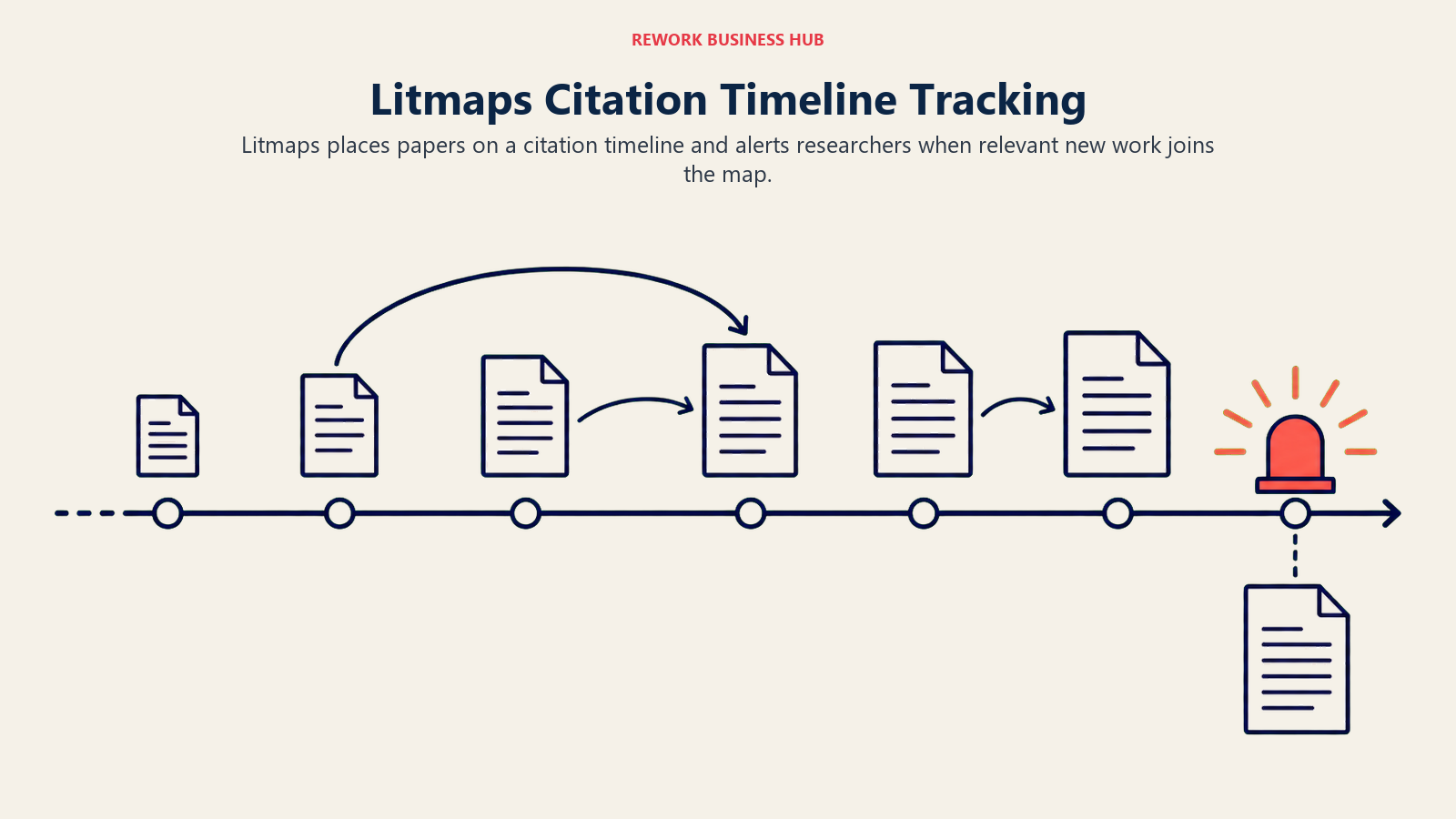
Litmaps solves a problem ResearchRabbit doesn't emphasize: watching how a citation network changes as new papers publish. Its literature maps plot articles on a timeline axis against citation-volume connections, and configurable alerts notify you when a relevant new paper enters your map, which matters for a review that stays open for months while new evidence keeps appearing.
The free plan limits you to a basic search with up to 20 seed inputs and 100 articles per map, enough to test the workflow. Pro ($10/month, or $120/year with a 20% annual discount) unlocks unlimited inputs, unlimited articles per map, and daily configurable alerts.
| What you get | What you don't |
|---|---|
| Timeline-based citation visualization | Free tier caps at 20 inputs, 100 articles per map |
| Configurable alerts for new relevant papers | No screening, extraction, or synthesis tools |
| Unlimited maps and inputs on Pro ($10/mo) | Collaboration features require the Team tier |
| Academic email discount available on Pro | Team pricing is custom, not published |
Pricing: Free (limited); Pro $10/month or $120/year; Team custom, per Litmaps' pricing page
Best for: Long-running reviews where you need to catch new relevant papers as they're published
4. Undermind: An Agent-Driven Search Tool for When Keywords Fail
Undermind takes a different approach to the search stage than every other tool here. Instead of a single keyword or embedding match, it deploys an AI agent that reads and reasons across hundreds of papers iteratively, finding work relevant to your question even when that work uses different terminology than you'd guess. That matters most for interdisciplinary reviews, where the right study sits in a field with its own vocabulary.
The Free plan gives capped searches with standard rate limits for evaluation. Pro ($16/month, billed annually) unlocks unlimited searches, current AI models, and 10x higher usage limits.
| What you get | What you don't |
|---|---|
| Agent-driven search finds relevant work keyword search misses | Slower per query than a standard search engine |
| Strong for interdisciplinary or emerging-field reviews | Free tier is capped, meant for evaluation |
| Unlimited projects and shared libraries on Pro | Newer product, smaller track record than Semantic Scholar |
| Team plans with centralized billing | Search-only, no screening or extraction |
Pricing: Free (capped searches); Pro $16/month (billed annually); Team $15/person/month; Enterprise custom, per Undermind's pricing
Best for: Interdisciplinary reviews where keyword search consistently misses relevant work
5. Rayyan: The Default AI Screening Tool for Title and Abstract Review
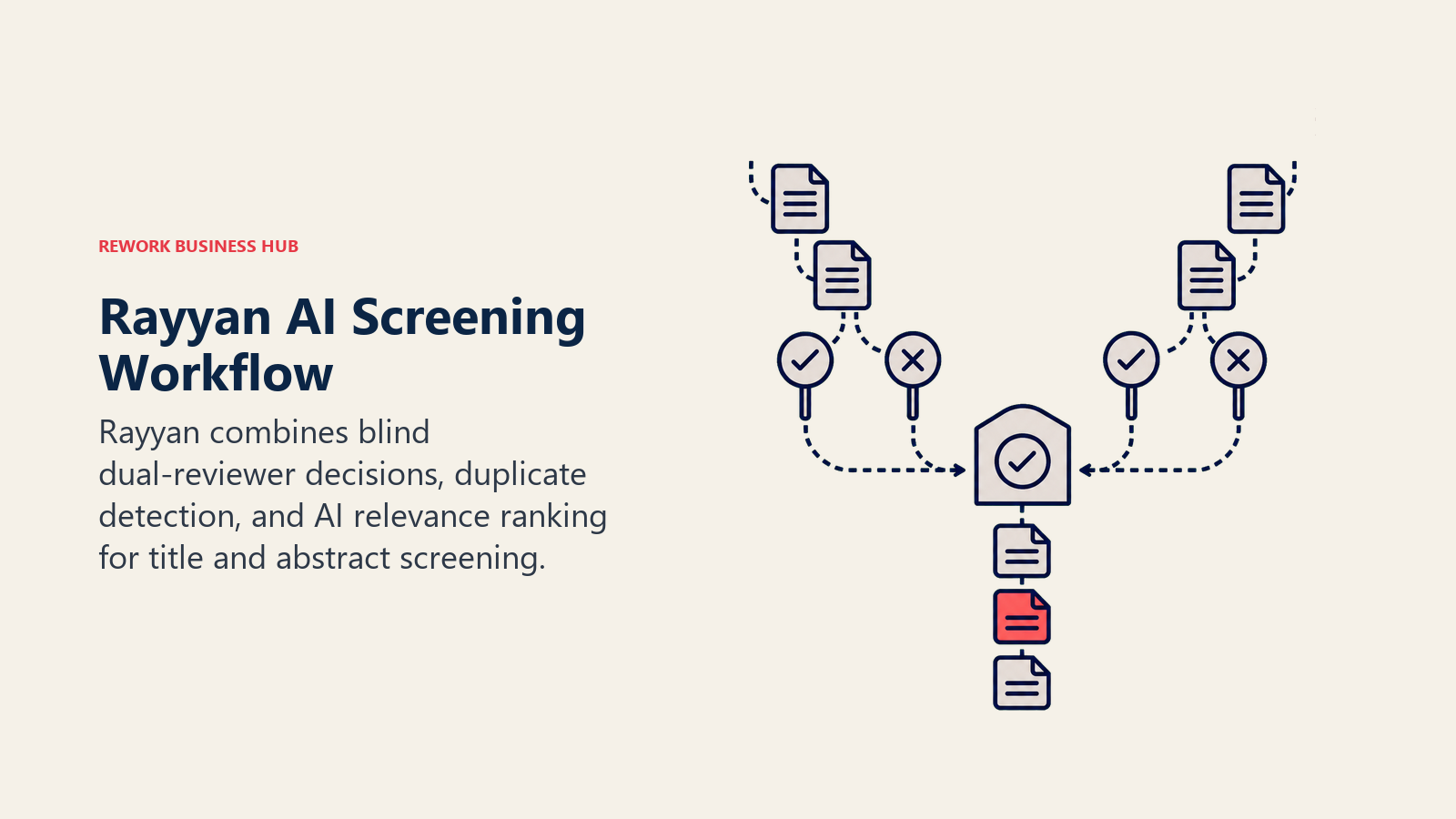
Rayyan is the tool most reviewers reach for first at the screening stage, and the adoption numbers back that up: more than 1,000,000 researchers across 190+ countries and 20,000+ institutions, per Rayyan's own figures. Its core workflow is blind screening, where two or more reviewers independently include or exclude each record without seeing each other's decisions until a resolution step, plus AI relevance predictions that surface likely-includes earlier in a long queue and automatic duplicate detection across imported records.
The Free plan covers 3 active reviews and 2 invited reviewers, enough for a small student project. Essential ($4.99/seat/month annual, $8.33/month quarterly) adds PRISMA flow diagrams and auto-resolved duplicates. Advanced ($8.33/seat/month annual) adds AI-assisted PICO data extraction. Institutional Business plans ($41.67/license/month, minimum 5 licenses) unlock the ResearchPilot AI assistant and org-wide review management.
| What you get | What you don't |
|---|---|
| Free tier: 3 reviews, 2 reviewers, AI relevance ranking | Free tier lacks PRISMA diagrams and auto-duplicate resolution |
| Blind screening designed for dual-reviewer workflows | ResearchPilot AI restricted to institutional plans |
| Mobile app for screening on the go | No monthly billing; quarterly is the minimum commitment |
| Institutional discounts for academics | No published accuracy numbers for its AI features |
Pricing: Free; Essential $4.99/seat/month (annual); Advanced $8.33/seat/month (annual); Business from $41.67/license/month; Enterprise custom, per Rayyan's pricing page
Best for: Individual researchers to small teams running dual-reviewer title and abstract screening on a budget
6. Covidence: The Cochrane-Standard, End-to-End Review Platform
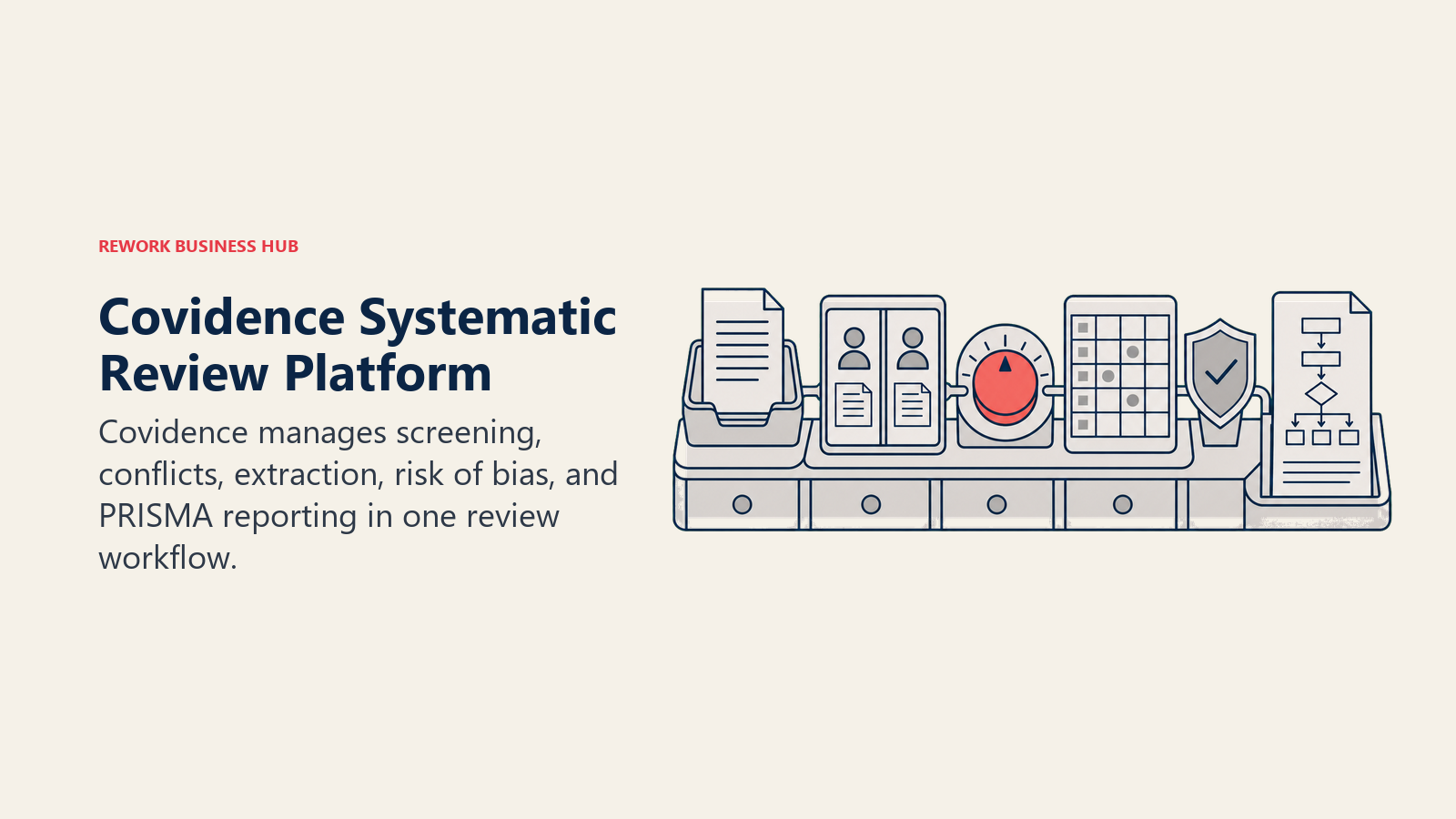
Covidence is what most Cochrane-affiliated and health-sciences reviews standardize on, and it's built to cover the full middle of a review rather than just screening. Beyond blind title/abstract and full-text screening, it handles reviewer conflict resolution, structured data extraction, risk-of-bias assessment, and generates a PRISMA flow diagram automatically as records move through each stage. It integrates directly with EndNote, Mendeley, and Zotero for import, and reports 2,500+ daily active users across 200 countries with 450+ universities holding unlimited site licenses, per Covidence's about page.
Pricing is per-review rather than per-seat. The Single plan ($339/year) covers one review with unlimited collaborators for 12 months. Package ($907/year) covers up to 3 reviews. There's no monthly option and no student discount, though a 500-record free trial lets you test the workflow before buying.
| What you get | What you don't |
|---|---|
| PRISMA flow diagrams generated automatically | No monthly plan; annual, per-review pricing only |
| Conflict resolution, risk-of-bias, and data extraction in one tool | No student discount published |
| Unlimited collaborators per review, even on Single | 500-record cap on the free trial |
| Integrates with EndNote, Mendeley, Zotero | Package pricing scales fast if you run many reviews at once |
Pricing: Single $339/year (1 review); Package $907/year (up to 3 reviews); Organizations custom, per Covidence's pricing page
Best for: Cochrane-style systematic reviews needing a full managed workflow from screening through PRISMA reporting
7. ASReview: Free, Open-Source Active-Learning Screening
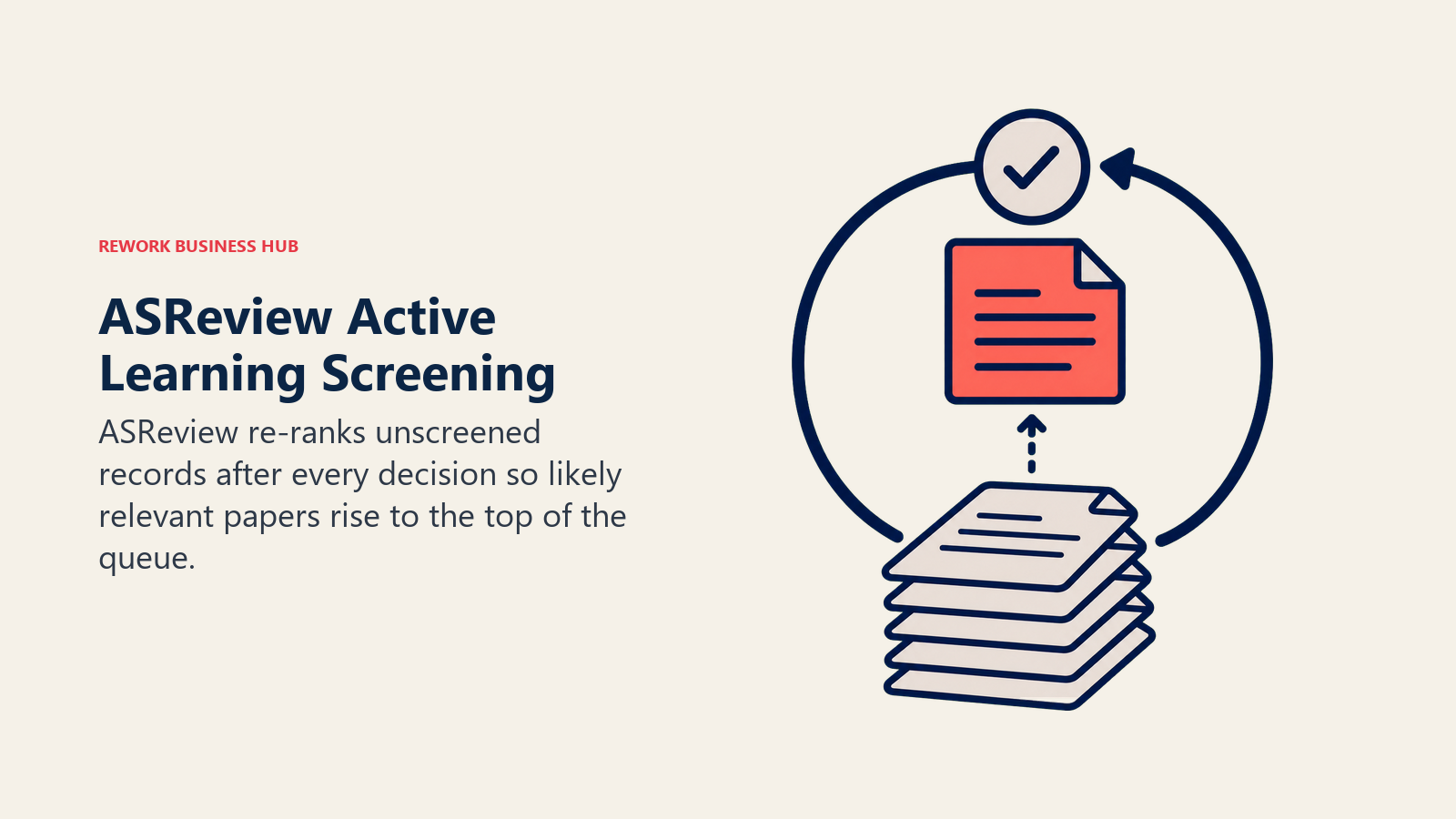
ASReview takes a fundamentally different technical approach: active learning. Instead of screening records in whatever order they were imported, its machine learning model re-ranks the remaining unscreened records after every decision you make, pushing the most likely relevant papers to the top of your queue. In practice that means you can find the vast majority of your true includes after screening a much smaller fraction of the total set, which is the whole point when a search returns 8,000 records.
It's fully open source under an MIT license, developed at Utrecht University, and validated in a peer-reviewed Nature Machine Intelligence paper. Version 3 (the current major release as of mid-2026) added support for multiple concurrent AI models and expert-crowd input within the same project. There is no vendor, no subscription, and no paid tier; you self-host it or run it through supported cloud options.
| What you get | What you don't |
|---|---|
| Completely free, MIT-licensed, no vendor lock-in | Requires self-hosting or a technical setup step |
| Peer-reviewed, published active-learning algorithm | Steeper learning curve than a hosted SaaS tool |
| Oracle, Exploration, and Simulation modes for different needs | No built-in extraction, synthesis, or PRISMA reporting |
| Actively maintained, frequent releases through 2026 | Community support model, not a vendor support line |
Pricing: Free, open source (MIT license), no paid tier, per ASReview's GitHub repository
Best for: Researchers and labs that want a free, transparent, algorithmically-validated screening tool and are comfortable self-hosting
8. DistillerSR: Enterprise Systematic Reviews at Regulatory Scale
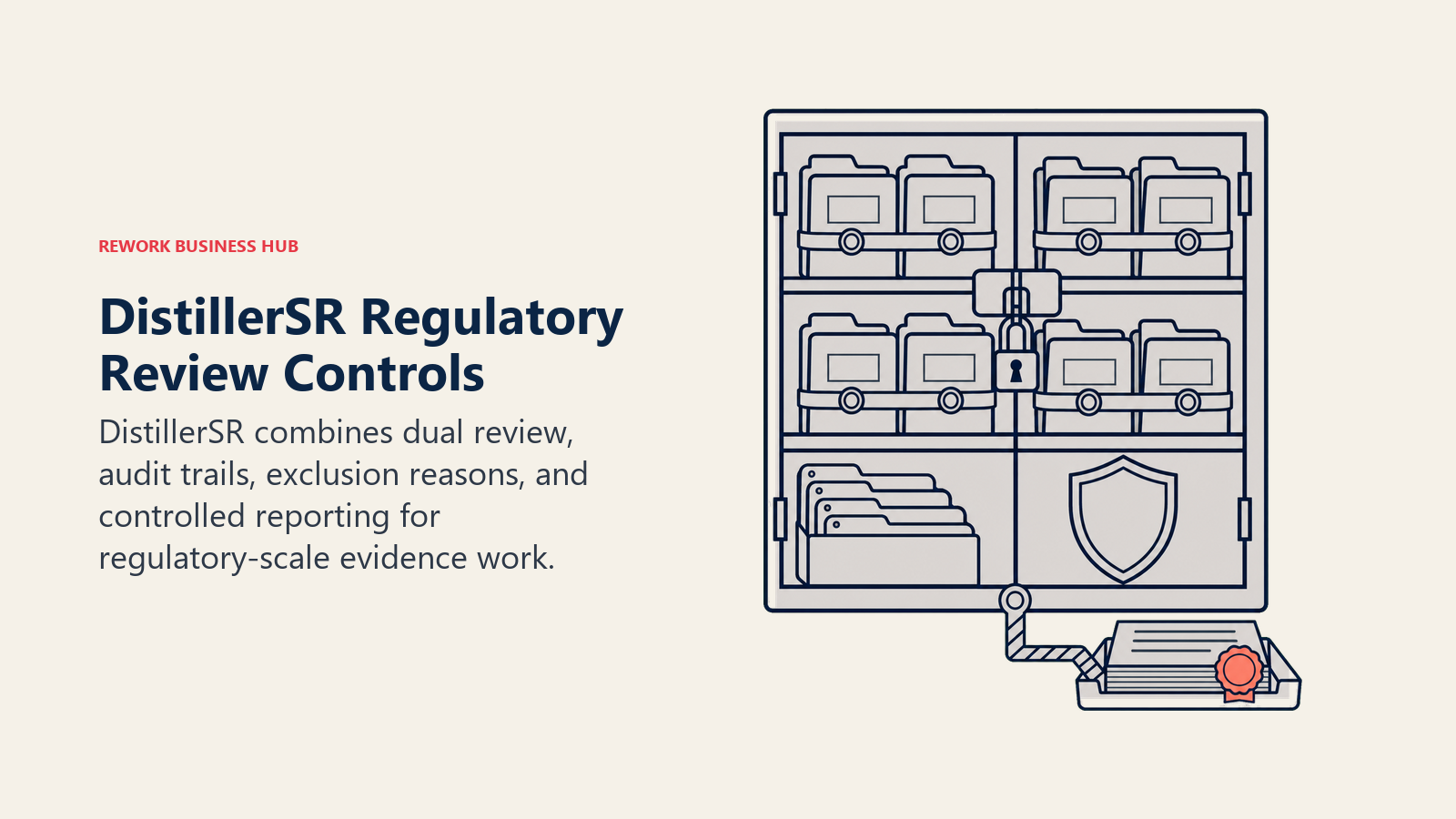
DistillerSR is the platform health technology assessment agencies, pharmaceutical companies, and large research organizations reach for when a review needs to survive regulatory or audit scrutiny. It handles dual-reviewer screening with conflict resolution, captures exclusion reasons inline as reviewers work, runs risk-of-bias assessments, detects duplicates across multiple database exports, and produces PRISMA-ready reporting templates, all with a full audit trail.
Full enterprise pricing is quote-based and not published, reflecting its focus on organizational and site-license deals rather than individual seats. Students and Cochrane Review Group members get a defined entry point: DistillerSR's own student pricing page lists $19.95 per month for three subscriptions (one project each), a meaningfully lower bar than the enterprise product.
| What you get | What you don't |
|---|---|
| Full audit trail built for regulatory/HTA scrutiny | Enterprise pricing is quote-only, not public |
| Dual-reviewer workflow with inline conflict resolution | Overkill for a single-author or small student review |
| Multiple database duplicate detection | Steeper cost than Rayyan or Covidence for casual use |
| Defined student pricing: $19.95/mo, 3 seats, 1 project each | Student tier excludes AI screening and Unpaywall access |
Pricing: Student $19.95/month (3 subscriptions, 1 project each); Enterprise custom, per DistillerSR's student pricing page
Best for: HTA agencies, pharma, and large research organizations running regulatory-grade systematic reviews
9. EPPI-Reviewer: Academic Systematic, Scoping, and Mixed-Method Reviews
EPPI-Reviewer, built and maintained by the EPPI-Centre at University College London as a not-for-profit service, is built for a wider range of review types than most tools on this list. Beyond conventional systematic reviews and meta-analysis, it supports framework synthesis and thematic synthesis, which matters if your review mixes quantitative and qualitative evidence. It manages references, stores linked PDFs, and runs both screening and analysis inside the same platform.
Pricing follows a subscription model: £10/month per user account for unlimited non-shareable reviews, or £35/month per shareable review for multi-user collaboration, per EPPI-Reviewer's own fees page. Cochrane authors get free access through their Archie credentials, and the Campbell Collaboration platform is free.
| What you get | What you don't |
|---|---|
| Handles thematic and framework synthesis, not just meta-analysis | Per-user + per-review fees can surprise a small team |
| Free for Cochrane authors via Archie credentials | UK pricing in pounds, plus 20% VAT for UK purchases |
| Screening and analysis inside one platform | Interface is less modern than Covidence or Rayyan |
| Site licensing available for multi-review organizations | Invoice payments carry a surcharge under £500 |
Pricing: £10/month per user account; £35/month per shareable review; free for Cochrane authors, per EPPI-Reviewer's fees page
Best for: Academic centers running mixed-method, scoping, or thematic reviews alongside conventional systematic reviews
10. Elicit: Structured Data Extraction Once Screening Narrows Your Set
Elicit earns its place at the extraction stage: once Rayyan, Covidence, or ASReview has narrowed your set to the papers you're actually including, Elicit pulls comparable data points out of each one into a table you can analyze. The Free Basic tier already includes unlimited search and chat across 138 million-plus papers. Pro ($49/month) adds a dedicated systematic review workflow that screens up to 5,000 papers and extracts data into tables with up to 20 to 30 columns, pulling from 135 different data sources.
More than 2 million researchers reportedly use Elicit across academia, pharma, and policy work, and its Enterprise tier (custom pricing) targets PRISMA-grade accuracy claims for teams screening up to 40,000 papers.
| What you get | What you don't |
|---|---|
| Free tier covers unlimited search and chat, 138M+ papers | Pro tier ($49/mo) needed for real systematic review workflows |
| Extraction tables with up to 20 to 30 columns | Not a discovery or citation graph tool like ResearchRabbit |
| Dedicated systematic review workflow, screens 5,000 papers | Reports and Research Agent usage capped even on Pro |
| API access on Pro and above | Team collaboration requires the Scale tier ($169/mo) |
Pricing: Free (Basic); Pro $49/month; Scale $169/month; Enterprise custom, per Elicit's pricing page
Best for: Structured data extraction across dozens to thousands of already-screened papers
11. Consensus: Fast, Evidence-Weighted Answers for Scoping Questions
Consensus fits a narrower job than a full systematic review: answering a specific, well-defined research question with the actual balance of peer-reviewed evidence. Ask a yes/no or comparative question and Consensus returns a synthesized answer with a visual consensus meter showing how many studies agree, disagree, or land somewhere in between, each linked to its source. That makes it useful early, for scoping whether a full review is even warranted, or late, as a sanity check against your own synthesis.
The Free tier includes 15 Pro messages and 3 Deep Searches a month. Premium (roughly $9/month) unlocks unlimited AI searches and filtering by study type and journal quality. Deep (roughly $45/month) adds 200 Deep Searches a month for teams running frequent reviews.
| What you get | What you don't |
|---|---|
| Consensus meter visualizes agreement across studies | Best for narrow, well-defined questions, not full screening |
| Deep Search synthesizes findings across up to 50-200 papers | Not designed for a formal PRISMA systematic review workflow |
| Filters by study type, sample size, journal quality | Coverage skews toward biomedical and social science |
| Student and clinician discounts available | Free tier caps out fast for daily heavy use |
Pricing: Free; Premium from approximately $9/month; Deep from approximately $45/month, per Consensus's pricing page
Best for: Scoping a research question quickly before committing to a full systematic review
12. Scite.ai: Verifying What a Citation Actually Says
Scite answers a question plain citation counts can't: does a cited paper actually support the claim it's attached to, or does later research contradict it? Its Smart Citations technology classifies each of the 1.6 billion-plus citations it has indexed as supporting, contrasting, or simply mentioning the original research, built across a network with 30-plus publisher partners. That distinction matters directly for a literature review's discussion section, where citing a source that's since been disputed undermines your synthesis.
Scite serves roughly 2 million users worldwide. A 7-day free trial covers premium features, and Personal plans run from approximately $12 to $20 a month depending on billing term.
| What you get | What you don't |
|---|---|
| Classifies citations as supporting, contrasting, or mentioning | Coverage depends on publisher partnerships (30+, not universal) |
| 1.6B+ citations indexed across the scholarly record | Not a screening, discovery, or extraction tool |
| 7-day free trial of premium features | Team pricing runs higher than individual plans |
| Institutional and student discount pathways | Best paired with a screening tool, not used standalone |
Pricing: Free trial; Personal from approximately $12 to $20/month; Team and Enterprise custom, per Scite's pricing page
Best for: Verifying a citation's actual evidentiary support before it goes into your review's discussion or synthesis
13. Zotero (+ Screening Plugins): Free Reference Management Across the Whole Review
Zotero is the reference manager most reviewers already trust to hold everything together, and the Zotero team has been explicit that citation management, not AI features, is the product's focus. That's a deliberate design choice: Zotero stays free, open source, and vendor-neutral, with 300 MB of free storage and paid tiers from $20/year for 2 GB up to $120/year for unlimited storage.
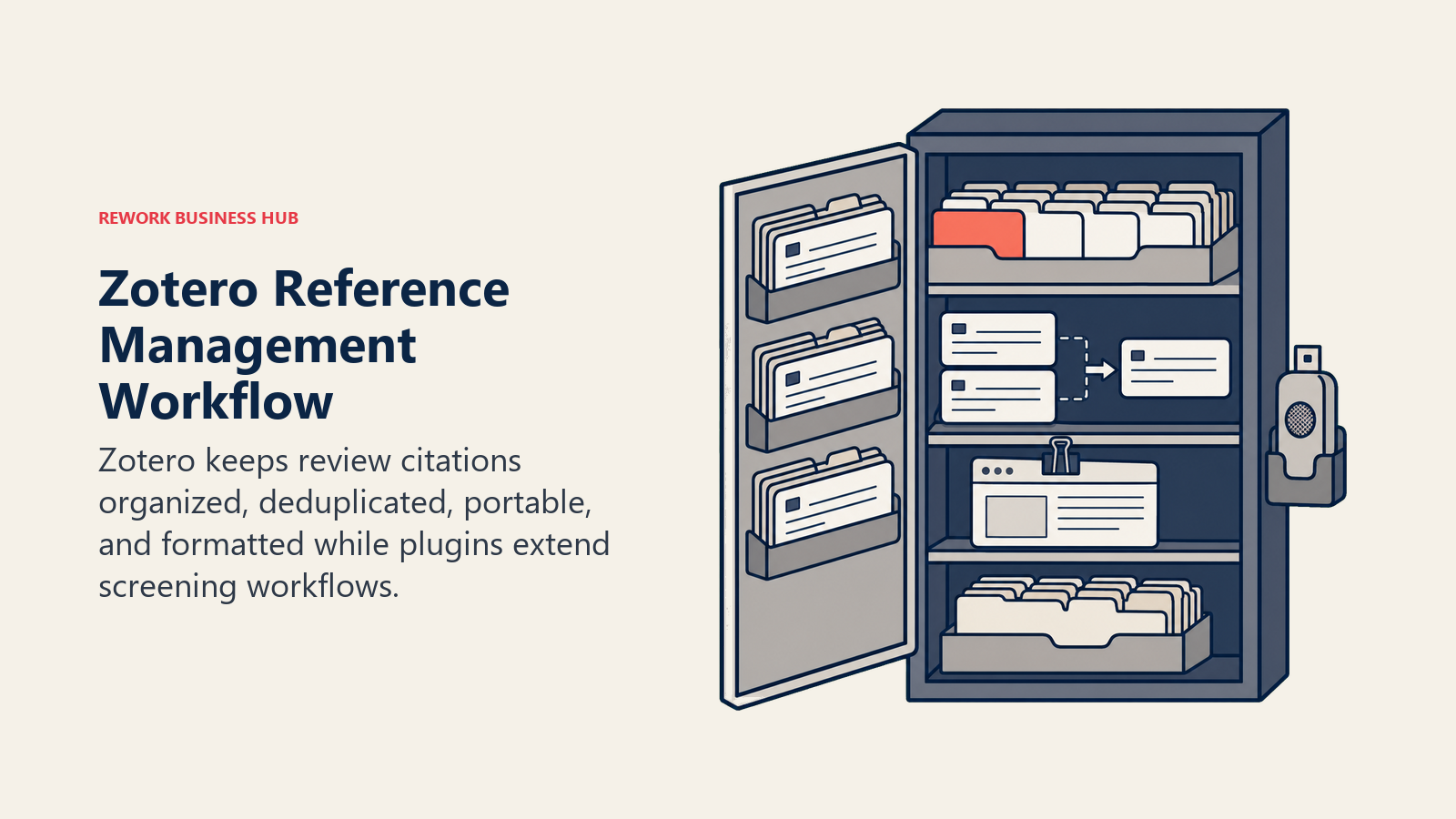
For a literature review specifically, Zotero's value is integration: ResearchRabbit and Litmaps sync into it directly, and several tools on this list, including Elicit's citation exports, are designed to drop into a Zotero library without reformatting. Third-party plugins like Beaver and Aria add conversational AI chat across your saved library if you want that layer, but they aren't built or maintained by the Zotero team, so evaluate them independently.
| What you get | What you don't |
|---|---|
| Free, open source, no vendor lock-in on your citation data | No native AI features; requires a third-party plugin |
| Massive citation style library, works with any target journal | Third-party AI plugins vary in quality and aren't Zotero-maintained |
| Deep integration with ResearchRabbit, Litmaps, most databases | Not a screening, extraction, or synthesis tool on its own |
| 300 MB free storage; paid tiers from $20/year (2 GB) | Group/lab storage still draws from the group owner's quota |
Pricing: Free (300 MB storage); paid storage from $20/year (2 GB) to $120/year (unlimited), per Zotero's storage page
Best for: Holding your entire review's citation library together across every other tool in this stack
AI Screening Accuracy: What Still Needs a Human
None of the tools above remove the need for a human decision on inclusion and exclusion, and treating them as if they do is the fastest way to get a review rejected at peer review. A few things to verify before you trust any AI-assisted step:
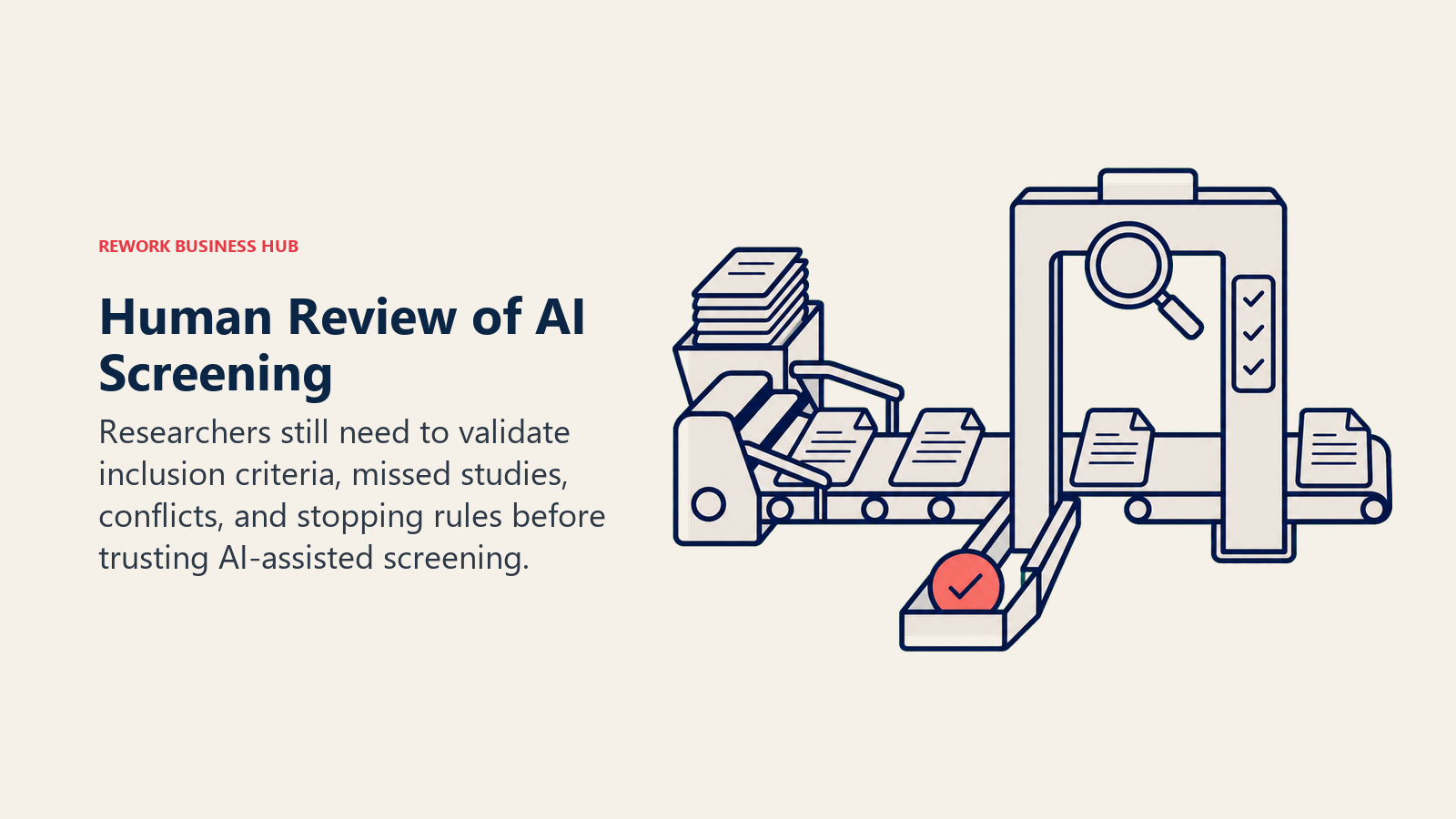
- Recall over precision. Active-learning tools like ASReview and AI-ranking features in Rayyan are tuned to surface likely includes early, not to make final decisions. A high-recall setting will still flag some records a human would exclude; that's the tool working as intended, not a bug.
- PRISMA still expects dual human review. Cochrane and PRISMA guidance treat AI screening as a workload-reduction aid, not a replacement for independent screening by two reviewers with a documented conflict-resolution process. Covidence, Rayyan, DistillerSR, and EPPI-Reviewer all build their screening interfaces around that dual-reviewer model for exactly this reason.
- Extraction summaries can be wrong in a way that looks right. A tool that pulls a sample size or an effect size into a table can misread a table in the source PDF, especially with complex figures or supplementary data. Spot-check extracted values against the original paper before they go into your synthesis, the same way you'd spot-check a research assistant's work.
- General-purpose chatbots hallucinate citations. This isn't specific to any tool on this list, but it's worth repeating: a general-purpose AI assistant used outside a citation-verified database can generate a source that sounds plausible and doesn't exist. Run anything it suggests through Semantic Scholar or Scite.ai before it enters your reference list. Our Claude vs ChatGPT vs Gemini and Perplexity vs ChatGPT Search vs Gemini comparisons go deeper on how each general-purpose assistant handles citations if you're using one for drafting.
Literature Review Mistakes to Avoid
| Mistake | What It Looks Like | What to Do Instead |
|---|---|---|
| Skipping a documented search strategy | Running ad hoc searches in Semantic Scholar with no saved query log | Log every search string and date; Covidence and DistillerSR do this automatically |
| Trusting AI relevance ranking as a final decision | Excluding a record because it ranked low in Rayyan's queue | Screen the full set; use AI ranking to reorder the queue, not to skip records |
| Using a discovery tool for extraction | Trying to pull structured data out of a ResearchRabbit citation map | Move your screened, included papers into Elicit or a review-specific extractor |
| Paying for enterprise tiers before testing free ones | Buying DistillerSR enterprise access before trying Rayyan's or ASReview's free tier | Exhaust the free or student tier first; most single-author reviews never need enterprise scale |
| Skipping citation verification under deadline pressure | Submitting a discussion section with sources you never re-checked | Budget verification time with Scite.ai into your schedule, not just writing time |
| Treating one tool as the whole workflow | Expecting Rayyan alone to handle search, screening, and extraction | Build a stack: one tool per stage, connected through a shared Zotero library |
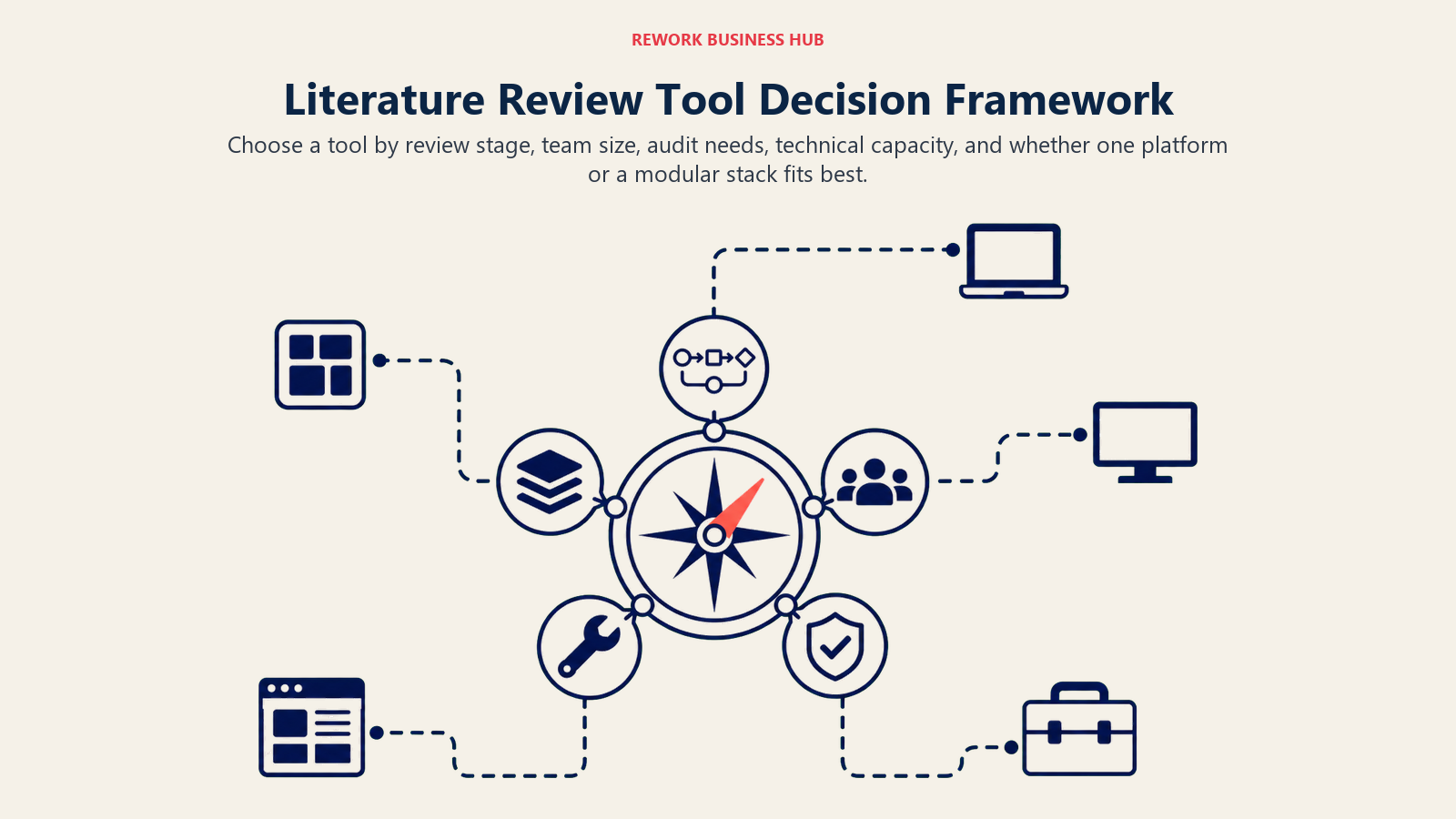
Decision Framework
Use this framework to match the review stage, team constraints, and governance burden to the right literature review tool before comparing price.
| If you need... | Pick... | Why |
|---|---|---|
| A free starting point for any literature search | Semantic Scholar | 214M+ papers, no paywall, no premium tier required |
| To map a citation network before you finalize a search | ResearchRabbit | Visual discovery across 280M+ articles, free forever |
| To track new papers entering your review over months | Litmaps | Timeline-based maps with configurable new-paper alerts |
| Deep search when keywords keep missing relevant work | Undermind | Autonomous agent reasons across literature iteratively |
| Budget-friendly dual-reviewer title/abstract screening | Rayyan | Free tier plus the widest adoption of any screening tool |
| A full managed review from screening to PRISMA diagram | Covidence | Cochrane-standard workflow, 450+ institutions with site licenses |
| A free, transparent, self-hosted screening algorithm | ASReview | Open source, peer-reviewed active-learning model |
| Regulatory or audit-grade systematic reviews at scale | DistillerSR | Full audit trail built for HTA and pharma review teams |
| Mixed-method, scoping, or thematic synthesis reviews | EPPI-Reviewer | Handles framework and thematic synthesis, not just meta-analysis |
| Structured data extraction across hundreds of papers | Elicit | Screens up to 5,000 papers, extraction tables to 20-30 columns |
| A fast, evidence-weighted answer to scope a question | Consensus | Consensus meter shows agreement across studies at a glance |
| To verify a citation supports the claim you're citing | Scite.ai | Smart Citations classify support, contrast, or mention |
| A free, portable citation library tying it all together | Zotero | Open source, no lock-in, integrates with the rest of this stack |
If your review work overlaps with heavier statistical analysis once extraction is done, our best AI tools for data analysis guide covers that next step. And if you're a student building this stack on a tight budget, best AI tools for students and best AI tools for college students round out the free tiers worth stacking here.
Frequently Asked Questions about AI Tools for Literature Review
What's the best AI tool for a literature review in 2026?
There's no single best tool because a literature review is a multi-stage workflow. Semantic Scholar and ResearchRabbit are best for search, Rayyan and Covidence for screening, Elicit for structured extraction, and Scite.ai for citation verification. Most formal reviews end up using three or four of these together, tied to a Zotero library.
What's the difference between Rayyan and Covidence?
Rayyan is a focused, budget-friendly screening tool: blind title/abstract review, AI relevance ranking, and duplicate detection, with a usable free tier. Covidence covers more of the review end to end, including data extraction, risk-of-bias assessment, and automatic PRISMA flow diagrams, but it's priced per review starting at $339/year with no free ongoing tier. Many teams use Rayyan for screening and export into a separate extraction tool; Covidence is built to skip that handoff.
Is Elicit good enough for a full systematic review on its own?
Elicit's Pro plan handles screening up to 5,000 papers and structured extraction into tables, which covers a real chunk of a systematic review. But it doesn't produce a PRISMA flow diagram or manage dual-reviewer conflict resolution the way Covidence or DistillerSR do, so most systematic reviewers pair it with a dedicated screening tool rather than relying on it alone.
Can AI screening tools replace two independent human reviewers?
No. PRISMA and Cochrane guidance still expect dual independent human screening with a documented conflict-resolution process. AI-assisted ranking in tools like Rayyan and ASReview reduces the number of records a human has to look at closely and reorders the queue toward likely includes, but it's a workload-reduction layer, not a replacement reviewer.
What's the difference between ResearchRabbit and Litmaps?
Both build visual citation networks from seed papers, but ResearchRabbit is stronger for one-time discovery of related and foundational work, while Litmaps is built around tracking a citation network as it changes, with configurable alerts when new relevant papers publish. A long-running review benefits from Litmaps' alerts; a fast initial scoping search often only needs ResearchRabbit.
Is ASReview really free with no catch?
Yes. ASReview is open source under an MIT license, developed at Utrecht University, and validated in a peer-reviewed Nature Machine Intelligence paper. There's no paid tier, but you do need to self-host it or run it through a supported cloud option, which takes more setup than a hosted SaaS tool like Rayyan.
How accurate is AI citation screening, and can it miss relevant studies?
AI relevance ranking is tuned for high recall, meaning it prioritizes not missing relevant studies over perfectly excluding irrelevant ones, so a well-configured tool rarely misses obviously relevant papers when you screen the full ranked queue. The real risk is skipping records near the bottom of the queue under time pressure; screening the complete set, not a truncated one, is what keeps recall intact.
What AI tool should I use for PRISMA-compliant reporting?
Covidence, DistillerSR, and EPPI-Reviewer all generate PRISMA-ready flow diagrams and reporting templates as part of their standard workflow, since they're built around managed, auditable reviews. Rayyan generates PRISMA diagrams starting at its Essential tier. Discovery and extraction-only tools like Elicit or Semantic Scholar don't produce PRISMA reporting on their own.
What to Do Next
Map your review's stages to one tool each rather than searching for a single app that does everything: start with Semantic Scholar or ResearchRabbit for search, move into Rayyan or Covidence for dual-reviewer screening, bring in Elicit once you're extracting structured data from your included set, and run anything you're about to cite through Scite.ai before it lands in your discussion section. Keep Zotero running underneath the whole stack so nothing gets lost between tools. Test this on your current review with each tool's free tier before paying for anything, most single-author and small-team reviews cover 80% of what they need without an enterprise plan, and the upgrade only earns its cost once you know exactly which stage is the actual bottleneck.

Principal Product Marketing Strategist
On this page
- Key Facts
- Quick Comparison Table
- The Literature Review Workflow: Where Each Tool Fits
- PRISMA Workflow Fit Matrix
- Sizing and Persona Table
- 1. Semantic Scholar: Free Search to Seed Your Review
- 2. ResearchRabbit: Visual Citation Mapping for Discovery
- 3. Litmaps: Timeline-Based Citation Maps You Can Track Over Time
- 4. Undermind: An Agent-Driven Search Tool for When Keywords Fail
- 5. Rayyan: The Default AI Screening Tool for Title and Abstract Review
- 6. Covidence: The Cochrane-Standard, End-to-End Review Platform
- 7. ASReview: Free, Open-Source Active-Learning Screening
- 8. DistillerSR: Enterprise Systematic Reviews at Regulatory Scale
- 9. EPPI-Reviewer: Academic Systematic, Scoping, and Mixed-Method Reviews
- 10. Elicit: Structured Data Extraction Once Screening Narrows Your Set
- 11. Consensus: Fast, Evidence-Weighted Answers for Scoping Questions
- 12. Scite.ai: Verifying What a Citation Actually Says
- 13. Zotero (+ Screening Plugins): Free Reference Management Across the Whole Review
- AI Screening Accuracy: What Still Needs a Human
- Literature Review Mistakes to Avoid
- Decision Framework
- What to Do Next