Harvey vs Legora: Which Legal AI Platform Fits Your Firm in 2026?
Turn this article into takeaways for your work.


Each assistant summarizes the article only for you and suggests best practices for your work.
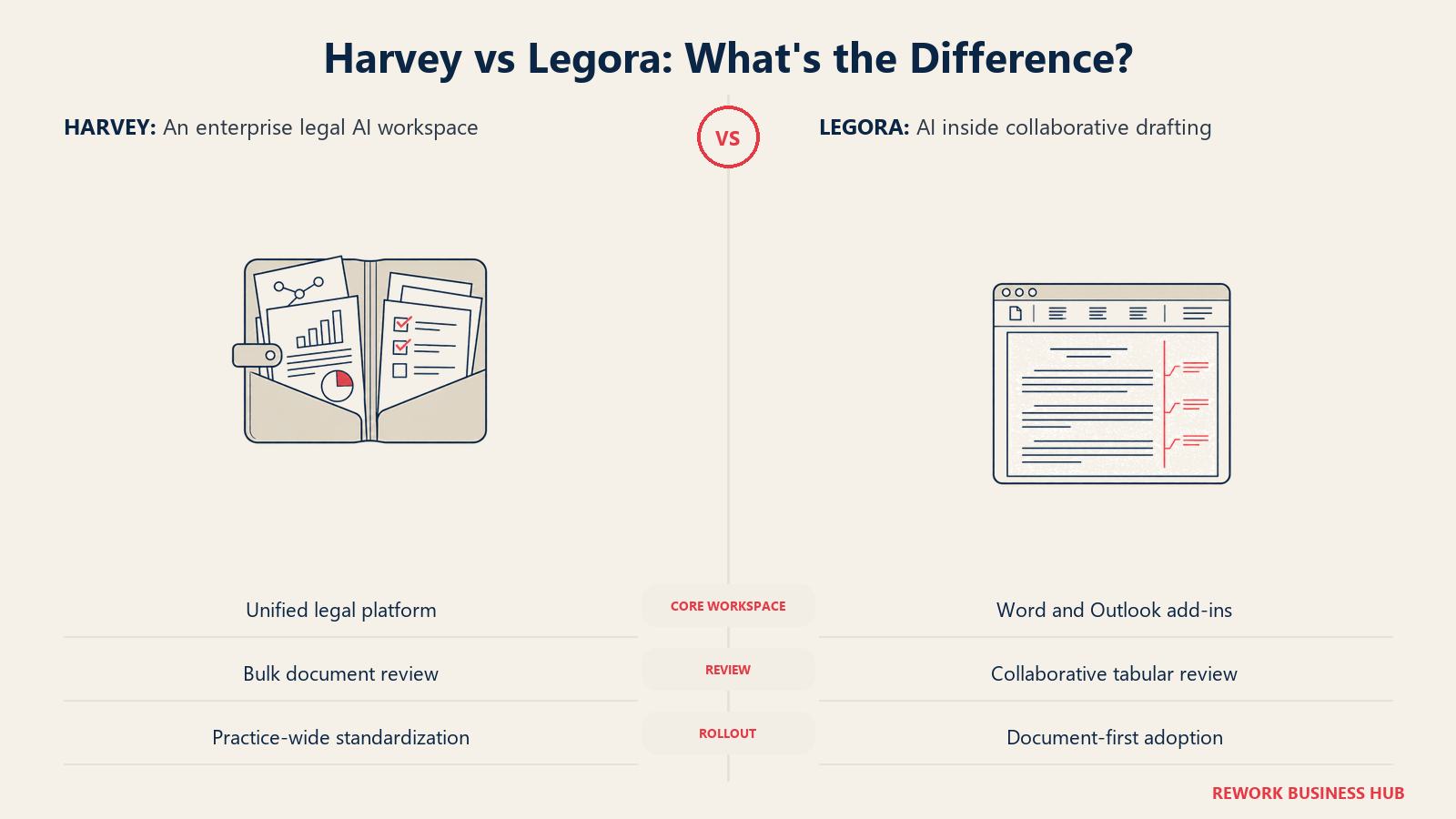
If you run a law firm, a legal department or a legal operations team, you have probably been told to look at two names: Harvey and Legora. They're the best-funded companies in legal AI, both sell to large firms and in-house teams, and both describe themselves as the system lawyers will do their work in rather than a single-purpose tool. That makes the decision harder than a typical software comparison, because the obvious feature checklist looks almost the same on both sides.
So this guide skips the checklist-first approach. It starts with who each company is built around, then compares products, security, document-system integration, deal size and buying process, and finishes with the situations where each one is plainly the better pilot. Neither vendor publishes a price list, so the comparison is about fit and evidence, not a cost winner.
One more point before you start. This category moves fast. Funding rounds, product names and packaging change every few months, so use this as a map for your evaluation and ask both vendors to confirm anything that will sit in your contract.
TL;DR
| Harvey | Legora | |
|---|---|---|
| What it is | AI platform for legal and professional services, for law firms and in-house teams | Collaborative AI for lawyers, built around an agentic operating system called Legora aOS |
| Headquarters signal | Not stated on its homepage | Technical team based in Sweden |
| Latest funding (reported) | $550 million at a $15.5 billion valuation, September 2026 | $550 million Series E at an $8.8 billion valuation, October 2026 |
| Core products | Agents, Vault, Knowledge, Spaces, Command Center, Contract Intelligence, Horizon Scanning, Intake | Agent, Monitors, Lists, Tabular Review, Workflows, Legal Research, Skills, Intake |
| Where lawyers use it | Harvey workspace; connectors and custom MCP | Word add-in, Outlook add-in, editor, mobile app, portal |
| Certifications listed | SOC 2 Type II, ISO 27001, ISO 27701, ISO 42001, AIUC-1, FedRAMP | SOC 2 Type II, ISO 27001, ISO 42001, GDPR, HIPAA |
| Published price | Pricing on request | Pricing on request |
| Buying path | Request a demo | Book a demo |
Key Facts
- Harvey's homepage says more than 3,500 legal organizations build on Harvey, with more than 200,000 professionals in over 85 countries and more than 80 AmLaw 100 firms. Those are the vendor's own figures.
- Harvey announced a $550 million raise at a $15.5 billion valuation on September 9, 2026, according to Legal Business.
- Legora raised a $550 million Series D led by Accel at a $5.55 billion valuation in March 2026, per Bloomberg Law, and later reported a $550 million Series E at an $8.8 billion post-money valuation in October 2026.
- Legora states on its security page that it "will not use your data to train or fine tune any AI models."
- Harvey's security page says it requires Zero Data Retention from model providers and offers processing in the EU and Switzerland or Australia.
- Neither vendor shows a rate card on its site. Both route buyers to a demo.
Who Each Platform Is Built For
Both vendors sell to law firms and in-house teams, so the useful question is which side each one leads with and what the sales motion looks like.
Harvey's homepage frames the product as a way to build what it calls a "frontier legal organization," and the customer list is heavy on the largest names in law and corporate legal: A&O Shearman, Latham & Watkins, Reed Smith, Cuatrecasas, Deutsche Telekom, Bayer, KKR and Repsol appear on the page. Its segments are in-house teams, law firms and mid-size firms, and it lists litigation, transactional and innovation as practice areas.
Legora's homepage calls the product "Collaborative AI for exceptional lawyers." Its solutions list is broader in how it slices the market: M&A, litigation, banking, tax, insurance, law firms, mid-sized firms, in-house, in-house SMB, public sector and private equity. The "in-house SMB" and "mid-sized firms" labels are worth noticing if you aren't a global firm, though that's a positioning signal, not a pricing promise.
| Harvey | Legora | |
|---|---|---|
| Lead positioning | Platform for a frontier legal organization | Collaborative AI for lawyers |
| Segments named | In-house teams, law firms, mid-size firms | Law firms, mid-sized firms, in-house, in-house SMB, public sector, private equity |
| Practice and deal areas | Litigation, transactional, innovation | M&A, litigation, banking, tax, insurance |
| Industries named | Healthcare and life sciences, energy and utilities, technology, media and telecom, public sector | Not listed as industries; solutions are by practice and firm type |
| Named customers on the homepage | A&O Shearman, Latham & Watkins, Reed Smith, Cuatrecasas, Deutsche Telekom, Bayer, KKR, Repsol, Dentsu | None named in the page text |
| Origin signal | Not stated | Technical team based in Sweden |
If you want the wider field before you commit to a two-way comparison, best AI agents for legal teams in 2026 maps the category by use case, and best Harvey alternatives covers what teams look at when Harvey isn't the right shape.
Product Scope Side by Side
Both companies have moved past the "chat with a model about a contract" stage. Each now sells a set of connected capabilities: agents that run multi-step work, tools for reviewing many documents at once, research, and intake.
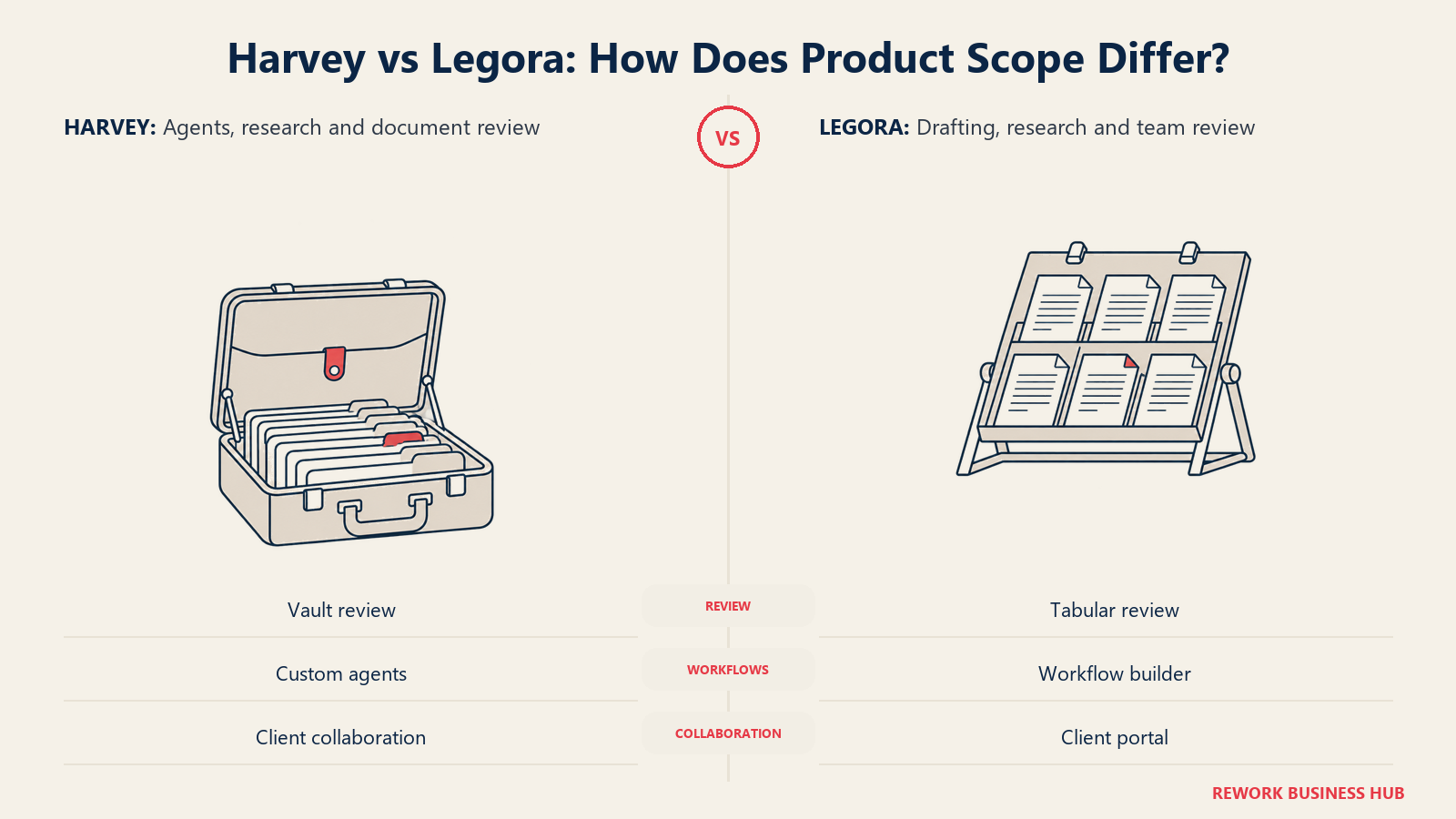
Harvey lists these products: Agents (orchestrating complex legal work and routing tasks to the right agent), Vault (storing and bulk-analyzing documents), Knowledge (legal, regulatory and tax research), Spaces (shared workspaces for firms, clients and co-counsel, with ethical walls), Command Center (usage analytics and peer benchmarking), Contract Intelligence, Horizon Scanning for regulatory change, Intake, a Connector Library, and Legal Work Orchestration for assigning and reviewing work across agents and staff.
Legora lists: Legora aOS, Agent, Monitors, Lists, a Word add-in, an Outlook add-in, an editor, a mobile app, a portal, Tabular Review, Workflows, Legal Research, Skills, Intake and Integrations.
| Capability | Harvey | Legora |
|---|---|---|
| Agentic task execution | Agents and Legal Work Orchestration | Agent and Workflows |
| Bulk document analysis | Vault | Tabular Review and Lists |
| Legal research | Knowledge (legal, regulatory, tax) | Legal Research |
| Contract review and negotiation | Contract Intelligence | Word add-in, editor and Tabular Review |
| Regulatory monitoring | Horizon Scanning | Monitors |
| Request intake | Intake | Intake |
| Client and co-counsel collaboration | Spaces, with ethical walls | Portal |
| Usage analytics | Command Center with peer benchmarking | Confirm with the vendor |
| Mobile | Confirm with the vendor | Mobile app |
| Reusable skills or playbooks | Confirm with the vendor | Skills |
The mapping above is the closest equivalent by name and description, not a guarantee the two behave the same. "Monitors" and "Horizon Scanning" may track different sources at different depth, and "Vault" and "Tabular Review" may handle very different volumes. The place to settle that is a pilot on your own documents.
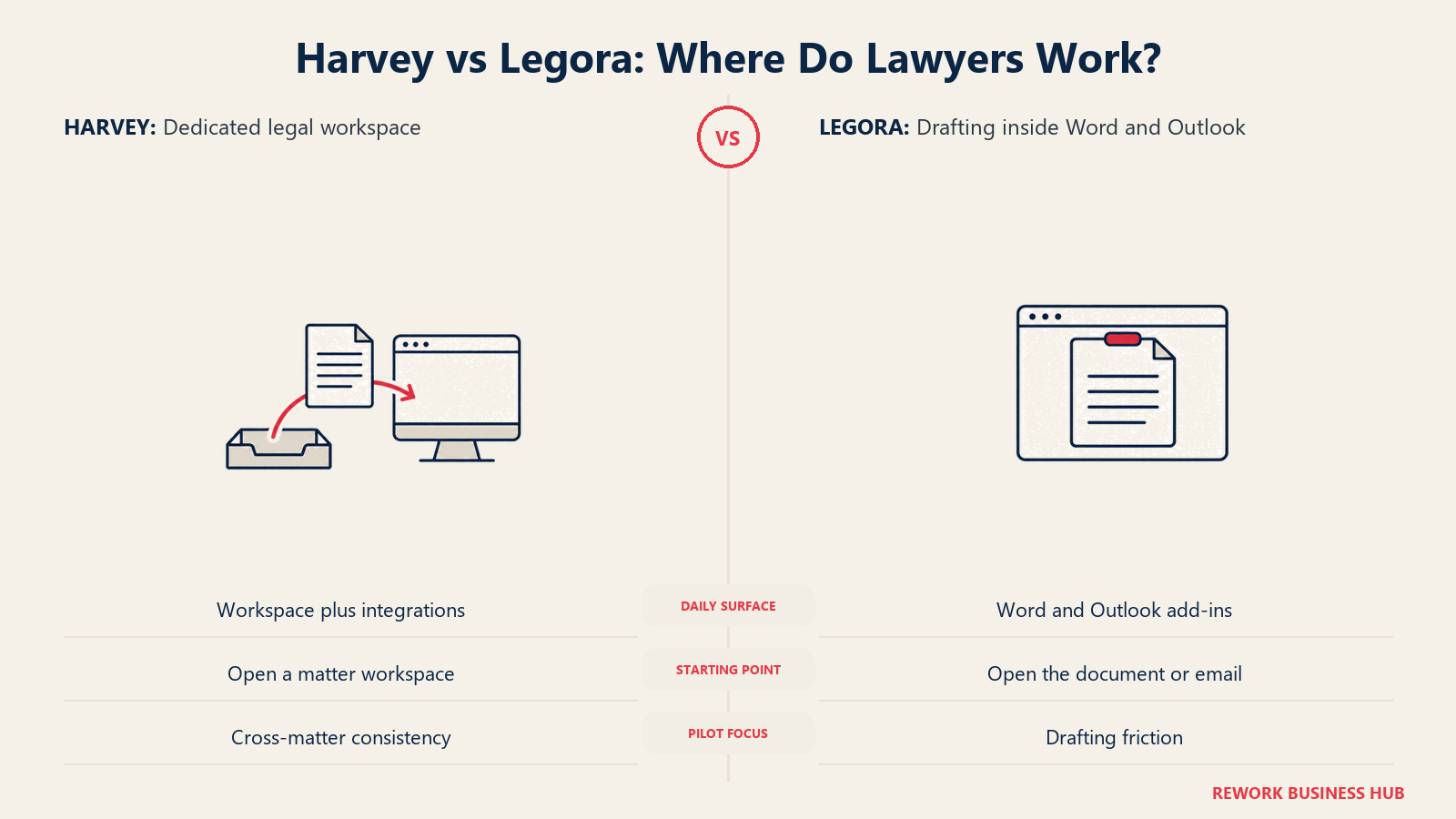
The distinction that shows up most clearly in the pages is where the lawyer sits. Legora puts a lot of surface area inside tools lawyers already use all day: the Word add-in and the Outlook add-in sit first on its product list. Harvey leads with its own workspace and a connector library for bringing in other systems. If most of your work is drafting and redlining in Word, the Word-first approach matters. If your priority is a shared environment for a firm, its clients and co-counsel with ethical walls, Harvey's Spaces describes exactly that.
Where Lawyers Do the Work
Adoption fails more often because of friction than because of model quality. A tool that asks a partner to leave Word to use it will lose to the habit of opening Word.
| Harvey | Legora | |
|---|---|---|
| Primary surface | Harvey workspace | Word add-in, Outlook add-in, editor, mobile app, portal |
| Extensibility | Connector Library with security-reviewed connectors, or custom MCP | Integrations product page |
| Document system | Confirm which DMS connectors apply to you | iManage, with permissions mirrored, per its integrations page |
| Matter-level restrictions | Spaces with ethical walls | Intapp Walls for AI and iManage Security Policy Manager, per its integrations page |
Legora's integrations page names iManage and says that if a user can't open a document in iManage, they can't open it through Legora either. That's the right shape of answer to the question every information security reviewer asks first: does the AI see more than the person does. Harvey's homepage describes a Connector Library of security-reviewed connectors plus custom MCP support, which is flexible, but it doesn't name document systems on the page, so ask which of yours are supported today.
Security, Compliance and Data Handling
Both vendors publish long lists, and the lists overlap heavily. The differences are in the details you'd want in a vendor security questionnaire.
Harvey's security page says it undergoes annual SOC 2 Type II and ISO 27001 audits and also lists ISO 27701, ISO 42001 and AIUC-1, plus GDPR and CCPA. Its homepage adds FedRAMP, SAML SSO, audit logs, IP allow-listing and data lifecycle management. Harvey hosts in Microsoft Azure and offers processing in the EU and Switzerland or Australia. It says it requires Zero Data Retention from model providers and contractually prohibits model providers from training on customer data. It also says a customer can ask for a bespoke model trained on its own data, which is a notable option and a contract conversation.
Legora's security page says it's certified for ISO 27001 and ISO 42001 and holds a SOC 2 Type II report available on request. It operates under GDPR with its technical team in Sweden, and its homepage also lists HIPAA. It says it supports all common single sign-on protocols and doesn't use customer data to train or fine tune any AI models. The page doesn't name specific storage regions, and offers tiered storage options with EU-based and US-based support, plus enterprise security packages that let you control where data is stored.
| Harvey | Legora | |
|---|---|---|
| SOC 2 Type II | Yes | Yes, report on request |
| ISO 27001 | Yes | Yes |
| ISO 27701 | Yes | Confirm with the vendor |
| ISO 42001 | Yes | Yes |
| AIUC-1 | Yes | Confirm with the vendor |
| FedRAMP | Listed on homepage | Confirm with the vendor |
| HIPAA | Confirm with the vendor | Listed on homepage |
| GDPR | Yes | Yes |
| Single sign-on | SAML SSO | All common SSO protocols |
| Cloud host | Microsoft Azure | Confirm with the vendor |
| Data residency | EU and Switzerland, or Australia | Tiered options; confirm regions in contract |
| Training on customer data | Prohibited for model providers; bespoke model only on request | Will not train or fine tune on your data |
A certification list tells you the vendor has been audited. It doesn't tell you the scope of the audit, which products fall inside it, or how the vendor behaves when a client's outside counsel guidelines are stricter than the standard terms. Ask for the actual reports and for the list of subprocessors and model providers.
If you're building a broader AI governance review, best AI agent security tools in 2026 lists the tooling that sits around agents once they're in production.
Company Scale and Funding
Both companies have raised enormous amounts in a short time, and both say they're expanding. That's reassuring about longevity and is also a reason to ask hard questions about how fast the products change underneath you.
| Harvey | Legora | |
|---|---|---|
| Most recent round (reported) | $550 million at $15.5 billion, announced September 9, 2026 | $550 million Series E at $8.8 billion post-money, announced October 21, 2026 |
| Previous round (reported) | Confirm with the vendor | $550 million Series D led by Accel at $5.55 billion, March 2026 |
| Customer scale claimed | 3,500+ legal organizations, 200,000+ professionals, 85+ countries | Confirm current figures with the vendor |
| Large-firm penetration claimed | 80+ AmLaw 100 firms | Confirm with the vendor |
| Usage metric claimed | 25+ average hours saved per month (not specified per user or per firm) | 70% of surveyed customers say they respond to stakeholders faster |
On Harvey's usage metric, its homepage doesn't say whether the 25-plus hours is per user or per firm, so don't take it into a business case without asking. On Legora's side, the figures it publishes come from a study with analyst Ari Kaplan covering 30 customers across 9 countries. It reports that 70% can respond to stakeholders faster, 50% are more confident in the quality of their work and 60% accomplish more in the same time. A study of 30 customers is a useful signal, not a benchmark.
Valuation also isn't a quality score. A higher valuation tells you investors expect larger revenue, not that the product fits a firm of your size or practice mix.
Pricing and How You Buy
This is the section where most readers expect a number, and there isn't one to give. Harvey's site offers "Request a Demo" and ROI calculators for law firms and in-house teams. Legora's offers "Book a demo." Neither shows a plan table or per-seat price.
| Harvey | Legora | |
|---|---|---|
| Published price | Pricing on request | Pricing on request |
| Free tier or trial shown | No | No |
| Entry action | Request a demo | Book a demo |
| Pricing tools on site | ROI calculators for law firms and in-house teams | None noted |
| Likely pricing variables | Seats, products, firm size, connectors | Seats, products, firm size, integrations |
The last row is an expectation, not a quote: enterprise legal software is usually priced on some combination of users, modules and firm size. Ask each vendor to price the same scenario, for example 50 lawyers, one practice group, and the document system you actually use, and ask what changes at 150 and 500 lawyers. Request written price protection for any multi-year term, since both companies are still changing their packaging.
For teams weighing AI spend across many tools, not only legal, best enterprise AI agent platforms in 2026 is a useful frame for how enterprise buyers structure those commitments.
Rollout and Change Management
A legal AI rollout is less like installing software and more like changing how a practice works. Three things decide whether it sticks.
First, who owns it. In a law firm that's usually a mix of knowledge management, innovation and a partner sponsor. In-house, it's often legal operations. Both vendors now sell a request intake product, which suggests they see legal operations as a buyer.
Second, how work is reviewed. Agents that run multi-step work produce more to check, not less, at least at the start. Harvey's Command Center and Legal Work Orchestration are aimed at this oversight problem. Legora's Monitors, Lists and Workflows are its equivalents. Whichever you pick, decide in advance who reviews agent output and at what threshold work gets a second reader.
Third, client permission. Outside counsel guidelines at large clients increasingly address AI use. Ask each vendor how it handles client-specific restrictions on model providers, data residency and retention, and make sure the answer is in the contract and not just in sales materials.
| Rollout question | What to ask both vendors |
|---|---|
| Time to first matter | How many weeks until a pilot group is working on live matters? |
| Training load | What does onboarding cost, and who delivers it? |
| Review and oversight | What reporting shows which agent steps a human approved? |
| Client restrictions | Can specific matters or clients be excluded or ring-fenced? |
| Exit | Can we export our configured workflows, playbooks and outputs? |
When Harvey Is the Right Call
- You're a large firm or enterprise legal department that wants a single environment for agents, research, bulk document review and client collaboration.
- You value named, published compliance depth, including FedRAMP and AIUC-1 on its homepage and security page, for a public sector or highly regulated client base.
- You need shared workspaces with ethical walls for firm, client and co-counsel work, which Spaces describes directly.
- You want usage analytics and peer benchmarking to manage adoption across a large lawyer population through Command Center.
- You work across several industries listed on its site, such as healthcare and life sciences, energy and utilities, or public sector.
- You want data processing in the EU and Switzerland or Australia, and Azure as the host.
When Legora Is the Right Call
- Your lawyers live in Word and Outlook, and you want AI inside those tools instead of beside them.
- You use iManage and want document permissions and matter-level restrictions mirrored, as its integrations page describes.
- You're a mid-sized firm or an in-house team, including a smaller one, and its segments match how you describe yourself.
- Your work is heavy on M&A, tax, banking or insurance review, where Tabular Review and Lists map neatly to diligence-style tasks.
- You prefer a vendor whose technical team is in Sweden and operates under GDPR as a baseline.
- You want an explicit statement that your data won't be used to train or fine tune models.
If Neither Fits
Plenty of teams end up with a third answer. Some in-house teams are better served by contract-lifecycle tools, some by research-first assistants, and some by the general enterprise assistants they already license. If your needs include legal research with citations rather than drafting, best AI research agents in 2026 is a better start, and if the real project is a company-wide agent program, best AI agents for enterprise in 2026 covers the broader platforms. For another head-to-head in a different function, see Fin vs Sierra.
Decision Framework
| If you are... | Pick |
|---|---|
| A large firm wanting one platform for agents, research and client collaboration | Harvey |
| A team whose work is mostly drafting and redlining in Word | Legora |
| A firm needing FedRAMP or AIUC-1 on the vendor's own list | Harvey |
| An iManage shop that wants permissions mirrored | Legora |
| Needing shared spaces with ethical walls across firm, client and co-counsel | Harvey |
| A mid-sized firm or in-house team, including SMB, comparing like-for-like | Legora, then price both |
| Needing HIPAA on the vendor's homepage list | Legora (confirm Harvey's scope) |
| Unable to decide from public material | Pilot both on the same matters |
What to Do Next
- Choose a pilot set. Pick one practice group and three to five real workflows, such as NDA review, due diligence on a data room, and a first-draft research memo.
- Book both demos with your own documents. Ask to see the product work in Word or your DMS, not only the vendor's sample data.
- Request the security pack. Get the SOC 2 Type II report, subprocessor list, model-provider list and data residency options in writing.
- Ask each vendor to price the same scenario. Give them your lawyer count, practice scope and document system, and ask for terms at three headcounts.
- Score the output blind. Have senior lawyers grade the work product without knowing which tool produced it, and track review time, not only accuracy.
- Negotiate the exit. Confirm export rights for configured workflows and outputs, and price protection for the length of the term.
Related Resources:

Co-Founder, Rework.com
On this page
- TL;DR
- Key Facts
- Who Each Platform Is Built For
- Product Scope Side by Side
- Where Lawyers Do the Work
- Security, Compliance and Data Handling
- Company Scale and Funding
- Pricing and How You Buy
- Rollout and Change Management
- When Harvey Is the Right Call
- When Legora Is the Right Call
- If Neither Fits
- Decision Framework
- What to Do Next