Best Vapi Alternatives in 2026: 11 Voice AI Agent Platforms Compared
Turn this article into takeaways for your work.


Each assistant summarizes the article only for you and suggests best practices for your work.
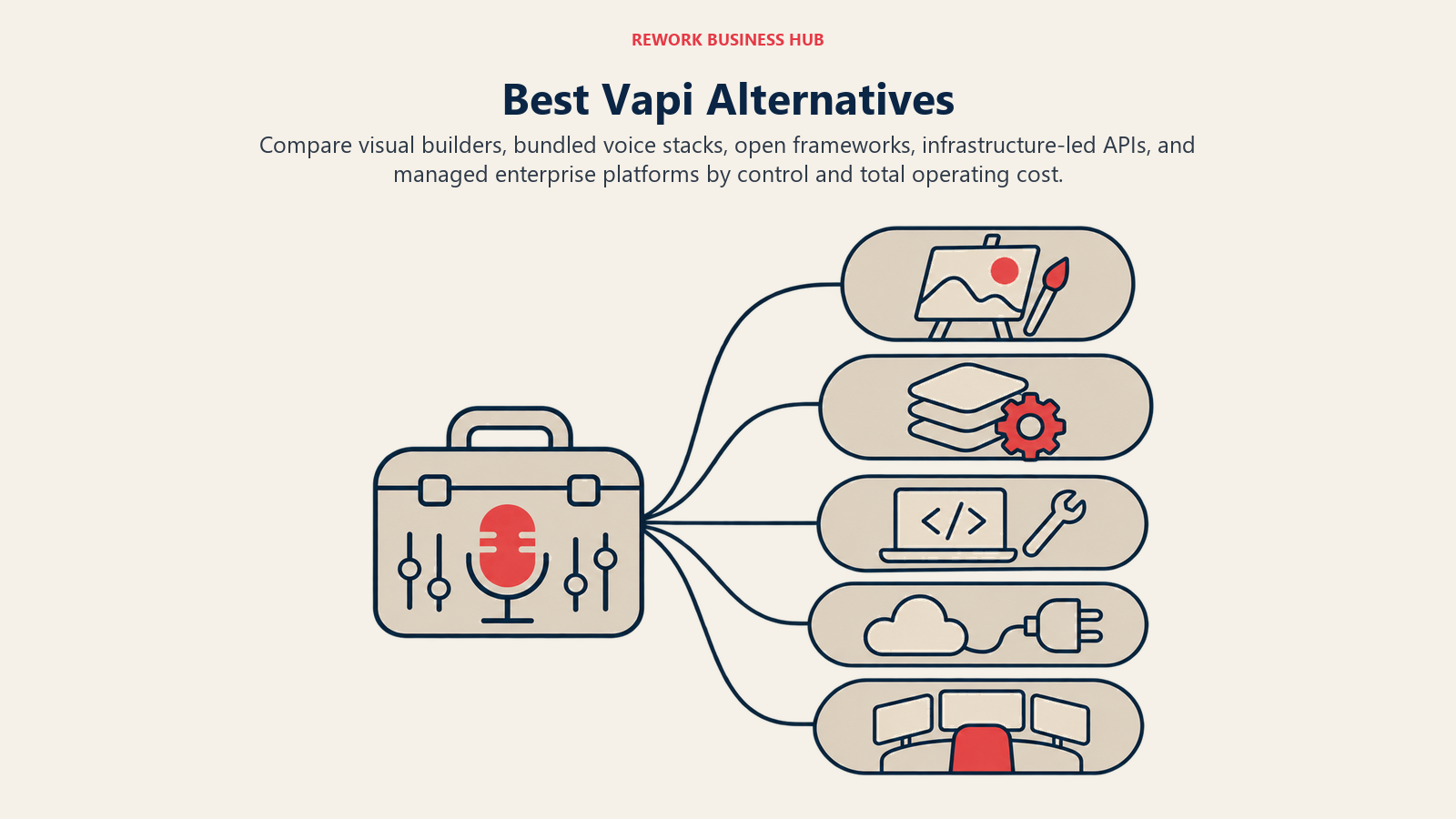
The best Vapi alternatives depend on what you want to stop doing. Retell and Synthflow are the picks if you want a builder your ops team can use, Bland if you want one flat per-minute rate with the model included, LiveKit Agents or Pipecat if you want open-source control, Telnyx or Deepgram if you want fewer vendors on the invoice, and PolyAI or Parloa if you're a large enterprise that wants a vendor to build the agent for you. This guide compares eleven of them on how they charge, how you build on them, and where each one falls short.
Vapi is a strong product, and plenty of teams should stay on it. It's one of the most flexible developer platforms in the category, and its customers include Amazon Ring. But voice pricing stacks up in layers, and a platform that lets you pick every provider also lets you own every integration. Each alternative below is judged on the same four questions: what does the per-minute number actually include, who builds and maintains the agent, what does a buyer of your size get, and what's the honest "not ideal for."
Key Facts
- Vapi announced a $50 million Series B in May 2026 led by Peak XV, bringing total funding to $72 million, and says it has handled more than 1 billion calls, per SiliconANGLE. Those are company-reported figures.
- Vapi's own pricing page lists a $0.05 per minute hosting fee, with transcription, model, voice and telephony costs billed on top at provider rates.
- Retell lists voice agents at $0.07 to $0.31 per minute depending on the voice, LLM and add-ons you choose, with 20 concurrent calls free, per Retell's pricing page.
- In a G2 and RingCentral study of 359 interviews with technology buyers, 57% said they have voice AI agents actively deployed, per RingCentral's October 2026 report. The sample is buyers at organizations where voice matters, so it isn't a market-wide rate.
- LiveKit's agent framework is Apache-2.0 licensed and Pipecat is BSD-2-Clause, per their GitHub pages for LiveKit Agents and Pipecat, so both can run without a platform contract.
Why Teams Look Beyond Vapi
Nobody swaps a live voice agent for fun. There are call flows, prompts, test calls and a telephony setup behind it, and moving means rebuilding and re-testing all of it. So when a team starts searching for alternatives, there's almost always one of five reasons.
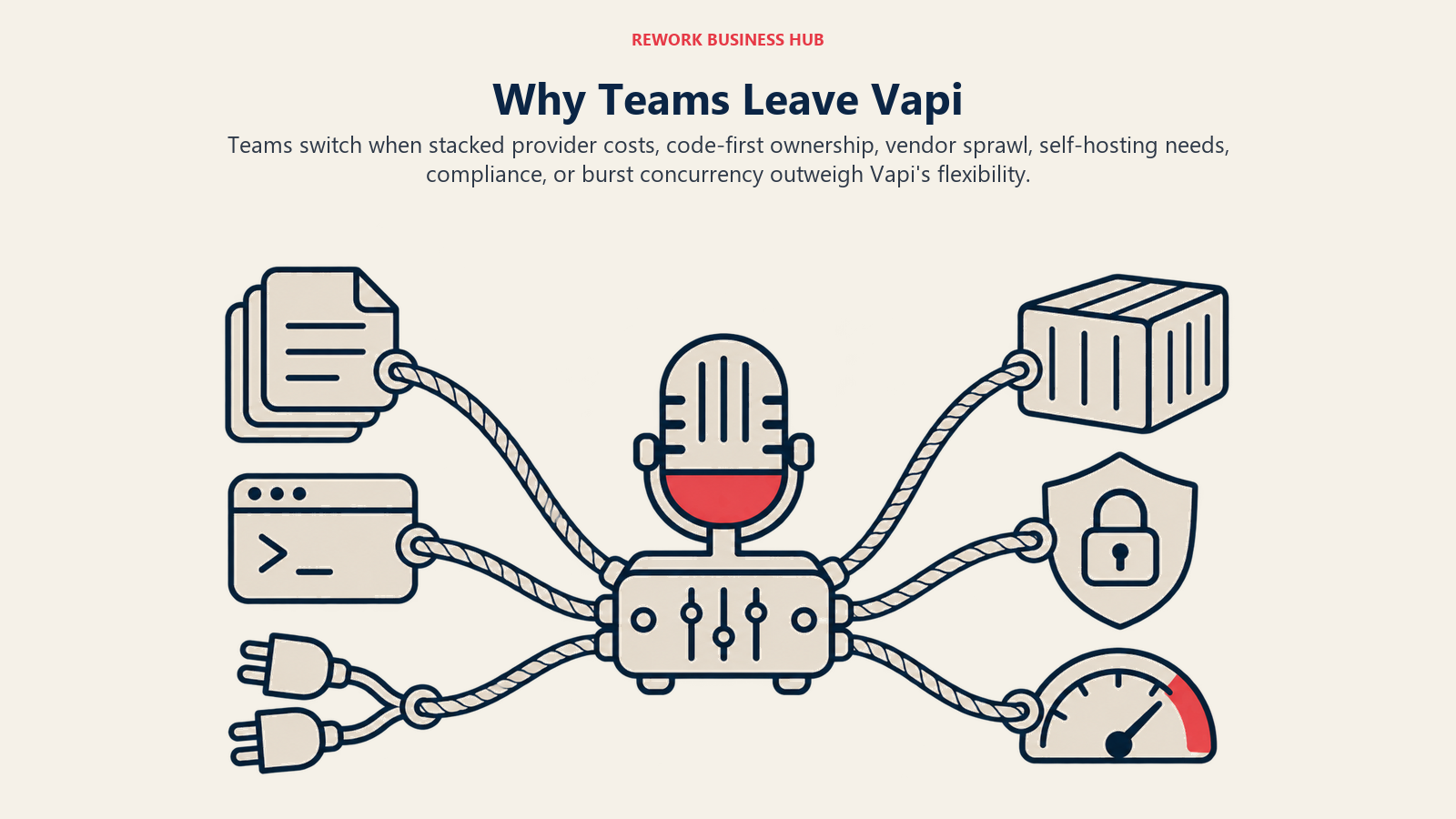
- The bill is hard to predict. Vapi's platform fee is $0.05 per minute, but you also pay a transcription provider, a model provider, a voice provider and sometimes a carrier. Finance sees five line items where it expected one.
- The build is code-first. Vapi is "voice agents for builders." If the person who owns call quality is an ops lead and not an engineer, a visual flow builder is a better fit.
- You want one vendor, not a stack. Some platforms bundle speech, model and voice into one rate. Others bundle the phone network too.
- You want to own the pipeline. Open-source frameworks let you run the agent on your own infrastructure, swap any component, and avoid a per-minute platform fee entirely.
- Compliance or procurement needs. HIPAA on Vapi is a $2,000 per month add-on. Other vendors include it on every plan or sell it inside an enterprise contract. And large buyers sometimes just want a managed service with a named team.
There's a sixth, quieter reason: concurrency. Vapi's base plans cap concurrent calls at 4, 10 and 30 depending on the tier, with extra lines at $10 per line per month. If your campaigns burst, compare how each vendor treats the ceiling before you sign anything.
What Changed in 2026
Vapi is still independent, and it just raised a Series B, so this isn't a "the incumbent is going away" story. What changed is how crowded the middle of the market got. Retell, Bland and Synthflow now all pitch enterprise buyers, ElevenLabs sells an agents product built on its own voices, and infrastructure vendors like Telnyx, Deepgram and Ultravox now sell bundled voice-agent rates of $0.05 to $0.075 per minute. If you are weighing the closest peer, see our Retell AI alternatives guide.
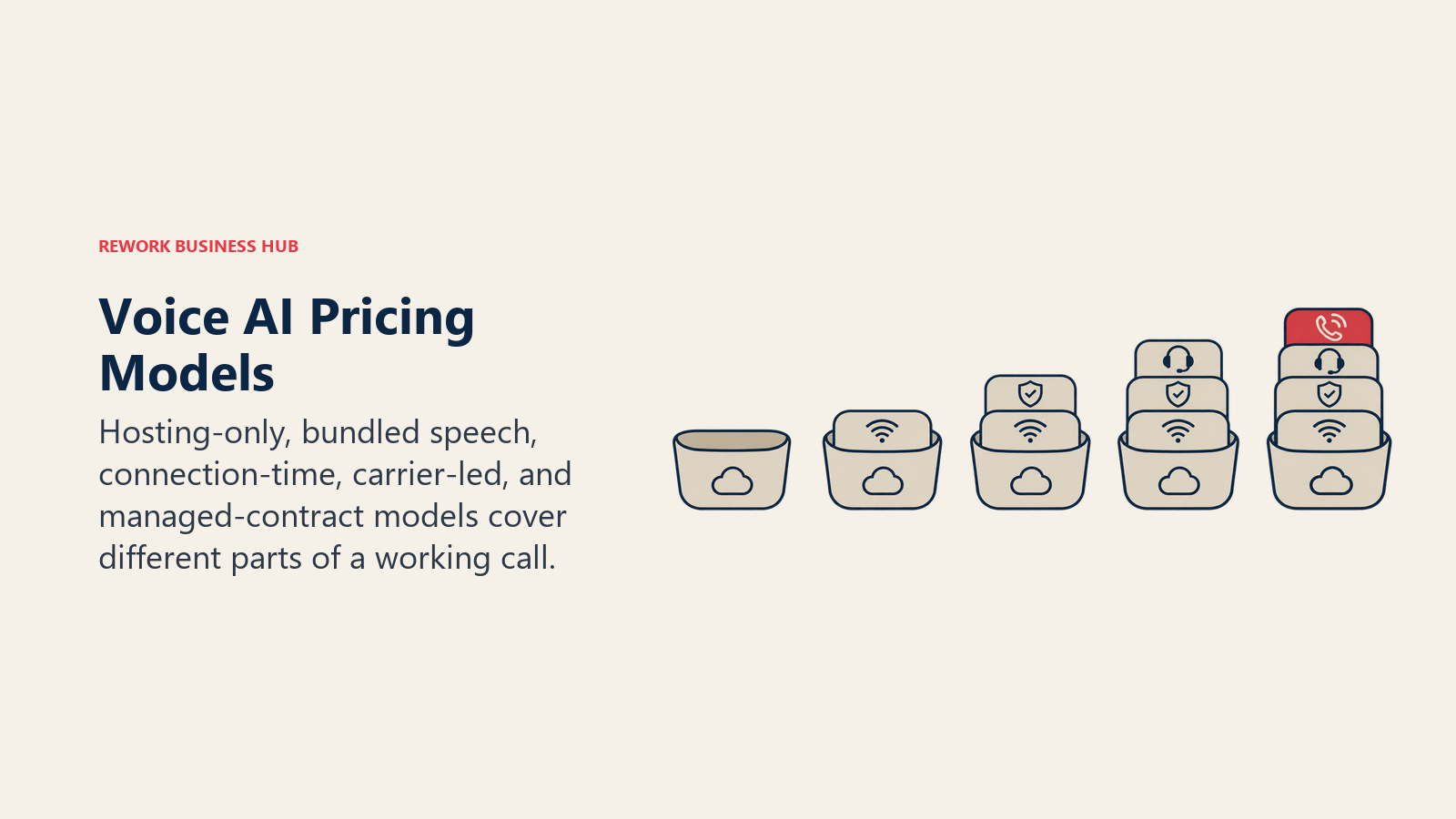
Pricing units also drifted. Some vendors bill a platform fee plus providers, some bill one bundled rate, some bill on WebSocket connection time and some bill per agent-hosting minute. A $0.05 number on one page and a $0.05 number on another often mean different things, which is why the cost tables below label exactly what each rate includes.
Where Vapi Stands Today
Vapi describes itself as a platform for building, deploying and improving voice AI agents, with integrations that include OpenAI, Anthropic, ElevenLabs, Deepgram, Twilio, Salesforce, HubSpot, Zendesk and Google Calendar, per vapi.ai. It lists SOC 2, HIPAA and PCI compliance, and shows Amazon Ring, Intuit, ServiceTitan, New York Life, Kavak, GoHealth and Instawork among its customers. Its published scale figures are vendor claims: 1 billion calls supported, 1M+ developers, 2.5M+ agents launched and average latency under 500ms.
The packaging, per Vapi's pricing page, looks like this.
| Tier | Price | Concurrent calls | Notable inclusions |
|---|---|---|---|
| No Success Package | $0 to start, $0.05 per minute hosting | 4 | $5 free credits, 1 phone number, 14-day retention |
| Core | $29 per month, prepaid, auto-renews | 10 | 5 phone numbers, 30-day retention, email support |
| Pro | 10% of hosting fee, $999 per month minimum | 30 | 180-day retention, RBAC, Slack support, 99% uptime SLA |
| Premier | Custom, direct sales | Custom | SSO, dedicated SIP, 99.9% uptime SLA, 1-hour P0 response |
HIPAA is a $2,000 per month add-on on any tier. Extra concurrency is $10 per line per month and extra organizations are $20 per month.
The part that surprises buyers is what the $0.05 doesn't cover. Vapi passes provider costs through with no markup. The page's example ranges show the stack for one minute of a call.
| Layer | Example provider | Cost per minute |
|---|---|---|
| Vapi hosting | Vapi | $0.05 |
| Transcription | Deepgram | $0.0095 to $0.0099 |
| Language model | OpenAI | $0.0077 to $0.0452 |
| Voice | ElevenLabs | $0.0146 to $0.0238 |
| Telephony | Vapi SIP or WebSockets free; Twilio $0.008 inbound, $0.014 outbound | $0 to $0.014 |
Add the first four rows and you land at roughly $0.082 to $0.129 per minute before carrier fees, which matches the $82 to $129 per 1,000 minutes the page estimates. That all-in range is the figure to compare against the alternatives below, not the $0.05 headline.
Quick Comparison Table
Prices are the vendor's published entry rate. The parenthesis says what that rate covers, because the scopes differ.
| Tool | Best For | Starting Price | Key Strength | Key Limitation |
|---|---|---|---|---|
| Retell AI | Teams that want a visual builder plus developer APIs | $0.07 to $0.31/min (voice, LLM and add-ons itemized) | Drag-and-drop flows, simulation testing, 20 free concurrent calls | Final rate depends on many selectors |
| Bland | Enterprises wanting one rate with the model included | $0.12 to $0.14/min (LLM, STT, TTS included; telephony extra) | Own speech and model stack, self-hosted option | Telephony billed separately |
| Synthflow | Ops teams buying a managed enterprise platform | Enterprise agreement, no public rate | Visual Flow Designer, in-house telephony | No self-serve or trial |
| ElevenLabs Agents | Voice quality and language breadth | $0.08/min beyond plan minutes (LLM billed on top) | 90+ languages, large voice library | LLM cost is a separate layer |
| LiveKit Agents | Engineering teams wanting open source | From $0/mo; $0.01/min agent session on paid plans (plus inference, telephony) | Apache-2.0 framework you can self-host | You assemble and run the pipeline |
| Pipecat Cloud | Python teams who want full pipeline control | $0.01/min active agent-1x (hosting only) | BSD-2-Clause framework, bring any provider | Hosting only; providers billed separately |
| Telnyx Voice AI | Teams that want the carrier and the agent from one vendor | $0.05/min (orchestration, STT, TTS; LLM and telephony extra) | Licensed carrier with HIPAA on every plan | Voice-engine charge rounds up per call |
| Deepgram Voice Agent API | Developers who want one WebSocket for the whole loop | $0.075/min (STT, managed LLM, TTS bundled) | Bundled rate, bring-your-own LLM option | No telephony in the product |
| Ultravox | Speech-native models and low-friction pricing | $0.05/min pay as you go (TTS included) | Speech-native model, open weights | Smaller concurrency on the base plan |
| PolyAI | Large enterprises wanting a managed voice build | Pricing on request | Voice, SMS, WhatsApp and chat, enterprise compliance | Sales-led only |
| Parloa | Voice-heavy contact centers | Pricing on request (per minute for voice) | Consumption pricing with volume packages | Quote-only, built for scale |
How the Alternatives Charge
Per-minute pricing is the most common reason a Vapi buyer shops around, so here's the unit each vendor bills on, taken from each vendor's own pages.
| Tool | Billing unit | What the headline rate includes | Published? |
|---|---|---|---|
| Vapi | Per minute plus providers | Platform hosting only ($0.05) | Yes |
| Retell AI | Per minute, itemized | Voice infrastructure $0.055 plus LLM, TTS, telephony as selected | Yes |
| Bland | Per minute talk time | LLM, STT and premium TTS; telephony separate | Yes |
| Synthflow | Annual enterprise agreement | Not stated | No |
| ElevenLabs Agents | Plan minutes, then per minute | Call minutes; LLM and telephony billed separately | Yes |
| LiveKit Agents | Agent session minute plus inference | Session only; models and telephony priced separately | Yes |
| Pipecat Cloud | Active or reserved agent minute | Hosting only | Yes |
| Telnyx | Per minute, 60-second increments per call | Orchestration, STT, TTS | Yes |
| Deepgram | WebSocket connection minute | STT, managed LLM, TTS | Yes |
| Ultravox | Per minute | Speech model including TTS | Yes |
| PolyAI | Not published | n/a | No |
| Parloa | Per minute for voice, per interaction for chat | n/a | Rates no |
Don't line these up in a spreadsheet column and subtract. A $0.05 Vapi hosting fee, a $0.05 Telnyx voice engine and a $0.05 Ultravox rate cover three different amounts of the stack. Convert each one into a full per-minute cost for your own call design (model choice, voice, carrier, average call length) and compare invoices, not rate cards.
A Fairer Way to Compare the Bundles
If you strip out the headline and ask "what's the cheapest published all-in number to run a call?", the vendors publish enough to build rough ranges. These are each vendor's own published figures, labeled by what they cover.
| Tool | Published figure | Scope of that figure |
|---|---|---|
| Vapi | About $0.082 to $0.129/min | Hosting plus example STT, LLM and voice from its page; carrier extra |
| Retell AI | $0.11/min in its own worked example | Voice infra, LLM, TTS and $0 telephony |
| Telnyx | About $0.06/min in its own estimate | Voice engine, Kimi LLM tokens and local US inbound telephony |
| LiveKit | $0.0479/min in its calculator example | Agent session, telephony, LLM, STT, TTS and observability |
| Deepgram | $0.075/min (pay as you go) | STT, managed LLM and TTS; no telephony |
| Bland | $0.12/min on Build, $0.14/min on Start | LLM, STT and TTS; telephony separate |
Treat the Telnyx, LiveKit and Retell examples as best cases picked by the vendor. They assume cheap models and short prompts, and a voice agent with a long system prompt and a premium model will cost more on all of them.
Build Style and Fit Matrix
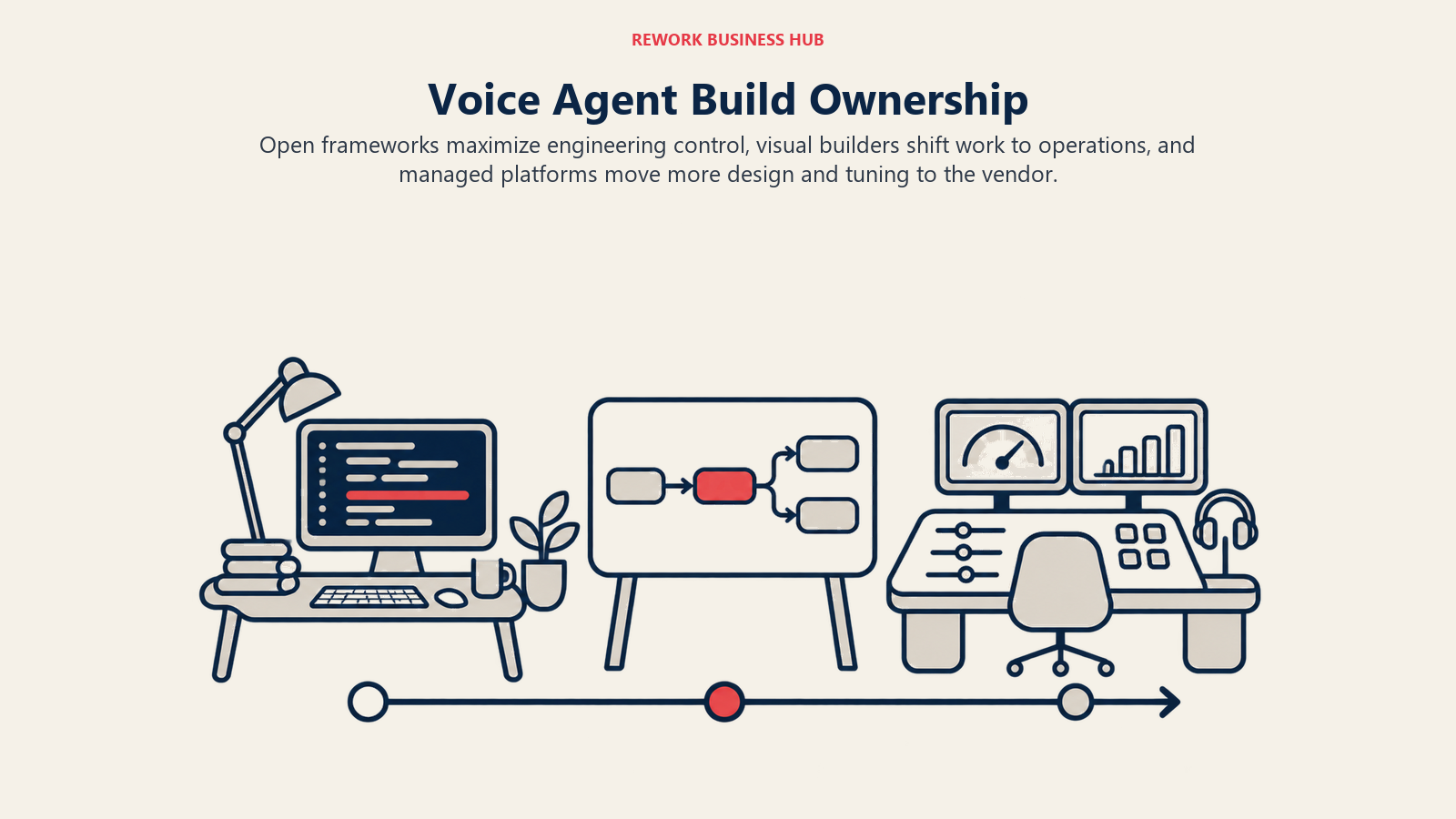
Build style determines who owns the agent after launch: engineers can favor open frameworks and APIs, operations teams need visual control, and enterprise programs may trade flexibility for vendor-led delivery.
| Tool | Build style | Who maintains the agent | Self-host option |
|---|---|---|---|
| Retell AI | Visual canvas plus API | Ops team or developers | Enterprise on-prem |
| Bland | Platform plus API | Vendor-assisted at enterprise tier | Yes, self-hosted and on-prem available |
| Synthflow | Visual Flow Designer | Ops team | Not stated |
| ElevenLabs Agents | Dashboard configuration plus API | Developers or ops | Not stated |
| LiveKit Agents | Python and Node.js code | Engineers | Yes, open source |
| Pipecat | Python code | Engineers | Yes, open source |
| Telnyx | Assistant builder plus API | Ops team or developers | No |
| Deepgram | API only | Engineers | Yes, via Helm chart on Kubernetes |
| Ultravox | API and SDKs | Engineers | Open-weight models published |
| PolyAI | Managed, with developer tools | Vendor plus your team | Not stated |
| Parloa | Managed platform | Vendor plus your team | Not stated |
Compliance and Trust Signals
These are the certifications each vendor shows on its own site. They're vendor statements, so ask for the report and the BAA before you put patient or payment data through any of them.
| Tool | Shown on vendor site |
|---|---|
| Vapi | SOC 2, HIPAA, PCI; HIPAA add-on at $2,000 per month |
| Retell AI | HIPAA, SOC 2 Type II, GDPR, ISO 27001 |
| Bland | SOC 2 Type I and II, HIPAA, PCI DSS (self-attested), BAAs and DPAs |
| Synthflow | SOC 2, GDPR, HIPAA, ISO 27001, EU and US hosting |
| ElevenLabs Agents | SOC 2 Type II, ISO 27001, PCI DSS Level 1, HIPAA, zero-retention mode |
| Telnyx | SOC 2 Type II; HIPAA included on every plan |
| PolyAI | SOC 2+ Type 2, ISO 27001, PCI DSS, GDPR |
| Parloa | ISO 27001, SOC 2 Type II, HIPAA, PCI DSS, DORA, EU AI Act badges |
LiveKit, Pipecat and Ultravox don't list certifications on their product pages, and neither does Deepgram's Voice Agent page. If you self-host an open-source framework, the compliance work moves to you and your cloud provider.
Sizing and Stage Fit
| Tool | Team size sweet spot | Technical skill needed | Typical stage |
|---|---|---|---|
| Retell AI | 2-500 | Low to medium | Pilot to production |
| Bland | 50-5,000 | Medium | Production at scale |
| Synthflow | 100-5,000 | Low | Enterprise rollout |
| ElevenLabs Agents | 1-1,000 | Medium | Prototype to production |
| LiveKit Agents | 5-1,000 | High | Custom product builds |
| Pipecat | 1-500 | High | Custom builds, research |
| Telnyx | 5-5,000 | Medium | Production with carrier needs |
| Deepgram | 5-1,000 | High | Embedded voice features |
| Ultravox | 1-500 | Medium to high | Prototype to production |
| PolyAI | 1,000+ | Low (vendor-led) | Enterprise contact center |
| Parloa | 500+ | Medium | Enterprise contact center |
1. Retell AI: The Closest Like-for-Like With a Visual Builder
Retell is the alternative most Vapi buyers evaluate first. It sells the same thing, a platform for phone-call voice agents, but wraps it in a drag-and-drop call-flow canvas with functions, transfers, DTMF and SMS, and it publishes an itemized rate card on its pricing page.
The itemization is the point. Voice infrastructure is $0.055 per minute, text-to-speech ranges from $0.015 per minute (Retell, Cartesia, OpenAI voices) to $0.10 for premium ElevenLabs voices, and LLM cost runs from $0.0016 per minute for a nano model to well above $0.10 for frontier ones. Retell's own worked example totals $0.11 per minute with telephony at $0. Telephony runs $0.015 per minute for listed countries, bring-your-own SIP trunking is free, and there are add-ons such as +$0.005 per minute for knowledge base, denoising or safety guardrails and +$0.01 for PII removal.
Billing is per second with no per-call rounding, and it covers the whole call, silence and hold included. Twenty concurrent calls are free and extra capacity costs $8 per concurrent call per month, which compares well with Vapi's $10 per line. Retell's homepage cites an independent Cekura benchmark of 414 calls with 95.7% workflow accuracy, a vendor-reported result, and lists HIPAA, SOC 2 Type II, GDPR and ISO 27001.
| What you get | What you don't |
|---|---|
| Visual builder, simulation testing and regression tests from real calls | A final rate that depends on voice, LLM and add-on choices |
| 20 free concurrent calls, $10 free credit on signup | Add-ons stack: knowledge base, denoising, guardrails |
| HIPAA, SOC 2 Type II, GDPR, ISO 27001 listed | Telephony priced per country |
Pricing: $0.07 to $0.31 per minute, itemized by voice engine, LLM, TTS and telephony; no minimums or contracts. Source: retellai.com/pricing.
Best for: Teams moving from a developer prototype to an ops-owned production agent. Not ideal for: buyers who need a single flat rate.
For a deeper side-by-side of this category, see best AI voice agents.
2. Bland: One Per-Minute Rate With the Stack Built In
Bland calls itself "an enterprise voice AI platform" and runs its own speech-to-text, language model and text-to-speech instead of reselling third parties, per bland.ai. That's what makes its pricing different. The pricing page states there are no token charges and no model-provider pass-throughs.
Two plans are self-serve. Start has no monthly fee and charges $0.14 per minute of talk time, with $0.05 per minute for transfers and 10 concurrent calls. Build is $299 per month, drops talk time to $0.12 per minute and transfers to $0.04, and raises concurrency to 50. Enterprise is custom and adds a dedicated orchestration server, on-prem or VPC deployment, a forward-deployed engineer, BAA, SSO and data residency. Telephony is billed separately, either through your own carrier or Bland's Twilio at pass-through cost.
The homepage reports 40+ languages natively and says most production agents go live in two to six weeks. Customer outcomes there (a $750K annual saving from retiring an IVR at Idaho Housing and Finance Association, a 92% cost reduction at Needle) are Bland's own case-study claims.
| What you get | What you don't |
|---|---|
| LLM, STT and premium TTS in one per-minute rate | Telephony isn't in the rate |
| Self-hosted and on-prem deployment available | Runs on Bland's own models, not your choice of provider |
| BAA, SOC 2 Type II and HIPAA | Case-study results are vendor-reported |
Pricing: $0.14 per minute on Start, $0.12 per minute plus $299 per month on Build, custom on Enterprise. Source: bland.ai/pricing.
Best for: Regulated enterprises that want predictable per-minute cost and a vendor-owned stack. Not ideal for: developers who want to pick every model and voice themselves.
3. Synthflow: A Managed Platform for Ops Teams
Synthflow describes itself as a "full-stack Voice AI platform engineered for enterprise phone automation," per synthflow.ai. The product centers on a visual Flow Designer, multi-agent subflows, a Test Center, real-time monitoring and its own telephony, which it says delivers sub-100 ms latency (the site's FAQ elsewhere says sub-500 ms, so ask which number applies to your setup). It lists 200+ integrations including Salesforce, HubSpot, Genesys and RingCentral.
Synthflow's pricing page is blunt: it sells an annual enterprise agreement, with no published per-minute rate, no free plan and no trial. Telephony, integrations, security and launch support are scoped into the contract, and BPOs and software platforms can add white-label.
Customer results on the site, such as Freshworks automating up to 65% of routine calls, are self-reported and unsourced. Treat them as a starting point for reference calls.
| What you get | What you don't |
|---|---|
| Visual designer and test tooling for non-engineers | No self-serve, no trial, no published rate |
| In-house telephony and SIP or PBX compatibility | Annual commitment |
| White-label option for BPOs and platforms | Case-study numbers are unsourced |
Pricing: Pricing on request, annual enterprise agreement. Source: synthflow.ai/pricing.
Best for: Enterprises and BPOs that want a managed rollout with ops-owned flows. Not ideal for: small teams that need to test on a card before talking to sales.
If your priority is a builder your ops team can run without engineers, best no-code AI agent builders covers the wider field.
4. ElevenLabs Agents: Voice Quality and Language Breadth
ElevenLabs is best known for voices, and its agents product leans on that. The agents page says agents speak 90+ languages and can switch mid-conversation, are LLM-agnostic (bring your own model or use hosted ones), and connect to telephony, web, mobile, WhatsApp, SMS and chat. It cites SOC 2 Type II, ISO 27001 and PCI DSS Level 1 and lists HIPAA, plus a zero-retention mode. The voice library is described as 16,000 to 17,000+ voices, depending on which part of the site you read.
Pricing sits on subscription plans, per ElevenLabs' agents pricing. Monthly billing runs from Free (15 call minutes, 4 concurrent calls) through Starter at $6, Creator at $11, Pro at $99 with 1,238 minutes and 20 concurrent calls, Scale at $299 and Business at $990 with 12,375 minutes and 40 concurrent calls. Extra minutes are $0.08. Calls above your concurrency limit use burst pricing at $0.16 per minute. LLM usage is billed separately, and ElevenLabs charges nothing for telephony because your carrier bills you directly.
| What you get | What you don't |
|---|---|
| Voice quality, voice library and 90+ languages | LLM cost on top of minutes |
| Simulation and guardrail testing before launch | Burst calls bill at double the rate |
| Monthly plans with included minutes | Annual rates aren't shown on the agents pricing page |
Pricing: Included minutes by plan, then $0.08 per minute; LLM and telephony billed separately. Source: elevenlabs.io/pricing/agents.
Best for: Multilingual or brand-voice-sensitive agents. Not ideal for: buyers who want one number that already includes the model.
5. LiveKit Agents: The Open-Source Route With a Cloud Option
LiveKit gives you a real-time infrastructure layer and an Apache-2.0 agent framework, per the LiveKit Agents repository. It supports Python and Node.js, handles phone calls through LiveKit's telephony stack, and you can self-host it. The turn-detection models use a separate LiveKit Model License, so read it if you plan to ship those.
LiveKit Cloud is the paid layer, and its pricing page is plan-based. Build is $0 per month with 1,000 agent session minutes and 5 concurrent sessions. Ship starts at $50 per month with 5,000 minutes, 20 concurrent sessions and $0.01 per minute overage. Scale starts at $500 per month with 50,000 minutes and up to 600 concurrent sessions. Inference (STT, LLM, TTS) is billed at model prices on top, with starter credits per plan. LiveKit's own calculator example puts one minute at $0.0479 all-in, made up of agent session, telephony, LLM, STT, TTS and observability.
That number is attractive, but it is the vendor's best case. The real tradeoff is labor. You write the agent, tune turn-taking, monitor it and handle failures.
| What you get | What you don't |
|---|---|
| Apache-2.0 framework you can self-host | You build and operate the pipeline |
| Concurrency up to 600 sessions on Scale | No visual builder |
| Inference, telephony and agent hosting under one vendor | Turn-detection models carry a separate license |
Pricing: $0 Build, from $50 per month Ship, from $500 per month Scale; $0.01 per minute agent session overage; inference and telephony extra. Source: livekit.com/pricing.
Best for: Engineering teams building voice into their own product. Not ideal for: ops-owned agents with no developers.
See also best AI agent frameworks for developers if you're comparing frameworks beyond voice.
6. Pipecat Cloud: Full Pipeline Control in Python
Pipecat is an open-source Python framework for real-time voice and multimodal agents under a BSD-2-Clause license, per its GitHub page. It integrates speech-to-text, LLM, text-to-speech, speech-to-speech and transport services across a long list of providers. Daily sells hosting for it.
Pipecat Cloud pricing is per minute of agent runtime: agent-1x (0.5 vCPU, 1 GB) is $0.01 per active minute, agent-2x is $0.02 and agent-3x is $0.03. Reserved always-on agents cost a fraction of that per minute, and concurrency is unlimited. Hosting, transport and telephony are billed per minute, and providers you bring (LLM, STT, TTS) bill you directly. That makes the $0.01 a hosting figure only, not a call cost.
| What you get | What you don't |
|---|---|
| BSD-2-Clause code, no platform lock-in | You pick, wire and monitor every provider |
| Unlimited concurrency on Pipecat Cloud | Hosting rate isn't a full per-minute cost |
| Bring any LLM, STT or TTS | No visual builder or hosted QA |
Pricing: $0.01 per active minute for agent-1x, hosting only. Source: daily.co/pricing/pipecat-cloud.
Best for: Python-fluent teams that want to own the pipeline. Not ideal for: teams without engineering capacity to maintain it.
7. Telnyx Voice AI: The Carrier and the Agent From One Vendor
Telnyx's pitch is that it's a licensed carrier, so the agent and the phone network sit in one place. Its Voice AI agents page says it originates calls as a licensed carrier in 45+ countries, offers 80+ languages and 1,400+ voices, and claims sub-200ms response times (a vendor figure). It also cites SOC 2 Type II.
The pricing page lists $0.05 per minute for the voice engine, covering orchestration, speech-to-text and text-to-speech. LLM tokens are billed separately, and telephony starts at $0.0032 per minute. Telnyx's own example estimate is about $0.06 per minute all-in at 230,000 minutes a month, using a Kimi model on its GPUs. Pay as you go has 500 concurrent calls, and HIPAA is included on every plan. Growth ($2,000 per month minimum spend) takes 15% off voice, messaging and numbers.
One catch: voice-engine charges round to 60-second increments per call, and Telnyx says its estimates exclude that, so short calls cost more than the example suggests.
| What you get | What you don't |
|---|---|
| Carrier, STT, TTS and orchestration in one account | LLM tokens billed on top |
| HIPAA on every plan, number porting from the US and Canada | 60-second rounding per call |
| 500 concurrent calls on pay as you go | Fewer builder tools than Retell or Synthflow |
Pricing: $0.05 per minute voice engine; LLM and telephony extra. Source: telnyx.com/pricing/voice-ai.
Best for: Teams that already buy phone numbers and SIP and want fewer vendors. Not ideal for: very short calls where per-call rounding bites.
For the phone-first view of this market, read best AI phone agents.
8. Deepgram Voice Agent API: One WebSocket for the Whole Loop
Deepgram started in speech recognition, and its Voice Agent API runs speech-to-text, LLM orchestration and text-to-speech over one WebSocket. You can bring an LLM through an OpenAI-compatible endpoint or Bedrock, use Deepgram's voices or a third party's, and deploy on your own Kubernetes cluster with Deepgram's Helm chart. Its Flux model detects end of turn in about 260 ms, a vendor figure. It's a WebSocket API, so you bring your own carrier.
Deepgram's pricing is per minute of WebSocket connection time. Standard (STT, managed LLM and TTS bundled) is $0.075 on pay as you go and $0.068 on Growth. Bringing your own LLM and TTS drops pay as you go to $0.050. New users get $200 in credit. Growth requires prepaid annual credits starting at $4,000 per year, and usage beyond those credits bills at the Growth rate plus 10%.
| What you get | What you don't |
|---|---|
| Bundled STT, LLM and TTS rate | No telephony in the product |
| Self-host option on Kubernetes | Growth tier requires prepaid annual credits |
| $200 non-expiring credit, no card on pay as you go | API only, no visual builder |
Pricing: $0.075 per minute Standard (pay as you go), $0.068 on Growth; billed on connection time. Source: deepgram.com/pricing.
Best for: Developers embedding voice agents in their own app. Not ideal for: ops teams who need a call-flow builder.
9. Ultravox: A Speech-Native Model With Simple Pricing
Ultravox takes a different technical approach. Its site says it trained a speech-native model so paralinguistic cues aren't lost in transcription, runs its own inference stack, publishes open-weight models on Hugging Face, and offers REST APIs and SDKs with telephony integrations. The performance numbers it publishes (91.8% on Big Bench Audio without reasoning) are its own.
The pricing page is simple. Pay as You Go is $0 per month with 30 free minutes, $0.05 per minute and a hard cap of 5 concurrent calls. Pro is $100 per month with no hard concurrency cap, an outbound call scheduler and more voices and RAG corpora. SIP is 0.5 cents per minute. Enterprise is custom. The homepage describes the $0.05 rate as including TTS.
| What you get | What you don't |
|---|---|
| $0.05 per minute including TTS | 5 concurrent calls on pay as you go |
| Open-weight models and its own inference | Fewer enterprise features than Bland or PolyAI |
| No surge pricing | Speech generation listed as coming soon |
Pricing: $0.05 per minute pay as you go (TTS included), Pro $100 per month. Source: ultravox.ai/pricing.
Best for: Developers who want a low per-minute rate and a speech-native model. Not ideal for: compliance-heavy enterprises that need audit documents upfront.
10. PolyAI: A Managed Enterprise Build
PolyAI sits at the other end of the spectrum from the open-source options. Its site sells the Wren Dialog Agent and Dialog Studio across voice, SMS, WhatsApp, web chat and email, with developer tools (Platform API, ADK, MCP, CLI). Customers listed include PG&E, NatWest, UniCredit, Foot Locker and Metro Bank. It lists SOC 2+ Type 2, ISO 27001, PCI DSS and GDPR, with data residency in the US, UK, EU and APAC.
Performance numbers on the page, such as 90% of calls resolved end to end on its largest deployments and 10,000 concurrent calls, are PolyAI's own claims. The site lists no pricing beyond a limited-time $100 free credit for new accounts, so expect a sales process.
| What you get | What you don't |
|---|---|
| Managed build for complex enterprise voice | No published rates |
| Multi-channel: voice, SMS, WhatsApp, chat, email | Sales-led onboarding only |
| Regional data residency options | Overkill for simple appointment bots |
Pricing: Pricing on request. Source: poly.ai.
Best for: Banks, utilities and retailers running large inbound contact centers. Not ideal for: startups testing a first agent.
If you're weighing a managed contact-center rollout, best AI agents for call centers covers it in more depth.
11. Parloa: Consumption Pricing for Voice-Heavy Contact Centers
Parloa describes itself as an AI agent platform for customer service. Its pricing page says it uses consumption-based pricing: per minute for voice and per interaction for chat. Customers pick a volume package, rates reflect the complexity of each use case, and outcome-based pricing is supported where it makes sense. No dollar amounts are published.
The homepage shows ISO 27001, SOC 2 Type II, HIPAA, PCI DSS, DORA and EU AI Act badges, and customers such as Booking.com, Zalando and SAP. Its headline claims (70% lower cost per contact, 3X faster time to resolution) are vendor-reported.
| What you get | What you don't |
|---|---|
| Per-minute voice pricing with volume packages | No published rates |
| Broad compliance badges, including EU-focused ones | Quote-only, aimed at large volume |
| Outcome-based pricing where it fits | Not a developer-first toolkit |
Pricing: Pricing on request. Source: parloa.com/pricing.
Best for: European and global contact centers with high phone volume. Not ideal for: teams that want to prototype this week.
Who Should Stay on Vapi
Switching costs real engineering time: you rebuild flows, re-test prompts, re-port numbers and re-run a pilot. Staying is the right call when:
| Situation | Why staying makes sense |
|---|---|
| Your developers like the API and want to swap providers freely | Few alternatives match Vapi's provider flexibility without writing your own pipeline |
| You're in production at volume with stable latency | A migration risks regressions in call quality |
| Your complaint is the stacked bill | Model the stack first: hosting plus provider rates is often $0.08 to $0.13 per minute, which sits in line with several bundled alternatives |
| You need the Premier tier features (SSO, dedicated SIP, SLAs) | Not every vendor above publishes equivalent terms |
| Your use case is a developer feature, not a call center | Visual-builder platforms add little for you |
If cost is the complaint, ask Vapi to price your actual call design (model, voice, carrier, average length) before you start a competing pilot. Then run the same design through one bundled alternative and compare real invoices.
How to Choose: Decision Framework
For the wider market view, start with best AI voice agents and best AI agent platforms.
| If you need... | Pick... | Why |
|---|---|---|
| A visual builder with itemized pricing | Retell AI | Drag-and-drop canvas and a public rate card |
| One per-minute rate with the model included | Bland | LLM, STT and TTS in the rate |
| A managed enterprise rollout for ops teams | Synthflow | Flow Designer, in-house telephony, annual agreement |
| The best voice library and language coverage | ElevenLabs Agents | 90+ languages and a large voice library |
| Open-source control and self-hosting | LiveKit Agents or Pipecat | Apache-2.0 and BSD-2-Clause frameworks |
| The carrier and the agent in one account | Telnyx | Licensed carrier with HIPAA on every plan |
| A bundled developer API on one WebSocket | Deepgram Voice Agent API | STT, LLM and TTS at $0.075 per minute |
| A low flat per-minute rate for prototypes | Ultravox | $0.05 per minute including TTS |
| A vendor-built enterprise contact-center agent | PolyAI or Parloa | Managed delivery and enterprise compliance |
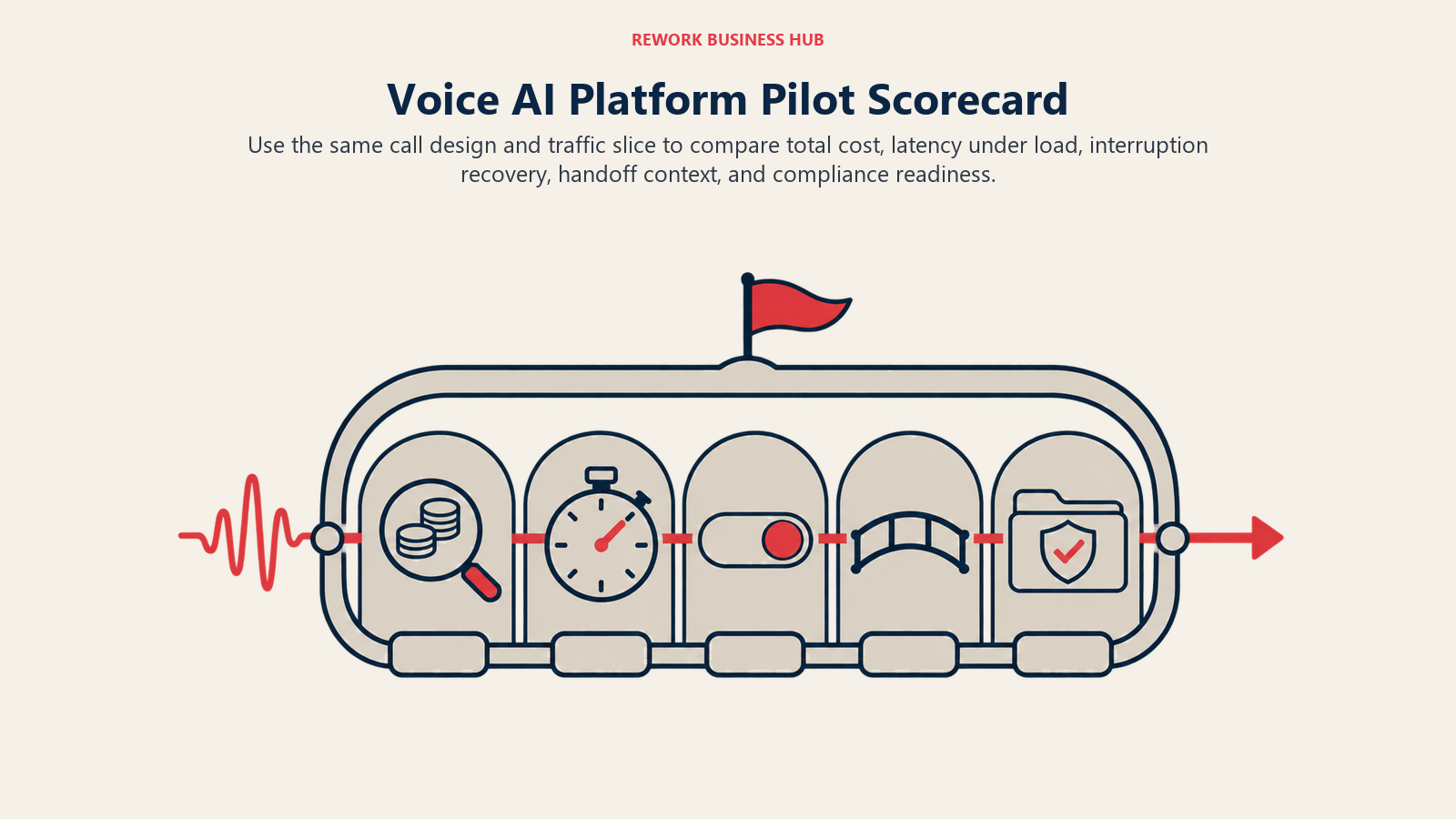
What to Test in a Pilot
| Test | What to measure | Red flag |
|---|---|---|
| Full-cost invoice | Real per-minute cost with your model, voice and carrier | A headline rate that covers only one layer |
| Latency under load | Time to first word at your peak concurrency | Delays when concurrent calls climb |
| Interruption handling | Does the agent recover when callers talk over it? | Repeated or talking-over behavior |
| Same 200 calls | Identical call scripts on two vendors | Vendor chooses the sample |
| Handoff quality | Context passed to a human or system | Callers repeat themselves |
| Compliance paperwork | BAA, DPA and SOC 2 report in hand | "Available on request" with no document |
Run the pilot for at least two weeks on live traffic with the agent handling one call type, not everything. Pick the calls you most want to automate, not the easy ones, since easy calls flatter every vendor. Have a person listen to a random sample of finished calls and grade them against the vendor's own success metric. And name an owner for the agent after launch. A voice agent without an owner drifts, whichever platform you pick. For monitoring options, best AI agent observability tools covers the layer that sits beside any of these platforms.
If voice support is the main use case, best AI agents for customer service compares the helpdesk-native options too.
Frequently Asked Questions about Vapi Alternatives
How much does Vapi cost per minute?
Vapi's hosting fee is $0.05 per minute, per its pricing page. Transcription, language model, voice and carrier costs are billed at provider rates on top, and Vapi's own example ranges work out to roughly $82 to $129 per 1,000 minutes before carrier fees.
What is the best alternative to Vapi?
Retell AI is the closest like-for-like with a visual builder, Bland bundles the model into one per-minute rate, and LiveKit Agents or Pipecat give you open-source control. The right pick depends on whether your team is engineers or ops.
Is there an open-source alternative to Vapi?
Yes. LiveKit Agents is Apache-2.0 licensed and Pipecat is BSD-2-Clause licensed. Both let you self-host the agent, but you build and operate the pipeline yourself, and LiveKit's turn-detection models carry a separate license.
Which Vapi alternative has the cheapest published per-minute price?
Ultravox and Telnyx both list $0.05 per minute, but Ultravox's rate includes TTS and Telnyx's covers orchestration, STT and TTS with LLM and telephony extra. LiveKit's calculator example is lower still at $0.0479 per minute all-in, though that is the vendor's best case.
Which alternative is best for HIPAA?
Telnyx includes HIPAA on every plan, per its pricing page. Retell, Bland, Synthflow, ElevenLabs and Parloa all list HIPAA on their sites, and Vapi sells it as a $2,000 per month add-on. Always ask for the BAA before sending patient data.
Do I need engineers to use these platforms?
Not for all of them. Retell, Synthflow and the Telnyx assistant builder let ops teams build flows visually. LiveKit, Pipecat, Deepgram and Ultravox are developer tools that assume Python or API skills.
Are vendor latency and resolution claims comparable?
No. Vapi claims average latency under 500ms, Telnyx claims sub-200ms and Synthflow quotes two different figures on one site. They're measured differently and self-reported, so test with your own calls.
What to Do Next
Pick two alternatives that match why you're leaving Vapi, price the same call design on each (model, voice, carrier and average call length), then run the same set of real calls through both and compare the invoice and the call quality side by side. If neither beats your current Vapi cost and quality on a like-for-like basis, you've got your answer, and you'll know the stack well enough to negotiate.

Co-Founder, Rework.com
On this page
- Key Facts
- Why Teams Look Beyond Vapi
- What Changed in 2026
- Where Vapi Stands Today
- Quick Comparison Table
- How the Alternatives Charge
- A Fairer Way to Compare the Bundles
- Build Style and Fit Matrix
- Compliance and Trust Signals
- Sizing and Stage Fit
- 1. Retell AI: The Closest Like-for-Like With a Visual Builder
- 2. Bland: One Per-Minute Rate With the Stack Built In
- 3. Synthflow: A Managed Platform for Ops Teams
- 4. ElevenLabs Agents: Voice Quality and Language Breadth
- 5. LiveKit Agents: The Open-Source Route With a Cloud Option
- 6. Pipecat Cloud: Full Pipeline Control in Python
- 7. Telnyx Voice AI: The Carrier and the Agent From One Vendor
- 8. Deepgram Voice Agent API: One WebSocket for the Whole Loop
- 9. Ultravox: A Speech-Native Model With Simple Pricing
- 10. PolyAI: A Managed Enterprise Build
- 11. Parloa: Consumption Pricing for Voice-Heavy Contact Centers
- Who Should Stay on Vapi
- How to Choose: Decision Framework
- What to Test in a Pilot
- What to Do Next