Best Retell AI Alternatives in 2026: 10 Voice Agent Platforms Compared
Turn this article into takeaways for your work.


Each assistant summarizes the article only for you and suggests best practices for your work.
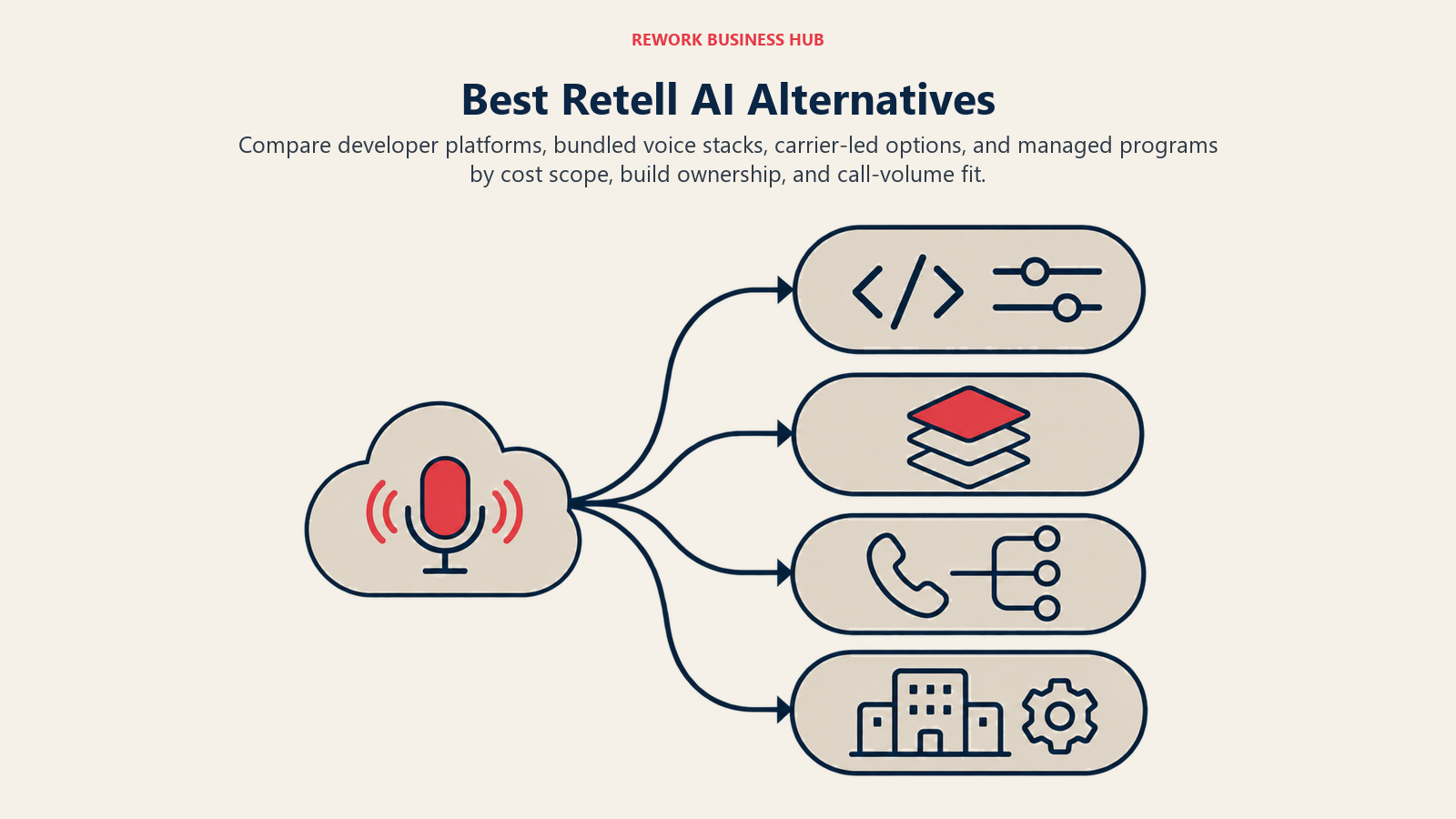
The best Retell AI alternatives depend on how much of the voice stack you want to own. Vapi is the closest developer-platform peer, Bland and Synthflow bundle more into one price, Telnyx owns the carrier underneath the agent, and PolyAI, Parloa, Cresta and Sierra are the managed or enterprise routes for teams running real call volume. This guide compares ten of them on what a minute actually costs, who builds the agent, and where each one falls short.
Retell is a good product, and a lot of teams should stay on it. This list is for the teams that have outgrown a self-serve build, or that want a vendor to carry more of the load. We judged each platform on the same four questions: how it bills, what it includes in that bill, how much your team has to build, and the honest "not ideal for."
Key Facts
- Gartner forecast in 2022 that conversational AI would cut contact center agent labor costs by as much as $80 billion in 2026, and said labor can be up to 95% of contact center costs, per CX Today's coverage. It's a forecast, not a measured outcome.
- Retell lists voice agents at $0.07 to $0.31 per minute, with 20 concurrent calls included and $10 in free credits, per Retell's pricing page.
- Vapi charges $0.05 per minute for hosting and passes model, voice and transcription costs through at cost, per Vapi's pricing page.
- Telnyx lists its voice engine at $0.05 per minute, with LLM tokens and telephony billed separately, per Telnyx's voice AI pricing.
- PolyAI lists its model-only Dialog-RSN-1 API at 2 cents per connected minute, billed per second, per PolyAI's pricing page. That excludes telephony and orchestration.
Why Teams Look Beyond Retell
Nobody switches a phone agent for fun. A live voice agent has prompts, call flows, test calls and a QA habit behind it, and moving means rebuilding and running two systems side by side. So when buyers start searching for alternatives, it's almost always one of these.
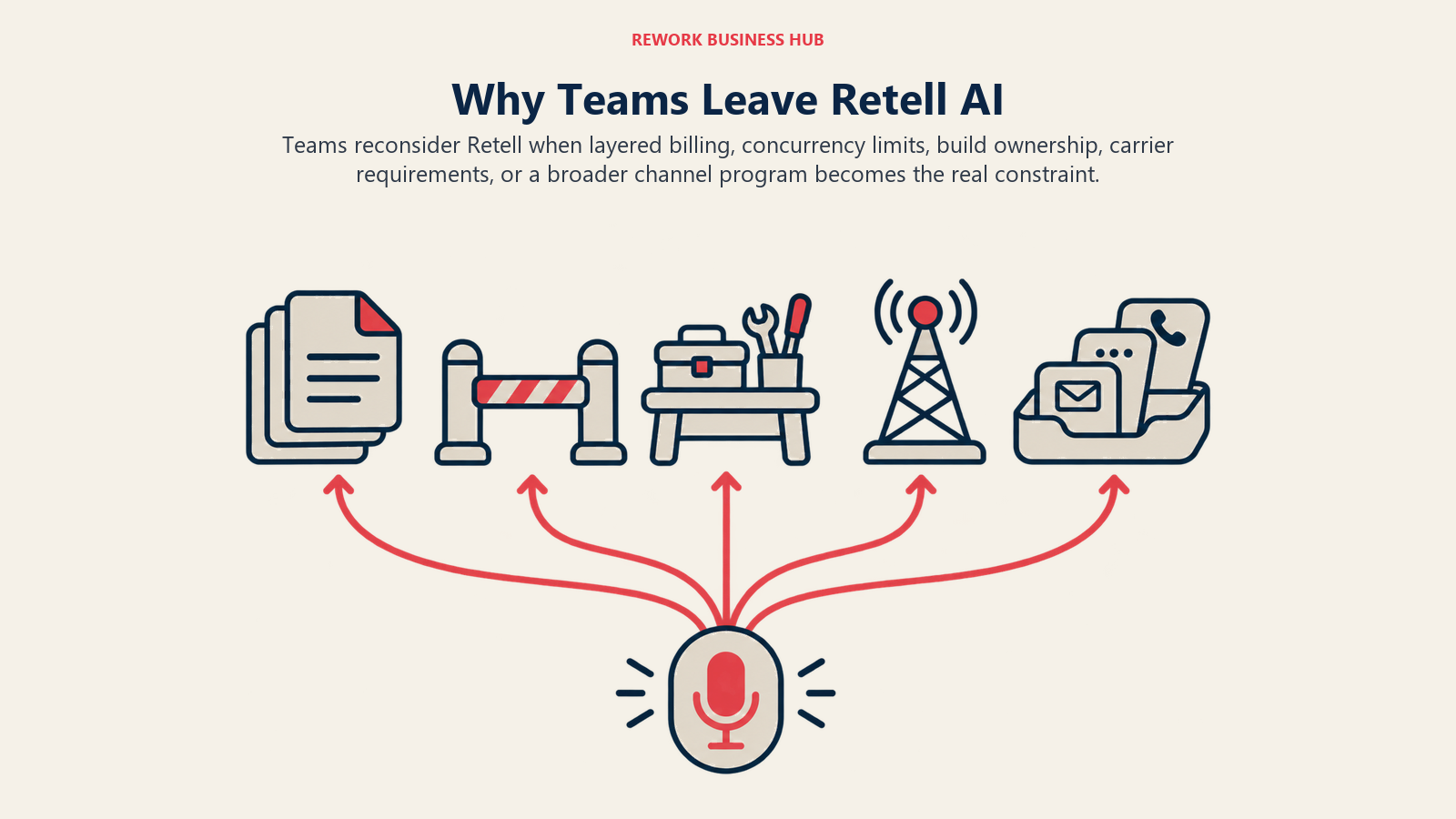
- The bill is a stack of parts. Retell breaks a minute into voice infrastructure, LLM, text-to-speech and telephony, plus add-ons. That's transparent, but finance teams that want one number per minute go looking at Bland or a quoted enterprise contract.
- Concurrency becomes the constraint. Retell includes 20 concurrent calls and charges extra beyond that. A contact center with peak-hour spikes prices that differently from a clinic booking appointments.
- The team wants a vendor to build the agent. Retell is a platform you build on. PolyAI, Parloa and Sierra will do more of the design and tuning for you.
- The carrier matters. Some buyers want the telephony, the voice engine and the SLA from one provider, which is Telnyx's pitch.
- It's a bigger program than outbound calls. Retell does phone calls well. If the roadmap spans chat, email, agent assist and QA across a whole contact center, a wider platform fits better.
Be honest about which camp you're in before reading the vendor sections. It will decide more than any feature table.
What Changed in 2026
Two shifts matter if you're re-running a voice shortlist this year. First, pricing moved toward components and bundles at the same time. Retell, Vapi and Telnyx publish itemized per-minute parts, while Bland folds the LLM, transcription and voice into one rate. Second, enterprise buyers pulled the market toward managed platforms: PolyAI and Parloa sell contact-center programs, not API keys, though PolyAI now also sells a self-serve model API.
The practical effect is that rate cards stopped being comparable. A "$0.05 per minute" on one page and a "$0.14 per minute" on another describe different things. The pricing section below puts every vendor's rate next to what it includes.
Where Retell Stands Today
Retell positions itself as an AI voice agent platform for automating phone calls. Its homepage lists a drag-and-drop visual builder, call transfer, appointment booking, a knowledge base, IVR navigation, batch calling, branded caller ID, simulated testing, A/B testing of agent versions and post-call analysis. It also covers chat, SMS and an API. It claims HIPAA, SOC 2 Type II, GDPR and ISO 27001 compliance, an on-premises option for enterprise, and about 600ms latency.
The results it publishes are its own: Pine Park Health scheduling NPS up 38%, SWTCH support costs cut by over 50%, and Medical Data Systems handling 100% of inbound calls with a 30% transfer rate. It also cites a third-party Cekura benchmark of 414 calls that gave it 95.7% workflow accuracy. Treat those as vendor claims and ask for your own test.
Pricing is the part that sends people shopping. Per Retell's pricing page, the pay-as-you-go components are:
| Component | Rate | Notes |
|---|---|---|
| Retell voice infrastructure | $0.055 per minute | Platform fee |
| Telephony | $0.015 per minute | Listed countries; no charge for SIP trunking or custom telephony |
| Text-to-speech | $0.015 to $0.10 per minute | Retell, Cartesia, OpenAI and others at $0.015; ElevenLabs models $0.04 to $0.10 |
| LLM | From $0.0016 per minute (GPT 5 nano) to $0.08 (Claude 4.6 Sonnet) | Varies widely by model |
| Add-ons | +$0.005 to +$0.10 per minute | Knowledge base, denoising, guardrails, PII removal, QA |
The page's own example totals $0.11 per minute: LLM $0.04, voice infrastructure $0.055 and text-to-speech $0.015, with telephony shown at $0.00. Billing is to the nearest second, silence and hold time are billed, and there are no minimums or contracts on pay-as-you-go. Extra concurrency is $8 per concurrent call per month. Enterprise is custom and adds SSO, BAA, a high concurrency cap and a named account manager.
| Dimension | What Retell offers | What to ask in a switch decision |
|---|---|---|
| Build approach | Visual builder plus API | Who on your team owns prompts after launch? |
| Pricing model | Itemized per minute, pay as you go | What's our real blended minute, with telephony? |
| Concurrency | 20 included, $8 per extra line per month | What's our peak hour? |
| Channels | Voice, chat, SMS | Do we need email or agent assist too? |
| Enterprise | Custom pricing, BAA, SSO | Is that a different product at our scale? |
Quick Comparison Table
| Tool | Best For | Starting Price | Key Strength | Key Limitation |
|---|---|---|---|---|
| Vapi | Developer teams wanting model and carrier choice | $0.05 per minute hosting (providers extra) | Bring any LLM, voice and transcriber | You assemble and manage the stack |
| Bland | Regulated, high-volume calling | $0.14 per minute (Start), LLM, STT, TTS included | Own speech stack, self-hosted option | Telephony billed separately |
| Synthflow | Contact centers and BPOs | Pricing on request (annual enterprise agreement) | In-house telephony, contact-center integrations | No self-serve tier |
| ElevenLabs Agents | Voice quality and many languages | $0.08 per additional minute (plans from $0 to $990 per month) | Plan-based minutes with a free tier | LLM billed on top |
| PolyAI | Enterprises wanting a managed voice program | Platform on request; model API 2 cents per connected minute | Voice-first, built for contact centers | Platform pricing is quote-only |
| Parloa | Large voice-led contact centers | Pricing on request (per minute, per interaction) | Enterprise governance and compliance badges | Built for large volume |
| Telnyx | Teams wanting carrier and AI on one invoice | $0.05 per minute voice engine (LLM, telephony extra) | Licensed carrier, single SLA | Realistic all-in is about $0.06 |
| Cresta | Contact centers blending AI and human agents | Pricing on request | Autonomous agent plus coaching | No public pricing |
| Sierra | Enterprises wanting a managed multichannel agent | Pricing on request (outcome-based) | One agent across voice, chat, SMS, email | No public rate card |
| Kore.ai | Enterprises consolidating AI programs | Pricing on request | Service, work and process agents | Wider than a voice buy |
What a Minute Actually Costs
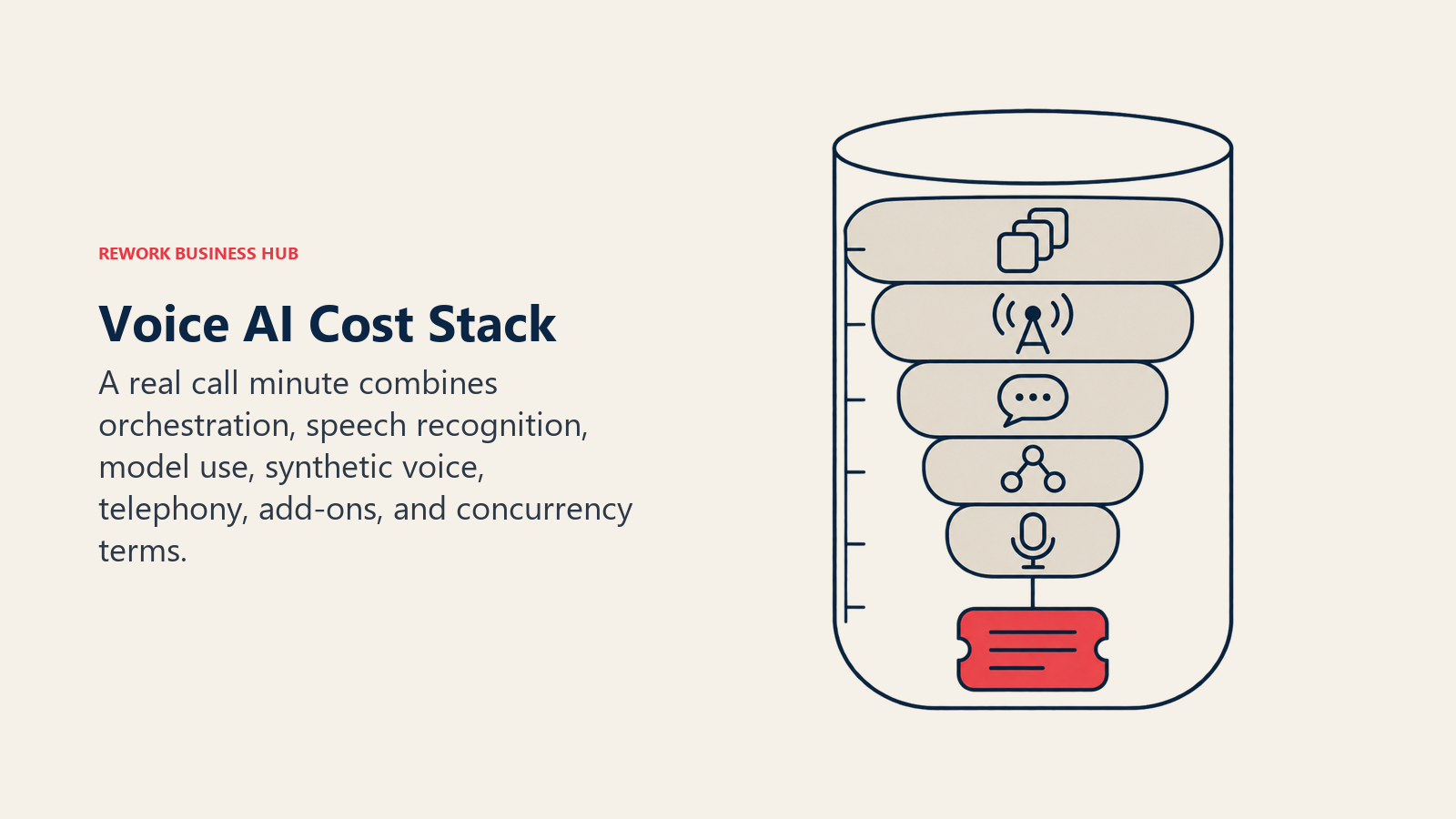
Voice pricing is multi-layer: platform, speech-to-text, LLM, text-to-speech and telephony. Here is what each vendor's published rate covers, so you can compare like with like.
| Tool | Published rate | What it includes | What's extra |
|---|---|---|---|
| Retell | $0.11 per minute (page example) | Voice infrastructure, LLM, text-to-speech | Telephony at $0.015 per minute in listed countries, add-ons |
| Vapi | $0.05 per minute | Hosting and orchestration | Transcriber, LLM, voice and carrier |
| Bland | $0.14 per minute (Start), $0.12 (Build) | LLM, real-time STT, premium TTS | Telephony |
| ElevenLabs Agents | $0.08 per additional minute | Agent platform | LLM, telephony (billed by your provider) |
| Telnyx | $0.05 per minute | Orchestration, hosted STT, hosted TTS | LLM tokens, telephony from $0.0032 per minute |
| PolyAI model API | 2 cents per connected minute | Dialog model | Text tokens, telephony, orchestration |
| Synthflow, Parloa, Cresta, Sierra, Kore.ai | Not published | Not published | Not published |
Vapi's page gives its own worked example: 1,000 minutes with a $50 hosting fee, $10 transcriber, $8 to $45 of model cost and $15 to $24 of voice comes to $82 to $129 a month, or roughly 8 to 13 cents per minute before telephony choices. Telnyx estimates about $0.06 per minute realistic all-in for its stack. Those are the vendors' own estimates for their own architectures.
Three billing details change the invoice more than the headline number. Retell and Telnyx both bill silence and short calls differently: Retell bills to the second including hold time, while Telnyx's voice engine rounds up to 60-second increments per call, so short calls cost more than the estimate. Concurrency is a separate line at Retell ($8 per line per month) and Vapi ($10 per line per month beyond the package). And Bland's rate includes the models while its telephony bills at pass-through cost.
Reading the Numbers Vendors Publish
Every vendor here publishes a result: Retell's 95.7% workflow accuracy, PolyAI's 90% of calls resolved end to end on its largest deployments, Bland's 92% cost reduction at one customer, Cresta's containment figures. They're all self-reported and they measure different things. Resolution means the issue was solved. Containment means the caller didn't reach a human, which can include people who gave up.
Ask three things. What's the numerator, and who decided a call counted? What's the denominator, all calls or only the ones the agent attempted? And does the reference deployment look like yours in call type, accent mix and audio quality? If a vendor can't answer in writing, trust your pilot, not the page.
Channel and Fit Matrix
| Tool | Voice | Chat / SMS | Contact-center integrations | Typical buyer |
|---|---|---|---|---|
| Vapi | Primary | Not a stated focus | Five9, Genesys, Avaya | Developers and product teams |
| Bland | Primary | SMS and web | Enterprise features | Regulated enterprises |
| Synthflow | Primary | Chat, SMS, WhatsApp | Cisco, Avaya, Genesys, RingCentral, Five9 | BPOs and contact centers |
| ElevenLabs Agents | Primary | Text messages | Via your telephony provider | Product and CX teams |
| PolyAI | Primary | SMS, WhatsApp, web chat, email | NICE, ServiceNow, Zendesk, Twilio | Enterprise customer service |
| Parloa | Primary | Chat | SAP certified app | Large enterprises |
| Telnyx | Primary | SMS | Own carrier network | Teams wanting one provider |
| Cresta | Voice | Chat, email, SMS | Contact-center tooling | Contact centers |
| Sierra | Yes | SMS, WhatsApp, email, chat | Enterprise stack | Large enterprises |
| Kore.ai | Yes | Digital agents | AI-native contact center | Large enterprises |
Sizing and Stage Fit
| Tool | Team size sweet spot | Technical skill needed | Deployment style |
|---|---|---|---|
| Vapi | 1-500 | High | Developer-built on APIs |
| Bland | 50-5,000+ | Medium | Self-serve start, Forward Deployed Engineers at enterprise |
| Synthflow | 200+ | Medium | Enterprise contract with scoping |
| ElevenLabs Agents | 1-1,000 | Medium | Self-serve plans, enterprise tier |
| PolyAI | 500+ | Low to medium | Vendor-supported platform |
| Parloa | 500+ | Medium | Platform plus implementation |
| Telnyx | 10-5,000 | High | Developer-built, carrier-hosted |
| Cresta | 200+ agents | Medium | Platform plus coaching |
| Sierra | 500+ | Low | Vendor-led build |
| Kore.ai | 1,000+ | Medium to high | Enterprise platform |
1. Vapi: The Developer Platform Most Like Retell
Vapi is the closest like-for-like swap, and the one most people compare first. It describes itself as a platform for building, deploying and improving voice AI agents and is "API-native by design," per its homepage. It lets you pick your own model (OpenAI, Anthropic, Gemini, Groq), voice and transcription providers, and your telephony (Twilio, Telnyx, plus contact-center connections to Five9, Genesys and Avaya).
The pricing structure is where it differs. On its pricing page, hosting is $0.05 per minute, prepaid, with the model, voice and transcriber passed through at cost. Packages: no package at $0 (4 concurrent calls, 1 phone number), Core at $29 per month (10 concurrent calls), Pro at 10% of the hosting fee with a $999 per month minimum (30 concurrent calls, 99% uptime SLA), and Premier, which is custom. HIPAA compliance is a $2,000 per month add-on, and extra concurrency is $10 per line per month.
| What you get | What you don't |
|---|---|
| Choice of model, voice and transcriber | You manage and tune every layer |
| Transparent hosting fee | The total bill needs a spreadsheet |
| Contact-center connectors | HIPAA is a paid add-on |
Pricing: $0.05 per minute hosting, providers billed at cost; Core $29 per month. Source: vapi.ai/pricing.
Best for: engineering teams that want to swap components as better models arrive. Not ideal for: buyers who want a single price per minute or a vendor-built agent. A separate roundup, best Vapi alternatives, covers the other direction.
2. Bland: Bundled Minutes and Its Own Speech Stack
Bland targets regulated, high-stakes calls in healthcare, insurance and financial services, and says it runs its own speech-to-text, LLM and text-to-speech stack instead of stitching vendors together (bland.ai). Its site claims 230+ regulated customers, SOC 2 Type I and II reports, HIPAA compliance, and self-hosted and on-premises deployment. Customer results on the page are the vendor's: a 92% cost reduction versus human calls at Needle and $750K in annual savings from retiring an IVR at Idaho Housing and Finance Association.
Per Bland's pricing page, Start is $0.14 per minute with no platform fee and 10 concurrent calls. Build is $0.12 per minute with a $299 monthly platform fee and 50 concurrent calls. Enterprise is custom, with unlimited call caps, VPC or on-prem deployment, SSO and forward-deployed engineers. The rate covers the LLM, real-time STT and premium TTS with no token charges, and telephony is billed separately.
| What you get | What you don't |
|---|---|
| One per-minute rate with models included | Telephony is a separate line |
| Daily call caps on lower plans (100 on Start, 2,000 on Build) | Warm transfers and guardrails are enterprise-only |
| Self-hosted option | Enterprise pricing is volume-contracted |
Pricing: $0.14 per minute (Start), $0.12 per minute plus $299 per month (Build), models included, telephony extra. Source: bland.ai/pricing.
Best for: outbound and inbound campaigns at volume in regulated industries. Not ideal for: small teams that need warm transfer without an enterprise contract.
3. Synthflow: In-House Telephony for Contact Centers and BPOs
Synthflow calls itself an enterprise voice AI platform with in-house telephony, aimed at inbound and outbound calls: booking, routing, lead qualification and follow-ups (synthflow.ai). It runs on its own network or on your SIP trunks, carriers or PBX, and lists connections to Cisco, Avaya, Genesys, RingCentral and Five9. Case studies include Freshworks and a multinational BPO operator running 600K+ monthly calls with 40+ agents deployed in 60 days, all vendor-reported.
Pricing is the notable bit. Per Synthflow's pricing page, every deployment starts on an annual enterprise agreement, with no free plan, no trial and no per-minute rate. Volume, telephony, integrations and concurrency are scoped on a call. White-label is available for BPOs and software platforms.
| What you get | What you don't |
|---|---|
| Native telephony and contact-center connectors | No self-serve pricing or trial |
| White-label option for BPOs | Annual commitment up front |
| Test Center and version rollback | Languages named on site are limited |
Pricing: Pricing on request, annual enterprise agreement. Source: synthflow.ai/pricing.
Best for: BPOs and contact centers that want one vendor for agents and telephony. Not ideal for: a team that wants to test a prototype this week.
4. ElevenLabs Agents: Plan-Based Minutes From a Voice Specialist
ElevenLabs sells its agents on plans that bundle minutes. On its agents pricing page, the monthly plans are Free ($0, 15 minutes, 4 concurrent calls), Starter ($6), Creator ($22), Pro ($99, 1,238 minutes, 20 concurrent), Scale ($299, 3,738 minutes, 30 concurrent) and Business ($990, 12,375 minutes, 40 concurrent), plus a custom Enterprise tier. Additional minutes cost $0.08 on every plan, and calls above your concurrency limit run at a $0.16 burst rate. LLM costs are billed separately and telephony is billed by your own provider. The page says yearly billing exists but doesn't list annual prices.
The draw is voice quality and language range from a company known for text-to-speech, plus a pricing ladder that starts at zero. The tradeoff is that the all-in minute depends on the LLM you pick and the carrier you bring.
| What you get | What you don't |
|---|---|
| Free tier and low-cost plans for testing | LLM cost is a separate deduction |
| Included minutes that drop the effective rate | No telephony from ElevenLabs |
| BAA and SSO at enterprise | Annual prices aren't listed |
Pricing: Plans $0 to $990 per month billed monthly; $0.08 per additional minute. Source: elevenlabs.io/pricing/agents.
Best for: teams where voice naturalness and language coverage decide the buy. Not ideal for: buyers who need telephony and models in one rate.
5. PolyAI: A Voice-First Enterprise Program
PolyAI is an enterprise voice AI company whose agents aim to resolve customer conversations without escalation. Its site lists Wren Dialog Agent, Dialog Studio and its own models, Dialog-RSN-1 for voice and Dialog-Raven-3.5 for text. Channels include voice, SMS, WhatsApp, web chat and email. Named customers include NatWest, PG&E, Foot Locker, Metro Bank and UniCredit, and it lists SOC 2+ Type 2, ISO 27001, PCI DSS and GDPR, with data residency in the US, UK, EU and APAC.
Its headline claims are the vendor's: 90% of calls resolved end to end on its largest deployments, 100M+ calls a year and 10,000 concurrent calls. On pricing, the Dialog-RSN-1 model API costs 2 cents per connected minute billed per second, with 10 concurrent calls and new accounts getting free credit; telephony and orchestration aren't included. The full Agentic Dialog Platform is custom and billed per minute through sales.
| What you get | What you don't |
|---|---|
| Voice-first enterprise platform | Platform pricing is quote-only |
| Model API for self-serve builders | API excludes telephony and orchestration |
| Data residency across four regions | Built for programs, not quick tests |
Pricing: Platform on request; model API 2 cents per connected minute, model only. Source: poly.ai/pricing.
Best for: enterprises that want a vendor-run voice program with named reference customers. Not ideal for: a small team wanting a prebuilt, all-in self-serve plan.
6. Parloa: Enterprise Voice With Governance
Parloa sells AI agents for enterprise customer service, built around Agent Builder, Performance Lab and Enterprise Security and Governance modules (parloa.com). Use cases it lists include IVR replacement, collections and first notice of loss. Logos include Booking.com, Zalando and SAP, and it shows ISO 27001, SOC 2 Type II, HIPAA, PCI DSS, DORA and EU AI Act badges. It claims 70% lower cost per contact and 3X faster resolution, which are the vendor's numbers.
Per Parloa's pricing page, billing is per minute for voice and per interaction for chat, with a volume package chosen up front and applied across use cases. Outcome-based pricing is offered "when it makes sense." No rates are published.
| What you get | What you don't |
|---|---|
| Governance and EU-oriented compliance | No published rates |
| One volume commitment across use cases | Large-volume buyer profile |
| Voice and chat on one platform | Not a self-serve build |
Pricing: Pricing on request. Source: parloa.com/pricing.
Best for: regulated European and global enterprises with high call volume. Not ideal for: startups and low-volume pilots.
7. Telnyx: The Carrier Builds the Agent
Telnyx is a telecom carrier that added a voice AI layer, and it's the most different option here. It says it is a licensed carrier in 45+ countries and promotes telephony, LLM inference and orchestration "on one platform, with one SLA" (Telnyx voice AI). Compliance readiness (HIPAA, SOC 2, GDPR, PCI, ISO 27701) is listed on every plan.
Per Telnyx's pricing page, the voice engine is $0.05 per minute and covers orchestration, hosted STT and hosted TTS. LLM tokens are billed separately, and telephony is billed at carrier cost starting at $0.0032 per minute for inbound SIP. Telnyx estimates about $0.06 per minute realistic all-in. Voice-engine charges round up to 60-second increments per call. Plans: pay as you go at $0, Growth at a $2,000 monthly minimum with 15% off voice, messaging and numbers, and Enterprise at $5,000 minimum.
| What you get | What you don't |
|---|---|
| Carrier, STT, TTS and LLM on one invoice | Short calls round up to 60 seconds |
| 500 concurrent calls on pay as you go | Developer-built; no managed service |
| Compliance readiness on every plan | Discounts apply to telephony, not the engine |
Pricing: $0.05 per minute voice engine (STT and TTS included); LLM and telephony extra. Source: telnyx.com/pricing/voice-ai.
Best for: cost-sensitive teams with call volume and developers who want one provider. Not ideal for: non-technical teams.
8. Cresta: AI Agent Plus Coaching for Contact Centers
Cresta describes its AI Agent as an autonomous voice and digital agent covering voice, chat, email and SMS, inbound and outbound (cresta.com). The pitch for a contact center is one vendor for autonomous handling and for human-agent tooling. Customers named include Cox, AAA, Alaska Airlines, United Airlines and Marriott. Published results are containment figures: Propel Holdings at 58% across its AI agents and Windstar Cruises at 70% chat containment. Containment isn't resolution, so ask how each customer defines it.
No pricing appears on the site, only demo calls to action.
| What you get | What you don't |
|---|---|
| Autonomous agent plus human-agent tooling | No published pricing |
| Four channels, inbound and outbound | Results are containment, not resolution |
| Large contact-center references | Heavy for small teams |
Pricing: Pricing on request. Source: cresta.com.
Best for: contact centers running blended human and AI queues. Not ideal for: lean teams without a floor to coach.
9. Sierra: A Managed Agent Across Every Channel
Sierra deploys one agent across chat, SMS, WhatsApp, email, voice and ChatGPT, and says it prices on outcomes so you "only pay for the value Sierra delivers" (sierra.ai). Customers shown include Rocket Mortgage, SiriusXM, Uber, Santander and ADT, and it lists SOC 2, ISO 27001, ISO 42001, HIPAA, GDPR, FedRAMP and PCI DSS badges. Voice is one channel among six there, not the whole product, and the site gives no voice detail or rates.
| What you get | What you don't |
|---|---|
| One agent across six channels | No published pricing |
| Outcome-based pricing model | Outcome definition needs contract work |
| Long list of compliance badges | Enterprise sales cycle |
Pricing: Pricing on request, outcome-based. Source: sierra.ai.
Best for: large enterprises that want a vendor-led, multichannel agent. Not ideal for: phone-only buyers who want a per-minute price.
10. Kore.ai: A Wider Platform With Voice Inside
Kore.ai covers four offerings: AI for service, AI for work, AI for process and the Artemis Platform. Its service line includes voice and digital agents, agent assist, quality management and an AI-native contact center (kore.ai). It says it was named a Leader in Gartner's 2026 Magic Quadrant for Conversational AI Platforms. The site has no pricing, only a demo and an RFP link.
This is the pick when voice is one use case among many. If you just want phone calls handled, it's more platform than you need.
| What you get | What you don't |
|---|---|
| Service, work and process agents in one stack | No published pricing |
| Contact-center products alongside agents | Longer evaluation expected |
| Analyst recognition | Voice isn't the sole focus |
Pricing: Pricing on request. Source: kore.ai.
Best for: enterprises consolidating several AI programs. Not ideal for: a single voice use case.
Who Should Stay on Retell
Switching costs you rebuilt call flows, retested prompts and a parallel-run period. Staying is the right call when:
| Situation | Why staying makes sense |
|---|---|
| Your agent is live and the numbers hold | Rebuilding costs weeks of call-flow work |
| Your volume fits 20 included concurrent calls | You aren't paying for extra lines |
| You want an itemized, pay-as-you-go minute | Few enterprise vendors give you that |
| Your concern is the LLM cost | Retell lets you pick a cheaper model; test that first |
| You need chat and SMS as well as voice | Retell already covers them |
If cost is the complaint, switch the model and text-to-speech provider inside Retell before you switch platforms. On Retell's rate table the spread between models is far larger than the platform fee.
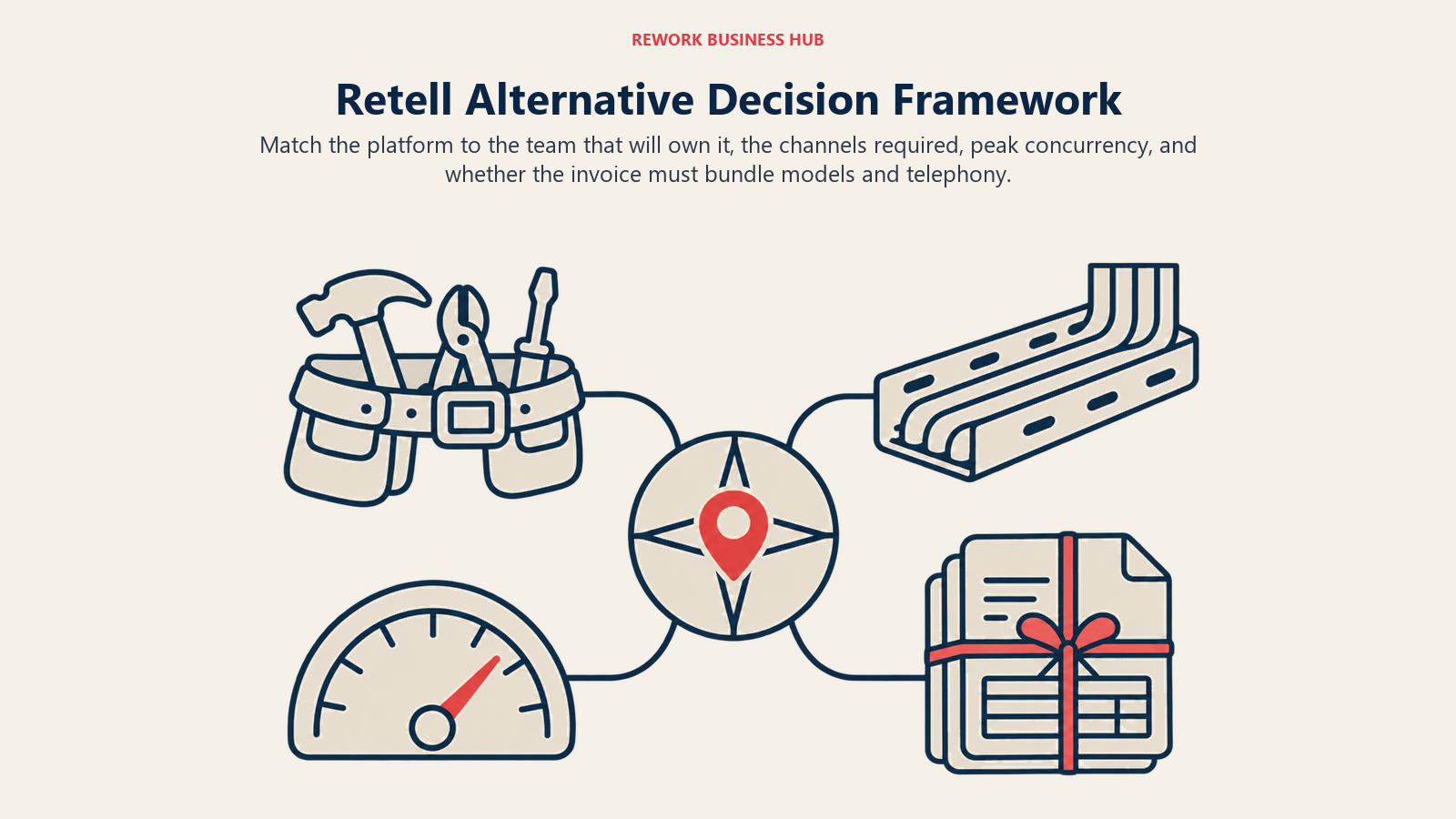
How to Choose: Decision Framework
For the wider market, see best AI voice agents, best AI phone agents and best AI agents for call centers.
| If you need... | Pick... | Why |
|---|---|---|
| Full control over models and providers | Vapi | Pass-through pricing, any LLM and voice |
| One rate with models included | Bland | LLM, STT and TTS in the per-minute price |
| A BPO or contact-center deployment | Synthflow | In-house telephony and CCaaS connectors |
| Best-in-class voices and languages | ElevenLabs Agents | Voice specialist with plan-based minutes |
| A vendor-run voice program | PolyAI or Parloa | Managed, enterprise-governed |
| Carrier and agent on one invoice | Telnyx | Licensed carrier with one SLA |
| AI plus human-agent coaching | Cresta | Both sides of the contact center |
| A multichannel managed agent | Sierra | One agent, six channels |
| AI across service, work and process | Kore.ai | Wider platform scope |
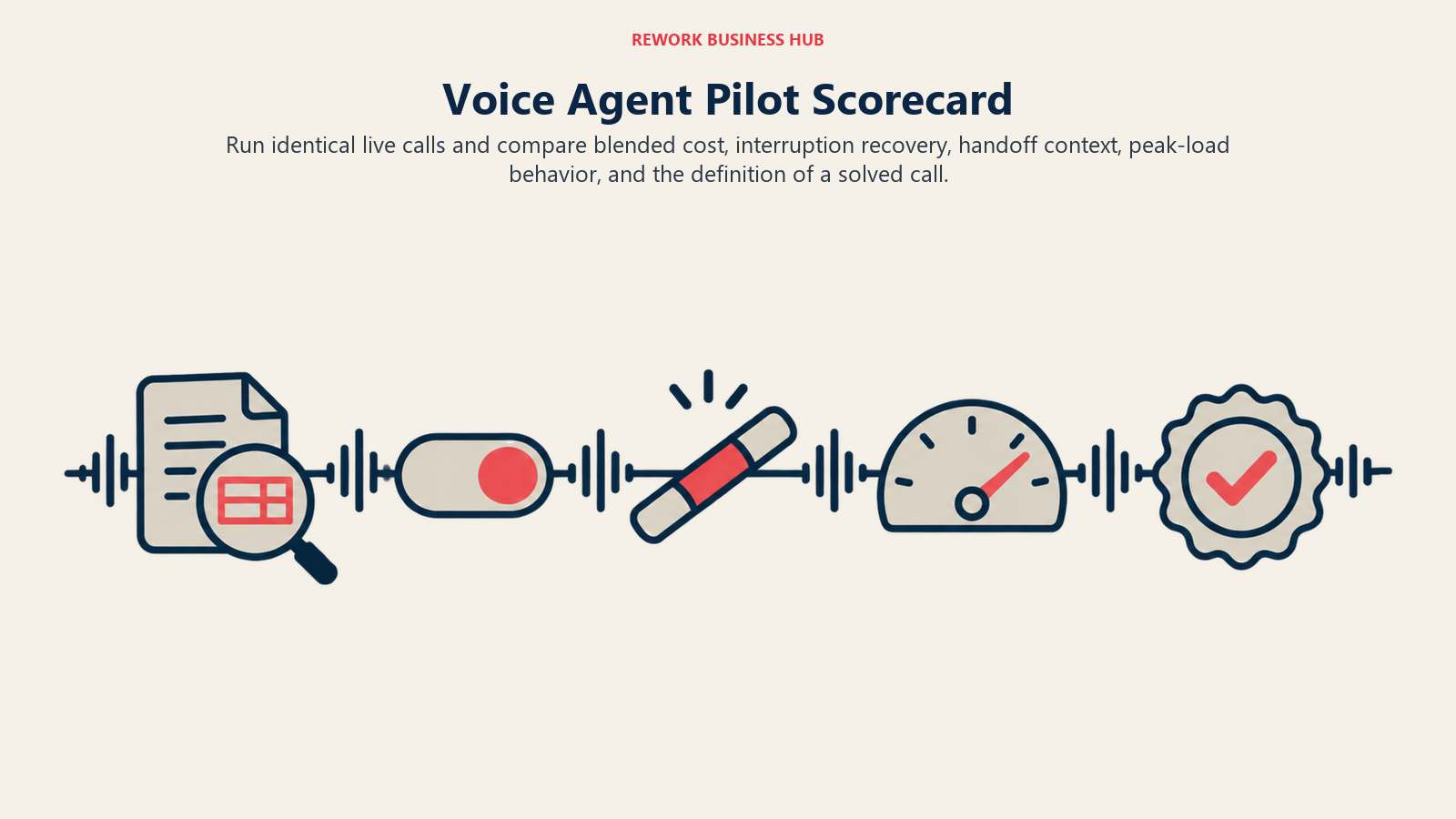
What to Test in a Pilot
| Test | What to measure | Red flag |
|---|---|---|
| Blended minute cost | Real invoice for 1,000 calls with telephony | Rate card excludes parts you need |
| Interruptions | How the agent handles talk-over | Long pauses or repeated answers |
| Transfer quality | Context handed to the human | Callers repeat themselves |
| Concurrency | Behavior at your peak hour | Calls queue or drop |
| Resolution definition | Does a billed unit equal a solved call? | Transfers counted as wins |
Run the pilot for two weeks on live traffic, with the agent on a fixed slice of one queue. Pick the call types you most want to automate, not the easiest ones. Have a human listen to a random sample of finished calls and compare it with the vendor's own count. And name an owner for the agent after launch, because an agent without one drifts whichever vendor you pick.
If customer service is the wider program, best AI agents for customer service and best no-code AI agent builders cover the adjacent decisions, and best Decagon alternatives covers the chat and email side.
Frequently Asked Questions about Retell AI Alternatives
How much does Retell AI cost per minute?
Retell lists voice agents at $0.07 to $0.31 per minute. Its page example totals $0.11 per minute: $0.055 voice infrastructure, $0.04 LLM and $0.015 text-to-speech, with telephony at $0.015 per minute in listed countries. Billing is to the second on pay as you go.
What is the best alternative to Retell AI?
Vapi is the closest developer-platform alternative. Bland bundles the models into one rate, Telnyx bundles the carrier, and PolyAI, Parloa and Sierra suit enterprises wanting a managed build.
Is Bland cheaper than Retell?
Not on the headline. Bland's Start plan is $0.14 per minute with the LLM, STT and TTS included and telephony extra, while Retell's page example is $0.11 per minute with telephony additional. The comparison depends on the model you choose and your volume.
Which Retell alternative is best for a contact center?
Synthflow, PolyAI, Parloa and Cresta are built for contact-center scale. Synthflow lists Cisco, Avaya, Genesys and RingCentral connections, and PolyAI lists NICE and ServiceNow. None of the four publishes platform rates.
Do any alternatives include telephony in the price?
Telnyx owns the carrier and bills everything on one invoice, but telephony is a separate line from its $0.05 voice engine rate. Bland and Vapi also bill telephony apart from the agent. Always ask for a blended per-minute cost.
Are vendor accuracy and resolution figures comparable?
No. Each vendor defines resolution, containment or accuracy differently and publishes its own results. Ask for the definition and denominator, then test with your own calls.
What to Do Next
Pick two alternatives that match your reason for leaving, run the same 500 real calls through each and through Retell, then compare the blended per-minute invoice and the solved-call count side by side. If neither beats your current setup on a like-for-like basis, you have your answer, and you'll renew on data.

Co-Founder, Rework.com
On this page
- Key Facts
- Why Teams Look Beyond Retell
- What Changed in 2026
- Where Retell Stands Today
- Quick Comparison Table
- What a Minute Actually Costs
- Reading the Numbers Vendors Publish
- Channel and Fit Matrix
- Sizing and Stage Fit
- 1. Vapi: The Developer Platform Most Like Retell
- 2. Bland: Bundled Minutes and Its Own Speech Stack
- 3. Synthflow: In-House Telephony for Contact Centers and BPOs
- 4. ElevenLabs Agents: Plan-Based Minutes From a Voice Specialist
- 5. PolyAI: A Voice-First Enterprise Program
- 6. Parloa: Enterprise Voice With Governance
- 7. Telnyx: The Carrier Builds the Agent
- 8. Cresta: AI Agent Plus Coaching for Contact Centers
- 9. Sierra: A Managed Agent Across Every Channel
- 10. Kore.ai: A Wider Platform With Voice Inside
- Who Should Stay on Retell
- How to Choose: Decision Framework
- What to Test in a Pilot
- What to Do Next