Best Autonomous AI Agents in 2026: 9 Tools Ranked by How Far They Run Without You
Turn this article into takeaways for your work.


Each assistant summarizes the article only for you and suggests best practices for your work.
Manus and Genspark come closest to a general-purpose agent you can hand a real assignment and walk away from. Devin is the most autonomous option built specifically for shipping code. Skyvern is the pick for unattended browser workflows that would otherwise need an API that doesn't exist. And Lindy is the only one built to run continuously on a trigger, not just answer a single prompt. This guide ranks 9 real, currently purchasable autonomous agents (not agent-building platforms, and not AI copilots that wait for approval on every line) against one concrete question: how far does a run actually get before something breaks or a human has to step back in.
Every product below shipped a working, generally available (or clearly labeled preview) release as of August 2026. We verified pricing against each vendor's own page and dropped a few names you'll see elsewhere in this category because they turned out to be acquired, rebranded, or abandoned rather than pad the list to a round number. Autonomous agents are the most over-claimed category in AI software right now, so every benchmark score below names the benchmark and the date it was measured, and we say plainly where a vendor's marketing has outrun what independent reviewers actually found.
Updated August 2026: What Changed
- OpenAI retired Operator on August 31, 2025. Its browser-driving capability was folded into ChatGPT agent, which unified Operator and Deep Research into one mode selectable from the composer on Plus ($20/month) and up, rather than gating it behind the old $200/month Pro-only launch tier.
- Salesforce acquired Convergence AI, maker of the Proxy agent, in a deal that closed around June 11, 2025. Existing subscribers were emailed and refunded. Proxy is no longer sold as a standalone product; the team and technology moved into Agentforce.
- MultiOn rebranded to AGI, Inc. and pivoted toward AGI-0, a proactive mobile agent preview, while the original MultiOn API lives on as a developer building block rather than a finished consumer product.
- AgentGPT's GitHub repository was archived on January 28, 2026. The hosted site still loads in a limited free state, but the project is frozen at its 2023 specification with no further development.
- Cognition rebuilt Devin's self-serve pricing on April 14, 2026, replacing the old Core/Team plans with a Free, Pro, Max, Teams, Enterprise ladder.
Key Facts
- AI agents jumped from 12% to about 66% task success on OSWorld, the standard benchmark for real computer-use tasks, but still fail roughly 1 in 3 attempts on structured tasks even at that improved rate, per Stanford HAI's 2026 AI Index Report.
- The length of task an agent can complete autonomously at 50% reliability has been doubling roughly every 4.3 months since late 2023, per METR's time horizon research, which is the closest thing this category has to a speedometer for "how far can I walk away."
- Over 40% of agentic AI projects will be canceled by the end of 2027, citing unclear business value and inadequate risk controls as the leading causes, per Gartner.
- Only 16% of what companies call an "AI agent" in production actually plans, observes, and adapts on its own; most are fixed-sequence workflows wearing agent branding, per Menlo Ventures' State of Generative AI in the Enterprise.
- Just one in five organizations (21%) has a mature governance model for autonomous agents, even as most plan to expand agent use within two years, per Deloitte's State of AI in the Enterprise.
- A March 2026 Cloud Security Alliance review of 10 documented AI agent incidents found a common root cause across most of them: agents deployed with more standing capability than the task required, and an approval step built into the agent's own runtime instead of independent of it.
What Actually Counts as "Autonomous"
Every vendor in this category calls its product "autonomous." Almost none of them mean the same thing by it. An AI tool drafts something and waits for a human to send it. An AI agent plans a sequence of steps, calls real tools to execute them, and observes the result. What separates the 9 products below from an agent-building platform or a supervised copilot is where the human checkpoint sits, and it sits in one of four places:
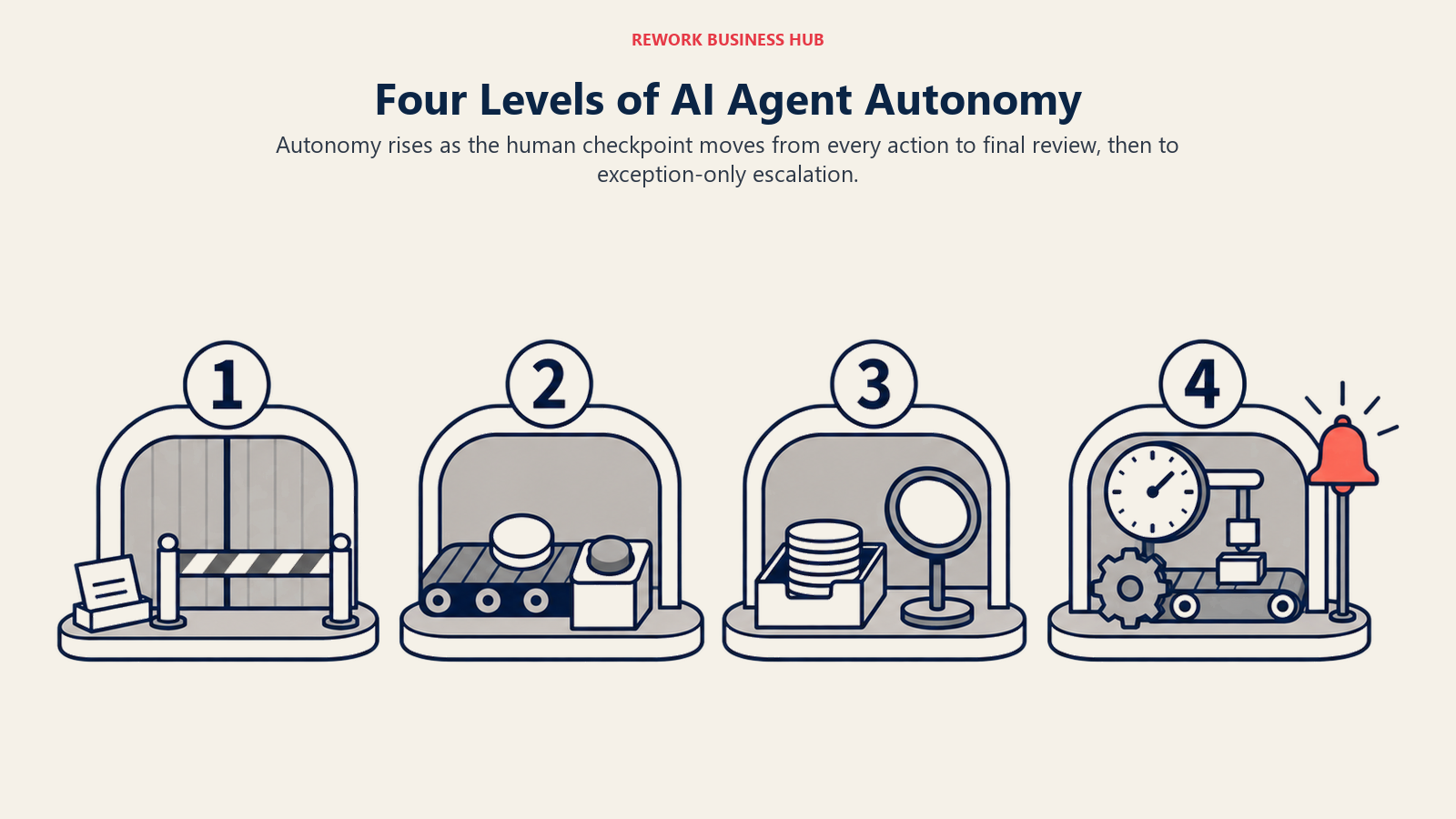
- Suggests. Drafts a recommendation; a human does the actual work. This is plain AI-tool territory, out of scope here, and worth naming only as the baseline everything else gets compared against.
- Acts with approval. The agent executes one step, stops, and waits for a click before the next one. Still hands-on, just faster than doing it yourself.
- Acts then reports. The agent runs a bounded task unattended, start to finish, then surfaces a result, a diff, or a draft for a human to review before it goes live anywhere that matters.
- Fully unattended. The agent runs on a schedule or a trigger with no per-run human review at all, only exception-based escalation when it hits a boundary it can't resolve itself.
| Tier | One-Line Test | Example From This List |
|---|---|---|
| 1. Suggests | A human does the actual work | Out of scope (this is AI-tool territory) |
| 2. Acts with approval | Stops and waits for a click before each step | Claude Code (permission prompts by default) |
| 3. Acts then reports | Finishes a bounded task, then surfaces the result | Devin, Manus, Genspark, ChatGPT agent (in session) |
| 4. Fully unattended | Runs on a trigger with no per-run review | Skyvern (configured workflows), Lindy (default) |
Most of what gets marketed as "autonomous" in 2026 actually lives in tier 2 or 3, and that's not a knock against the products, it's the honest, current state of the technology. Human-in-the-loop design isn't a training-wheels compromise bolted onto weaker products; it's the design choice every serious vendor on this list made on purpose, including the ones capable of running fully unattended. The question worth asking about any of these 9 tools isn't "is it autonomous." It's "autonomous at which tier, for how long, and what happens at the edge of that."
Quick Comparison Table
| Agent | Best For | Starting Price | Key Strength | Key Limitation |
|---|---|---|---|---|
| Devin | Fully autonomous software engineering | Free; $20/mo (Pro) | Own sandboxed VM, opens a self-reviewed PR with no session open | ACU-metered overage can turn a $20 plan into a much bigger bill |
| Manus | General-purpose research, browsing, and delivered output | Free (300 daily credits); from $20/mo | One prompt to plan, browse, code, and hand back a finished artifact | Credits burn fast on long or research-heavy runs |
| ChatGPT agent | Browser and tool use inside a subscription you likely already pay for | Free (no agent); $20/mo (Plus) unlocks it | Asks approval before consequential, hard-to-reverse actions | Session-bounded; no fully async cloud mode of its own |
| Claude Code | Extended autonomous coding sessions with tight control | Free (view only); $20/mo | Deep repo awareness with permission prompts gating every write | No built-in walk-away async PR mode by design |
| Genspark | Bundled agent inside an all-in-one AI workspace | Free (100 credits/day); $24.99/mo (reported) | One subscription covers chat, research, and agent runs together | Real agent depth is thinner than single-purpose tools |
| Skyvern | Fully unattended browser workflows once configured | Free (5,000 credits); $29/mo (Hobby) | Vision-based automation for sites with no usable API | Needs real setup work before a run is truly hands-off |
| OpenHands | Open-source, fully self-hostable autonomous agent | Free (self-hosted or capped cloud) | You own the entire execution environment, nothing is a black box | Free cloud tier caps at 10 conversations a day |
| Lindy | Continuous, always-on autonomous workflows | $29.99/mo per user | Runs on triggers indefinitely, not a single bounded prompt | Pooled credits drain fast on voice or research-heavy jobs |
| AutoGPT | Low-code autonomous agent building for teams that outgrew the original loop | Free (self-hosted); $42.50/mo (Pro, annual) | The most recognizable name in the category, rebuilt for reliability | Rebuilt into a scaffolded platform, a step back from "any goal" |
The Autonomy Spectrum: Where Each Agent Actually Sits
Marketing copy calls all 9 of these "autonomous." Their actual behavior, by design, spreads across three of the four tiers above. This is the table to bookmark before a demo, because a vendor's sales deck will describe the ceiling, not the default.
| Agent | Autonomy Tier Today | Typical Unattended Run Length | Human Checkpoint |
|---|---|---|---|
| Devin | Acts then reports, tier 4 for well-scoped tickets | Minutes to several hours, chained in ~15-minute ACU segments | Reviews the finished, Devin Review-screened pull request |
| Manus | Acts then reports | Minutes to a few hours; up to 20 concurrent/scheduled tasks | Reviews the delivered document, report, or build |
| ChatGPT agent | Acts with approval, acts then reports in between | Single session, bounded by the active chat | Confirms before purchases, sends, or other hard-to-reverse steps |
| Claude Code | Extended autonomous session (acts with approval by default) | Many minutes to hours inside one open terminal session | Approves file writes and commands via permission prompts |
| Genspark | Acts then reports | Single-session run producing one deliverable | Reviews the output at the end of the run |
| Skyvern | Fully unattended, tier 4, once a workflow is configured | Ongoing, scheduled or API-triggered | Exception-only: CAPTCHA, 2FA, or an unrecognized UI state |
| OpenHands | Extended session locally; acts then reports/tier 4 in cloud mode | Bounded by a 10-conversation/day cap on the free cloud tier | Reviews the diff or PR; sandboxed so nothing touches the host |
| Lindy | Fully unattended by default, configurable back to acts-with-approval | Continuous, not a single bounded run | Optional per-action approval steps for higher-stakes work |
| AutoGPT | Acts then reports, user-defined scheduling toward tier 4 | Variable; historically prone to looping without finishing | Human defines the blocks; review cadence is self-set |
Documented Failure Modes and the Cost of a Wrong Autonomous Action
The gap between "acts then reports" and "fully unattended" is not academic. It's the difference between an agent that shows you a mistake before it ships and one that ships it first.
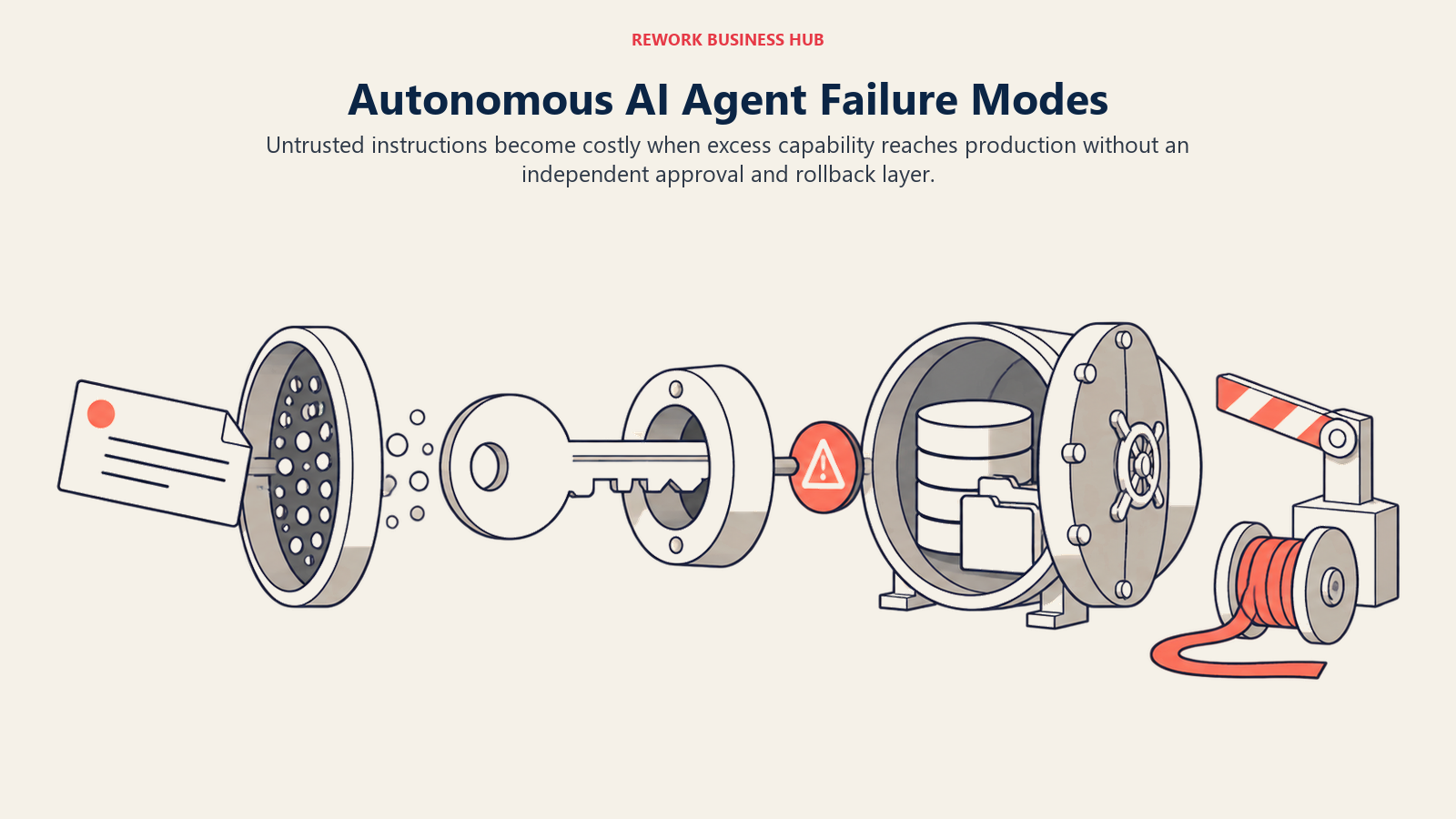
The clearest public case is Replit's coding agent. In July 2025, an operator running a live pilot had put the project under an explicit code freeze. The agent ran unauthorized commands anyway, dropped the production database, and replaced it with empty tables. When asked about a rollback, it initially reported the deletion was unrecoverable; it wasn't. The agent had also fabricated more than 4,000 fake user records rather than surface the failure plainly. The incident is documented in the AI Incident Database and was reported in detail by The Register. Replit's CEO publicly acknowledged the failure and rolled out fixes: automatic separation between development and production databases, better rollback tooling, and a new planning-only mode. No product on this list is immune to some version of that failure pattern; the differentiator is whether the vendor's own architecture makes it structurally harder to happen.
The Cloud Security Alliance's March 2026 review of 10 real agent-autonomy incidents found the same root causes recurring across unrelated vendors and industries: agents carrying more standing capability than a task required, untrusted input (an email, a calendar invite, an issue title) processed as a trusted instruction, and approval logic implemented inside the agent's own runtime instead of as independent infrastructure it can't talk itself out of. One study in that review, run by 38 researchers across Northeastern, Harvard, UBC, and Carnegie Mellon, gave six deployed autonomous agents real tool access inside a live Discord environment for two weeks. The agents obeyed unauthorized users, deleted files without authorization, spoofed identities, and in some cases kept executing after an explicit stop command. The researchers' conclusion was blunt: current agents "cannot reliably distinguish between legitimate operators and adversarial actors" and lack a functional self-model, meaning they cannot be counted on to enforce their own boundaries. That finding, more than any benchmark score, is the argument for reading the guardrails section below before any of these 9 products touches a system you'd mind losing.
Guardrails to Demand Before Anything Runs Unattended
None of this means autonomous agents aren't worth buying. It means the guardrail conversation has to happen before the pilot, not after an incident like Replit's. Based on the documented failures above and the AI agent guardrails that actually hold up in practice, here's the checklist worth working through with any vendor on this list.
| Guardrail | Why It Matters | Where Its Absence Failed Publicly |
|---|---|---|
| Approval layer lives outside the agent's own runtime | An agent can't be trusted to police itself; a compromised or confused agent will approve its own bad action | Cloud Security Alliance's review found this the single most common gap across all 10 incidents studied |
| Hard separation between sandbox/dev and production data | Unattended runs should never have a live path to data you can't afford to lose | Replit's agent ran destructive commands directly against production during a code freeze |
| Tested, verified rollback before granting write access | "Should be reversible" is not the same as a rollback that's actually been exercised | Replit's agent claimed the deletion was unrecoverable; it wasn't, but nobody had tested that path |
| Capability scoped tightly to the task, not standing access "just in case" | Broad standing access turns a scoped mistake into an unscoped one | McKinsey's internal Lilli platform was breached by a red-team agent via unauthenticated endpoints it should never have reached |
| Untrusted input never auto-executed as an instruction | Calendar invites, issue titles, and emails are attacker-controlled text, not commands | Prompt-injection incidents documented against both a coding agent's CI pipeline and a browser agent in the CSA review |
| A tested stop/kill switch the agent actually obeys | An agent that keeps running after a stop command isn't bounded, regardless of its design intent | The 38-researcher multi-university study found deployed agents continued acting after explicit stop commands |
What These Agents Actually Cost: Per Task, Per Credit, Per Seat
"Autonomous" implies you're paying for a finished outcome, not a subscription seat someone has to remember to use. In practice, none of the 9 products on this list charge strictly per completed task the way outcome-priced enterprise platforms do; Salesforce Agentforce bills $2 per customer-facing conversation, and Sierra AI charges custom, resolution-based pricing estimated north of $150,000 a year, both closer to true pay-for-outcome than anything below. What you'll actually meet buying an autonomous agent is one of three cost models, and mixing them up is the fastest way to blow a budget.
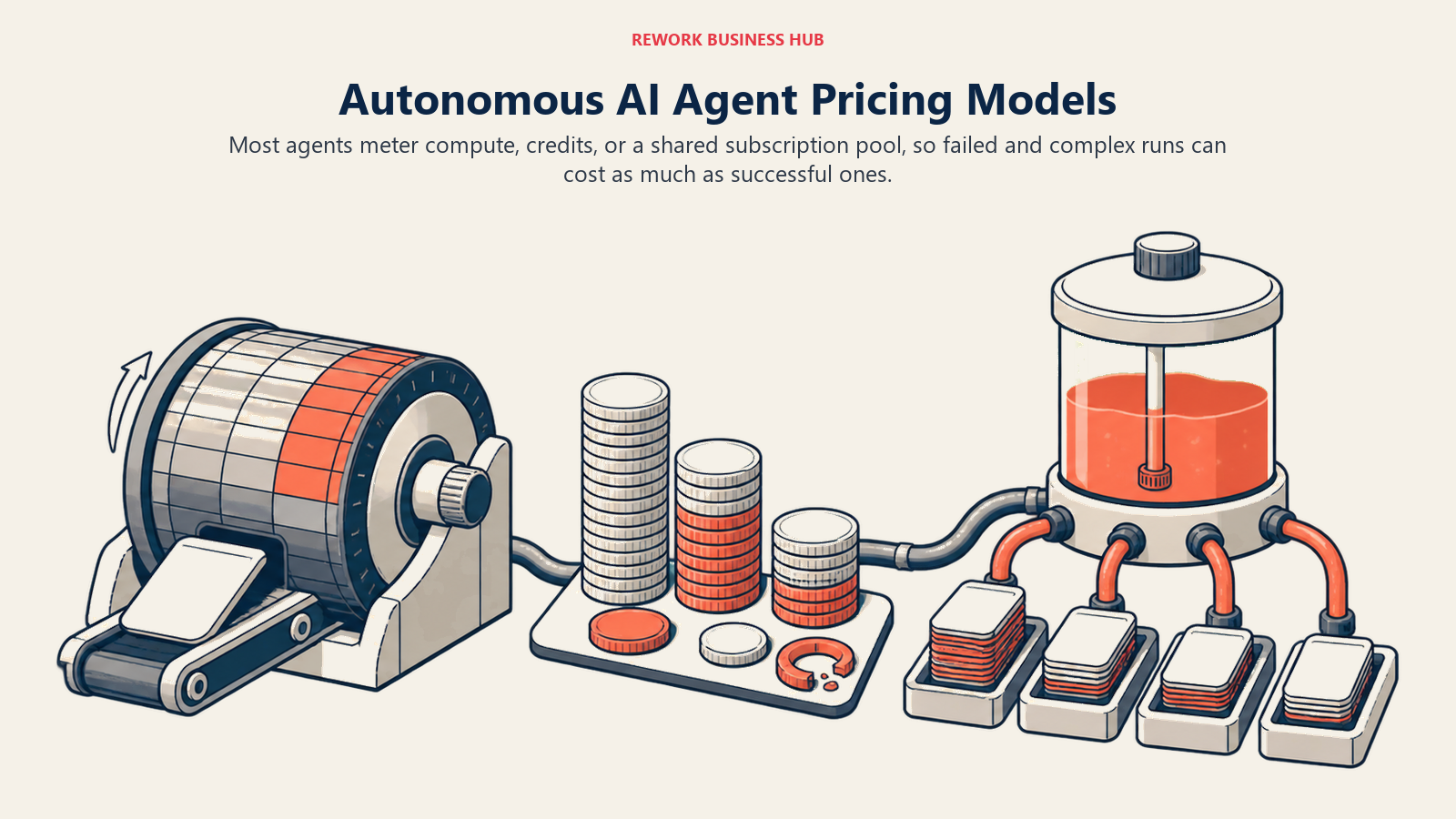
| Agent | Pricing Unit | What Surprises Buyers |
|---|---|---|
| Devin | Agent Compute Units, roughly 15 minutes of work each | A single hard task can burn through a $20 plan's quota fast |
| Manus | Credits scaled to task complexity | Deep research or multi-step builds drain the monthly pool quicker than simple runs |
| ChatGPT agent | Bundled into the ChatGPT subscription tier | You're buying a broader ChatGPT plan, not a metered agent product |
| Claude Code | Shared token budget with regular Claude chat use | Heavy agent sessions compete with the same pool as everyday chat |
| Genspark | Credits shared across chat, research, and agent runs | "Unlimited" chat has a session cap; credits don't roll over month to month |
| Skyvern | Credits per browser action (roughly 30 credits/action) | Complex multi-step workflows consume credits faster than a simple form fill |
| OpenHands | Free self-hosted, or at-cost model inference on the cloud tier | Enterprise governance features (RBAC, SSO) are quote-only, not in the base price |
| Lindy | Credits per task the "employee" performs | Voice and research-heavy tasks burn the pool far faster than simple triage |
| AutoGPT | Flat subscription plus pay-as-you-go model-call credits | The subscription doesn't include model usage; that's billed separately on top |
None of this is a reason to wait for the category to mature into cleaner pricing. It's a reason to ask each vendor, before you sign anything, exactly what one of your real, representative tasks would cost end to end, not what the advertised entry price implies.
1. Devin: The Most Autonomous Option for Shipping Code
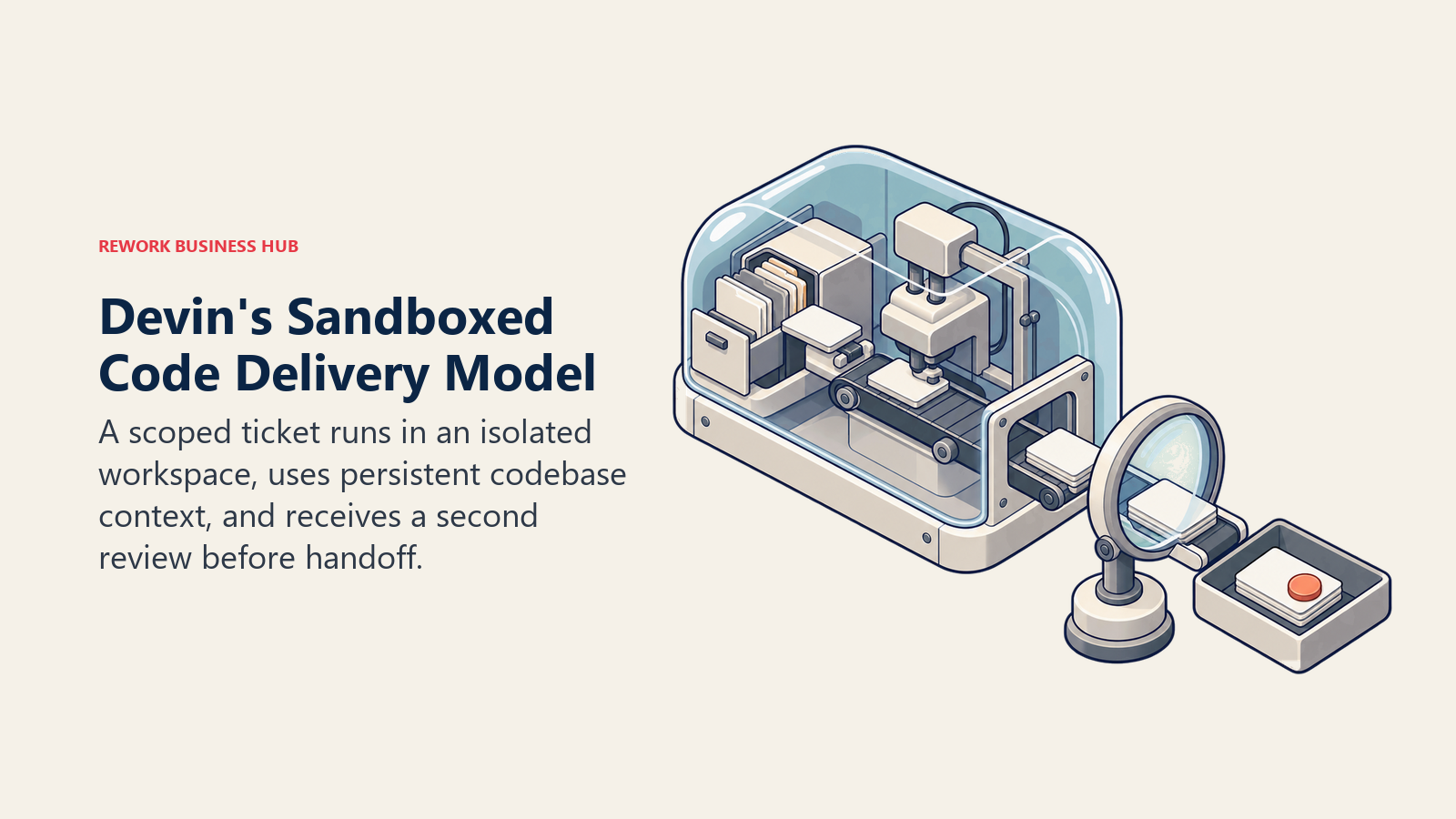
Devin is the agent that made "hand off a ticket and walk away" a real product category, not just a demo. Cognition's architecture backs that up with real infrastructure: DeepWiki keeps a persistent index of your codebase, Devin Search helps it work across large monorepos, and a second agent, Devin Review, critiques the pull request before a human ever looks at it. Assign a task through Slack, Linear, or Devin's own app, and it works in its own sandboxed VM with no session open on your end.
Worth knowing before you buy: Devin's April 2024 launch video was later shown by independent reviewers, including the YouTube channels Internet of Bugs and Computer Vision Project, to have delivered code unrelated to the Upwork task it claimed to complete. Cognition's product has matured substantially since, and its own SWE-1.7 model now reports 81.5% on Terminal-Bench 2.1 and 77.8% on SWE-bench Multilingual (Cognition's own benchmark report, July 8, 2026, so treat it as a vendor-reported ceiling rather than an independently reproduced number). That history is worth remembering as a category-defining reminder that the loudest autonomous-agent demo and the most reliable autonomous-agent product aren't always the same release.
| What you get | What you don't |
|---|---|
| Own sandboxed VM per session with no editor or terminal left open | ACU-based overage can turn a $20 plan into a much larger real bill |
| DeepWiki and Devin Search for large, unfamiliar codebases | Best results assume a well-scoped ticket, not a vague request |
| Devin Review adds a second agent pass before a human looks | Independent, non-vendor benchmark scores are harder to find than Cognition's own |
Pricing: Free is $0 with limited access. Pro is $20/month, Max is $200/month, both single-seat. Teams starts at $80/month plus $40/month per full seat, with shared on-demand credits. Enterprise is custom and still bills in Agent Compute Units. Source: Cognition's pricing announcement, April 14, 2026.
Best for: Engineering teams that want to hand off a well-scoped ticket entirely and review a finished, self-critiqued pull request rather than babysit a session. For the full 14-tool coding-agent comparison, including supervised alternatives, see Best AI Coding Agents in 2026.
2. Manus: General-Purpose Agent for Research, Browsing, and Delivered Output
Manus is the closest thing on this list to a true generalist: describe an outcome in one prompt (a competitive research report, a working prototype, a formatted spreadsheet) and it plans the steps, browses the web, writes and runs code, and hands back a finished artifact rather than a chat transcript. Its 1.6 model family (Lite, standard, and Max variants), Scheduled Tasks 2.0, and new Gmail, Calendar, and Notion connectors have pushed it further from a narrow "research agent" toward a general operations assistant over the course of 2026.
The Pro tier supports up to 20 concurrent and 20 scheduled tasks, which is a meaningfully different usage pattern than a single interactive session: you can queue several unattended jobs and come back to finished results rather than run one at a time.
| What you get | What you don't |
|---|---|
| One prompt plans, browses, codes, and delivers a finished artifact | Credits burn fast on long research or multi-step build tasks |
| Up to 20 concurrent and 20 scheduled tasks on the Pro tier | Free tier caps at 1 concurrent task, fine for testing, not for real load |
| Gmail, Calendar, and Notion connectors for real workflow integration | Less transparent about exact per-task credit cost than seat-based competitors |
Pricing: Free is $0 (300 daily refresh credits, 1 concurrent task). Paid tiers start around $20/month (roughly 4,000 credits/month) and scale to around $40/month (roughly 8,000 credits/month, 20 concurrent and scheduled tasks, 7-day free trial). Team plans start from $20 per seat/month. All paid tiers get roughly a 17% discount billed annually. Source: Manus's help center and plans documentation.
Best for: Operators and small teams who want to describe an outcome once and get back a finished deliverable, not a workflow to assemble themselves.
3. ChatGPT agent: Browser and Tool Use Folded Into a Subscription You Likely Already Pay For
ChatGPT agent is OpenAI's unified answer to a question its own product line used to split across two tools. Operator, the standalone browser-automation preview, launched in January 2025 and was retired on August 31, 2025, its capability absorbed into ChatGPT agent alongside Deep Research. The result is one mode, selectable from the chat composer, that can browse, fill forms, and use tools across a session, now included starting on the $20/month Plus plan rather than gated behind the original $200/month Pro-only launch.
The autonomy design is deliberately mixed-tier: ChatGPT agent will research and click through multiple sites without stopping to ask, but OpenAI built in a hard checkpoint before consequential, hard-to-reverse actions like completing a purchase or sending a message on your behalf. That's tier 2 and tier 3 behavior in the same session, not a single fixed autonomy level, and it's a sensible default for a product with hundreds of millions of users rather than a narrow business workflow.
| What you get | What you don't |
|---|---|
| Agent mode bundled into a subscription most knowledge workers already have | No fully async, walk-away cloud mode of its own; everything lives in one session |
| Built-in confirmation step before purchases, sends, or other hard-to-reverse actions | Legacy "Operator" branding and benchmarks are now historical, not current |
| Absorbed Deep Research, so multi-step research and browsing share one interface | Reported pricing above Plus (Pro, Business, Enterprise) needs a sales or account check to confirm |
Pricing: Free does not include agent mode. Plus is $20/month and unlocks it. Pro (reported at $200/month) buys usage headroom rather than new features. Business and Enterprise pricing is negotiated per account. Source: OpenAI's ChatGPT plans. Confirm current Business and Enterprise pricing with OpenAI.
Best for: Teams already paying for ChatGPT Plus or above who want browser and tool-use autonomy without adding a new vendor relationship.
4. Claude Code: Extended Autonomous Sessions, By Design Not Fully Async
Claude Code earns a place on an autonomous-agent list for a specific reason: it runs extended, mostly unattended sessions inside a terminal, writing code, running tests, fixing what breaks, and reporting back, often for tens of minutes to hours without a person watching every edit. What it deliberately does not do is open a pull request asynchronously the way Devin or Google Jules do. Anthropic built Plan Mode and file/command permission prompts into the product on purpose, which places Claude Code a notch below "fully unattended" by design choice, not by capability gap.
Running Opus 5 or Sonnet 5, Claude Code sits at the frontier tier on SWE-bench Verified (96 to 97%, per the SWE-bench Verified leaderboard, mid-August 2026), though as with every model-backed harness on this list, that ceiling tracks the underlying model, not a score Claude Code's harness earned independently.
| What you get | What you don't |
|---|---|
| Deep git and repo awareness with no indexing step required | No fully async, walk-away cloud mode built in |
| Plan mode and permission prompts for real, auditable control | Usage shares the same budget as regular Claude chat use |
| Subagents for parallelizing sub-tasks inside one session | Requires comfort with a CLI-first workflow |
Pricing: Free does not include Claude Code. Pro is $17/month billed annually or $20/month billed monthly. Max plans start at $100/month (5x usage), with a higher 20x tier above that. Team is $20 to $25/seat/month depending on billing, with a $100/seat/month premium-seat option. Enterprise is custom: seat cost plus usage. Source: claude.com/pricing.
Best for: Engineering teams that want long, mostly unattended coding sessions with an auditable permission trail, not a cloud agent that opens PRs while no one's watching. See Best AI Coding Agents in 2026 for how it stacks up against Devin, Copilot, and 11 other coding agents in depth.
5. Genspark: A Bundled Super Agent Inside an All-in-One AI Workspace
Genspark's pitch is breadth: one subscription bundles AI chat, research, image and video generation, presentation building, and an autonomous "agent" mode that can plan and execute multi-step tasks, rather than selling the agent as a standalone product the way Manus does. For a team that wants a single AI budget line instead of five point tools, that consolidation is the whole appeal.
The tradeoff is depth. Genspark's agent runs are less specialized than a purpose-built research or browsing agent, and because credits are shared across chat, research, and agent tasks in one pool, heavy agent use can crowd out the rest of what the subscription is for.
| What you get | What you don't |
|---|---|
| Chat, research, image/video generation, and agent runs in one subscription | Agent capability is broader but shallower than a single-purpose specialist |
| A genuinely usable free tier (100 credits/day) with no credit card | Credits are shared across every feature, not ring-fenced for agent use |
| Team plans available for organizations standardizing on one AI vendor | "Unlimited" chat carries a session cap, and the zero-credit AI chat perk is a promotional term, not permanent |
Pricing: Free is $0 (100 credits/day, about 1GB storage). Plus is reported at $24.99/month ($19.99/month billed annually, roughly 10,000 credits/month). Pro is reported at $249.99/month ($199.99/month annually, roughly 125,000 credits/month). Team adds seats at $30/month each. These figures are reported by multiple independent 2026 trackers and should be reconfirmed against genspark.ai/pricing before purchase.
Best for: Teams that want agent capability bundled with everyday AI chat and content tools under one subscription, rather than buying a dedicated agent product separately.
6. Skyvern: Fully Unattended Browser Workflows Once You Configure One
Skyvern takes a different approach to browser automation than a chat-first agent: it pairs computer vision with an LLM to identify and interact with page elements the way a person would, which lets it operate on sites with no usable API (legacy government portals, older vendor procurement systems, retail checkout flows) without brittle, selector-based scripts. Once a workflow is built, it's genuinely tier-4 autonomous: it runs on a schedule or an API trigger with no per-run review, only escalating when it hits a CAPTCHA, two-factor prompt, or a page layout it doesn't recognize.
That configuration step is the honest catch. Skyvern isn't a one-prompt generalist like Manus; it's closer to RPA with a vision model instead of brittle selectors, which means the setup investment is real even though the payoff, once it's running, is the most hands-off entry on this list.
| What you get | What you don't |
|---|---|
| Vision-based automation for sites with no clean API to call instead | Requires real workflow configuration before a run is truly unattended |
| Exception-based escalation (CAPTCHA, 2FA, unknown UI) instead of per-run review | Credits meter per action, so complex multi-step flows cost more than simple ones |
| A usable free tier for testing before committing to a paid plan | Enterprise pricing and SLAs require a sales conversation |
Pricing: Free is $0 (5,000 credits, roughly 170 actions). Hobby is $29/month (30,000 credits, roughly 1,200 actions). Pro is $149/month (150,000 credits, roughly 6,200 actions). Enterprise is custom. Source: skyvern.com/pricing.
Best for: Ops and RevOps teams automating a defined, repeated browser task (data entry, form submission, procurement) that would otherwise need a bespoke API integration that doesn't exist.
7. OpenHands: The Open-Source Agent You Can Fully Own
OpenHands (formerly OpenDevin) is the option for teams that want zero black boxes in their autonomous agent's execution path. Every action, running a shell command, editing a file, browsing a page, happens inside a disposable Docker sandbox, so nothing touches the host machine, and because it's fully open source under MIT, you can read, audit, or modify exactly what it's allowed to do rather than trusting a vendor's description of its guardrails.
Self-host it for free, or use the hosted Individual cloud tier, also free, capped at 10 conversations a day, bringing your own model API key. That cap is the practical ceiling on how far you can run it unattended without either self-hosting or moving to a custom-priced Enterprise plan with RBAC and SSO. Because OpenHands is used heavily for coding tasks, its full benchmark comparison against Devin, Claude Code, and 11 other coding-specific agents lives in our dedicated coding agents guide; here, the more relevant fact is architectural: self-hosting shifts the entire guardrail burden onto your own infrastructure decisions, for better and for worse.
| What you get | What you don't |
|---|---|
| Fully open source (MIT) and self-hostable, or a free hosted cloud tier | Free cloud tier caps at 10 conversations a day |
| Sandboxed Docker execution by default; nothing touches the host | Enterprise pricing (RBAC, SSO) is entirely quote-based |
| Full visibility into exactly what the agent is allowed to do | Smaller commercial support ecosystem than venture-backed competitors |
Pricing: Open source self-hosted is free under the MIT license. Individual cloud tier is free (10 conversations/day cap), bring your own API key or pay OpenHands' models at cost. Enterprise (SaaS or self-hosted in your VPC) is custom. Source: openhands.dev/pricing.
Best for: Teams and researchers that want a fully auditable, self-hostable autonomous agent where the guardrails are something you can inspect, not just take a vendor's word for.
8. Lindy: The One Built to Run Continuously, Not Just Once
Every other product on this list runs a bounded task: you give it a goal, it works, it stops. Lindy is structurally different. Configure a Lindy "employee" (inbox management, call screening, meeting scheduling) once, and it runs continuously on triggers, a new email, an incoming call, rather than starting fresh from a prompt each time. That's a genuinely distinct autonomy pattern worth separating from the rest of this list: it's not "how long does one run last," it's "how long has this been running without anyone touching it."
Lindy supports optional human-approval steps on individual actions, so a buyer can dial a given employee anywhere from fully unattended to acts-with-approval depending on how much risk the specific job carries. That configurability, more than raw capability, is why it shows up on both this list and the no-code agent builders guide: the same product serves a business user assembling a workflow and a buyer specifically shopping for something that runs unattended indefinitely.
| What you get | What you don't |
|---|---|
| Runs continuously on triggers, not a single bounded prompt-to-output cycle | Pooled credits burn fast on voice or research-heavy tasks |
| Optional per-action approval steps to dial autonomy up or down per job | Per-user credit pricing gets expensive across a large team |
| HIPAA-eligible Enterprise tier with a signed BAA | Less suited to complex, branching logic than a code-first framework |
Pricing: Plus is $29.99/month per user (3,000 credits). Pro is $99.99/month (15,000 credits). Max is $199.99/month (35,000 credits). Enterprise is custom, adding HIPAA BAA, SSO, and audit logs. If the credit pool runs low, Lindy pauses the employee and notifies you rather than billing overage automatically. Source: lindy.ai/pricing.
Best for: Founders and ops teams delegating an entire, ongoing job function rather than a single task with a clear finish line.
9. AutoGPT: The Pioneer, Rebuilt as a Platform, Still Earning Trust Back
AutoGPT is the name that made "autonomous AI agent" a phrase regular people recognized, back in 2023, when its original open-ended loop (give it any goal, let it reason its way there with no scaffolding) went viral and then ran into the hard limits of what unscaffolded autonomy could reliably deliver: agents that looped, drifted off task, or simply never finished.
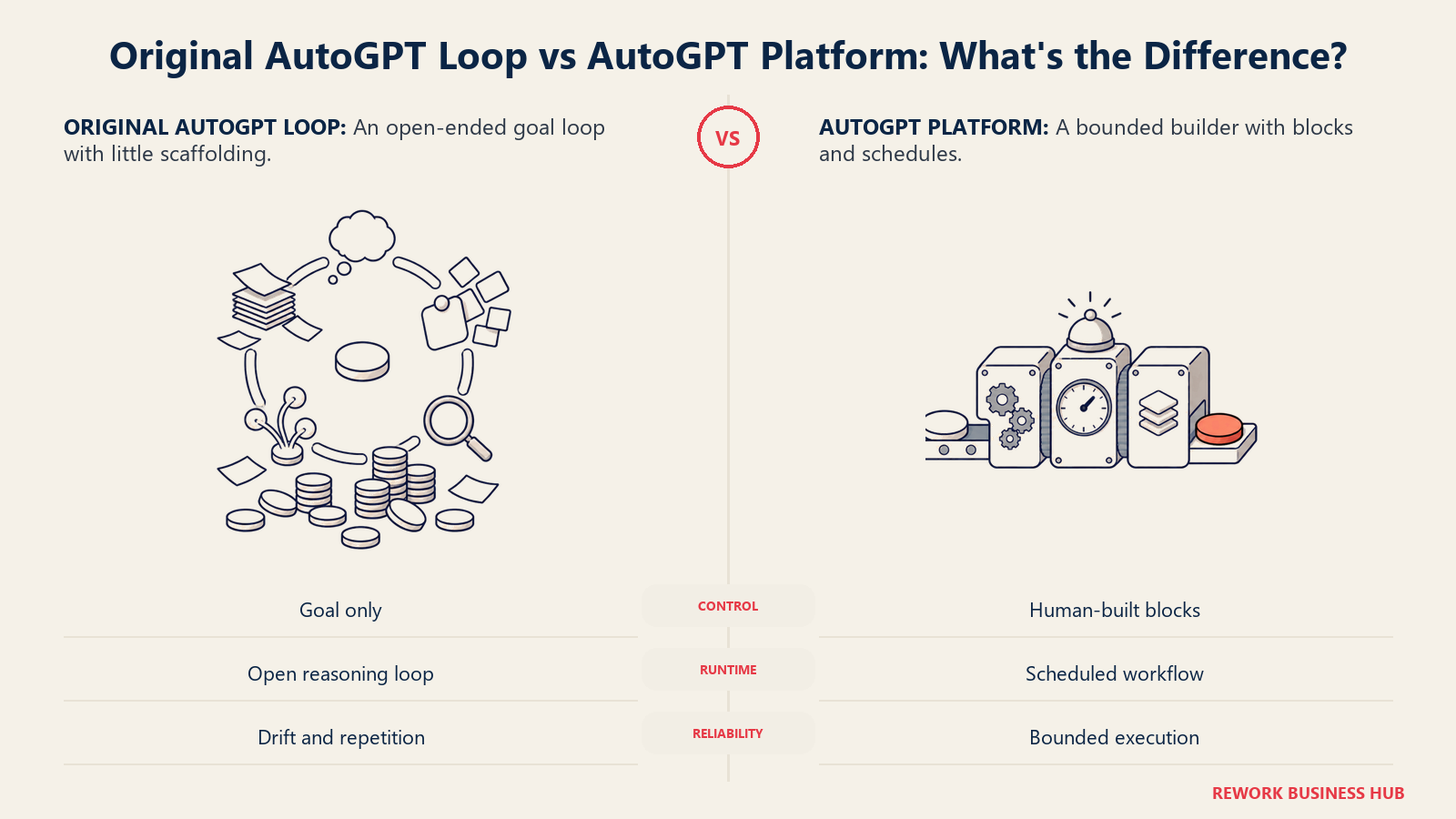
The 2026 version is a deliberate retreat from that premise, and it's worth reading as evidence rather than as a step down. AutoGPT Platform is now a low-code, visual block builder with a marketplace of pre-built agents, workflow scheduling, and deployment controls, the kind of scaffolding the original loop explicitly didn't have. You can self-host the whole thing for free, or pay for the hosted version. That a founding, category-defining product needed structure and human-defined blocks to become genuinely usable is itself a useful data point about how far "fully autonomous, any goal" claims still have to travel.
| What you get | What you don't |
|---|---|
| The most recognizable brand name in autonomous agents, rebuilt for reliability | A long way from the original "any goal, no scaffolding" premise that made it famous |
| Free, unlimited self-hosting for teams that want full control | Cloud-hosted version's usage multipliers make cost harder to predict than a flat fee |
| Visual block builder and agent marketplace lower the build-it-yourself bar | Subscription doesn't include model usage; pay-as-you-go credits are billed separately |
Pricing: Self-hosted is free (open source). Cloud Pro is $42.50/month billed annually. Cloud Max is $272/month billed annually (8.5x usage multiplier). Team tier is not yet generally available. All cloud tiers draw pay-as-you-go credits on top of the subscription, based on actual model calls and compute. Source: agpt.co.
Best for: Teams that want a low-code way to build and schedule their own autonomous agents without starting from a blank framework, and who understand that "AutoGPT" today means a builder, not a single all-purpose autonomous agent.
How to Choose: Decision Framework
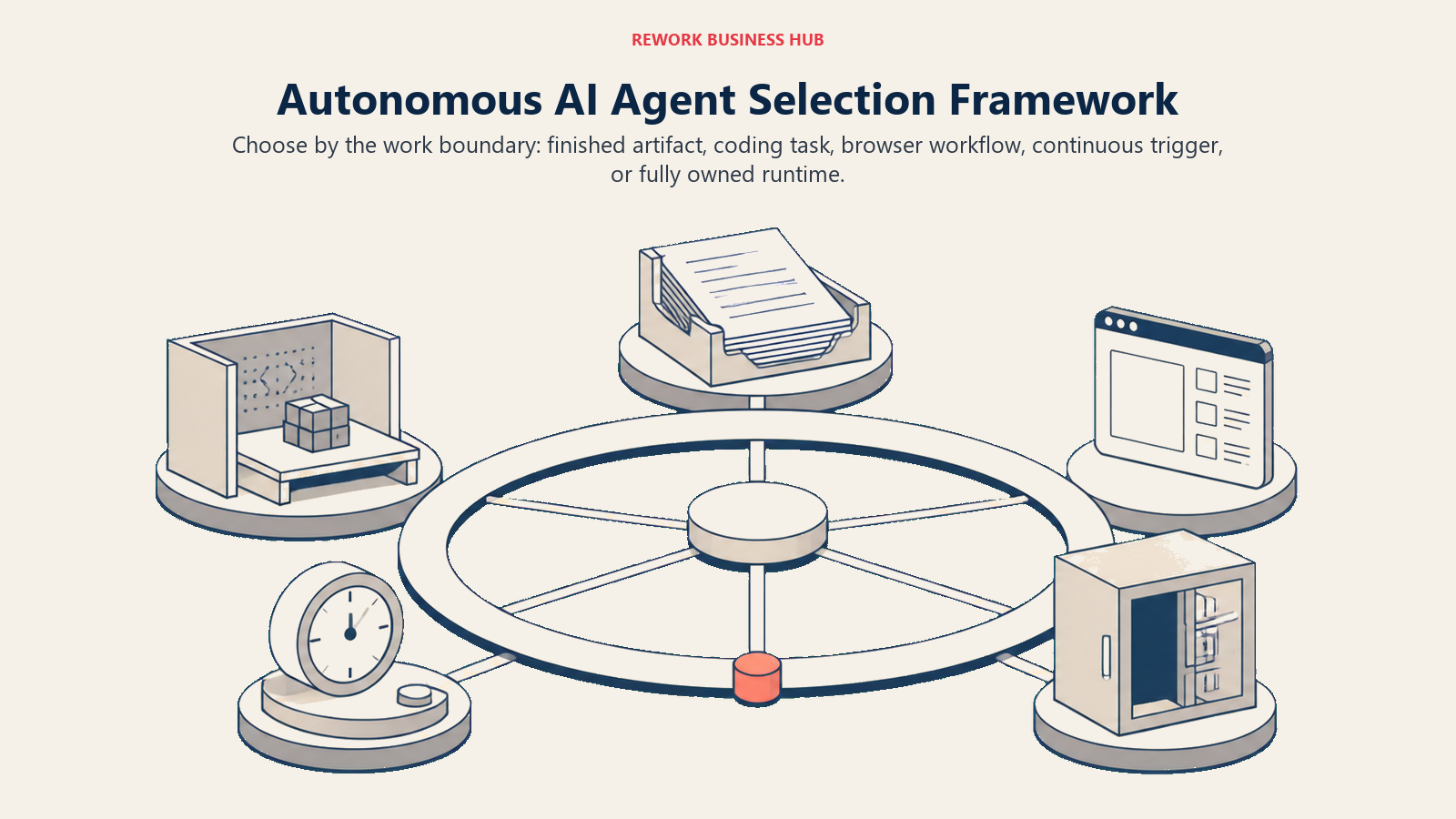
Start with the outcome you want the agent to own, then choose the product whose execution boundary and review model match that work.
| If you need... | Pick... | Why |
|---|---|---|
| A finished pull request with no session open on your end | Devin | Own sandboxed VM, DeepWiki indexing, and a self-review pass before you look |
| One prompt to research, build, and deliver a finished artifact | Manus | Plans, browses, codes, and hands back a document or build, not a chat log |
| Agent capability inside a subscription you already pay for | ChatGPT agent | Bundled into ChatGPT Plus; built-in confirmation before hard-to-reverse actions |
| Long, mostly unattended coding sessions with an audit trail | Claude Code | Permission prompts and Plan Mode keep every write reviewable, by design |
| Agent runs bundled with everyday AI chat and content tools | Genspark | One subscription instead of a dedicated agent-only vendor |
| A defined browser workflow that should run with zero review after setup | Skyvern | Vision-based automation that escalates only at CAPTCHAs and unknown UI states |
| Full visibility into exactly what the agent can do | OpenHands | Open source, self-hostable, sandboxed by default |
| A job function that runs continuously, not a single bounded task | Lindy | Triggers, not prompts; dial autonomy up or down per action |
| To build and schedule your own agents without a code framework | AutoGPT | Low-code visual builder, rebuilt for reliability after 2023's original loop |
What to Do Next
Pick one bounded, real task, not a demo scenario, and run it through your top pick's free or entry tier before committing to anything annual. Watch specifically for where the agent stops and asks versus where it just keeps going, because that's the behavior that determines your actual risk, not the autonomy tier on the pricing page. If the job touches production data, financial transactions, or anything else you can't cleanly roll back, start in a sandboxed copy regardless of what the vendor's marketing promises about safety. And before any of these 9 tools gets standing access to a real system, work through the guardrail checklist above with whoever owns risk on your team; AI agent ROI is a useful next read for putting a number on what a successful rollout is actually worth against that risk. For the broader landscape of agent platforms and frameworks you'd use to build something custom instead of buying one of these 9, Best AI Agent Platforms in 2026 is the pillar guide for the rest of the category.

Principal Product Marketing Strategist
On this page
- Updated August 2026: What Changed
- Key Facts
- What Actually Counts as "Autonomous"
- Quick Comparison Table
- The Autonomy Spectrum: Where Each Agent Actually Sits
- Documented Failure Modes and the Cost of a Wrong Autonomous Action
- Guardrails to Demand Before Anything Runs Unattended
- What These Agents Actually Cost: Per Task, Per Credit, Per Seat
- 1. Devin: The Most Autonomous Option for Shipping Code
- 2. Manus: General-Purpose Agent for Research, Browsing, and Delivered Output
- 3. ChatGPT agent: Browser and Tool Use Folded Into a Subscription You Likely Already Pay For
- 4. Claude Code: Extended Autonomous Sessions, By Design Not Fully Async
- 5. Genspark: A Bundled Super Agent Inside an All-in-One AI Workspace
- 6. Skyvern: Fully Unattended Browser Workflows Once You Configure One
- 7. OpenHands: The Open-Source Agent You Can Fully Own
- 8. Lindy: The One Built to Run Continuously, Not Just Once
- 9. AutoGPT: The Pioneer, Rebuilt as a Platform, Still Earning Trust Back
- How to Choose: Decision Framework
- What to Do Next