Best AI Agents for Recruiting in 2026: 12 Agents for Screening, Scheduling, and Interviewing
Turn this article into takeaways for your work.


Each assistant summarizes the article only for you and suggests best practices for your work.
Paradox (Olivia) leads high-volume conversational screening and scheduling, HireVue leads structured AI video interviewing at enterprise scale, SeekOut and Findem lead agentic sourcing built to run with far less manual searching, and Eightfold leads enterprise talent intelligence that spans hiring and internal mobility on one model. This guide ranks 12 real AI agents built for the hiring funnel from the moment someone applies onward: screening, scheduling, interviewing, assessment, and candidate communication. Each was evaluated on whether it genuinely plans and executes multi-step work rather than just assisting a recruiter one click at a time.
That word "genuinely" is doing real work here. An agent runs multi-step work on its own: it reads an application, scores it against a rubric, checks whether the candidate already exists in your ATS, and books a calendar slot, all without a recruiter clicking through each step. A tool only assists a human who stays in the loop for every action, like a note-taker that summarizes a call after a recruiter has already run it (for the underlying plan-act-observe loop, see what is an AI agent). That distinction matters twice in recruiting: once for what you're actually buying, since our best AI recruiting tools guide covers the wider, tool-heavy field this list narrows down from, and once for the law, because a growing list of jurisdictions now regulates the agentic, decision-influencing kind specifically. This guide also starts at the applicant: finding candidates who haven't applied yet is a different job with its own blueprint (see the AI Candidate Sourcing Agent), and what follows covers screening, scheduling, interviewing, and communication from the moment someone hits "apply."
Key Facts
- 63% of job seekers have now been interviewed by AI, up 13 percentage points in six months, and 38% have walked away from a hiring process specifically because it included an AI interview, per Greenhouse's 2026 Candidate AI Interview Report (2,950 candidates surveyed, May 2026).
- 70% of candidates say they were never clearly told upfront that AI would evaluate them, and only 21% believe most employers use AI responsibly in hiring, per the same Greenhouse research.
- Gartner predicts over 40% of agentic AI projects will be canceled by the end of 2027, citing unclear business value and inadequate risk controls as the leading causes.
- Screening resumes (44%) and automating candidate searches (32%) rank among the most common recruiting uses of AI, per SHRM's State of AI in HR 2026 report, and 89% of organizations using AI for recruiting report time savings or efficiency gains, per SHRM's 2025 Talent Trends research.
- Talent acquisition professionals using generative AI save roughly a full workday a week, about 20% of total work time, per LinkedIn's Future of Recruiting report.
- New York City has required an independent, published bias audit before using an automated employment decision tool since July 2023, and employment counsel are tracking a stricter enforcement phase through 2026, per Deloitte's analysis of Local Law 144.
Quick Comparison Table
| Agent | Best For | Starting Price | Key Strength | Key Limitation |
|---|---|---|---|---|
| Paradox (Olivia) | High-volume frontline conversational screening | Not published (reported from ~$1,000/mo) | Automates apply-to-schedule in one chat thread, 24/7 | No self-serve pricing; mid-transition into Workday |
| HireVue | Structured AI video interviews at enterprise scale | Not published (Vendr median $20,900/yr, reported) | Competency-based scoring standardized across huge pools | Opaque, multi-year contracts common |
| Eightfold | Enterprise talent intelligence, hire to mobility | Not published (reported $150,000+/yr) | One AI model scores external hires and internal moves | Priced against total workforce; built for 10,000+ employees |
| SeekOut | Agentic sourcing across a 1B+ profile index | $149/mo (Recruit Core, annual) | Enterprise tier runs full "Agentic AI workflows," not just search | Genuinely agentic tier is custom-quoted Enterprise only |
| Findem | Turning a job post itself into a sourcing agent | Not published (Vendr median $58,000/yr, reported) | Intelligent Job Post sources and qualifies with no manual search | Newest agent priced outcome-based, hard to budget upfront |
| HeyMilo | Adaptive voice screening for thin recruiting teams | Not published (reported estimate, unverified) | Multilingual, ATS-native knockout plus adaptive interview | No published pricing at any volume |
| Alex (formerly Apriora) | 24/7 multi-channel first-round interviewing | Not published | Phone, video, SMS, WhatsApp outreach plus fraud detection | Recent rebrand makes older reviews and prices unreliable |
| Greenhouse AI (Real Talent) | Agentic sourcing and screening inside your ATS | Not published (reported Core ~$6,000-$10,000/yr) | Sourcing Automation and fraud detection live in your ATS | The agentic sourcing piece is a costly add-on, not core |
| Ashby AI Assistant | Credit-metered AI search and review in a modern ATS | $400/mo (Foundations, up to 100 employees) | Rare, real published self-serve pricing | Heavy AI use burns credits fast; not sold standalone |
| Workable AI Recruiter | Pay-per-action agent on an all-in-one ATS/HRIS | $299/mo (Standard) + metered agent credits | Pay only for screening, sourcing, or chat actions taken | Credit costs stack on an already add-on-heavy base plan |
| SmartRecruiters Winston | Enterprise hiring agent inside ATS + CRM + onboarding | $14,995 (Essential, entry tier, period unstated) | Screening, matching, and chat unified under one agent | Agentic modules need Professional tier or above, custom |
| Mercor | AI-screened contractor marketplace, not funnel software | Not published (marketplace/placement-fee model) | 20-minute autonomous interview can trigger instant offers | Not installed in your ATS; you hire through Mercor's pool |
How to Choose an AI Recruiting Agent in 2026
Most teams shopping this category make the same mistake CRM buyers made a decade ago: they compare feature lists before they define the job. Settle three questions before you request a demo.
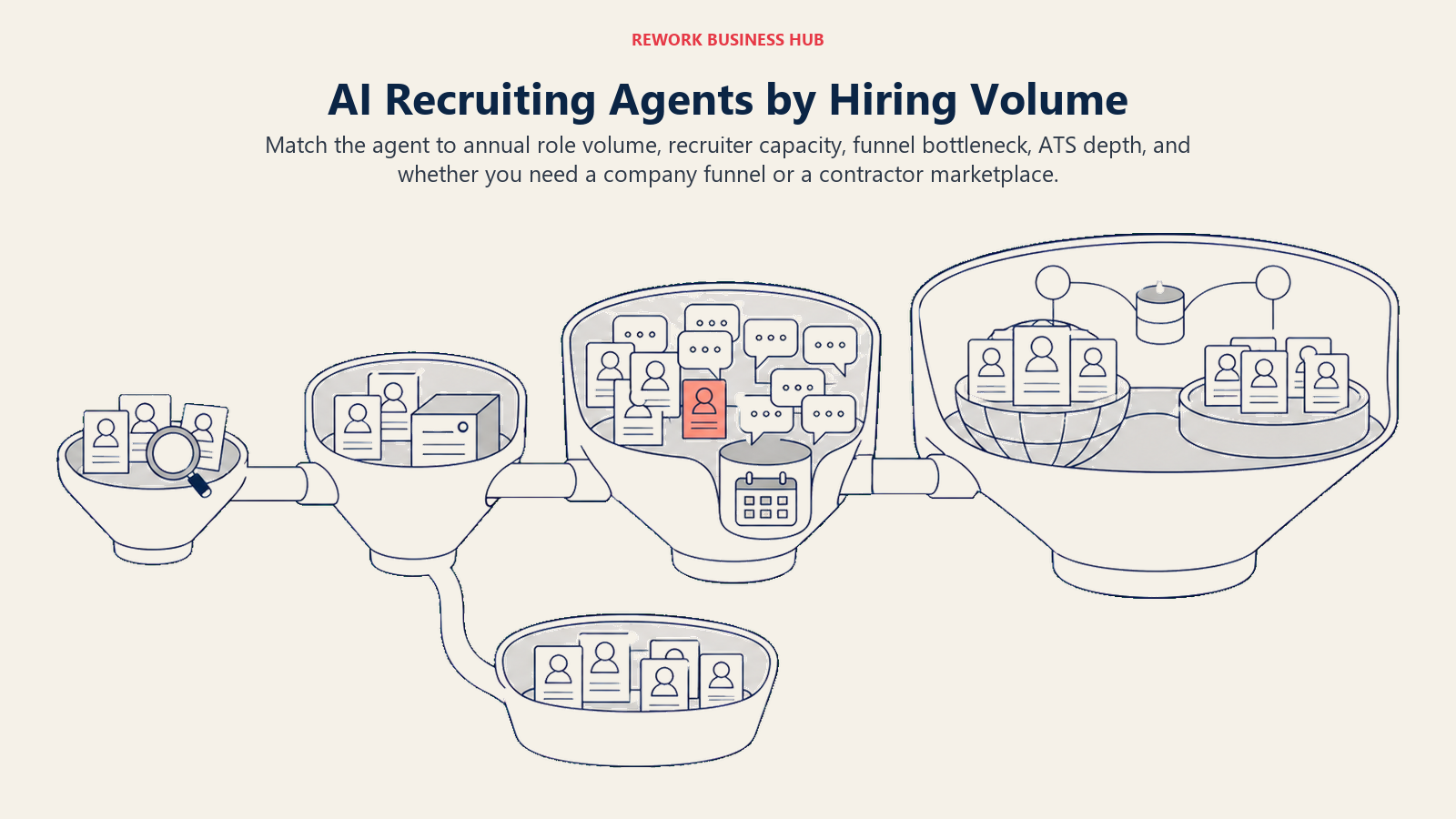
- Which stage of the funnel is actually your bottleneck? A conversational agent that screens and schedules solves a different problem than an agent that sources candidates who haven't applied, and both differ from an enterprise agent that also handles internal mobility. Match the agent to the bottleneck, not to whichever demo looked most impressive.
- How deep does it need to integrate with your ATS? Several agents below, including HeyMilo, Greenhouse AI, and Ashby's AI Assistant, only run fully inside a specific ATS or a short supported list. Others, like HireVue and Paradox, are built to sit alongside whatever ATS you already run. Check your applicant tracking system against each vendor's actual integration list, not a logo on their homepage, before you assume it will work.
- Are you buying for speed, or can you actually prove quality of hire? Almost every number a vendor leads with is a speed metric: time-to-screen, time-to-hire, recruiter hours saved. Genuine quality-of-hire data, whether hires stay, ramp, and perform, takes months to show up and is rarely published with real methodology behind it. The Josh Bersin Company's July 2026 research on talent acquisition found that "business outcomes are replacing operational hiring metrics as the primary measure of success," a sign buyers are pushing harder on this, not proof that today's agents already deliver it. Ask any finalist for a reference customer who tracked quality of hire, not just speed.
There's a fourth question this category adds that a generic AI agent purchase doesn't: what happens the first time a candidate complains, or someone asks for your bias audit. That gets its own section below, because it changes which vendors even belong on your shortlist depending on where you hire. If your build is general-purpose rather than recruiting-specific, best AI agent platforms covers the no-code, managed, and framework options outside this category.
Framework: By Hiring Volume and Team Size
| Hiring Volume / Team Signal | What You Need | Best Fits |
|---|---|---|
| Under 20 roles/year, thin or no recruiting team | Self-serve or low-commitment agent bolted onto a light ATS | Ashby AI Assistant, Workable AI Recruiter, SeekOut Recruit Core |
| 20-100 roles/year, 1-3 recruiters | Agentic screening or sourcing inside the ATS you already run | Greenhouse AI, Ashby AI Assistant, SeekOut Sourcing |
| 100-500 roles/year, high-volume or frontline | 24/7 conversational or voice screening and scheduling | Paradox (Olivia), HeyMilo, Alex, HireVue |
| 500+ roles/year or enterprise-wide TA | Enterprise agent unifying hiring, mobility, and workforce intelligence | Eightfold, Findem, SmartRecruiters Winston, SeekOut Enterprise |
| Filling expert or technical contractor roles, not a company TA team | Marketplace with AI screening built in | Mercor |
Bias, Auditability, and the Law
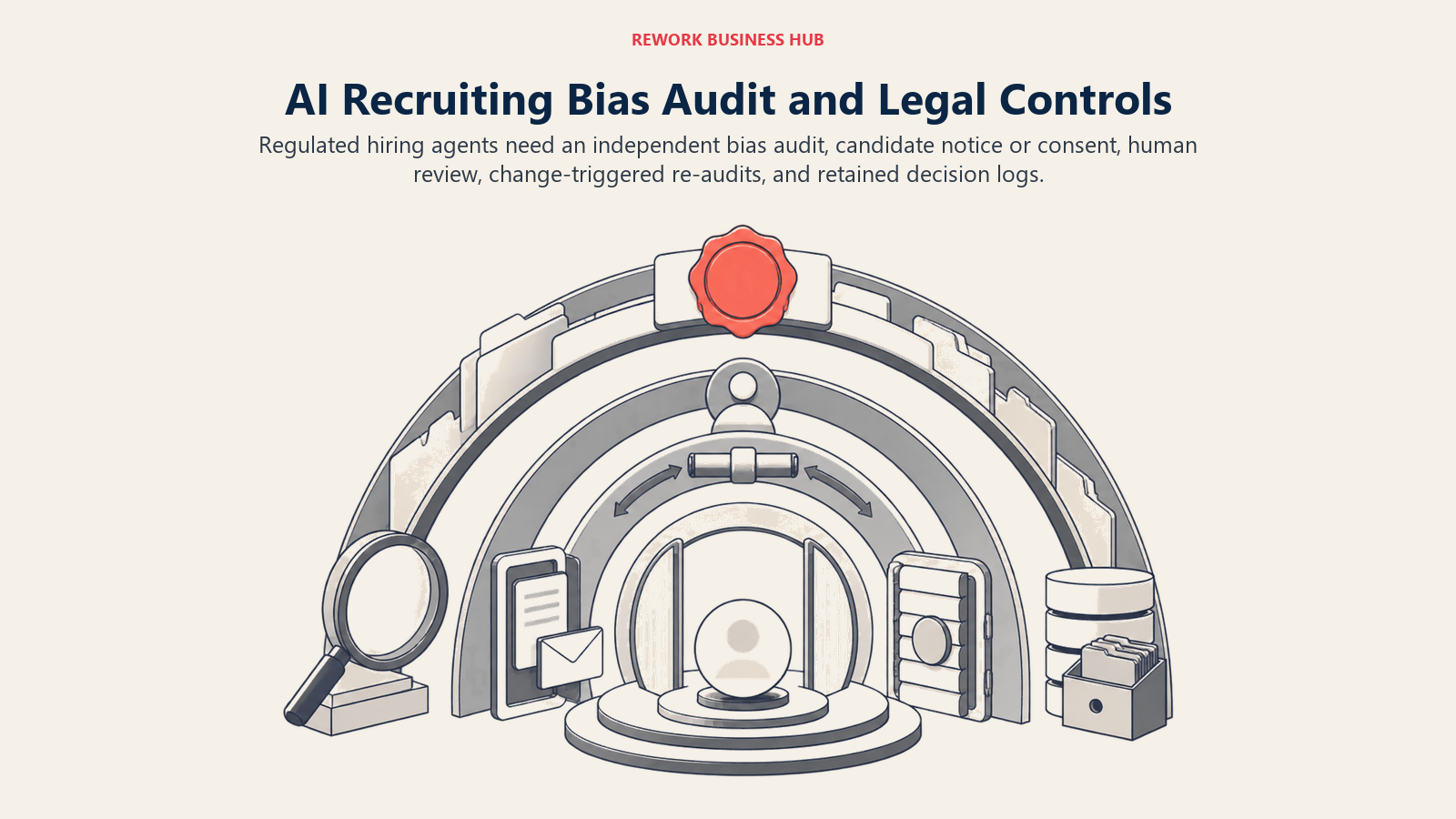
This is the section most "best AI recruiting" roundups skip, and it's the one that can cost you the most. An agent that screens, scores, or ranks candidates is now regulated in a growing list of places, and the rules differ enough by jurisdiction that "our vendor says it's compliant" isn't an answer. It's a question you haven't finished asking.
| Jurisdiction | Law | What It Requires | Status as of August 2026 |
|---|---|---|---|
| New York City | Local Law 144 (AEDT) | Independent bias audit within the prior 12 months; audit summary and distribution date published on the employer's careers site; advance candidate notice | In force since July 2023; a stricter enforcement phase is underway in 2026 |
| Illinois | HB 3773 (amends the Illinois Human Rights Act) | Makes AI employment decisions with a discriminatory effect a civil rights violation; requires notice explaining when and how AI factors into a decision | Effective January 1, 2026 |
| Illinois | Artificial Intelligence Video Interview Act (as amended) | Notice before the interview that AI will analyze it, an explanation of how it works, and consent obtained before recording | Amendments in force since January 1, 2026; full effect from February 2026 |
| Maryland | HB 1202 | Signed written consent required before using a facial recognition service to build a facial template during an interview | In effect since October 2020 |
| Colorado | AI Act, originally SB 24-205, repealed and replaced by SB 26-189 | Original law required impact assessments and risk management for high-risk employment AI; the replacement is a lighter disclosure-and-rights framework for automated decision-making | Delayed three times; the replacement framework takes effect January 1, 2027 |
| European Union | AI Act, Annex III | Classifies recruitment, CV screening, candidate ranking, and promotion or termination AI as high-risk: conformity self-certification, technical documentation, human oversight, six-month log retention, and a Fundamental Rights Impact Assessment | High-risk obligations delayed from August 2, 2026 to December 2, 2027 by Regulation (EU) 2026/1744 |
None of this makes AI screening illegal. It means the burden of proof has shifted: you now have to show a tool doesn't discriminate, not just claim it doesn't. The EEOC's Title VII guidance applies the same four-fifths rule that NYC's law expects: if a tool selects a protected group at less than 80% of the rate of the highest-scoring group, that's evidence of adverse impact, whether or not a local law requires you to publish an audit proving otherwise. Not confirmed: whether your specific use case counts as an AEDT under Local Law 144, or as a high-risk system under the EU AI Act, turns on facts, chiefly how much weight the tool's output carries in the final decision, that need a lawyer's read on your actual workflow, not a blog post.
What to Demand From Any Vendor Before You Sign
| Demand | Why It Matters | Red Flag |
|---|---|---|
| A current, published independent bias audit report | NYC Local Law 144 requires this by law if you hire there, and it's the clearest proof a vendor has actually tested for disparate impact | Vendor points you to a generic "responsible AI" page instead of a dated report from a named auditor |
| Adverse-impact testing by protected class, using the four-fifths rule as a floor | The EEOC applies this standard under Title VII regardless of which state you hire in | Vendor can't describe how selection rates are tested across race, sex, age, or disability status |
| A documented human-review step before any rejection is sent | Every law above assumes a human stays accountable for the final call, not just the agent's ranking | "Fully autonomous" is pitched as a feature with no human checkpoint described |
| A re-audit trigger tied to model or scoring changes | A bias audit from a year ago says nothing about a model the vendor silently updated last month | Vendor can't say when the underlying model or rubric was last changed or re-tested |
| Candidate notice and consent flows built into the product | Illinois, Maryland, and NYC all require notice or consent before or during the AI interaction, not a footer disclaimer | Notice and consent are left entirely to you to build outside the tool |
| Defined audit log retention | The EU AI Act requires six months minimum for high-risk systems once its deadline lands | Vendor can't state a log retention period at all |
If you need to independently verify what an agent actually did before a human overrides it, rather than trust the vendor's own summary, best AI agent observability tools covers the layer built for exactly that.
1. Paradox (Olivia): High-Volume Conversational Screening, Now Inside Workday
Paradox built Olivia around one bet: most hiring friction is a response-time problem, not a sourcing problem. The agent texts and chats with candidates 24/7 in over 100 languages, answering questions, running knockout screening, and booking interview slots without a recruiter touching a calendar. Paradox reports Olivia has powered more than 189 million AI-assisted candidate conversations with employee conversion rates over 70% (vendor-reported), and says the platform automates roughly 90% of the hiring process for high-volume employers.
The bigger 2026 story is ownership. Workday completed its acquisition of Paradox on October 1, 2025, for roughly $1 billion in cash, and Olivia is being folded into Workday's talent acquisition suite as the Workday Paradox Candidate Experience Agent, per Workday's own announcement. That gives Paradox deeper ATS distribution than almost anything else on this list, but the product is mid-transition, so expect packaging and branding to keep shifting through 2027.
| What you get | What you don't |
|---|---|
| Conversational apply, screen, and schedule in one chat thread, 24/7 | No self-serve or published pricing at any tier |
| Deep ATS integrations built specifically for high-volume, frontline hiring | Built for volume screening, not deep professional or executive assessment |
| Now backed by Workday's distribution and ATS reach | Mid-acquisition; expect packaging changes through 2027 |
Pricing: Not published on paradox.ai; every path leads to a demo request. Third-party estimates (reported, not vendor-confirmed) put entry deployments around $1,000/month, mid-market contracts at $25,000 to $60,000/year, and large enterprise rollouts at $75,000 to $150,000+/year.
Best for: High-volume, frontline, and retail employers that need 24/7 conversational screening and scheduling and are already in, or adopting, the Workday ecosystem.
2. HireVue: Structured AI Video Interviewing at Enterprise Scale
HireVue's AI Hiring Agent standardizes what would otherwise be thousands of inconsistent human interviews: candidates record on-demand video responses, an AI Interviewer scores them against competency models, and self-service scheduling moves qualified candidates forward without a recruiter chasing calendars. Assessments extend into Virtual Job Tryouts and game-based, auto-scored technical evaluations for roles where a resume alone doesn't prove skill.
The tradeoff is opacity and scale. No pricing appears anywhere on hirevue.com; every path leads to a demo. Our companion guide to AI recruiting tools already tracked a Vendr-reported median contract of $20,900 a year, and other third-party estimates put entry-level Essential deployments around $35,000 a year, with AI-assessment-enabled Enterprise tiers running $50,000 to $145,000 or more.
| What you get | What you don't |
|---|---|
| Competency-based AI scoring standardized across huge candidate pools | No pricing published anywhere; sales-led process only |
| Self-service scheduling that removes manual calendar coordination | Multi-year commitments and implementation fees are common |
| Game-based and technical assessments beyond a plain video interview | Overkill for teams hiring well under a few hundred roles a year |
Pricing: Not published. Reported (not vendor-confirmed): Vendr median contract $20,900/year; other estimates put Essential around $35,000/year and Enterprise or AI-assessment tiers at $50,000 to $145,000+/year.
Best for: Large employers running structured, scored video interviews across a high volume of applicants who need consistency a live interviewer can't guarantee at scale.
3. Eightfold: Enterprise Talent Intelligence From Hire to Internal Mobility
Eightfold's pitch is that hiring and internal mobility should run on the same AI model instead of two disconnected systems. Its agents evaluate candidates around the clock, guide applicants through the process, and, per the vendor, won a 2026 HR Tech award for agentic AI. The same skills graph that scores an external applicant also powers internal moves and succession planning, which is Eightfold's real differentiator against pure-play screening agents.
That breadth comes with an enterprise-only shape. Eightfold prices against your total workforce, not recruiter seats, and the vendor itself positions the platform as best suited to organizations of 10,000 employees or more. There's no pricing page on eightfold.ai; every quote is custom. If you need an agent platform that spans more than recruiting across a large organization, best enterprise AI agent platforms covers the broader managed-suite category Eightfold sits alongside.
| What you get | What you don't |
|---|---|
| One AI model scoring both external hires and internal moves | Priced against total workforce headcount, not recruiter seats |
| Agentic interview support and round-the-clock candidate evaluation | Built for 10,000+ employee organizations; a poor fit under that |
| Vendor-reported 2026 HR Tech award for agentic AI | 3-6 month implementation typical; $5,000-$50,000 in onboarding fees reported |
Pricing: Not published; eightfold.ai has no pricing page. Reported (not vendor-confirmed): roughly $7-$10 per employee per month, with enterprise annual contracts commonly cited at $150,000 to $500,000+.
Best for: Enterprises with 10,000+ employees that want one AI model spanning external hiring, internal mobility, and succession rather than a point screening tool.
4. SeekOut: Agentic Sourcing Across a 1 Billion-Plus Profile Index
SeekOut's self-serve Recruit Core plan is the rare exception in this list: real, published pricing at $149/month billed annually ($179/month month-to-month), per seekout.com/pricing, covering unlimited search across more than a billion profiles, AI search, 500 monthly contacts, and 1,000 exports.
The genuinely agentic layer sits higher up. SeekOut's Enterprise-tier "Full Recruiting Funnel" plan adds what the vendor calls Agentic AI workflows: auto-generated scoring rubrics, inbound evaluation, and AI screening running end to end, not just search. A separate service, SeekOut Spot, pairs agentic sourcing with human recruiters on outcome-based pricing (per role, per contractor, or agency-style) with no annual commitment.
| What you get | What you don't |
|---|---|
| Real published self-serve pricing starting at $149/mo | Core plan is sourcing-only; the agentic funnel is Enterprise, custom-quoted |
| Enterprise tier runs auto-generated rubrics and AI screening, not just search | 3-seat minimum and annual commitment above the self-serve tier |
| SeekOut Spot offers outcome-based agentic sourcing with no lock-in | This segment is new enough that agentic features and pricing are still shifting fast |
Pricing: Recruit Core $149/mo annual ($179/mo monthly); Sourcing, Team, and Full Recruiting Funnel tiers are custom, seat-based, and billed annually. SeekOut Spot pricing is separate and outcome-based.
Best for: Teams that want to start with straightforward, published sourcing pricing and grow into a genuinely agentic screening and scoring workflow without switching vendors.
5. Findem: Turning the Job Post Itself Into a Sourcing Agent
Findem's Intelligent Job Post, launched alongside its 2026 acquisition of Getro, is one of the more literal "agent" products in this category: it takes a job posting and autonomously sources, engages, qualifies, and delivers hire-ready candidates, rather than waiting for a recruiter to run a search. That sits on top of Findem's existing attribute-based talent data model, which tracks career trajectory rather than relying on keyword matching alone.
Findem introduced outcome-aligned pricing tied to actual hires for the Intelligent Job Post specifically in 2026, a meaningful shift from the flat seat-based pricing common elsewhere on this list. Nothing is published on findem.ai; every quote runs through a demo and sales conversation.
| What you get | What you don't |
|---|---|
| Job post itself acts as an autonomous sourcing and qualifying agent | No published pricing; outcome-based model is unfamiliar to budget for |
| Attribute-based data model surfaces candidates keyword search misses | Full platform access still runs through annual, custom contracts |
| Outcome-aligned pricing ties cost to actual hires for the newest agent | Broader availability only reached through 2026; still maturing |
Pricing: Not published on findem.ai. Reported (not vendor-confirmed): Vendr median contract $58,000/year for the broader platform; Intelligent Job Posts are priced outcome-based, tied to hires.
Best for: Enterprise teams that want the top of funnel to run itself from the job post outward, without a recruiter manually building a search.
6. HeyMilo: Adaptive Voice and Video Screening for Thin Recruiting Teams
HeyMilo's agent works in three steps: an AI Agent Builder reads the job description straight from your ATS and generates an interview framework, an AI Agent Interviewer runs knockout questions followed by an adaptive voice, video, or phone interview that asks real follow-ups instead of a fixed script, and an analysis layer transcribes, scores, and summarizes every conversation back into the ATS. It's multilingual by default and built specifically for staffing agencies, BPOs, and employers without a traditional recruiting team, where roles can draw thousands of applicants within days.
HeyMilo connects natively to Greenhouse, Workday, Ashby, SmartRecruiters, Bullhorn, Avionté, and JobDiva, writing scores, summaries, and reports directly back to the candidate record rather than living in a separate dashboard. It's built recruiting-specific rather than general-purpose; for agents built around phone and voice conversation across other use cases, see best AI voice agents.
| What you get | What you don't |
|---|---|
| Adaptive follow-up questions, not a fixed script, across voice, video, and phone | No pricing published on heymilo.ai at any volume |
| Native writeback into Greenhouse, Workday, Ashby, and other major ATS platforms | Built for volume screening; not positioned for executive-level assessment |
| Multilingual by default, aimed at high-volume and frontline hiring | Third-party volume-pricing estimates exist but are unverified |
Pricing: Not published. One third-party estimate puts costs around $4,000+/month at a volume of roughly 1,000 interviews, but treat that as an unverified, rough signal rather than a vendor-confirmed rate.
Best for: Staffing agencies, BPOs, and high-volume employers with a thin or nonexistent recruiting team that need adaptive screening wired natively into an existing ATS.
7. Alex (formerly Apriora): 24/7 Multi-Channel First-Round Interviewer
Apriora rebranded to Alex in 2026, and the product now positions itself as an always-on first-round interviewer: it conducts personalized AI interviews, reaches candidates across phone, video, SMS, and WhatsApp, screens resumes against job criteria, books qualified candidates directly onto a team's calendar, and includes fraud and identity detection to catch fabricated or duplicated applications. It also rediscovers qualified candidates already sitting in your ATS rather than only processing new inbound applicants. The platform claims 24/7 operation across 30+ languages and 33+ ATS integrations.
Pricing is not published anywhere on the current site, alex.com; every call to action leads to a demo request. Older reviews under the Apriora name cited a roughly $30/month Starter plan, but that predates the rebrand and could not be confirmed as still current.
| What you get | What you don't |
|---|---|
| Outreach and interviewing across phone, video, SMS, and WhatsApp in one agent | No pricing published under the current Alex brand |
| Built-in fraud and identity detection on top of interview scoring | Recent Apriora-to-Alex rebrand makes older reviews and prices unreliable |
| ATS-based rediscovery of past qualified candidates, not just new applicants | 33+ ATS integrations claimed but depth per integration isn't detailed publicly |
Pricing: Not published on alex.com. A pre-rebrand third-party listing cited a Starter plan around $30/month under the Apriora name (reported, unconfirmed as current).
Best for: Companies that want one agent running always-on, multi-channel first-round interviews with fraud detection built in, rather than stitching outreach and screening tools together.
8. Greenhouse AI (Real Talent): Agentic Sourcing and Screening Inside Your ATS
Greenhouse's Real Talent AI layer is less a standalone agent than an agentic upgrade to an ATS you likely already run. The Core plan includes structured interview kits, an AI Notetaker, and Real Talent Matching. Plus adds Greenhouse Sourcing Automation, the most genuinely agentic piece, along with AI-powered report filtering and Real Talent fraud and spam detection. Pro layers on enterprise governance, an audit log, and developer-level configuration.
Nothing on greenhouse.com/pricing shows an actual dollar figure; all three tiers route to a custom quote based on hiring volume and complexity. Third-party estimates (reported) put small-team Core contracts around $6,000 to $10,000 a year, with the Sourcing Automation add-on alone reportedly running roughly $25,000 a year for 10 seats on top of a base contract, and Pro-tier enterprise deals reaching $50,000 to $70,000 or more.
| What you get | What you don't |
|---|---|
| Sourcing Automation and fraud detection running inside the ATS you already use | No dollar figures published anywhere; every tier is a custom quote |
| Structured interview kits and an AI Notetaker included at the entry Core tier | The genuinely agentic sourcing piece is a Plus-tier add-on, not included in Core |
| Enterprise governance and audit logging at the Pro tier | Reported add-on pricing can roughly double a base contract |
Pricing: Not published; Core, Plus, and Pro are all custom-quoted. Reported (not vendor-confirmed): Core around $6,000-$10,000/year for small teams, Sourcing Automation add-on around $25,000/year for 10 seats, Pro-tier enterprise deals $50,000-$70,000+/year.
Best for: Teams that want agentic sourcing and screening layered directly into Greenhouse rather than adding a separate point vendor.
9. Ashby AI Assistant: Credit-Metered AI Search and Review Inside a Modern ATS
Ashby is the one product on this list with fully transparent, published self-serve pricing, per ashbyhq.com/pricing: Foundations at $400/month for up to 100 employees, including 1,500 AI credits a month, scaling to custom-quoted Plus (101-1,000 employees, 2,500 credits per seat annually) and Enterprise (1,000+ employees, 12,500 credits per seat annually) tiers.
The AI itself sits closer to the assistive end of this list than a fully autonomous agent: AI Candidate Search turns natural-language requests into structured search filters, AI-generated Interview Summaries save note-taking time, and AI Assisted Application Review scores fit against job criteria. The Ashby AI Assistant handles plain-language queries and takes some bounded actions, but it operates inside Ashby's ATS rather than running an independent, end-to-end funnel the way Paradox or SeekOut's Enterprise tier does. AI Notetaker and Advanced Scheduling are separate paid add-ons on top of the base credit pool.
| What you get | What you don't |
|---|---|
| Rare, fully published self-serve pricing starting at $400/mo | Not sold standalone; you're buying the whole Ashby ATS |
| Natural-language search, review, and summarization inside one product | Heavier AI usage burns the monthly credit pool fast |
| Predictable credit scaling by company size at Plus and Enterprise | Closer to AI-assisted tooling than a fully autonomous, multi-step agent |
Pricing: Foundations $400/mo (up to 100 employees, 1,500 AI credits/mo); Plus and Enterprise are custom-quoted with 2,500 and 12,500 credits per seat annually, respectively. AI Notetaker and Advanced Scheduling cost extra.
Best for: Startups and scaleups already choosing Ashby as their ATS that want AI search, review, and summarization metered by usage rather than a separate agent subscription.
10. Workable AI Recruiter: A Pay-Per-Action Agent on an All-In-One ATS/HRIS
Workable bundles recruiting and core HR into one product, with plans per workable.com/pricing: Standard at $299/month, Premier at $599/month, and Enterprise at $719/month (roughly 20% cheaper billed annually), each layering on add-ons like texting, video interviews, and assessments.
The Workable Agent is priced separately and unusually transparently: candidate screening costs 1 credit, sourcing costs 2 credits, and chat interactions cost 10 credits, with credit packages running $600 for 5,000 credits up to $4,750 for 50,000, and 3,000 free credits included on paid plans. That "pay for what the agent does, nothing else" model is one of the more honest pricing structures in this category, even if it makes total cost harder to predict at real usage volume.
| What you get | What you don't |
|---|---|
| Transparent, action-metered agent pricing: screening, sourcing, and chat priced separately | Costs stack on an already add-on-heavy base ATS plan |
| Full ATS plus core HR (onboarding, time off) in one product | Credit consumption at real volume is hard to forecast in advance |
| 3,000 free credits included before you pay for agent usage | Agent is an add-on, not a standalone product outside Workable |
Pricing: Standard $299/mo, Premier $599/mo, Enterprise $719/mo (annual billing, ~20% cheaper than monthly); Workable Agent credits: 5,000 for $600, 10,000 for $1,000, 50,000 for $4,750; 3,000 free credits included on paid plans.
Best for: SMB and mid-market teams that want an all-in-one ATS and HRIS with an AI agent billed strictly by the actions it takes.
11. SmartRecruiters Winston: An Enterprise Hiring Agent Bundled Into One Platform
Winston is SmartRecruiters' AI hiring agent brand, and 2026's Winston Companion release extended it across screening, scheduling, shortlisting, candidate rating, and a new conversational Q&A agent for candidates. It ships inside a platform that already unifies ATS, CRM, onboarding, SMS messaging, and job distribution, so the pitch is one agent brand spanning the whole hire, not a bolt-on.
Confirmed on smartrecruiters.com/pricing, the Essential tier starts at $14,995 (the page does not state whether that figure is monthly or annual; treat it as unconfirmed until a sales conversation clarifies). The genuinely agentic pieces, the AI-powered Hiring Agent and AI Talent Matching Engine, only appear from the Professional tier upward, and AI-powered Candidate Screening plus Conversational AI Chat require High Volume or above, all under "Request Pricing."
| What you get | What you don't |
|---|---|
| Screening, matching, and conversational chat unified under one agent brand | Genuinely agentic modules require Professional tier or higher, custom-quoted |
| Bundled ATS, CRM, onboarding, and job distribution in one platform | Entry price alone starts near $15,000 before any AI module is added |
| 2026 Winston Companion release added conversational Q&A for candidates | Billing period on the published starting price isn't stated |
Pricing: Essential starts at $14,995 (billing period not specified on the vendor page); Professional, High Volume, and Complete tiers, which unlock the AI Hiring Agent, Talent Matching Engine, and Conversational AI Chat, are all "Request Pricing."
Best for: Enterprise and high-volume employers that want an AI hiring agent bundled into one ATS, CRM, and onboarding platform rather than assembled from point tools.
12. Mercor: An AI-Screened Contractor Marketplace, Not Funnel Software
Mercor deserves an honest caveat before anything else: it isn't software you install into your own hiring funnel like the other 11 agents here. It's a two-sided marketplace that recruits and vets contractors, particularly for AI training data work, engineering, and other technical or expert roles, and sells access to that pre-screened pool to enterprise buyers. The screening itself is genuinely agentic: candidates complete an autonomous, roughly 20-minute AI-led video interview that generates a transcript and a structured evaluation, and Mercor has described "instant offers" issued directly from the matching system when a candidate's performance already clears a listing's bar.
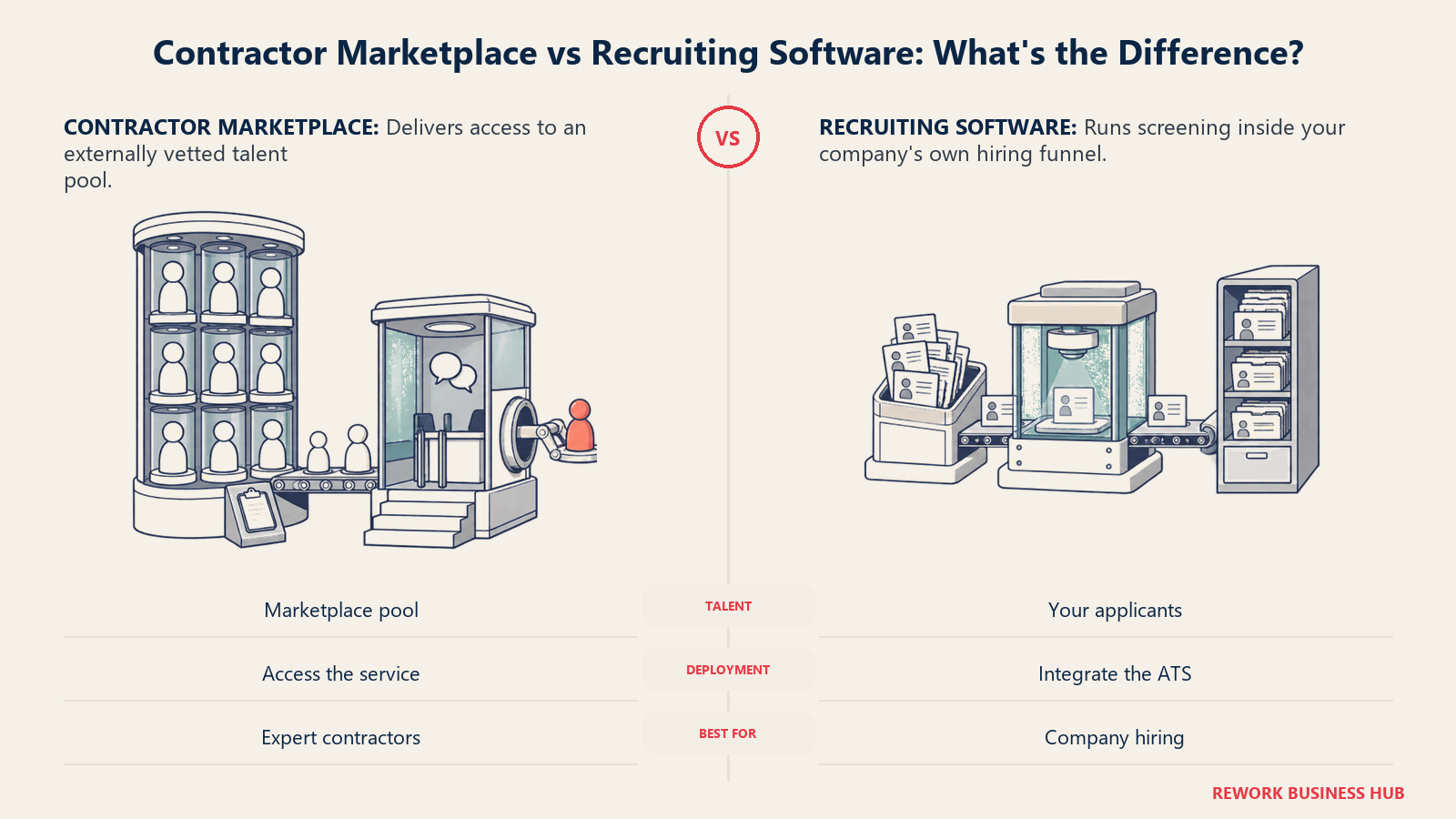
That makes Mercor worth knowing about, but it's solving a different problem than the rest of this list. If you need an agent that screens applicants inside your own ATS, look elsewhere here. If you need a fast, AI-vetted pool of contractors for a specific, often technical, need, Mercor is built for exactly that.
| What you get | What you don't |
|---|---|
| A 20-minute autonomous AI interview standardizing evaluation across candidates | Not deployable inside your own ATS; you access Mercor's own pool |
| Pre-vetted contractors, especially for AI training and technical work | No published employer pricing; contractor pay ($50-150/hr) is shown, not employer cost |
| "Instant offer" workflow for candidates who already clear the bar | A marketplace and placement model, not a licensed screening tool |
Pricing: Not published for employers. The model is marketplace-based (placement or success-fee structured), not a licensed SaaS subscription; contact sales for terms.
Best for: Companies that want a fast, AI-vetted pool of expert or technical contractors rather than a tool to run inside their own recruiting funnel.
AI Recruiting Agent Buying Mistakes to Avoid
| Mistake | What It Looks Like | What to Do Instead |
|---|---|---|
| Buying the agent before checking ATS compatibility | Signing a contract, then discovering it only writes back to three of the fifteen fields you need | Get the actual integration list in writing, not a marketing page |
| Treating "agentic" as a checkbox | Assuming every vendor claiming "AI agent" actually plans and executes multi-step work | Ask what the agent does without a human clicking "approve" at every step |
| Skipping the bias audit request | Deploying a screening agent because it feels neutral | Request the vendor's most recent independent audit before the demo, not after the contract |
| Measuring only time-to-hire | Reporting a faster funnel as proof the agent is working | Track offer-accept rate and early-tenure performance for agent-touched hires too |
| Assuming one agent covers sourcing and screening equally well | Buying a screening specialist and expecting strong outbound sourcing, or the reverse | Match the agent to the specific funnel stage it was actually built for |
| Ignoring candidate consent flows | Launching an AI interview with no upfront disclosure | Build notice and consent into the workflow before candidate one, not after a complaint |
Decision Framework
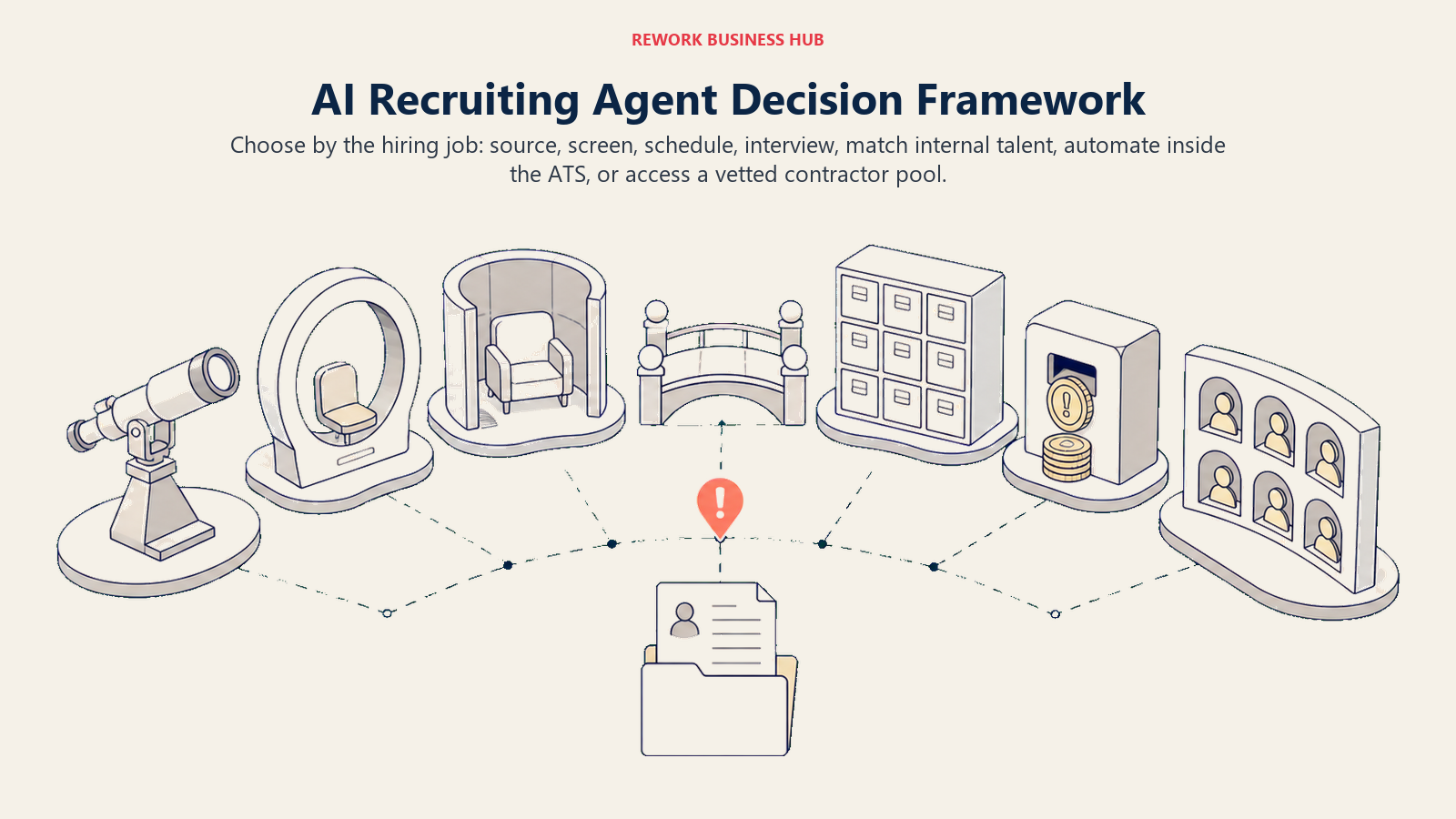
Recruiting agents belong to different hiring jobs, so shortlist by the work being delegated before comparing product breadth. This decision theatre separates sourcing, conversational screening, video interviews, talent intelligence, ATS-native automation, pay-per-action work, and contractor marketplaces.
| If you need... | Pick... | Why |
|---|---|---|
| 24/7 conversational screening and scheduling for high-volume frontline roles | Paradox (Olivia) | Automates apply-to-schedule in one chat thread, now backed by Workday's ATS reach |
| Structured, scored video interviews across a huge applicant pool | HireVue | Competency-based AI scoring standardizes what would otherwise be inconsistent live interviews |
| The deepest agentic sourcing across the widest public candidate index | SeekOut | Agentic AI workflows run search, scoring, and rubric generation, not just search |
| An agent that works before a candidate ever sees your careers page | Findem | Intelligent Job Post sources and qualifies candidates from the post itself |
| Enterprise talent intelligence spanning external hiring and internal mobility | Eightfold | One AI model scores both new hires and internal moves for large organizations |
| Adaptive voice or video screening for a thin or nonexistent recruiting team | HeyMilo | Multilingual knockout plus adaptive follow-up interview, native to your ATS |
| A 24/7 first-round interviewer across phone, video, SMS, and WhatsApp | Alex (formerly Apriora) | Multi-channel outreach plus built-in fraud and identity detection |
| Agentic sourcing and screening without leaving your ATS of record | Greenhouse AI | Real Talent AI and Sourcing Automation live inside the ATS you already run |
| Transparent, published pricing for AI-assisted search and review | Ashby AI Assistant | The only agent here with real self-serve pricing on the vendor's own site |
| A pay-per-action agent instead of a flat agent subscription | Workable AI Recruiter | Credits meter exactly what the agent does: screen, source, or chat |
| One agent brand unifying screening, matching, and chat at enterprise scale | SmartRecruiters Winston | Winston Companion bundles the agentic modules into one ATS, CRM, and onboarding platform |
| Vetted expert or technical contractors, not software for your own funnel | Mercor | A marketplace with AI screening built in, not a tool you install |
Frequently Asked Questions about AI Agents for Recruiting
What makes an AI agent different from an AI recruiting tool?
An agent plans and executes multi-step work on its own, reading an application, scoring it, checking the ATS for duplicates, and booking a calendar slot without a recruiter clicking through each step. A tool assists a human at a single step, like generating interview questions or summarizing a call a recruiter already ran. A few products here, like Ashby's AI Assistant, sit in between: they take bounded autonomous actions but stay inside a broader ATS rather than running the full loop end to end.
Are AI interview agents legal to use?
Using one is generally legal, but several jurisdictions require specific steps first. New York City requires an independent bias audit and public disclosure before you use an automated employment decision tool. Illinois requires notice and consent before an AI-analyzed video interview. Maryland requires signed consent before facial recognition is used in an interview. None of these ban AI screening outright; they require you to prove it doesn't discriminate and tell candidates it's happening.
What is a bias audit, and does every company need one?
A bias audit tests whether a tool's selection rate for a protected group falls below four-fifths of the rate for the highest-scoring group, the standard the EEOC applies under Title VII. New York City's Local Law 144 legally requires an independent bias audit before you use an AEDT to hire or promote anyone within NYC, published on your careers site. Outside NYC it isn't always a legal mandate yet, but the same four-fifths standard is what a Title VII disparate-impact claim would test against anywhere in the US.
Does NYC Local Law 144 apply if my company isn't based in New York City?
Yes. The law applies based on where the candidate or employee is evaluated for a covered decision, not where the employer is headquartered or incorporated. If you're using an AEDT to evaluate someone for a New York City-based role, the law applies regardless of where your company sits.
What happened to Colorado's AI Act?
SB 24-205 was signed in 2024, delayed twice through 2026, then repealed and replaced by SB 26-189 in May 2026. The replacement is a lighter disclosure-and-rights framework for automated decision-making and takes effect January 1, 2027, so as of August 2026 Colorado's original high-risk AI obligations are not yet in force.
Is the EU AI Act's employment AI rule in effect right now?
Not yet. The high-risk obligations covering recruitment, screening, and candidate ranking were originally due August 2, 2026, but Regulation (EU) 2026/1744, published in the Official Journal on July 24, 2026, delayed them to December 2, 2027. Other AI Act obligations, including transparency rules and the prohibited-practices regime, remain on their original schedule.
Can a candidate refuse an AI interview?
In most US states, yes, an employer generally can't force a candidate through an AI-scored interview, though declining may mean they aren't considered further for that specific process. Maryland goes further for one technology specifically: an employer cannot use facial recognition during an interview at all without the candidate's signed consent.
Do AI recruiting agents actually improve quality of hire, or just speed?
Most public evidence is a speed and volume story, time-to-screen, time-to-hire, recruiter hours saved, because those numbers are easy to measure in weeks. Quality of hire takes months to show up and is rarely published with real methodology behind it. The Josh Bersin Company's July 2026 research on talent acquisition put it plainly: "business outcomes are replacing operational hiring metrics as the primary measure of success," which signals buyers are pushing harder on this, not proof that today's agents already deliver it.
Which AI recruiting agent is cheapest to start with?
Ashby's AI Assistant is the only agent here with real published self-serve pricing, from $400/month on the Foundations plan. SeekOut's Recruit Core starts at $149/month, though its agentic workflows require the custom-quoted Enterprise tier. Most dedicated interview and screening agents, including Paradox, HireVue, Eightfold, HeyMilo, and Alex, publish no pricing at all.
Should sourcing and screening be handled by the same agent or two different ones?
Most vendors here, and the build-side blueprints this guide links to, treat them as separate jobs. A sourcing agent searches for candidates who haven't applied and drafts first-touch outreach; a screening agent evaluates people who already applied. Findem's Intelligent Job Post and SeekOut's Enterprise tier are the two products in this list blurring that line by running sourcing and screening in one agentic workflow.
What to Do Next
Before you request a single demo, decide which stage of the funnel is actually your bottleneck. If it's top-of-funnel volume, start with Paradox, HeyMilo, or Alex. If it's structured evaluation at scale, start with HireVue or Eightfold. If it's agentic sourcing, start with SeekOut or Findem. Then, whichever agent makes your shortlist, ask for its most recent bias audit report and its candidate notice and consent flow before you ask about price. A vendor that can't produce either on request has told you something more important than anything on its pricing page.
If you're building the screening or sourcing logic yourself instead of buying it, the AI Recruiting Screener Agent and AI Candidate Sourcing Agent blueprints show exactly how to configure the rules, guardrails, and human handoff points a compliant version of each one needs. And once someone accepts an offer, the AI Employee Onboarding Agent blueprint picks up from there.

Principal Product Marketing Strategist
On this page
- Key Facts
- Quick Comparison Table
- How to Choose an AI Recruiting Agent in 2026
- Framework: By Hiring Volume and Team Size
- Bias, Auditability, and the Law
- What to Demand From Any Vendor Before You Sign
- 1. Paradox (Olivia): High-Volume Conversational Screening, Now Inside Workday
- 2. HireVue: Structured AI Video Interviewing at Enterprise Scale
- 3. Eightfold: Enterprise Talent Intelligence From Hire to Internal Mobility
- 4. SeekOut: Agentic Sourcing Across a 1 Billion-Plus Profile Index
- 5. Findem: Turning the Job Post Itself Into a Sourcing Agent
- 6. HeyMilo: Adaptive Voice and Video Screening for Thin Recruiting Teams
- 7. Alex (formerly Apriora): 24/7 Multi-Channel First-Round Interviewer
- 8. Greenhouse AI (Real Talent): Agentic Sourcing and Screening Inside Your ATS
- 9. Ashby AI Assistant: Credit-Metered AI Search and Review Inside a Modern ATS
- 10. Workable AI Recruiter: A Pay-Per-Action Agent on an All-In-One ATS/HRIS
- 11. SmartRecruiters Winston: An Enterprise Hiring Agent Bundled Into One Platform
- 12. Mercor: An AI-Screened Contractor Marketplace, Not Funnel Software
- AI Recruiting Agent Buying Mistakes to Avoid
- Decision Framework
- What to Do Next