Best AI Agents for Ecommerce in 2026: 14 Tools for Support, Merchandising, and Agentic Commerce
Turn this article into takeaways for your work.


Each assistant summarizes the article only for you and suggests best practices for your work.
The best AI agents for ecommerce in 2026 split by job, not by hype: Gorgias AI Agent and Zowie lead order-aware customer service, Klaviyo AI and Attentive lead abandoned-cart and lifecycle messaging, Algolia and Constructor lead onsite search and product discovery, and Shopify Sidekick is the free store-ops assistant most of the others plug into. This guide ranks 14 real agents across those jobs, evaluated on whether each one actually plans a sequence of steps, calls a real system, and takes action, rather than just answering a question.
An AI agent is different from the AI tools most "best ecommerce AI" lists cover. A tool like Shopify Magic drafts a product description and waits for a person to use it. An agent like Gorgias AI Agent reads an order record, decides whether a refund qualifies under your policy, and processes it without anyone clicking approve. If you're shopping for writing, image, or analytics tools instead, Best AI Tools for Ecommerce in 2026 and Best AI Tools for Ecommerce Stores in 2026 cover that assistive layer. This guide covers what actually acts on your behalf.
There's a second, newer meaning of "AI agent" in ecommerce that has nothing to do with which vendor you buy: the AI assistant your shopper is already using to buy from you. ChatGPT, Perplexity, and Amazon's own Alexa for Shopping can now research and sometimes complete a purchase without the shopper ever loading your storefront, and whether you show up in that transaction depends on decisions none of the vendors below make for you. So this guide covers both halves: which agent to buy for your own operations, and what your store needs to do to be discoverable and transactable by the agents your customers bring with them.
Updated August 2026: What Changed
- Amazon retired Rufus and replaced it with Alexa for Shopping on May 13, 2026, folding in an agentic "Buy for Me" checkout that by March 2026 had expanded to more than 100 million products across 400,000-plus merchants outside Amazon's own marketplace, a move that drew pushback from some of those merchants in January 2026.
- OpenAI scaled back the original in-chat Instant Checkout flow and is now building dedicated retailer apps inside ChatGPT instead, after early friction with merchants. The open source Agentic Commerce Protocol it built with Stripe is still live, with Etsy and a growing list of Shopify merchants.
- Google donated its Agent Payments Protocol (AP2) to the FIDO Alliance, moving it from a Google-led spec toward an industry standard, and added a Universal Cart layer on top of it.
- Visa and Mastercard both shipped competing agent-credentialing schemes (Trusted Agent Protocol and Agent Pay), and Mastercard extended Agent Pay to machine-speed transactions in June 2026. A merchant now has several agentic commerce specs to track instead of one.
- Resolution-based and per-action pricing kept spreading. Gorgias, Zowie, and Siena all bill on some version of a completed action rather than a flat seat, and Klaviyo's Customer Agent is still in beta pricing as of this update.
Key Facts
- NRF research found 41% of consumers now use AI assistants to research products while shopping, 33% to read reviews, and 31% to hunt for deals, all before they reach a checkout page (NRF).
- AI-driven traffic to US retail sites grew 393% year over year in Q1 2026, and for the first time AI-referred shoppers converted 42% better than traditional organic traffic, based on Adobe Analytics data covering more than 1 trillion visits (TechCrunch).
- Shopify reported AI-referred traffic to its merchants grew more than 8x year over year in Q1 2026 and orders from AI-powered search grew nearly 13x, before both measures tripled again year over year in Q2 (TechCrunch).
- AI and agents influenced 20% of all global online orders during Cyber Week 2025 and were on pace to drive $263 billion in holiday sales for the season, per Salesforce's Shopping Index (Salesforce).
- Gartner predicts more than 40% of agentic AI projects will be canceled by the end of 2027, citing unclear business value and inadequate risk controls, worth remembering before signing an annual agent contract (Gartner).
- ChatGPT crossed 900 million weekly active users in February 2026, the scale of audience now sitting behind agentic shopping features like Instant Checkout (TechCrunch).
Agent, AI Tool, or Build-It-Yourself: Where This List Fits
Two other guides on this site cover ground that looks similar to this one, and the difference matters before you compare vendors. Best AI Tools for Ecommerce in 2026 and Best AI Tools for Ecommerce Stores in 2026 both cover assistive software: Shopify Magic writing a product description, Photoroom cleaning up a photo, tools that produce something a person then reviews and uses. Every product on this page instead plans a sequence of steps, calls a real system (an order database, an inventory feed, a payment processor), and acts, with a person checking in at boundaries rather than approving every step.
If none of the 14 agents below fit your stack or budget, you don't have to buy one. AI Agents for Ecommerce: 8 Use Cases to Deploy First is the vendor-neutral blueprint library for building a narrower agent yourself, covering order management, refunds and returns, inventory alerts, and support triage. And if what you actually need is the underlying platform class (no-code builder, managed enterprise suite, or developer framework) rather than a ready-made ecommerce product, Best AI Agent Platforms in 2026 is the pillar guide for that decision.
Quick Comparison Table
| Tool | Best For | Starting Price | Key Strength | Key Limitation |
|---|---|---|---|---|
| Shopify Sidekick | Any Shopify merchant wanting a free store-ops assistant | Free with every Shopify plan | Deep native access to store data and admin actions | Only works inside Shopify; not a customer-facing agent |
| Gorgias AI Agent | Shopify and BigCommerce brands wanting order-aware support | $10-900+/mo helpdesk plus $0.90-$1.00/resolution | Real order, shipping, and return data in every answer | Can bill as both a ticket and a resolution |
| Zowie | Enterprise ecommerce wanting high-autonomy actions | About $34,500/yr for 25K conversations (reported) | Executes refunds, reships, and password resets, not just replies | No public pricing; sales-led only |
| Siena AI | DTC brands wanting agentic CX across every channel | About $750/mo plus $0.90/ticket (reported) | Built agent-first, not a chatbot with AI bolted on | Requires a sales call for a real quote |
| Rep AI | Stores wanting one agent for sales chat and support | About $99/mo for 10K visitors (reported) | Chats pre-purchase and post-purchase in one thread | Bills on visitors, so traffic spikes inflate cost |
| Klaviyo AI | Ecommerce brands wanting AI tied to revenue data | Free (250 profiles); paid scales by contact count | Composer and Customer Agent work from real purchase history | No flat paid number; agent features still in beta |
| Attentive | SMS-led DTC brands wanting AI on email too | Usage-based, no flat published rate | AI Journeys coordinate SMS and email from one signal | Built SMS-first; email is the secondary channel |
| Algolia AI | Stores wanting agentic onsite search and a shopping assistant | Free (10K requests/mo); Grow from $0.50/1K requests | Agent Studio adds real multi-step reasoning to search | AI shopping guides bill per guide past the first one |
| Constructor | Enterprise retailers wanting search plus a merchandising agent | Custom, enterprise-quoted | Gartner-recognized leader; shopper-facing and merchant-facing agents | Not built for small or mid-size catalogs |
| Bloomreach Loomi | Mid-market to enterprise brands wanting a campaign-building agent | Custom, roughly $19K-22.5K/yr and up (reported) | Turns one prompt into a full, targeted campaign | Real cost often lands well above the quoted license |
| Lily AI | Enterprise retailers with weak or inconsistent product data | Custom, enterprise-quoted | Attribute data feeds search, ads, and agent discoverability at once | Overkill for a catalog under a few thousand SKUs |
| Wiser | Multi-channel sellers needing automated competitive pricing | Custom, enterprise-quoted | Tracks 10B+ products daily and can execute price changes | Not marketed or built as a conversational agent |
| Intelligems | Shopify brands wanting to test price and offers, not guess | $69-349/mo (app store tiers); more at scale | Atlas AI layer recommends and helps build tests | Core product is experimentation; agent features are secondary |
| Amazon Project Amelia | Amazon marketplace sellers wanting a business co-pilot | Free, bundled into Seller Central | Full access to Amazon's own seller data; now acts with permission | US beta only; not available to every seller yet |
1. Shopify Sidekick: The Free Baseline Built Into the Platform
Sidekick is the AI assistant Shopify ships with every store, and it's expanded well past its original chat-question role. As of the Winter '26 release, it can generate and edit theme blocks, write ShopifyQL queries against your own sales and payments data, create customers and companies from a plain-language description, build Flow automations, and proactively flag a sales anomaly or a well-performing product before you go looking for it. Voice chat is available on mobile.
The honest limitation is scope. Sidekick only knows your Shopify store. It doesn't run customer conversations across WhatsApp or Instagram, and it isn't a merchandising or lifecycle-messaging engine. It's a co-pilot for the person running the store, not the store's customer-facing layer. Most merchants on this list pair Sidekick with at least one of the customer-facing agents below rather than treating it as a replacement.
| What you get | What you don't |
|---|---|
| Included free with every Shopify plan, no separate purchase | Only operates inside Shopify's own admin and data |
| Generates theme edits, Flow workflows, and ShopifyQL reports | Not a customer-facing support or sales agent |
| Proactively surfaces anomalies and opportunities | Feature depth and usage limits vary by plan tier |
Pricing: Included with every Shopify plan at no extra cost; which specific abilities you get scales with your plan tier and staff admin permissions.
Best for: Any Shopify merchant who wants an AI co-pilot for store operations before paying for a dedicated customer-facing agent.
2. Gorgias AI Agent: Order-Aware Resolution for Shopify and BigCommerce Stores
Gorgias built its AI Agent around live order data most general-purpose helpdesks simply don't have. Because Gorgias sits deeply inside Shopify, BigCommerce, and similar platforms, it can answer with an actual order status, shipping estimate, or return eligibility instead of a generic scripted response, which is the difference between a real resolution and a chatbot stalling for time.
The pricing mechanic has a real trap worth flagging. An AI-resolved conversation counts as both a helpdesk ticket and a resolution, billed separately for each, unless a human replies within 72 hours to convert it back. A mid-sized store resolving 1,000 conversations a month with AI can land well above the advertised base plan once that double-count and overage interactions are included. If that model doesn't fit your store, best Gorgias alternatives covers the broader helpdesk field, AI agent aside.
| What you get | What you don't |
|---|---|
| Order-aware answers pulled from live Shopify and BigCommerce data | Can be billed twice: once as a ticket, once as a resolution |
| Simple, published per-resolution AI pricing | Real cost can run well above the advertised base plan |
| Deep ecommerce-specific integrations most general helpdesks lack | Not built for support use cases outside commerce |
Pricing: Helpdesk plans $10/month (Starter, 50 tickets) to $900+/month (Advanced, 5,000 tickets), annual billing knocks off roughly 16%. AI Agent runs $0.90 per resolution (annual) or $1.00 (monthly), which also counts as a billable ticket; overage interactions run $1.50 each.
Best for: Shopify and BigCommerce brands that want AI resolution with real order context, not generic scripted answers. For a deeper field of customer service agents beyond ecommerce, see best AI agents for customer service.
3. Zowie: High-Autonomy Actions for Enterprise Ecommerce Support
Zowie built its case around autonomy, not just deflection. Its proprietary Decision and Reasoning engines resolve more than 95% of customer inquiries without a human touching the ticket, and it executes real actions (refunds, reships, password resets) rather than just producing an answer for someone else to act on. For a large ecommerce operation drowning in repetitive tickets, that autonomy is the entire pitch.
The tradeoff is transparency. Zowie has no public pricing page, there's no self-serve signup, and the only public data point is its own AWS Marketplace listing at roughly $34,500 a year for 25,000 conversations, about $1.38 each. That's a real number, not a universal rate, since Zowie sells through sales-led annual contracts that can land well above or below it depending on scope.
| What you get | What you don't |
|---|---|
| Resolves 95%+ of inquiries with real actions, not just replies | No public pricing, no free trial, sales-led only |
| Multilingual support and brand-tone enforcement across channels | AWS Marketplace listing is the only public price anchor |
| Built for enterprise ticket volume most helpdesks can't absorb | Overkill and likely overpriced for a small or early-stage store |
Pricing: No published rate card. Zowie's AWS Marketplace listing prices a deployment at roughly $34,500/year for 25,000 conversations (reported); real enterprise contracts are negotiated individually.
Best for: Enterprise ecommerce support operations that need an agent to execute resolutions, not just draft them, and have the ticket volume to justify a custom contract.
4. Siena AI: Agentic Customer Experience Built for DTC Brands
Siena positions itself as agent-native rather than a chatbot with an AI layer bolted on afterward, and its customer base backs that framing: roughly 100 DTC brands as of 2026, concentrated in health, beauty, fashion, and lifestyle. It automates customer service across email, live chat, WhatsApp, SMS, and social from one system, which matters for a DTC brand whose support volume doesn't neatly live in a single channel.
Like Zowie, Siena doesn't publish self-serve pricing. Third-party analysis puts the model at roughly a $750 monthly platform fee plus $0.90 per automated ticket, with the final number settled on a sales call that asks about your order volume, ticket volume, and team size before quoting.
| What you get | What you don't |
|---|---|
| Native across email, chat, WhatsApp, SMS, and social in one system | No public self-serve pricing; requires a sales conversation |
| Built specifically for DTC brand support patterns | Smaller vendor than Gorgias or Zendesk, less brand recognition |
| Hybrid platform-fee-plus-usage model, not a black box | Two-part pricing (platform fee and per-ticket) takes modeling to budget |
Pricing: Not published. Reported at roughly $750/month platform fee plus $0.90 per automated ticket, finalized via a sales quote (reported).
Best for: DTC brands whose support volume spans multiple messaging channels and want one agent built for that pattern from the ground up.
5. Rep AI: An Onsite Sales and Support Agent That Watches Live Visitors
Rep AI's pitch is combining two jobs a lot of stores buy separately: an onsite sales assistant that helps a browsing visitor decide what to buy, and a support agent that answers a post-purchase question, inside the same chat thread and the same visitor context. For a Shopify store trying to reduce both cart abandonment and support tickets without running two vendors, that combination is genuinely useful.
The pricing model is the thing to model carefully before you buy. Rep AI prices on visitor volume rather than conversations, so a traffic spike from a marketing campaign or a sale inflates your bill even if the agent doesn't handle more chats. Rep AI doesn't publish a fixed rate card a merchant can screenshot; third-party trackers report a Professional entry point around $99 a month for up to 10,000 monthly visitors plus roughly $12 per additional 1,000 visitors, though at least one source puts the effective floor closer to $250 a month once session and catalog-based fees apply. Confirm your actual number with a live quote before budgeting.
| What you get | What you don't |
|---|---|
| One agent for pre-purchase sales chat and post-purchase support | Bills on total visitors, not chats or resolutions |
| Live visitor context carries across the sales-to-support handoff | No fixed, vendor-published rate card |
| Fast setup with a stated ROI guarantee and free trial | Overage during traffic spikes can be unpredictable |
Pricing: Not published as a fixed rate card. Reported at roughly $99/month for 10,000 visitors plus about $12 per additional 1,000 (reported); confirm current terms directly.
Best for: Shopify stores wanting one agent to cover onsite sales chat and support instead of running separate tools for each.
6. Klaviyo AI: Lifecycle Messaging Tied Directly to Purchase Data
Klaviyo built its reputation on connecting every send to actual purchase data, and its AI layer inherits that advantage. Composer drafts campaign and flow content, and Customer Agent, now in beta, handles agentic customer-facing work grounded in the same profile data Klaviyo already uses for revenue reporting. For an abandoned-cart or win-back flow, that means the agent is reasoning from real purchase history and predicted lifetime value, not generic engagement signals.
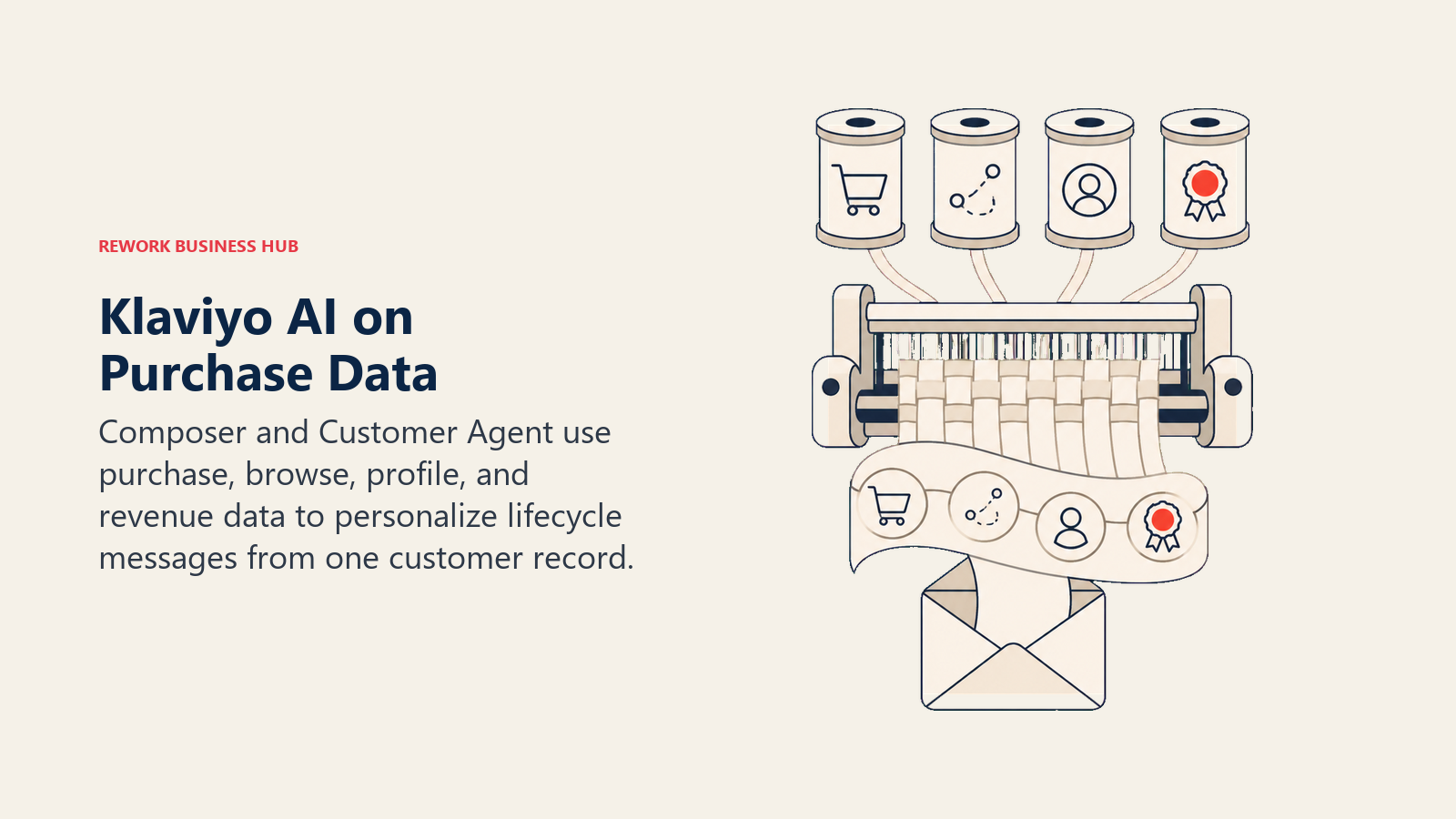
Pricing is where Klaviyo asks for patience. The free plan covers 250 profiles, 500 email sends, and $5 of mobile messaging credit a month. Past that, Email and Email+SMS plans scale by contact count through a live calculator rather than a flat published number, and Composer and Customer Agent are priced at a beta discount as of this update. If contact-based pricing or the ecommerce-first design isn't the fit, best Klaviyo alternatives covers the wider field.
| What you get | What you don't |
|---|---|
| Composer and Customer Agent work from real purchase and browse data | No flat paid tier; recalculate as your list grows |
| Generous free tier: 250 profiles, 500 sends, mobile credit included | Customer Agent is still in beta, not fully mature |
| Deepest revenue attribution tie-in of any lifecycle messaging agent | Contact-based pricing punishes list growth if unmanaged |
Pricing: Free: $0/month (250 profiles, 500 email sends, $5/mo mobile credit). Paid plans scale by contact count via Klaviyo's calculator, no flat self-serve number; Composer and Customer Agent are in beta as of August 2026 at 30% off eventual list pricing.
Best for: Ecommerce brands that want lifecycle messaging AI working from the same data as their revenue reporting. For the wider messaging-agent field, see best AI agents for email marketing.
7. Attentive: AI Journeys for SMS-Led Retention
Attentive built its name on SMS, and its AI is packaged accordingly. AI Essentials (copy generation, automated retargeting) comes free on every plan, AI Pro and AI Grow are flat monthly add-ons for predictive optimization, and AI Journeys, the most agentic tier, is priced pay-per-click and explicitly coordinates cross-channel journeys automatically rather than triggering one channel at a time.
For a retail or DTC brand that already treats SMS as a primary channel, folding email into the same AI Journeys logic is a real advantage over running two separate messaging agents. For a team where email still drives most of the revenue, Attentive's pricing gravity and product design both assume SMS is doing at least as much work, which may not match your program.
| What you get | What you don't |
|---|---|
| AI Journeys coordinate SMS and email from one customer signal | Product and pricing are built SMS-first, email second |
| Usage-based pricing with no credit system to manage | Most AI tier pricing (Pro, Grow) is not published |
| Free AI Essentials included on every plan | Bundling discounts require adopting multiple channels |
Pricing: Usage-based, priced on message volume, subscriber list size, channel count, and which AI products you enable; no flat published rate. AI Essentials is free on every plan; AI Journeys is billed pay-per-click; Enterprise bundles the full AI suite under a custom quote.
Best for: SMS-led DTC and retail brands that want email coordinated inside the same agent as text, not a separate tool.
8. Algolia AI: Agentic Search and a Real Shopping Assistant
Algolia's AI Shopping Assistant handles what a keyword search bar can't: a full-sentence request like "a waterproof jacket under $150 for a rainy commute" gets interpreted, matched against live inventory, and turned into a ranked, purchase-ready set of options. Agent Studio is the layer that makes this genuinely agentic rather than a smarter autocomplete. It checks real-time inventory across locations, applies your merchandising rules, asks a clarifying question when the request is ambiguous, and guides a shopper from discovery through to a completed purchase decision.
Pricing starts free and scales with usage rather than seats. The free tier covers 10,000 search requests a month; Grow and Grow Plus add AI Synonyms, AI Ranking, and deeper personalization on a pay-as-you-go basis; Elevate is a custom annual contract with NeuralSearch and the full Agent Studio feature set. AI-generated shopping guides are free for the first one on any plan, then billed per additional guide.
| What you get | What you don't |
|---|---|
| Agent Studio adds real multi-step reasoning, not just semantic search | Deepest AI features (AI Synonyms, NeuralSearch) sit on higher tiers |
| Free tier genuinely usable for a smaller catalog | Pay-as-you-go pricing scales with traffic, not a flat fee |
| Grounded in live catalog data via retrieval-augmented generation | Elevate tier requires an annual commitment |
Pricing: Free (10K search requests/mo, 50K records); Grow from $0.50 per additional 1K requests; Grow Plus from $1.75 per additional 1K requests; Elevate is custom-quoted. First AI shopping guide free on any plan; additional guides $3.50 each, one-time.
Best for: Stores wanting onsite search that reasons through a shopper's actual request instead of matching keywords.
9. Constructor: Product Discovery Agents Plus a Merchandising Copilot
Constructor runs two distinct agents rather than one. The consumer-facing AI Shopping Agent autonomously researches a shopper's request and refines personalized recommendations in real time, using both the query and behavioral signals. The AI Product Insights Agent explains those recommendations, and the newer Merchant Intelligence Agent (MIA) brings conversational, agentic intelligence to the merchandising team's side of the business, surfacing what's working and what needs attention without someone building a report first.
Constructor's traction is real: it was named a Leader in the 2026 Gartner Magic Quadrant for Search and Product Discovery, and reports its platform now powers 322 billion shopping interactions with 82% customer growth in its most recent fiscal year. That scale comes with enterprise-only positioning. Pricing isn't published anywhere on the site, and implementation is built for large catalogs, not a mid-size store's first agent purchase.
| What you get | What you don't |
|---|---|
| Agents on both the shopper side and the merchandising team's side | No public pricing anywhere; enterprise sales cycle required |
| Gartner-recognized leader in search and product discovery | Built for large catalogs, not a first agent for a smaller store |
| AI Shopping Agent grounded in real-time behavioral signals | Implementation and onboarding are not fast or self-serve |
Pricing: Not published. Custom, enterprise-quoted; see Constructor's agentic commerce overview and request a quote directly.
Best for: Enterprise retailers with large catalogs who want agents covering both shopper-facing discovery and internal merchandising intelligence.
10. Bloomreach Loomi: A Marketing Agent That Builds Campaigns From a Prompt
Loomi Marketing Agent reached general availability in June 2026, and its core trick is converting a single prompt into a fully built campaign workflow: audience, content, and channel logic assembled in minutes rather than the hours or days a legacy tool needs. Under the hood it uses an agentic architecture for multi-step reasoning and complex query handling, governed by your existing merchandising rules and brand voice, and it connects out to third-party customer service, checkout, and review tools so the campaign experience stays consistent end to end. Bloomreach's own case study reports one customer, 260 Sample Sale, saw a 2.4x higher conversion rate while cutting the audience size for a "last chance" campaign by 82%.
Pricing follows Bloomreach's usual module-plus-usage model, billed annually, with Loomi AI included at no extra charge on every plan. The Shopify App Store lists an entry point around $22,500 a year; broader third-party trackers put real enterprise contracts anywhere from the high five figures to well into six or seven figures, and the quoted license typically represents only part of the true first-year cost once implementation and training are added.
| What you get | What you don't |
|---|---|
| One prompt builds a full campaign: audience, content, and channel | No public rate card; annual contracts negotiated per account |
| Loomi AI included at no extra charge on every plan | Quoted license often understates real first-year cost |
| Connects to third-party checkout and review tools for a consistent experience | Built for mid-market and enterprise, not a small store's budget |
Pricing: Not published. Module-plus-usage, billed annually; Shopify App Store lists an entry point around $22,500/year, with broader enterprise contracts reported well into six figures (reported).
Best for: Mid-market to enterprise brands that want campaign creation itself handled by an agent, not just campaign execution.
11. Lily AI: Product Attribute Intelligence That Feeds Search and Discoverability
Lily AI solves a problem upstream of search, merchandising, and agentic commerce alike: most product catalogs describe items the way a merchandiser thinks, not the way a shopper (or a shopping agent) searches. Trained on more than 300 fine-grained classification models against billions of retail data points, Lily AI turns a bare product listing into rich, customer-relevant attributes (fit, occasion, style, material) that improve search relevance, ad performance, and personalization across every channel that reads from the same catalog.
That upstream position matters more in 2026 than it did a few years ago. An AI shopping agent, whether it's your own onsite Agent Studio search or ChatGPT reading your product feed through the Agentic Commerce Protocol, can only work with the attributes actually present in your data. Lily AI doesn't require ripping out your existing commerce stack. It enriches the catalog underneath it, but it's built and priced for enterprise retailers, not a small catalog.
| What you get | What you don't |
|---|---|
| Rich, customer-facing attributes generated at enterprise scale | Enterprise-only pricing and deployment, no self-serve tier |
| Improves search, ads, and personalization from one attribute layer | Overkill for a catalog of a few thousand SKUs or fewer |
| Interoperates with your existing commerce stack, no rip-and-replace | Value depends on how much your current catalog data is missing |
Pricing: Not published. Custom, enterprise-quoted through a demo and ROI estimate.
Best for: Enterprise retailers whose product data is too thin or inconsistent for search, ads, or agentic discovery to work well.
12. Wiser: Automated Competitive Pricing and Repricing
Wiser is the most automation-forward, least chatbot-styled product on this list, and it's worth being direct about that. Wiser doesn't market Price Execution as a conversational "agent," it describes it as AI blended with proven pricing logic. But functionally, it does the agent loop anyway: it collects pricing and product data from more than 10 billion products daily across marketplaces like Amazon, eBay, and Walmart, evaluates that against your profit targets and MAP rules, and executes price changes across channels automatically rather than just flagging them for a person to act on.
For a brand selling across multiple marketplaces plus its own Shopify store, that cross-channel consistency (and MAP enforcement, so an automated repricing run never drops below your approved advertised price) is the real value. Wiser reports results in the range of a 12% sales lift or an 18% margin gain for customers using its pricing automation, though as with any vendor-reported figure, treat it as a starting benchmark to validate against your own catalog rather than a guarantee.
| What you get | What you don't |
|---|---|
| Executes price changes automatically, not just pricing recommendations | Not marketed or built as a conversational AI agent |
| MAP enforcement prevents automated repricing from violating policy | No public pricing; custom enterprise quote required |
| Tracks 10B+ products and 150,000+ sellers daily for context | Best fit is multi-marketplace sellers, less useful for single-storefront brands |
Pricing: Not published. Custom enterprise pricing via demo.
Best for: Multi-channel sellers who need pricing decisions actually executed across marketplaces, not just surfaced in a dashboard.
13. Intelligems: Pricing and Offer Experimentation With an AI Agent Layer
Intelligems is fundamentally a Shopify experimentation platform: it lets you A/B test prices, shipping rates, discounts, and content to find the combination that actually maximizes profit, rather than guessing. Its AI layer, Atlas, is a genuine but secondary addition on top of that core: it recommends tests tailored to your store's own data, helps build them through a visual builder, and connects to ChatGPT and Claude for ideation and analysis. That's a real agentic capability, but it's fair to say Intelligems is an experimentation platform with an AI agent attached, not an agent-first product like Siena or Zowie.
Pricing runs modular. The Shopify App Store lists Smart Content at $69/month and Smart Merchandising or Smart Shipping at $112/month each, with an Unlimited plan starting at $349/month for smaller stores. On Intelligems' own site, the Unlimited plan for larger stores (up to 200,000 orders) runs $1,279/month on a discounted multi-month commitment or $2,894/month standard, with bundle discounts for combining modules.
| What you get | What you don't |
|---|---|
| Atlas AI layer recommends and helps build tests from your own data | Core product is experimentation, not conversational agent-first |
| Modular pricing lets you buy only the test types you need | Price scales sharply with order volume at larger stores |
| Proven at scale: 95%+ of brands find a more profitable price after 3 tests | Requires real traffic volume to reach statistical significance quickly |
Pricing: Shopify App Store tiers from $69-349/month depending on module; Unlimited plan for larger stores runs $1,279/month (discounted, 3-month minimum) to $2,894/month standard, 14-day trial.
Best for: Shopify brands that want to test pricing and offers with AI-assisted recommendations, not run a full conversational commerce agent.
14. Amazon Project Amelia: An AI Agent for Marketplace Sellers, Not Shoppers
Amelia is worth separating clearly from the shopper-facing agents elsewhere on this page, because it solves the opposite problem. Where Gorgias or Zowie help you serve your own customers, Amelia is Amazon's AI co-pilot for the seller side of the business: it delivers status updates on sales and traffic, offers advice on pricing and advertising strategy, diagnoses account issues, and, since gaining agentic capabilities, can take action on a seller's behalf with permission rather than only advising.
Amelia runs on Amazon Bedrock and combines general AI reasoning with Amazon-specific marketplace knowledge, which is the advantage a third-party seller tool can't easily replicate: it sees your actual account data natively. It remains a US beta as of this update, rolling out to more sellers with international and multilingual expansion planned, so availability, not price, is the current constraint.
| What you get | What you don't |
|---|---|
| Free, native access to your own Amazon seller account data | US beta only; not every seller has access yet |
| Business advice plus, increasingly, permissioned autonomous action | Amazon-only; doesn't help with a Shopify or BigCommerce store |
| No separate subscription or contract to negotiate | Feature set still expanding; not yet a full autonomous operator |
Pricing: Free, bundled into Seller Central for eligible sellers.
Best for: Amazon marketplace sellers who want a free AI co-pilot for pricing, advertising, and account health inside Seller Central itself.
Agentic Commerce: How to Get Found and Bought by AI Shopping Assistants
Every vendor above is something you buy and configure. Agentic commerce is different: it's the growing share of your customers who let an AI assistant shop and sometimes check out on their behalf, whether or not you've bought anything at all. NRF found 41% of consumers already use an AI assistant to research products before they buy, and Salesforce measured AI and agents influencing 20% of all global online orders during Cyber Week 2025. Whether your store is part of that traffic is increasingly a data and integration question, not a marketing one. To see whether your products are being recommended at all, Best AEO Tools for Ecommerce in 2026 compares 14 tools on product-level tracking. Schema Markup for AI Search covers what Product schema does and doesn't do for a feed.
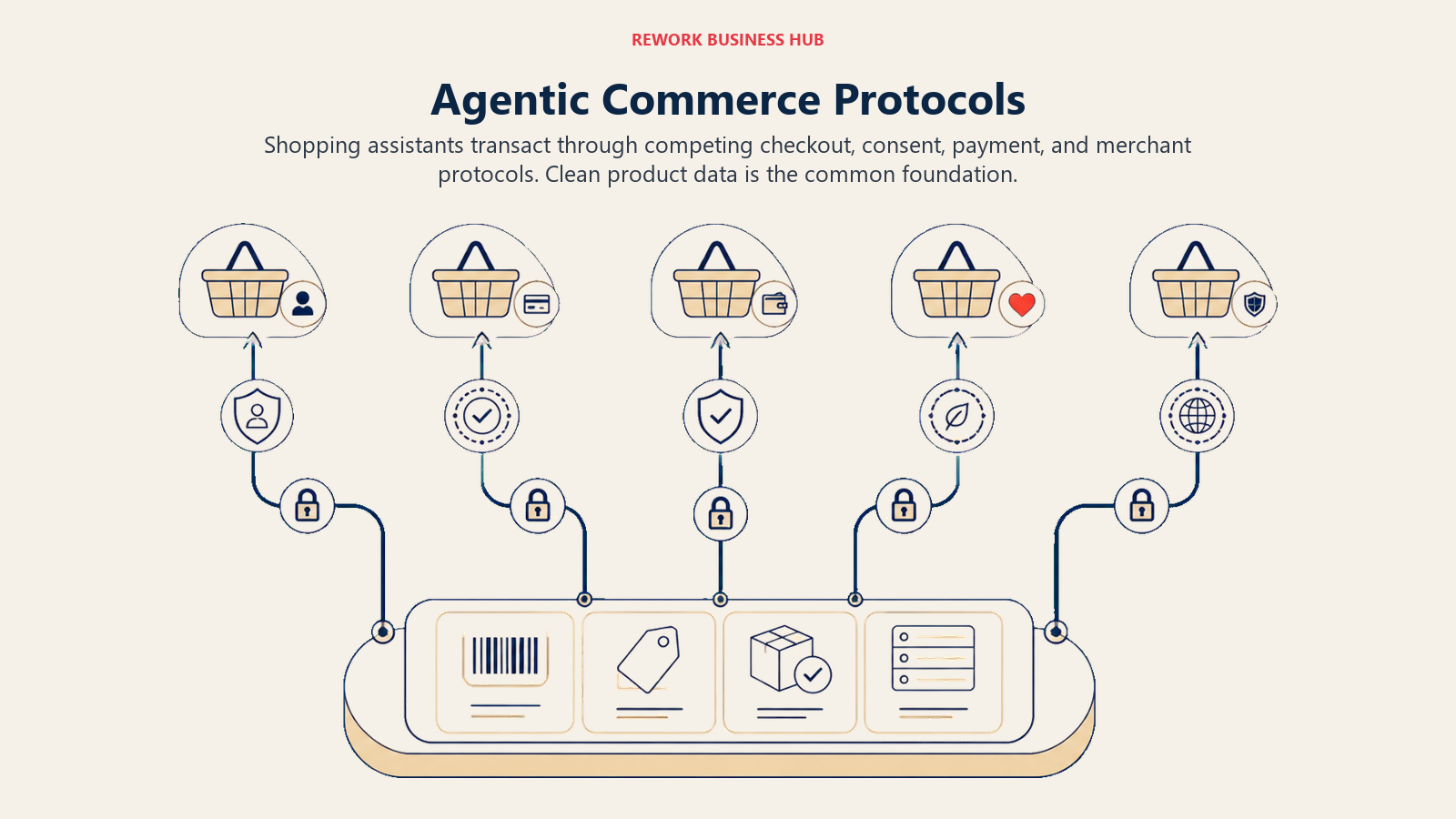
At least five competing specs now govern how an AI agent actually transacts with a merchant, and none of them are fully consolidated yet.
| Protocol or Assistant | Backed By | What It Does | What a Merchant Needs to Do |
|---|---|---|---|
| Agentic Commerce Protocol (ACP) | OpenAI and Stripe (open standard) | Lets ChatGPT complete checkout with a participating merchant without leaving the chat; the merchant stays merchant of record | Integrate through Shopify or Etsy, or the open spec directly; a fee applies only on completed purchases |
| Agent Payments Protocol (AP2) | Google, donated to the FIDO Alliance; 60+ launch partners including Mastercard, PayPal, and American Express | Wraps every agent purchase in signed Intent, Cart, and Payment Mandates so a merchant can verify what the shopper actually authorized | Support mandate verification through your payment processor or commerce platform as it rolls out |
| Visa Trusted Agent Protocol | Visa | Issues a Verified Agent ID plus a signed consumer consent record so a merchant can tell a legitimate shopping agent from a bot | Recognize Visa's agent credential at checkout through your existing payment gateway |
| Mastercard Agent Pay | Mastercard | Binds a tokenized card to a specific agent, merchant, and consent policy through its existing tokenization service | Accept Mastercard's tokenization rails; most gateways will support this without a separate build |
| Alexa for Shopping and Buy for Me (formerly Rufus) | Amazon | Buys from other retailers' sites on a shopper's behalf from inside the Amazon app, using encrypted checkout details | Keep product pages accurate and fast; Amazon's agent reads your live page rather than requiring a separate feed |
| Perplexity Buy with Pro | Perplexity | Lets Perplexity Pro subscribers check out in-chat for participating merchants, with Perplexity funding shipping | Join the free Perplexity Merchant Program for better indexing and the in-chat checkout affordance |
None of this requires a rebuild. The floor is the same clean product data that has always mattered for SEO: accurate titles, current pricing and availability, a real product identifier, and structured JSON-LD markup an agent can parse without rendering your page. What's changed is the cost of skipping it. A page a person might tolerate reading around is a page an agent simply skips, and Shopify's own data shows AI-referred shoppers already convert at a higher rate and a 14% higher average order value than organic search traffic once they do arrive. Lily AI, Constructor, and Algolia's attribute and search-indexing work, covered above, all feed directly into this same discoverability problem, even though none of them are a checkout protocol themselves.
How to Choose: Decision Framework
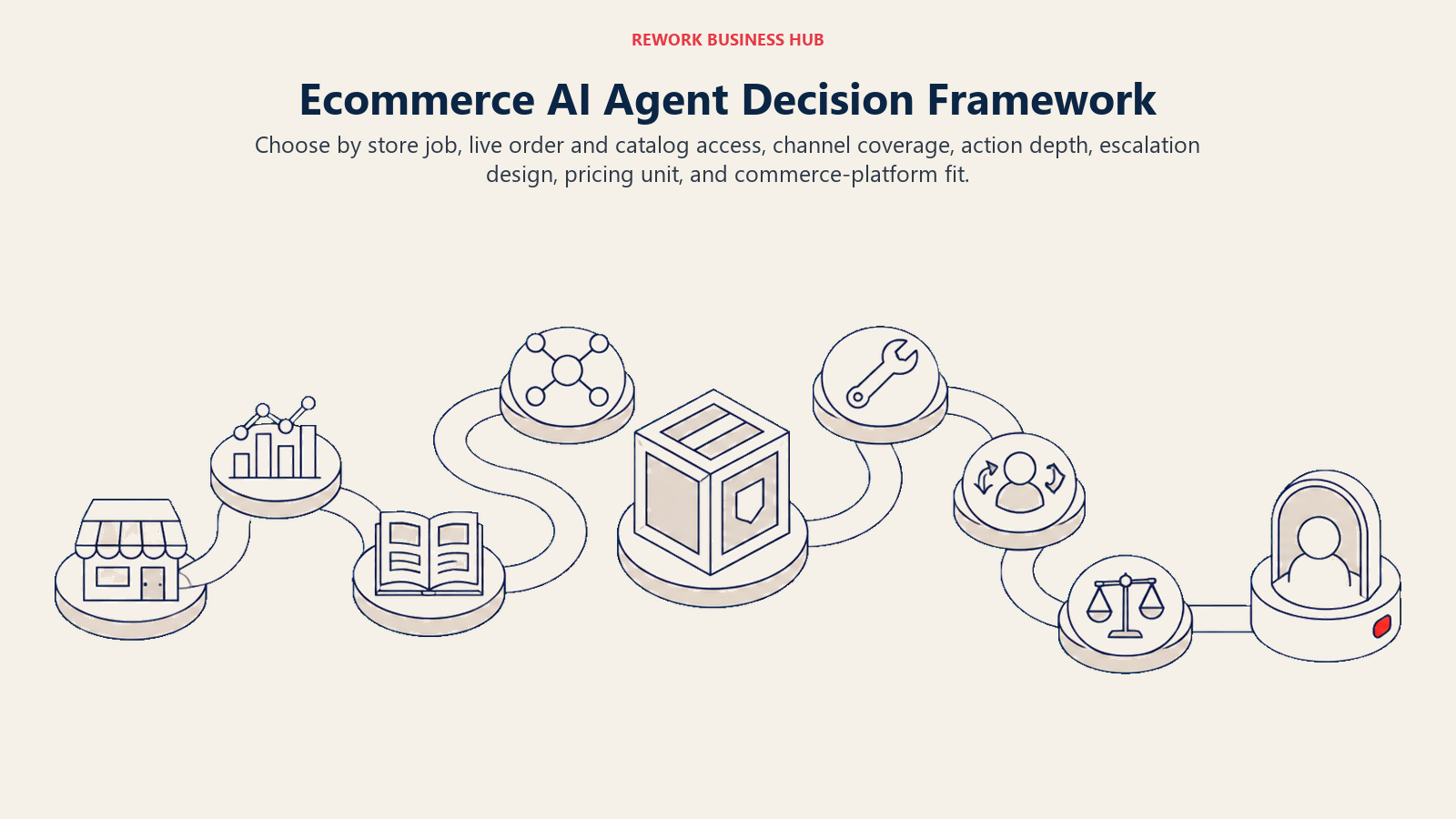
Use this framework to match an ecommerce agent to the store job, live data, action depth, and pricing unit.
| If you need... | Pick... | Why |
|---|---|---|
| A free assistant for store operations before buying anything | Shopify Sidekick | Included with your plan; handles copy, reporting, and admin tasks today |
| Order-aware support for a Shopify or BigCommerce store | Gorgias AI Agent | Live order, shipping, and return data in every answer |
| Enterprise-grade support that takes real action, not just replies | Zowie | Executes refunds, reships, and account changes at high autonomy |
| Agentic CX built specifically for a DTC brand's channel mix | Siena AI | Native across email, chat, WhatsApp, SMS, and social from day one |
| One agent covering pre-purchase sales chat and post-purchase support | Rep AI | Same thread handles "will this fit me" and "where's my order" |
| Lifecycle messaging tied to real purchase and browse data | Klaviyo AI | Composer and Customer Agent work from the same data as revenue reporting |
| SMS-first retention with email folded into the same agent | Attentive | AI Journeys coordinate both channels from one customer signal |
| Agentic onsite search that answers "what should I buy" | Algolia AI or Constructor | Both run multi-step reasoning against live catalog and inventory data |
| A marketing agent that builds full campaigns from a prompt | Bloomreach Loomi | Converts one instruction into a targeted, connected campaign |
| Weak or inconsistent product data undermining search and ads | Lily AI | Purpose-built attribute intelligence, not a general search layer |
| Automated competitive pricing across many marketplaces | Wiser | Tracks 10B+ products daily and can execute price changes |
| Live price and offer testing instead of guessing | Intelligems | Purpose-built experimentation platform with an AI recommendation layer |
| A free co-pilot for an Amazon marketplace business | Amazon Project Amelia | Native access to Amazon's own seller data at no extra cost |
Ecommerce AI Agent Buying Mistakes to Avoid
These mistakes expose the gaps that appear when action depth, pricing, product data, and escalation are not tested together.
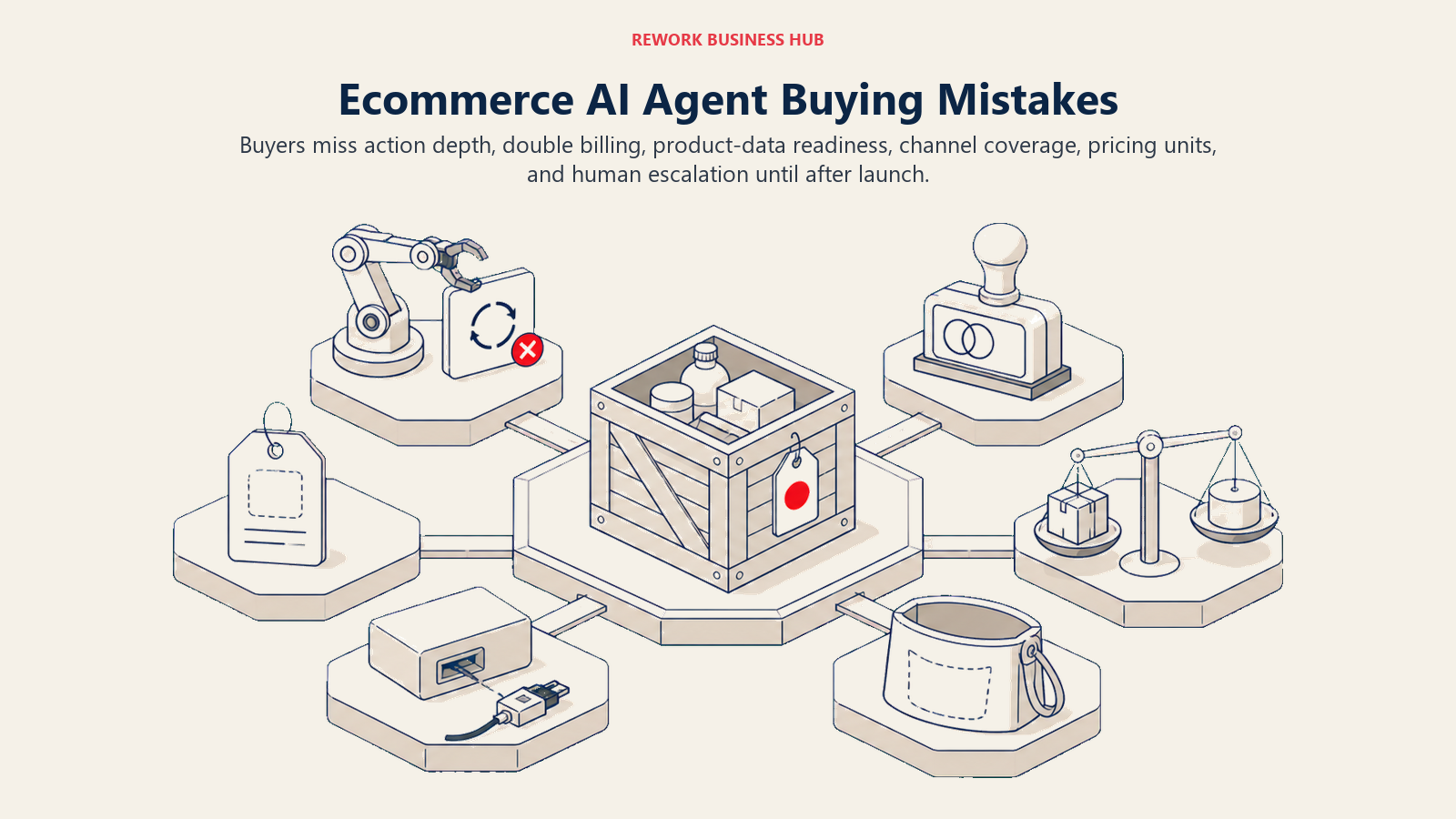
| Mistake | What It Looks Like | What to Do Instead |
|---|---|---|
| Buying an "agent" that's really a chatbot with a new label | Paying agent pricing for something that only drafts replies for a human to send | Ask the vendor to show it completing an action, like a refund or a price change, without a human click |
| Missing the double-billing trap in resolution pricing | Budgeting for Gorgias's advertised base plan, then getting billed for each AI resolution as a ticket too | Model your actual monthly resolution volume against the full rate card before signing |
| Assuming agentic commerce readiness happens automatically | Discovering your product pages aren't structured for an AI agent to read once a competitor starts winning that traffic | Audit your product feed for clean identifiers, current pricing, and JSON-LD markup now |
| Picking a support agent before checking channel coverage | Buying a Shopify-native agent, then realizing half your support volume is WhatsApp and Instagram DM | Match the agent to where your customers actually message you, not just email and chat |
| Treating every vendor's pricing model as apples to apples | Comparing Klaviyo's contact-based pricing directly against Zowie's per-conversation rate | Model each vendor's pricing against your own volume, not their advertised floor |
| Ignoring what happens when the agent is wrong | Deploying an agent with no escalation path for an angry customer or an unusual refund | Require a defined handoff to a human for high-value or ambiguous cases before launch |
What to Do Next
Pick one agent tied to your loudest operational problem, not the one with the flashiest demo. If support tickets are piling up, trial Gorgias AI Agent or Zowie against 30 days of real tickets before committing to an annual contract. If lifecycle messaging is still manual, connect Klaviyo AI or Attentive to your actual list and measure the lift against your current flows. And regardless of which vendor you pick, spend an afternoon this month auditing your product feed for the clean titles, current pricing, and structured data that every agent on this page, and every AI shopping assistant your customers already use, depends on to find you in the first place. If you'd rather build a narrow agent than buy one of the platforms above, AI Agents for Ecommerce: 8 Use Cases to Deploy First is the place to start.

Principal Product Marketing Strategist
On this page
- Updated August 2026: What Changed
- Key Facts
- Agent, AI Tool, or Build-It-Yourself: Where This List Fits
- Quick Comparison Table
- 1. Shopify Sidekick: The Free Baseline Built Into the Platform
- 2. Gorgias AI Agent: Order-Aware Resolution for Shopify and BigCommerce Stores
- 3. Zowie: High-Autonomy Actions for Enterprise Ecommerce Support
- 4. Siena AI: Agentic Customer Experience Built for DTC Brands
- 5. Rep AI: An Onsite Sales and Support Agent That Watches Live Visitors
- 6. Klaviyo AI: Lifecycle Messaging Tied Directly to Purchase Data
- 7. Attentive: AI Journeys for SMS-Led Retention
- 8. Algolia AI: Agentic Search and a Real Shopping Assistant
- 9. Constructor: Product Discovery Agents Plus a Merchandising Copilot
- 10. Bloomreach Loomi: A Marketing Agent That Builds Campaigns From a Prompt
- 11. Lily AI: Product Attribute Intelligence That Feeds Search and Discoverability
- 12. Wiser: Automated Competitive Pricing and Repricing
- 13. Intelligems: Pricing and Offer Experimentation With an AI Agent Layer
- 14. Amazon Project Amelia: An AI Agent for Marketplace Sellers, Not Shoppers
- Agentic Commerce: How to Get Found and Bought by AI Shopping Assistants
- How to Choose: Decision Framework
- Ecommerce AI Agent Buying Mistakes to Avoid
- What to Do Next