Penyelidikan Akaun AI pada Halaju Jualan SaaS: Penyediaan Pra-Panggilan Bawah 5 Minit yang Benar-benar Mempersonalisasi
Turn this article into takeaways for your work.


Each assistant summarizes the article only for you and suggests best practices for your work.
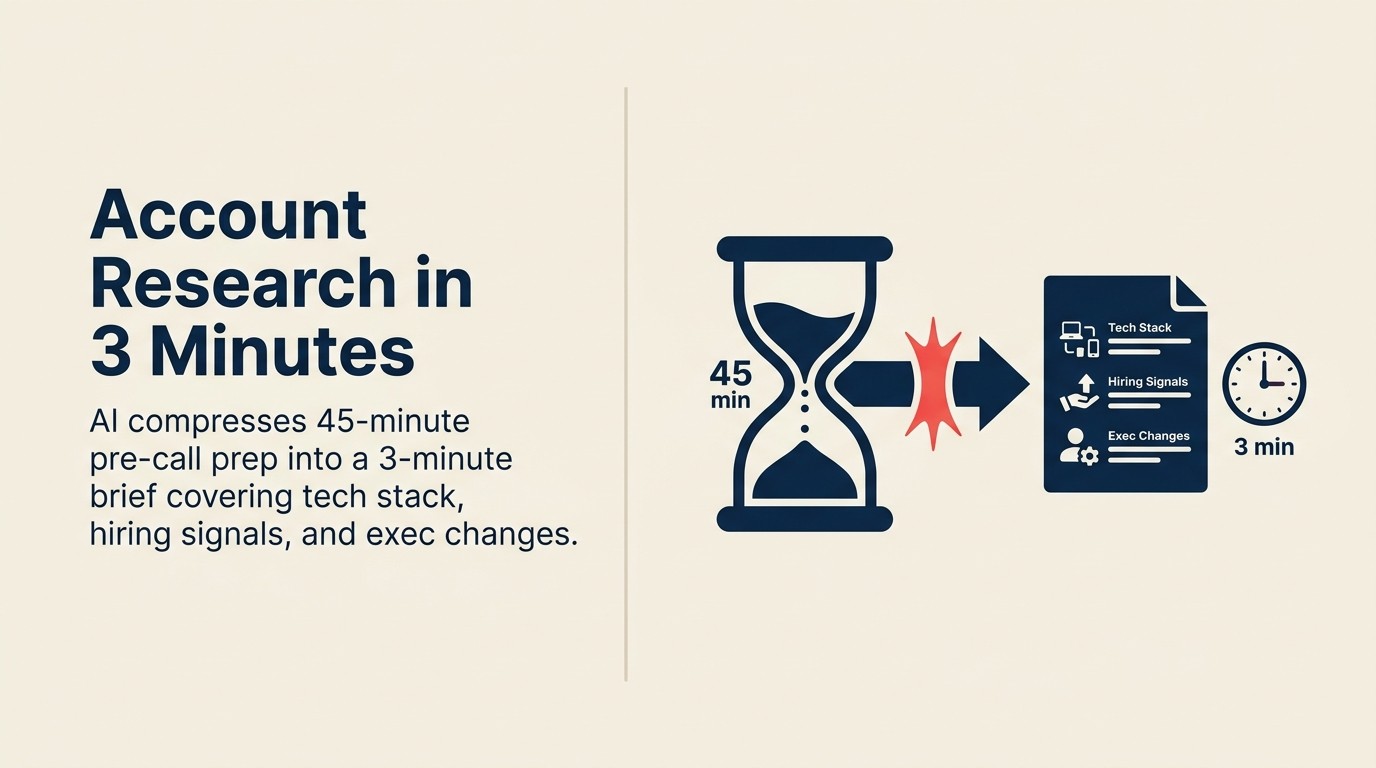
Seorang AE (Account Executive) SaaS menempah panggilan discovery. Ia masuk ke dalam kalendar pada hari Selasa jam 2 petang. Pada hari Isnin jam 1:45 petang, AE tersebut membuka CRM mereka, menyedari panggilan itu adalah esok jam 2 petang, dan menghabiskan empat puluh lima minit berikutnya melakukan apa yang sentiasa mereka lakukan: membaca laman web syarikat, menyemak LinkedIn untuk sejarah jawatan prospek, menarik ringkasan pembiayaan Crunchbase, mengimbas G2 untuk ulasan perisian yang prospek mungkin akan gantikan, dan menyusun gambaran kasar tentang mengapa akaun ini mungkin mengambil berat tentang apa yang mereka jual.
Empat puluh lima minit. Untuk setiap panggilan pertama. Bagi seorang AE mid-market yang menjalankan lima belas panggilan discovery setiap minggu, itu adalah sebelas jam penyelidikan. Sepanjang setahun, itu adalah 550 jam kerja yang tidak secara langsung menutup tawaran. McKinsey menganggarkan bahawa AI boleh mengautomasikan 60-70% masa yang diluangkan profesional jualan untuk aktiviti bukan-jualan, dengan penyelidikan akaun menjadi salah satu tugas bervolum paling tinggi dalam kategori tersebut.
Penyelidikan akaun AI memotong masa itu kepada tiga minit. Bukan dengan melakukan penyelidikan yang lebih sedikit. Tetapi dengan melakukannya lebih cepat dan mensintesiskan dengan lebih baik daripada kebanyakan jurujual lakukan secara manual.
Apa yang sebenarnya dimuat oleh brifing penyelidikan akaun AI yang baik
Sebelum membincangkan alat, ada baiknya menjadi spesifik tentang rupa output. Brifing akaun yang dijana AI bukan senarai fakta syarikat yang boleh Anda dapatkan dari LinkedIn dalam dua minit. Itu adalah data, bukan penyelidikan. Brifing yang menjadikan panggilan pertama lebih bermakna mengandungi sintesis.
Key Facts: Penyelidikan Akaun AI untuk Jualan SaaS
- Ejen AI kini menghasilkan brifing akaun dalam masa bawah 5 minit per akaun yang sebelum ini memerlukan 30-60 minit penyelidikan SDR (Sales Development Representative) manual, dengan satu platform melaporkan peningkatan 42% dalam sales velocity selepas penggunaan (Salesmotion B2B Sales Automation Benchmarks, 2025)
- McKinsey menganggarkan jurujual menghabiskan kurang dari 30% masa mereka bersama pelanggan, dengan bakinya hilang untuk menggubal e-mel, mengemaskini rekod CRM, dan menyediakan cadangan. Penyelidikan akaun adalah komponen tunggal terbesar masa bukan-jualan tersebut untuk motion discovery-heavy SaaS
- Syarikat B2B SaaS yang mengurangkan kitaran jualan kepada 30-45 hari mencapai 38% lebih tinggi pipeline velocity berbanding syarikat yang mengambil purata 76-90 hari, dan penyelidikan akaun AI adalah salah satu tuas utama yang memampatkan panjang kitaran (Optifai Sales Cycle Benchmarks, 2025)
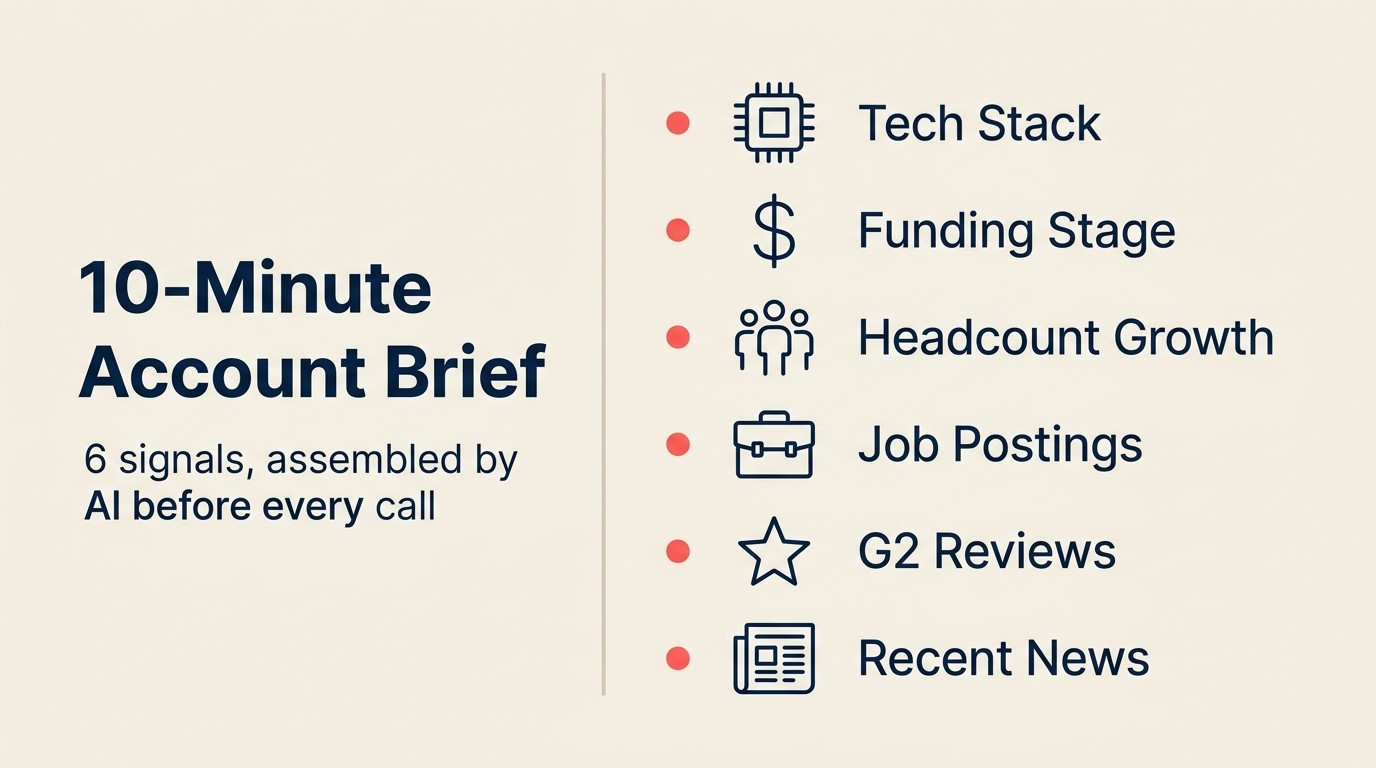
Tech stack. Perisian apa yang sedang dijalankan oleh akaun tersebut? BuiltWith dan Wappalyzer mengenal pasti alat pemasaran, CRM, analitik, dan infrastruktur yang kelihatan dari laman web syarikat. Untuk syarikat SaaS yang menjual produk yang mengintegrasikan atau menggantikan alat biasa, ini adalah maklumat yang boleh terus diambil tindakan. Jika mereka menjalankan HubSpot dan Anda menjual alat atribusi yang lebih baik, Anda tahu titik permulaan perbualan.
Kebaruan dan peringkat pembiayaan. Syarikat Siri B yang mengumpul $40 juta lapan bulan lalu mempunyai bajet dan tekanan untuk menunjukkan hasil. Syarikat yang mengumpul empat tahun lalu dan tidak mengumumkan pusingan baru sama ada menguntungkan dan tidak berkembang pesat, atau menghadapi masalah. Crunchbase dan PitchBook mendedahkan ini dalam beberapa saat. Implikasi untuk pitch Anda berbeza dengan ketara.
Perubahan headcount. Isyarat perubahan organisasi LinkedIn Sales Navigator antara input paling berguna untuk jualan SaaS. VP Jualan baru yang diambil tiga bulan lalu bermakna mereka kemungkinan besar sedang menilai alat jualan. Headcount pasukan jualan berkembang 30% dalam dua belas bulan bermakna motion penskalaan sedang berlangsung, dan kebersihan CRM kemungkinan mengalami masalah. Headcount kejuruteraan yang mengecil bermakna mereka mengurangkan keutamaan pelaburan produk. Isyarat ini bukan petunjuk pasti, tetapi ia adalah hipotesis permulaan yang boleh Anda uji dalam panggilan.
Penyiaran kerja aktif. Syarikat menyiarkan apa yang mereka cuba bina. Jika akaun mempunyai lima peranan terbuka untuk penganalisis data dan dua untuk jurutera BI, mereka melabur dalam infrastruktur analitik. Jika mereka mengambil pengurus customer success, mereka menskalakan CS. Papan kerja adalah salah satu isyarat paling dipercayai untuk di mana syarikat membelanjakan bajet dan perhatian pada masa ini.
Kesakitan pesaing di laman ulasan. Ulasan G2 dan Capterra untuk perisian yang sedang digunakan prospek Anda memberitahu Anda apa yang rosak. Ini benar-benar kurang digunakan. Jika sebuah syarikat mempunyai lima belas orang yang mengulas CRM semasa mereka di G2 dan lapan daripada ulasan tersebut menyebut "pelaporan adalah mimpi ngeri," Anda masuk ke dalam panggilan mengetahui kesakitan tersebut. Anda tidak meneka. Anda membacanya dari pekerja mereka sendiri. Penyelidikan Gartner mengenai perjalanan pembelian B2B mengesahkan bahawa pembeli berunding dengan purata enam hingga sepuluh sumber maklumat sebelum bersetuju dengan mesyuarat pertama, dan ulasan rakan sebaya di laman seperti G2 adalah antara yang paling dipercayai.
Berita terkini. Google News, berita Crunchbase, dan kemas kini syarikat LinkedIn mendedahkan pelancaran produk, perubahan kepimpinan, liputan akhbar, dan pengumuman strategik dari enam puluh hari lalu. Muncul dengan mengetahui mereka baru sahaja berkembang ke Eropah atau mengambil CMO baru bukan sanjungan. Ia adalah persediaan.
The 10-Minute Account Brief
The 10-Minute Account Brief adalah format output standard untuk penyelidikan akaun AI pada halaju jualan SaaS: sintesis empat hingga enam ayat yang dihantar ke workflow rep dua jam sebelum panggilan yang dijadualkan, meliputi tech stack, kebaruan pembiayaan, isyarat headcount, satu titik kesakitan pesaing dari ulasan awam, dan satu item berita terkini. Nama sepuluh minit merujuk kepada jumlah masa rep yang diperlukan: dua minit untuk menyemak brifing ditambah masa yang jimat berbanding penyelidikan manual. Brifing harus mengandungi sekurang-kurangnya satu pandangan yang akan diiktiraf oleh prospek sebagai khusus untuk syarikat mereka, bukan kohort industri mereka. Jika brifing boleh digunakan untuk mana-mana syarikat dalam segmen yang sama, ia adalah pengagregatan data, bukan penyelidikan akaun. Format sepuluh minit dikalibrasi khusus untuk halaju jualan SaaS mid-market: cukup mendalam untuk mempersonalisasi panggilan pertama, cukup cepat untuk tidak bersaing dengan masa rep.
| Jenis Isyarat | Sumber | Apa yang Diberitahu | Relevan SaaS |
|---|---|---|---|
| Tech stack | BuiltWith, Wappalyzer | Perisian semasa yang dijalankan | Peluang integrasi, isyarat penggantian |
| Kebaruan pembiayaan | Crunchbase, PitchBook | Tekanan bajet dan pertumbuhan | Keterdesakan pembelian dan potensi saiz tawaran |
| Perubahan headcount | LinkedIn Sales Navigator | Keutamaan pengambilan pekerja | Di mana mereka melabur bajet sekarang |
| Penyiaran kerja aktif | LinkedIn, Indeed | Apa yang mereka bina | Pelaburan infrastruktur dan keperluan pembelian |
| Ulasan pesaing G2 | G2, Capterra | Titik kesakitan perisian semasa | Perisikan bantahan pra-layak |
| Berita terkini | Google News, LinkedIn | Konteks strategik | Pembukaan untuk outreach yang dipersonalisasi |
Sumber: Dokumentasi produk Clay, ZoomInfo, Apollo, Cognism (2025)
Corak Generative Research diterapkan pada penyelidikan akaun
Sebab penyelidikan akaun AI secara kualitatif berbeza dari "Googling yang lebih baik" adalah sintesis. Corak Generative Research dalam ACE Framework berfungsi dengan menggabungkan Ingest (menarik data berstruktur dan tidak berstruktur dari pelbagai sumber) dengan Analyze (mengekstrak corak dan kepentingan) dan Generate (menghasilkan ringkasan yang boleh digunakan dengan tindakan yang disiratkan).
Output bukan "berikut adalah tujuh fakta tentang syarikat ini." Ia adalah "berdasarkan ulasan G2 mereka, kesakitan adalah akses pelaporan, bukan keterlihatan pipeline. Pengambilan VP Jualan terbaru mereka datang dari Salesloft, jadi mereka mempunyai pandangan berorientasikan proses tentang sales ops. Mereka menggunakan HubSpot tetapi tidak mengisi medan CRM secara konsisten berdasarkan keperluan penyiaran kerja untuk 'admin Salesforce.'" Itu adalah kluster pandangan. Ia memberitahu AE di mana untuk menyiasat dahulu dan apa yang tidak perlu diandaikan.
Alat seperti Clay, penyelidikan AI Apollo, ZoomInfo Copilot, dan Cognism semuanya beroperasi variasi corak ini. Clay amat berkuasa untuk pasukan yang ingin menyesuaikan logik penyelidikan: Anda menentukan sumber isyarat, arahan sintesis, dan format output, dan Clay menyusun brifing untuk setiap akaun dalam pipeline Anda. Untuk tawaran perusahaan dengan keperluan penyelidikan panjang, ZoomInfo Copilot menyediakan data peringkat organisasi yang lebih mendalam. Untuk pasukan SDR yang menjalankan outbound bervolum tinggi, penyelidikan AI Apollo mencipta brifing yang mencukupi pada kelajuan yang diperlukan.
Logik asasnya adalah sama merentasi semua alat: ingest dari pelbagai sumber, analyze untuk relevan dengan motion jualan Anda, generate brifing yang mendedahkan isyarat yang layak untuk ditindaklanjuti.
Personalisasi sebenar berbanding personalisasi palsu
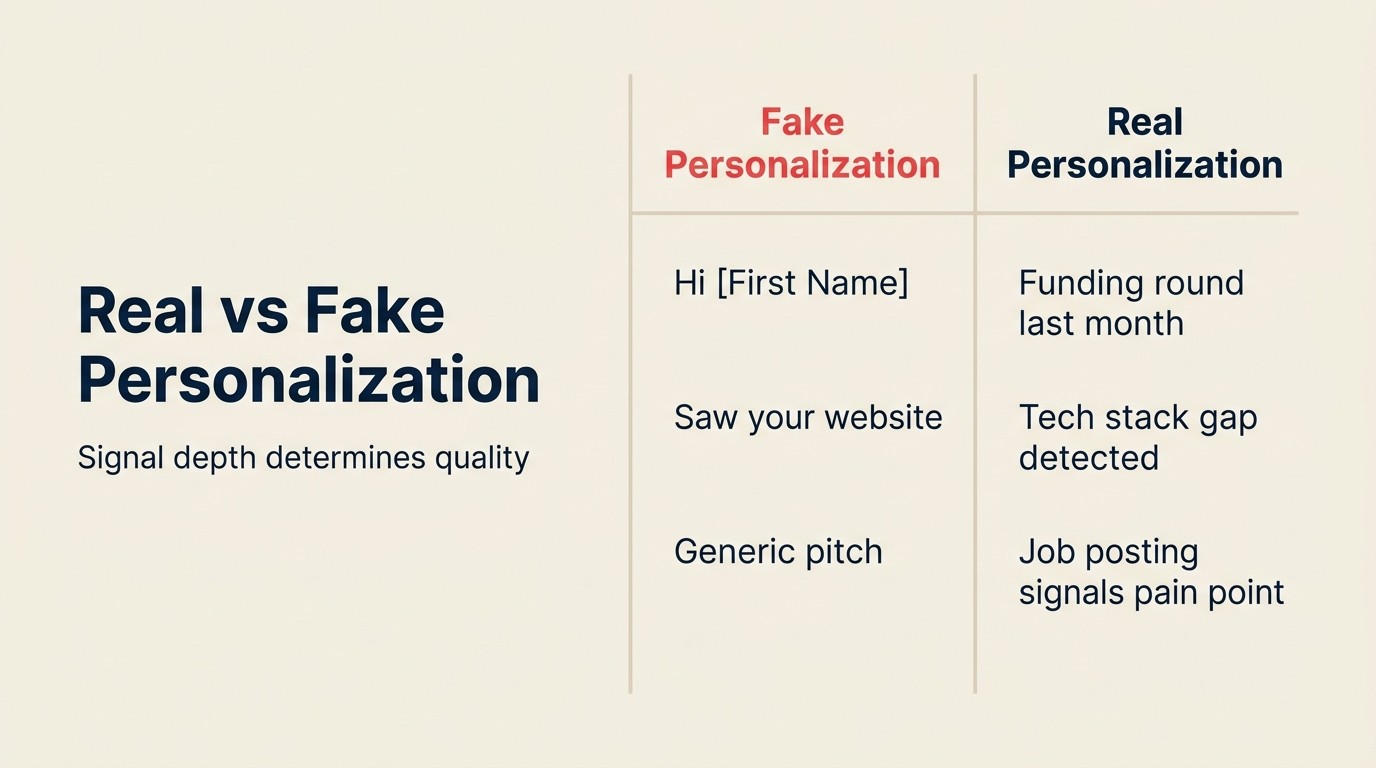
Terdapat perbezaan antara penyelidikan AI yang membolehkan personalisasi sebenar dan templat AI yang menghasilkan personalisasi palsu.
Personalisasi palsu kelihatan seperti: "Hai [Nama], saya perasan Anda baru-baru ini [menghadiri/menyukai/mengulas] [perkara generik]. Saya bekerja dengan syarikat seperti Anda tentang [masalah generik]..."
Personalisasi sebenar kelihatan seperti: "Hai Sarah, saya melihat ketua CS Acme menulis minggu lalu tentang cabaran menskalakan penyediaan QBR manual apabila pangkalan pelanggan berkembang. Kami bekerja dengan pasukan CS di [syarikat serupa] dan [syarikat serupa] yang menyelesaikan masalah khusus itu. Berbaloi untuk panggilan 20 minit?"
Perbezaannya adalah mesej kedua memerlukan pengetahuan khusus tentang situasi sebenar akaun. Penyelidikan akaun AI menjadikan pengetahuan khusus itu tersedia untuk setiap akaun dalam pipeline Anda, bukan hanya yang kebetulan Anda lakukan penyelidikan manual mendalam.
Peraturan taktikal: brifing yang dijana AI harus mengandungi sekurang-kurangnya satu pandangan yang akan diiktiraf prospek sebagai benar-benar khusus untuk syarikat mereka. Bukan industri mereka, bukan kohort saiz syarikat mereka. Syarikat mereka. Jika brifing tidak mengandungi itu, ia bukan penyelidikan. Ia adalah pengagregatan data.
Perusahaan vs. SMB: kedalaman penyelidikan yang berbeza
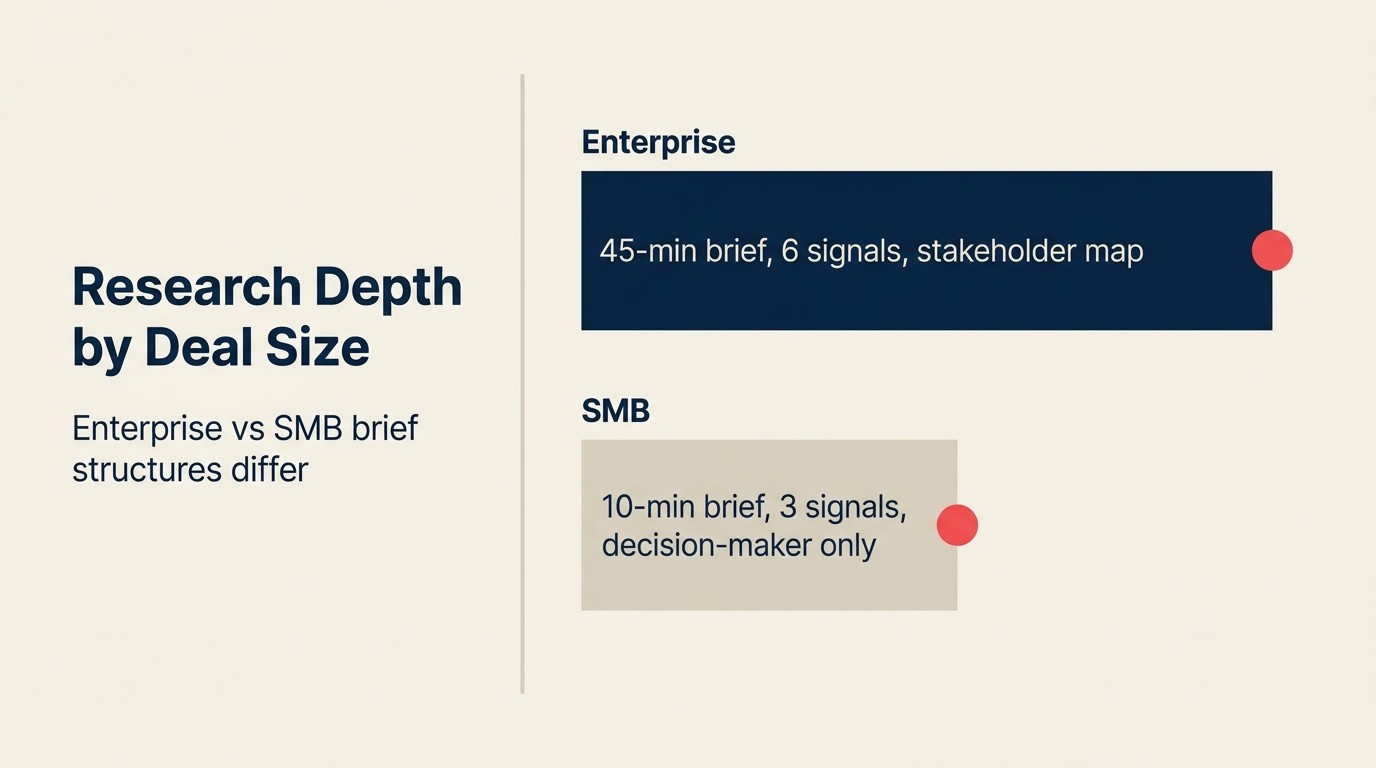
Kedalaman penyelidikan yang betul berbeza dengan ketara mengikut saiz tawaran dan motion jualan.
Untuk tawaran perusahaan ($100K+ ACV), brifing mewajarkan analisis yang lebih mendalam: pemetaan pihak berkepentingan, struktur pelaporan, hubungan vendor sedia ada, pelaburan teknologi sebelumnya, keperluan undang-undang atau pematuhan, dan inisiatif strategik terkini yang kelihatan dari pemfailan awam atau akhbar. Corak Generative Research dalam konteks ini mungkin mengagregat lebih dua puluh sumber dan menghasilkan brifing tiga hingga lima muka surat yang disemak AE sebelum panggilan discovery berbilang pihak berkepentingan.
Untuk akaun SMB pada halaju SaaS (sub-$20K ACV, kitaran jualan lima hingga sepuluh hari), kedalaman ini tidak perlu dan terlalu lambat. Apa yang diperlukan jualan SaaS SMB adalah pengecaman corak merentasi akaun serupa, bukan kajian mendalam individu. Brifing penyelidikan AI untuk akaun SMB harus mengambil sembilan puluh saat untuk dijana dan dua minit untuk dibaca. Ia menjawab: apakah tech stack mereka, adakah mereka berkembang atau mengecut, dan adakah terdapat satu isyarat yang menjadikan mereka pembeli yang munasabah sekarang?
Perbezaan dalam perkakas: pasukan perusahaan melabur dalam ZoomInfo Copilot atau Clay dengan sumber data yang diperkaya. Pasukan SMB memerlukan workflow yang dioptimumkan kelajuan Apollo atau Cognism di mana brifing dijana secara automatik apabila lead memasuki urutan dan dihantar sebelum sentuhan pertama, bukan hanya sebelum panggilan pertama.
Mengintegrasikan penyelidikan akaun ke dalam workflow jualan
Alat penyelidikan terbaik adalah yang menghantar brifing sebelum AE perlu memintanya. Itu bermakna mengintegrasikan ke dalam workflow daripada memerlukan AE menavigasi ke alat berasingan.
Corak yang berfungsi di syarikat SaaS mid-market: brifing dijana secara automatik apabila prospek menempah mesyuarat (melalui Calendly atau serupa), dihantar kepada AE melalui mesej Slack dan dicatatkan dalam CRM dua jam sebelum panggilan. AE membuka Slack, membaca brifing empat hingga enam ayat, dan masuk ke dalam panggilan dengan konteks. Tiada log masuk berasingan. Tiada pencetus manual.
Alat seperti modul Sales AI Rework, Salesloft, dan Outreach semuanya menyokong corak penghantaran ini. Brifing tiba dalam workflow di mana AE sudah bekerja. Penyelidikan tidak bersaing untuk perhatian; ia muncul di mana perhatian sudah berada.
Untuk pasukan yang ingin menjadi lebih canggih, lapisan brifing kedua dijana secara automatik selepas panggilan pertama, menggabungkan nota dari rakaman panggilan (corak Meeting Intelligence) dan mengemas kini brifing akaun untuk perbualan seterusnya. Setiap titik sentuh memperkaya brifing daripada memerlukan AE mengekalkan nota mereka sendiri.
Isyarat yang menunjukkan penyelidikan akaun berfungsi
Tiga metrik menunjukkan sama ada pelaburan penyelidikan akaun AI Anda berhasil:
Pengurangan masa penyediaan pra-panggilan. Jadikan ini garis dasar sebelum menggunakan alat. Berapa lama AE median Anda menghabiskan masa untuk penyelidikan pra-panggilan hari ini? Jika ia lebih dari tiga puluh minit per mesyuarat, memotongnya kepada tiga hingga lima minit membebaskan masa jualan yang besar setiap minggu. Masa itu boleh digunakan untuk lebih banyak panggilan, susulan yang lebih baik, atau discovery yang lebih menyeluruh. Ini adalah sebahagian daripada bagaimana AI membentuk semula model operasi SaaS di peringkat rep.
Kadar penukaran panggilan pertama. Ukuran paling langsung kualiti penyelidikan. Jika kadar penukaran Anda dari panggilan discovery pertama kepada peluang layak bertambah baik sebanyak sepuluh hingga lima belas mata peratusan selepas menggunakan penyelidikan AI, brifing mendedahkan maklumat yang mencipta perbualan yang lebih baik. Ini mengambil masa dua hingga tiga bulan untuk menunjukkan dengan jelas.
Kadar mesyuarat-kepada-peluang mengikut kedalaman penyelidikan. Bandingkan kadar mesyuarat-kepada-peluang untuk panggilan di mana brifing AI digunakan berbanding panggilan di mana ia tidak (kerana brifing tidak dihantar tepat pada masanya, atau AE tidak membukanya). Jika jurangnya ketara, Anda mempunyai bukti bahawa kualiti penyelidikan mempengaruhi perkembangan tawaran pada peringkat paling awal.
Panggilan discovery yang dibantu brifing menukar kepada peluang layak pada kadar 15-25% lebih tinggi daripada panggilan tanpa brifing dalam pasukan SaaS mid-market yang telah menjalankan perbandingan terkawal. Jurang penukaran itu berganda: rep yang menjalankan 15 panggilan discovery setiap minggu dengan brifing AI menjana 2-4 peluang layak tambahan setiap minggu berbanding garis dasar tanpa brifing. Sepanjang suku tahun, itu adalah 25-50 peluang tambahan dari kapasiti rep yang sama, pada CAC inkremental sifar.
Rework Analysis: Mod kegagalan penyelidikan akaun AI yang paling biasa adalah membina brifing yang komprehensif tetapi tidak boleh ditindaklanjuti. Rep yang menerima profil syarikat sepuluh mata mengimbas dan tidak membawa apa-apa ke dalam panggilan, kerana tiada isyarat "mulakan dengan ini" yang jelas. Brifing terbaik mengutamakan satu isyarat di atas yang lain: satu perkara yang perlu dibawa oleh rep dalam lima minit pertama. Untuk SaaS, itu hampir selalu sama ada titik kesakitan pesaing G2 ("pasukan Anda telah mengulas CRM semasa Anda dan lapan daripada lima belas ulasan menyebut isu pelaporan") atau perubahan organisasi terkini ("Anda baru sahaja mengambil VP Jualan dari Outreach, jadi dia datang dengan metodologi ops khusus yang sudah ada"). Satu isyarat kuat mengatasi sepuluh yang lemah.
Di luar panggilan pertama
Penyelidikan akaun AI tidak berhenti pada panggilan discovery pertama. Corak Generative Research terus menjana nilai sepanjang kitaran jualan.
Sebelum demo produk, brifing dikemas kini dengan apa yang Anda pelajari dalam discovery. Sebelum panggilan berbilang pihak berkepentingan, ia menambah konteks tentang keutamaan masing-masing peserta berdasarkan peranan dan aktiviti terkini mereka. Sebelum rundingan kontrak, ia mendedahkan maklumat tentang corak perolehan prospek dan hubungan vendor masa lalu.
Tetapi panggilan pertama adalah di mana ia paling penting. Era e-mel sejuk "saya hanya ingin memperkenalkan diri" sudah berakhir. Pembeli tahu Anda mempunyai akses kepada tech stack mereka, aktiviti pengambilan pekerja mereka, dan ulasan G2 mereka. Soalannya adalah sama ada Anda benar-benar telah membacanya. Analisis McKinsey tentang AI dalam jualan B2B mendapati bahawa jurujual yang dilengkapi AI boleh meluangkan lebih banyak masa dalam aktiviti bernilai tinggi seperti membina hubungan dan mengendalikan rundingan kompleks, daripada penyelidikan manual yang automasi kendalikan dengan baik. Penyelidikan akaun AI menjadikan jawapannya ya, untuk setiap akaun, tanpa kos marginal tambahan per panggilan.
Untuk konteks AI jualan yang lebih luas, AI Sales Operator untuk Pipeline B2B SaaS meliputi tindanan corak penuh termasuk pemarkahan lead, analisis panggilan, dan ramalan pipeline. Untuk sisi penukaran corong pemerolehan, AI untuk Penukaran Percubaan SaaS kepada Berbayar melanjutkan di mana pemerolehan outbound berakhir.
Soalan Lazim
Apakah 10-Minute Account Brief dalam jualan SaaS?
The 10-Minute Account Brief adalah format output standard untuk penyelidikan akaun AI pada halaju jualan SaaS: sintesis empat hingga enam ayat yang dihantar ke workflow rep dua jam sebelum panggilan yang dijadualkan, meliputi tech stack, kebaruan pembiayaan, isyarat headcount, satu titik kesakitan pesaing dari ulasan awam, dan satu item berita terkini. Nama ini merujuk kepada jumlah masa rep yang diperlukan: dua minit untuk menyemak brifing ditambah masa penyediaan yang jimat berbanding penyelidikan manual. Brifing mesti mengandungi sekurang-kurangnya satu pandangan khusus untuk syarikat tersebut, bukan kohort industri mereka.
Berapa banyak masa penyelidikan akaun AI jimat untuk rep jualan SaaS?
Ejen AI menghasilkan brifing akaun dalam masa bawah lima minit per akaun yang sebelum ini memerlukan 30-60 minit penyelidikan SDR manual. Bagi AE mid-market yang menjalankan 15 panggilan discovery setiap minggu, itu adalah 6-10 jam masa penyelidikan yang dipulihkan setiap minggu dan diubah hala kepada perbualan yang berhadapan dengan pelanggan. Satu platform automasi jualan melaporkan peningkatan 42% dalam pipeline velocity selepas menggunakan penyelidikan akaun AI pada skala. McKinsey menganggarkan jurujual menghabiskan kurang dari 30% masa mereka bersama pelanggan, dan penyelidikan akaun adalah komponen tunggal terbesar daripada 70% yang tinggal.
Apakah isyarat yang perlu dimuat oleh brifing akaun AI untuk B2B SaaS?
Enam jenis isyarat paling penting: tech stack (BuiltWith, Wappalyzer mengenal pasti perisian semasa untuk perbualan integrasi dan penggantian), kebaruan pembiayaan (Crunchbase, PitchBook mendedahkan keterdesakan pembelian dan bajet), perubahan headcount (isyarat perubahan organisasi LinkedIn menunjukkan di mana mereka melabur), penyiaran kerja aktif (mendedahkan pelaburan infrastruktur dan keperluan pembelian), ulasan pesaing G2 (perisikan bantahan pra-layak dari pekerja prospek sendiri), dan berita terkini (konteks strategik untuk pembukaan yang dipersonalisasi). Keutamaan: satu isyarat kuat mengatasi sepuluh yang lemah.
Bagaimana brifing penyelidikan AI meningkatkan kadar penukaran panggilan pertama?
Panggilan discovery yang dibantu brifing menukar kepada peluang layak pada kadar 15-25% lebih tinggi daripada panggilan tanpa brifing dalam pasukan SaaS mid-market yang telah menjalankan perbandingan terkawal. Bagi rep yang menjalankan 15 panggilan setiap minggu, itu adalah 2-4 peluang layak tambahan setiap minggu pada CAC inkremental sifar. Mekanismenya: penyelidikan yang mendedahkan isyarat khusus akaun membolehkan rep memulakan dengan kesakitan sebenar prospek daripada soalan discovery generik, yang memendekkan fasa pembinaan kepercayaan dan mempercepatkan kelayakan.
Alat apa yang menghantar penyelidikan akaun AI untuk jualan SaaS?
Clay adalah yang paling boleh disesuaikan: tentukan sumber isyarat, arahan sintesis, dan format output, dan Clay menyusun brifing untuk setiap akaun dalam pipeline. Penyelidikan AI Apollo mencipta brifing yang mencukupi pada kelajuan yang diperlukan untuk outreach SDR bervolum tinggi. ZoomInfo Copilot menyediakan data peringkat organisasi yang lebih mendalam untuk tawaran perusahaan. Cognism mengendalikan liputan data EMEA. Rework Sales AI menghantar brifing secara automatik ke dalam CRM apabila prospek menempah mesyuarat. Alat yang betul bergantung kepada saiz tawaran: pasukan perusahaan memerlukan Clay atau ZoomInfo; pasukan SMB memerlukan workflow yang dioptimumkan kelajuan Apollo.
Bagaimana penyelidikan akaun AI berubah sepanjang kitaran jualan?
Panggilan pertama adalah di mana penyelidikan AI paling penting. Tetapi corak Generative Research terus menjana nilai sepanjangnya: sebelum demo produk, brifing dikemas kini dengan apa yang discovery dedahkan. Sebelum panggilan berbilang pihak berkepentingan, ia menambah konteks tentang keutamaan mungkin setiap peserta berdasarkan peranan mereka. Sebelum rundingan kontrak, ia mendedahkan corak perolehan dan hubungan vendor masa lalu. Setiap titik sentuh memperkaya brifing secara automatik daripada memerlukan AE mengekalkan nota mereka sendiri.
Berkaitan:

Co-Founder, Rework.com
On this page
- Apa yang sebenarnya dimuat oleh brifing penyelidikan akaun AI yang baik
- The 10-Minute Account Brief
- Corak Generative Research diterapkan pada penyelidikan akaun
- Personalisasi sebenar berbanding personalisasi palsu
- Perusahaan vs. SMB: kedalaman penyelidikan yang berbeza
- Mengintegrasikan penyelidikan akaun ke dalam workflow jualan
- Isyarat yang menunjukkan penyelidikan akaun berfungsi
- Di luar panggilan pertama