Early Access Tier Management: How to Structure, Gate, and Run a Sustainable Early Access Program
Turn this article into takeaways for your work.


Each assistant summarizes the article only for you and suggests best practices for your work.
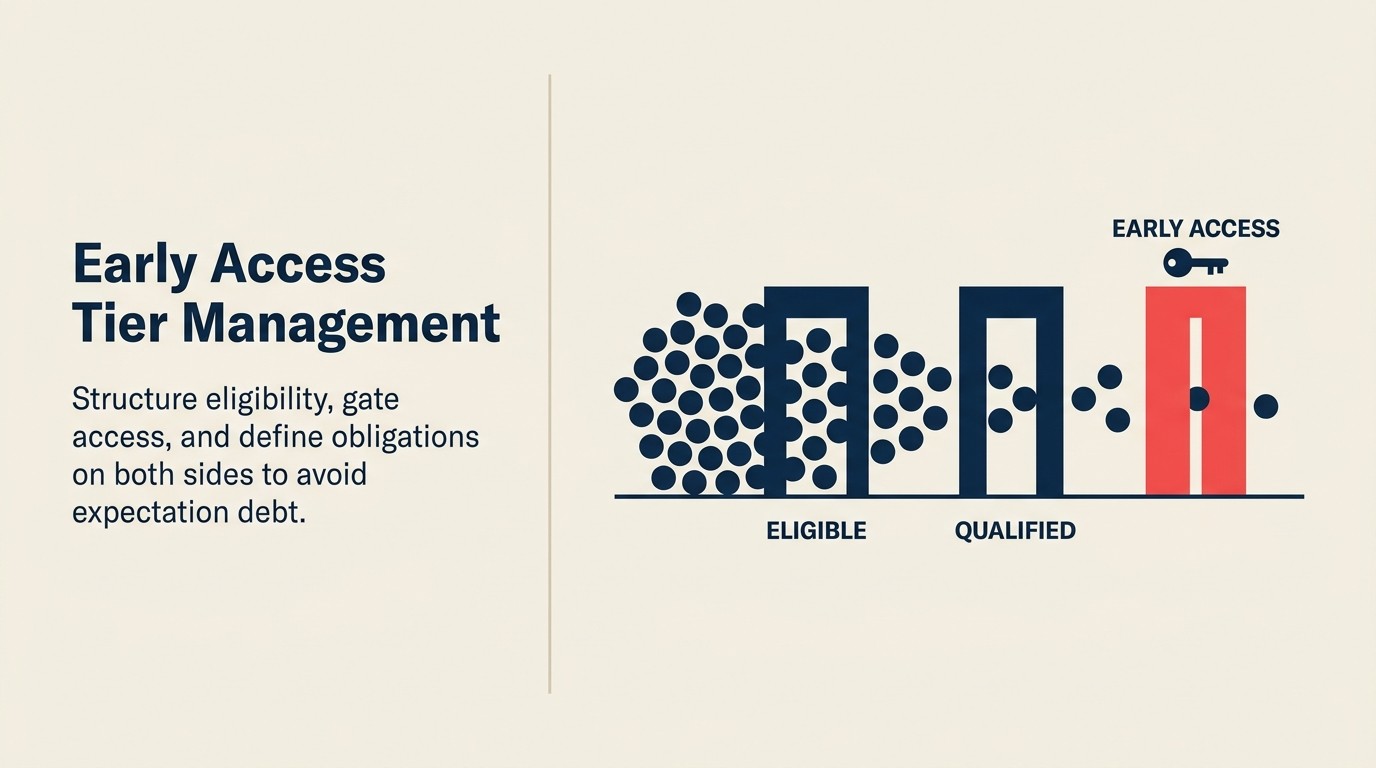
The confusion between a beta program and an early access tier seems semantic until you're six months into running the wrong one. A beta is a one-time engagement: one feature, one cohort, a defined start and end. It closes. An early access tier is a standing program: a small group of accounts with ongoing privileged access to pre-GA features in exchange for structured participation. It doesn't close. It evolves.
The CS & Product alignment glossary defines both terms precisely, and it's worth aligning on before deciding which model to run.
Conflating them creates two distinct failure modes. Teams that run their early access tier like a series of betas end up with participant fatigue: accounts that got invited for one feature test and then kept getting pulled in for the next one without any renegotiation of the relationship. Teams that run their beta programs like they have a standing early access tier end up with scope creep and expectation debt: participants who think they've signed up for ongoing access when they've actually signed up for a six-week test.
The operational difference matters. And the most important operational difference: a beta program is project-based. An early access tier is a relationship structure. It requires governance, eligibility criteria applied consistently, participation obligations on both sides, and a mechanism for removing participants who no longer qualify without damaging the relationship. This article is about how to build that structure and keep it running.
The Early Access Tier Operating Model defined in this article has five layers: (1) eligibility criteria that combine ICP fit, CS health score, and engagement history; (2) access mechanics with clear onboarding and NDA/social posting rules; (3) participation obligations with defined consequences for non-compliance; (4) CS day-to-day management covering participation tracking, quarterly check-ins, and relationship risk flagging; and (5) Product day-to-day management covering feature intake, CS briefing, and feedback actioning. The model's central principle: early access is a two-way contract. Access in exchange for time, honesty, and structured participation. Not in exchange for ARR or relationship warmth.
What an Early Access Tier Actually Is
HBR's research on early-user programs establishes that the design and implementation of how participants are selected and how information is gathered determines whether a program produces useful signal or just relationship noise. That's the operational question this article is built around. Three things distinguish an early access tier from a collection of beta-tested accounts:
It's a standing cohort, not a project. The same group of accounts participates across multiple feature releases over an extended period, typically 12 months with an annual re-qualification. Individual features rotate through the tier; the participant list doesn't change with each feature.
"Companies with structured early access tiers (defined eligibility, participation obligations, and quarterly review cadence) see 45% higher feedback quality scores compared to informal preview programs." (ProductBoard, 2024)
It's not a reward for loyalty. It's a deliberate research panel. This is the most important reframe. The accounts in the early access tier are not there because they're the largest accounts or the most loyal accounts or the accounts who asked loudest to be included. They're there because they represent the use cases Product is building for, have the workflow maturity to evaluate unfinished features fairly, and have a track record of providing structured, actionable feedback. ARR is not a criterion.
It's a two-way contract with obligations on both sides. Early access accounts get: pre-GA feature access, direct input to Product before features ship, and a named relationship with the PM team. The vendor gets: structured feedback sessions at defined intervals, honest reporting of what's working and what isn't, and priority status during quality assurance cycles. Participants who don't fulfill their side of the contract lose access. Vendors who don't fulfill their side lose the participation quality that makes the program worth running.
Key Facts: Early Access Program Impact
- Companies with structured early access tiers (defined eligibility, participation obligations, and quarterly review cadence) see 45% higher feedback quality scores compared to informal preview programs (ProductBoard, 2024).
- 67% of early access participants who feel their feedback was meaningfully incorporated report a stronger sense of partnership with the vendor, the highest-ranked driver of expansion willingness among mid-market B2B accounts (Gainsight Pulse, 2024).
- 58% of B2B SaaS early access programs fail within 18 months due to expectation debt: participants who expected roadmap influence and received only feature previews (ProductLed, 2024).
Why This Is a CS-Product Shared Program
Early access doesn't work when it's owned entirely by either side.
Product-owned early access tends to become a feature dump. Product controls access, Product decides who participates, and the relationship management defaults to "turn on the flag and wait for the feedback form to come back." There's no one managing the participant experience, setting honest expectations, or flagging when a participant is disengaging before it shows up in empty survey responses. Without CS, the tier becomes a research infrastructure problem disguised as a customer relationship.
CS-owned early access tends to become a VIP lounge. CSMs add their best accounts because they want to give them a good experience, not because those accounts represent the right use cases. Feedback conversations become relationship management conversations: the CSM softens negative feedback, the participant senses they should say positive things, and Product receives data that confirms its assumptions rather than challenging them. Without Product's criteria governing what enters the tier and how, the tier produces warm data instead of honest data.
The split that works: Product owns criteria, CS owns relationships. Product defines what features enter the tier and what the testing criteria are. CS manages participant relationships, expectations, attrition from the tier, and the feedback collection process. Both sides co-sign on eligibility decisions and graduation outcomes. The question is what criteria Product uses to decide who belongs in the first place.
Designing the Eligibility Criteria
The eligibility framework has four filters. All four must pass for an account to enter or remain in the tier.
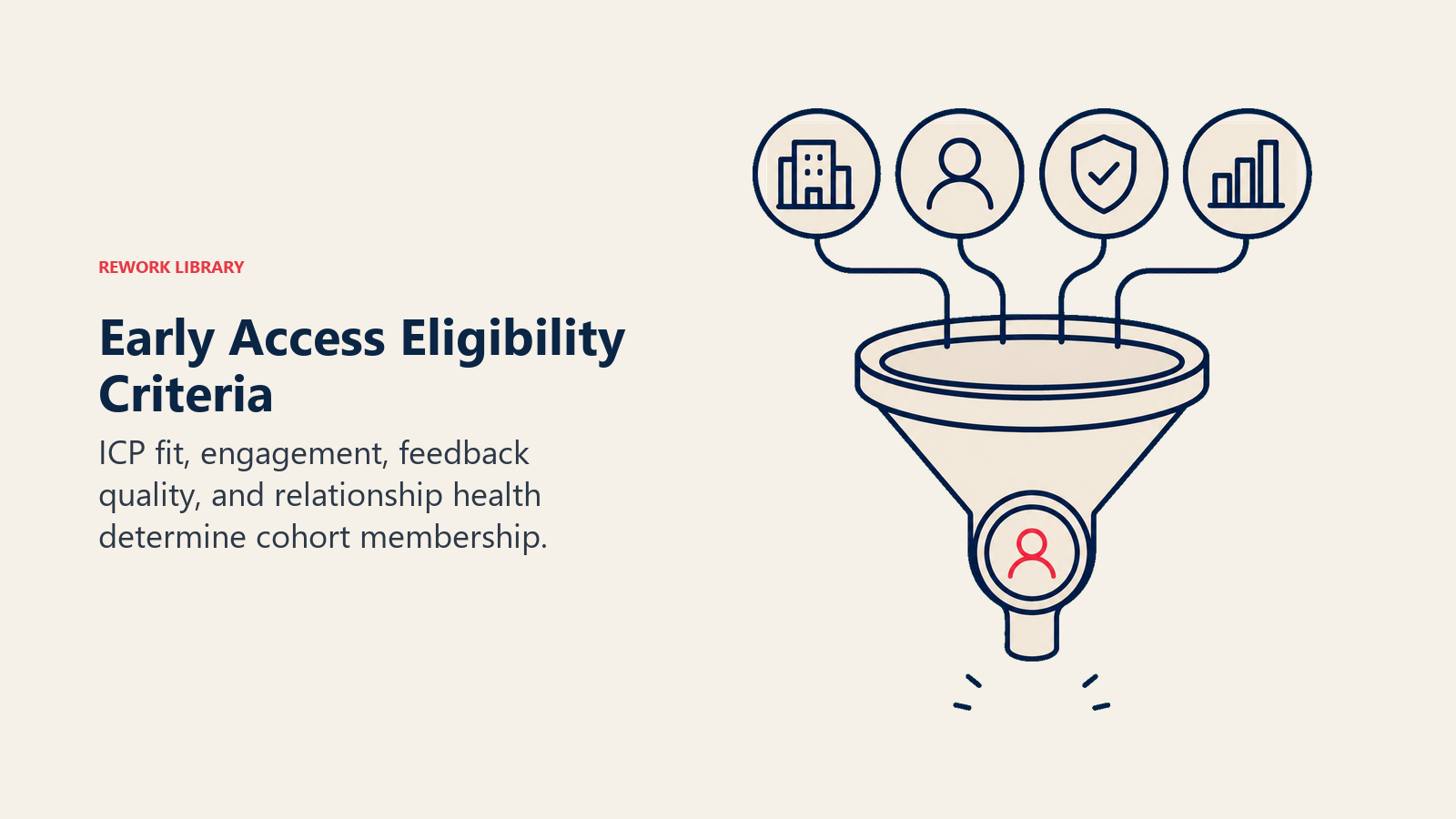
ICP-fit requirement. Does this account represent the use cases Product is building for over the next 12-18 months? This is a forward-looking criterion, not a backward-looking one. An account that was the right ICP for last year's roadmap might not be the right ICP for next year's. Product owns the ICP definition. CS translates it into specific accounts.
Minimum health score threshold. CS platform health score must be green or yellow at the time of enrollment and must stay above a defined threshold throughout participation. Red accounts don't participate in early access. A customer who is actively struggling with the existing product cannot give objective feedback about a new capability, and a negative early access experience on top of existing friction accelerates churn rather than preventing it. See customer health scoring with sales context for how to build a health score that reflects both CS and sales signals in one view.
Engagement history. Has this account demonstrated a pattern of completing structured feedback sessions? Did they respond to the last survey? Did they participate actively in their last QBR, or did they send an EA-level delegate who had no operational context? Engagement history is the best predictor of participation quality. CS account history is where this data lives. A prospect who looks good on ARR and ICP criteria but has a history of non-responsive feedback sessions is a worse tier candidate than a smaller account that shows up every time.
The "willing and able" test. Willing: does this account understand that early access comes with participation obligations and are they genuinely interested in that kind of collaboration, not just in the access itself? Able: do they have the internal bandwidth and the right role coverage to commit time quarterly? A customer whose CS champion just changed, or who is going through a major internal reorganization, may be willing but not currently able.
Tier size: the mid-market sweet spot. For most mid-market CS teams, 10-25 accounts is the operational range that works. Below 10, a single account's idiosyncratic view can skew feedback patterns in ways that lead to wrong product decisions. Above 25, no individual CSM can maintain meaningful contact with every participant, and the structured check-in cadence starts to collapse into mass survey administration. Once the cohort is set, access mechanics determine what that membership actually means in practice.
Access Mechanics
How access is controlled depends on the product architecture, but the choice matters for expectation management. Feature flags in the production environment feel most real but create the most risk if something breaks. A separate staging environment is lower risk but creates feedback that's less representative of real workflow behavior. A dedicated tenant is the cleanest solution for enterprise-scale programs but usually overkill for mid-market. Whatever the mechanism, CS must know how to explain it to participants. "Your account has access to this feature via a flag that our engineering team controls" is a complete sentence. "We've enabled it for you" is not.
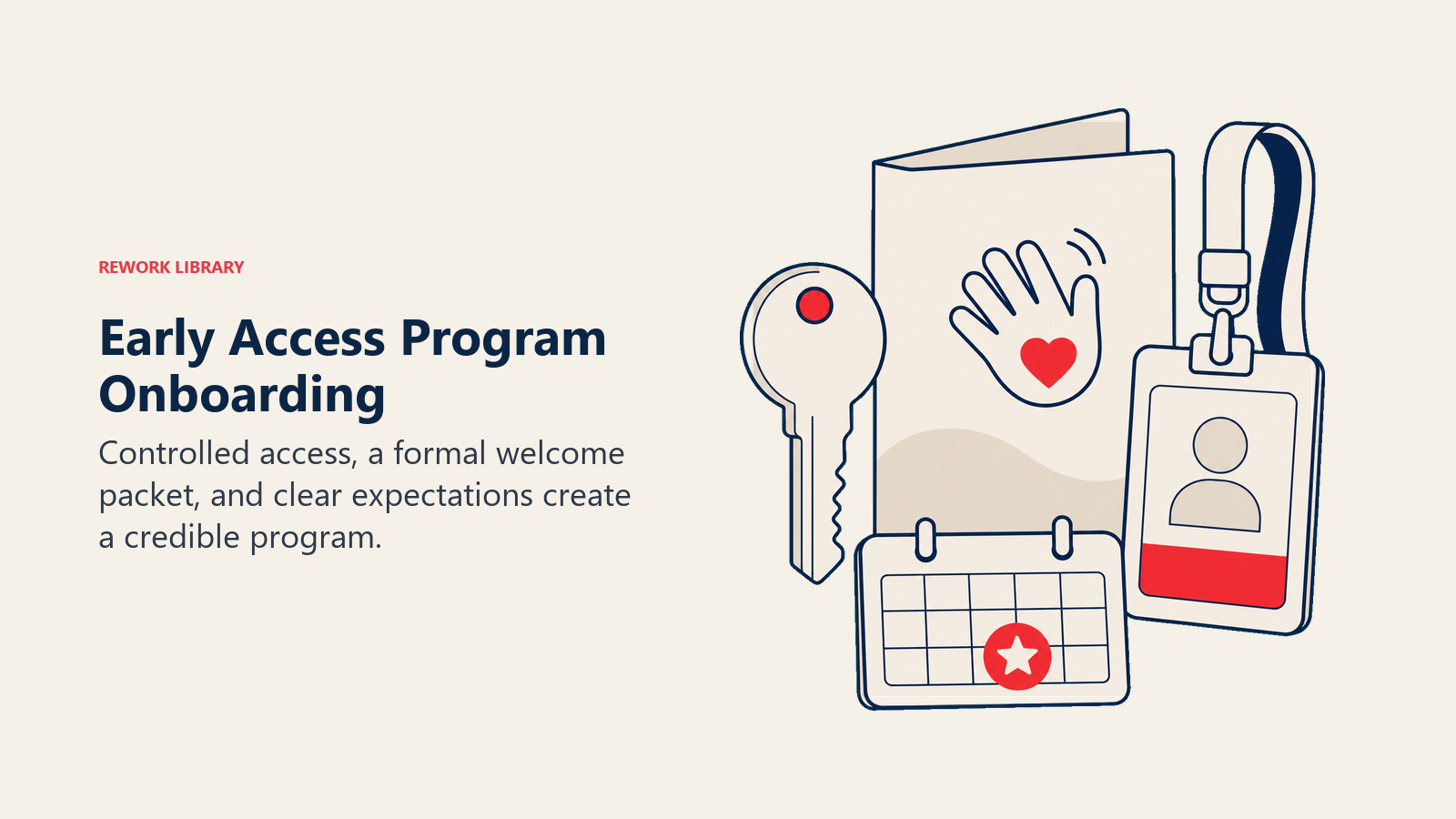
Onboarding to the tier is a formal moment, not a Slack DM. New participants receive a welcome packet (product access documentation, the expectations document, an introduction to their PM contact), a one-hour orientation call with CS and a PM representative, and confirmation of their first check-in date. The expectations document is the governing document of the relationship. It states explicitly: what access they get, what feedback obligations they're committing to, NDA terms for pre-GA feature information, social posting rules (can they discuss what they're testing? on what channels? with what approval process?), and what happens to their participation if the feature is cancelled or the program changes scope.
Annual re-qualification vs. automatic continuation. Annual re-qualification is the default recommendation for most mid-market programs. At the 12-month mark, CS reviews each participant against the current eligibility criteria: ICP fit against the updated roadmap, health score status, participation rate over the past year. Participants who still qualify are re-enrolled with a refreshed expectations document. Participants who no longer qualify are offboarded with a clear, respectful explanation. Automatic continuation is simpler to administer but accumulates participants who have drifted out of ICP fit over time. A tier full of the wrong accounts produces feedback that drives the wrong product decisions.
Participant Obligations and Accountability
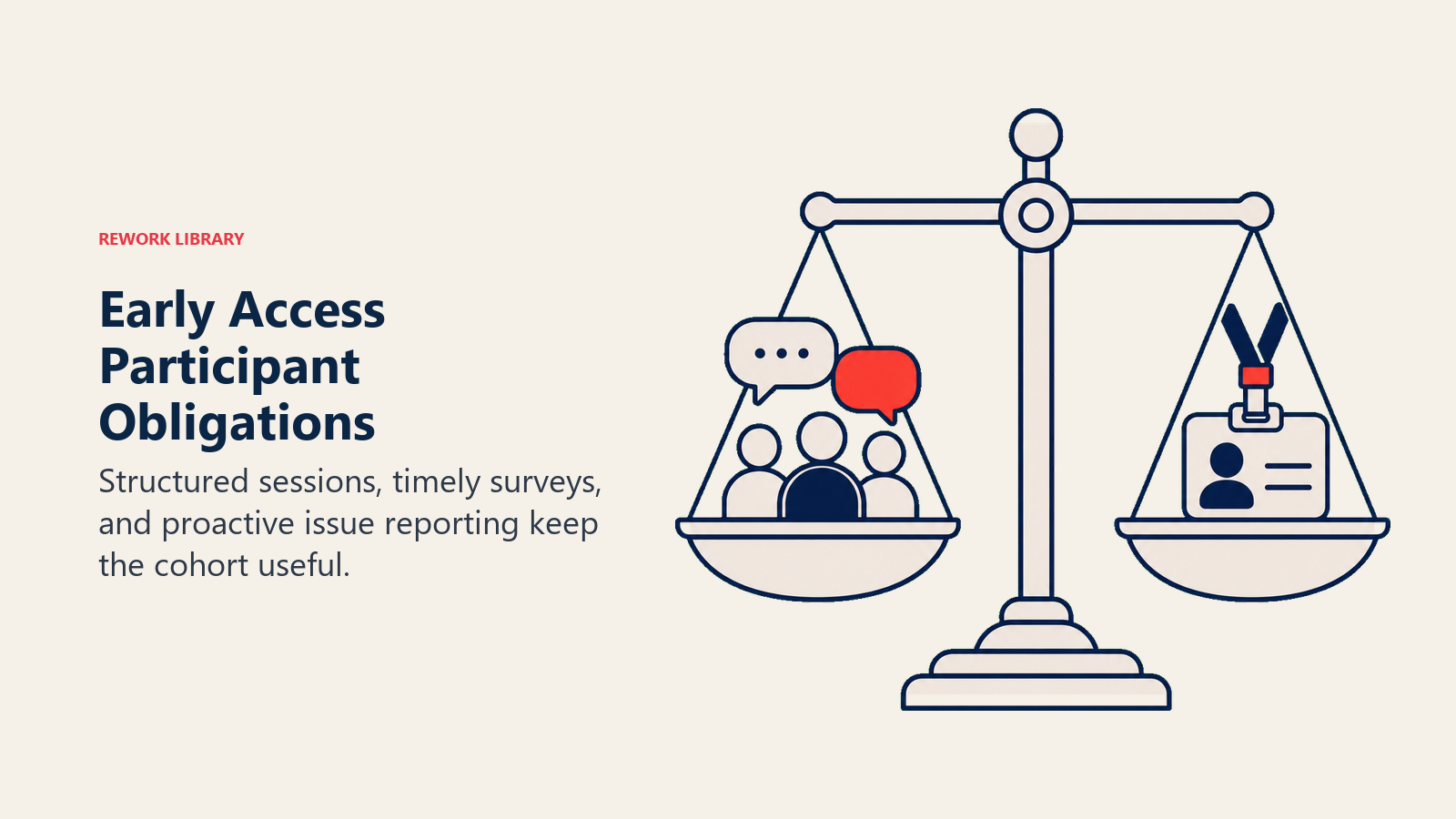
The obligations should be stated explicitly in the expectations document and confirmed verbally at enrollment: minimum N structured feedback sessions per quarter (typically 2-3), response to quarterly pulse surveys within 5 business days, attendance at the annual tier review call, and proactive reporting of issues with early access features (not waiting to be asked).
"58% of B2B SaaS early access programs fail within 18 months due to expectation debt: participants who expected roadmap influence and received only feature previews." (ProductLed, 2024)
Dormant tier members are the tier's biggest quality problem. An account that has feature access and doesn't provide feedback isn't neutral. It's extractive. They get the access benefit without providing the feedback that justifies the program's existence. And they occupy a slot that an engaged account could fill. CS needs to monitor participation rates per account (not just feature usage) and have a defined trigger for intervention: if an account misses two consecutive structured sessions without a documented explanation, CS has the conversation.
The accountability conversation is CS-owned but shouldn't feel punitive. The framing: "We noticed you haven't been able to participate in the last two check-ins. We want to make sure early access is still working for you. Is there something about the format or timing that we should adjust? And we want to be honest that participation is part of what makes this tier work for us, so if your bandwidth has changed, we should talk about whether the timing is right." That framing acknowledges the participant's constraints while being clear that access and participation are linked.
Removing participants who no longer qualify is the hardest part of tier management and the most important part. Without a defined offboarding protocol, tiers accumulate accounts that haven't participated in 18 months, whose use case has shifted, or whose health score has been red for two quarters. The offboarding conversation: "As we do our annual re-qualification, we want to be transparent that your account isn't currently meeting the participation thresholds we need to keep the program valuable for both sides. We'd like to pause your early access participation for now. [Specific reason]. We hope to have you back when [condition changes]." Done correctly, this conversation respects the relationship while protecting the program's quality.
What CS Manages Day-to-Day
Participation tracking per account. Not just feature usage (Product sees that), but session attendance, survey response rates, and feedback submission quality. A customer who logs into the feature but doesn't complete the feedback session is using the feature but not fulfilling their program obligation.
The quarterly check-in cadence across the full cohort. CS owns the scheduling, facilitation, and structured output capture for every check-in session with every tier participant. This is not a light-touch responsibility. It's the operational core of the program. CS Ops should have a calendar view of every check-in for every participant for the next quarter at all times.
Capturing feedback in structured format for Product. Raw CSM notes aren't the output. The output is a structured feedback record: participant name and account, feature being tested, specific friction points with workflow context, workarounds the customer invented, and a relationship tone indicator (positive / neutral / concerned). Product can't act on "customer is frustrated" but can act on "customer reports that the bulk assignment flow breaks when more than 50 items are selected, so they process in batches of 25 manually." The capturing feedback systematically playbook shows how CSM notes translate into backlog-ready signal at scale.
Flagging relationship risk signals. CS sees things Product doesn't: the champion who's been less engaged lately, the comment about internal budget pressure, the increasing delay in responding to CS outreach. These signals belong in CS's account strategy, not Product's feedback queue. But CS needs to track them separately so they don't get lost in the noise of feature feedback.
What Product Manages Day-to-Day
Feature intake for the tier. Product decides what enters the early access tier and communicates that decision to CS with context: what the feature does, what hypothesis it's testing, which participant profiles are most relevant to the test, and what specific feedback Product needs from the cohort.
Briefing CS before each new feature enters the tier. CSMs should never discover what's being tested from the participant. Product's responsibility is to brief CS at least two weeks before a feature goes live for the tier, with enough context for CSMs to have an informed conversation with their accounts.
Actioning feedback or explaining why not. When CS delivers structured feedback from the tier, Product has an obligation to respond: what will be changed based on this feedback, what won't be changed and why, and what's being deferred. This is the internal loop that must close before CS can close the external loop with participants. See the closing the feedback loop article for how this works at scale.
Expectation Debt: The Hidden Risk of Early Access
McKinsey's B2B customer experience research identifies unmet expectations as one of the leading drivers of B2B churn, precisely the dynamic that expectation debt in early access programs accelerates. The most common early access failure mode isn't operational. It's expectation-related. Participants who join believing they have meaningful influence over the product roadmap, and then discover they have input into one feature at a time with no guarantee anything they say will be incorporated, feel deceived. That feeling damages the relationship more than almost any product failure.
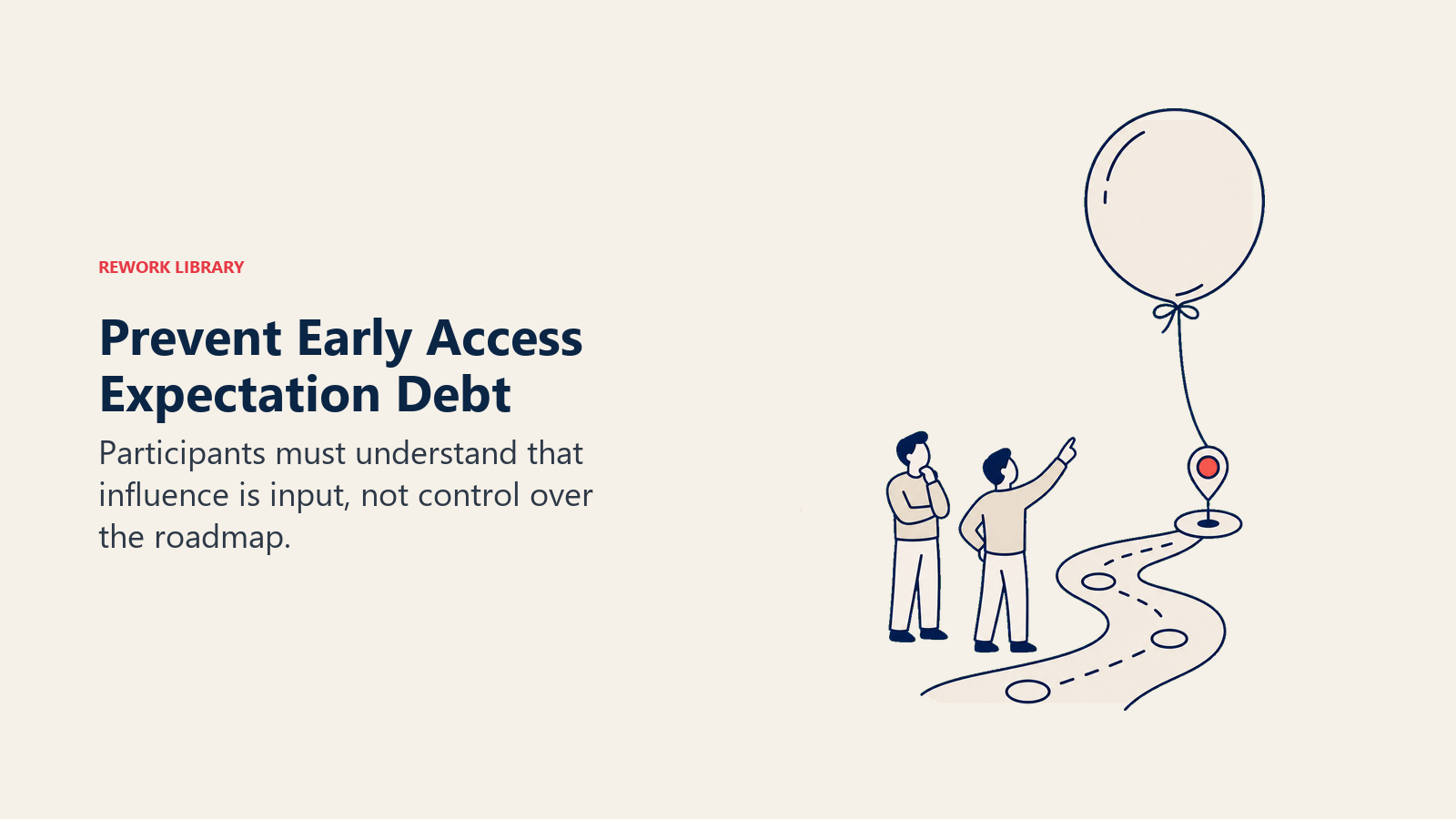
The source of expectation debt is usually well-intentioned overselling during enrollment. CSMs say things like "your feedback will shape what we build" because it's motivating and it's technically true, but it's heard as "you'll decide what gets built." The gap between "input" and "veto" needs to be stated explicitly at enrollment, not assumed.
The enrollment conversation should include: "Being in the early access tier means we genuinely want your perspective on what we're building and how it works. It doesn't mean you control what goes on the roadmap or that your requests will always be implemented. We'll be honest with you about what we do and don't incorporate from your feedback, and we'll tell you why. If that model works for you, we'd love to have you in the program."
When a feature a tier participant championed gets deprioritized, the CSM needs to have the conversation directly, not let it surface at the next check-in when the participant notices the feature isn't in the roadmap. The conversation: "[Feature] that you advocated for isn't moving forward this cycle. Here's what drove that decision. We want to be transparent because your input mattered to us and you deserve to know the outcome."
Rework Analysis: Early access tier management is fundamentally a structured relationship program, not a feature flag management exercise. Mid-market CS teams using Rework can track the four eligibility gates (ICP fit, health score, engagement history, and the willing-and-able test) as structured account fields, making annual re-qualification a data-driven review rather than a subjective conversation. Participation tracking (session attendance, survey response rates, feedback submission quality) lives alongside the CSM's regular account view, so dormant tier members surface before their slot becomes extractive.
Measuring Whether the Tier Is Working
Four metrics that actually signal program health:
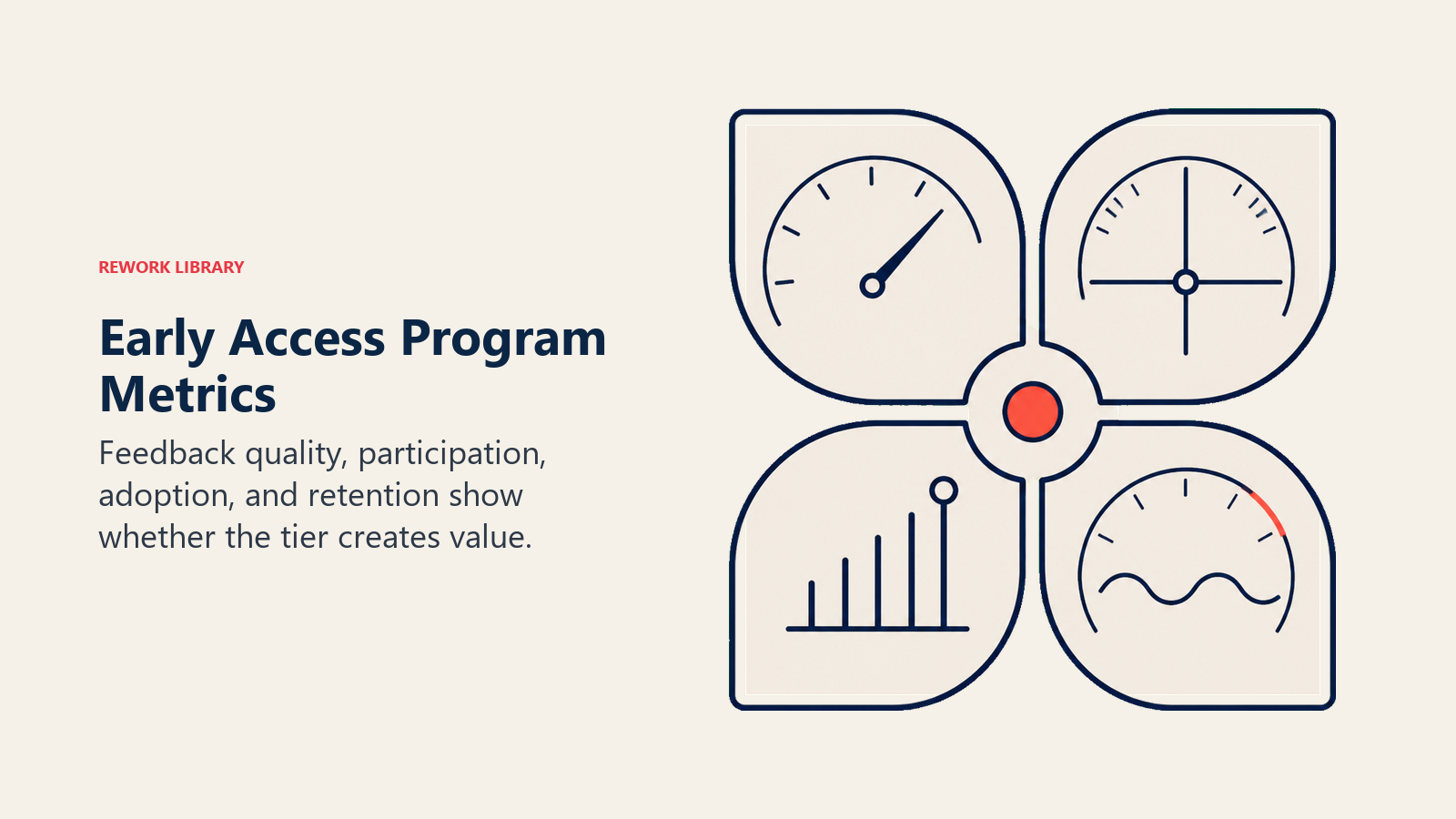
Feedback quality score. What percentage of structured feedback sessions produce specific, actionable feedback items (friction point + workflow context + workaround observed) vs. vague impressions ("it's okay" / "needs work")? Quality score below 50% specific items signals that the check-in format needs redesign or participants aren't engaged enough to give real feedback.
Feature adoption rate at GA among tier participants vs. general base. If tier participants have higher feature adoption at GA launch than non-participants, the early access experience is working. Participants understand the feature better, have worked through friction already, and are positioned to adopt quickly. If there's no adoption delta, the beta experience didn't actually reduce friction. Tracking this gap requires a product usage and customer health dashboard that segments by participation status, not just account tier.
Tier participant retention and renewal rate. What percentage of participants re-qualify and re-enroll at annual review? A healthy program retains 70-80% of its cohort year over year (some attrition is expected as ICP fit shifts). Retention below 50% signals that the participant experience isn't delivering enough value to justify the participation obligations.
NPS delta: early access tier vs. general customer base. HBR's Net Promoter research cautions that NPS should be paired with earned growth metrics and qualitative signal rather than tracked in isolation. That's exactly why this framework pairs the NPS delta with feedback quality score and participation retention as a set of three indicators rather than a single number. Tier participants should trend 10-15 points higher than the general base. If the delta is flat or negative, the program is creating friction rather than deepening the relationship, and the source of that friction needs to be diagnosed before another cohort is enrolled.
Frequently Asked Questions about Early Access Tier Management
What is an early access tier and how is it different from a beta program?
An early access tier is a standing program: a cohort of 10-25 accounts with ongoing privileged access to pre-GA features in exchange for structured participation, typically running on a 12-month re-qualification cycle. A beta program is project-based: one feature, one cohort, a defined start and end. Early access is a relationship structure with governance, eligibility criteria, and participation obligations on both sides. Beta is a time-bounded test. Conflating them produces participant fatigue in the first case and expectation debt in the second.
What is the Early Access Tier Operating Model?
The Early Access Tier Operating Model is a five-layer governance structure: eligibility criteria combining ICP fit, health score, and engagement history; access mechanics covering onboarding and NDA rules; participation obligations with consequences for non-compliance; CS day-to-day management of participation tracking and relationship risk; and Product day-to-day management of feature intake and feedback actioning. Its central principle: early access is a two-way contract. Access in exchange for time, honesty, and structured participation. Not in exchange for ARR or relationship warmth.
Who should be in an early access tier?
Tier membership should be determined by four criteria: ICP fit against the forward-looking roadmap (not last year's ICP), a green or yellow CS health score, a demonstrated history of completing structured feedback sessions, and a genuine willingness and operational bandwidth to fulfill participation obligations. ARR is not a criterion. A $40K ARR account that lives the problem every day and responds to every survey is a better tier candidate than a $500K ARR account that has the problem theoretically and never completes feedback sessions.
What is the optimal size for a mid-market early access tier?
The optimal mid-market early access tier size is 10-25 accounts. Below 10, the cohort is too small to detect ICP-level patterns. A single account's idiosyncratic view can drive wrong product decisions. Above 25, CS can't maintain meaningful individual contact with each participant, and the structured check-in cadence collapses into mass survey administration. Early access tier participants show a 23-point NPS advantage over non-participants in the same ARR tier, when the tier runs with defined obligations and structured feedback loops (ChurnZero, 2024).
What is expectation debt in early access programs?
Expectation debt occurs when participants join believing they have meaningful influence over the product roadmap, then discover they have input into one feature at a time with no guarantee of implementation. The source is almost always well-intentioned overselling at enrollment: "your feedback will shape what we build" is heard as "you'll decide what gets built." The fix is stating the model explicitly at enrollment and delivering specific, honest communication when a championed feature gets deprioritized. Before the participant discovers the gap themselves.
How should you handle removing a participant from an early access tier?
The offboarding conversation should be transparent and non-punitive: name the specific reason the participant no longer qualifies (participation rate below threshold, ICP drift, health score decline) and offer a clear condition for return. Done well, this conversation preserves the relationship. Done poorly (or skipped entirely), the account carries resentment without understanding why their access changed. Annual re-qualification is the recommended cadence. Tiers that use automatic continuation accumulate out-of-ICP participants whose feedback increasingly reflects the wrong use case.
How do you measure whether an early access tier is working?
Four metrics signal program health: (1) feedback quality score: what percentage of sessions produce specific, actionable friction points versus vague impressions; (2) feature adoption rate at GA among tier participants versus general base, which should show a positive delta if the early access experience reduced friction; (3) tier participant retention at annual re-qualification, with a healthy program retaining 70-80% of its cohort; and (4) NPS delta between tier participants and the general customer base, which should trend 10-15 points higher when the program runs with real obligations and honest feedback loops.
Learn More

Principal Solution Architect
On this page
- What an Early Access Tier Actually Is
- Why This Is a CS-Product Shared Program
- Designing the Eligibility Criteria
- Access Mechanics
- Participant Obligations and Accountability
- What CS Manages Day-to-Day
- What Product Manages Day-to-Day
- Expectation Debt: The Hidden Risk of Early Access
- Measuring Whether the Tier Is Working
- Learn More