Common CS-Product Alignment Failures: Symptoms, Diagnoses, and Fixes
Turn this article into takeaways for your work.


Each assistant summarizes the article only for you and suggests best practices for your work.
The post-mortem happens after the churn notice arrives. CS says Product didn't ship the feature that was explicitly on the roadmap. Product says CS over-promised a timeline they never committed to. The account executive who sold the contract says both teams dropped the ball on onboarding. Leadership sits at the table, everyone is pointing in a different direction. Nobody has a clear account of what signals were present and when.
That conversation repeats, not because these are uniquely bad teams, but because the structure underneath hasn't changed.
CS-Product failures tend to cluster around the same eight structural breakdowns. Each one looks like a communication problem on the surface. But dig a level deeper and you find a missing definition, a missing cadence, or a missing shared view of the data. Fix the structure and the argument mostly stops: not because people got along better, but because they stopped needing to argue about things that are now visible and agreed upon.
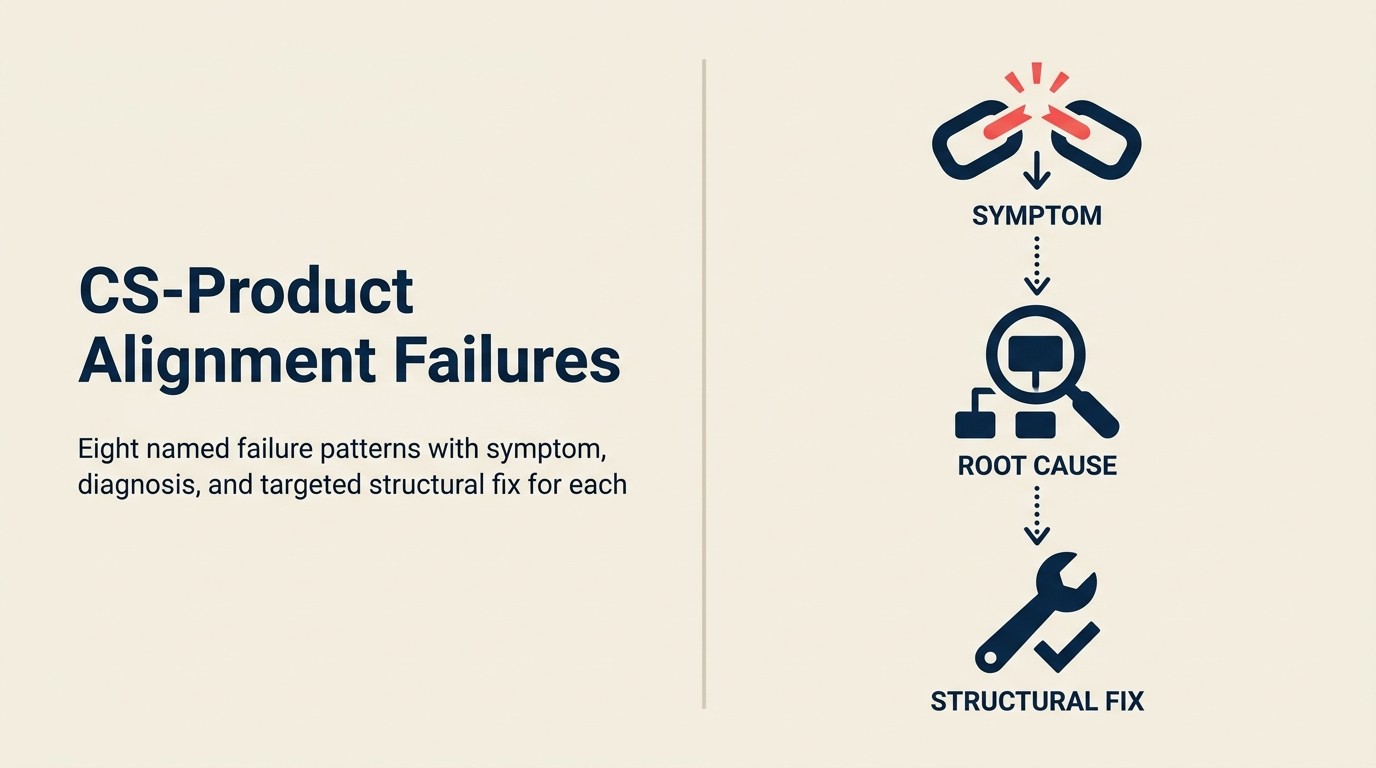
The 8 Common CS-Product Failure Patterns is a diagnostic reference for VP CS, Head of Product, and RevOps leaders who need to name a structural failure mode before they can fix it. Each pattern follows a Symptom → Diagnosis → Fix format. The scope is strictly the CS-Product seam (not marketing-sales or sales-CS anti-patterns). For the full diagnostic picture, use this article alongside the 8 Warning Signs CS and Product Are Misaligned: the warning signs article tells you something is wrong; this article tells you what specifically is broken and how to fix it.
How to Use This Article
Each pattern below follows the same three-part format: Symptom is what you observe in meetings, in tickets, in churn post-mortems. Diagnosis is the structural root cause (the thing that would generate the same symptom with completely different people in the same roles). Fix is the specific process or decision that addresses the root, not the surface.
You'll likely recognise two or three patterns simultaneously. That's normal and expected. Start with the one that's most directly costing you retention or product adoption. Each fix section links to a deeper article for full implementation.
This article is a map. The deep-dive articles are the territory.
Key Facts: The Cost of CS-Product Structural Failures
- B2B companies with high cross-functional alignment report 2.4x higher revenue growth and 2x higher profitability growth than those without it, according to Forrester. Yet most CS-Product teams have no formal joint post-mortem process.
- Top-quartile SaaS performers carry 40-50% lower gross revenue churn than mean performers, a gap driven almost entirely by structural retention discipline rather than relationship heroics, per McKinsey research.
- 79% of B2B buyers say they've received conflicting information from different company contacts before making a purchase decision. At the CS-Product seam, that conflict usually centres on roadmap commitments (Salesforce State of the Connected Customer, 2023).
The 8 CS-Product Failure Patterns Framework
This diagnostic framework names the eight structural breakdowns that account for the majority of avoidable churn and feature adoption failures at the CS-Product seam in B2B SaaS. Each pattern is fully defined by three elements: the presenting symptom (what teams argue about), the structural diagnosis (the missing definition, cadence, or shared data that generates the conflict), and the targeted fix (the specific process decision that eliminates the structural gap). The framework is not a culture or personality model. It is a structural model. Two entirely different teams, in the same structural conditions, will produce the same eight failure patterns. The framework predicts this; fixing the structure prevents it.
Failure Pattern 1: The Feature-Request Graveyard
Presenting symptom: "We keep logging requests but nothing ever ships"
Symptom: CSMs dutifully log feature requests from customers: in the CRM, in Jira, in a shared spreadsheet, wherever they've been told to put them. Three months later, a customer asks for an update. The CSM checks and can't find the request, or finds it sitting untouched in a backlog with no status. Eventually CSMs stop collecting feedback at all, because "nothing happens anyway." The feedback channel atrophies precisely when Product needs it most.
Diagnosis: There is no triage SLA on incoming requests and no closed-loop notification process. Product has no formal obligation to acknowledge or respond to CS-submitted requests within any defined window. The request disappears into a system that is optimised for engineering workflow, not for customer communication or CS relationship management. The absence of status categories means CSMs have nothing they can tell a customer other than "we passed it along."
Fix: Implement a triage SLA: any CS-submitted request gets a PM acknowledgement within five business days. This doesn't mean the request is actioned. It means it's been reviewed and placed into one of three status buckets: "under review," "not planned," or "on roadmap." CSMs can share any of those three statuses with customers. The quarterly backlog purge is equally important: stale requests older than 12 months with no ARR signal should be archived, not left to accumulate. The graveyard problem compounds when the backlog becomes so large that no one believes triage is happening, even when it is.
See The Feature-Request Graveyard Problem for the full triage process design and status category definitions.
Failure Pattern 2: CS Over-Promises Roadmap, Customer Churns at Delay
Presenting symptom: "CS told the customer that feature was coming, now they're threatening to leave"
Symptom: A CSM, under pressure to hold a renewal, mentions a feature as being "on the roadmap." The feature slips by two quarters. The customer cites the broken promise as primary reason for churn. CS says Product changed the priority without warning. Product says they never committed to that timeline. The argument is technically correct on both sides, which makes it impossible to resolve. And it will happen again with the next CSM in the next renewal conversation. McKinsey research shows top-quartile SaaS performers carry 40-50% lower gross revenue churn than mean performers, a gap driven almost entirely by structural retention discipline, not relationship heroics.
Diagnosis: There is no shared language for roadmap certainty levels. "On the roadmap" means something different to a CSM doing a renewal call than it does to a PM doing quarterly planning. CSMs are incentivised to retain customers but have no mechanism to make commitments that require Product sign-off before they're spoken aloud. The word "roadmap" carries an implicit promise that the PM never intended.
Quotable: B2B SaaS companies that lack a formal roadmap certainty tier system (distinguishing "committed," "planned," and "exploring") expose every CSM to unlimited implied commitments with every renewal conversation, because the word "roadmap" carries no legally or operationally defined meaning in their organisation.
Fix: Adopt a three-tier roadmap language that both teams agree to in writing. "Committed" means the feature has a development owner, a target quarter, and PM sign-off: CSMs may quote this tier. "Planned" means the feature is prioritised for the next two roadmap cycles but has no committed date: CSMs may say it's planned but not quote a quarter. "Exploring" means it's in consideration with no committed priority. CSMs should not use this as a retention lever at all. The rule is simple: no CSM may quote a timeline or commitment without a PM sign-off in writing, for that specific customer, before the conversation happens.
See How CS Communicates Roadmap Without Overpromising for the full three-tier language guide and the PM sign-off workflow.
Failure Pattern 3: PM Never Talks to Customers, Builds from Intuition
Presenting symptom: "We built exactly what was requested but CS says customers hate it"
Symptom: A feature ships. CS immediately starts fielding complaints (not that the feature is broken, but that it doesn't match how customers actually work). Net Promoter Score (NPS) dips in the cohort that should be happiest about the release. PM says they built what was requested in the feedback sessions. CS says the feedback sessions never captured the real workflow. Both are telling the truth.
Diagnosis: Product discovery doesn't include structured, direct customer contact. CS is treated as a translation layer rather than a direct-access channel. PM's exposure to actual customer language and workflow is filtered through Slack summaries, product analytics, and a handful of formal research sessions (none of which capture the nuance of how a customer's team actually uses the product day-to-day). The result is features that solve the stated problem but miss the lived problem.
Fix: Mandatory PM ride-alongs on customer calls: at minimum, one per week for PMs on active feature development. Not to present or to sell, but to listen. Add a structured customer-call debrief slot to the CS-PM 1:1: what did CS hear this week that PM should know before shipping the next sprint? And at least once per quarter, a PM joins a customer quarterly business review (QBR) as a silent observer, not to own the room, but to hear how the customer describes their own workflow in their own words.
See Running PM Customer Call Ride-Alongs for a step-by-step guide to structuring these sessions so they produce actionable product insight. The CS-PM 1:1 Cadence article has the agenda template for making the debrief slot productive rather than just another meeting.
Failure Pattern 4: Support Tickets Disappear into Jira Black Hole
Presenting symptom: "We've logged this bug three times and it's still not fixed"
Symptom: The support team logs bugs and friction patterns. Tickets sit in the engineering backlog with no visible triage priority. CSMs can't tell customers whether a bug is "known and being fixed" or "hasn't been looked at yet." The same friction pattern shows up across multiple customer cohorts because the signal never reached Product clearly enough to generate a prioritisation decision. Customers stop reporting bugs because they don't believe it will help.
Diagnosis: There is no escalation path from a support ticket to a product backlog item with annual recurring revenue (ARR) context attached. Product's backlog is organised by engineering priority, not by customer impact or revenue-at-risk. Support-originated tickets have no SLA obligation on the Product side, so they sit in the default queue indefinitely. And because no severity framework links a ticket to a retention risk, a P1 bug affecting a $200K ARR account looks identical to a cosmetic issue affecting a trial user.
Fix: Define escalation tiers with clear criteria. P1 is revenue-at-risk (ARR-weighted, renewal within 90 days, or customer has explicitly cited the bug). P2 is widespread friction affecting more than 10% of the customer base. P3 is isolated and low-urgency. ARR weighting is applied at triage. The weekly CS-Product sync reviews all open P1 and P2 items as a standing agenda item. When a ticket transitions to "in development," the owning CSM gets an automated notification so they can update the customer.
See Moving Support Tickets into the Product Backlog for the ARR-weighting model and the escalation tier definitions.
Failure Pattern 5: Beta Program Runs Without Customer Voice Surfacing Back
Presenting symptom: "We ran a beta, why does the feature still miss the mark?"
Symptom: A beta cohort is recruited, mostly by CS. Customers participate, submit feedback, and wait. The feature ships at general availability (GA) with only minor changes from the beta version. Beta customers feel ignored. They gave time and detailed feedback, and they can see the product didn't change much. CSMs weren't looped in on what feedback was actioned or why certain requests were declined. The beta becomes a trust liability rather than a trust asset.
Diagnosis: The beta program is designed for engineering validation, not customer co-design. Feedback is collected informally, usually through a shared Slack channel or a survey, and synthesised by the PM alone. There is no structured mechanism for communicating back to beta customers about what changed and why. CS is in the program as a recruiter but not as a participant with a defined role in the feedback process.
Fix: CS owns the beta customer relationship throughout the program, not just at recruitment. Structured feedback sessions include a PM as a named attendee, not a passive reader of the output. After the beta closes, a written post-beta retrospective goes to all beta participants: what was actioned, what was not, and why. Beta customers receive GA release notification before the general customer base. This closes the loop in a way that makes future beta participation feel valuable rather than extractive. Forrester notes that B2B firms which fail to prove they acted on client feedback undermine the very relationships they built to collect it. The post-beta retrospective is the mechanism that prevents this.
See Closing the Feedback Loop with Beta Customers for the post-beta retrospective template and the communication cadence that turns beta participants into advocates.
Failure Pattern 6: We Built It, Nobody Uses It: No Feedback Loop on Adoption Gap
Presenting symptom: "Adoption is at 8% sixty days after launch, whose problem is this?"
Symptom: A feature launches. CS starts onboarding customers onto it. Sixty days later, product analytics show 8% adoption against a 40% target. Product assumes this is a CS execution problem. CS assumes the feature missed the mark or was too hard to find in the product. Neither team has a shared success definition they agreed on before launch, so there's no baseline to diagnose against. No joint review happens. The adoption gap persists and becomes the background noise on every CS-Product call for the next two quarters.
Diagnosis: There is no joint definition of feature success metrics before launch. Product usage data sits in the product analytics tool. Customer health and engagement data sits in the CS platform. Neither team has a combined view. Post-launch review cadences don't exist or are ad hoc. Without pre-agreed success criteria and a shared data view, the adoption gap is impossible to diagnose or own.
Quotable: When CS and Product do not agree on a target adoption percentage before a feature launches, neither team can diagnose a 60-day adoption failure. Neither team can be accountable for fixing it either. The definition gap precedes the adoption gap.
Fix: Before any feature launches, CS and Product agree on three numbers: target adoption percentage at 30 days, target adoption percentage at 60 days, and the NPS delta expected from the cohort that adopts. These numbers go into a shared doc that both teams sign off on. Then a 30/60/90 day post-launch review is booked at the same time the launch date is confirmed. Both CS and Product are co-owners of that review. The review uses a shared dashboard combining product usage signals and customer health data. Not two separate decks stitched together after the fact.
See The "We Built It, Nobody Uses It" Problem for the pre-launch success criteria template and joint review format. For the broader CS-side adoption playbook, feature adoption strategy covers how to drive customer uptake after launch.
Failure Pattern 7: CS and Product Point Fingers When a Customer Churns
Presenting symptom: "Nobody owns the churn post-mortem and everyone blames everyone else"
Symptom: A customer churns. The post-mortem is either run by CS alone or by Product alone, never jointly. CS's version says Product failed to ship what customers needed. Product's version says CS never surfaced the risk signals early enough. Leadership gets two narratives and no actionable owner for prevention. The same failure recurs with a different customer six months later because the structural gap (who is responsible for at-risk accounts that cross the CS-Product boundary) was never resolved.
Diagnosis: There is no shared early-warning system and no RACI (Responsible, Accountable, Consulted, Informed) for at-risk accounts where a product gap is the primary driver. Churn post-mortems are conducted within each team rather than jointly, so each team's version of events is optimised for self-protection rather than diagnosis. Forrester research found that B2B firms with high cross-functional alignment report 2.4x higher revenue growth and 2x higher profitability growth than those without it, and the joint post-mortem is where that alignment gets stress-tested. The signals that would have flagged the churn risk (product usage declining, support ticket volume increasing, CSM notes referencing a missing feature) are described in detail in 8 Warning Signs CS and Product Are Misaligned. They were present in both systems but never combined into a single view that triggered an escalation.
Fix: A joint churn post-mortem template with mandatory CS and PM attendees. The template asks three questions: what signals were present and when, who received them, and what escalation path existed (or should have existed) at the point when intervention was still possible. The at-risk account list, specifically accounts where a product gap is the documented primary risk factor, is reviewed in the CS-PM 1:1 as a standing agenda item. The RACI for escalation is simple: when a product gap is the primary churn driver, the PM is the accountable party for the fix decision, and the CS lead is the accountable party for the customer relationship through the resolution.
See The CS-PM 1:1 Cadence for the at-risk account review process. If the same blame dynamic also runs between Sales and CS (a common compounding factor), 8 Warning Signs Sales and CS Are Misaligned covers the equivalent diagnostic at that seam.
Failure Pattern 8: Roadmap Goes Silent: CS Can't Answer Customer Questions
Presenting symptom: "Customers are asking what's coming next and we have nothing to tell them"
Symptom: Product stops sharing roadmap updates with CS. It might be because the roadmap is in flux, or because a new planning cycle hasn't been communicated yet, or simply because no internal communication cadence exists. CSMs start fielding "what's coming next?" from strategic accounts with no good answer. Some improvise, which risks another over-promise cycle. Others go quiet, which erodes trust with customers who expect a strategic partner, not silence. The longer the blackout, the worse the relationship damage with high-ARR accounts who depend on roadmap visibility for their own internal planning.
Diagnosis: There is no internal roadmap communication cadence for CS. Product treats the roadmap as internal-only by default, something to be shared with customers only in formal QBRs, not with CS as an operating team that needs current information to manage relationships effectively. No bridge role or process exists to translate product planning language into CS-safe messaging that CSMs can use without risk of over-committing.
Fix: A monthly internal roadmap briefing for CS, even when the roadmap is quiet or uncertain. "Nothing has changed" is a useful communication. "We're in a planning cycle and here's what we can and can't share with customers right now" is also useful. CS receives two-week advance notice of any release with customer-facing impact. Product Marketing or a named PM owns CS enablement for each major release: a one-page CS brief with approved customer messaging, key talking points, and things not to say. This isn't a big operational lift: it's a standing calendar item and a templated doc.
See Handling "When Is X Coming?" Customer Questions for the approved response framework CSMs can use when customers ask about specific features and no committed date exists.
The 8 Failure Patterns at a Glance
| Pattern | Presenting Symptom | Root Cause Category | Primary Fix |
|---|---|---|---|
| 1. Feature-Request Graveyard | "Nothing ever ships from our feedback" | Missing cadence | Triage SLA; status categories; quarterly backlog purge |
| 2. CS Over-Promises Roadmap | "Broken promise is why they churned" | Missing definition | Three-tier roadmap language; PM sign-off workflow |
| 3. PM Never Talks to Customers | "Built what was requested, still wrong" | Missing cadence | PM ride-alongs; debrief slot in CS-PM 1:1 |
| 4. Tickets into Jira Black Hole | "We've logged this bug three times" | Missing process | Escalation tiers; ARR weighting; weekly P1/P2 review |
| 5. Beta Without Customer Voice | "Beta feedback was ignored" | Missing cadence | CS owns beta relationships; post-beta retrospective |
| 6. Low Adoption, No Owner | "8% adoption, whose problem is it?" | Missing shared data | Pre-launch success criteria; 30/60/90 joint review |
| 7. Finger-Pointing at Churn | "CS blames Product, Product blames CS" | Missing definition | Joint post-mortem template; RACI for product-gap churn |
| 8. Roadmap Goes Silent | "Customers ask what's next, no answer" | Missing cadence | Monthly CS roadmap briefing; two-week advance notice |
Analysis: The two failure patterns that most directly generate avoidable churn are Pattern 2 (CS Over-Promises Roadmap) and Pattern 7 (Finger-Pointing at Churn). Pattern 2 creates the broken promise; Pattern 7 ensures no one learns from it. But Pattern 1 (Feature-Request Graveyard) is the one that corrupts the feedback system. Once CSMs stop logging requests because "nothing happens," Product loses its highest-quality customer signal and the remaining patterns compound faster. Fix Pattern 1 first. It doesn't require software; it requires a PM triage SLA and three agreed status labels.
Rework Analysis: Across CS-Product alignment implementations, the teams that resolve these failure patterns fastest share one common approach: they fix one missing definition, one missing cadence, and one missing shared data view simultaneously, rather than running a culture workshop or a re-org. The three-root-cause model (definitions / cadences / shared data) means that fixing any one pattern in isolation leaves two structural gaps open. The most efficient path is to map your top-priority churn driver to its root cause category, then cross-reference the other two categories for related patterns that compound it. For most mid-market B2B SaaS teams, that triad is: Pattern 2 (definition) + Pattern 1 (cadence) + Pattern 6 (shared data). These three, addressed together, eliminate the feedback-loop corruption that makes the other five patterns harder to sustain.
The Pattern Behind the Patterns
After eight failure patterns, the structure becomes clear. Almost all of them reduce to one of three root causes.
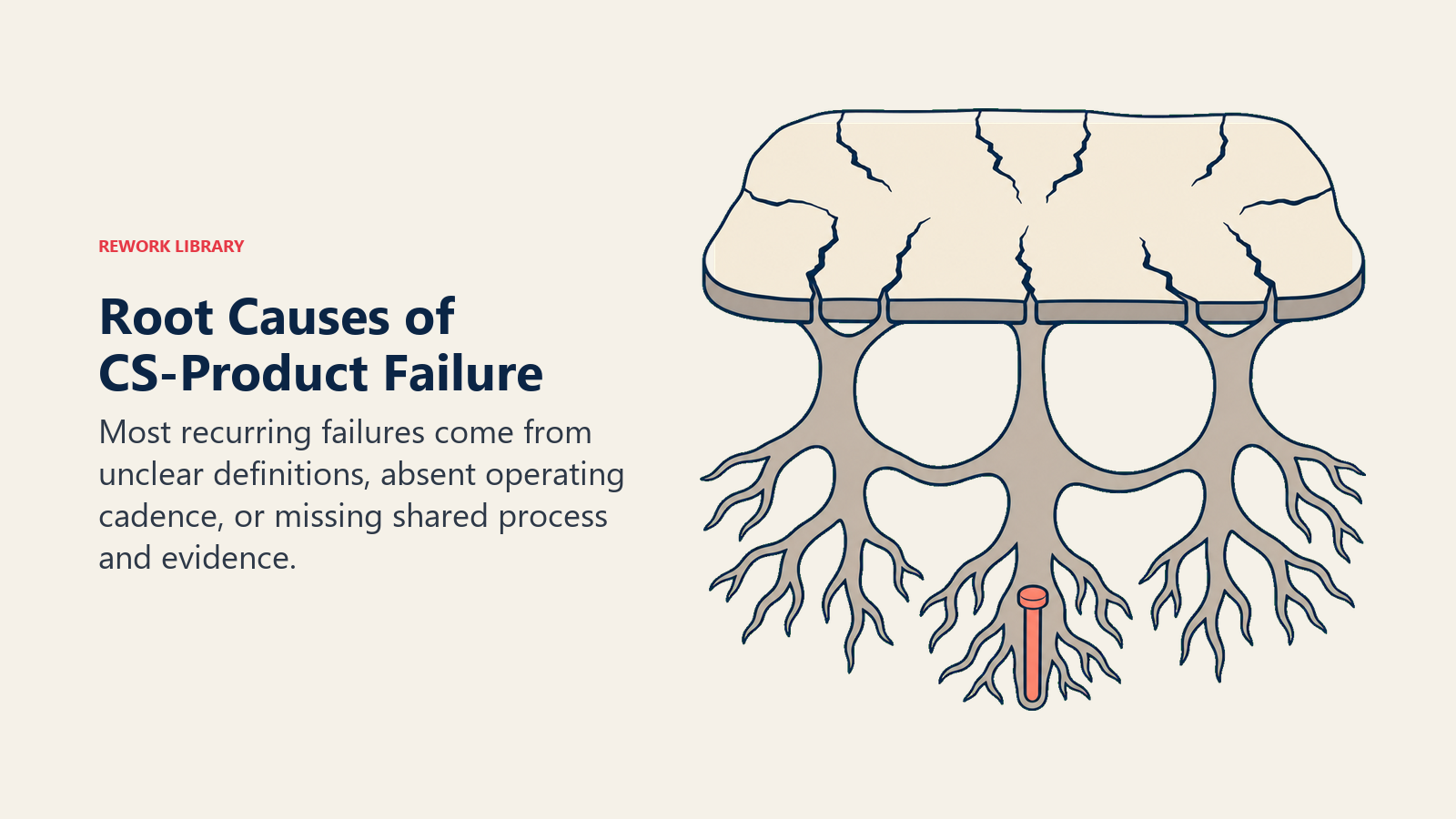
Missing definitions. What CS can say about the roadmap. What counts as a "bug" versus a "feature request." What "on the roadmap" actually commits the company to. What a beta program's obligations are to participants. When definitions are absent, every downstream process (every customer conversation, every post-mortem, every prioritisation call) is built on ambiguous inputs. The arguments look like personality conflicts, but they're definitional ambiguities surfacing as disagreement between people who are using the same words to mean different things.
Quotable: Three of the eight most common CS-Product failure patterns (roadmap over-promises, finger-pointing at churn, and beta feedback loss) share a single structural cause: the two teams never wrote down what their shared terms meant. The conflict looks interpersonal. The fix is a definition document.
Missing cadences. The weekly P1/P2 ticket review. The monthly internal roadmap briefing. The 30/60/90 post-launch review. The CS-PM 1:1 with an at-risk account slot. The quarterly post-beta retrospective. Alignment between CS and Product isn't a project state you reach and maintain. It's an operating rhythm you sustain through recurring structured contact. Cadences that aren't locked into the calendar with named owners will drop when people get busy. And that's exactly when you need them most. As HBR analysis on cross-functional collaboration shows, the breakdown typically isn't cultural. It's structural, and the fix is explicit shared processes rather than better intentions.
Missing shared data. Product usage and customer health in separate silos. Churn signals that are visible in the CS platform but invisible to the PM managing the feature. ARR context absent from the engineering ticket that would have changed its priority if it had been visible. When both teams don't see the same signals, they can't have the same conversation about what's happening to a customer account. The data isn't hard to share, but it requires a deliberate decision to build the shared view rather than assuming each team's system will talk to the other.
These three root causes interact and compound. Missing definitions corrupt the feedback loop. Missing shared data makes cadences unproductive because you're discussing different versions of the same situation. Missing cadences allow definitions to drift back to informal as teams turn over. You can usually identify the primary root cause by asking which category of failure most consistently shows up in your post-mortems. Start there, not with a workshop or a re-org, but with the specific definition, cadence, or shared data view that is currently absent.
Structural fixes outlast culture fixes. Two teams that disagree about whose fault a churn is will keep disagreeing until the structure that generated the disagreement (undefined roadmap language, absent post-mortem templates, siloed usage data) is replaced with something explicit. Fix the structure. The relationship quality tends to follow. The FAQ below answers the questions teams ask most often before they commit to that fix.
Learn More
- 8 Warning Signs CS and Product Are Misaligned
- The Feature-Request Graveyard Problem
- How CS Communicates Roadmap Without Overpromising
- Support Tickets to Product Backlog Items
- Closing the Feedback Loop with Customers
- The "We Built It, Nobody Uses It" Problem
- Handling "When Is X Coming?" Questions
- The CS-PM 1:1 Cadence

Principal Solution Architect
On this page
- How to Use This Article
- Failure Pattern 1: The Feature-Request Graveyard
- Failure Pattern 2: CS Over-Promises Roadmap, Customer Churns at Delay
- Failure Pattern 3: PM Never Talks to Customers, Builds from Intuition
- Failure Pattern 4: Support Tickets Disappear into Jira Black Hole
- Failure Pattern 5: Beta Program Runs Without Customer Voice Surfacing Back
- Failure Pattern 6: We Built It, Nobody Uses It: No Feedback Loop on Adoption Gap
- Failure Pattern 7: CS and Product Point Fingers When a Customer Churns
- Failure Pattern 8: Roadmap Goes Silent: CS Can't Answer Customer Questions
- The 8 Failure Patterns at a Glance
- The Pattern Behind the Patterns
- Learn More