CS as Voice of Customer Channel: Turning Relationship Signal into Product Intelligence
Turn this article into takeaways for your work.


Each assistant summarizes the article only for you and suggests best practices for your work.
CS is either the best voice-of-customer (VoC) channel in your company or one of the worst. The difference has nothing to do with how good your CSMs are. It has everything to do with whether the signal they're holding is captured, tagged, weighted, and routed, or whether it's still living in their heads, their Slack messages, and the notes section of their last quarterly business review (QBR) deck. If you haven't read the operating model foundation, what CS-Product alignment is is the place to start.
The anecdote version sounds like this: "Our biggest customer keeps asking for a better API." A PM hears that in a meeting, nods, adds a vague note to the backlog. A month later a different CSM mentions: "Harrington has been asking about the API too." Another note. Three months after that, a PM runs discovery on API improvements and invites a few customers to chat, but not the accounts that have been asking, because nobody mapped the requests to specific accounts with specific ARR and specific renewal timelines. The feature that ships solves a slightly different problem from the one the CSMs were hearing about. Adoption is underwhelming. Nobody's quite sure why.
The intelligence version of that same signal looks different. Over six months, 14 accounts have submitted structured feedback about API rate limits and authentication flow. Those accounts represent $1.8M in ARR. Four of them are up for renewal in the next 90 days. Three have flagged this as a factor in their renewal decision. The PM opening the product analytics tool sees all of that before their next planning session. The discovery conversation is already scoped to the right problem.
Same CSMs. Same customers. Completely different input quality. The difference is structure.
Why CS Is the Best VoC Channel (When Structured)
Let's start with the case for CS as a primary intelligence channel, because it's not obvious from the outside, especially to Product teams that have their own customer contact through discovery interviews, sales calls, and support escalations. Gartner's definition of Voice of the Customer frames VoC as the set of customer needs and requirements, obtained from direct and indirect feedback. CS is the only function that captures both, in a continuous post-sale relationship context.

CS's advantage comes from three things that no other channel combines.
Post-sale relationship depth. CSMs hear what customers won't put in an NPS survey, a support ticket, or a product review site comment. They hear it because they've built a relationship with the account over months or years. A customer who gives a 7 on an NPS survey and writes "generally satisfied" in the comment field will tell their CSM in a quarterly business review: "Honestly, if you don't fix the permissions model in the next two quarters, we're going to have a serious conversation at renewal." That's a completely different signal: specific, business-contextualized, actionable. And it only exists in the relationship channel.
Quotable: "The same customer who writes 'generally satisfied' on an NPS survey will tell their CSM in a QBR: 'If you don't fix the permissions model in the next two quarters, we're going to have a serious conversation at renewal.' That gap between survey signal and relationship signal is why CS is the most underutilized VoC channel in B2B SaaS."
Volume and breadth across the book. An individual PM might do 10-15 customer discovery interviews per quarter if they're being disciplined about it. A 10-person CS team is in structured conversations with 200+ accounts every quarter, every one of them talking about what's working and what's not. No other channel gives you that combination of frequency and breadth. The question is whether you're capturing the pattern signal across all of those conversations or just the loudest individual voices.
Business context that raw feedback forms don't carry. CS understands which accounts are strategic, which are at-risk, which are expansion candidates. When a CSM submits a feature request, they know whether the account asking is a $10K long-tail account that's been a support burden or a $150K strategic account whose champion just moved from Director to VP and is now planning a cross-departmental rollout. That business context is what converts a feature request into a prioritization decision. NPS surveys and support tickets don't carry it. CS does, and pairing that context with post-sale customer journey data makes the prioritization case even stronger.
Key Facts: VoC Channel Effectiveness
- Companies with a structured CS-to-Product feedback channel launch features with 15-20% higher 90-day adoption rates, because the team closest to customers was involved in both shaping the build and preparing the rollout (Forrester).
- 74% of customers who churned for product-related reasons had raised the same concern with their CSM before churning. The signal existed but didn't route to a decision that changed the outcome (Gainsight).
- Only 22% of product teams report having a formal, consistent process for incorporating post-sale CS feedback into roadmap planning (ProductPlan).
Why CS Is Often the Worst VoC Channel (When Unstructured)
And now the honest side: unstructured CS feedback is often worse than no feedback at all. Not because the signal isn't there, but because it introduces a specific set of distortions that lead product teams toward the wrong decisions.
Loudest voice wins. When feedback travels by whoever talks to the PM most frequently, the product roadmap responds to the most assertive CSM's most demanding customer, regardless of whether that customer represents a significant ARR segment or a common pain point. The 20 accounts who share the same quiet frustration but don't have a CSM who aggressively escalates are invisible. Their churn when the gap persists is equally invisible until the pattern is obvious in retrospect.
No ARR weighting means no prioritization signal. A $5K account's feature request and a $200K account's churn-risk feature request look identical in a Slack message. In an unstructured channel, "Harrington's asking about X" and "Patel Corp is blocking their rollout on X and renewing in 45 days" might both be a single Slack ping, with no indication of which one has a $200K decision attached to it. Product can't prioritize from noise. The ARR-weighted feedback quantification model is exactly how you fix this: it attaches dollar weight to every request before it reaches a PM.
No tagging, no tracking, no routing. Feedback dies in email threads, Slack DMs, and the notes section of QBR decks. A PM who wants to understand the scope of a specific customer pain can't query unstructured data. They're relying on memory and whoever they happen to talk to, which means their sample is biased toward the most recent and the loudest, not toward the most representative or the most business-critical.
The closed-loop problem. When feedback goes in and nothing comes back, CSMs stop submitting. It's a rational response to a system that provides no evidence that input has any effect. After two or three experiences of submitting a customer concern and never hearing what happened to it, a CSM internalizes that the feedback channel doesn't work and stops using it consistently. The signal pool shrinks to the people who are persistent enough to keep submitting despite the absence of feedback. HBR's research on closing the customer feedback loop found that the greatest impact comes from relaying feedback results immediately to the employees who served customers and empowering them to act. The same closed-loop principle applies directly to the CS-Product channel.
Quotable: "Gainsight benchmarks found that 74% of customers who churned for product-related reasons had raised the same concern with their CSM before churning. The signal existed. The failure was routing: feedback captured in the relationship channel never reached the decision that could have changed the outcome." (Gainsight, 2024)
The Four Properties of a Structured CS VoC Channel
The fix isn't complicated in concept, though it requires operational discipline to execute. The Structured CS VoC Channel Model defines four properties that must all be present for the channel to function as product intelligence rather than noise. Missing any one property degrades the entire system.
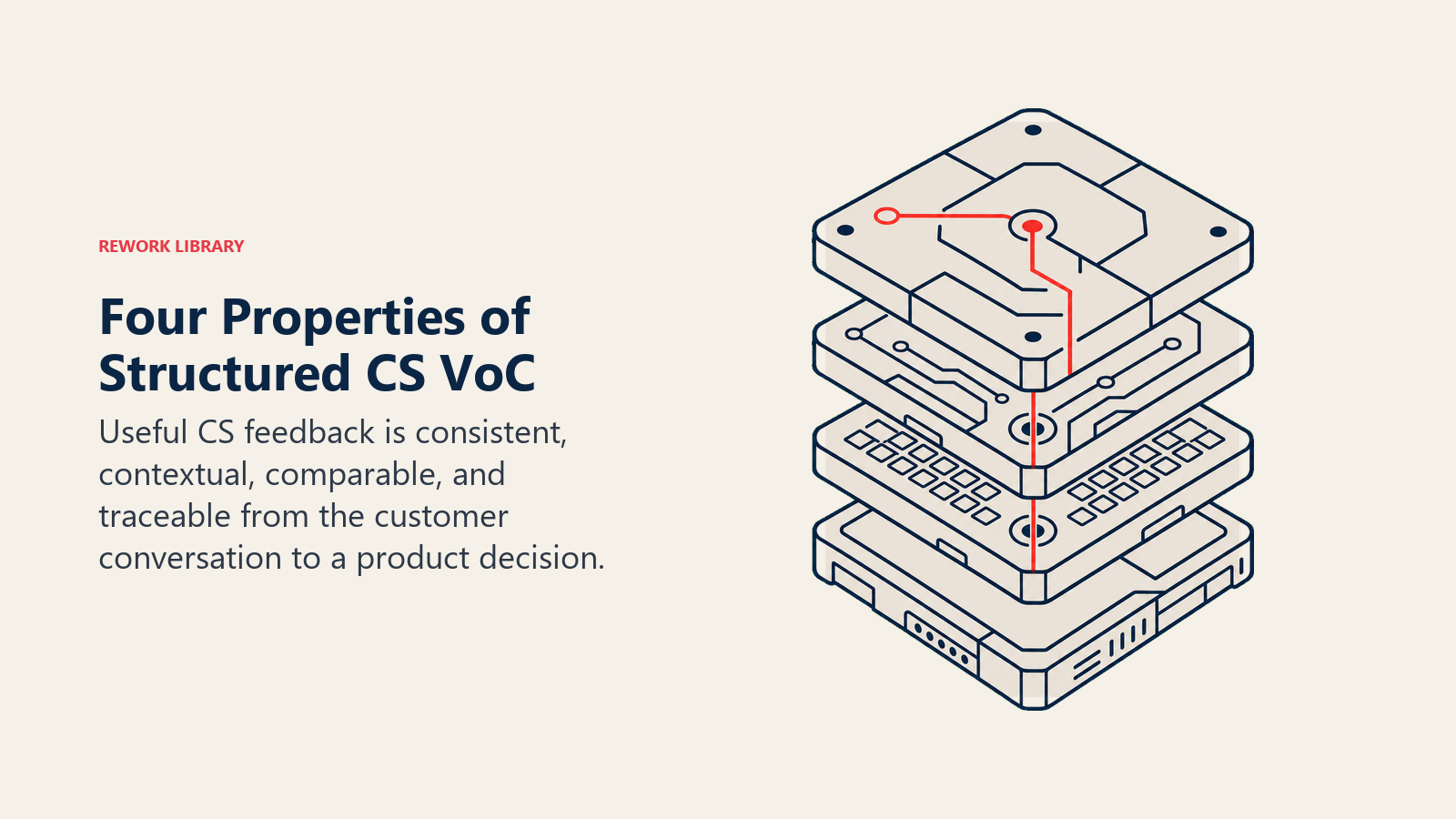
Captured. Feedback is recorded in a system (a field in the CRM, a CS platform feature, a structured intake form), not just heard in a conversation and held in the CSM's memory. The bar for "captured" isn't high: it should take a CSM under two minutes to log a piece of feedback in a way that makes it queryable later. If it takes longer, the process won't be followed consistently.
Tagged. Feedback is categorized by theme, product area, and account context at the point of capture. Not after a quarterly review. Not when someone has time to go back through the backlog. At capture. A minimal tagging schema might include: product area (3-5 options), feedback type (feature request / bug / UX friction / workflow gap), ARR tier of the account (automatic from CRM), and whether the feedback is renewal-blocking. Four fields, logged at the moment of capture, changes everything about how usable the data is for product planning.
Weighted. ARR or strategic importance is applied to feedback so Product can prioritize. A simple approach: automatically surface ARR from the CRM record attached to each feedback item. A more sophisticated approach: use a scoring formula (ARR × renewal urgency × number of accounts with the same request) to generate a priority score. The formula matters less than the principle. Feedback from a $200K account with a renewal in 60 days should sort higher than feedback from a $15K account with no urgency signal, and that ranking shouldn't depend on which CSM was most aggressive in following up.
Closed-loop. The CSM who submitted feedback, and ideally the customer who raised it, learns what happened to that input. Not every piece of feedback can be acted on. But every piece of feedback should receive one of three responses: "this is on the roadmap for Q3," "we've looked at this and here's why we're not prioritizing it in the next two quarters," or "this is under active review." The closed loop is what keeps the channel functioning. It gives CSMs evidence that submitting feedback has an effect, which keeps them submitting.
How CS Compares to Other VoC Channels
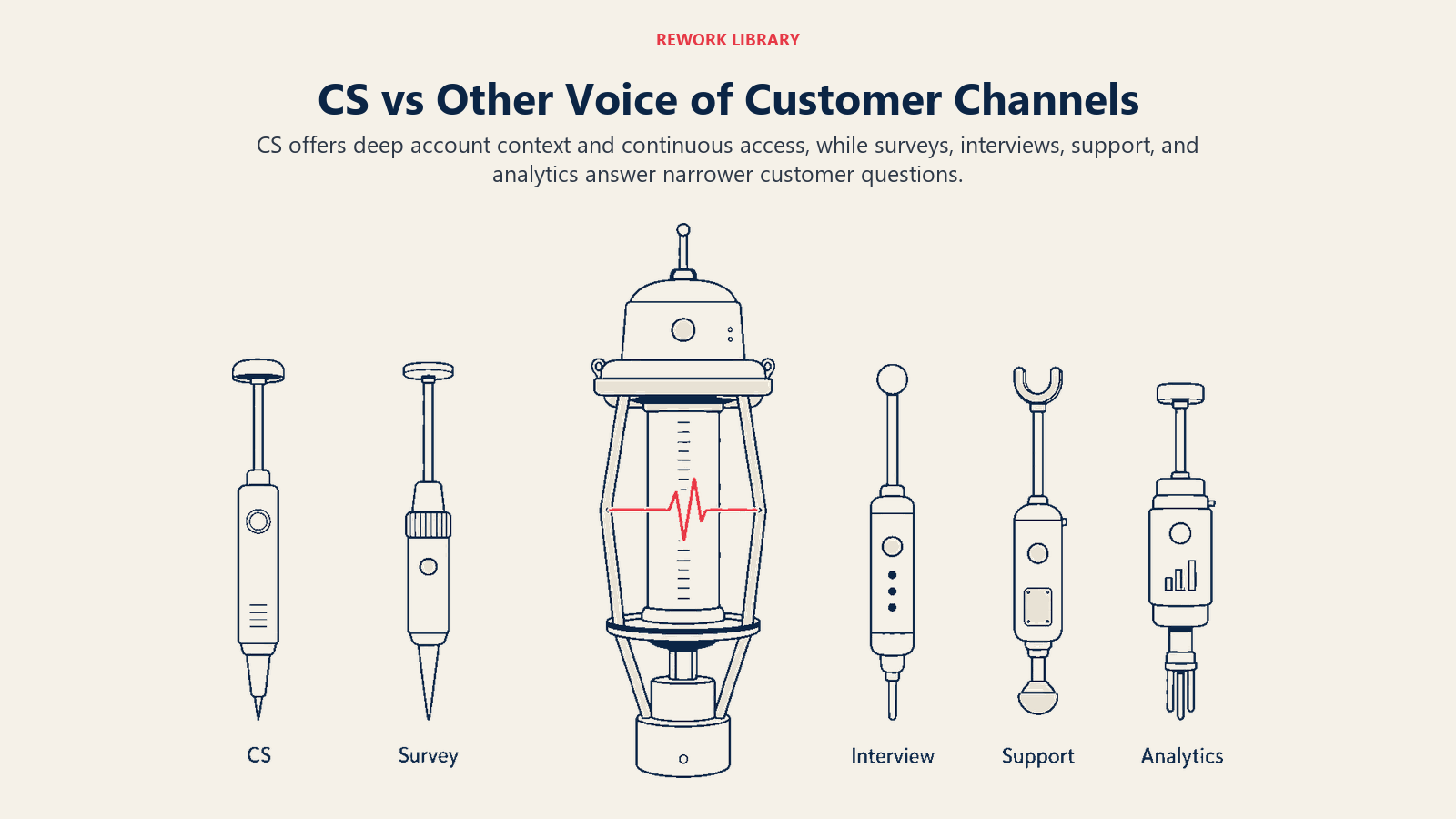
It's worth being specific about how CS compares to the other feedback channels that compete for Product's attention, because the comparison makes the structural argument clearer.
| Channel | Depth | Breadth | Business Context | Structured by Default? |
|---|---|---|---|---|
| NPS / CSAT surveys | Low (transactional) | High (many respondents) | None | Partially |
| Support tickets | Medium (pain-oriented) | High (volume signal) | Low | Yes (ticketing system) |
| Sales feedback | Medium (pre-sale needs) | Low (filtered by pipeline) | Low-medium | No |
| Customer advisory boards | High (strategic depth) | Very low (10-15 accounts) | High | Partially |
| CS (structured) | High (relationship depth) | High (full book of business) | High (CSM context built over months) | Only with deliberate process |
| CS (unstructured) | High, but biased | High, but noisy | High, but invisible to Product | No |
NPS and CSAT surveys give you breadth but not depth. You know that 30% of your customers gave you a 6-7 on NPS, but you don't know which 30%, what they're actually frustrated about, or what their renewal situation looks like. The surveys are useful for trend monitoring, not for roadmap input.
Support tickets give you volume signal. They tell you what's breaking. They're oriented toward pain that has crossed a threshold severe enough that the customer took action to report it. But they don't capture the quiet friction that accumulates over months: the workflow that takes three extra steps, the report format that requires a manual export every Friday, the permission model that requires an admin workaround for every new team member. That friction lives in CS conversations, not in tickets.
Sales feedback reflects pre-sale customer needs: what customers say they need to evaluate and buy the product. That signal matters for marketing and positioning, but it's systematically different from what post-sale customers experience when they're actually using the product. The gap between what customers say they need to buy and what they need to succeed is where most product teams find the most actionable insight.
Customer advisory boards give you deep, strategic input from a self-selected group of engaged customers. They're valuable for validation and co-design, but they're not representative. The accounts that participate in CABs are typically the most engaged, most willing to invest time, and most likely to give diplomatically positive feedback in a setting where they know the vendor is in the room.
CS is the only channel that combines relationship depth (hearing what customers won't say in a survey), breadth (full book of business, not just vocal minority), and business context (ARR, renewal timing, strategic importance). But it only delivers on that combination when it's structured. Unstructured, it's just another noise source competing with all the others.
What Product Needs from CS (and Rarely Gets)
Most product teams have absorbed a lot of CS feedback over the years. Most of them will also tell you that the signal quality is inconsistent and hard to act on. When you ask product teams what would make CS feedback more useful, three themes come up almost universally.
Not just "the feature request" but the job-to-be-done behind it. "Customers want a better reporting export" is a feature request. "Finance teams at our $100K+ accounts are spending 3-4 hours per month manually reformatting exported reports to match their internal templates, which is causing two of our biggest accounts to evaluate a competing tool that offers native template mapping" is a job-to-be-done with business context. The PM who receives the second version can make a much better build decision than the PM who receives the first. Clayton Christensen's Jobs to Be Done framework, published in HBR, is the theoretical foundation for this distinction: customers don't buy features, they hire products to accomplish a specific outcome in a specific situation.
Not just "customers are unhappy" but which segment, what ARR, and what's the renewal timeline. The escalation that reaches Product as "we have some accounts that are upset about the data sync performance" is nearly impossible to prioritize. The escalation that comes with "7 accounts representing $420K ARR have flagged data sync reliability in the last 90 days; three are up for renewal in Q2 and two have listed this as a factor in their renewal decision" gives Product something to work with. One of those is a pressure signal. The other is a product priority. This is the same framing that makes voice of customer flow into sales messaging work: accurate segment context converts noise into a decision.
Not just "several customers asked" but how many, weighted how. The word "several" is almost useless in a roadmap conversation. How many is several? Are they strategic accounts? Are they in the same segment? Are they all experiencing the same underlying problem, or are they each using the term "API" to describe three different frustrations? Structured feedback with a count and an ARR weight eliminates the ambiguity and gives Product a basis for prioritization that doesn't depend on advocacy skills.
The Shared Responsibility
Structured CS VoC doesn't happen because CS does all the work or because Product does all the work. It requires explicit ownership on both sides.
CS owns: Capturing feedback consistently in the agreed system, tagging it by the agreed schema, and routing it through the agreed process. CSMs shouldn't be writing product specs. They should be logging what they hear in a structured way and handing it to the team that makes build decisions. The bar for what CS owns is: capture, tag, route. Not analyze, not prioritize, not advocate. The capturing feedback systematically article covers the specific mechanics of that capture step.
Product owns: Acknowledging input on a defined cadence, closing the loop on what happened to each piece of feedback, and making the submission process feel worth doing through consistent follow-through. If Product's only obligation is to receive feedback and then do whatever they were going to do anyway, the channel breaks. The closed loop is what makes it functional.
PMM often serves as the bridge. Product marketing understands both the customer language that CS speaks and the product language that PMs operate in. PMMs are often the natural translation layer, converting "customers keep saying the reports are confusing" into "there's a discoverability problem in the analytics module that's affecting retention in the mid-market segment." Without a translation layer, feedback that arrives in CS language often doesn't connect to product framing, and both sides wonder why the conversation keeps failing to produce shared understanding. The PMM as the Bridge article covers that translation role in detail.
Rework Analysis: The Structured CS VoC Channel Model (Capture, Tag, Weight, Close the Loop) is only as durable as the tooling that enforces it. When the process depends entirely on CSM discipline (manually filing Slack messages into a Notion doc), adherence degrades within two quarters. When it's embedded in the CS platform (a required field at QBR close, automatic ARR pull from the CRM record, a PM review cadence triggered by feedback volume), the process runs at near-zero overhead and CSM submission rates stay consistent. Rework's CS-Product module is built on this model: feedback capture happens at the point of the CSM workflow, ARR weighting is automatic, and closed-loop notifications go out without manual PM follow-up. The structural requirement is the same whether you're using Rework or another stack: the four properties of the model must be embedded in tooling, not carried by individual behavior.
One Thing to Do This Week
Before investing in tooling, process redesign, or a new feedback framework, schedule a 30-minute working session between the CS team lead and one PM. The agenda: agree on what "good feedback" looks like before any submission happens. You can also run the CS-Product alignment maturity model diagnostic first to understand which stage your feedback infrastructure is actually at.
Specifically, answer these three questions together:
- What information does a PM need from a piece of CS feedback to make it useful for a roadmap decision?
- What does a CSM need to know after submitting feedback to believe the channel is worth using?
- What's the one field, beyond free text, that would make feedback easier to prioritize?
That 30-minute conversation produces the agreement that everything else builds on. It's also a proxy test for alignment maturity: if CS and Product can't agree on the answers in 30 minutes, the gap isn't tooling. It's the shared understanding of what each side needs from the other.
The VoC Pipeline article covers the full operational mechanics of capturing and routing feedback once that shared definition is in place. The ARR-Weighted Feedback Quantification article covers the weighting model in detail.
Frequently Asked Questions about CS as Voice of Customer Channel
What is a voice of customer (VoC) channel in B2B SaaS?
A VoC channel is a systematic process for collecting, organizing, and routing customer feedback to the teams that make decisions based on it. In B2B SaaS, the most important VoC channels are NPS surveys, support tickets, customer advisory boards, and the customer success team. CS is uniquely positioned because it combines relationship depth, breadth across the book, and business context that other channels lack. But only when the feedback it holds is structured and routed systematically.
Why is unstructured CS feedback a problem for product teams?
Unstructured feedback creates three distortions: loudest voice wins (the most assertive CSM's most demanding customer shapes the roadmap), no ARR weighting (a $5K account's request is indistinguishable from a $200K account's churn risk), and no tracking (feedback disappears into Slack and email without any way to query it later). These distortions make unstructured CS feedback worse than useless. It creates a false sense that Product has customer input when the input it has is systematically biased.
What are the four properties of a structured VoC channel?
Captured (feedback recorded in a system, not held in memory), tagged (categorized by theme, product area, and account context at the point of capture), weighted (ARR or strategic importance applied for prioritization), and closed-loop (CSMs and customers learn what happened to their input). A feedback process that has all four properties produces usable intelligence. Missing any one significantly degrades the output.
How does CS feedback differ from NPS surveys?
NPS surveys give you a numerical score and open-ended comments from a broad respondent pool. They're good for trend monitoring but weak on depth and business context. CS feedback, when structured, gives you specific customer concerns with account context (ARR, renewal timing, strategic importance) that NPS can't carry. The same customer who gives a 7 on NPS and writes "generally satisfied" might tell their CSM in a QBR that they're actively evaluating a competitor because of a specific workflow gap. That's the gap between transactional feedback and relationship feedback.
What role does PMM play in CS VoC?
PMM typically serves as the translation layer between CS language and product language. CS describes customer problems in customer terms: workflow frustrations, use case gaps, comparison to competitors. Product thinks in feature specs, technical constraints, and discovery frameworks. Without a translation layer, feedback that arrives in CS language often doesn't map cleanly to product framing, and both sides end up frustrated. PMMs who sit at the CS-Product boundary can convert relationship-level signal into product-ready input, which is one reason why the PMM function appears earlier and more deliberately in organizations that have achieved Stage 3 alignment.
Learn More

Principal Solution Architect