日本語

Lead vs Prospect vs Opportunity: Key Differences

The lead vs prospect debate trips up sales teams more than almost any other terminology question. Someone fills out a form, your SDR gets on a call, a deal gets created -- but what do you actually call each of those people at each stage? And does it matter?

It matters a lot. When your team uses these terms inconsistently, leads get handed off too early, reps waste time on contacts who'll never buy, and your pipeline metrics become unreliable. Managers can't forecast accurately when "opportunity" means something different to every rep.

This guide gives you sharp definitions, a side-by-side comparison, and a clear progression from first touch to deal.

What's the Difference Between a Lead, Prospect, and Opportunity?

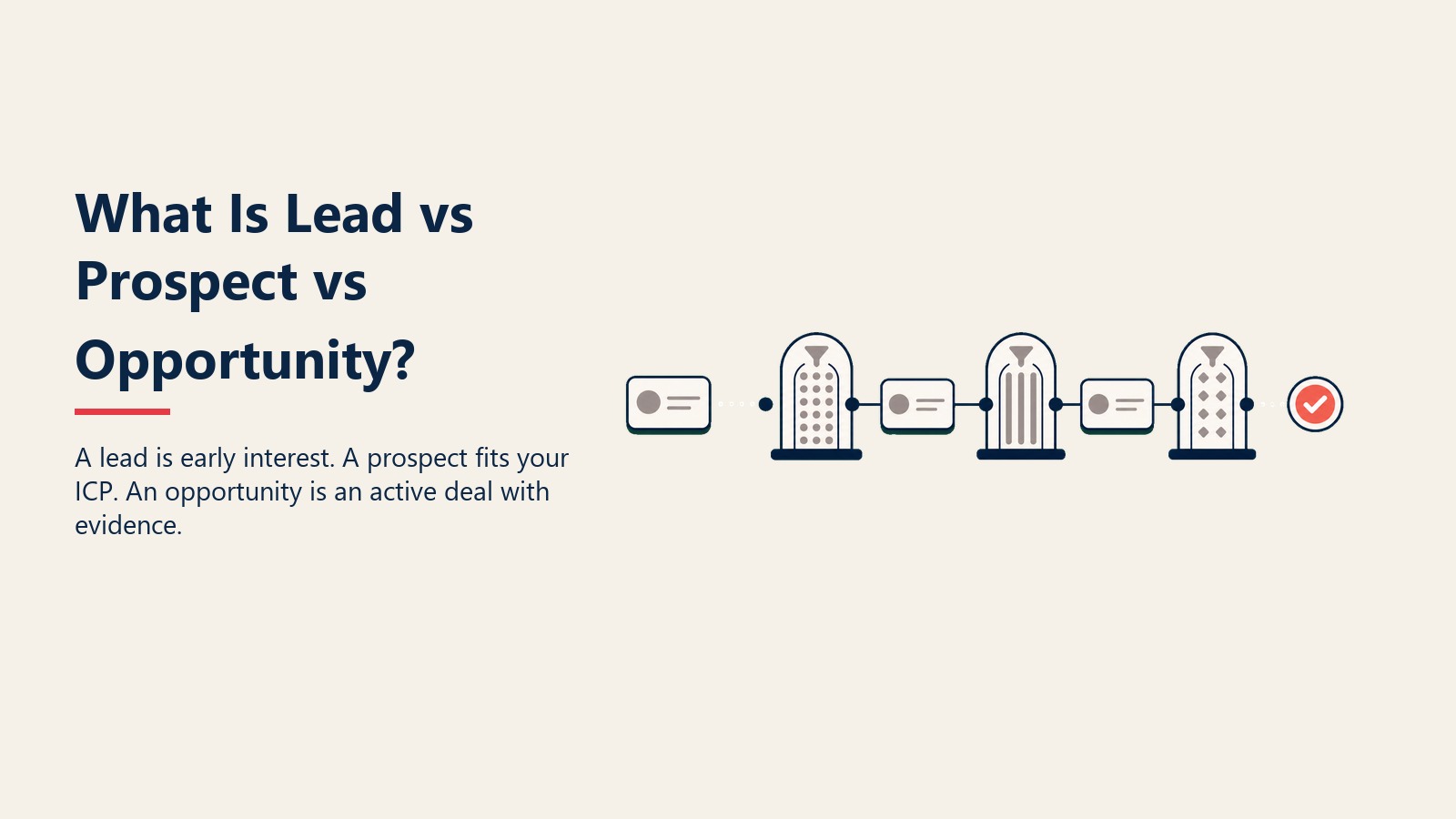
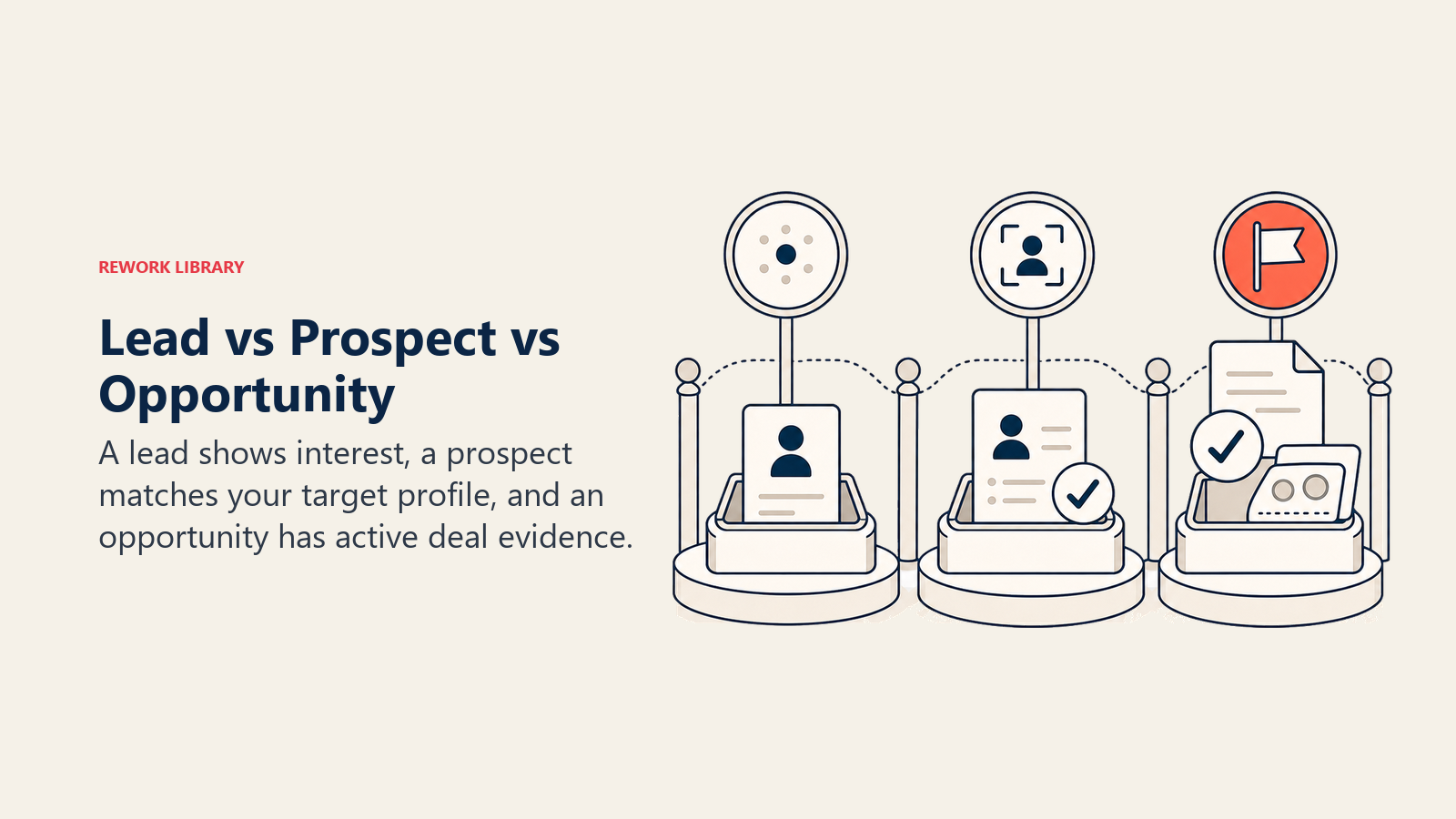
A lead is an unqualified contact who has shown some signal of interest. A prospect is a lead that's been screened and fits your target profile. An opportunity is a qualified prospect who has engaged with your sales team and represents a real, active deal in your pipeline.

Each term marks a distinct gate in the qualification process. Crossing each gate requires specific evidence -- not just a gut feeling.

Key Facts

  • 79% of marketing leads never convert to sales because they're handed off before being properly qualified. (MarketingSherpa, 2022)
  • Companies with a defined lead qualification process generate 133% more revenue than those without one. (Demand Gen Report, 2023)
  • Sales reps spend an average of 21% of their time on unqualified leads that were never going to close. (HubSpot, 2023)

Lead vs Prospect vs Opportunity at a Glance

Lead Prospect Opportunity
Definition Unqualified contact with some signal of interest Screened contact who fits your ICP Active deal in the pipeline with a real buying process underway
Qualification level None to minimal ICP fit confirmed Full BANT or similar framework applied
Owner Marketing or SDR SDR or inside sales Account executive
Funnel stage Top of funnel Middle of funnel Bottom of funnel
CRM stage Lead object Lead (qualified) or Contact Opportunity/Deal object
Next action Nurture or initial outreach Discovery call or deeper qualification Proposal, demo, negotiation

What Is a Lead?

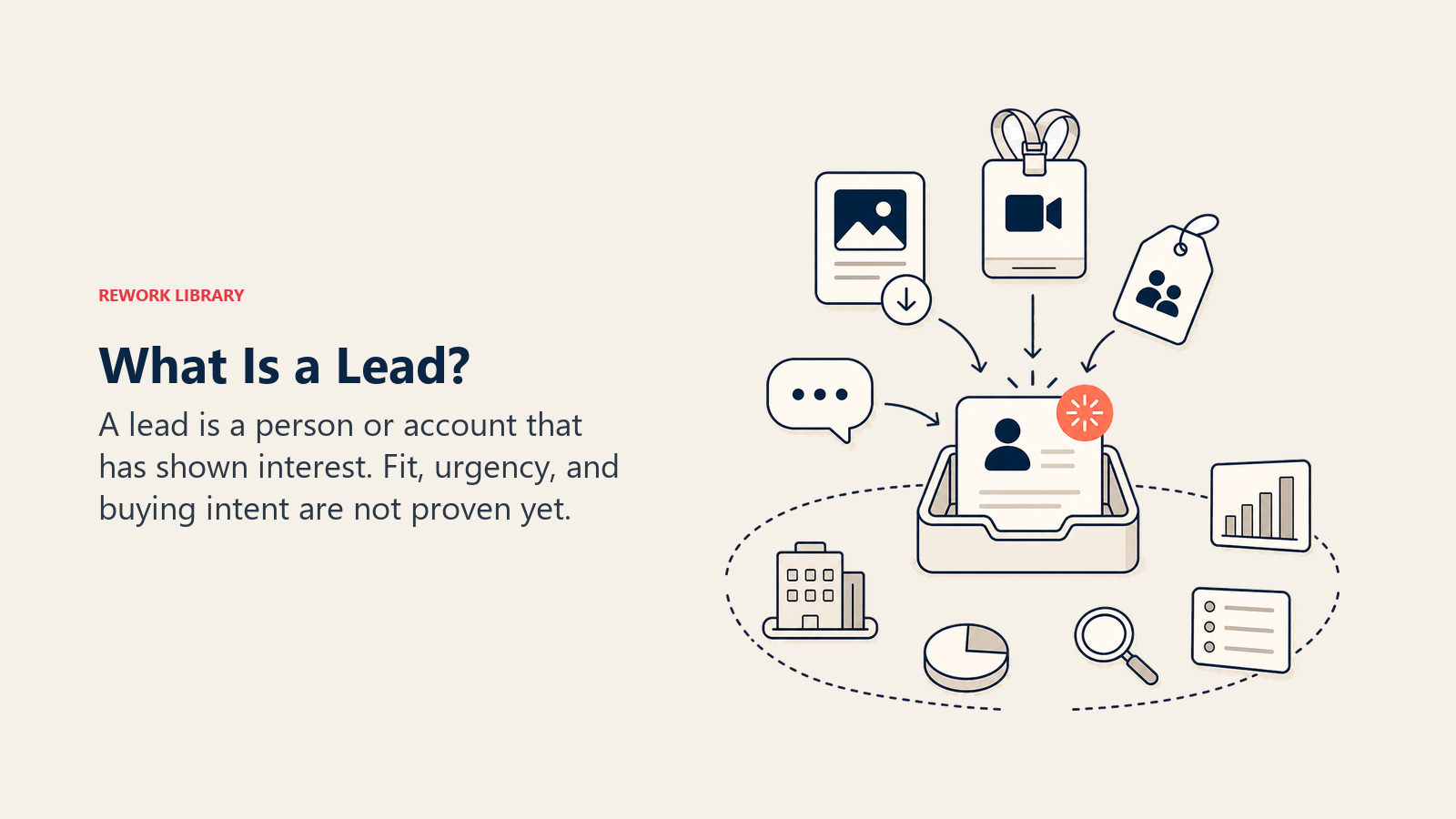
A lead is anyone who has interacted with your business in a way that suggests they might have interest. That's a low bar -- and intentionally so.

Leads come from everywhere: form fills, content downloads, webinar registrations, cold outreach responses, trade show badge scans, referrals. At this stage, you know almost nothing about whether they're a real buyer. You don't know their budget, authority, timeline, or even if the problem you solve is one they care about.

What makes someone a lead is the signal, not the fit. A VP who downloads your whitepaper is a lead. A student who signs up for your newsletter is also a lead. Both need qualification before they're worth a rep's direct attention.

Leads split into two camps:

  • Marketing Qualified Leads (MQLs): Contacts who've engaged enough with marketing content to meet a threshold score. Marketing owns them.
  • Sales Qualified Leads (SQLs): Leads that have been screened by an SDR and passed to sales. Sales owns them.

The handoff from MQL to SQL is one of the most friction-prone moments in the funnel. See MQL vs SQL for how to define that boundary clearly.

For a full taxonomy of lead types -- cold, warm, hot, inbound, outbound -- check Types of Leads.

What Is a Prospect?

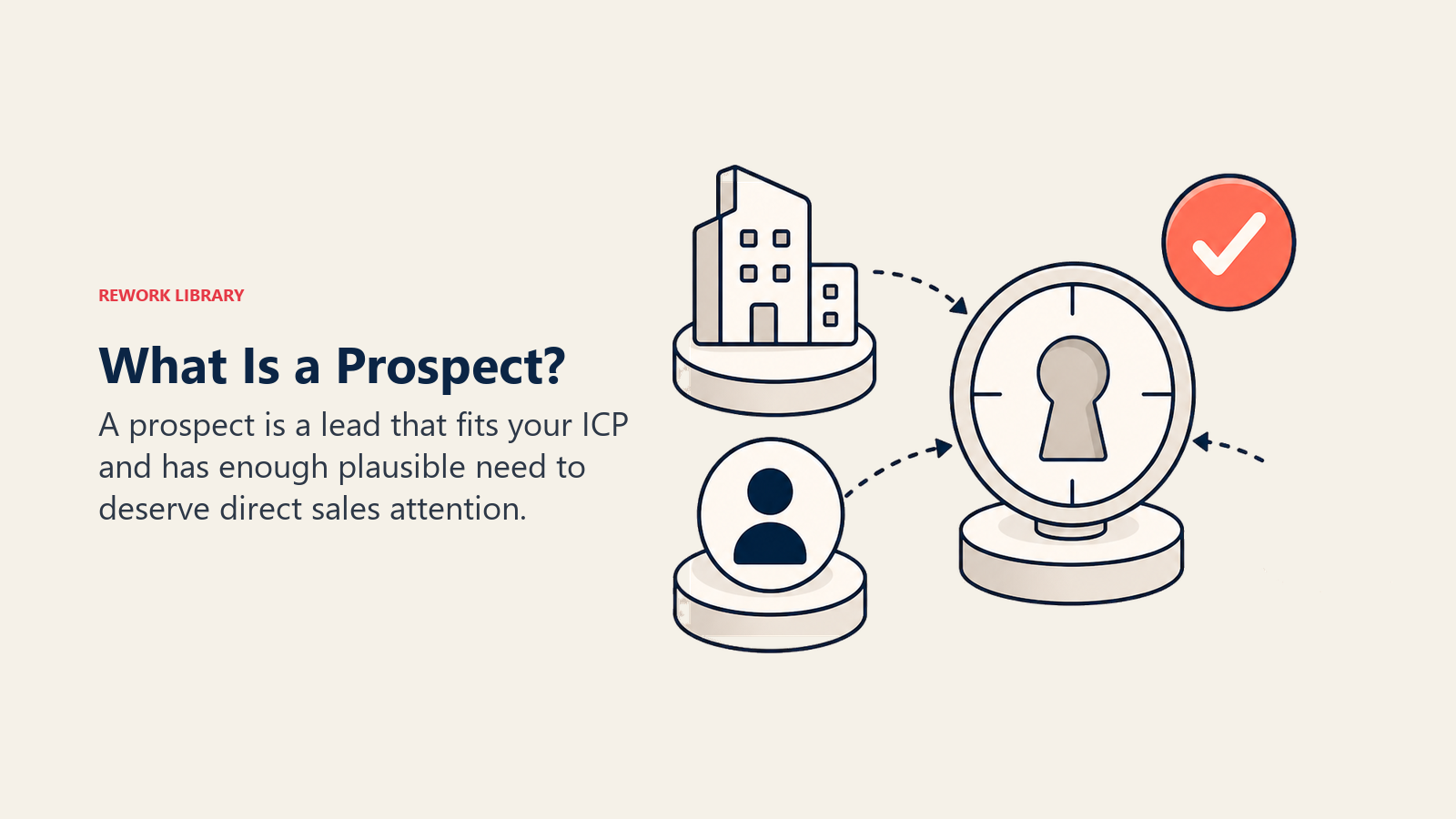
A prospect is a lead who has passed an initial qualification screen. They fit your ideal customer profile -- the right company size, industry, role, and use case. And crucially, there's reason to believe they have the problem your product solves.

The key shift: a lead becomes a prospect when you confirm fit from your side. You don't need the prospect's buy-in yet. You just need enough information to decide the contact is worth real selling time.

What typically confirms prospect status:

  • Company fits ICP criteria (headcount, industry, tech stack, revenue range)
  • The contact holds a relevant title or buying influence
  • There's a plausible pain point based on their industry, recent activity, or stated interest
  • They haven't been disqualified by a hard blocker (e.g., locked into a competitor for three years)

At the prospect stage, an SDR or inside sales rep typically owns the relationship. The goal is to get to a discovery call and determine whether an opportunity can be created.

Your buyer persona definitions should map directly to what qualifies someone as a prospect. If a contact matches your persona, they're prospect-worthy.

What Is an Opportunity?

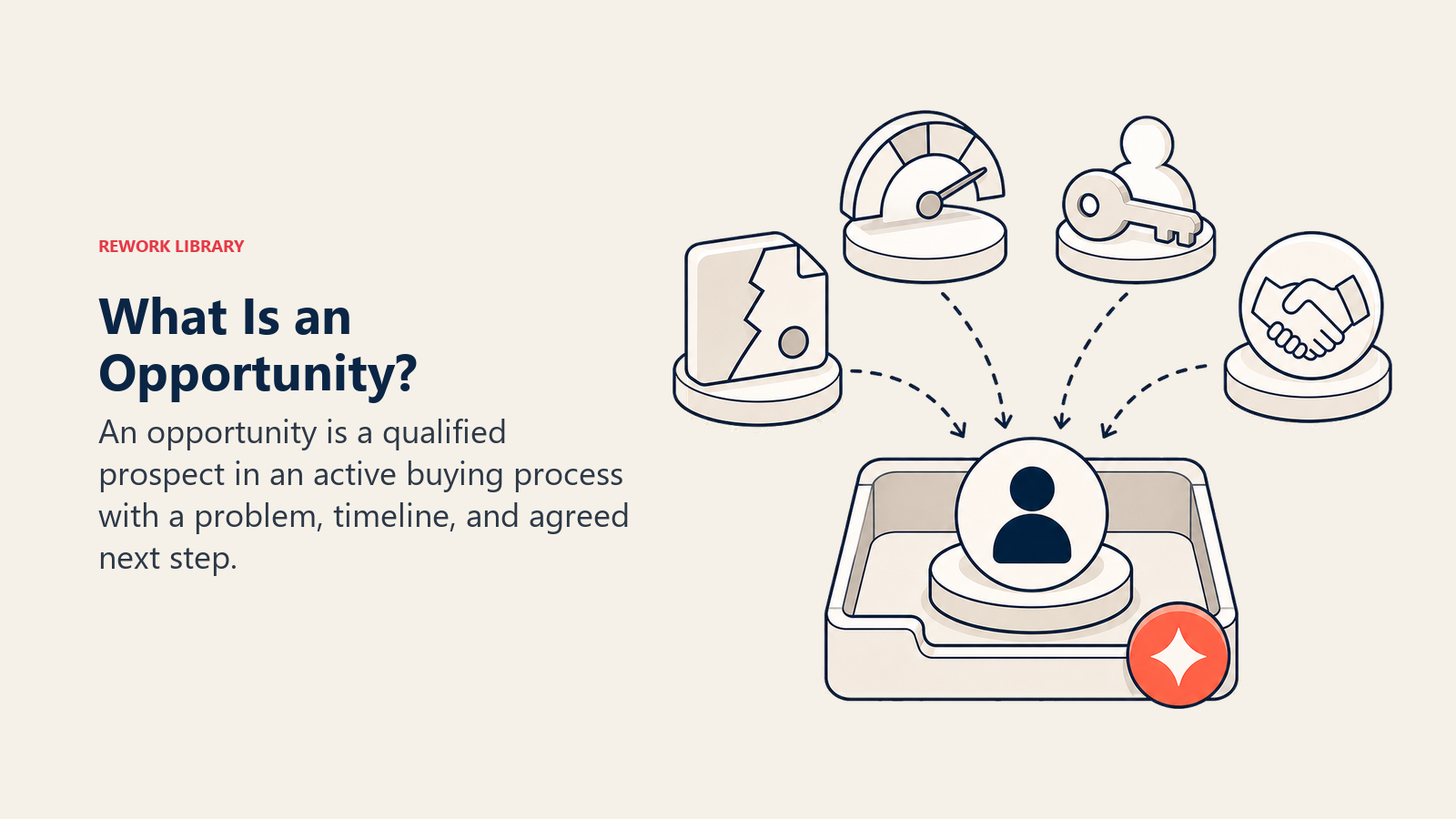
An opportunity is a prospect who has engaged in an active buying process. They've confirmed they have the problem, they're evaluating solutions, and your team has established enough context to believe a deal can close.

Creating an opportunity in your CRM should require specific criteria -- not just "the rep had a good call." Common entry criteria include:

  • The prospect confirmed the problem your product addresses
  • A budget range has been discussed or is understood
  • There's a decision-maker identified or accessible
  • A rough timeline exists (even "sometime this year" counts)
  • Next steps are agreed upon

This is where the deal object is created in your CRM and moves into the formal sales pipeline. The account executive owns it from here.

Good opportunity qualification is what separates forecasts you can rely on from ones that fall apart in the last week of the quarter. See lead-to-opportunity conversion for how to define and measure this transition.

How a Lead Becomes a Prospect and Then an Opportunity

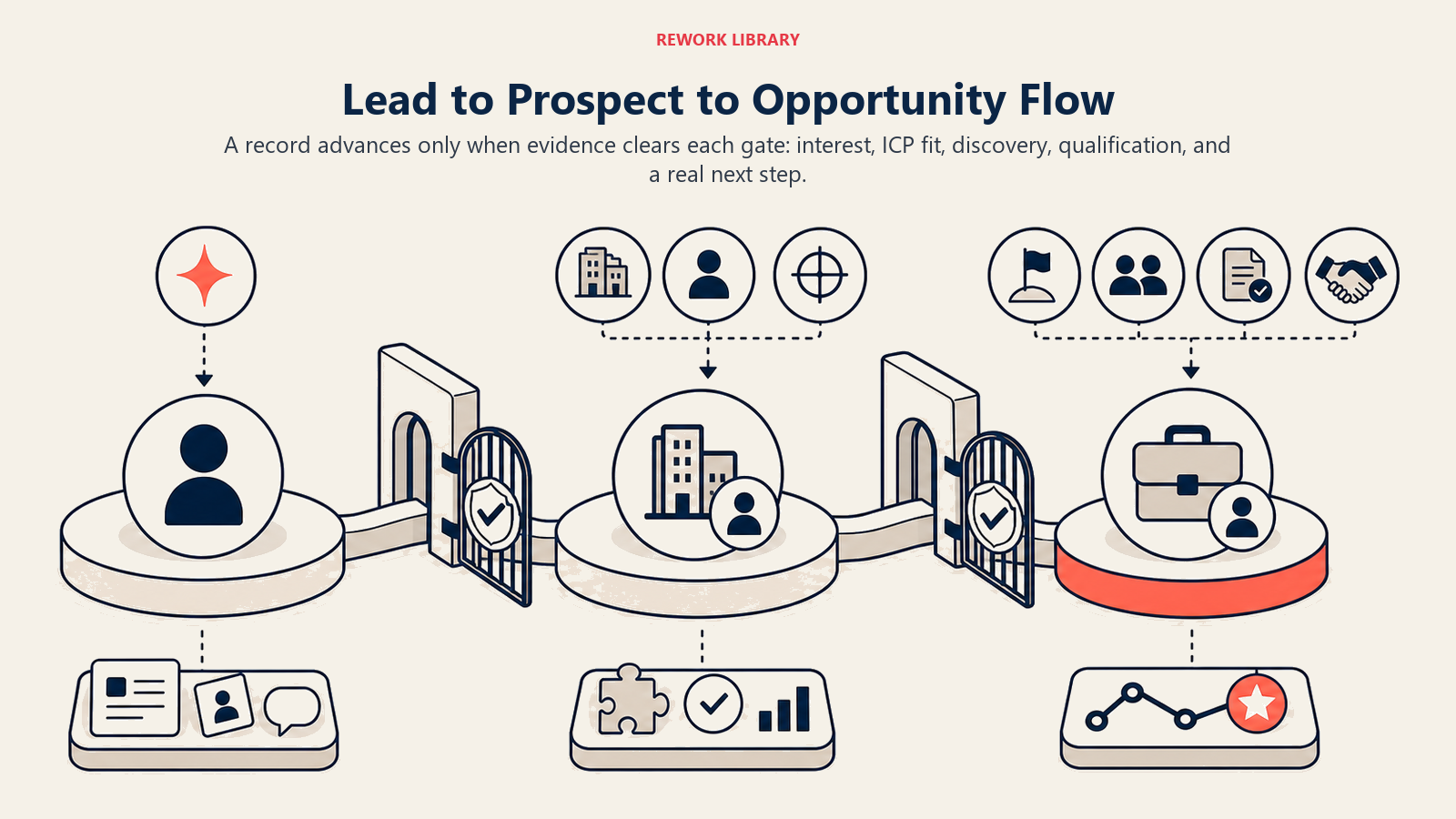
The progression isn't automatic. Each transition requires deliberate qualification. Here's how it works in practice:

  1. Lead created. A contact engages with your brand -- downloads content, responds to a sequence, attends a webinar, gets referred. The lead record is created in your CRM.

  2. Initial screening. An SDR or marketing ops reviews the lead against ICP criteria. Does the company fit? Does the title match? Is there a plausible use case? This takes two to five minutes if your ICP is well-defined.

  3. Lead becomes a prospect. ICP fit confirmed. The contact is now worth direct outreach. The SDR crafts a personalized message and attempts connection.

  4. Discovery conversation. The SDR connects with the prospect -- by phone, email exchange, or a scheduled call. The goal is to surface whether there's a real problem and a real interest in solving it.

  5. Qualification against criteria. The SDR runs through a qualification framework (BANT, MEDDIC, CHAMP) to assess budget, authority, need, and timeline. See lead qualification frameworks for options.

  6. Opportunity created. The prospect has confirmed the problem, expressed interest in a solution, and agreed to a next step with an account executive. The deal is created in the pipeline.

  7. Active selling begins. The AE takes over. Demos, proposals, negotiation, and closing activity happen at this stage, tracked through pipeline stages.

The time between each step varies by business. Enterprise deals might spend weeks at the prospect stage before an opportunity is created. SMB deals might move through in days. What shouldn't vary is the criteria for advancement.

A well-run lead lifecycle stages model formalizes this entire progression so nothing falls through the cracks.

Examples Through the Funnel

Real-world scenarios help make the distinctions concrete:

Scenario Stage Why
CMO downloads your ABM guide Lead Signal of interest, no qualification done yet
CMO's company matches your ICP (500+ employees, B2B SaaS, uses Salesforce) Prospect ICP fit confirmed, worth outreach
CMO gets on a call, confirms they're evaluating vendors for Q3 Opportunity Active buying process confirmed, deal created
Startup founder fills out a contact form Lead Unknown fit, unqualified
Startup is too small (5 employees, not in ICP) Disqualified Hard blocker, never becomes prospect
Mid-market RevOps lead responds to an email sequence Lead Initial engagement
RevOps lead confirms they have the right headcount and a real process problem Prospect ICP fit confirmed
RevOps lead requests a demo and shares their decision timeline Opportunity Active deal, AE engaged

The disqualification row matters. Not every lead becomes a prospect, and not every prospect becomes an opportunity. The goal isn't to push everyone through -- it's to route the right people to the right stage quickly and remove everyone else cleanly.

Common Mistakes

Calling everything a "lead." When reps use "lead" as a catch-all for leads, prospects, and opportunities, pipeline reporting breaks down. You can't measure conversion rates or forecast accurately when the categories blur together.

Creating opportunities too early. A good call doesn't equal a real deal. If the prospect hasn't confirmed the problem and a timeline, you're padding your pipeline with noise. This inflates forecast numbers and leads to last-minute surprises when deals don't close.

Skipping the prospect stage. Going straight from raw lead to opportunity skips the qualification that protects your AEs' time. AEs end up demoing to contacts who have no budget, no authority, or no real problem -- and that's expensive at their compensation level.

Inconsistent qualification criteria. If one rep creates an opportunity after a five-minute LinkedIn DM and another requires a full discovery call with confirmed budget, your pipeline data is meaningless. Standardize lead status management criteria and enforce them in your CRM.

Not reviewing stalled transitions. A lead sitting in "prospect" for 60 days without an opportunity being created is usually a dead end. Build review checkpoints into your pipeline cadence so stale contacts get recycled or disqualified.

Best Practices

Define each stage in writing. Put the exact criteria for moving from lead to prospect and prospect to opportunity into your sales playbook. Post it in your CRM. Make it non-negotiable.

Align marketing and sales on the MQL definition. The most common breakdown is marketing handing over leads that sales doesn't consider qualified. Fix this by agreeing on a shared definition of what makes a lead worth a rep's time. The MQL vs SQL distinction is where that agreement lives.

Use a qualification framework consistently. BANT, MEDDIC, or CHAMP all work -- but only if the whole team uses the same one. Pick one, train on it, and track it. See lead qualification frameworks for a comparison.

Build stage criteria into your CRM as required fields. If creating an opportunity requires filling in "confirmed problem" and "decision-maker name," reps can't skip the qualification. Required fields enforce process without requiring constant manager oversight.

Track conversion rates at each transition. Lead-to-prospect rate, prospect-to-opportunity rate, opportunity win rate -- each tells you something different. A low lead-to-prospect rate is a targeting or ICP problem. A low prospect-to-opportunity rate is a qualification or outreach problem. A low win rate is a sales execution problem. You can't diagnose what you don't measure.

Review the pipeline with stage discipline. During pipeline reviews, ask for evidence, not optimism. If an "opportunity" has no confirmed timeline, send it back to prospect status.

Frequently Asked Questions

Is a prospect the same as a contact? Not exactly. A contact is a CRM record -- anyone you have information on. A prospect is a contact who has been screened and confirmed to fit your ICP. All prospects are contacts, but most contacts are not prospects.

When should you convert a lead to an opportunity in a CRM like Salesforce? Only when an active buying process has started. In Salesforce, this usually means converting the lead record to a contact, account, and opportunity simultaneously -- but only after the prospect has confirmed the problem and a next step with an AE. Converting too early pollutes your pipeline; converting too late loses momentum.

Can a prospect become a lead again? Yes, and you should plan for it. If a prospect goes dark, misses calls, or tells you they're not evaluating vendors right now, move them back to a nurture track. This is called lead recycling. See lead lifecycle stages for how to handle re-entry.

What's the difference between a prospect and a qualified lead? They're often used interchangeably, and that's fine as long as your team is consistent. The cleaner model: a qualified lead (SQL) is the output of the SDR's initial screening, and a prospect is that same contact once outreach has begun. Some teams skip the distinction entirely and go straight from MQL to opportunity.

Does every lead need to go through the prospect stage? No. Some leads are disqualified immediately (wrong company size, competitor employee, student, etc.). Others are so warm -- a referral from a current customer who described the exact problem -- that they can be treated as opportunities almost immediately. The stages are gates for decision-making, not mandatory waiting rooms.


The lead vs prospect vs opportunity distinction is one of those definitions that seems obvious until you're in a pipeline review and three reps have three different answers to "what stage is this deal in?" Getting it right means cleaner forecasts, better-protected AE time, and a qualification process your whole team trusts.

Start with the definitions, put them in your CRM, and check your conversion rates at each stage. The numbers will tell you where your funnel actually breaks down.