More in
Team Productivity Playbook
Running a Productive 1:1 That Reps Actually Look Forward To
4月 18, 2026
Focus Blocks at the Team Level, Not Just the Individual
4月 18, 2026
Weekly Status Updates Without the Theater
4月 18, 2026
Project Kickoffs That Prevent Scope Creep
4月 18, 2026
Prioritization Frameworks Your Team Will Remember
4月 18, 2026
Managing Distributed Teams Across 3+ Time Zones
4月 18, 2026 · Currently reading
Capacity Planning Without Spreadsheets From Hell
4月 18, 2026
The Team Norms Conversation You've Been Avoiding
4月 18, 2026
Onboarding New Team Members to Your Ways of Working
4月 18, 2026
Meeting Audit: How to Kill the Meetings Your Team Hates
4月 1, 2026
Managing Distributed Teams Across 3+ Time Zones

Three time zones sounds manageable. One team member in London, one team in New York, one in Singapore. You've seen org charts like that. The company functions.
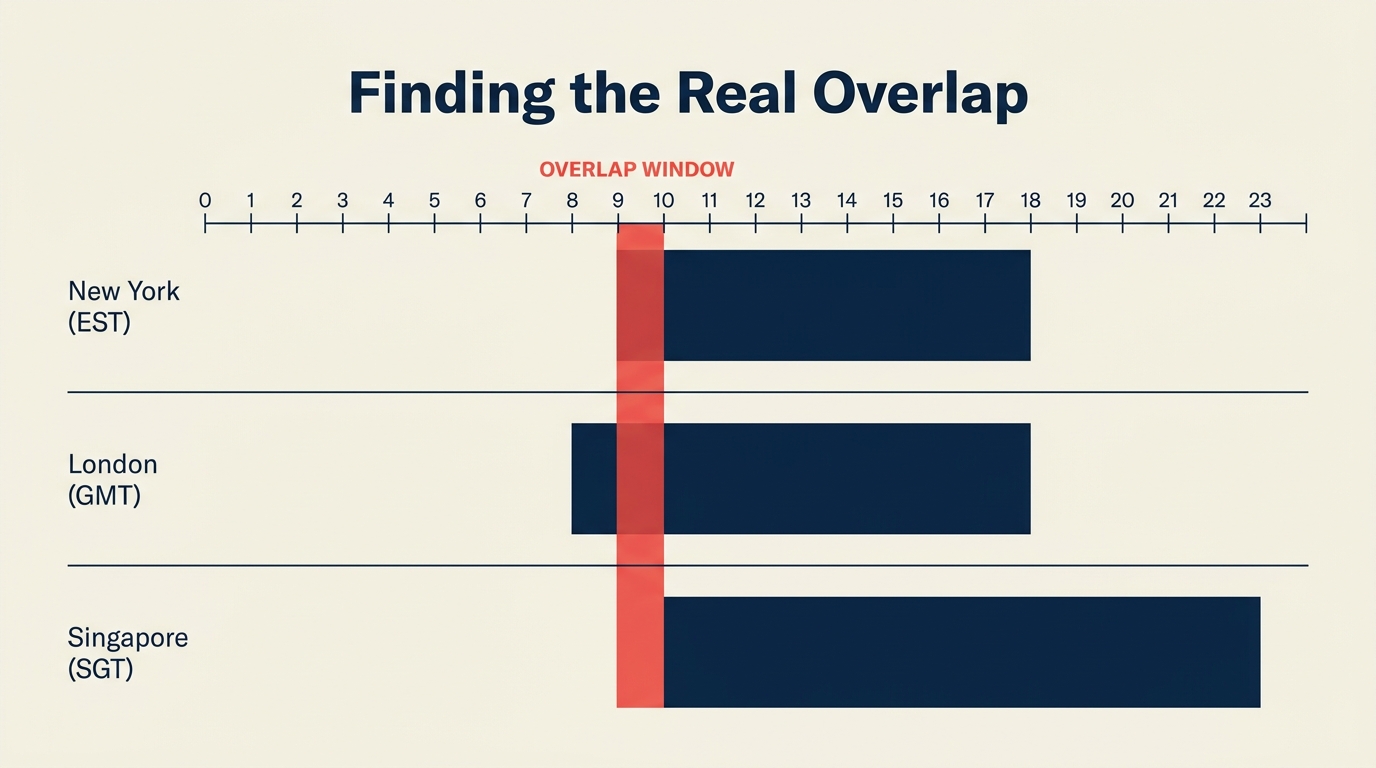
But here's what most managers discover too late: when you actually map the overlap, the real shared window where everyone can be synchronous at the same time is often two hours or less. London-New York overlap before 6 p.m. is maybe four hours. Singapore-New York is roughly zero for any reasonable working day. Singapore-London gives you a brief window in the early Singapore afternoon if London is willing to start at 7 a.m.
Two hours. On a good day.
If your operating system assumes team members are broadly reachable during the workday, a two-hour overlap window breaks it. Decisions that require real-time input become half-day blockers. Stand-ups require someone to take the early or late slot permanently. And the most engaged members of your team start working split schedules to cover the gap, until they burn out or leave.
Post-pandemic hiring made timezone sprawl the organizational default. Most teams hired globally for talent density and flexibility, and never updated their operating norms. The result is a team that operates with geographic diversity but communication assumptions built for co-location. Gartner research on hybrid workforce management found that by 2024, over 60% of knowledge-work organizations had team members spanning three or more time zones, yet fewer than 20% had formal operating norms designed for that configuration. This guide is about fixing that mismatch deliberately. It's also a key reason why onboarding new hires to your ways of working matters so much — distributed new hires can't absorb culture through proximity.
Start By Mapping the Real Overlap

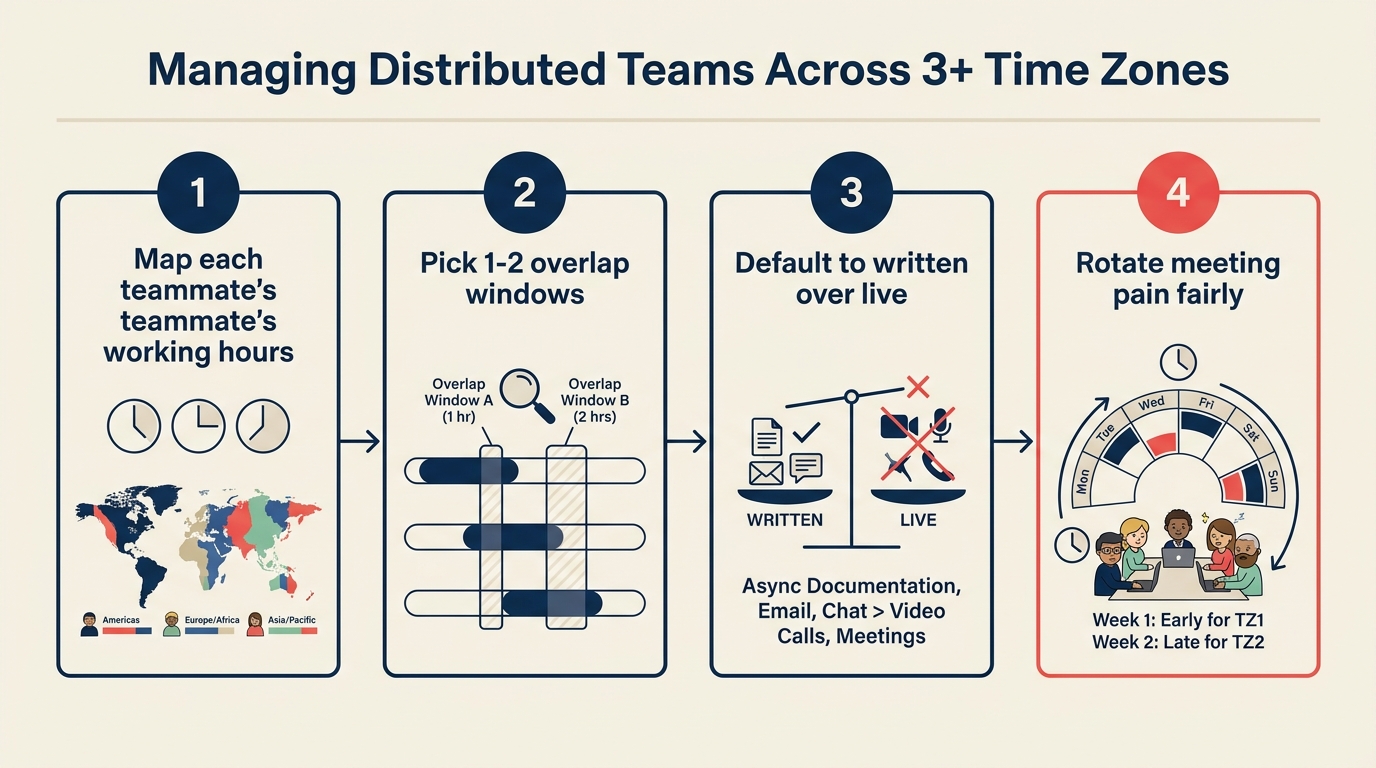
Before you can redesign your team's operating system, you need to know what you're actually working with. Most managers have a rough sense of where their people are but haven't done the math on the real overlap.
Do it now. Put every team member's timezone on a map and calculate the window where at least half the team is in working hours simultaneously. Don't use the standard "9 to 5." Use each person's actual stated working hours.
What you'll often find:
- The overlap is shorter than assumed
- One or two people are consistently at the extreme ends (very early or very late)
- The "core" overlap window is driven by 2-3 people's preferences rather than a team agreement
This map is the foundation for everything else. Protect the overlap window. It's the team's scarcest resource. Don't fill it with status updates.
The Core Principle: Reserve Overlap for Decisions
This is the operating principle that changes everything: synchronous time is for decisions and unblocking. Everything else is async.
Most multi-timezone teams do the opposite. They use their overlap window for stand-ups (which are mostly status), team updates (which should be written), and informational meetings (which could be a doc). By the time a real decision needs real-time discussion, there's no shared time left.
Flip the allocation:
Reserve overlap window for:
- Decisions that require discussion and buy-in
- Unblocking: resolving dependencies and cross-team blockers
- Relationship maintenance: the calls and conversations that build trust and psychological safety, especially for newer team members
- True escalations: situations that require real-time judgment
Move to async everything that doesn't need real-time:
- Status updates (written in a shared doc or channel)
- FYI information that doesn't require a response
- Reviews and feedback that can be done with comments
- Anything that could be a Loom recording instead of a meeting
When you free the overlap window from status theater and informational meetings, you have room for the conversations that actually benefit from everyone being in the room at the same time.
Building the Distributed Operating System
Step 1: Map the Overlap and Protect It
Once you've done the overlap calculation, get the whole team to agree on the protected window. Post it publicly. Block it on the team calendar for synchronous-eligible work.
Then protect it from erosion. The most common way multi-timezone teams lose their overlap window is through gradual meeting creep: a new stakeholder needs a regular sync, a partner team wants a weekly update call, someone schedules a standup during the window. Once the window is full of low-value synchronous time, it can't serve the high-value function you've carved it out for.
The no-meeting day principle applies here at the window level: the team overlap window is not available for routine recurring meetings. Routine meetings get scheduled outside the overlap, with the relevant subset of the team.
Step 2: Build Handoff Docs Into Every Task
In a co-located team, a verbal handoff takes 90 seconds. "I finished this part, it's ready for you to pick up, here's where I left it." In a distributed team, you don't share hallways. Your Singapore engineer finishing their working day at 6 p.m. can't brief the London engineer who starts at 8 a.m.
A handoff doc fills that gap. It doesn't have to be elaborate. For most tasks, three elements are enough:
What's done: What state is the work in? Where does the next person pick it up?
What's next: What's the immediate next action? What needs to happen before this can move forward?
What's blocked: Is there anything preventing progress? What does the next person need to know about dependencies or risks?
This can be as short as three bullet points in a task comment. The discipline of writing it consistently is more important than the format.
Make handoff docs a team norm, not a best practice. Include it in your team operating agreement: every task that passes between people across timezone boundaries gets a handoff doc. No exceptions.
Step 3: Set Response-Time SLAs by Channel
The biggest anxiety driver in distributed teams is response-time ambiguity. A Slack message sent at 9 a.m. EST might not be seen until 3 p.m. EST when the Singapore team member's day starts. Is that acceptable? Or should the sender be worried?
Without clear response-time expectations, two bad things happen. First, the sender escalates prematurely, sending a follow-up message or pulling someone into a call because there was no response in two hours. Second, the receiver feels constant background pressure to check messages outside their working hours "just in case."
Set explicit SLAs by channel:
| Channel | Expected Response Time | Notes |
|---|---|---|
| Slack / Teams (DM) | Within 4 working hours | Not real-time. Senders should not expect immediate responses. |
| Slack / Teams (channel) | By end of your working day | Same-day visibility, next-day response acceptable |
| Within 24 working hours | Not urgent by default | |
| Doc comment | Within 48 working hours | Review cycle, not real-time |
| Marked [URGENT] | Within 1 working hour | Use sparingly — only true blockers |
Post these SLAs in your team operating agreement and point new members to them in onboarding. When someone sends a message and doesn't hear back in two hours, the response is: "Check our SLA table. Four working hours is the expectation for direct messages."
This also protects team members from the ambient pressure to be always-on. If the SLA says 4 hours, nobody can reasonably expect a response in 20 minutes. The policy creates the social permission to be unreachable for a few hours without anxiety. Harvard Business Review research on "always-on" culture found that employees without clear response-time norms report significantly higher burnout rates and are 1.4x more likely to leave within 18 months than those on teams with explicit async expectations.
Step 4: Rotate Meeting Times Quarterly
One of the most demoralizing patterns in distributed teams is the permanent inconvenience of the same timezone. The Singapore team member who always takes the 8 p.m. call. The London member who always joins the 6 a.m. standup. After six months, they've absorbed hundreds of hours of off-hours work that their colleagues haven't.
Rotating meeting times doesn't eliminate the inconvenience, but it distributes it fairly. If your recurring team call rotates between slots that favor different timezones each quarter, everyone takes the bad slot eventually, and nobody has to take it permanently.
Common approaches:
- Rotate the weekly sync time quarterly between three slots that roughly serve three different timezone clusters
- Alternate the standup between two slots that split the team's timezone spread
- Explicitly track who took the "bad slot" last time and rotate away from them next
This requires slightly more logistics than picking one permanent time. But the fairness it signals is worth it. Team members who see that the inconvenience is shared are significantly more willing to absorb it than those who perceive it as systematically falling on them.
Step 5: Default to Async for Non-Urgent Decisions
In a distributed team, the cost of an async decision is waiting until the next overlap window. That's a delay of hours to half a day for most timezones. That sounds like a drag on velocity, but it's far less than what teams lose to "always on" burnout and the decision quality degradation that comes from poor synchronous decision-making.
Async decision-making works well when:
- The decision is documented clearly (not just a Slack thread)
- The options and recommendation are stated explicitly
- A deadline is given (default: respond by end of your next working day)
- The decision is captured in a record that doesn't disappear
Your decision logs practice is the infrastructure for async decisions. When a decision needs to be made, the proposer drafts a short doc: here's the situation, here are the options, here's my recommendation, here's the deadline for input. Stakeholders comment asynchronously. The DRI makes the call at the deadline.
This process handles 70-80% of decisions that teams currently force into real-time synchronous meetings because there's no trusted async alternative.
The Handoff Doc Template
Here's a format you can drop into any task management tool or doc:
Handoff: [Task Name] [Your name] → [Next person's name] | [Your timezone] end of day [date]
What's done: [State of the work when you're handing off]
What's next: [Specific next action the recipient should take]
What's blocked: [Any dependencies, risks, or things the recipient needs to know about]
Where to find the work: [Link to file, branch, design, document]
Questions for me: [Anything the recipient might need clarification on — answer preemptively if possible]
Response SLA Communication Template
Here's a message you can send to your team when establishing channel SLAs:
"We're updating our communication norms to support how we actually work across timezones. Here's what to expect from each channel:
- Slack DMs: 4 working hours (not real-time)
- Slack channels: By end of your working day
- Email: Within 24 working hours
- Doc comments: Within 48 working hours
- [URGENT] tag: Within 1 working hour (reserved for true blockers)
If something is genuinely urgent, mark it clearly. For everything else, these SLAs are the expectation. You don't need to respond immediately to messages outside these timeframes, even if you see them outside your working hours."
Common Pitfalls
Defaulting to the HQ timezone. When the company's main office is in New York, "working hours" means New York working hours by default. Every meeting is scheduled in EST. Every "just hop on a quick call" is timed for EST convenience. Over time, the distributed team learns that their needs are secondary. Fight this explicitly. Timezone fairness requires active management, not just good intentions.
Assuming async tools fix culture problems. Slack and Notion don't make a team async. Teams make themselves async by agreeing on norms and then holding each other to them. A tool-first approach ("we added Loom, so now we're async") misses the agreements that actually change behavior.
Requiring real-time participation for non-urgent decisions. Every time you schedule a meeting for a decision that could have been a doc comment, you're paying a timezone tax. The London member takes a 7 p.m. call. The Singapore member joins at 6 a.m. The decision takes 20 minutes. Multiply that across every "quick check-in" in a year and you've extracted hundreds of hours of off-hours participation for no reason.
Not accounting for cultural communication differences. Timezone is the most visible distributed team challenge, but cultural communication norms are often more significant. Some team members will be direct and brief in async writing; others will interpret that as cold or curt. Some will hesitate to push back on proposals in written form where the response is permanent. Building explicit norms around communication style, especially around how disagreement is expressed in writing, prevents a lot of misread intent. Deloitte research on inclusive global teams found that communication-style mismatches — not timezone gaps — are the primary driver of trust breakdowns in globally distributed teams.
Optimizing the tool stack instead of the norms. Adding a new communication tool is visible, feels like progress, and doesn't require the awkward conversation about behavioral change. But the fifth communication channel your team uses is never the problem. The norms are the problem.
Connecting to Your Broader Operating System
Distributed team management intersects most directly with your async communication guide, which covers the full framework for deciding when to sync versus when to write. The channel-by-channel guidance in that playbook gives your distributed team a complete vocabulary for how to route work communication.
The team operating agreement is where the distributed team's norms live in a permanent, documented form. When a new team member joins and asks "how does this team work across timezones?", the answer shouldn't be "ask around." It should be a link to the operating agreement.
Measuring Whether It's Working
After-hours message volume per team member. Most communication tools can show you when messages are sent and whether they're sent outside someone's stated working hours. A team with healthy async norms has low after-hours message volume, not because people are less engaged, but because they've moved communication into their working day. Research on why meeting-heavy teams face higher attrition shows the same burnout signal in synchronous overload — the mechanism is identical.
Cross-timezone blocker resolution time. How long does it take for a blocker that surfaces in Singapore to be resolved by a team member in London? Track this as a leading indicator of how well your handoff docs and async decision processes are working. If the average is more than 24 hours, something in the handoff process is broken. McKinsey's research on organizational speed identifies cross-functional blocker resolution time as one of the most actionable indicators of organizational agility — teams that measure and improve it consistently show 15-25% better time-to-delivery over 12 months.
Qualitative check: who's taking the bad slot? Ask the team directly, quarterly: "Do you feel like timezone inconvenience is distributed fairly? Is anyone consistently taking the early/late slots?" This can't be fully captured in quantitative data, but it surfaces the fairness perception that drives long-term engagement and retention.
The Overlap Window Is Your Asset
Two hours of real overlap time (or whatever your team's actual window is) sounds like a constraint. But when you protect it for the right work, it's actually an asset. It's the time when the team can move at its fastest: decisions in real-time, blockers unblocked, relationships maintained.
The mistake is treating the overlap window as the default slot for everything. When you fill it with status meetings and informational briefings, you've used your scarcest resource on the cheapest work. Reserve it for what actually requires real-time human judgment.
Build the async infrastructure (the handoff docs, the SLA tables, the decision log process) and you'll find that the overlap window becomes genuinely productive because it's no longer doing the work that async handles better.
Learn More: Explore the full Team Productivity Playbook for more guides on running distributed, async-first teams that deliver consistently. Related reads: weekly status updates without the theater, focus blocks at the team level, and building AI team readiness across remote teams.

Principal Product Marketing Strategist
On this page
- Start By Mapping the Real Overlap
- The Core Principle: Reserve Overlap for Decisions
- Building the Distributed Operating System
- Step 1: Map the Overlap and Protect It
- Step 2: Build Handoff Docs Into Every Task
- Step 3: Set Response-Time SLAs by Channel
- Step 4: Rotate Meeting Times Quarterly
- Step 5: Default to Async for Non-Urgent Decisions
- The Handoff Doc Template
- Response SLA Communication Template
- Common Pitfalls
- Connecting to Your Broader Operating System
- Measuring Whether It's Working
- The Overlap Window Is Your Asset