Customer Onboarding Mastery: The First 30 Days That Make or Break NRR
Turn this article into takeaways for your work.


Each assistant summarizes the article only for you and suggests best practices for your work.
Key Onboarding Numbers
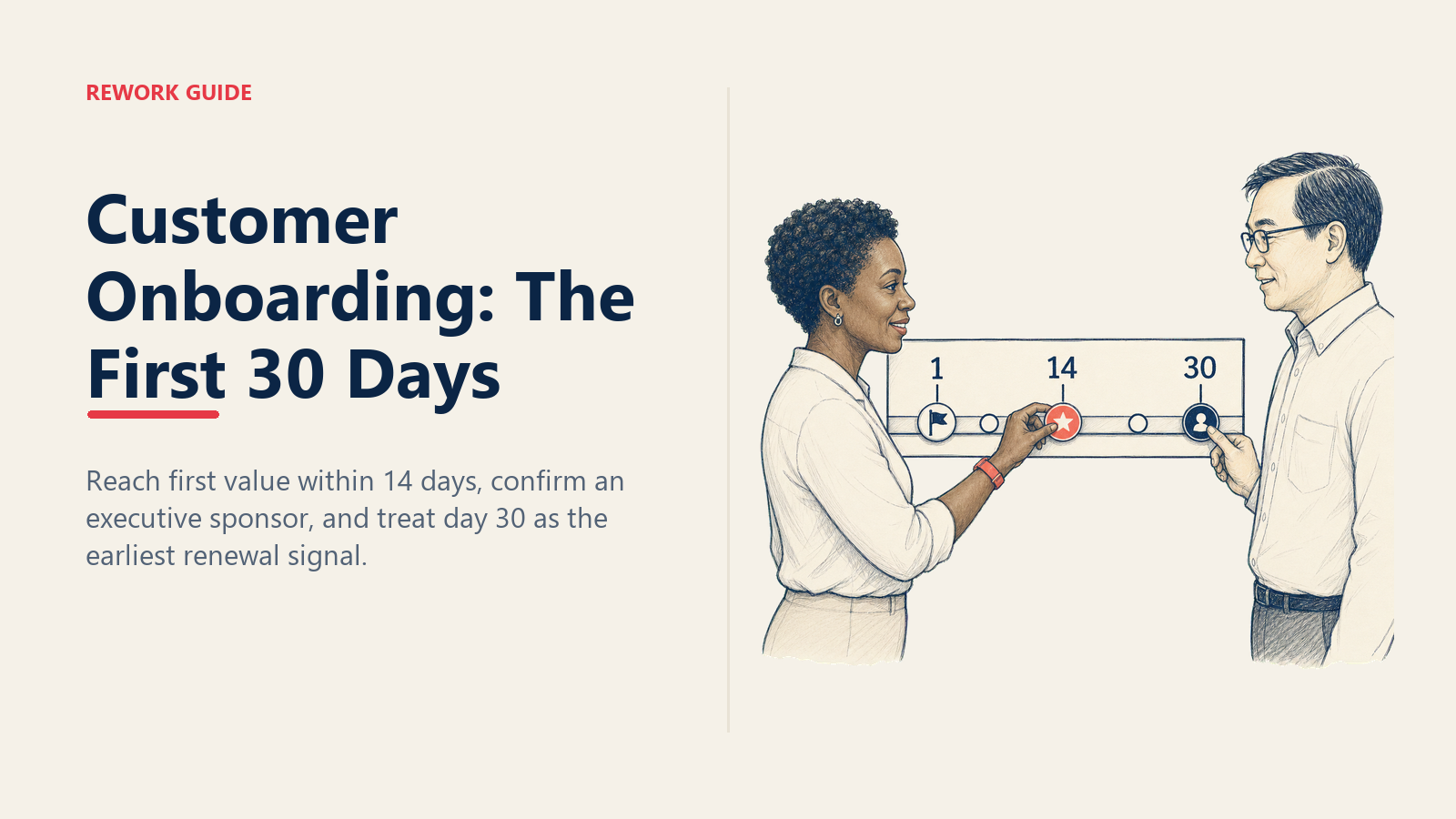
- Day-30 product adoption is the strongest single predictor of B2B SaaS renewal: across most published cohort data, customers who hit a defined first-value milestone in 30 days renew at 2-3x the rate of those who don't.
- Time-to-first-value (TTFV) of 14 days or less correlates with materially higher 12-month NRR than TTFV of 45+ days, even when the eventual outcome is identical.
- Customers without a confirmed executive sponsor by day 30 churn at roughly 2x the rate of customers with one, regardless of usage.
- The "month 11 renewal risk" alert is almost always a month 1 problem that nobody flagged because the customer was technically onboarded.
- Benchmark kickoff cadence: kickoff within 5 business days of contract signature, not 15.
It's Friday afternoon. You open your inbox and there it is: the renewal-risk alert. Account ABC, contract expires in 30 days, health score 42, sponsor unresponsive for six weeks, usage flatlined since February. You pull up the account history and start working backward.
Month 10 looks fine. Month 8 looks fine. Month 6 looks fine. You keep scrolling. Month 2, the sponsor was still on the QBR. Month 1, the sponsor came to the kickoff. So when did this go wrong?
Then you find it. Week 2 of onboarding. The implementation went live. The customer's team got provisioned. There's a Slack message from the CSM saying "you're all set!" And there's nothing. No value-confirmation moment, no first success metric, no sponsor email saying "we did the thing we bought this for." Just provisioned, then crickets.
That's the autopsy. The customer died in week 2. They just stayed on payroll until month 11.
This is the playbook for not letting that happen. The first 30 days aren't onboarding. They're the renewal conversation, just early. Every week you finish without a value-confirmation moment is a week the renewal probability decays, quietly, in a column nobody's looking at yet.
Why Month 1 Decides NRR (Not Month 11)
Renewal conversations feel like the moment the deal happens, but they're not. They're the moment the deal clears. The deal happens, or doesn't, in the first 30 days, when the customer either confirms out loud "yes, this worked" or quietly decides "we'll see how it goes."
The data is consistent across every B2B SaaS dataset that's been published. Day-30 product adoption is the single best predictor of renewal. Customers who hit a defined first-value milestone in their first 30 days renew at materially higher rates (often 2-3x) than customers who don't. The CFO will tell you NRR is a function of pricing, expansion, and churn. The CSM knows it's a function of whether week 2 had a value-confirmation moment.
This is why "we got you provisioned!" is the most dangerous sentence in customer success. Provisioned isn't onboarded. Onboarded isn't value-confirmed. And value-confirmed is the only state that predicts renewal. (For the renewal-side metrics that actually move with month-1 work, see CSM Metrics That Matter: NRR, GRR, Health Scores.)
Your job in the first 30 days isn't to make the customer happy. It's to manufacture, deliberately, the moment when the executive sponsor says, in writing, to someone who matters internally, that this thing is working.
Week 1: Kickoff and Value Confirmation
Your week-1 job is to pin down the one outcome the customer bought for, get it in writing, and confirm the executive sponsor agrees with the buyer's definition.
Kickoff in the first 5 business days. Not the first 15. Speed signals seriousness. A kickoff scheduled three weeks out tells the customer this isn't urgent, and they'll match your energy. Block the calendar before the contract is even countersigned.
The kickoff is outcome-first, not feature-first. Most kickoffs walk through the product. That's a demo with extra steps. A real kickoff opens with one question: "If we're sitting here in 90 days and this has worked, what's different about your business?" Then you shut up and listen.
The answer you're looking for is specific and measurable. Not "we'll be more efficient." Not "the team will be happier." Something like: "We'll have cut our average response time on inbound leads from 4 hours to 30 minutes, and the SDR team will be working from one queue instead of three." That's an outcome. That's something you can confirm, in writing, six months from now.
Get it in writing in the kickoff deck. Read it back. Have the sponsor say "yes, that's right" on camera. If the sponsor isn't on the kickoff, you don't have a kickoff. You have a working session.
Kickoff Agenda (45 minutes, outcome-first)
| Time | Block | What happens |
|---|---|---|
| 0:00–0:05 | Introductions | CSM, sponsor, project lead, technical owner. Names, roles, and what each person needs out of this engagement. |
| 0:05–0:15 | Outcome confirmation | "What's different about your business in 90 days?" Sponsor articulates. CSM writes it on the slide live. Sponsor confirms. |
| 0:15–0:25 | Success metric definition | What's the leading indicator we'll measure weekly? Where is it instrumented? Who sees the dashboard? |
| 0:25–0:35 | Power-user identification | Name the 2-3 people who will drive daily usage. Get calendar holds for their training in week 3. |
| 0:35–0:42 | 30-day milestones | Walk the week-by-week plan. Sponsor agrees to be on the day-30 review. |
| 0:42–0:45 | Written success definition | Read the outcome and metric back, confirm in writing, send the deck within 24 hours. |
End the kickoff with a written success definition the sponsor has acknowledged. That document is the spine of the rest of the engagement. Every QBR, every business review, every renewal conversation references back to it. (For how to make those QBRs land later, QBRs Customers Look Forward To is the companion read.)
Week 2: Implementation Against the Outcome
Week 2 is where most onboardings quietly die. The technical team gets the customer "set up." The full product surface area gets configured. The customer thinks they're done. The CSM thinks they're done. Nobody has actually confirmed that the outcome is reachable from this configuration.
Stand up implementation against the outcome, not the feature list. If the outcome is "cut inbound lead response time to 30 minutes," then implementation week is about routing, alerting, and the queue the SDR team works from. It's not about configuring custom fields the sponsor mentioned in passing. Cut everything that doesn't directly serve the outcome and revisit it post-renewal.
Define and instrument the first success metric. This is the leading indicator of the outcome. If the outcome is "30-minute response time," the leading indicator might be "median time-to-first-touch on inbound leads." It needs a dashboard. It needs to be visible to the sponsor without the sponsor having to log in. Email it weekly.
End week 2 with one piece of evidence. A screenshot, a chart, a number, something the customer can show their boss. Not "we configured your account." Something like: "Last week your median time-to-first-touch was 2 hours 14 minutes. The week before launch it was 4 hours 31 minutes. Here's the trend." That screenshot is the value-confirmation moment in seed form.
If you can't produce that screenshot at the end of week 2, you have a problem. Not a small one. Stop and re-scope before week 3 begins.
Week 3: Power-User Training
Adoption is a power-user problem, not a population problem.
Train the 2-3 people who will actually drive daily usage, not the 20 people on the email distribution. The 20 will follow the 2-3. The 2-3 will not follow the 20. Picking them is a decision, not a courtesy. They should be the people whose daily workflow most depends on the outcome: the SDRs whose pipeline runs through the new tool, not the VP who'll see the dashboard quarterly.
Verify they actually use it. A trained power user is not a power user. A power user is someone who logged in three times this week and completed a real workflow without asking for help. Confirm logins. Confirm workflow completion. Confirm they know who to ping when stuck, and that "who to ping" is a real human with a Slack handle, not "submit a ticket."
Build a small internal feedback loop. Tell the power users: "If anything in your workflow breaks or feels harder than it should, message me directly that day. Don't wait for our weekly check-in." Most onboarding fails because the friction shows up on Tuesday and nobody hears about it until Friday's call, by which point the user has already routed around the problem and convinced themselves the tool doesn't work for their use case.
By end of week 3 you should be able to name three specific workflows three specific people are running, and produce evidence (screenshot, dashboard, log) that they ran them this week. (For the day-to-day rhythm that supports this, see A Day in the Life of a CSM.)
Week 4: Success Documentation and the 90-Day Plan
Week 4 is when you manufacture the value-confirmation moment, in writing, for an audience that matters internally to the customer.
Document what the customer achieved in 30 days. A one-page document. The outcome they bought for, the metric you committed to, where the metric is now versus where it was at signature, who used the product, what's working, what's still in flight. Send it to the sponsor. Send it before the day-30 call, not during it.
Co-build the 90-day plan in the day-30 call. What's the next milestone, what does month 2 look like, what's month 3, who owns each piece. End the call with a shared document that has the next three milestones with dates and owners. Don't end onboarding. Extend it into a roadmap.
Trigger the day-30 success email, but the CSM doesn't send it. This is the move most CSMs miss. The success email is most powerful when it comes from the sponsor's manager, not from you. You draft it. You send it to the sponsor. The sponsor forwards it (lightly edited) to their boss. That's an internal credibility transfer the sponsor benefits from, the boss notices, and the renewal conversation in month 11 leans on.
Day-30 Success Email Template (sponsor → sponsor's manager)
Subject: 30-day update on the {Vendor} rollout, early wins

Hi {Manager},

Quick update on where we are 30 days into the {Vendor} rollout.

Goal we set at kickoff: {one-line outcome, e.g., "cut median
inbound lead response time from 4 hours to 30 minutes"}.

Where we are at day 30:
- {Metric}: {start} → {now} ({% change}). Target by day 90: {target}.
- {N} power users on the {team} are running {workflow} daily.
- {One concrete artifact, e.g., "the SDR team is now working from a
  single queue, which has eliminated the duplicate-touch issue we
  flagged in Q3."}

What's next (90-day plan, co-built with their CS team):
- Month 2: {milestone + owner}
- Month 3: {milestone + owner}

Happy to walk through any of this on Friday. Forwarding the day-30
review deck below for reference.

- {Sponsor}
The sponsor isn't writing a glowing review. They're reporting on a project they own. The email is structured so the sponsor looks competent for the rollout, which means the sponsor wants to send it. Make it easy. Make it accurate. Make it specific.
The Onboarding Scorecard
Onboarding is binary, not directional. Either the box is checked or it isn't. "Mostly onboarded" is the same as "not onboarded" from a renewal-prediction standpoint.
| Milestone | Done = | Status at day 30 |
|---|---|---|
| Sponsor confirmed | Sponsor on kickoff, agreed to outcome in writing, attended day-30 review | ☐ Yes ☐ No |
| Outcome defined | One-sentence business outcome, written, sponsor-acknowledged | ☐ Yes ☐ No |
| Success metric instrumented | Leading indicator metric, dashboarded, visible to sponsor without login | ☐ Yes ☐ No |
| Power users trained | 2-3 named users, confirmed logins, confirmed workflow completion | ☐ Yes ☐ No |
| Day-30 evidence produced | One artifact (chart, screenshot, number) showing movement on the metric | ☐ Yes ☐ No |
| 90-day plan signed | Co-built doc, three milestones, owners and dates, sponsor agreed | ☐ Yes ☐ No |
| Day-30 success email sent | Drafted by CSM, sent by sponsor to sponsor's manager | ☐ Yes ☐ No |
Six of seven isn't passing. If any box is unchecked at day 30, that's a renewal-risk flag that needs a name on it and a recovery plan. Don't move the customer to "steady state" with open boxes. The boxes don't close themselves; they get forgotten, and forgotten boxes are the silent churn signal you'll find in the autopsy 10 months later.
Common Pitfalls That Kill NRR Before Month 2
Treating onboarding as setup-only. "We got you provisioned!" is not onboarding. It's the start of onboarding. If the only thing you've delivered by week 4 is a configured account, you've delivered nothing the renewal will reference.
No explicit value-confirmation moment. The customer never says, out loud, on the record, that this thing worked. Without that moment, every health-score signal afterward is interpretation. With that moment, every health-score signal afterward has a baseline to compare against.
No executive sponsor, or a sponsor who hasn't seen evidence. The sponsor is the person who carries the renewal internally. If they haven't seen a screenshot by day 30, they have nothing to defend the line item with when finance asks.
Training the wrong people. Training 20 people instead of the 2-3 power users feels democratic but produces zero adoption. Adoption is carried by people whose daily workflow depends on the tool, not people who got an invite.
Letting onboarding drift past 30 days. "The customer isn't ready" is sometimes true and almost always a silent churn signal. Drift means something is blocked that nobody is naming. Either the sponsor is gone, the outcome is wrong, or the customer's internal politics killed the project. All three are renewal risks. Don't let drift hide them.
Measuring Onboarding (And Why TTFV Is the Number That Matters)
Three numbers. That's it. If you can't produce all three for every customer at day 30, your onboarding program isn't measurable.
Time-to-first-value (TTFV) = days from contract signature to confirmed first success metric movement. Target varies by product. The number is less important than the fact that you have one. Cohort customers by TTFV bucket (0-14 days, 15-30, 31-60, 61+) and watch their 12-month NRR diverge. The pattern is consistent enough across SaaS that you can use TTFV as a leading indicator for renewal forecasting.
Day-30 adoption rate = % of named power users with confirmed active usage at day 30. Active usage = logged in 3+ days that week, completed at least one defined workflow, no open critical support ticket. Target should be 100%, because the denominator is the 2-3 people you handpicked. If two out of three named power users aren't active at day 30, the engagement is in trouble regardless of what the sponsor said on the kickoff.
Day-90 health score = composite of usage trend, sponsor engagement (responses to email within 5 business days, attendance at scheduled reviews), and stated outcome progress. Day-90 health score is the single most predictive number for the renewal nine months later. Customers with day-90 health scores in the top quartile renew at materially higher rates than the bottom quartile, even when product usage looks similar on a feature-count basis.
These three numbers also create the natural baseline for expansion conversations later, because they document the value the customer is getting, in their own words and metrics, which is the only durable foundation for an upsell that doesn't feel like sales. (See Expansion and Upsell Without Becoming Sales for how that conversation actually goes.)
How Rework Supports the First 30 Days
CSMs running structured onboarding juggle four surfaces in parallel: the customer's outcome and metric, the implementation tasks and owners on both sides, the power-user training schedule, and the internal handoff back to AE/leadership at day 30. Most CSMs end up with the outcome in a Google Doc, tasks in a project tool, training in calendar invites, and the handoff in Slack DMs (four places that don't talk). Rework Work Ops gives you one surface for all four. Track the outcome and success metric on the customer record, manage implementation tasks with owners and dates so nothing promised at kickoff quietly falls off, schedule and confirm power-user training with attendance tracking, and run the day-30 review from the same workspace the AE handed off from. Work Ops (the Project Engine) starts at $99/month billed yearly with 5 seats included. For revenue teams that want CSM motions and AE pipeline in the same system, including renewal-risk dashboards built off the day-90 health score, Rework CRM (the Sales Engine) starts at $69/month billed yearly and shares the same data layer, so the customer's onboarding history is one click from the renewal opportunity.
What Comes After Day 30
You've manufactured the value-confirmation moment. The sponsor has the artifact. The metric is moving. The power users are using. The 90-day plan is signed. Day 30 wasn't the finish line. It was the foundation for the renewal conversation 11 months from now.
The next 60 days are about converting that foundation into a habit the customer's team can run without you. Month 2 is for expanding the workflow surface beyond the initial outcome. Month 3 is for the first formal business review, where the success email becomes a deck and the deck becomes the muscle memory of how this customer evaluates the relationship.
But none of that works if month 1 didn't. The customer who churns at month 11 didn't churn at month 11. They churned in week 2, the week the value-confirmation moment never happened. Don't let that be your customer's story.
Learn More

Principal Product Marketing Strategist
On this page
- Why Month 1 Decides NRR (Not Month 11)
- Week 1: Kickoff and Value Confirmation
- Kickoff Agenda (45 minutes, outcome-first)
- Week 2: Implementation Against the Outcome
- Week 3: Power-User Training
- Week 4: Success Documentation and the 90-Day Plan
- Day-30 Success Email Template (sponsor → sponsor's manager)
- The Onboarding Scorecard
- Common Pitfalls That Kill NRR Before Month 2
- Measuring Onboarding (And Why TTFV Is the Number That Matters)
- How Rework Supports the First 30 Days
- What Comes After Day 30
- Learn More