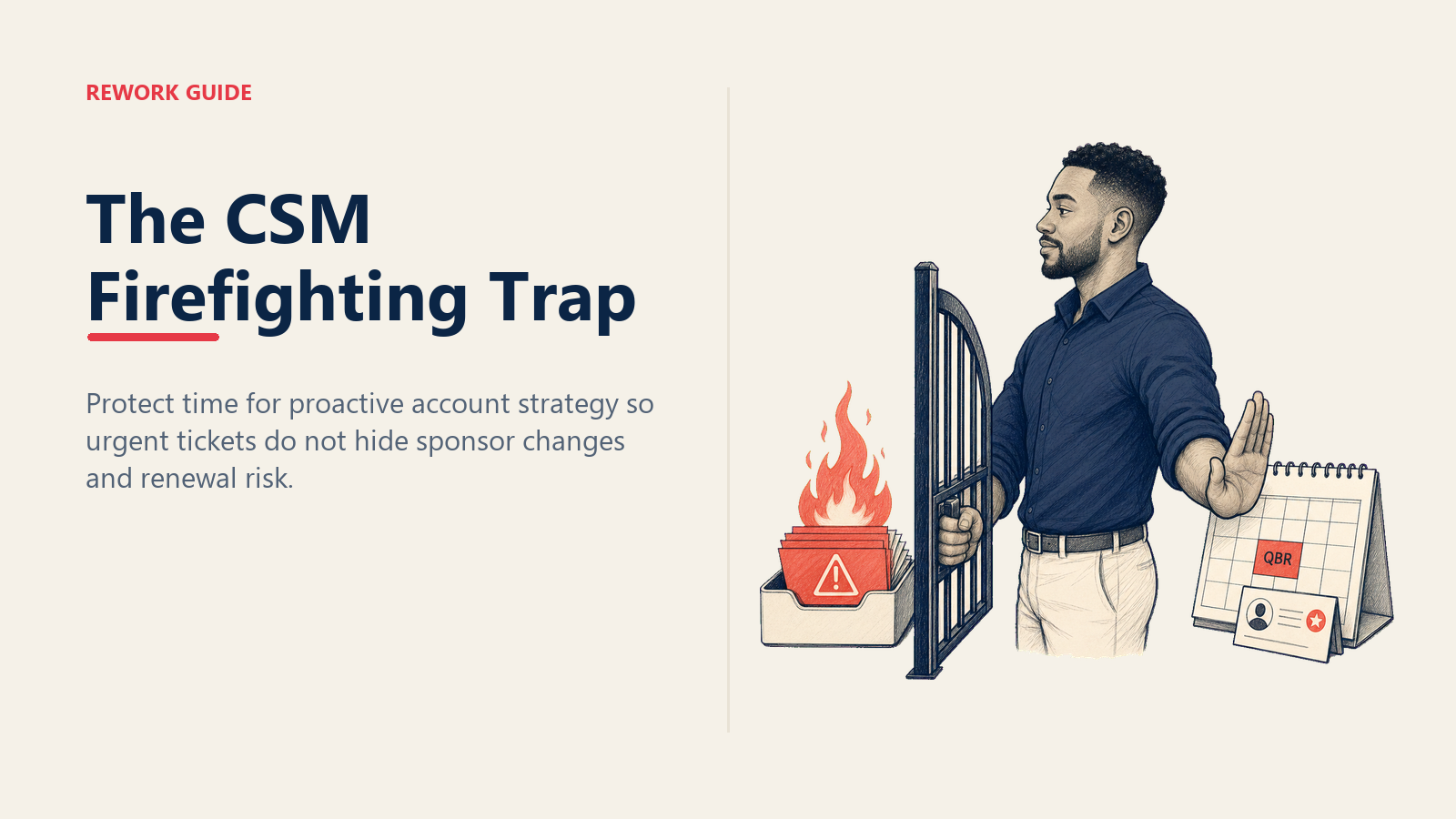
Common CSM Pitfalls: The Firefighting Trap
Turn this article into takeaways for your work.


Each assistant summarizes the article only for you and suggests best practices for your work.
I spent two years as the firefighter CSM. I answered tickets at 11pm. I jumped on every angry call within minutes. I had a reputation as "the responsive one." Account managers loved me, Support loved me, my manager loved me, because I was the easy hire to hand a panicking customer to.
Then renewal season came, and three of my top ten accounts churned in a six-week stretch. Not because of bugs. Not because of pricing. Because I hadn't run a real QBR with any of them in six months. I was so busy putting out fires that I never sat down with the executive sponsors, never noticed the new VP who'd quietly replaced my champion.
I was busy all day. I was losing the job.
If any of that sounds familiar, this article is for you. Not to shame you, but to give you a way out before renewal exposes the gap.
Why Firefighting Feels Like the Job (and Isn't)
Firefighting is comfortable because every ticket has a clear end state. Customer asks a question, you answer it, they say thanks, you close the loop. Dopamine hit. Repeat. By 6pm you can look back at fifty Slack threads and feel like you produced something.
Proactive work has no end state. There's no inbox that empties when you finish a QBR. No one pings you to say "great account plan." The work is invisible until renewal, and by then, if you didn't do it, the damage is already done.
Customers don't renew because you closed tickets fast. They renew because you helped them see value they couldn't see themselves. A point of view on their roadmap. A benchmark against their peers. An introduction to another customer solving the same problem. A check-in with their executive sponsor before that sponsor gets reorged out. None of those come through the support queue.
Here's the harder version: if a customer can't tell the difference between you and a fast support rep, you don't have a CSM role. You have an expensive ticket-closer role. And ticket-closers don't survive a budget cycle.
The Diagnostic Question
When you're not sure if you're firefighting or actually serving the customer, ask yourself this:
"If I'm 100% reactive, what does the customer want from me that they're not getting?"
The answer is almost always: a point of view, a roadmap, a benchmark, an introduction, a strategic check-in. None of those come through the support queue. Write the question on a sticky note. Put it on your monitor. Look at it before you accept the next "quick call" that wasn't on your calendar this morning.
We'll come back to this question at the end, because it's the single most useful test for whether your week was actually a CSM week or a glorified support shift.
The 7 Firefighting Pitfalls
These are the patterns I've seen on every team I've worked with, including, painfully, on myself. They look productive from the outside. They lose accounts on the inside.
Pitfall 1: Becoming the Support Escalation Queue
When you're the fastest path to a fix, every account routes everything through you. You answer the password reset because it's quicker than telling them to file a ticket. You triage the integration question because Support is "backed up." Three months later you're Tier 3 support with a CSM title.
The fix isn't being unhelpful. It's making your support team's queue the front door, not your DM. Your value isn't speed of resolution; it's strategic context the support team can't provide.
Pitfall 2: No Proactive Outreach Calendar
If your week is whatever lands in your inbox, you don't have a book of business. You have a queue. A real CSM has a calendar of QBRs, EBRs, account-plan reviews, and check-ins scheduled weeks in advance. Reactive work fills the gaps; it doesn't define the day.
Common tell: ask a struggling CSM what they're doing Thursday afternoon. If the answer is "depends what comes in," that's the diagnosis.
Pitfall 3: Treating QBRs as Optional
"The customer is too busy for a QBR" is almost always you projecting your own avoidance. QBRs are how renewal and expansion get won. They're where the executive sponsor sees the value, where the new VP gets oriented to your relationship, where you surface the use case that isn't live yet. Skipping QBRs is skipping the part of the job that protects revenue. See QBRs Customers Look Forward To for a structure customers actually want on their calendar.
Pitfall 4: Single-Threading the Relationship
One champion. One contact. One point of failure. When they leave (and they will), the account is a coin flip. Multi-threading isn't paranoia; it's basic risk management. Two named contacts on every A and B account, minimum.
Pitfall 5: No Expansion Conversations
You tell yourself "I'm not Sales." You're not. But you're the one who sees the usage gaps, the new teams adopting the product, the use case that's three steps from a bigger contract. If you don't surface those signals to the AE, no one does. The AE sees a renewal date and a usage report. You see the relationship. Expansion and Upsell Without Becoming Sales walks through how to do this without crossing the line.
Pitfall 6: Sandbagging Health Scores
Marking accounts "yellow" when they're red so the leadership dashboard looks calm. Telling yourself you'll fix it before the next review. Renewal day is not calm. The point of a health score is to surface risk early enough to act on it; sandbagging defers the conversation to the worst possible moment.
Pitfall 7: Hoarding Knowledge from Peers
Every CSM solving the same edge case alone. No shared playbook. No compounding learning. The answer to "how do you onboard a 200-seat enterprise?" should be a doc, not a Slack DM to whichever CSM did it last. If your team doesn't have a shared knowledge base, start one. A half-built one beats five private ones.
The Meta-Pitfall
The biggest pitfall is calling firefighting "doing your job." It's not. Reactive work is the floor; proactive work is the job. You'll always have tickets to answer, calls to take, escalations to manage. That doesn't make those things the work. That's the cost of doing the work. The work is the QBR you ran, the multi-threading you built, the expansion lead you surfaced, the at-risk account you saved at T-90 instead of T-7.
A note before the prescription: not all of this is on you. Bad product, missing CSOps tooling, a support team that punts everything upward, an AE org that won't take expansion leads. Those are real systemic problems and they make the trap deeper. Name them out loud to your manager. But don't use them as a reason to stay in the queue. The rest of this article is about what you, the individual CSM, control.
The Two-Week "Stop the Bleeding" Plan
If you recognized yourself in any of those pitfalls, here's a concrete two-week plan to climb out. It's not a permanent fix, but it's enough to break the pattern and prove to yourself that the proactive work is possible.
Week 1: Reroute and Reclaim
Monday. Audit yesterday and the past week. For every 30-minute block, label it P (proactive: outreach, QBR prep, EBR, expansion call, account plan) or R (reactive: tickets, escalations, ad-hoc questions). Don't judge. Count. Most firefighter CSMs land between 80–95% R. The number is the diagnosis.
Tuesday. Set up a template that routes incoming "quick question" DMs to your support queue. Wording: "Thanks for the message. For the fastest fix, please file this with [support email/portal]. I'll see it there and add context if needed. For strategic conversations, here's my Calendly: [link]." This is the single highest-leverage change in the plan.
Wednesday. Block four hours of proactive time on your calendar, every day, for the next two weeks. Label it: "Proactive, do not book." Treat it like a customer meeting. If a fire pulls you out, note which fire and ask whether it actually needed you.
Thursday. Identify your top five at-risk accounts. Not your biggest. Your at-risk. Use whatever signal you have: usage drop, champion change, support volume spike, late on payment, NPS dip. Write the list. This is your week-two work.
Friday. Tell your manager what you're doing. Use the script in the next section. Don't ask permission; tell them what you're prioritizing and why.
Week 2: Reach the Top 5
Monday. Schedule a QBR or strategic check-in with each of your top five at-risk accounts. Aim for the next 14 days. If a customer pushes back with "we're too busy," push back gently: "I want 30 minutes to walk through what we're seeing in your usage and a few things other customers in your space are doing. If after 30 minutes it's not useful, we won't do another one." Most will say yes.
Tuesday and Wednesday. Identify a second contact at each of those five accounts. Could be someone in a sister team, someone in a procurement role, someone the champion has cc'd before. Send a low-pressure intro: "I work with [champion] on the account and wanted to introduce myself directly. Here's what I'm seeing across your usage, happy to share more if useful."
Thursday. Pick one of the five accounts where you see an expansion signal: a new team adopting the product, a use case they've outgrown, a feature gap they keep mentioning. Surface it to the AE with a one-paragraph summary. You're not closing the deal; you're putting the ball in the right court.
Friday. Re-run the time audit from Monday of week one. You won't be at 50% proactive yet. But if you went from 90% reactive to 70% reactive, you've broken the pattern. The first 20 points are the hardest.
Reasonable target from here: 50% proactive within 60 days. That's not "answer no tickets." That's half your week on outreach, QBR prep, account plans, and expansion conversations: the work that determines next year's revenue.
The Manager 1:1 Reset Script
The conversation with your manager on Friday of week one is the linchpin. If your manager is still rewarding you for fast ticket times, the new pattern won't survive. Here's a verbatim template you can adapt.
"I want to talk about how I'm spending my time. I've looked at the last [X weeks/months] and roughly [percentage] of my hours have been reactive: tickets, escalations, ad-hoc questions. I've been the fastest fix and I think that's actually been hurting the book.
I've got [N] A-tier accounts and I haven't run a real QBR with [most/several] of them in [time period]. I think that's where the renewal risk is, not in the support queue.
Here's what I'd like to do for the next two weeks: route inbound 'quick questions' through Support's queue instead of my DMs, block four hours of proactive time per day, and run QBRs with my top five at-risk accounts.
The trade is that some short-term ticket response will get slower. I want to be upfront about that. I think it's worth it because [renewal/expansion outcome you're protecting], but I want to know if you see it differently before I make the change."
A few things about that script. First, you're not asking permission. You're telling them the trade you're making and inviting disagreement. Second, you're naming the cost honestly (slower ticket response) rather than pretending there isn't one. Third, you're tying the change to a business outcome they care about (renewal, expansion), not to your preference.
If your manager pushes back, listen. Sometimes there's a real reason: a customer in active escalation, a coverage gap on the team. And you adjust. Most of the time, though, managers will agree because they've been wanting the team to do this and didn't know how to ask.
What to Measure
Five metrics tell you whether the change is real. Track them weekly for the first 60 days.
- % of weekly time on proactive outreach. Target: 50%+ within 60 days. Use the same P/R audit you did in week one.
- QBR completion rate. Target: 100% of A-tier and B-tier accounts every quarter. Not "scheduled." Completed.
- Expansion conversations started per quarter. Target: at least one per A-tier account. Doesn't have to close. Just has to be surfaced to the AE with enough context to act on.
- Multi-threaded coverage. Target: 2+ named contacts on every A and B account. Track in your CRM. If you're missing the second contact, that's the next conversation.
- Health score accuracy at renewal. Red accounts at T-90 should match red accounts at renewal. No surprises. If you're still finding red accounts in the last week before renewal, the system upstream is broken.
The metrics that look like CSM work (tickets closed, response time, NPS) are not on this list on purpose. They're hygiene. They're not the job. CSM Metrics: NRR, GRR, and Health Scores walks through which numbers actually predict retention and which ones just feel like they should.
Coming Back to the Diagnostic
I told you we'd come back to it, so here it is again:
"If I'm 100% reactive, what does the customer want from me that they're not getting?"
If you can't answer that question for your top five accounts right now, you're firefighting. The answer for an A-tier account isn't "faster ticket response." It's "a roadmap conversation we haven't had in six months," "an introduction to the customer in their industry doing this better," "a benchmark on how their usage compares," "an EBR with the executive sponsor before he gets reorged out."
Those are the things you have to deliberately schedule, deliberately protect, and deliberately tell your manager you're prioritizing. They will never land in your inbox. No customer is going to ping you on Slack and say "hey, can you please give me a strategic point of view on my account?" That's why the work is invisible until renewal, and why renewal is when the work, or its absence, finally becomes visible.
For a sense of what a healthy CSM week actually looks like (proactive blocks, QBR cadence, support boundaries) see A Day in the Life of a CSM.
Climb out. Your renewal numbers next quarter will be the proof.

Principal Product Marketing Strategist
On this page
- Why Firefighting Feels Like the Job (and Isn't)
- The Diagnostic Question
- The 7 Firefighting Pitfalls
- Pitfall 1: Becoming the Support Escalation Queue
- Pitfall 2: No Proactive Outreach Calendar
- Pitfall 3: Treating QBRs as Optional
- Pitfall 4: Single-Threading the Relationship
- Pitfall 5: No Expansion Conversations
- Pitfall 6: Sandbagging Health Scores
- Pitfall 7: Hoarding Knowledge from Peers
- The Meta-Pitfall
- The Two-Week "Stop the Bleeding" Plan
- Week 1: Reroute and Reclaim
- Week 2: Reach the Top 5
- The Manager 1:1 Reset Script
- What to Measure
- Coming Back to the Diagnostic